


Community hub
Recent from talks
Contribute something
Nothing was collected or created yet.
Labrador City
View on Wikipedia
Labrador City is a town in western Labrador (part of the Canadian province of Newfoundland and Labrador), near the Quebec border.[3] With a population of 7,412 as of 2021, it is the second-largest population centre in Labrador, behind Happy Valley-Goose Bay. Neighbouring Labrador City is Wabush, a smaller town with a population of approximately 1,964 as of 2021.[4] Together, the "twin towns" are known as Labrador West.
Key Information


In the 1960s, Labrador City was founded to accommodate employees of the Iron Ore Company of Canada; iron ore mining continues to be the primary industry in the town.
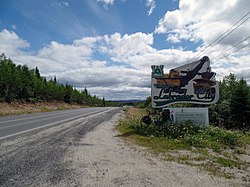
The Labrador City town motto is Kamistiatusset, a Naskapi word meaning "land of the hard-working people." The Labrador City town crest is that of a snowy owl holding a scroll atop a black spade on a mound of red earth. The symbol represents iron ore mining. The spade is flanked by two caribou. Both snowy owls and caribou are native to the Labrador City area.
Government
[edit]Since the 2025 election, the federal riding of Labrador seat has been held by Philip Earle, a Liberal Party member while Progressive Conservative Joseph Power has represented Labrador West in the provincial House of Assembly since 2025.[5][6]
Jordan Brown is currently the Mayor of Labrador City
Economy
[edit]Labrador City was built around the rich iron ore deposits of the Labrador Trough by the Iron Ore Company of Canada (IOC) in the 1960s. The Carol Project is the major iron ore mining operation for the area.[7] In 2008, IOC and their parent company Rio Tinto announced they would spend $800 million to develop additional mines in the region. However, only a few months after announcing the second phase of their expansion, the project was shelved due to the economic recession and low demand for steel.
The town is serviced by the Wabush Airport, and the airlines flying out of the airport are Provincial Airlines, Air Inuit and Pascan Aviation. Additionally, the Quebec North Shore and Labrador Railway provides freight rail transportation to and from Sept-Îles. The Trans-Labrador Highway (Route 500) serves as the only road connection to Labrador City, connecting it with the rest of Labrador as well as the neighbouring province of Quebec, becoming Quebec Route 389 at the border.
The town contains many amenities found in larger locations thanks to investments by the mining companies who established the area including an ice arena, curling, downhill & cross country ski clubs. The White wolf snowmobile club connects with a larger trail network across the region and is home to the Cain's Quest Snowmobile Endurance Race.
The main shopping mall in the town, the 22,940-square-metre (246,923 sq ft) Labrador Mall, includes a Walmart, Canadian Tire and Mark's.[8] The mall opened in 1978 and is the largest shopping mall in Labrador; it is also the only enclosed mall in Labrador.[9][10][11][12]
There is a Masonic lodge in Labrador City, Lodge Anik No 1707 of the District Grand Lodge of Newfoundland and Labrador of the Grand Lodge of Scotland.
Demographics
[edit]In the 2021 Census of Population conducted by Statistics Canada, Labrador City had a population of 7,412 living in 3,070 of its 3,368 total private dwellings, a change of 2.7% from its 2016 population of 7,220. With a land area of 34.11 km2 (13.17 sq mi), it had a population density of 217.3/km2 (562.8/sq mi) in 2021.[13]
| Canada 2016 Census | Population | % of Total Population | |
|---|---|---|---|
| Visible minority group Source:[14] |
South Asian | 25 | 0.3% |
| Chinese | 25 | 0.3% | |
| Filipino | 250 | 3.5% | |
| Arab | 1 | 0% | |
| Other visible minority | 10 | 0.1% | |
| Mixed visible minority | 10 | 0.1% | |
| Total visible minority population | 330 | 4.6% | |
| Aboriginal group Source:[15] |
First Nations | 170 | 2.4% |
| Métis | 295 | 4.1% | |
| Inuit | 125 | 1.7% | |
| Other Aboriginal | 30 | 0.4% | |
| Total Aboriginal population | 630 | 8.7% | |
| White | 6,230 | 86.3% | |
| Total population | 7,220 | 100% | |
Attractions
[edit]Climate
[edit] | This article needs to be updated. (February 2025) |
Wabush and Labrador City have a continental subarctic climate (Köppen: Dfc), with mild summers and severely cold winters.[16] Precipitation is heavy year round (although higher in summer) due to the strong Icelandic Low to the east driving cold, moist and unstable air onto the region. Snowfall, as is typical for the province, is very heavy for seven months each year and depths can reach as high as 218 centimetres (85.83 in). Despite its latitude around the same as cities like Berlin, London, and Amsterdam, its annual mean temperature is 13 °C (23 °F) colder.
| Climate data for Wabush Airport (1991–2020 normals, extremes 1960–present) | |||||||||||||
|---|---|---|---|---|---|---|---|---|---|---|---|---|---|
| Month | Jan | Feb | Mar | Apr | May | Jun | Jul | Aug | Sep | Oct | Nov | Dec | Year |
| Record high humidex | 7.7 | 5.9 | 14.6 | 16.9 | 35.0 | 37.1 | 39.0 | 35.3 | 32.2 | 22.6 | 13.8 | 7.1 | 39.0 |
| Record high °C (°F) | 8.0 (46.4) |
6.2 (43.2) |
14.7 (58.5) |
17.4 (63.3) |
28.8 (83.8) |
33.3 (91.9) |
32.6 (90.7) |
30.6 (87.1) |
29.5 (85.1) |
21.1 (70.0) |
12.2 (54.0) |
7.2 (45.0) |
33.3 (91.9) |
| Mean daily maximum °C (°F) | −16.2 (2.8) |
−14.3 (6.3) |
−6.8 (19.8) |
1.3 (34.3) |
9.8 (49.6) |
16.7 (62.1) |
19.6 (67.3) |
18.2 (64.8) |
12.4 (54.3) |
4.5 (40.1) |
−3.7 (25.3) |
−11.1 (12.0) |
2.5 (36.5) |
| Daily mean °C (°F) | −21.7 (−7.1) |
−20.6 (−5.1) |
−13.7 (7.3) |
−4.5 (23.9) |
4.1 (39.4) |
10.7 (51.3) |
14.1 (57.4) |
13.1 (55.6) |
7.8 (46.0) |
1.0 (33.8) |
−7.5 (18.5) |
−15.9 (3.4) |
−2.8 (27.0) |
| Mean daily minimum °C (°F) | −27.1 (−16.8) |
−26.9 (−16.4) |
−20.5 (−4.9) |
−10.2 (13.6) |
−1.6 (29.1) |
4.7 (40.5) |
8.2 (46.8) |
7.9 (46.2) |
3.2 (37.8) |
−2.4 (27.7) |
−11.3 (11.7) |
−20.7 (−5.3) |
−8.0 (17.6) |
| Record low °C (°F) | −44.1 (−47.4) |
−46.8 (−52.2) |
−41.6 (−42.9) |
−36.4 (−33.5) |
−13.4 (7.9) |
−6.9 (19.6) |
0.1 (32.2) |
−1.2 (29.8) |
−8.1 (17.4) |
−22.4 (−8.3) |
−33.6 (−28.5) |
−42.5 (−44.5) |
−46.8 (−52.2) |
| Record low wind chill | −62.8 | −58.2 | −52.6 | −43.4 | −32.6 | −11.8 | — | −6.2 | −13.9 | −28.1 | −43.9 | −59.5 | −62.8 |
| Average precipitation mm (inches) | 48.7 (1.92) |
38.1 (1.50) |
52.3 (2.06) |
47.9 (1.89) |
55.0 (2.17) |
88.7 (3.49) |
113.5 (4.47) |
119.9 (4.72) |
90.8 (3.57) |
80.6 (3.17) |
72.2 (2.84) |
52.5 (2.07) |
860.1 (33.86) |
| Average rainfall mm (inches) | 0.8 (0.03) |
1.8 (0.07) |
3.1 (0.12) |
11.8 (0.46) |
42.0 (1.65) |
85.7 (3.37) |
112.1 (4.41) |
119.6 (4.71) |
86.7 (3.41) |
45.1 (1.78) |
14.7 (0.58) |
3.6 (0.14) |
526.8 (20.74) |
| Average snowfall cm (inches) | 70.7 (27.8) |
56.7 (22.3) |
71.4 (28.1) |
47.7 (18.8) |
13.9 (5.5) |
1.2 (0.5) |
0.0 (0.0) |
0.3 (0.1) |
3.4 (1.3) |
38.9 (15.3) |
80.2 (31.6) |
74.8 (29.4) |
458.9 (180.7) |
| Average precipitation days (≥ 0.2 mm) | 18.1 | 14.0 | 14.7 | 14.0 | 15.3 | 17.4 | 19.3 | 20.7 | 20.3 | 21.1 | 20.8 | 18.5 | 214.1 |
| Average rainy days | 0.9 | 0.9 | 1.4 | 3.8 | 12.5 | 16.7 | 19.3 | 20.7 | 19.7 | 11.9 | 4.8 | 1.7 | 114.3 |
| Average snowy days (≥ 0.2 cm) | 19.6 | 15.4 | 16.2 | 12.7 | 9.3 | 0.91 | 0.05 | 0.05 | 2.0 | 13.5 | 20.8 | 20.7 | 128.0 |
| Average relative humidity (%) (at 15:00 LST) | 67.8 | 61.0 | 58.4 | 58.0 | 54.4 | 54.4 | 58.3 | 61.2 | 64.9 | 71.6 | 77.8 | 75.3 | 63.6 |
| Mean monthly sunshine hours | 98.0 | 132.2 | 151.3 | 180.1 | 210.6 | 212.5 | 218.0 | 202.7 | 116.6 | 75.4 | 56.9 | 67.3 | 1,721.4 |
| Percentage possible sunshine | 38.6 | 47.6 | 41.2 | 43.1 | 43.0 | 42.1 | 43.0 | 44.4 | 30.6 | 22.9 | 21.7 | 28.3 | 37.2 |
| Source: Environment Canada[17][18] | |||||||||||||
See also
[edit]- List of cities and towns in Newfoundland and Labrador
- Wabush, neighbouring twin town of Labrador City
- Fermont, nearest town in Quebec
Notable residents
[edit]Notable former residents of Labrador City include:
- Damhnait Doyle, singer-songwriter
- Margot Kidder, actress[19]
- Dan LaCosta, National Hockey League goaltender
- Pascal Pelletier, National Hockey League player
- Chad Penney, National Hockey League player
- Mark Nichols, 2006 Turin Olympics gold medallist curler
References
[edit]- ^ Council, retrieved Feb. 23, 2022
- ^ "Labrador City, Town [Census subdivision]". www12.statcan.gc.ca. Statistics Canafa. Retrieved 16 September 2019.
- ^ Labrador West. "Labrador City". Archived from the original on 2008-12-01. Retrieved 2008-03-13.
- ^ "Wabush, Town". www12.statcan.gc.ca. Statistics Canada. 8 February 2017. Retrieved 16 September 2019.
- ^ "Cabinet ministers Letto and Hawkins among 9 defeated Liberals". CBC News Newfoundland and Labrador, May 17, 2019.
- ^ "Here are all the MHAs elected in the Newfoundland and Labrador election". CBC News. March 27, 2021.
- ^ "Labrador West". Archived from the original on 2011-05-27. Retrieved 2009-04-15.
- ^ Page 2 | List of companies in Labrador City, Newfoundland Canada
- ^ History of Labrador City Archived 2014-06-06 at the Wayback Machine, LabradorWest.com, Retrieved February 7, 2011
- ^ "Labrador Mall - Labrador City - A Scoff an' Scuff". www.ascoffanscuff.com. Archived from the original on 29 September 2007. Retrieved 17 January 2022.
- ^ Labrador Mall Archived 2014-06-06 at the Wayback Machine, Westcliff.ca, Retrieved February 7, 2011
- ^ (22 November 2010). Concerns turn to action, The Aurora
- ^ "Population and dwelling counts: Canada, provinces and territories, census divisions and census subdivisions (municipalities), Newfoundland and Labrador". Statistics Canada. February 9, 2022. Retrieved March 15, 2022.
- ^ "Visible minority population". www12.statcan.gc.ca. Statistics Canada. Retrieved 16 September 2019.
- ^ "Aboriginal population". www.12.statcan.gc.ca. Statistics Canada. Retrieved 16 September 2019.
- ^ "Wabush, Newfoundland and Labrador Köppen Climate Classification (Weatherbase)". Weatherbase. Retrieved 2020-03-24.
- ^ "Canadian Climate Normals 1991–2020". Environment and Climate Change Canada. Retrieved March 21, 2025.
- ^ "Canadian Climate Normals 1981–2010". Environment and Climate Change Canada. Retrieved March 21, 2025.
- ^ Rothman, Clifford (November 19, 1997). "Back From The Brink". Los Angeles Times. Archived from the original on March 21, 2015.
External links
[edit] Media related to Labrador City at Wikimedia Commons
 Labrador City travel guide from Wikivoyage
- Labrador West website
- The Aurora newspaper (published by Transcontinental)
- Labrador City - Encyclopedia of Newfoundland and Labrador, vol. 3, p. 221-222.


| International | |
|---|---|
| National | |
| Geographic | |

Labrador City
View on GrokipediaHistory
Founding and Early Development
Labrador City was established in 1961 by the Iron Ore Company of Canada (IOC) as a planned company town to support iron ore mining operations in the Labrador Trough region.[8] The community, initially known as the Carol Project, was renamed Labrador City by Newfoundland Premier Joseph Smallwood in June 1961 and designed by the Ottawa-based firm Dineen with curvilinear streets and preserved natural taiga woodlands to attract settlers and workers.[8] As a company-owned settlement, it began as a temporary worker camp in 1960, focusing on housing and services essential for mining personnel.[9] An early population influx consisted of workers and families drawn from Newfoundland, Quebec, and other regions to build and operate the mines, leading to rapid growth in the 1960s.[2] By 1966, the population had reached 5,037 residents, reflecting the community's expansion alongside mining activities.[10] Initial infrastructure included single-story ranch houses, followed by two-story row houses and multi-story apartment blocks to accommodate families, as well as schools overseen by Newfoundland administrators that opened by 1960.[8] Basic services were prioritized, with the Captain William Jackman Memorial Hospital opening in 1965 to provide medical care for the growing workforce.[11] The settlement operated under IOC management with an appointed town council established in 1964, remaining unincorporated as a private company town during its formative years.[8] It achieved official status as a town in 1980, transitioning to municipal governance with elected officials.[9]Mining Expansion and Modern Growth
During the 1970s, the Iron Ore Company of Canada (IOC) pursued major expansions at its Labrador City operations, including a $270 million investment in new facilities to increase iron pellet production capacity to approximately 33 million tons annually by 1972.[12] These developments, driven by strong global demand for iron ore, spurred rapid population growth in Labrador City, reaching over 10,000 residents by the 1981 census.[10] The 1980s and 1990s brought significant challenges as global iron ore markets experienced downturns, exacerbated by economic recessions and increased competition from lower-cost producers. IOC responded with production cuts, including reductions between 1980 and 1982 that led to substantial layoffs in Labrador City, contributing to a temporary population decline of about 25% from 1981 to 1986.[13][10] Revitalization efforts gained momentum in the 2000s amid recovering commodity prices, with IOC announcing a multi-phase expansion in May 2010 valued at approximately $400 million to enhance processing and extend mine life through improved technology such as automated rail systems and concentrator upgrades.[14] These investments helped stabilize employment and attract new workers to the region. By 2024, IOC had increased its annual saleable production to 16.1 million tonnes, approaching a target capacity of 18 million tonnes, supported by pit expansions like the Moss Pit opened in 2018.[15] Sustainability initiatives have also advanced, including updated tailings management plans for the Carol Project site that incorporate flocculation and wetland creation to reduce environmental impacts and enhance biodiversity on tailings facilities.[16][17] In 2025, IOC announced restructuring measures advised by Bain & Company to ensure long-term operational sustainability at its Labrador City operations, alongside production guidance of 16.5 to 19.4 million tonnes for the year.[18][19]Geography
Location and Physical Setting
Labrador City is situated in western Labrador, in the province of Newfoundland and Labrador, Canada, at coordinates 52°57′N 66°56′W and an elevation of approximately 550 meters above sea level.[20][21] The town lies about 5 kilometers east of its twin city, Wabush, and roughly 10 kilometers from the Quebec provincial border, with the two communities collectively forming the Labrador West region known for its mining heritage and shared infrastructure.[22][23] Physically, Labrador City is enveloped by dense boreal forests typical of the Canadian Shield, interspersed with numerous small lakes including Little Wabush Lake, and lies in close proximity to the historic Knob Lake area, contributing to a landscape of rolling terrain and natural water bodies.[24][25] As part of Census Division No. 10, the town serves as a key entry point to interior Labrador and is directly accessible via the Trans-Labrador Highway (Route 500), which connects it to other regional centers and facilitates overland travel across the province.[26][27]Climate and Environmental Conditions
Labrador City lies within a subarctic climate zone, classified as Dfc under the Köppen-Geiger system, featuring prolonged, severe winters lasting from November to May and brief, mild summers from June to August. Winters are dominated by frigid temperatures and persistent snow cover, while summers bring moderate warmth but remain cool overall, with limited growing seasons for vegetation. This climate pattern is typical of the boreal forest region in western Labrador, influenced by its northern latitude and continental air masses.[28] Based on 1991-2020 normals from the Wabush weather station, which serves the Labrador City area, the mean annual temperature stands at -2.8°C. Winters routinely drop below -20°C, with record lows reaching approximately -45°C, while summer highs occasionally approach 30°C, though averages hover around 15°C in July. These temperature extremes underscore the harsh seasonal contrasts, with frost possible even in the shoulder months of spring and fall.[29] Annual precipitation totals 812 mm, predominantly as snow, with 458.9 cm of snowfall accumulating over the cold season. The wettest months are October and November, when a combination of rain and early snow contributes the bulk of the yearly total, often leading to foggy conditions and slippery terrain. This precipitation regime supports the surrounding taiga ecosystems but also poses challenges for local operations during peak accumulation periods.[29] Mining activities in the region exert notable environmental pressures on the local ecology, including air quality degradation from dust emissions and habitat fragmentation for wildlife. To address these impacts, operators implement dust suppression measures, such as water spraying and vegetative barriers around mine sites, as outlined in provincial environmental assessments. Additionally, wildlife corridors have been integrated into mine planning to facilitate animal movement and preserve biodiversity in the boreal landscape, particularly for species like caribou and moose.[30][31]Government and Administration
Municipal Structure
Labrador City is governed by a council-manager system as established under the Municipalities Act, 1999, featuring a mayor and six councillors who are elected at-large by residents every four years to serve four-year terms.[32][33] The council sets policy, approves budgets, and oversees major initiatives, while the mayor serves as the ceremonial head and presides over meetings. As of November 2025, Jordan Brown holds the position of mayor, having been elected in the municipal election on October 2, 2025.[34] Administrative operations are led by the town manager, who reports to the council and supervises core departments responsible for planning and development, finance and administration, and public works and engineering.[35] These departments handle essential functions such as land use planning, fiscal management, infrastructure maintenance, and regulatory compliance to support the town's daily governance and service delivery. The municipal budget underscores the scale of local operations, with the 2025 operating budget totaling $25.2 million within a balanced overall budget of $39.5 million that includes capital expenditures.[36] This funding primarily supports critical infrastructure and community services, including road maintenance, water and wastewater systems, and recreational programs, ensuring the delivery of essential public amenities to residents.Provincial and Federal Representation
Labrador City is situated within the provincial electoral district of Labrador West in Newfoundland and Labrador. The current Member of the House of Assembly (MHA) for Labrador West is Joe Power of the Progressive Conservative Party, who was elected in the provincial general election on October 14, 2025. Power's victory marked a shift from the previous NDP representation, reflecting broader provincial trends toward Progressive Conservative gains in resource-dependent regions. At the federal level, Labrador City falls under the Labrador electoral riding. The Member of Parliament (MP) for Labrador is Philip Earle of the Liberal Party, elected in the federal general election on April 28, 2025.[37][38] Earle succeeded longtime MP Yvonne Jones, continuing Liberal representation in the riding amid national minority government dynamics. Local political advocacy in Labrador City centers on securing mining royalties and infrastructure investments from the Newfoundland and Labrador government, given the town's reliance on iron ore production. In 2025, announcements highlighted federal-provincial-municipal funding of approximately $5.7 million for municipal infrastructure upgrades in Labrador City, underscoring ongoing efforts to support resource sector growth.[39] Broader provincial policies emphasize enhancing mining contributions to the economy, with total mineral shipments projected at $5.3 billion for 2025, of which iron ore accounts for approximately $4.0 billion, amid calls for streamlined royalties to bolster regional development.[40][41] Voting trends in Labrador City demonstrate high participation in elections tied to resource industries, with turnout often exceeding provincial averages due to stakes in mining and infrastructure policies. In the 2025 provincial election, Labrador West saw robust engagement, contributing to the Progressive Conservatives' upset majority win province-wide, where total votes reached nearly 192,000—higher than the 2021 figure of 178,632—despite an overall lower turnout rate compared to historical peaks.[42][43] This pattern aligns with resource communities' mobilization on economic issues, as seen in the district's shift to Progressive Conservative support in 2025.[44]Economy
Primary Industries
The primary industry in Labrador City is iron ore mining, which forms the economic backbone of the community through the operations of the Iron Ore Company of Canada (IOC), a joint venture in which Rio Tinto holds a majority ownership stake of 58.7% as of 2024.[45] IOC's integrated facilities, including mining pits, a concentrator, and a pelletizing plant, produce high-grade iron ore concentrate and pellets essential for global steelmaking.[46] For 2025, IOC's saleable production guidance is 16.5 to 19.4 million tonnes, with expectations at the lower end as of October 2025.[47] Central to these operations is the Carol Lake complex near Labrador City, which commenced production in 1962 and remains a cornerstone of the region's mining activity.[48] The complex draws from mineral reserves estimated at 1.1 billion tonnes with an average iron grade of approximately 38%, alongside additional resources of 1.7 billion tonnes, ensuring long-term viability.[49] IOC employed over 1,500 workers directly at its Labrador City site as of late 2024, including approximately 1,576 unionized hourly employees represented by the United Steelworkers, while also generating indirect jobs through local suppliers and contractors.[48] Processed ore is transported via a dedicated 418-kilometer railroad to the company's port in Sept-Îles, Quebec, for export to international markets.[46] Recent innovations at IOC have focused on enhancing efficiency and sustainability, including the piloting of autonomous electric blasthole drills since 2021 to improve safety and precision in mining operations.[50] Post-2020 green steel initiatives include a 2024 partnership with the Government of Canada to decarbonize iron ore processing, funded to reduce greenhouse gas emissions by an estimated 2.2 million tonnes over the project's lifetime through electrification upgrades.[51] Additionally, IOC has committed to installing a 40 MW electric boiler at its pellet plant to displace fossil fuel use and lower Scope 1 emissions in pellet production.[52] These efforts position IOC's high-grade products as key inputs for low-carbon steelmaking worldwide.[53]Supporting Sectors and Commerce
Labrador City functions as a key retail hub for the Labrador West region, including nearby Wabush and Fermont, providing essential shopping and services to a remote population. The Labrador Mall, the largest enclosed shopping center in Labrador, opened in March 1978 and encompasses approximately 19,700 square meters of retail space with over 40 stores, services, and dining options.[54][55] Its major anchors include Walmart, which opened in 2004, and Canadian Tire, added in 2012, alongside outlets like Mark's Work Warehouse, catering to everyday needs such as groceries, apparel, and household goods.[56] This commercial infrastructure supported local employment in retail and wholesale trade, which employed over 900 residents across the Labrador City-Wabush area as of 2020.[57] Tourism in Labrador City emphasizes year-round outdoor activities, leveraging the region's natural landscapes for economic diversification. Visitors engage in summer pursuits like camping, fishing, hiking, and boating, while winter offers 450 kilometers of groomed snowmobile trails and other adventure sports.[57] Although mining remains the primary economic driver, tourism complements it through interpretive experiences tied to the area's industrial heritage and natural attractions, fostering community events and visitor services that enhance local commerce.[57] Provincial investments, such as those enhancing visitor experiences in Labrador, indirectly bolster these activities by promoting sustainable tourism practices.[58] Supporting sectors include construction, logistics, and small-scale forestry, which provide auxiliary services to the broader economy. Construction activity benefits from available industrial land and ongoing projects related to infrastructure expansion, with local firms offering civil works and fabrication services.[59] Logistics plays a vital role in mining support, with Labrador City hosting operational optimization centers that manage transportation, supply chains, and equipment distribution for major operators like the Iron Ore Company of Canada.[60] Specialized providers, such as P&H MinePro Services, further strengthen this sector through warehousing and logistical solutions tailored to remote operations.[61] Small-scale forestry exists via local sawmills and resource management, contributing modestly to wood products amid the province's broader $400 million forest industry, though activity in Labrador City remains limited compared to coastal areas.[62][63] In the 2020s, diversification efforts in Labrador West target tech and renewable energy to reduce reliance on mining. Federal funding exceeding $660,000 supports smart renewables and electrification projects, enhancing clean energy infrastructure and creating jobs in emerging green technologies.[64] Provincial strategies through the Department of Industry, Energy and Technology promote business growth in these areas, aligning with broader goals for sustainable economic development in resource-dependent communities.[65] These initiatives aim to expand non-mining employment opportunities, building on the region's existing strengths in innovation and environmental stewardship.[66]Demographics
Population Trends
Labrador City experienced significant population growth during its early development in the mid-20th century, driven by the expansion of iron ore mining operations. The town reached a historical peak of 11,538 residents in the 1981 census, reflecting the boom in mining activity that attracted workers and their families to the region.[67] However, subsequent decades saw a marked decline due to fluctuations in the global iron ore market and operational curtailments at local mines, with the population dropping to 8,665 by 1986 and further to 9,061 in 1991.[68] This trend continued into the 2000s, as the town recorded 7,744 residents in 2001 and 7,240 in 2006, illustrating the vulnerability of the community's demographics to the mining industry's cycles.[68] In more recent years, the population has shown relative stability with minor fluctuations tied closely to employment opportunities in the primary industry. The 2011 census counted 7,367 residents, followed by a decline to 7,220 in 2016, representing a net loss of 147 individuals over that period and an average annual growth rate of approximately -0.4%.[69] This downturn was largely attributed to a mining slowdown, including the 2014 closure of Wabush Mines amid reduced demand from China, which led to over 1,000 job losses and prompted out-migration among workers seeking employment elsewhere.[70] By the 2021 census, the population had recovered slightly to 7,412, a 2.7% increase from 2016, as renewed mining activities and regional economic stabilization encouraged some return migration.[1] Over the decade from 2011 to 2021, the average annual growth rate remained near zero at about 0.06%, underscoring the town's dependence on job availability in mining for demographic shifts.[69] Migration patterns in Labrador City continue to correlate strongly with mining sector performance, with net changes reflecting broader economic conditions in the Labrador West region.[71]| Census Year | Population | Change from Previous Census |
|---|---|---|
| 1981 | 11,538 | - |
| 1986 | 8,665 | -24.9% |
| 1991 | 9,061 | +4.6% |
| 1996 | 8,455 | -6.7% |
| 2001 | 7,744 | -8.4% |
| 2006 | 7,240 | -6.5% |
| 2011 | 7,367 | +1.7% |
| 2016 | 7,220 | -2.0% |
| 2021 | 7,412 | +2.7% |