Hubbry Logo
JamameJamameMain
Open search
Jamame
Community hub
Jamame
logo
8 pages, 0 posts
0 subscribers
Be the first to start a discussion here.
Jamame
Jamame
from Wikipedia

Jamame (Somali: Jamaame, Arabic: جمامة, Italian: Giamama, formerly Villaggio Regina Margherita), also spelled Giamame, is a town in the southern Lower Juba (Jubbada Hoose) region of Somalia. There are many farms located near Jamame.[1] The equator passes over the town.

Key Information

Overview

[edit]

Jamame is situated between the Somali Sea in the east, the agricultural land along the Jubba River in the west, and the port city of Kismayo in the south. It is the center of the Jamame District.

Since 2014, the Al-Shabaab Al-Mujahideen has controlled Jamaame.[2] In June 2018, American Special Forces and Al-Shabaab fighters engaged in a firefight near Jamame, which killed one American soldier.[3]

Demographics

[edit]

In 2005, Jamame had a population of around 129,149 inhabitants according to the UNDP.[4]

References

[edit]
Revisions and contributorsEdit on WikipediaRead on Wikipedia
from Grokipedia
Jamaame is a town in southern Somalia's region, serving as the capital of Jamaame District and functioning as a primary agricultural and commercial center along the . Positioned near the river's confluence with the , approximately 35 miles north of the port city of , it supports extensive farming of cash crops such as bananas, which are exported through regional ports, alongside staples like and . The town's economy relies heavily on this riverine fertility, contributing to Somalia's broader agricultural output where crop production sustains a significant portion of the population despite environmental and security challenges. With an estimated population of around , Jamaame's inhabitants predominantly engage in farming, , and , reflecting its historical role as a coastal trading hub influenced by ancient networks and later colonial administrations under . The area has ancient roots with evidence of pre-Islamic settlement, evolving into a key node for commerce connecting with Arabia and before in 1960. However, since the 1991 , the district has faced persistent insecurity, with most towns under direct control of the Al-Shabaab insurgent group, exacerbating clan tensions over land and while disrupting through conflict and recurrent droughts. This volatility underscores causal links between weak state presence, militant dominance, and hindered economic potential in Somalia's southern riverine zones.

Geography

Location and Topography


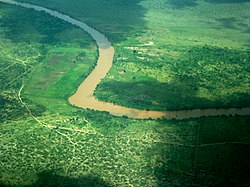
Jamame is situated on the eastern bank of the lower Jubba River in the Lower Juba region of southern Somalia. The town lies in the southeastern part of the country, in proximity to the Indian Ocean coast and the port city of Kismayo to the south. Its geographic coordinates are approximately 0.07°N latitude and 42.75°E longitude, placing it just north of the equator.
The of Jamame consists of low-lying coastal lowlands and fertile riverine plains formed by alluvial deposits from the . The area's average is around 12 to 15 meters above , characterized by flat terrain that supports and along the riverbanks. This riverine setting, combined with the equatorial proximity, features and influences hydrological patterns, including seasonal flooding that shapes the local landscape.

Climate

Jamame experiences a characterized by consistently high temperatures and bimodal rainfall patterns. Average daily high temperatures range from 32°C to 35°C throughout the year, with lows typically between 24°C and 26°C, reflecting the region's proximity to the . The hot season peaks from to May, while remains elevated year-round due to the Jubba River's influence, often exceeding 70% during mornings. Precipitation occurs in two main seasons: the Gu rains from to , accounting for the majority of annual totals, and the shorter Deyr rains from to . Annual rainfall in Jamame averages 700 to 800 mm, concentrated in these periods, with often recording the highest monthly amounts around 90 mm. The riverine location enhances local moisture, supporting humidity levels conducive to , though dry intervals from to feature minimal rain under 10 mm monthly. Seasonal overflows from the lead to periodic flooding, particularly during peak Gu and Deyr flows, altering local and affecting habitability. Historical records indicate vulnerability to such events, with river discharges at Jamame gauging stations reaching significant volumes that exceed banks, as observed in broader southern flood patterns. These floods, while replenishing for crops like bananas and , pose risks to and settlements along the riverbanks.

History

Pre-Colonial and Colonial Periods

The Jubba Valley's fertile alluvial soils and reliable water supply from the river facilitated early agricultural settlements, drawing communities engaged in farming, , and . Beginning around 1830, the lower Jubba region saw influxes of East African-origin agriculturalists, including slaves and their descendants who established riverine villages for crop cultivation such as millet, , and bananas introduced via trade networks. Somali pastoral clans, including subclans, integrated into these areas for dry-season grazing and limited irrigation-based farming, though nomadic herding predominated over sedentary agriculture. Italian interest in the intensified after consolidating control over southern in the early , with systematic agricultural development accelerating in the under Fascist policies aimed at colonies and commodities. Bananas emerged as a , cultivated on state-supported plantations that relied on coerced local labor and experimental farming techniques to supply Mediterranean markets. Jamame became a focal point for these efforts, renamed Villaggio Regina Margherita and positioned as an agro-industrial hub with canals diverting river water to expand cultivable land for banana . By the 1930s, infrastructure investments—including expanded canal networks and processing facilities—had transformed the area into a key node for exports, integral to Italy's ambitions for self-sufficiency in after 1936. Production scaled rapidly, with annual yields supporting monopolized trade under the Regia Azienda Monopolio Banane, though vulnerability to pests and wartime disruptions limited long-term viability. These colonial interventions laid the groundwork for the region's enduring reliance on irrigated cash-crop agriculture, despite the era's exploitative labor practices and environmental strains from over-irrigation.

Independence Era and Civil War

Following Somalia's independence on July 1, 1960, Jamame, located in the region, was integrated into the unified , where its agricultural lands, particularly banana plantations along the Juba River, initially contributed to national export revenues under a centralized economy. However, after Siad Barre's seizure of power in a bloodless coup on October 21, 1969, the regime's adoption of led to the of major banana plantations, including those in southern , shifting control from private Italian-era enterprises to state-managed cooperatives that prioritized ideological goals over efficiency. This policy, intended to modernize through collectivization, resulted in mismanagement, reduced , and declining outputs by the , as state farms suffered from inadequate and bureaucratic inefficiencies amid Barre's emphasis on urban industrialization and military spending. Tensions escalated in the 1980s as Barre's favoritism toward his clan, particularly and sub-clans dominant in parts of , alienated other groups like and , fostering clan-based insurgencies that disrupted trade routes and agricultural operations in Jamame. By the late 1980s, rebel groups such as the (SPM), led by figures but increasingly factionalized, clashed with government forces and rival militias, halting banana exports from the region, which had peaked at contributing to Somalia's $96 million annual banana revenue in 1990 before plummeting due to insecurity and blockades. The collapse of central authority in January 1991, following Barre's ouster, created power vacuums in , where inter-clan militias vied for control of fertile lands and -dependent farms in Jamame, turning plantations into battlegrounds and exploiting export checkpoints for extortion. Factional fighting in the early 1990s destroyed or abandoned much of the infrastructure, including pumps and canals essential for Juba Valley agriculture, empirically reducing arable productivity as fields salinized and farms reverted to subsistence use amid ongoing skirmishes between , , and other coalitions. filled the void, consolidating local power through alliances while prioritizing resource extraction over reconstruction, perpetuating economic decline in the area.

Post-Civil War Developments

In the mid-2000s, the (ICU) extended its influence to , including Jamame, by leveraging local clan alliances to displace entrenched and restore rudimentary order along trade corridors. This brief period, peaking in , facilitated the reopening of markets and agricultural supply lines, reducing localized anarchy that had prevailed since the early collapse. However, the ICU's governance relied heavily on ideological enforcement rather than inclusive institutions, limiting long-term viability. The Ethiopian military intervention in December 2006, backed by the Transitional Federal Government, swiftly dismantled ICU control in southern , including , but empirically exacerbated instability by alienating local populations and enabling the of ICU remnants into al-Shabaab. Ethiopian forces occupied key areas briefly, yet withdrew by early amid guerrilla resistance and backlash, leaving a vacuum that al-Shabaab exploited to dominate rural districts like Jamame. This external push, intended to install federal authority, instead fragmented alliances and intensified power struggles, as evidenced by subsequent surges in asymmetric violence that undermined stabilization goals. The formation of as a semi-autonomous federal member state in 2013 positioned Jamame as a district capital within , yet administration has oscillated between Jubaland Darwish forces, federal units, and al-Shabaab incursions, with the latter retaining sway over peripheral farmlands as late as the mid-2010s. Intermittent international stabilization via AMISOM (later ATMIS) recaptured urban pockets by 2014, but persistent clan rivalries—such as those between and Biyamal groups over and district oversight—have thwarted unified governance, perpetuating patronage-based militias over formal institutions. NGO-led efforts have sporadically bolstered agricultural recovery in Jamame, with programs like AVSI's 2024 training of 600 residents in techniques aiming to enhance resilience amid flood-prone riverine soils. Broader World Bank assessments highlight such interventions' role in rehabilitating sesame and production, yet their scale remains dwarfed by clan-driven disputes that disrupt and displace laborers, underscoring the limits of exogenous without resolving endogenous power asymmetries. Local farmers' adaptive practices, including informal cross-clan bartering, demonstrate underlying resilience despite these structural failures.

Demographics

Population Estimates

In 2005, the estimated the population of Jamame district at 129,149 residents. This figure, derived from surveys amid post-civil war instability, represented one of the more systematic assessments available for the area, though it predates intensified Al-Shabaab influence and recurrent displacements. Subsequent projections from the UN Population Fund's 2014 Population Estimation Survey adjusted the district figure downward to 97,911, accounting for outflows linked to conflicts and in . A extrapolation based on these inputs yielded 100,635 inhabitants, implying modest recovery but persistent volatility. No nationwide has occurred since 1986, rendering post-2014 data reliant on partial humanitarian assessments prone to underreporting in contested zones. Regional demographic trends, including Somalia's approximate 2.5-3% annual growth rate, suggest potential expansion toward 150,000-200,000 by the mid-2020s, fueled by the River's agricultural productivity drawing farmers and secondary migration from insecure urban centers like . Yet such extrapolations lack verification, as conflict disrupts enumeration; nomadic pastoralists are systematically undercounted due to mobility, while 1990s war-era surges temporarily inflated prior tallies before repatriations and further violence reversed gains. Estimates for the town proper vary more sharply, with some sources citing around 22,000 in older urban-focused data, highlighting inconsistencies between district-wide and core settlement figures.

Ethnic and Clan Composition

The population of Jamame and its environs in is predominantly Somali, with a complex composition that includes the (notably the Mohamed Zubeir sub-clan of the ), the Dir Biyomaal sub-clan, the Digil-Mirifle group, and Somali Bantu (also known as Jareer) minorities concentrated in riverine areas. This ethnic mosaic reflects the broader diversity of southern Somalia's , where pastoralist lineages like the coexist alongside more sedentary agrarian groups such as the and Bantu, whose settlement patterns trace back to historical migrations and agricultural adaptations along the Juba River. The Jamame-Saakow corridor exemplifies Somalia's highest levels of intermixing, where overlapping territories of these groups have driven both —through shared riverine trade and farming—and recurrent disputes over , particularly between nomadic ists seeking grazing access and settled Bantu or farmers defending cultivated plots. Somali Bantu communities, often marginalized in hierarchies despite their pivotal role in intensive like and cultivation in the fertile valley, have faced displacement pressures from dominant clans amid weak central enforcement of . Empirical mappings highlight Biyomaal-Ogaden rivalries in Jamame proper as a key flashpoint, rooted in competing claims to governance and resources rather than transient feuds. This clan heterogeneity underscores causal dynamics of cohesion in trade networks versus fragmentation in resource allocation, with Bantu contributions to food production frequently underrecognized in favor of narratives privileging nomadic Somali lineages, though data from regional assessments affirm their demographic and economic significance in stabilizing valley livelihoods.

Economy

Agriculture and Primary Production

Agriculture in Jamaame centers on irrigated farming along the Juba River, enabling cultivation despite irregular rainfall patterns in the region. Bananas serve as the principal cash crop, with production supported by river sediments that enhance soil fertility in the floodplains. and constitute staple food crops, grown primarily under for maize and rain-fed conditions for sorghum in adjacent areas. Banana exports from Jamaame historically peaked during the Italian colonial period, with shipments to commencing in and expanding significantly after the 1929 global cotton market collapse, reaching 320,000 quintals by 1939. Plantations in southern , including areas near Jamaame, drove this growth through organized commercial farming. Post-independence of land, water access, and marketing boards in the contributed to production declines by disrupting private incentives and efficiency. In recent decades, smallholder farmers have sustained output for local consumption and exports via port to Gulf markets, reflecting resilience amid civil unrest. National production hit 360,000 metric tons in 1988 before collapsing, but localized efforts in persist, though exact Jamaame figures remain limited. yields in riverine zones like average near-normal in irrigated plots, supporting household . Key constraints include vulnerability to pests and diseases due to low-input farming and poor seed quality, alongside inadequate that exacerbates post-harvest losses and informal of produce. Erratic flows and limited extension services further hinder yields, though floodplains provide natural advantages over rain-fed highlands.

Trade and Commercial Activities

Jamame serves as a regional hub for informal in and agricultural commodities from the Jubba , with and moving through local markets toward cross-border routes into . Traders often begin with smaller like to build capital before scaling to , supporting cross-border despite regulatory voids. exports from southern , including Lower Juba, historically comprised over 60% of national export value until the 1990s, with informal networks persisting amid state absence. The illicit charcoal trade constitutes a major revenue stream, evading bans imposed by successive Somali governments and the since 2012, with smuggling routes linking production sites to Gulf ports via . Entities like Jamame Brothers Company, sanctioned by the U.S. Treasury in 2023, have facilitated exports estimated at tens of thousands of metric tons annually, generating over $20 million yearly for associated networks before intensified enforcement. Conflict dynamics enable these networks by fragmenting control, allowing armed groups to tax production and transit without state oversight, though such activities exacerbate and fund insurgencies. Banana trade from plantations, including areas near Jamame, historically flowed southward to for export, comprising up to 30% of Somalia's pre-1991 foreign exchange earnings before disruptions reduced volumes. Efforts to revive shipments in the 2010s targeted European and Middle Eastern markets, but persistent instability limited output to localized informal sales. Militia-operated checkpoints along Jubba Valley routes impose ad hoc taxes on goods, elevating transport costs and diverting flows toward , with studies documenting daily violent incidents at such sites and broader erosion of formal competitiveness. These extortions, collected by al-Shabaab and clan militias alike, prioritize cross-border over domestic volumes, sustaining illicit economies while constraining verifiable export data.

Governance and Politics

Administrative Structure

Jamame functions as a within the region of , a Federal Member State of , placing it under the dual oversight of the Jubaland state administration and the (FGS). The is formally administered by a district commissioner, appointed by the Jubaland or regional authorities, who heads local governance structures including a district council responsible for basic administrative functions such as taxation, minor , and coordination with state-level ministries. Kismayo serves as the primary administrative hub for and , with Jamame holding secondary status, limiting its direct access to state resources and decision-making. Efforts to establish elected district councils in , including in districts like Jamame, have proceeded irregularly since the early as part of broader initiatives under the Provisional , but implementation remains inconsistent due to federal-state tensions and logistical barriers. In practice, formal hierarchies exhibit limited effectiveness, evidenced by persistent gaps in service delivery and oversight, as federal and state directives often fail to translate into local execution owing to poor connectivity and resource allocation disconnects. Local committees, drawing on customary practices, handle routine and community matters, reflecting where central authority's reach is constrained by geographic and administrative challenges.

Clan and Local Power Dynamics

In Jamaame, clan structures serve as the de facto governance framework, with elders and sub-clan leaders mediating resource distribution, land disputes, and local conflicts through the customary xeer system, frequently overriding appointments by federal or regional authorities due to the absence of effective state enforcement mechanisms. This reliance on clan mediation stems from the collapse of centralized authority post-1991, where formal institutions lack legitimacy without clan endorsement, as elders leverage kinship networks to enforce decisions via social pressure and militia mobilization. The sub-clans of the lineage exert dominant influence in districts including Jamaame, controlling key economic and political levers through historical settlement patterns and alliances that prioritize pastoralist interests in riverine and grazing lands. Inter-clan tensions, such as dormant feuds between and Biyamal groups over land ownership, underscore how sub-clan vetoes on resource-sharing agreements impede unified local administration, as seen in stalled negotiations that favor kin-based claims over equitable allocation. Somali Bantu communities, lacking affiliation with major nomadic , remain marginalized in these dynamics, excluded from elder councils and resource pacts, which exposes them to exploitation and limits participation in decision-making despite their concentration in Jamaame's fertile Juba Valley farmlands. This exclusion perpetuates cycles where clan loyalty trumps merit-based , as Bantu groups historically provided agricultural labor without reciprocal power-sharing, reinforcing disparities in distribution and development projects. Alliances among clans in Jamaame adapt fluidly to scarcity or pressures, forming temporary pacts for mutual defense or water access while subordinating formal state initiatives; for instance, elder-brokered deals have repeatedly blocked land reforms proposed by authorities, prioritizing intra-clan equity over broader productivity gains as of 2023 mappings of unresolved disputes. Such patterns explain the inefficacy of imposed administrative structures, which falter absent clan , as loyalty to lineage elders ensures compliance through customary sanctions rather than legal coercion.

Security and Conflicts

Al-Shabaab Insurgency

Al-Shabaab has maintained influence over Jamame and surrounding rural pockets in since its 2008 offensive, when the group seized control of much of southern amid the Transitional Federal Government's collapse. Militants hold peripheral territories, exploiting them for through taxation on farms, banana plantations, and charcoal production—key economic activities in the district. These levies, enforced at checkpoints and via threats of violence, generate millions annually for the group across , with Jamame's agricultural output providing a steady revenue stream despite intermittent government disruptions. The district's location along the Juba River positions it as a vital inland corridor for Al-Shabaab logistics, facilitating fighter movements, arms smuggling, and supply lines toward the porous Kenya-Somalia border roughly 100 km south. This route supports cross-border raids and infiltration, with militants leveraging rural mobility to evade detection. In August 2021, airstrikes targeted Al-Shabaab convoys in Jamame city transporting fighters and explosives, killing several militants alongside reported civilian casualties in the vicinity. Al-Shabaab sustains operations through persistent roadside IEDs and vehicle ambushes on highways like the Kismayo-Jamame road, contributing to over 200 recorded attacks in since 2020 per ACLED data. Clan-based grievances, including marginalization of and other subclans by federal-aligned forces, combined with acute poverty—exacerbated by and —enable coerced and voluntary recruitment, drawing youth with promises of income or protection. In held areas, the group imposes Hanbali-derived , meting out amputations for theft, floggings for alcohol use, and executions for to enforce ideological compliance and deter defection.

Government and Allied Operations

In 2023 and 2024, joint operations by (SNA) units and forces targeted Al-Shabaab positions in Jamame and Afmadow districts of , focusing on urban centers and supply routes along the Juba River. These efforts, part of the broader federal offensive launched in 2022, resulted in the recapture of key villages such as Bulo Haji in Afmadow district in June 2024 and several areas between and Afmadow in July 2024, with reports of over 200 Al-Shabaab militants killed in -wide actions that year. In March 2024, SNA and forces executed 30 Al-Shabaab fighters in the Jamame area during a riverine operation. However, Al-Shabaab often retreated to rural hinterlands, regrouping for counterattacks, as evidenced by coordinated assaults on SNA bases in Bulo Haji, Harbole, Miido, and Bar Sanguni in July 2024, which inflicted dozens of casualties on troops. Airstrikes supported these ground efforts, with (FGS) forces conducting bombings in Jamame city in August 2021 that targeted Al-Shabaab vehicles carrying explosives, disrupting logistics but reportedly causing civilian deaths that heightened local resentment toward operations. U.S. Africa Command provided additional precision strikes near Jamame in January 2021, destroying Al-Shabaab compounds in coordination with SNA advances, though such foreign dependencies exposed vulnerabilities during the Transition Mission in Somalia (ATMIS) drawdown beginning in 2023. By late 2024, ATMIS troop reductions—totaling over 5,000 personnel by mid-year—left gaps in southern , enabling Al-Shabaab to exploit handed-over bases and launch bolder incursions near the Kenyan border, including in districts. Persistent challenges undermined operational gains, including corruption within SNA ranks that diverted resources and fueled low morale, alongside clan-based defections and rivalries that fragmented alliances. In December 2024, FGS forces withdrew from positions in Raskamboni, , following deadly clashes with Jubaland troops—killing at least 75—highlighting how intra-allied tensions allowed Al-Shabaab to regain footholds absent unified local support. Without addressing these internal weaknesses, government control remained confined to urban enclaves, with rural areas reverting to insurgent influence despite tactical successes.

Infrastructure and Recent Developments

Transportation and Basic Services

Transportation in Jamame relies primarily on unpaved roads connecting to nearby cities like , approximately 118 kilometers south, which are frequently disrupted by seasonal flooding and washouts due to the region's heavy rains and poor maintenance. Links to Baraawe, further north along the coast, face similar challenges, with travel times extended by degraded earth tracks vulnerable to erosion. Navigation on the Juba River, which flows through Jamame, remains limited by meandering channels, seasonal water levels, and insecurity, restricting it mostly to small, informal boats for local goods rather than reliable commercial transport. The Jamaame Airstrip exists but lacks scheduled commercial operations or regular maintenance, with residents depending on distant facilities like Kismayo Airport for . Basic services in Jamame are characterized by localized, self-reliant provisions amid limitations. is supplied erratically by private diesel generators operated by local entrepreneurs, providing intermittent power to households and businesses without a connected national grid. access depends on shallow wells and the Juba River, where contamination from agricultural runoff and flooding poses health risks, though NGO-installed boreholes offer partial mitigation but fall short of demand for the . Agricultural irrigation reflects adaptive resilience following decades of neglect; Italian colonial-era canals in the area, damaged during the civil war and subsequent conflicts, have not been systematically repaired, compelling farmers to use manual pumping and bucket methods from river diversions. This shift underscores community-driven maintenance over unfulfilled state infrastructure commitments, sustaining production despite systemic disruptions from instability.

Development Initiatives and Challenges

Non-governmental organizations have undertaken water infrastructure projects in Jamaame and surrounding areas of Lower Juba, focusing on boreholes and wells to address chronic shortages exacerbated by droughts and floods. For instance, AVSI Foundation's baseline assessments in Jamaame highlight efforts to enhance access to diverse sources, including piped systems serving 32% of households and river-based supplies for 33%, as part of broader initiatives improving livelihoods for drought-affected communities. Similarly, CERF-funded responses in 2021 rehabilitated water points nationwide, delivering clean to over 130,500 people through constructed and repaired infrastructure, with analogous projects extending to southern regions like amid recurrent crises. These efforts prioritize local implementation to sustain usage, though comprehensive return-on-investment data remains scarce, limiting evaluations of long-term efficacy. Agricultural rehabilitation following floods has involved NGO-led seed distribution and repairs, particularly after heavy rains in October-December 2023 inundated Jamaame town and disrupted farming. In response to such events, organizations like FAO promote climate-resilient practices under national frameworks, including post-flood recovery in riverine areas to restore crop production essential for local food security. authorities outlined farm modernization plans in the 2020s, aligned with Somalia's National Development Plan (2020-2024), emphasizing irrigation upgrades and input access to boost yields in fertile Juba Valley zones. However, these initiatives have stalled due to persistent insecurity, with agricultural output declining from droughts, poor rains, and conflict-related disruptions. Key barriers include Al-Shabaab's of aid convoys and taxation on humanitarian , which diverts resources and inflates operational costs in , as documented in analyses of the group's revenue mechanisms through checkpoints and protection rackets. Clan dynamics further complicate progress, with dormant disputes in Jamaame between Biyamal (Dir) and Ogaden (Darood) clans centering on land and governance, potentially reigniting over scarce arable plots amid population pressures. networks, particularly and commodities via nearby ports, undermine legitimate incentives by fostering illicit economies that bypass formal development channels and erode farmer profitability. International inefficiencies compound these issues, often marked by high administrative overheads and limited local , reducing tangible impacts despite substantial inflows. Local Jubaland-led efforts, such as proposals to secure tenure, offer potential for greater agency but require addressing insecure environments to attract sustained investment.

References

Add your contribution
Related Hubs
User Avatar
No comments yet.