


Community hub
Recent from talks
Contribute something
Nothing was collected or created yet.
Jannes and Jambres
View on Wikipedia.jpg)
In Jewish and Christian traditions, Jannes and Jambres (Hebrew: יניס Yannis, ימבריס Yambres) are the names given to magicians mentioned in the Book of Exodus. This naming tradition is well-attested in ancient and medieval literature. In Latin manuscripts of the New Testament, and in Latin writing traditions, their names are known as Jamnes and Mambres.[1]
Hebrew Bible
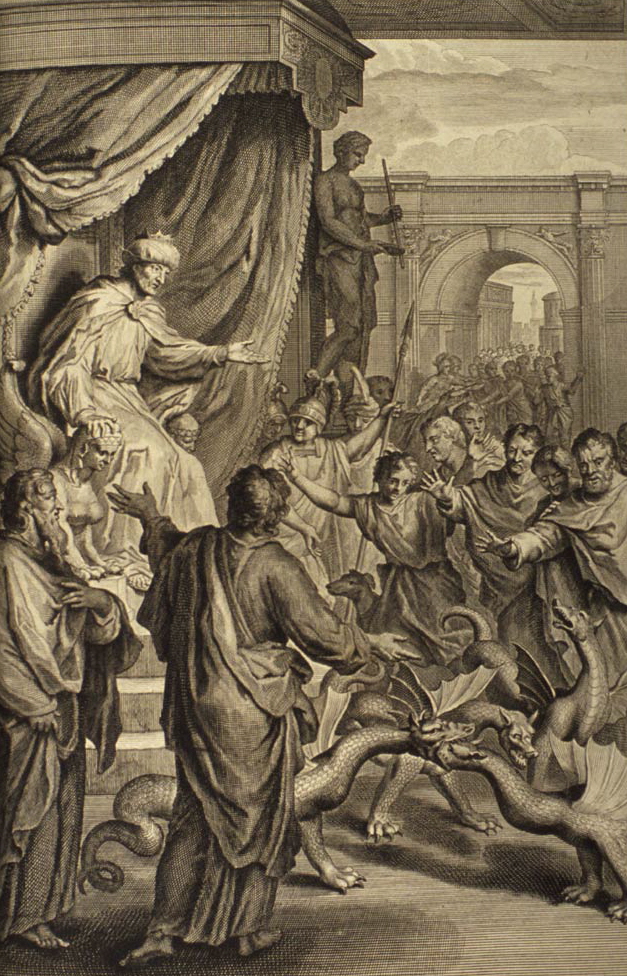
[edit]Jannes and Jambres are not specifically mentioned in the Tanakh ("Hebrew Bible"), but the Egyptian "wise men and sorcerers" (two of whom were identified with Jannes and Jambres in Jewish and Christian traditions) are mentioned in Exodus 7:10-12 (KJV)
And Moses and Aaron went in unto Pharaoh, and they did so as the LORD had commanded: and Aaron cast down his rod before Pharaoh, and before his servants, and it became a serpent. Then Pharaoh also called the wise men and the sorcerers: now the magicians of Egypt, they also did in like manner with their enchantments. For they cast down every man his rod, and they became serpents: but Aaron's rod swallowed up their rods.
New Testament and Second Temple literature
[edit]The names Jannes and Jambres (Greek: Ἰάννης, Ἰαμβρῆς; Iannēs, Iambrēs) appear in 2 Timothy[2] in the New Testament. Origen says that there was an apocryphal book called The Book of Jannes and Jambres, containing details of their exploits, and that Paul the Apostle was quoting from it. This book, known as The Apocryphon of Jannes and Jambres the magicians, exists in some Greek fragments present in the Chester Beatty Papyri No XVI (which has been edited and translated by Albert Pietersma[3]), and in an extensive Ethiopic fragment which was discovered in 2014.[4] It was also probably known to the Qumran community, since the Qumran community refers to one of the magicians by the name of Jannes.[5] The Testament of Solomon also refers to the magicians by the name of Jannes and Jambres.
Greco-Roman literature
[edit]The name of Jannes not as that of a magical opponent of Moses but as the originator with Moses and one Lotapea[6] (or Lotapes[7]) of a sect of magicians occurs in Pliny the Elder's Natural History (XXX, II, 11);[8] Pliny's citation is also referred to in Apuleius. Numenius of Apamea, a Neopythagorean philosopher, called them sacred Egyptian scribes. The Gospel of Nicodemus also refers to the magicians by the name of Jannes and Jambres.
In a brief passage cited in Eusebius' Praeparatio evangelica, Numenius said that "Jannes and Jambres were able to undo, publicly, even the greatest of the disasters that Moses brought against Egypt." This statement contradicts the biblical account according to which the magicians were able to follow Moses' acts only to the second plague inclusive (Ex 8:18).[9]
Rabbinic literature
[edit]The Babylonian Talmud names "Johana and Mamre" as two of Pharaoh's sorcerers.[10] "Jannis and Jambres" are mentioned several times by name in Targum Pseudo-Jonathan.[11][12] Jewish traditions in the Targums preserve other legendary lore about the pair. They are called the sons of Balaam, the unwitting non-Jewish prophet of Peor.[13][14] It was also claimed that they converted to Judaism, and that they left Egypt at the Exodus to accompany Moses and the Israelites; however, they perished on the way, either at the Red Sea, or the destruction of the Golden Calf, or at the slaughter of Korah and his followers.[citation needed]
Apart from their opposition to Moses there are other aggadic lore and legends about Egyptian sorcerers; it was said that during the end of their days they had necessary occult knowledge to embark on a journey to the Jewish world to come. They were not welcomed and the angels of the first few heavens fought them vigorously but they could not evict them due to the potent talismans that were worn by the wizards. As they entered the fourth heaven they were met by Michael and Gabriel; legends say that the battle was very evenly balanced, but in the end it was the angels who had to fall back. Upon entering the fifth heaven they were met by none other than Metatron, who did not come at them with defiance or anger, but appeared accommodating, considering the circumstances; after conversing for a short time the angel was successful in convincing Jannes and Jambres to remove their talismans, leaving them thus vulnerable. Metatron was quick to act and threw them out of heaven with a wave of his hand.
League with the Devil
[edit]The earliest mention of "Jannes and his brother" in the Damascus Document, states that the two were in league with "Belial", who would later be personified as the devil in Christian texts.[15] In the Testament of Solomon, a demon who has some connections with "the Red Sea" replies to the king: "I am who was called upon by Jannes and Jambres who fought against Moses in Egypt" (25:4).[9] Similarly, in the later text of the Questions of St. Bartholomew (6th-7th century), Satan says that "Simon Magus, Zaroës, Arfaxir, and Jannes and Mambres are my brothers" (Lat. 2, 4:50).[9] In the Penitence of Cyprian (5th century?), the great magician of Antioch relates how the Devil called him "a clever lad, a new Jambres, trained for service, and worthy of fellowship with himself".[9] In his Lausiac History (5th century), Palladius relates that Macarius of Alexandria (4th century) once visited the garden-tomb of Jannes and Jambres, and upon arrival was met by seventy demons who resided there.[9]
In popular culture
[edit]- In the film The Ten Commandments (1956), Douglass Dumbrille plays Jannes as a constantly fretful and pompous High Priest of Egypt and a devoted follower of the Nile God Khnum, as well as Court Mage and one of the Pharaoh's top advisers.
- The Prince of Egypt, a 1998 animated DreamWorks film, has Steve Martin and Martin Short provide the voices of Hotep and Huy, characters who were based on Jannes and Jambres. They are somewhat comical characters, despite the movie's overall serious tone.
- In the 2014 film Exodus: Gods and Kings, Indira Varma plays an Egyptian high priestess whose character is roughly parallel to the role of Jannes and Jambres.
See also
[edit]Notes
[edit]- ^ Sparks, H. F. D. (1939-07-01). "ON THE FORM MAMBRES IN THE LATIN VERSIONS OF 2 TIMOTHY iii 8". The Journal of Theological Studies. os–XL (3): 257–258. doi:10.1093/jts/os-XL.3.257. ISSN 0022-5185.
- ^ 3:8
- ^ Pietersma A. The Apocryphon of Jannes and Jambres
- ^ Erho, Ted; Krueger, Frederic; Hoffmann, Matthias (2016). "Neues von Pharaos Zauberern". Welt und Umwelt der Bibel. 2: 70–72. Retrieved 29 January 2018.[permanent dead link]
- ^ "For in times past, Moses and Aaron stood in the power of the Prince of Lights, and Belial raised up Yannes and his brother in his cunning when seeking to do evil to Israel the first time." The Dead Sea Scrolls: A New Translation; Michael Wise, The Damascus Document, pg56)
- ^ The relevant chapter at the Perseus Project
- ^ Torrey, Charles C. “The Magic of ‘Lotapes.’” Journal of Biblical Literature, vol. 68, no. 4, Society of Biblical Literature, 1949, pp. 325–27, https://doi.org/10.2307/3262101.
- ^ "PLINY'S NATURAL HISTORY". www.masseiana.org. Archived from the original on 2017-01-01. Retrieved 2017-05-03. XXX
- ^ a b c d e A. Pietersma and R. T. Lutz, Jannes and Jambres (First To Third Centuries A.D.9. A New Translation and Introduction, in James H. Charlesworth (1985), The Old Testament Pseudoepigrapha, Garden City, NY: Doubleday & Company Inc., Volume 2, ISBN 0-385-09630-5 (Vol. 1), ISBN 0-385-18813-7 (Vol. 2), pp. 427-428
- ^ Menachot 85a
- ^ Targum Yerushalmi (Yonatan), Exodus 1:15, Targum Yerushalmi (Yonatan), Exodus 7:10–12, Targum Yerushalmi (Yonatan), Numbers 22:22
- ^ Clontz, T.E. and J., "The Comprehensive New Testament with complete textual variant mapping and references for the Dead Sea Scrolls, Philo, Josephus, Nag Hammadi Library, Pseudepigrapha, Apocrypha, Plato, Egyptian Book of the Dead, Talmud, Old Testament, Patristic Writings, Dhammapada, Tacitus, Epic of Gilgamesh", Cornerstone Publications, 2008, p. 680, ISBN 978-0-9778737-1-5
- ^ "The Legends of the Jews: Chapter IV: Moses in Egypt". www.sacred-texts.com. Retrieved 2021-02-08.
- ^ "Book of Jasher, Chapter 79". www.sacred-texts.com. Retrieved 2021-02-08.
- ^ Long, Phillip (22 May 2018). "The Book of Jannes and Jambres". readingacts.com. Retrieved 18 February 2023.
References
[edit]- Chronicles of Jerahmeel
- The Book of the Bee Chapter 30
- Book of Jasher chapter 79
- Ginzberg Legends of the Jews Volume 2 Chapter 4
- Josephus Antiquities of the Jews Book 2
- Exodus 1, Exodus 7, and Numbers 22 in the Targum of Pseudo-Jonathan
- Ante-Nicene Fathers, Vol. VIII
- Easton's Bible Dictionary
- Nicene and Post-Nicene Fathers, Vol. XIII
Jannes and Jambres
View on GrokipediaBiblical References
In the Hebrew Bible
In the Book of Exodus, the narrative introduces Pharaoh's court officials as unnamed "wise men and sorcerers" who serve as counterparts to Moses and Aaron during the initial confrontation before Pharaoh. When Aaron casts down his staff, which becomes a serpent as a sign of divine authority (Exodus 7:10), Pharaoh summons these figures, described as the "magicians of Egypt," who replicate the act using their "secret arts," turning their own staffs into serpents (Exodus 7:11). However, Aaron's serpent swallows theirs, demonstrating the superiority of Yahweh's power over Egyptian ritual practices.[10] These magicians play a pivotal role in the early stages of the plagues, attempting to undermine the authenticity of the divine judgments by mimicking the first three afflictions through their esoteric techniques. They successfully imitate the transformation of the Nile's waters into blood (Exodus 7:22) and the infestation of frogs across the land (Exodus 8:7), thereby initially bolstering Pharaoh's resistance to Moses' demands for Israel's release. Their efforts falter with the third plague, however, as they fail to produce lice from the dust despite trying with their secret arts, leading them to concede to Pharaoh that "this is the finger of God" (Exodus 8:18-19). During the sixth plague of boils, the magicians are mentioned as being unable to stand before Moses because the boils afflicted them and all the Egyptians (Exodus 9:11). After this point, the magicians do not reappear in the narrative or perform any further counter-miracles.[11][10] The depiction draws on historical Egyptian magical traditions, where court ritualists employed rods or staffs in performances of transformation and incantations to invoke divine or supernatural effects, often in temple or royal settings to affirm pharaonic authority. These practices, integral to ancient Egyptian religion, involved lector-priests who recited spells from sacred texts to manipulate reality, mirroring the biblical account's emphasis on staffs and verbal enchantments. The Hebrew terms used reflect this cultural milieu: "ḥartummîm" (חַרְטֻמִּים), rendered as "magicians," derives from the Egyptian "ẖry-ḥb," denoting lector-priests skilled in ritual recitation and interpretation of signs; paired with "mekhashefîm" (מְכַשֵּׁפִים), "sorcerers" or enchanters, and "laḥaš" (לָהַט), referring to their incantatory secret arts, these descriptors highlight figures versed in divination, astrology, and manipulative rites.[10] Subsequent extrabiblical traditions would name these magicians, expanding on their role in Jewish and Christian lore.[10]In the New Testament
The only explicit reference to Jannes and Jambres in the New Testament occurs in 2 Timothy 3:8, where the author compares contemporary false teachers to these figures: "Just as Jannes and Jambres opposed Moses, so also these people oppose the truth—people of depraved minds, who, as far as the faith is concerned, are rejected" (NIV). This verse draws on the unnamed Egyptian magicians in Exodus 7:11, 22 and 8:7, who replicated some of Moses' signs through sorcery before ultimately failing.[12] In the context of this Pastoral Epistle, attributed to Paul and addressed to Timothy in Ephesus, the mention serves as a warning about perilous times in the "last days" (2 Timothy 3:1), during which impostors will infiltrate households and lead the vulnerable astray with deceptive doctrines (2 Timothy 3:6–7).[12] Jannes and Jambres are portrayed here as archetypes of those who resist divine truth through counterfeit power, mirroring the magicians' mimicry of God's miracles while lacking authentic authority, much like the false teachers whose influence will be exposed and limited, as their folly becomes evident to all (2 Timothy 3:9). This exegesis underscores a theological contrast between enslaving deception and the liberating gospel, emphasizing moral corruption over mere intellectual error.[12] The names Jannes and Jambres, absent from the Hebrew Bible, are non-Hebrew in form—likely Semitic roots adapted through Greek influence—and reflect early Jewish oral traditions known to the New Testament author, as evidenced by their appearance in sources like the Dead Sea Scrolls (e.g., the Damascus Document) and later Targums.[13][14] This suggests the epistle's audience was familiar with such extrabiblical identifications of Pharaoh's sorcerers, integrating them to bolster apostolic authority.[12] The reference carries implications for early Christian perceptions of magic as a form of satanic opposition to God's work, positioning Jannes and Jambres as prototypes for heretics who pervert faith through sophistry and false signs, akin to the proto-Gnostic or ascetic errors troubling the Ephesian church. By invoking them, the text reinforces the call to persevere in sound teaching amid such threats, highlighting the ultimate triumph of truth over imitation.[12]Ancient Jewish Literature
Second Temple Period Texts
The Apocryphon of Jannes and Jambres represents one of the earliest extrabiblical expansions on the figures of Jannes and Jambres as opponents of Moses, preserved primarily in fragmentary Greek manuscripts from the Chester Beatty Papyri (P. Chester Beatty XVI), dated to the 3rd-4th century CE.[15] This pseudepigraphic work, likely composed in Greek during the late Second Temple period or shortly thereafter in Roman Egypt, narrates the story from the perspective of the brothers themselves, who are depicted as chief Egyptian magicians advising Pharaoh to beware of Moses and Aaron as threats to Egypt.[16] The plot unfolds with Jannes and Jambres engaging in magical rivalry, initially replicating Moses' rod-to-serpent miracle but failing as their creations are devoured, symbolizing the superiority of divine power over human sorcery. A recently identified Ethiopic fragment, published in 2014, offers further textual evidence of an early translation tradition, reinforcing the narrative's focus on the brothers' warnings to Pharaoh and their eventual downfall.[17] In the Dead Sea Scrolls, the Damascus Document (CD 5:17-19) provides a brief but significant reference, portraying Jannes and his brother (Jambres) as instruments raised by Belial, the prince of darkness, to seduce Israel during the exodus from Egypt, marking the "first deliverance."[18] This apocalyptic dualistic framework aligns them with the "sons of darkness" in the Qumran community's cosmology, emphasizing their role in tempting the Israelites toward apostasy and opposition to God's chosen leaders.[19] Philo of Alexandria, in his treatise De Vita Mosis (I.92-94), describes the Egyptian magicians—traditionally identified as Jannes and Jambres—as proficient priests and sophists skilled in esoteric arts, capable of imitating initial miracles like transforming rods into serpents.[20] However, their abilities prove illusory and inferior to Moses' God-empowered signs, as evidenced by the consumption of their serpents, underscoring the limits of pagan wisdom. These texts collectively depict magical confrontations during the plagues and exodus, serving to affirm Jewish theological distinctiveness, resisting Hellenistic tendencies toward syncretism by contrasting monotheistic prophecy with Egyptian-Hellenistic magic.[21]Rabbinic Literature
In rabbinic literature, Jannes and Jambres are identified as Pharaoh's chief magicians and advisors, whose opposition to Moses underscores themes of human hubris versus divine authority. The Babylonian Talmud refers to them by variant names, Yoḥana and Mamre, portraying them as Pharaoh's leading necromancers who derided Moses during his initial audience with the king. In Menachot 85a, they mockingly ask Moses, "Are you bringing straw to Afarayim?"—a proverb implying redundancy, as Afarayim was renowned for its abundant straw production—highlighting their role in challenging Moses' mission from the outset.[22] The Targum Pseudo-Jonathan expands their backstory, naming them as sons of Balaam and depicting them as prophetic magicians who foretold Moses' birth as "the destroyer of Egypt" to Pharaoh in Exodus 1:15, advising the slaughter of Hebrew male infants to avert the threat. In the same Targum to Exodus 7:11–12, they replicate Aaron's sign of the staff turning into a serpent but ultimately fail when their magic cannot match the divine plagues, symbolizing the inferiority of sorcery to God's power. Legends in the Targum to Numbers 22:22 and Exodus 14:27 further detail their temporary conversion to Judaism during the Exodus, only to be rejected and punished: they are said to have been stoned by the Israelites for their past sins against the Hebrews, or drowned in the Red Sea alongside the Egyptians, illustrating divine justice meted out to deceivers.[22] Midrashic collections like Exodus Rabbah elaborate on their magical prowess and downfall, noting in 9:7 that Jannes and Jambres performed feats akin to the plagues—"the magicians of Egypt did so with their secret arts"—yet their abilities waned, as their staffs were swallowed by Aaron's, signifying the limits of human enchantment before true miracles. In expansions found in Yalkut Shimoni 776 (drawing from earlier midrashim), they invoke the Ineffable Name to evade Phinehas' sword during a later confrontation, flying into the air and turning invisible, but are ultimately captured and slain by its divine potency, emphasizing that even stolen sacred knowledge cannot thwart God's will due to their moral corruption and arrogance.[22] These narratives in rabbinic sources collectively teach the futility of sorcery against divine intervention and the inevitability of retribution for opposing the righteous, as seen in their progression from advisors inciting tyranny to condemned outcasts. Such themes reinforce ethical lessons on humility and fidelity to God, with their stories serving as cautionary exemplars in post-Talmudic interpretations.[22]Greco-Roman and Early Christian Sources
Greco-Roman Literature
In his Natural History (Book 30, Chapter 2), Pliny the Elder catalogs Jannes among the most renowned magicians of antiquity, placing him alongside Moses as a key figure in the transmission of magical knowledge from the East to the West, with Jambres implied in the pairing derived from shared traditions of Egyptian opposition to Hebrew sorcery. Pliny specifically identifies "Iannes" (Jannes) and "Lotape" (likely a variant for Jambres) as figures from whom a faction of magic, along with Moses and the Jews, is derived, within a narrative tracing magic's Persian origins evolving through diverse cultural channels.[23] The second-century CE Neopythagorean philosopher Numenius of Apamea provides one of the earliest explicit non-Jewish references to both Jannes and Jambres, portraying them in surviving fragments as Egyptian magicians whose abilities opposed those of Moses during the Exodus confrontation. Preserved in Eusebius of Caesarea's Praeparatio Evangelica (9.8), Numenius' account draws on Platonic interpretations of ancient wisdom, equating the duo's thaumaturgic feats with Moses' to argue for a universal hierarchy of divine knowledge accessible through philosophical contemplation, thereby challenging any exclusive claim to supremacy by Hebrew traditions. This depiction underscores Numenius' syncretic approach, blending Egyptian mysticism with Pythagorean and Platonic elements to elevate non-Hellenic sources as precursors to Greek philosophy.[24] Allusions to Jannes appear in other Greco-Roman texts, notably Apuleius' Apologia (90), where he enumerates Jannes among legendary magicians like Zoroaster, Orpheus, and Moses to defend his own philosophical pursuits against accusations of sorcery, emphasizing their mastery of theurgia—ritual invocation of divine powers—as part of esteemed Egyptian wisdom traditions. Similarly, in Neoplatonic contexts, figures like Porphyry reference such Egyptian magicians in discussions of theurgy and hieratic practices, integrating Jannes and Jambres into broader explorations of how non-Greek lore, including the Exodus motifs, contributed to contemplative ascent toward the divine. These portrayals treat the pair not as villains but as exemplars of arcane expertise, often anonymized or paired with Moses to illustrate competitive dynamics in ancient theosophical rivalries.[25] Collectively, these Greco-Roman sources reveal a fascination with the Jewish Exodus narrative as a repository of exotic, empirical magic, refracted through lenses of natural history, philosophy, and cultural syncretism, where Jannes and Jambres serve as bridges between perceived Oriental mysteries and Roman intellectual curiosity, devoid of overt theological advocacy. This integration highlights how pagan authors appropriated Semitic lore to enrich discourses on universal wisdom, viewing the magicians' contest with Moses as a paradigmatic clash of esoteric traditions rather than a moral allegory.[26]Apocryphal and Pseudepigraphal Works
In the Testament of Solomon, a pseudepigraphal text dated to the early centuries CE and associated with Solomonic magical traditions, Jannes and Jambres are portrayed as Egyptian magicians who invoked the demon Abezithibod to resist Moses during the Exodus.[27] This demon confesses to Solomon that it hardened Pharaoh's heart and assisted the pair in performing signs and wonders against the Israelites, highlighting their role in summoning malevolent spirits as part of broader demon-binding narratives that influenced later esoteric and demonological literature.[27] The Questions of St. Bartholomew (also known as the Gospel of Bartholomew), an apocryphal work with Gnostic influences from the 5th century or earlier, depicts Jannes and Mambres (a variant of Jambres) as siblings of Satan alongside other notorious magicians like Simon Magus.[28] In this text, Satan is resurrected or summoned during a confrontation with the apostle Bartholomew, who binds and interrogates him about his origins and deceptions; the mention of Jannes and Mambres underscores their familial tie to demonic forces, emphasizing supernatural opposition to apostolic authority and contributing to early Christian motifs of satanic resurrection and magical defeat.[28] Fragments of related pseudepigraphal works, such as the Paenitentia Iamne et Mambres (Penitence of Jannes and Jambres), appear in early Christian lists like the Decretum Gelasianum (ca. late 5th century), describing the magicians' remorse and demise after their failed sorcery against Moses.[29] A Latin fragment preserved in an 11th-century manuscript, with parallels in Old English and potential Irish apocryphal adaptations, narrates Jannes' deathbed vision and incantation-like pleas for mercy, portraying their magic's ultimate failure and linking to traditions of penitence amid supernatural retribution.[29] Syriac and Coptic Christian fragments, including those from Sahidic Exodus apocrypha (4th-6th centuries), expand on their magical contests, often involving incantations that mimic divine signs but collapse under divine judgment, as seen in variants where demons abandon them.[30] These texts, preserved in 4th-6th century manuscripts like the Vienna papyrus (4th century Greek fragment of the Apocryphon of Jannes and Jambres) and Chester Beatty papyri (3rd-4th centuries), shaped early Christian perspectives on necromancy by associating Jannes and Jambres with demon invocation and failed sorcery, portraying their practices as archetypal warnings against illicit supernatural arts that influenced medieval views on demonic pacts and magical prohibitions.[22]Supernatural and Demonic Traditions
Association with the Devil
In the Damascus Document from the Qumran community, Jannes and Jambres are depicted as figures raised by Belial to oppose Moses and Aaron during Israel's initial deliverance from Egypt, serving as leaders in Belial's schemes to lead the nation astray through false prophecy and inspiration of wicked angels.[18] This passage (CD 5:17-19) frames their actions within a cosmic dualism, where Belial cunningly elevates them as counterparts to the divinely appointed leaders, emphasizing their role in fostering apostasy among the people. Their biblical feats of magic thus appear as a human manifestation of underlying demonic influence, enabling imitation of divine signs through Belial's power.[31] The tradition expands in the Testament of Solomon, an early Christian pseudepigraphal text, where the demon Abezethibou reveals that Jannes and Jambres invoked it to perform wonders against Moses, hardening Pharaoh's heart and pursuing the Israelites to the Red Sea.[27] Abezethibou, identifying the devil as its father, describes how the brothers' sorcery stemmed from this demonic pact, aimed at thwarting God's redemptive plan by mimicking miracles through infernal aid.[27] This narrative portrays Jannes and Jambres as active collaborators with demonic forces, binding themselves to Satan in opposition to divine authority. Medieval Christian interpretations further associate their sorcery with satanic imitation, likening it to deceptive arts employed by Egyptian magicians to counterfeit true miracles and resist God's prophets. In this hagiographical context, their actions exemplify how Satan raises human agents to parody sacred wonders, ultimately exposing the futility of such opposition. These traditions underscore theological dualism in Second Temple Judaism, particularly at Qumran, where Belial orchestrates historical deceptions through figures like Jannes and Jambres, prefiguring eschatological conflicts between light and darkness. Patristic writers built on this, viewing their resistance to Moses as a prototype for satanic heresy, with Origen and others interpreting their magic as empowered by fallen angels in an ongoing battle against truth, highlighting their enduring role in dualistic eschatology.Other Mythical Elements
In Targumic and midrashic traditions, Jannes and Jambres are frequently depicted as brothers and the sons of the prophet Balaam, inheriting his profound knowledge of sorcery and divination, which they employed as chief advisors in Pharaoh's court.[22][32] These texts portray them as the "two youths" or "lads" who accompanied Balaam during his mission to curse the Israelites, leveraging their inherited magical arts to interpret dreams, predict events, and counter divine signs, thereby extending the familial legacy of enchantment into the Egyptian royal milieu.[22] This legendary kinship underscores their role as formidable opponents to Moses in the biblical confrontation over the plagues, amplifying their status as archetypal sorcerers in Jewish lore.[32] Jewish traditions further elaborate on narratives of their partial conversion to the Israelite faith amid the escalating plagues, where they ostensibly joined the "mixed multitude" departing Egypt, only to relapse into idolatry by aiding in the construction of the golden calf upon reaching Sinai.[22] Apocryphal accounts suggest they embraced Judaism during the Exodus but later apostatized, leading to their punishment—either drowning in the Red Sea during the pursuit by Pharaoh's forces or being stoned to death by Phinehas for inciting rebellion in the wilderness. These tales emphasize a moral arc of temporary redemption thwarted by persistent hubris, culminating in divine retribution that mirrors the downfall of other biblical figures who challenged God's authority. Origen references an apocryphal book attributed to Jannes and Jambres containing details of their exploits. In Eastern Christian folklore, influenced by shared Jewish roots, the spirits of Jannes and Jambres were believed to linger in Egypt, with their third-century tomb site serving as a notorious locale for consulting malevolent demons, as noted by monastic authors like Palladius in his Historia Lausiaca.[22] This haunting motif portrays their unrested souls as perpetuators of forbidden knowledge, warning against the perils of unchecked sorcery even after death. Islamic-influenced texts from the medieval period, drawing on the broader legendary milieu, echo similar ideas of their enduring influence, where their magical arts are said to have been transmitted to later Egyptian sorcerers, though without explicit naming in core Qur'anic exegesis.[33] Recurring motifs of hubris dominate these legends, illustrating how Jannes and Jambres' overconfidence in their powers led to inevitable ruin, as seen in tales where they attempted to fly or vanish using the Ineffable Name but were ultimately subdued.[22] Medieval grimoires, such as later compilations referencing ancient Egyptian magic, attribute specific spells for illusion and invocation to them, positioning their techniques as foundational yet cautionary examples of sorcery's limits against divine will.Scholarly Perspectives and Cultural Impact
Modern Scholarship
Modern scholars debate the historical basis of Jannes and Jambres, viewing them primarily as legendary figures drawn from Jewish interpretive traditions surrounding the Exodus narrative, though some propose loose connections to real Egyptian priestly or magical practices. Egyptological studies highlight parallels with the roles of priests in the House of Life, ancient Egyptian institutions dedicated to ritual magic and scribal knowledge, where figures like those in the Papyrus Westcar—magicians performing feats such as animating wax figures or predicting events—echo the biblical magicians' confrontations with Moses. However, direct identification remains speculative, as no archaeological or textual evidence confirms Jannes and Jambres as historical individuals; instead, they likely represent archetypal opponents in Jewish-Hellenistic lore, possibly inspired by Ptolemaic-era interactions between Jewish and Egyptian religious elites.[30][34] Textual criticism of apocryphal traditions has advanced through 20th- and 21st-century editions of key manuscripts, revealing significant variants in the narrative of Jannes and Jambres. The Chester Beatty Papyrus XVI (fourth century CE), edited by Albert Pietersma in 1994, preserves the most extensive Greek fragments of the Apocryphon, depicting the brothers as sons of the high priest Petephres who summon a demonic advisor and ultimately face divine retribution; this recension differs from the shorter Papyrus Vindobonensis G 29456 verso (third century CE) in emphasizing their remorse. Ethiopic fragments, including a previously unattested manuscript identified in 2015, expand the text by about 80%, introducing details like their posthumous warnings against sorcery, as analyzed in studies of Ge'ez translations from late antique Christian contexts. These editions underscore the work's composite nature, with interpolations reflecting evolving moral and theological emphases across Jewish and Christian communities.[35][36] Scholarly analyses of cultural transmission trace the names Jannes and Jambres to Hellenistic Jewish authors, with Artapanus (second century BCE), who describes Pharaoh's chief magicians opposing Moses, influencing later pseudepigrapha and New Testament allusions like 2 Timothy 3:8. Josephus alludes to unnamed Egyptian sorcerers in Antiquities of the Jews (2.284–85), drawing from similar Exodus expansions, while the tradition's spread into Christian and rabbinic texts reflects adaptation for anti-magical polemics. James H. Charlesworth's The Old Testament Pseudepigrapha (Volume 2, 1985) compiles these sources, highlighting how the apocryphon served as a bridge between Jewish exegesis and early Christian ethics, with editions by Pietersma and Lutz emphasizing its first- to third-century CE composition in Roman Egypt.[22][37] Nineteenth-century biblical criticism often dismissed Jannes and Jambres as fictitious embellishments without historical value, aligning with rationalist views that rejected extra-canonical traditions as mere folklore. In contrast, contemporary interfaith studies reappraise them within broader discourses on magic across Abrahamic religions, examining how their story critiques sorcery in Jewish, Christian, and Islamic contexts—such as parallels to Pharaoh's magicians in the Qur'an (e.g., Surah 7:113–126)—and fosters dialogue on shared motifs of divine versus illicit power. Works like David Frankfurter's explorations of Egyptian influences on Judeo-Christian demonology illustrate this shift, portraying Jannes and Jambres not as historical actors but as enduring symbols in the cultural negotiation of magic and orthodoxy.[38][32][33]In Popular Culture
Jannes and Jambres have appeared in several 20th-century films as archetypal Egyptian magicians opposing divine authority, often symbolizing deception and false power. In Cecil B. DeMille's 1956 epic The Ten Commandments, Douglass Dumbrille portrays Jannes as the scheming High Priest of the Nile, a pompous advisor to Pharaoh who employs sorcery to mimic Moses' miracles, such as turning a staff into a serpent, before ultimately failing against God's plagues.[39] Jambres is implied as his counterpart among the unnamed court sorcerers but lacks explicit identification in the film.[40] The 1998 DreamWorks animated feature The Prince of Egypt reimagines the duo through the characters Hotep (voiced by Steve Martin) and Huy (voiced by Martin Short), bumbling royal magicians who use sleight-of-hand illusions to replicate Aaron's rod turning into a snake and the Nile turning to blood, underscoring themes of hubris and the limits of human trickery against true miracles.[41] These portrayals draw from their traditional biblical role as Pharaoh's enchanters in Exodus, adapting them into comedic yet villainous figures to highlight faith over deception. In literature, Louis Ginzberg's early 20th-century compilation Legends of the Jews (1909–1938) expands on their lore, depicting Jannes and Jambres as arch-magicians who craft wings to ascend to heaven and prophesy Moses' threat to Egypt, portraying them as cunning antagonists in a narrative blending folklore with moral allegory.[42] Modern artistic representations often emphasize their mystical and demonic aspects. Howard Parsell's 2010 acrylic painting Jannes & Jambres illustrates the pair as shadowy sorcerers amid Egyptian motifs, evoking their role as symbols of occult resistance.[43] Similarly, digital artwork on platforms like DeviantArt, such as a 2024 piece by artist jk55092, shows them performing secret arts before Pharaoh, reinforcing visual themes of ancient magic versus prophecy.[44] In contemporary media, Jannes and Jambres feature in niche gaming contexts as embodiments of Egyptian villainy. The Christian trading card game Land of Redemption (released in expansions from 2006 onward) includes cards for Jannes and Jambres as "Egyptian Magicians" with abilities like summoning serpents or resisting heroes, used in gameplay to represent spiritual opposition.[45] These depictions maintain their archetypal status as deceptive foes in biblical-themed entertainment.References
- https://en.wikisource.org/wiki/The_Lost_Apocrypha_of_the_Old_Testament/Jannes_and_Mambres