Hubbry Logo
BelialBelialMain
Open search
Belial
Community hub
Belial
logo
8 pages, 0 posts
0 subscribers
Be the first to start a discussion here.
Belial
Belial
from Wikipedia

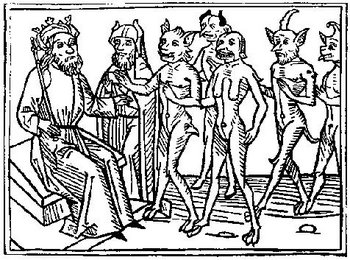
A woodcut of Belial and some of his followers from a German edition of Jacobus de Teramo's book Consolatio peccatorum, seu Processus Luciferi contra Jesum Christum (1473).

Belial (/ˈbli.əl/;[1] Hebrew: בְּלִיַּעַל, Bəlīyyaʿal) is a term occurring in the Hebrew Bible/Old Testament which later became personified as the devil[2] in Christian texts of the New Testament.[3] Alternate spellings include Baalial, Balial, Belhor, Beliall, Beliar, Berial, Bylyl and Beliya'al. Early usage of Belial referred to "wickedness" or "worthlessness", occurring several times in the Old Testament. Later, in the Dead Sea Scrolls (c. 300 BCE), Belial was personified as a demon.

In the Secret Book of John, an early Gnostic text, the ruler of the underworld is referred to as Belias.[4]

Hebrew Bible/Old Testament

[edit]

Belial is a Hebrew word "used to characterize the wicked or worthless". The etymology of the word is often understood as "lacking worth",[5] from two common words: beli- (בְּלִי "without-") and ya'al (יָעַל "to be of value").

Some scholars translate it from Hebrew as "worthless" (Beli yo'il), while others translate it as "yokeless" (Beli ol), "may he have no rising" or "never to rise" (Beli ya'al). Only a few etymologists have believed it to be an invented name from the start.[6]

The word occurs twenty-seven times in the Masoretic Text, in verses such as the Book of Proverbs (Proverbs 6:12), where the King James Version (KJV) translates the Hebrew phrase adam beli-yaal as "a naughty person".[7]

In the Hebrew text, the phrase is either "sons of Belial" or simply "sons of worthlessness".[8][9] Phrases beginning with "sons of" are a common Semitic idiom, such as "sons of destruction" or "sons of lawlessness".[10] In Semetic languages, the term "sons of" (in any context other than preceding the name of an actual human being) is better explained as "people defined by." "Sons of worthlessness/belial" means "people defined by worthlessness." Another common example of this is Aramaic term "Bar Mitzva" (literally "son of the commandment," but better translated as "one defined by the commandment" as it refers to an individual who is obligated to fulfill the commandment of God).

Of these 27 occurrences, the idiom "sons of Belial" (בְּנֵֽי־בְלִיַּעַל beni beliyaal) appears 15 times to indicate worthless people, including idolaters (Deuteronomy 13:13), the men of Gibeah (Judges 19:22, 20:13), the sons of Eli (1 Samuel 2:12), Nabal, and Shimei. The Geneva Bible (1560) uses "wicked", and at the Book of Judges 19:22 has the marginal note "Ebr [Hebrew] men of Belial: that is, given to all wickednes." In the KJV these occurrences are rendered with "Belial" capitalised:

  • "the sons of Eli were sons of Belial" (KJV)

In modern versions these are usually read as a phrase:

  • "the sons of Eli were worthless men" (1 Samuel 2:12, NRSV and NIV)
  • "the wicked men of the city" (Judges 19:22, NIV)

"Belial" is applied to ideas, words, and counsel, to calamitous circumstances, and most frequently, to worthless men of the lowest sort, such as men who would induce worship of other gods; those of Benjamin who committed the sex crime at Gibeah; the wicked sons of Eli; insolent Nabal; opposers of God's anointed, David; Rehoboam's unsteady associates; Jezebel's conspirators against Naboth; and men in general who stir up contention. Indicating that the enemy power would no longer interfere with the carrying out of true worship by his people in their land, YHWH declared through his prophet: "No more will any worthless person pass again through you. In his entirety he will certainly be cut off."

Second Temple period

[edit]

The term belial appears frequently in Jewish texts of the Second Temple period (texts classified by Christians as the Old Testament pseudepigrapha and apocrypha).[5] Also a large number of references to Belial are evidenced in the Dead Sea Scrolls discovered at Qumran from 1948.

Dead Sea Scrolls

[edit]

In The War of the Sons of Light Against the Sons of Darkness,[11] one of the Dead Sea Scrolls, Belial is the leader of the Sons of Darkness:

You made Belial for the pit, angel of enmity; in darkness is his domain, his counsel is to bring about wickedness and guilt. All the spirits of his lot are angels of destruction, they walk in the laws of darkness; towards it goes their only desire.[12]

In the Rules of the Community, God is depicted as saying, "I shall not comfort the oppressed until their path is perfect. I shall not retain Belial within my heart." Belial controls all demons, which are specifically allotted to him by God for the purpose of performing evil.[13] Belial, despite his malevolent disposition, is considered an angel.[14]

Belial's presence is found throughout the War Scrolls and is established as the force occupying the opposite end of the spectrum of God. In Col. I, verse 1, the first line of the document, it is stated that "the first attack of the Sons of Light shall be undertaken against the forces of the Sons of Darkness, the army of Belial."[15][16] This dichotomy sheds light on the negative connotations that Belial held at the time.

The War Scroll and the Thanksgiving hymns both delve into the idea that Belial is accursed by God and his people, and shows how the existence of Belial in this world can be attributed to the mysteries of God since we can not know why he permits the dealings of Belial to persist.

In the Dead Sea Scrolls, Belial is further contrasted with God. These are the Angel of Light and the Angel of Darkness. The Manual of Discipline identifies the Angel of Light as God himself. The Angel of Darkness is identified in the same scroll as Belial.[12]

The Dead Sea Scrolls also provide a recounting of a dream of Amram, the father of Moses, who finds two watchers contesting over him. One is Belial who is described as the King of Evil and Prince of Darkness. Belial is also mentioned in the Fragments of a Zadokite Work (which is also known as The Damascus Document (CD)), which states that during the eschatological age, "Belial shall be let loose against Israel, as God spoke through Isaiah the prophet."[17] The Fragments also speak of "three nets of Belial" which are said to be fornication, wealth, and pollution of the sanctuary.[18] In this work, Belial is sometimes presented as an agent of divine punishment and sometimes as a rebel, as Mastema is. It was Belial who inspired the Egyptian sorcerers, Jochaneh and his brother, to oppose Moses and Aaron. The Fragments also say that anyone who is ruled by the spirits of Belial and speaks of rebellion should be condemned as a necromancer and a wizard.

Jubilees

[edit]

In the Book of Jubilees, uncircumcised Israelites are called "sons of Belial".[19]

Testament of the Twelve Patriarchs

[edit]

Belial is also mentioned in the Testaments of the Twelve Patriarchs. The author of the work seems to be a dualist because he presents Belial as God's opponent, not as a servant, but does not mention how or why this came to be. Simeon 5:3 says that fornication separates man from God and brings him near to Belial. Levi tells his children to choose between the Law of God and the works of Belial[20] It also states that when the soul is constantly disturbed, the Lord departs from it and Belial rules over it. Naphtali[21] contrasts the Law and will of God with the purposes of Belial. Also, in 20:2, Joseph prophesies that when Israel leaves Egypt, they will be with God in light while Belial will remain in darkness with the Egyptians. Finally, the Testament describes that when the Messiah comes, the angels will punish the spirits of deceit and Belial[22] and that the Messiah will bind Belial and give to his children the power to trample the evil spirits.[23]

For many hath fornication destroyed; because, though a man be old or noble, it maketh him a reproach and a laughing-stock with Beliar and the sons of men.[24]

Ascension of Isaiah

[edit]

In the Ascension of Isaiah, Belial is the angel of lawlessness and "the ruler of this world", and identified as Samael and Satan.[2][failed verification]

And Manasseh turned aside his heart to serve Belial; for the angel of lawlessness, who is the ruler of this world, is Belial, whose name is Matanbuchus.

— (Ascension of Isaiah 2:4)[2]

Christianity/New Testament

[edit]

The word occurs just once in the New Testament, when Paul the Apostle asks:

[W]hat concord hath Christ with Belial? or what part hath he that believeth with an infidel?

The spelling found in most manuscripts of 2 Corinthians is actually Beliar (Βελιάρ) not Belial (Βελίαλ). This is the reading preferred by textual scholars[25] and the change of -l to -r is attributed to a common change in Aramaic pronunciation.[26][27]

The Jewish Greek Septuagint, later the Old Testament of the early Christian church, generally renders the "sons of Belial" verses in the Hebrew Bible either as "lawless men", by idioms "sons of the pestilence", rather than a personal name "sons of Belial":

  • andres paranomoi ("lawless men" ἄνδρες παράνομοι) (Deuteronomy 13:13)
  • huioi loimoi ("sons of the plague" υἱοὶ λοιμοὶ) (1 Samuel 2:12)

The Septuagint also avoids Belial in the singular so Shimei (2 Samuel 16:7) when he cursed David, "Come out, come out, thou bloody man, and thou man of Belial" is rendered "you lawless man" (paranomos), and Hannah to Eli "Count not thine handmaid for a daughter of Belial" is rendered "don't count your maidservant as a daughter of the pest."[28] The Latin Vulgate[29][30] and Syriac Peshitta Old Testaments in some cases follow the Greek, in other literalize as Hebrew. The single New Testament use is preserved "Belial" in Latin and Syriac.

Rabbinical literature

[edit]

The Talmud and rabbinical interpretation generally present Belial as an allegorical personification of evil, consistent with its usage in the Torah and later Jewish texts. The phrase "sons of Belial" appears in various rabbinic writings as a reference to wicked or corrupt individuals.[31]

The Teliya Yeshu (a variant of the Toledot Yeshu, a later medieval anti-Christian text) applies the name Belial to Yeshu, whom it describes as the son of Miriam Migdala. However, these writings are not part of mainstream Talmudic tradition and are generally considered polemical or satirical rather than historical.

The claim that Yeshu is the son of "Miriam Magdala" is misleading. The Talmud does not mention Mary Magdalene from the New Testament. Instead, it refers to a Miriam Migdala (מרים מגדלא), likely meaning "Miriam the hairdresser", which has no connection to the historical Mary Magdalene [citation needed]. Additionally, the figures Ben Stada and Ben Pandera (son of a Roman Soldier) are debated within Talmudic scholarship [by whom?], and there is no definitive evidence linking them to Jesus (Yeshua) of the New Testament [citation needed].[relevant?]

English literature

[edit]

John Milton, Paradise Lost, Book I:

BELIAL came last, than whom a Spirit more lewd
Fell not from Heaven, or more gross to love
Vice for it self: To him no Temple stood
Or Altar smoak'd; yet who more oft then hee
In Temples and at Altars, when the Priest
Turns Atheist, as did ELY'S Sons, who fill'd
With lust and violence the house of God.
In Courts and Palaces he also Reigns
And in luxurious Cities, where the noyse
Of riot ascends above thir loftiest Towrs,
And injury and outrage: And when Night
Darkens the Streets, then wander forth the Sons
Of BELIAL, flown with insolence and wine.
Witness the Streets of SODOM, and that night
In GIBEAH, when hospitable Dores
Yielded thir Matrons to prevent worse rape.

John Milton, Paradise Lost, Book 2:

... On th' other side up rose
BELIAL, in act more graceful and humane;
A fairer person lost not Heav'n; he seemd
For dignity compos'd and high exploit:
But all was false and hollow; though his Tongue
Dropt Manna, and could make the worse appear
The better reason, to perplex and dash
Maturest Counsels: for his thoughts were low;
To vice industrious, but to Nobler deeds
Timorous and slothful: yet he pleas'd the eare...

Robert Browning (1839), "Soliloquy of the Spanish Cloister", eighth stanza:

Or, my scrofulous French novel
   On gray paper with blunt type !
Simply glance at it, you grovel
   Hand and foot in BELIAL's gripe:
If I double down its pages
   At the woeful sixteenth print,
When he gathers his greengages,
   Ope a sieve and slip it in't?

Occult

[edit]

The 17th-century grimoire The Lesser Key of Solomon mentions Belial, as does Aleister Crowley's Goetia (1904) and Anton LaVey's The Satanic Bible (1969). In The Satanic Bible, Belial is listed as one of the Four Crown Princes of Hell, and the third book of The Satanic Bible is The Book of Belial.[32]

In 1937, Edgar Cayce used the term "sons of belial" and (in opposition to) the "sons of the law of one" for the first time in one of his deep trance readings given between 1923 and 1945. Cayce was often referred to as the "sleeping prophet" who gave over 2,500 readings to individuals while in a deep trance state. While his definition of the sons of belial was consistent with the Hebrew meaning of "worthless" individuals focused on self-gratification, Cayce went on to use the term frequently to compare opposing human forces at work in pre-historical times related to the early development of Atlantis.

[edit]

Popular culture in the 20th century included many references to Belial; notably in the celebrated silent film Nosferatu (1922), Aldous Huxley's novel Ape and Essence (1948), Philip K. Dick's novel The Divine Invasion (1981), the cult horror film Basket Case (1982), Dean Koontz's novel Phantoms (1983), and Graham Masterton's novel Master of Lies (1991). Belial has also experienced a resurgence in popularity during the 21st Century in numerous media, with video games being the most prominent.

  • In the anime series Digimon Adventure, the antagonist MaloMyotismon is known as “BelialVamdemon” in Japanese version.
  • In the Gothic game series Belial is the god of death.
  • In the Square Enix game Final Fantasy Tactics: The War of the Lions, a character named Wiegraf uses the power of a mystical stone and is then possessed by the demon "Belial".
  • In the 2005 horror film, The Exorcism of Emily Rose, Belial is featured as the Devil's representative who possesses the title character.
  • In the real-time strategy game Dungeon Keeper's Deeper Dungeons expansion the final level is titled "Belial".
  • In the role playing game Vampire: the Requiem, Belial's Brood is a covenant of vampires that serve Vice and evil forces, consorting with infernal spirits for power.
  • Blizzard Entertainment's video game Diablo 3 has Belial function as the final boss of Act 2 in its storyline. In the City of Caldeum, where Belial takes residence, there are definite Arabic tones for the art direction and setting in the aforementioned chapter. Also known as the "Lord of Lies" and the "Master of Deception", Belial is regarded as one of the four Lesser Evils and seven Great Evils in the mortal realm that seek to make this world an outpost of Hell itself.
  • Westwood Studios's PC game Lands of Lore: Guardians of Destiny features Belial as its main antagonist, portraying him as an evil god with a devil-like appearance.
  • In the Warhammer 40k universe Belial is the current Grand Master of the Deathwing of the Dark Angels Space Marine Chapter which has other characters named after bleaker Abrahamic entities, such as Samael, the poison of God, and Azrael, the Angel of Death.
  • In the mobile game Puzzle and Dragons, Belial is a monster that is part of the Archdemon series.
  • In the book The Little Ships by J.A. Sutherland, the main character sails in a spaceship named Belial.
  • "Belial's Meat" is a health item in the video game Off by Mortis Ghost.
  • In the video game Binding of Isaac, the Book of Belial is an activated item that increases damage for the current room.
  • In the mobile game Crash Fever [ja], Belial is one of the first protagonists.
  • In Granblue Fantasy, Belial is a "fallen angel", appearing in the What Makes The Sky Blue 2 and 3 event(s) as one of the main antagonists. Belial is also a summon in the gacha, and another summer variant summon. Belial has theme songs associated with his story. His costumes can be unlocked for the main character though in-game code.
  • Similarly, in Granblue Fantasy Versus fighting game and its sequel Granblue Fantasy Versus: Rising, Belial is a playable character.
  • "Belial" is the theme held in meditation by Vaughn Benjamin (the vocalist of Akae Beka) on the Midnite & Ras L Collaborative album Thru & True (2006).
  • Belial is referenced, among other demons, on Mayhem's 2014 studio album Esoteric Warfare. Belial is mentioned in "Pandaemon," the fourth track on the LP.
  • Lord Belial is a Swedish black metal band.
  • In the Ultra Series, Belial is the namesake of recurring villain Ultraman Belial, a rogue Ultraman that made a dark pact to gain the ability to control and merge with monsters, with his alternate forms occasionally taking on demonic appearances.
  • Belial is mentioned in the track "Fall from Grace" from Morbid Angel's 1991 album, Blessed Are the Sick.
  • In Cassandra Clare's bestselling Shadowhunter Chronicles, Belial is one of the Princes of Hell as well as the demonic father of a major character, Theresa Gray, who was the protagonist of The Infernal Devices. In Shadowhunters, the television adaptation of the novel series, Belial is the demonic father of a supporting character in season 3, the warlock Lorenzo Rey. Belial is mentioned as Lorenzo's father in the episode "City of Glass".
  • In the 2019 comedy horror film, Ready or Not, the name of the demonic presence, Mr. Le Bail, is an anagram for Belial.
  • In the Shin Megami Tensei and Persona games, Belial appears as a demon and persona to be used in combat.
  • In the 2021 Anime series Beyblade Burst Dynamite Battle the main character Bell Daikokuten named his Beyblade Dynamite Belial. Later on, he upgrades Dynamite Belial into Dangerous Belial after its destruction. The name of the bey, however, was changed to Belfyre in the dub and in Hasbro toy releases.
  • In Season 2 episode 5 of The Chosen, Caleb is possessed by Belial and shares who he is while conversing with Mary.
  • In The Wheel of Time, one of the Forsaken is named Belal, a reference to Belial.
  • In the anime and manga series Welcome to Demon School! Iruma-kun, Belial is an elderly man who butts heads with the protagonist's grandfather.

See also

[edit]

References

[edit]
[edit]
Revisions and contributorsEdit on WikipediaRead on Wikipedia
from Grokipedia
Belial (Hebrew: בְּלִיַּעַל, bĕlīyaʿal) is a term originating in the Hebrew Bible, etymologically derived from bĕlî ("without") and yaʿal ("to be of use" or "to profit"), literally signifying "worthlessness," "lawlessness," or "wickedness." In its biblical usage, it appears 27 times, most commonly in the phrase "sons of Belial" (bĕnê bĕlīyaʿal) to denote morally corrupt or rebellious individuals, such as scoundrels who incite idolatry (Deuteronomy 13:13) or the depraved men of Gibeah in Judges 19:22. The term is never employed as a proper name in the Hebrew Bible but rather as an abstract noun characterizing evil actions or worthless people, often translated in the Septuagint as paranomos ("lawless") or similar terms. In intertestamental , particularly the Dead Sea Scrolls, Belial evolves into a personified demonic entity, portrayed as the prince of darkness and adversary of God, ruling over evil spirits and ensnaring humanity through temptations like the "three nets of Belial"—, , and defilement of the —as described in the (CD 4:15) and rooted in earlier traditions from the Levi Document. This personification reflects sectarian critiques of corrupt temple practices and positions Belial as a central figure in cosmic dualism, influencing the community's withdrawal from mainstream . In the , Belial appears only once, in 2 Corinthians 6:15, where the Apostle Paul contrasts Christ with Belial (Beliar in Greek) to emphasize incompatibility between righteousness and lawlessness, marking an early Christian adoption of the figure as a for . Subsequent further elaborates Belial as a high-ranking demon, often depicted as a king of Hell in grimoires and associated with vices like impurity, lies, and , though these developments build on Jewish apocalyptic traditions rather than direct biblical foundations. Across these contexts, Belial symbolizes the embodiment of moral and spiritual corruption, serving as a theological foil to divine order in Abrahamic traditions.

Etymology and Origins

Linguistic Roots

The term "Belial" originates from the Hebrew בְּלִיַּעַל (bəlîyaʿal), a compound word formed from בְּלִי (bəlî, meaning "without" or "not") and יַעַל (yaʿal, from the root יָעַל, denoting "to profit," "to be useful," or "to ascend"). This etymology yields the sense of "worthlessness," "uselessness," or "without profit," reflecting an abstract concept of futility or moral baseness in ancient Hebrew usage. In the , בְּלִיַּעַל functions primarily as an abstract noun or adjective, appearing 27 times to describe moral corruption, , or destructive tendencies, often in the context of human depravity or societal ruin. Alternative scholarly proposals include derivations from the root בָּלַע (bālaʿ, "to swallow" or "to engulf"), implying notions of destruction or devouring chaos, though the "without worth" interpretation remains the most widely accepted among lexicographers like Gesenius and in standard references such as Brown-Driver-Briggs. Phonetically, the term undergoes variation in Greek transliterations as Βελίαλ (Belial) or Βελιάρ (Beliar), particularly in the Septuagint and intertestamental literature, where the form's resemblance to a proper name facilitated its later evolution from an abstract epithet toward personified connotations in theological texts.

Early Conceptual Development

In pre-exilic Jewish thought, the term Belial transitioned from a mere descriptor of worthlessness to a symbolic embodiment of chaos and rebellion against divine order, particularly within prophetic and narrative traditions that emphasized social and moral disruption. This abstraction highlighted Belial as representative of forces undermining communal stability and ethical norms, reflecting broader theological concerns with covenantal fidelity. The Babylonian exile further shaped this conceptualization, transforming Belial into a for moral decay amid cultural upheaval. Early uses in the maintained a non-personified character for Belial, associating it with folly and lawlessness as human vices rather than entities, thereby reinforcing didactic warnings against deviant behavior without attributing demonic qualities. Scholars continue to debate the precise nature of this early , with some positing Belial as a deified notion of nothingness—rooted in its etymological sense of "without worth"—while others view it as an incipient dualistic counterforce to , albeit remaining impersonal in pre-exilic contexts.

Biblical References

Hebrew Bible

In the , the term Belial (Hebrew: בְּלִיַּעַל, beli yaʿal), meaning "worthlessness" or "wickedness," functions primarily as an epithet to denote moral , , or , rather than as a proper name for a being. It appears approximately 27 times, often in the compound phrase "sons of Belial" (bene beliyaʿal), which describes individuals who embody societal threats through their actions. This usage underscores human agency in evil, aligning with the Deuteronomistic emphasis on covenant fidelity and the consequences of deviation. A prominent example occurs in Deuteronomy 13:13, where "sons of Belial" refers to worthless men who incite their community to by advocating worship of foreign gods, portraying such as a direct on communal to . Similarly, in Judges 19:22, the term labels violent debauchees who besiege a Levite's host in , demanding sexual access to his concubine; their actions precipitate her and the ensuing , symbolizing profound social and moral disorder in early Israelite tribal life. In 1 Samuel 2:12, Eli's sons are deemed "sons of Belial" for their sacrilegious of priestly offerings and exploitation of worshippers, exemplifying against divine and familial that leads to the downfall of Shiloh's priesthood. Thematically, Belial consistently evokes patterns of , , and disruption, particularly in the Deuteronomistic histories (Deuteronomy through 2 Kings) and prophetic literature. For instance, in 1:11, a "counselor of Belial" emerges from to devise wicked plans against , linking the term to imperial aggression and prophetic judgment on Assyria's hubris. These motifs reflect Israelite society's (ca. 1200–586 BCE) preoccupation with condemning and ethical lapses as existential dangers to the covenant community, reinforcing calls for purity amid threats from neighboring cultures and internal strife.

New Testament

The only explicit reference to Belial in the New Testament occurs in 2 Corinthians 6:15, where the Apostle Paul poses a rhetorical question: "What accord has Christ with Belial?" This verse forms part of a larger exhortation in 2 Corinthians 6:14–7:1, urging Corinthian believers to avoid close associations with unbelievers through a series of antithetical contrasts, such as righteousness and lawlessness, light and darkness, and Christ and Belial. In this context, Belial serves as a symbolic antithesis to Christ, representing the epitome of opposition to divine order and embodying the forces of evil that threaten the purity of the Christian community. Scholars interpret Belial in this passage as a personified figure of , often equated with or the prince of darkness, reflecting a development from its earlier uses as an abstract term for worthlessness in the to a demonic entity in Jewish intertestamental . This personification draws directly from Jewish traditions, where Belial emerges as a subordinate yet powerful angelic adversary who tests and tempts the faithful, as seen in texts like the Dead Sea Scrolls. In Pauline usage, Belial thus symbolizes not only spiritual wickedness but also the corrupting influence of pagan and imperial powers, aligning with apocalyptic motifs that demonize earthly rulers as agents of cosmic . Within Paul's theology, the reference underscores a stark dualism between the realm of and that of evil, emphasizing the need for believers to maintain separation from unbelievers to preserve their identity as the temple of the living . Belial here epitomizes pagan corruption, evoking the moral and spiritual perils of unequal yoking with non-Christians, which could lead to compromise in the face of Greco-Roman cultural pressures. This rhetorical strategy reinforces Paul's broader theme of ethical purity and communal holiness, positioning Belial as the ultimate counterforce to Christ's redemptive work. The New Testament's employment of the term Belial is shaped by the , the Greek translation of the Hebrew Scriptures, where the Hebrew beliya'al—denoting worthlessness or wickedness—occurs 26 times and is rendered variously as terms like "transgressor," "impious," or "lawless one," preserving its connotations of moral disorder. This translational tradition facilitated the term's adoption into Greek-speaking Christian contexts, allowing Paul to invoke Belial as a familiar symbol of evil drawn from Jewish scriptural heritage, thereby bridging epithets with emerging .

Intertestamental Period

Dead Sea Scrolls

In the sectarian writings of the , Belial emerges as a central figure in the community's cosmic dualism, depicted as the prince of evil forces opposing and the "sons of light." This portrayal reflects the Essene theology of two predetermined lots—light and darkness—where Belial governs the realm of iniquity under divine sovereignty, serving to test humanity's until the eschatological victory of . Belial's role underscores a ethical and spiritual conflict, where his influence provokes rebellion against but remains subordinate to the ultimate divine plan. The War Scroll (1QM) vividly presents Belial as the leader of the "sons of darkness" in the final apocalyptic battle, commanding an army that includes earthly nations like , , and the , alongside demonic hosts. The text opens with the sons of light launching their assault against "the forces of the Sons of Darkness, the army of Belial," framing the seven-stage war as a that culminates in Belial's eternal defeat and the annihilation of his dominion in the seventh confrontation. Belial is cursed as an "angel of malevolence" made for the pit, inspiring hostility toward the community of light through spirits of injustice, yet his forces are ultimately subdued by God's hand (1QM 13:10–11; 17:5–8). In the Community Rule (1QS), Belial functions as the "angel of darkness," apportioning dominion to the spirits of that govern the wicked and lead the "children of falsehood" into and of the righteous (1QS 3:18–25). The Levites invoke curses upon "all the men of the lot of Belial," marking the damned as those ensnared by his rule during the present age of testing (1QS 2:4–5, 19). This dualistic framework emphasizes Belial's permitted authority to blind and corrupt, contrasting with the spirit of truth that guides the , until intervenes to purge evil in the final war (1QS 4:18–26). Belial appears in at least 11 key passages across these texts, consistently highlighting his oversight of the spirits of and the "lot of Belial" as the domain of the reprobate.

Pseudepigraphal Texts

In the pseudepigraphal literature of the Second Temple period, Belial emerges as a fully personified demonic figure, often portrayed as the chief antagonist to God and humanity, commanding evil spirits and tempting the righteous into sin. This development builds on biblical allusions but expands Belial into a cosmic ruler whose influence threatens Israel's fidelity to the covenant. Key texts such as the Testament of the Twelve Patriarchs, the Book of Jubilees, and the Ascension of Isaiah depict him as a seducer and oppressor, emphasizing moral and spiritual warfare. The Testament of the Twelve Patriarchs presents Belial (or Beliar) as the chief of malevolent spirits who infiltrate human life from birth, inciting specific vices to ensnare individuals. In the Testament of Reuben, for instance, Belial dispatches seven spirits that provoke youthful sins, prominently including , which is described as a gateway allowing Belial to "prevail against" the sinner unless resisted through . Similarly, in the Testament of Dan, one of Belial's spirits tempts with and violence, urging the murder of , while pride and anger grant Belial dominion over the mind, displacing . The patriarchs repeatedly warn their descendants to eschew Belial's works—contrasted with God's law—lest they fall under his bondage, as seen in exhortations like "keep the Lord’s commandments... and Belial [will] fly from you." Eschatological hope is offered through a future messianic figure who will bind Belial and empower the righteous to trample evil spirits. In the , Belial is associated with , the prince of evil spirits, as a leader of who corrupt humanity, particularly in the post-flood era. Although not always named directly as Belial, the text links this figure to the adversarial role of tempting and accusing ; for example, in Jubilees 1:20, prays that "the spirit of Belial" not rule over the people to accuse them before . , equated or paralleled with Belial in scholarly interpretations of related fragments, petitions to retain a tenth of the demons after the flood to continue misleading Noah's descendants into warfare and , thus perpetuating human depravity. This role underscores Belial's function as an agent of ongoing corruption, testing fidelity to divine commandments from the patriarchal narratives onward. The further personifies Belial as the "angel of lawlessness" and "ruler of this world," synonymous with and , who wields authority over earthly powers to persecute the prophets. In chapters 1-5, Belial indwells King Manasseh, inspiring him to apostatize and orchestrate Isaiah's martyrdom by sawing, as vengeance for the prophet's visions condemning Jerusalem's . Belial's descent and rule are tied to the world's creation, but his influence is temporary, destined to end with . Across these texts, common themes portray Belial as hierarchically supreme over demonic forces, seducing through targeted temptations like , , and , while promising ultimate defeat in an eschatological triumph where he is bound or cast into . This dualistic framework highlights Belial's opposition to , urging ethical vigilance to evade his dominion.

Rabbinic and Medieval Judaism

Talmud and Midrash

In the Babylonian Talmud, Belial is etymologically dissected in Sanhedrin 111b as "beli 'ol" (without a ), denoting individuals or forces that reject divine authority and the commandments of . This interpretation frames Belial as a of and moral disorder, consistent with its biblical usage as a descriptor for the wicked. Rashi's commentary on Deuteronomy 13:14 echoes this view, explaining Belial as one who casts off the of , thereby emphasizing its role in legal and ethical discussions within rabbinic . Midrashic expands on this concept, portraying Belial as synonymous with and opposition to divine rule. In Deuteronomy 93, the term is glossed as utter disregard for heavenly law, linking it to and ethical transgression. Samuel (chapter 6) further identifies Belial with adversarial forces akin to , positioning it as an antagonist that challenges God's sovereignty but remains subordinate. These expansions often occur in homiletic contexts, where Belial symbolizes the seductive pull toward sin, much like its tempter role in intertestamental texts. In aggadic narratives, Belial functions as a tempter active in human trials, inciting false and among the people of while always under God's control. This rabbinic portrayal subordinates Belial to a lesser demonic , reflecting a theological framework that asserts divine amid surrounding cultural influences. While rabbinic texts largely retain Belial as a descriptor for , later apocalyptic and Kabbalistic works increasingly personify it as a demonic .

Apocalyptic and Kabbalistic Traditions

In the seventh-century Jewish apocalyptic text Sefer Zerubbabel, —a monstrous end-times born from the union of and a statue in —rises as a false king claiming messianic status and wages war against the people of . In some related traditions, Armilus is called the "son of Belial." gathers armies to besiege , slays the , and embodies ultimate wickedness until his defeat and death at the hands of the Davidic , who pierces him with a branch from a great cedar, ushering in redemption. This narrative positions such figures within eschatological chaos central to the final redemption sequence. Kabbalistic traditions further develop Belial as a manifestation of the klipot, the husks or shells of impurity that obscure divine light and represent cosmic imbalance. In the , Belial is associated with the forces of the sitra achra (the other side), particularly embodying the unbalanced severity of the sefirah Geburah on the , where strict judgment devolves into destructive evil without the tempering influence of mercy. This portrayal underscores Belial's role in trapping holy sparks (nitzotzot) within impure realms, requiring mystical rectification (tikkun) to restore harmony. Building briefly on Talmudic depictions of Belial as a subordinate , Kabbalah elevates him to a metaphysical adversary in the structure of creation. Medieval Jewish apocalyptic texts reflect influences from Christian and Islamic eschatological motifs, adapting elements like the into narratives of cataclysmic wars, where demonic forces associated with Belial align with the forces of in the battle of the end days. These syncretic developments emphasize orchestration of global upheaval preceding divine victory, enriching with broader Abrahamic apocalyptic imagery.

Early and Medieval Christianity

Patristic Writings

In his , Origen links Belial to wickedness and the devil, portraying the "sons of Belial" in the as exemplifying those influenced by demonic forces, which he equates with the demons worshiped as pagan gods criticized by . This interpretation connects Belial to as an adversary promoting and moral corruption. Tertullian identifies Belial as a name for , drawing on 2 Corinthians 6:15 to emphasize the incompatibility between Christ and Belial, using this in his writings to refute heresies like by contrasting Belial's association with wickedness against the unity of law and gospel. Lactantius, in his Divine Institutions, depicts (also rendered as Beliar) as a chief who instigated a primordial rebellion against , aligning with Jewish apocalyptic narratives of angelic defection and subsequent demonic influence on humanity. He describes Belial's role in leading other angels into , resulting in their transformation into demons that propagate and , thereby framing Belial as the archetypal source of cosmic disorder. Across 2nd- to 4th-century patristic literature, Belial served as a potent symbol of and , representing the satanic forces that ensnared souls in falsehood; early invoked this imagery in anti-heretical polemics to depict deviant teachings as offspring of Belial's deceit, as seen in Tertullian's and Origen's works.

Demonological Classifications

In medieval , Belial was frequently classified as one of the principal demons subordinate to , reflecting the scholastic effort to systematize the hierarchy of based on biblical and patristic traditions. This classification drew from earlier identifications of Belial with in patristic writings, where the term evolved from a biblical for wickedness to a personified demonic entity. Thomas Aquinas, in his Summa Theologica (1265–1274), references Belial in discussions of demonic temptations, linking the demon to vices such as and , which align with the Hebrew of "Belial" as "without worth" or "lawless one" from 2 Corinthians 6:15. Aquinas uses the "What concord hath Christ with Belial?" to illustrate the incompatibility between divine order and demonic disorder, portraying Belial's influence as a toward spiritual rebellion and moral anarchy. This theological framing underscores Belial's role in inciting humanity away from God's law, integrating scriptural with of evil. Belial's hierarchical position in these texts often mirrors pseudo-Aristotelian celestial orders, adapted to infernal realms, where he ranks as a or commanding legions of subordinate demons—typically eighty legions in later compilations, though medieval sources vary. Such structures, influenced by scholastic angelology, portrayed Belial as a high-ranking infernal lord responsible for distributing titles, favors, and deceptions, reinforcing the organized nature of hell's in contrast to divine .

Occult and Esoteric Traditions

Renaissance Grimoires

In Renaissance grimoires, Belial is prominently featured as a high-ranking amenable to for practical magical ends, particularly in texts derived from Solomonic traditions. The Lesser Key of Solomon, also known as the Lemegeton, describes Belial as the 68th spirit, a mighty and powerful king created immediately after and of his order, who governs 80 legions of spirits. He appears in the form of a beautiful sitting in a chariot of fire, speaking with a comely voice, and declares that he fell first among the worthier and wiser sort of s before Michael and others. Belial distributes preferments such as senatorships, causes favor among friends and foes to reconcile enmities, and provides excellent familiars to the conjurer. The by , published in 1577 as an appendix to , presents a closely related depiction of Belial as a ruling 80 legions, drawn partly from the order of Virtues and partly from Angels, created soon after and regarded as the father and seducer of many . In this text, Belial similarly appears as a beautiful angel seated upon a fiery and bestows senatorial dignities, reconciles adversaries, and yields excellent familiars, though he answers truly only when constrained by divine power and requires offerings to remain truthful beyond an hour. Unlike some lesser spirits, Belial's loyalty is tied to , and he is noted for revealing hidden knowledge pertinent to earthly affairs and conflicts, echoing his role as a revealer of secrets of war and the earth. Ritual procedures for summoning Belial in these grimoires emphasize protective measures and precise timing to counter his deceptive allure, often warning that his beautiful form and soft voice mask treachery. The conjurer must wear Belial's sigil—a complex geometric seal—as a lamen over the heart during the evocation to command obedience, while offerings, sacrifices, and gifts are mandatory to ensure truthful responses, as Belial tarries not in veracity without them unless compelled by superior divine names. Invocations are ideally performed during the planetary hours of Venus for matters of favor and reconciliation or Saturn for binding his power, aligning with his associations in Solomonic planetary magic—though such planetary associations are not universal across all occult traditions—to enhance efficacy. These practices underscore the grimoires' cautionary tone: despite his grants of honors, Belial's beauty serves as a veil for recklessness and guile, demanding the magician's unyielding authority. This portrayal of Belial in 16th- and 17th-century European grimoires reflects the synthesis of , particularly Kabbalistic angelology and demonology, with Arabic magical texts transmitted through medieval translations, influencing Christian occultists like whose De occulta philosophia (1533) integrated such elements into a hierarchical cosmology of spirits. Agrippa's framework of celestial influences and sigillary evocation directly shaped later Solomonic compilations, adapting Semitic names and invocations—such as those derived from the —to while preserving Belial's status amid medieval demonic ranks like the infernal kings.

Modern Occultism

In the early 20th century, Aleister Crowley incorporated Belial into his Qabalistic system in Liber 777 and Other Qabalistic Writings of Aleister Crowley, Including Gematria and Sepher Sephiroth (1909, revised 1955), attributing the demon to the twenty-eighth path on the Tree of Life, corresponding to the Hebrew letter Tzaddi (from Netzach to Yesod). There, Belial is depicted as "two beautiful angels sitting in a chariot of fire," symbolizing dynamic forces of independence and fiery transformation within Thelemic pathworking practices. This attribution positions Belial as an entity for meditative exploration of personal will and mystical ascent, aligning with Crowley's emphasis on confronting inner barriers to self-realization in works like Magick in Theory and Practice (1929). In contemporary demonolatry, E.A. Koetting's The of Belial: The Calling (2019), the first volume of the Nine Demonic Gatekeepers series, portrays Belial as the inaugural gatekeeper from the , serving as a primordial force for practitioners to invoke through rituals that foster against spiritual conformity and unlock personal power. These rites, including evocations for dominion and self-sovereignty, emphasize Belial's role in dismantling egoic limitations and accessing , as detailed in chapters on "Darkness Communion" and "Mirror Gate." Extending this lineage, Seth Helix's Daemonium and Belial: The Infernal (2025) compiles invocations and sigils for Belial as a chaotic initiator, focusing on rituals that blend traditional goetic elements with modern eclectic approaches to empowerment and autonomy. Within and paradigms, Belial embodies the archetype of lawlessness and self-determination. In Anton Szandor LaVey's (1969), Belial ranks as one of the four Crown Princes of Hell—alongside , , and —governing the element of Earth and representing carnal independence from moral impositions, as explored in "The Book of Belial," which outlines Satanic rituals for asserting individual will. In some modern demonolatry interpretations, such as the Dukante hierarchy, this earth association is extended to a deliberate link with the planet Saturn, symbolizing sovereignty, limitation, and earth elemental forces, though this connection is not universal across all occult traditions; some independent sources describe Belial as sometimes associated with Saturn for similar reasons. Chaos magicians, drawing from this framework, utilize Belial as a psychological or thoughtform for paradigm-shifting operations that promote , often in non-hierarchical workings inspired by Peter J. Carroll's Liber Null & Psychonaut (1987), where demonic archetypes facilitate ego transcendence and adaptive reality manipulation. Recent trends in online occult literature and communities highlight Belial's invocation for psychological empowerment, with 2020s publications emphasizing his role in shadow integration and personal sovereignty. For instance, Asenath Mason's Belial: Without a Master (part of the 2019–2025 Nine Demonic Gatekeepers saga) frames Belial as a catalyst for therapeutic rebellion, using evocations to confront and dissolve internalized authority structures. Similarly, the 2024 grimoire Belial's Path to Power: Achieving Success and Influence details meditative and ritual techniques for harnessing Belial's energy in self-development, portraying him as a modern archetype for overcoming societal constraints through inner alchemy and empowerment practices. These works reflect a broader shift toward viewing Belial not merely as a destructive force but as a tool for mental resilience and ethical individualism in esoteric circles.

Cultural Depictions

Literature

In English literature, Belial emerges as a of , often embodying , lewdness, and seductive rather than overt . Edmund Spenser's (1590) draws on biblical connotations of Belial as wickedness to depict "sonnes of Belial" as figures driven by "outrageous lusts" and moral corruption, symbolizing the unchecked passions that undermine in allegorical encounters. This portrayal aligns with Spenser's broader moral framework, where Belial-like vices tempt characters toward ethical decay without the brute force of more demonic adversaries. John Milton's Paradise Lost (1667) elevates Belial to a prominent , described as the lewdest spirit who "fell not from Heaven, or more gross to love / Vice for it self," profaning sacred spaces through corruption rather than worship. In Book II, during the infernal council, Belial delivers an eloquent speech advocating passive endurance of their hellish fate over futile war, urging his peers to "sit in darkness" and find ease in slothful resignation, thus representing a insidious, non-confrontational evil that seduces through hollow reason. Milton contrasts Belial's smooth persuasion—deemed "false and hollow" by the narrator—with the fiery aggression of demons like or Satan's ambitious defiance, highlighting as a tool of vice. Milton's depiction influenced Romantic interpretations of infernal figures, contributing to a tradition of viewing Milton's devils sympathetically as rebels against divine tyranny, though Belial's slothful subtlety tempers this heroism. , in works like Milton: A Poem (–1810), reimagines Belial as an "obscure of Bribes" tied to "secret Assassinations," extending the theme of seductive into prophetic visions of moral ambiguity. Belial's literary archetype thus persists as a symbol of vice through rhetorical seduction, distinct from the violent rebellion of figures like Satan, emphasizing the dangers of passive moral surrender. In video games, Belial is prominently featured as a formidable demonic antagonist embodying deception and lies. In Blizzard Entertainment's Diablo series, spanning from the 1990s to the 2020s, Belial is depicted as the Lord of Lies, one of the four Lesser Evils, serving as the Act II boss in Diablo III where players confront his multi-phase transformations within the corrupted city of Caldeum. He reappears in Diablo IV's Season 8 (released in 2025) as a challenging boss in the Palace of the Deceiver dungeon, tied to endgame apparition incursions that test player strategies against his illusion-based attacks. Similarly, in Atlus's Shin Megami Tensei franchise, Belial functions as a summonable demon of the Tyrant race with Chaos alignment, often involved in narratives of rebellion and falsehood, as seen in Shin Megami Tensei V where he can be fused and wields skills like Mudobarion for severe dark damage. Belial's portrayals in film and television emphasize his role as a cunning trickster or possessing force in supernatural horror contexts. In the Arrowverse's portrayal of John Constantine on Legends of Tomorrow (Season 4, Episode 15: "Terms of Service," 2019), Belial is one of Hell's ruling Triumvirate of demons alongside Satan and Beelzebub, engaging in deceptive bargains with Constantine to manipulate souls and maintain infernal power structures. The character is portrayed by actor Mel Tuck as a sly, aristocratic demon in costume who exploits human vulnerabilities for hellish gains. In the 2023 Peacock animated series Fright Krewe, Belial serves as the primary antagonist, an ancient demon who possesses the 19th-century voodoo practitioner Pierre D'Rousseau to orchestrate a plot merging New Orleans folklore with apocalyptic horror, using mind control and spectral minions to corrupt the protagonists. In music, particularly heavy metal, Belial inspires band names and lyrical themes centered on infernal rebellion and satanic motifs. The Swedish black metal band Lord Belial, formed in 1992, draws directly from the demon's lore in albums like Realm of a Thousand Burning Souls (1997), blending melodic riffs with lyrics invoking Belial as a symbol of unholy dominion and anti-religious defiance. Finnish death metal pioneers Belial, active from 1991 to 1995, further embed the figure in their discography, such as the album The Gods of the Pit Pt. II (2023 reissue), where tracks explore themes of primordial evil through raw, aggressive soundscapes. Comics depict Belial as a high-ranking infernal often entangled in familial and power struggles within realms. In DC Comics' modern runs, such as The Demon: is (2017-2018 miniseries), Belial is portrayed as an of Hell and the father of the rhyming Etrigan, scheming to invade through demonic hordes while clashing with his son in battles that highlight themes of betrayal and otherworldly politics. This characterization positions him as a manipulative anti-heroic figure whose ambitions drive cross-dimensional conflicts, influencing titles like .

References

Add your contribution
Related Hubs
User Avatar
No comments yet.