Hubbry Logo
Joey MaximJoey MaximMain
Open search
Joey Maxim
Community hub
Joey Maxim
logo
8 pages, 0 posts
0 subscribers
Be the first to start a discussion here.
Joey Maxim
Joey Maxim
from Wikipedia

Giuseppe Antonio Berardinelli (March 28, 1922 – June 2, 2001) was an American professional boxer. He was the World Light Heavyweight Champion from 1950 to 1952. He took the ring-name Joey Maxim from the Maxim gun, the world's first self-acting machine gun, based on his ability to rapidly throw a large number of left jabs.

Key Information

Early life

[edit]

Maxim was born and raised in Collinwood, a neighborhood of Cleveland, Ohio.[citation needed]

Career

[edit]

Early career

[edit]

Maxim learned to box at a very young age. Following a successful amateur career, during which he won the Golden Gloves, he turned professional in 1940. Maxim boxed fairly regularly at exhibitions during the war years while serving as a military police officer at Miami Beach, Florida.

Maxim becomes world champion

[edit]
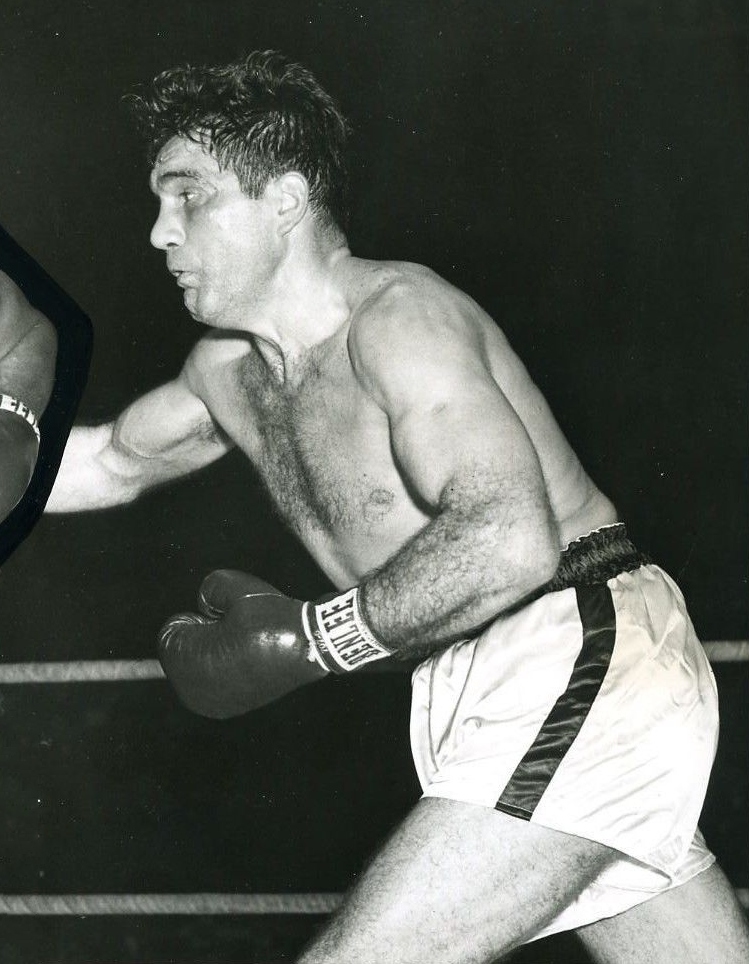
Joey Maxim exchanges blows with Ezzard Charles in 1951

It is somewhat surprising that Maxim had to wait so long for a world title shot, he was 28 and had already fought 87 times as a professional, considering his undoubted ability. His chance came on January 24, 1950, against British boxer Freddie Mills, who was making his first defense, at London's Earl's Court Exhibition Centre. Maxim, very much the underdog against the popular Englishman, won the fight by knockout in the 10th round. After the fight three of Mills's teeth were found embedded in Maxim's left glove, Mills never fought again.

Maxim's next major fight was on May 30, 1951, when he made a bid for Ezzard Charles's world heavyweight title. Maxim was unsuccessful, losing on points.

June 25, 1952: Joey Maxim vs. Sugar Ray Robinson

[edit]

The most famous fight of Maxim's career was on June 25, 1952, when he made his second defense of his world light heavyweight crown, against Sugar Ray Robinson at Yankee Stadium. The fight had originally been scheduled for June 23, but was postponed due to torrential rain. By the time the fight took place New York City was in the midst of a record heat wave.

During the fight Robinson built up a large points lead over the champion, although Maxim began to come on later in the fight. Robinson gradually succumbed to hyperthermia and Maxim's harder punches. He collapsed to the canvas at the end of the 13th round, but managed to stagger back to his corner. However, Robinson failed to answer the bell at the start of the 14th, even though he only had to remain on his feet to win the fight and Maxim won by a technical knockout. This was the only time that Robinson was stopped in his 200 fight career.

By this time the original referee, Ruby Goldstein, had himself been forced to retire from the fight after collapsing into the ropes complaining that he could no longer continue. This meant that a substitute referee, Ray Miller, had to be called out to finish the fight. Goldstein and Robinson were not the only people who had to be stretchered from the stadium: several dozen spectators also collapsed during the fight. Between them, the two fighters lost over 20 pounds in weight during the fight.

Late career

[edit]

Despite winning, the Robinson fight took a heavy toll on Maxim. He lost his world title six months later to the veteran Archie Moore. Following this loss Maxim, formerly one of the division's most active fighters, fought only 14 fights in the remaining 6 years of his career. These fights included two rematches with "The Old Mongoose" Archie Moore, both of which Maxim lost. Maxim retired in 1958 after losing six consecutive fights.

Maxim retired with a record of 82 wins (21 by KO), 29 losses, and 4 draws; in his 115 fight career, he was knocked out only once. During his career he defeated such legendary figures as Jersey Joe Walcott, Jimmy Bivins, Sugar Ray Robinson, and Floyd Patterson.

Life after boxing

[edit]
"Goldilocks and the Three Bares" poster

After his retirement Maxim spent time as a stand-up comic, restaurateur, and taxi driver. He also served as a greeter at hotels and casinos located in Las Vegas.[1]

He appeared in Herschell Gordon Lewis's 1963 nudie-cutie Goldilocks and the Three Bares as himself, playing a nightclub owner. The movie was billed as the "first nudist musical." He was prominently featured on the movie poster, with the blurb:

"It's me...Joey Maxim, the former world's light heavyweight champion! I'm one of the stars! My first screen appearance."

The role did not lead to any more motion picture work, though he did appear as an extra in the 1999 film Play It to the Bone.

He was inducted into the International Boxing Hall of Fame in 1994.

Maxim's wife Michelina, with whom he had two daughters, died in 1977.

In February 2001, Maxim suffered a stroke. He died in West Palm Beach, Florida on June 2, 2001.[2] In addition to his daughters, he was survived by his mother, Henrietta Berardinelli, who was 97 years old (died at 101 in 2006), and six great-grandchildren.[3]

Professional boxing record

[edit]
115 fights 82 wins 29 losses
By knockout 21 1
By decision 61 27
By disqualification 0 1
Draws 4
No. Result Record Opponent Type Round Date Location Notes
115 Loss 83–28–4 Ulli Ritter PTS 10 May 17, 1958 Eisstadion am Friedrichspark, Mannheim, Baden-Württemberg
114 Loss 83–27–4 Giacomo Bozzano PTS 10 Apr 27, 1958 Milan, Lombardy
113 Loss 83–26–4 Heinz Neuhaus PTS 10 Apr 12, 1958 Killesbergpark, Stuttgart, Baden-Württemberg
112 Loss 83–25–4 Bobo Olson SD 10 Jun 18, 1957 Portland Auditorium, Portland, Oregon
111 Loss 83–24–4 Eddie Machen UD 10 May 3, 1957 Freedom Hall, Louisville, Kentucky
110 Loss 83–23–4 Eddie Machen UD 10 Jan 25, 1957 Miami Beach Auditorium, Miami Beach, Florida
109 Win 83–22–4 Edgardo Romero PTS 10 Sep 29, 1956 Vancouver, British Columbia
108 Loss 82–22–4 Willie Pastrano UD 10 Jun 28, 1955 New Orleans Municipal Auditorium, New Orleans, Louisiana
107 Loss 82–21–4 Bobo Olson UD 10 Apr 13, 1955 Cow Palace, Daly City, California
106 Win 82–20–4 Paul Andrews UD 10 Nov 24, 1954 Chicago Stadium, Chicago, Illinois
105 Win 81–20–4 Floyd Patterson UD 8 Jun 7, 1954 Boxing From Eastern Parkway, Brooklyn, New York
104 Loss 80–20–4 Archie Moore UD 15 Jan 27, 1954 Miami Orange Bowl, Miami, Florida For NBA, NYSAC, and The Ring light heavyweight titles
103 Loss 80–19–4 Archie Moore UD 15 Jun 24, 1953 Ogden Stadium, Ogden, Utah For NBA, NYSAC, and The Ring light heavyweight titles
102 Win 80–18–4 Danny Nardico UD 10 Mar 4, 1953 Miami Stadium, Miami, Florida
101 Loss 79–18–4 Archie Moore UD 15 Dec 17, 1952 Arena, Saint Louis, Missouri Lost NBA, NYSAC, and The Ring light heavyweight titles
100 Win 79–17–4 Sugar Ray Robinson RTD 14 Jun 25, 1952 Yankee Stadium, Bronx, New York Retained NBA, NYSAC, and The Ring light heavyweight titles
99 Win 78–17–4 Ted Lowry UD 10 Mar 6, 1952 Saint Paul Auditorium, Saint Paul, Minnesota
98 Loss 77–17–4 Ezzard Charles UD 12 Dec 12, 1951 Cow Palace, Daly City, California
97 Win 77–16–4 Irish Bob Murphy UD 15 Aug 22, 1951 Madison Square Garden, New York City Retained NBA, NYSAC, and The Ring light heavyweight titles
96 Loss 76–16–4 Ezzard Charles UD 15 May 30, 1951 Chicago Stadium, Chicago, Illinois For NBA, NYSAC, and The Ring heavyweight titles
95 Win 76–15–4 Hubert Hood KO 3 Jan 27, 1951 Indianapolis Naval Reserve Armory, Indianapolis, Indiana
94 Win 75–15–4 Dave Whitlock KO 4 Dec 11, 1950 Winterland Arena, San Francisco, California
93 Win 74–15–4 Big Boy Brown UD 10 Nov 22, 1950 Wharton Field House, Moline, Illinois
92 Win 73–15–4 Bill Petersen PTS 10 Oct 10, 1950 Fairgrounds Coliseum, Salt Lake City, Utah
91 Win 72–15–4 Jackie Swanson KO 3 Sep 25, 1950 Radio Center Arena, Huntington, West Virginia
90 Win 71–15–4 Bill Petersen KO 6 May 12, 1950 Memphis, Tennessee
89 Win 70–15–4 Joe Dawson KO 2 Apr 19, 1950 Omaha Civic Auditorium, Omaha, Nebraska
88 Win 69–15–4 Freddie Mills KO 10 Jan 24, 1950 Empress Hall, Earl's Court, Kensington, London Won NBA, NYSAC, and The Ring light heavyweight titles
87 Win 68–15–4 Bill Petersen PTS 10 Dec 9, 1949 Grand Rapids, Michigan
86 Win 67–15–4 Pat McCafferty TKO 4 Nov 30, 1949 Wichita, Kansas
85 Win 66–15–4 Joe Kahut TKO 5 Oct 25, 1949 Cincinnati Gardens, Cincinnati, Ohio
84 Win 65–15–4 Gus Lesnevich UD 15 May 23, 1949 Cincinnati Gardens, Cincinnati, Ohio Won U.S. light heavyweight title
83 Loss 64–15–4 Ezzard Charles MD 15 Feb 28, 1949 Cincinnati Gardens, Cincinnati, Ohio
82 Win 64–14–4 Jimmy Bivins SD 10 Dec 7, 1948 Cleveland Arena, Cleveland, Ohio
81 Win 63–14–4 Bob Satterfield UD 10 Nov 12, 1948 Chicago Stadium, Chicago, Illinois
80 Loss 62–14–4 Joe Kahut SD 15 Oct 19, 1948 Auditorium, Portland, Oregon
79 Win 62–13–4 Bill Petersen UD 10 Sep 28, 1948 Auditorium, Portland, Oregon Won Pacific Northwest heavyweight title
78 Win 61–13–4 Bill Petersen UD 10 Jun 29, 1948 Seattle Ice Arena, Seattle, Washington
77 Win 60–13–4 Joe Kahut UD 10 Jun 22, 1948 Auditorium, Portland, Oregon
76 Draw 59–13–4 Pat Valentino PTS 10 Jun 7, 1948 San Francisco Civic Auditorium, San Francisco, California
75 Win 59–13–3 Roy Hawkins PTS 10 May 27, 1948 Tacoma Ice Palace, Tacoma, Washington
74 Win 58–13–3 Francisco de la Cruz PTS 10 May 7, 1948 El Paso County Coliseum, El Paso, Texas
73 Win 57–13–3 Whitey Berlier PTS 10 Apr 27, 1948 Houston, Texas
72 Draw 56–13–3 Pat Valentino PTS 10 Mar 22, 1948 San Francisco Civic Auditorium, San Francisco, California
71 Win 56–13–2 Tony Bosnich UD 10 Feb 13, 1948 San Francisco Civic Auditorium, San Francisco, California
70 Win 55–13–2 Robert Lee Sikes Jr. PTS 10 Feb 2, 1948 Barton Coliseum, Little Rock, Arkansas
69 Win 54–13–2 Olle Tandberg SD 10 Jan 9, 1948 Madison Square Garden, New York City
68 Win 53–13–2 Billy "Chicken" Thompson UD 10 Dec 8, 1947 Philadelphia Arena, Philadelphia, Pennsylvania
67 Win 52–13–2 Bob Foxworth SD 10 Nov 12, 1947 Chicago Stadium, Chicago, Illinois
66 Win 51–13–2 John Thomas PTS 10 Sep 17, 1947 Cleveland, Ohio
65 Win 50–13–2 Clarence Jones KO 5 Sep 8, 1947 Wheeling Island Stadium, Wheeling, West Virginia
64 Loss 49–13–2 Jersey Joe Walcott SD 10 Jun 23, 1947 Gilmore Field, Los Angeles, California
63 Win 49–12–2 Charley Roth KO 4 May 12, 1947 Louisville, Kentucky
62 Win 48–12–2 Marty Clark TKO 7 Jan 28, 1947 Miami Orange Bowl, Miami, Florida
61 Loss 47–12–2 Jersey Joe Walcott MD 10 Jan 6, 1947 Philadelphia Convention Center, Cincinnati, Ohio
60 Win 47–11–2 Jack Marshall PTS 10 Dec 17, 1946 Houston, Texas
59 Win 46–11–2 Dolph Quijano PTS 10 Dec 12, 1946 El Paso County Coliseum, El Paso, Texas
58 Win 45–11–2 Jimmy Webb TKO 6 Dec 3, 1946 Houston, Texas
57 Draw 44–11–2 Jimmy Richie PTS 10 Nov 12, 1946 Kiel Auditorium, Saint Louis, Missouri
56 Win 44–11–1 Bearcat Jones KO 5 Oct 16, 1946 Rollercade, Toledo, Ohio
55 Win 43–11–1 Clarence Jones PTS 10 Oct 10, 1946 Akron Armory, Akron, Ohio
54 Win 42–11–1 Jersey Joe Walcott PTS 10 Aug 28, 1946 Public Service Ball Park, Camden, New Jersey
53 Win 41–11–1 Henry Cooper PTS 10 Aug 14, 1946 Comiskey Park, Chicago, Illinois
52 Win 40–11–1 Phil Muscato UD 10 Aug 2, 1946 Red Wing Stadium, Rochester, New York
51 Win 39–11–1 Phil Muscato SD 12 May 14, 1946 Buffalo Memorial Auditorium, Buffalo, New York
50 Draw 38–11–1 Charley Eagle PTS 10 May 7, 1946 Buffalo Memorial Auditorium, Buffalo, New York
49 Loss 38–11 Phil Muscato UD 10 Apr 9, 1946 Buffalo Memorial Auditorium, Buffalo, New York
48 Win 38–10 Buddy Walker UD 10 Apr 1, 1946 Baltimore Coliseum, Baltimore, Maryland
47 Win 37–10 Ralph DeJohn TKO 1 Mar 27, 1946 Buffalo Memorial Auditorium, Buffalo, New York DeJohn broke his arm during the fight.
46 Loss 36–10 John Thomas PTS 10 Mar 11, 1946 St. Nicholas Arena, New York City
45 Win 36–9 Panther Williams UD 10 Mar 4, 1946 Arena Gardens, Detroit, Michigan
44 Win 35–9 Cleo Everett UD 10 Nov 26, 1945 Arena Gardens, Detroit, Michigan
43 Win 34–9 Clarence Brown UD 10 Apr 16, 1945 Arcadia Gardens, Detroit, Michigan
42 Win 33–9 Johnny Flanagan PTS 8 Feb 2, 1945 Chicago Coliseum, Chicago, Illinois
41 Loss 32–9 John Kowalczyk SD 10 Dec 19, 1944 Cleveland Arena, Cleveland, Ohio
40 Loss 32–8 Lloyd Marshall UD 10 Jul 27, 1944 Lakefront Stadium, Cleveland, Ohio
39 Win 31–8 Frank Androff PTS 8 Jun 26, 1944 Marigold Gardens, Chicago, Illinois
38 Win 30–8 Bob Garner PTS 10 May 29, 1944 Marigold Gardens, Chicago, Illinois
37 Win 29–8 Buddy Walker UD 10 Apr 28, 1944 Detroit, Michigan
36 Win 28–8 George Parks PTS 10 Jan 31, 1944 Turner's Arena, Washington, District of Columbia
35 Win 27–8 Claudio Villar TKO 6 Dec 1, 1943 Cleveland Arena, Cleveland, Ohio
34 Win 26–8 Buddy Scott PTS 10 Oct 29, 1943 Chicago Stadium, Chicago, Illinois
33 Win 25–8 Nate Bolden PTS 10 Aug 9, 1943 Wrigley Field, Chicago, Illinois
32 Win 24–8 Al Jordan PTS 10 Apr 26, 1943 Marigold Gardens, Chicago, Illinois
31 Win 23–8 Curtis Sheppard UD 10 Mar 31, 1943 Cleveland Arena, Cleveland, Ohio
30 Loss 22–8 Curtis Sheppard KO 1 Mar 10, 1943 Cleveland Arena, Cleveland, Ohio
29 Win 22–7 Clarence Brown PTS 10 Feb 15, 1943 Chicago Stadium, Chicago, Illinois
28 Win 21–7 Clarence Brown PTS 8 Jan 18, 1943 Marigold Gardens, Chicago, Illinois
27 Loss 20–7 Ezzard Charles UD 10 Dec 1, 1942 Cleveland Arena, Cleveland, Ohio
26 Loss 20–6 Ezzard Charles UD 10 Oct 27, 1942 Duquesne Gardens, Pittsburgh, Pennsylvania
25 Win 20–5 Larry Lane PTS 10 Oct 13, 1942 Akron Armory, Akron, Ohio
24 Win 19–5 Hubert Hood UD 10 Oct 5, 1942 Marigold Gardens, Chicago, Illinois
23 Win 18–5 Shelton Bell PTS 10 Sep 22, 1942 Hickey Park, Millvale, Pennsylvania
22 Win 17–5 Jack Marshall KO 9 Aug 27, 1942 Comiskey Park, Chicago, Illinois
21 Loss 16–5 Altus Allen MD 10 Aug 10, 1942 Marigold Gardens, Chicago, Illinois
20 Win 16–4 Curtis Sheppard PTS 10 Jul 27, 1942 Forbes Field, Pittsburgh, Pennsylvania
19 Win 15–4 Lou Brooks SD 10 Jul 10, 1942 Wilmington Park, Wilmington, Delaware
18 Loss 14–4 Jimmy Bivins SD 10 Jun 23, 1942 Lakefront Stadium, Cleveland, Ohio
17 Win 14–3 Charley Roth KO 4 Jun 1, 1942 Marigold Gardens, Chicago, Illinois
16 Loss 13–3 Charley Roth DQ 2 May 11, 1942 Marigold Gardens, Chicago, Illinois Maxim disqualified for hitting Roth while he was down.
15 Win 13–2 Frank Greene KO 2 Apr 20, 1942 Marigold Gardens, Chicago, Illinois
14 Win 12–2 Lou Brooks SD 10 Mar 23, 1942 Baltimore Coliseum, Baltimore, Maryland
13 Win 11–2 Herbie Katz KO 6 Mar 11, 1942 Cleveland Arena, Cleveland, Ohio
12 Loss 10–2 Booker Beckwith UD 10 Jan 16, 1942 Chicago Coliseum, Chicago, Illinois
11 Win 10–1 Red Burman PTS 10 Dec 1, 1941 Cleveland Arena, Cleveland, Ohio
10 Win 9–1 Oliver Shanks KO 5 Oct 27, 1941 Marigold Gardens, Chicago, Illinois
9 Win 8–1 Bill Petersen UD 10 Oct 6, 1941 Marigold Gardens, Chicago, Illinois
8 Win 7–1 Nate Bolden UD 10 Sep 15, 1941 Marigold Gardens, Chicago, Illinois
7 Win 6–1 Lee Oma PTS 8 Aug 11, 1941 Marigold Gardens, Chicago, Illinois
6 Win 5–1 Johnny Trotter PTS 8 Jul 28, 1941 Marigold Gardens, Chicago, Illinois
5 Win 4–1 Tony Paoli PTS 10 Jul 11, 1941 Sportsman's Park, Cleveland, Ohio
4 Win 3–1 Bobby Berry PTS 6 Apr 29, 1941 Cleveland Arena, Cleveland, Ohio
3 Loss 2–1 Orlando Trotter SD 8 Feb 17, 1941 Marigold Gardens, Chicago, Illinois
2 Win 2–0 Frank McBride UD 8 Jan 27, 1941 Marigold Gardens, Chicago, Illinois
1 Win 1–0 Bobby Berry PTS 4 Jan 13, 1941 Cleveland Arena, Cleveland, Ohio

Titles in boxing

[edit]

Major world titles

[edit]

The Ring magazine titles

[edit]

Regional/International titles

[edit]

Undisputed titles

[edit]

See also

[edit]

References

[edit]
[edit]
Revisions and contributorsEdit on WikipediaRead on Wikipedia
from Grokipedia
Joey Maxim (born Giuseppe Antonio Berardinelli; March 28, 1922 – June 2, 2001) was an American professional boxer who held the world championship from 1950 to 1952 and was renowned for his crafty defensive style during boxing's golden age. Born and raised in , , Maxim turned professional in 1941 at age 18, compiling a career record of 82 wins (21 by knockout), 29 losses, and 4 draws over 115 bouts before retiring in 1958. He won the vacant world title by knocking out defending champion in the 10th round on January 24, 1950, in , and successfully defended it against notable challengers including Bob Murphy and Ray Robinson. Maxim's amateur career was equally impressive, beginning at age 12 and featuring over 225 bouts, culminating in 1940 victories in the National AAU middleweight tournament, , and Intercity Golden Gloves. During , he served in the U.S. Army from 1943 to 1945 as a instructor at Fort Bragg, , before resuming his professional ascent. Key highlights included defeating future heavyweight champion in 1946, capturing the American light heavyweight title against Gus Lesnevich in 1949, and handing undefeated prospect his first professional loss in 1954. His most famous bout came on June 25, 1952, against middleweight legend at , where Maxim won by technical knockout in the 14th round after Robinson collapsed from amid record temperatures exceeding 100°F (38°C); this fight is often cited as one of 's most grueling due to the sweltering conditions. Maxim lost his world title to by unanimous decision on December 17, 1952, in , ending his reign after two defenses, and he lost to five times during his career, including a heavyweight title challenge in 1951. Facing seven future inductees and defeating three, Maxim was himself enshrined in the Hall in 1994, along with the National Italian American Sports Hall of Fame in 1979. After retiring, he invested in a delicatessen that evolved into Maxim's Pizza and Catering, and later worked in casinos, construction, and as a cab driver in , where he resided until his death from a at age 79. One of only two natives to claim a world boxing title, Maxim's legacy endures as a durable, strategically brilliant fighter who thrived against the era's elite competition.

Early life and amateur career

Upbringing in Cleveland

Giuseppe Antonio Berardinelli, later known as Joey Maxim, was born on March 28, 1922, in 's neighborhood to John and Henrietta Berardinelli, Italian immigrants who raised a large family amid the challenges of working-class life. The family included three brothers—Emmanuel, John, and Richard—and two sisters, Lucille and Janet, all growing up in a close-knit Italian-American household that emphasized resilience during the , when economic hardships affected many immigrant communities in industrial . Their modest was typical of the era's blue-collar neighborhoods, where families like the Berardinellis navigated limited resources and the uncertainties of urban labor in a city dominated by steel mills and . As a youth in , a diverse area with a strong Italian heritage, Berardinelli attended Collinwood High School, where he graduated before fully committing to athletics. His early years involved typical school activities and community involvement in the neighborhood's social fabric, fostering a sense of local pride amid the ethnic enclaves of northeast . It was around age 12 that Berardinelli first encountered through the vibrant local gym scene, an outlet that appealed to many young men in the community seeking discipline and opportunity during tough times. This introduction to the sport marked a pivotal shift, drawing him away from routine childhood pursuits toward the structured world of amateur pugilism, influenced by 's longstanding tradition of producing fighters from its working-class ranks. Berardinelli used his birth name during his amateur career. Upon turning professional, he adopted the Joey Maxim in 1941, a change suggested by his manager Jack "Doc" Kearns to evoke the rapid-fire intensity of the Maxim machine gun, reflecting his quick left jab while also aligning with the Americanized personas common among Italian-American athletes of the time. This rebranding symbolized his transition from a Collinwood youth to an aspiring professional, setting the foundation for his development in the city's dynamic culture.

Amateur boxing achievements

Giuseppe Antonio Berardinelli, who later adopted the ring name Joey Maxim, began his competitive amateur boxing career in 1940 at the age of 18, training in Cleveland gyms under local coaches amid the city's vibrant Italian-American community and accessible youth boxing programs. In 1940, Maxim achieved significant success in major tournaments, starting with a victory in the Chicago Golden Gloves at middleweight, defeating Otto Stowe in the Tournament of Champions. He followed this by winning the Intercity Golden Gloves championship at middleweight against Bob Jacobs, representing the Chicago champions against the New York Golden Gloves victors. Later that year, he claimed the National Golden Gloves middleweight title in Chicago, solidifying his status as a top amateur prospect. Additionally, Maxim secured the National AAU middleweight championship in Boston, defeating Lou Angelucci in the final. Throughout his amateur tenure, Maxim compiled an impressive record of over 225 bouts, honing a technical style centered on a sharp jab, agile footwork, and strong defensive capabilities rather than relying on power. These skills, developed through rigorous and competitive exposure, laid the groundwork for his transition. Following his peak amateur accomplishments in 1940, Maxim decided to turn in early 1941, capitalizing on emerging opportunities in the pre-World War II landscape that promised financial stability and career advancement.

Professional boxing career

Early professional bouts (1940-1949)

Joey Maxim made his professional boxing debut on January 13, 1941, defeating Bob Perry by four-round decision at the Cleveland Arena in his hometown. This victory marked the beginning of a career that saw him transition from amateur success to the paid ranks, leveraging his technical foundation from earlier tournaments to adapt to professional demands. In the early 1940s, Maxim built his record primarily in Midwest venues such as Cleveland, Chicago, and Pittsburgh, facing journeyman opponents and accumulating steady wins through decision victories rather than knockouts. Notable early bouts included unanimous decisions over Frank McBride in Chicago on January 27, 1941, and Nate Bolden in Chicago on August 9, 1943, contributing to a pattern of 25 victories by the end of 1943 against durable but non-elite fighters. His style emphasized a sharp jab and ring generalship, though his limited punching power resulted in few stoppages during this phase. World War II significantly interrupted Maxim's progress when he enlisted in the U.S. Army in 1943, serving until 1945 as an athletic instructor and military police officer stationed in . During this period, his professional fights were limited to a handful, including wins over Buddy Walker in on April 28, 1944, and Cleo Everett in on November 26, 1945, alongside numerous service exhibitions that kept him active but delayed his momentum. He returned to civilian boxing in 1946 with renewed focus, securing a first-round TKO against Ralph DeJohn in Buffalo on March 27 and a decision over in Camden on August 28, signaling a resurgence. Key bouts in the mid-to-late 1940s highlighted Maxim's growth and challenges, including an upset victory over former world champion Gus Lesnevich on May 23, 1949, in , where he captured the vacant NBA American title after 15 rounds. However, losses to future champions such as (twice in 1942 and again in 1949) and (in 1947) exposed vulnerabilities in conditioning and power against elite competition, prompting refinements in his defensive approach. By the end of the decade, Maxim had compiled a 1940s record of 47 wins, 13 losses, and 2 draws, with only a handful of knockouts, establishing him as a resilient technician known for his jab, footwork, and ability to in grueling fights.

Rise to (1950)

Entering 1950 with strong momentum from a series of victories in late 1949, including a fifth-round TKO over Joe Kahut on October 25 and a fourth-round TKO against Pat McCafferty on November 30, Joey Maxim positioned himself for a world title opportunity. These wins showcased his growing confidence and ring generalship, building on his extensive professional experience to earn a shot at the crown. On January 24, 1950, Maxim faced defending champion at the Earls Court Empress Hall in , , in a bout attended by over 18,000 spectators. Maxim employed a tactical approach, using his jab and footwork to control the distance and accumulate points while avoiding Mills' power shots early on. By the middle rounds, Maxim's pressure led to cuts on Mills' face and mounting fatigue, culminating in the British champion's at the end of the tenth round after a barrage of punches, awarding Maxim the TKO victory and the world title. Mills reportedly lost several teeth in the exchange, highlighting Maxim's effective combinations. The victory was immediately recognized by major boxing authorities, including the and the National Boxing Association, establishing Maxim as the new lineal champion and returning the title to the for the first time since 1948. Back in , the win sparked widespread celebration, with local media hailing Maxim as a hometown hero and boosting his profile amid extensive coverage in newspapers like . This triumph provided a significant surge, solidifying his status in the city's lore and setting the stage for preparations against emerging contenders in . Following the bout, Maxim shifted toward building stamina for championship-distance fights, engaging in non-title bouts throughout the year to maintain sharpness, such as a unanimous decision over Joe Dawson in April and a third-round KO of in September.

Title reign and key defenses (1950-1952)

Maxim's reign as the light heavyweight champion began on January 24, 1950, when he knocked out defending champion Freddie Mills in the tenth round at Earls Court in London, claiming the NYSAC, NBA, and The Ring versions of the title. During his championship tenure, Maxim made two successful defenses while maintaining the lineal recognition of the division. His first official defense came on August 22, 1951, against Bob Murphy at Madison Square Garden in New York, where Maxim outpointed the challenger over 15 rounds in a unanimous decision, showcasing his superior stamina and ring generalship in a grueling contest attended by over 9,500 fans. On May 30, 1951, Maxim challenged for the heavyweight title but lost a unanimous 15-round decision to champion Ezzard Charles at Madison Square Garden. The most iconic moment of Maxim's reign occurred on June 25, 1952, in a sweltering in , New York, where temperatures reached 104°F (40°C) amid a brutal . Facing great , who was seeking a third divisional crown after dominating and , Maxim retained his title via retirement before the 14th round after Robinson, leading on the scorecards through 13 rounds, collapsed from exhaustion and —his halting the fight to protect his health. This victory, despite Robinson's early dominance with sharp combinations and superior speed, elevated the prestige of Maxim's title, as it marked the first time the undisputed champion had been stopped in such dramatic fashion. Maxim's momentum from the Robinson triumph was short-lived, as his reign ended on December 17, 1952, at the Arena in , . There, , a powerful and strategically astute contender known as the "Old Mongoose," dethroned him with a unanimous 15-round decision, leveraging superior and body work to open cuts and wear down the champion over the distance. Moore's victory concluded Maxim's approximately two-year-and-eleven-month title hold, during which he defended the belt twice and solidified his status among the era's top light heavyweights through lineal and major sanctioning body recognition.

Late career and retirement (1953-1958)

Following his loss of the title to in December 1952, Maxim returned to the ring in March 1953, securing a victory over Danny Nardico in a 10-round bout in Miami, Florida, though he was knocked down in the eighth round. However, in June 1953, Moore defended his title successfully against Maxim in a 15-round in , where the physical demands of the championship level continued to take a toll on the 31-year-old fighter. In 1954, Maxim faced Moore again in January for the title in , suffering another 15-round loss after being knocked down twice, which highlighted his increasing vulnerability to the veteran's power. He rebounded with two non-title wins that year: an eight-round decision over the undefeated heavyweight prospect in , New York, in June, and a 10-round decision against Paul Andrews in in November, demonstrating resilience amid mounting career wear from prior title defenses. These victories provided brief momentum, but the cumulative punishment from high-stakes fights had begun to slow his once-sharp reflexes. Maxim's results turned more inconsistent in 1955, as he dropped 10-round decisions to former middleweight champion Bobo Olson in San Francisco in April and to Willie Pastrano in New Orleans in June, marking two losses in quick succession against rising light heavyweight contenders and signaling a shift toward journeyman status. He managed a single win in 1956, a 10-round decision over Edgardo Jose Romero in Vancouver, but by 1957, defeats mounted with 10-round losses to heavyweight prospect Eddie Machen in Miami Beach in January and in Louisville, Kentucky, in May, followed by another 10-round setback to Olson in Portland, Oregon, in June. These bouts underscored his declining speed and endurance, exacerbated by minor injuries and the physical legacy of over 100 professional fights. The final phase of Maxim's career unfolded in 1958 across , where he endured three consecutive 10-round losses: to Heinz Neuhaus in in April, Mino Bozzano in later that month, and Ulli Ritter in in May, his 115th and last bout. After this string of six straight defeats dating back to late 1957, Maxim retired at age 36, citing an inability to recover motivation and physical readiness for further competition. Over this late period from 1953 to 1958, he compiled a record of 4 wins and 10 losses in 14 fights, reflecting a transition from contender to opponent for younger talents amid evident ring wear.

Post-boxing life

Business and entrepreneurial efforts

Following his retirement from in 1958, Joey Maxim transitioned to civilian employment by working as a cab driver in during the early 1960s, a role that provided steady income amid his adjustment to life outside the ring. During this period, he also owned a bar in , leveraging his local recognition from to attract patrons. Maxim maintained ties to his entrepreneurial roots through the family-owned Maxim's Delicatessen and Pizza, which he had co-founded with his brother Emanuel "Manny" Berardinelli in 1949 at the corner of Cornwall Road and East 185th Street in Cleveland's North neighborhood. Post-retirement, the establishment featured boxing memorabilia from Maxim's career adorning its walls, drawing fans and enhancing its appeal as a local landmark that operated successfully for decades under family management. In the mid-1960s, Maxim relocated to , where he spent nearly two decades employed as a greeter at prominent hotels and casinos, including the and , utilizing his charismatic public persona from to engage guests and contribute to the industry's front-line operations. He also worked in construction during this period. These varied pursuits reflected Maxim's adaptability, with his fame from the ring occasionally facilitating networking in business settings. In his later years, he returned to , where he resided until his death.

Acting and media appearances

Following his retirement from boxing, Joey Maxim ventured into , leveraging his fame as a former world champion to pursue and opportunities. In 1963, he made one of his notable appearances in the low-budget nudie-cutie Goldilocks and the Three Bares, directed by , where he portrayed himself as a owner. The film, marketed as the "first nudist musical," featured Maxim in a cameo that capitalized on his recognizable persona from the ring. During his active boxing years, Maxim had already gained exposure through televised bouts, including appearances on the series Pabst Blue Ribbon Bouts in 1951 and 1952, where he competed in high-profile matches such as his non-title fight against . These broadcasts, part of early television's coverage of , introduced him to a broader audience beyond live arenas. Post-retirement, he briefly tried his hand at , performing routines that drew on his boxing anecdotes, though the endeavor did not lead to sustained success. In his later years, Maxim made a final screen appearance as an uncredited party guest in the 1999 boxing comedy , directed by and starring and . This minor role marked a nostalgic return to the sport's cinematic portrayal, reflecting his enduring connection to culture even as he transitioned to other post-boxing pursuits like hospitality work in .

Legacy

Hall of Fame recognition

Joey Maxim was inducted into the Sports Hall of Fame in 1976, recognizing his achievements as a world champion from . This honor highlighted his local roots and contributions to the sport, as he had turned professional in the city and built a career there before his title wins. In 1979, Maxim received induction into the National Italian American Sports Hall of Fame, acknowledging his heritage as Giuseppe Antonio Berardinelli and his success as an Italian-American athlete in . This accolade underscored his role in representing immigrant communities through excellence during the mid-20th century. Maxim's most prominent recognition came in 1994 with his induction into the (IBHOF) in , in the Modern category for his accomplishments. The IBHOF citation praised his exceptional boxing skills and ring intelligence, noting that despite limited knockout power—with only 21 KOs in 115 bouts—he defeated elite opponents through superior technique and endurance, including his 1950 title-winning TKO over and his 1952 survival against in extreme heat, bouts that were pivotal to his eligibility. Following his death in 2001, obituaries in major outlets celebrated Maxim's Hall of Fame status as a capstone to his career, with describing him as a "Hall of Fame prize fighter" who competed in boxing's golden age against legends like and . Similarly, the referred to him as "the Hall of Fame boxer," emphasizing how his inductions validated his legacy as a durable champion who outlasted some of the era's biggest names.

Influence on light heavyweight division

Joey Maxim exemplified the boxer-puncher hybrid style in the division, blending defensive craft with a potent left jab and remarkable durability that allowed him to outlast opponents through skill rather than raw power. His career rate of approximately 18%, with only 21 stoppages in 115 bouts, underscored a preference for technical prowess over slugging, influencing the strategic approach of s who prioritized ring generalship. This stylistic legacy, marked by an "anvil for a " and ability to against elite competition, helped shift emphasis toward endurance and precision in a division often overshadowed by brawlers. Maxim's career unfolded during boxing's in the 1940s and 1950s, a period when the class gained prestige through high-profile cross-weight clashes involving stars like and . By competing against such and icons while holding the 175-pound title from 1950 to 1952, Maxim elevated the division's visibility amid the era's heavyweight dominance, drawing larger audiences and showcasing light heavyweights as versatile athletes capable of challenging bigger foes. His defenses against top contenders, including victories over Hall of Famers, reinforced the class's competitive depth during this transformative time. As a white champion in the post-World War II era, Maxim faced prominent African-American contenders including and in interracial title fights, which were becoming more common in during the . These matchups, including his 1952 title retention against Robinson and subsequent losses to Moore, helped normalize such contests in the light heavyweight ranks amid the sport's integration. His funeral drew boxing peers, reflecting respect for his resilience, as noted in an ESPN obituary that lauded his "anvil chin" and ability to endure grueling bouts like the 1952 heatwave clash with Robinson. In modern assessments, historians rank Maxim among the top 20-25 light heavyweights of all time for his title reign and wins over Hall of Famers, with analyses highlighting his 1952 bout with Robinson—fought in 104-degree heat at —as a benchmark for endurance, where Maxim's stamina prevailed despite extreme conditions affecting both fighters. His 1994 induction into the formalized this enduring influence on the division's tactical evolution.

Boxing accomplishments

Professional record overview

Joey Maxim's professional boxing career spanned from 1941 to 1958, encompassing 116 fights in total. He compiled a record of 83 wins, including 22 by or technical and 61 by decision, alongside 29 losses—only one by or technical and 28 by decision—and 4 draws. Maxim competed primarily in the light heavyweight division, contesting 82 bouts there, while also fighting occasionally in the and classes. His knockout rate stood at approximately 27%, underscoring a technical, decision-oriented fighting style that emphasized skill and endurance over power punching. Throughout his career, Maxim experienced a post-title slump with 2 wins in his final 9 bouts. He was stopped only once in his career, in his final fight, demonstrating remarkable durability over nearly two decades. He faced high-caliber opposition, including 5 future or past world champions such as Freddie Mills, Archie Moore, and Sugar Ray Robinson, with approximately 70% of his victories coming against fighters who had winning records of .500 or better. Geographically, about 60% of his fights took place in the U.S. Midwest and East Coast regions, with an average fight length of 8 rounds that extended to 15-round distances during his championship contests.

Championships and rankings

Joey Maxim captured the lineal championship on January 24, 1950, by knocking out defending champion in the tenth round at in , , a title he held until his unanimous decision loss to on December 17, 1952, in , . This reign established him as one of the division's premier figures during a period when multiple sanctioning bodies governed the sport without full unification, preventing a single undisputed champion. Maxim was simultaneously recognized as the National Boxing Association (NBA) and (NYSAC) world light heavyweight champion from 1950 to 1952, reflecting broad consensus among major U.S. authorities on his status atop the 175-pound division. The Ring magazine also awarded him their light heavyweight title with the Mills victory, a recognition he retained through successful defenses until the Moore defeat, underscoring his dominance in the era's preeminent publication's assessments. In The Ring's annual rankings, Maxim first entered the top 10 in 1947 at No. 8 in the division, transitioning to contention thereafter. He peaked at No. 1 in the category from 1950 to 1952 as , then ranked No. 2 in 1953, No. 1 again in 1954, and No. 6 in 1955 before exiting the top 10. Earlier in his career, Maxim secured the vacant American title with a win over Gus Lesnevich in , a stepping stone that elevated his profile toward world contention. These accolades highlighted his growing prowess in a competitive domestic scene, though his professional focus remained on major international pursuits without amateur world or Olympic honors.

References

Add your contribution
Related Hubs
User Avatar
No comments yet.