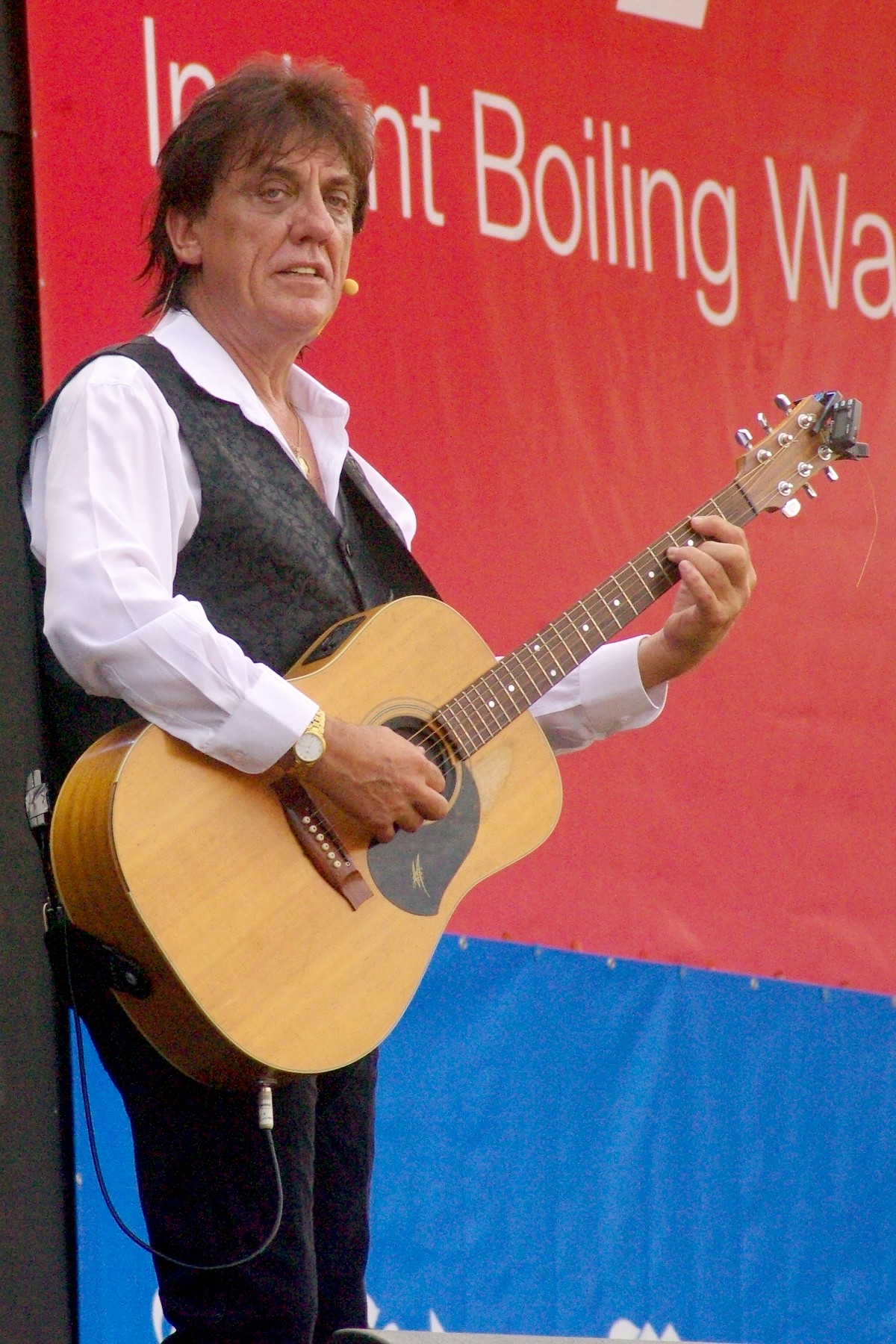

Jon English
View on Wikipedia
Jonathan James English (26 March 1949 – 9 March 2016) was an English-born Australian singer, songwriter, musician and actor. He emigrated from England to Australia with his parents in 1961. He was an early vocalist and rhythm guitarist for Sebastian Hardie but left to take on the role of Judas Iscariot in the Australian version of the stage musical Jesus Christ Superstar from May 1972,[1] which was broadcast on television.[2] English was also a solo singer; his Australian top twenty hit singles include "Turn the Page", "Hollywood Seven", "Words are Not Enough", "Six Ribbons" and "Hot Town".[3][4]
Key Information


For his starring role in the 1978 Australian TV series Against the Wind he won the TV Week Logie Award for 'Best New Talent in Australia'.[4] He also co-wrote and performed the score with Mario Millo (ex-Sebastian Hardie).[4] The series had international release, known as Mot alla vindar (1980) in Swedish, where "Six Ribbons" was released as a single, both single and the soundtrack album peaked at No.1 on the Norwegian charts;[5] the first single, "Six Ribbons" and the album, peaked at No.4 on the Swedish charts.[6]
From 1983 to 1985, English won four Mo Awards with three consecutive 'Entertainer of the Year' awards and a further 'Male Vocal Performer' in 1985.[7][8][9] English has performed in Gilbert and Sullivan's operettas The Pirates of Penzance, The Mikado and H.M.S. Pinafore from 1984.[10][11] Performances of Essgee Entertainment's productions of the Gilbert and Sullivan trilogy from 1994 to 1997 were broadcast on Australian TV. They were all released on VHS and subsequently on DVD.[11]
Early life
[edit]Jonathan James English was born in 1949 in Hampstead, London, to Sydney and Sheila English, with siblings Janet, Jeremy and Jill.[10] Sheila had worked as a hospital worker, teacher and ambulance driver; Sydney was working in air cargo for KLM and was moved to Sydney Airport.[10] Sheila and the children followed, when the family emigrated to Australia in 1961 on RMS Orion with English turning 12 years old just before calling in at Fremantle.[10]
Sydney had bought a house in Cabramatta, where young Jon attended Cabramatta High School.[10] Sydney was a self-taught piano player and dabbled with guitar and drums, he bought a guitar for the young Jon English.[10] Janet took her younger brother to the Sydney Stadium to see the Beatles perform during their 1964 Australian tour.[10]
Career
[edit]1965–72: First bands
[edit]English's first rock gig occurred when his neighbour's band needed a guitarist, he was about 16 and mid-performance was called upon to do vocals, he sang the Beatles' "Twist and Shout".[10] His earliest known band was Zenith in 1965, formed at Cabramatta High School, and according to English "they were crap".[10] Next was Gene Chandler & the Interns, which included guitarist Graham Ford, drummer Richard Lillico, bass guitarist Peter Plavsic and English as vocalist and rhythm guitarist. At the same time, he played Lock for the Parramatta Eels reserve grade team.[12]
Ford founded Sebastian Hardie Blues Band in 1967 with Lillico and new band members.[13][14] They played R&B and soul covers but disbanded by early 1968.[15] When Ford reformed the band later in 1968, he recruited English and Peter Plavsic again, Anatole Kononewsky on keyboards and Peter's brother Alex Plavsic on drums.[15] They had dropped the 'Blues Band' part to play more pop oriented music and were the backing band for legendary Australian rocker Johnny O'Keefe during 1969.[15] Covering songs from the Rolling Stones, the Beatles, Bob Dylan, Otis Redding and Wilson Pickett they built a reputation in the Sydney pub scene.[15][16]
Also attending Cabramatta High School, but one year lower was Carmen Sora; Sora and English married in September 1969 when she was 19 and he was 20.[10] In January 1972, English left Sebastian Hardie when he won the role of Judas Iscariot in the Australian version of Jesus Christ Superstar from May 1972.[1][4] Sebastian Hardie were later joined by Mario Millo on vocals and lead guitar and Toivo Pilt on keyboards. By 1974 they had become Australia's first symphonic rock band and released Four Moments in August 1975, which was produced by English.[15]
1972–1979: Actor and solo performer
[edit]Australian theatre producer Harry M. Miller and theatre director Jim Sharman had worked on the stage musical Hair and kept some of the cast and crew for their next project, the Australian version of Jesus Christ Superstar by Tim Rice/Andrew Lloyd Webber.[1] Miller and Sharman chose English, from over 2,000 applicants,[17] to take the starring role of Judas Iscariot alongside fellow stars Trevor White (ex-Sounds Unlimited) as Jesus Christ and Michele Fawdon as Mary Magdalene.[1]
The initial run was from 4 May 1972, at Sydney's Capitol Theatre, to February 1974. With over 700 shows, it included other Australian music/theatre performers Reg Livermore (from Hair, later in The Rocky Horror Show), John Paul Young (later a solo singer with "Love is in the Air"), Marcia Hines (from Hair, took over as Mary Magdalene in 1973, later a solo singer with "You"), Doug Parkinson (Doug Parkinson in Focus had a hit with "Dear Prudence", took over from Livermore) and Stevie Wright (ex-the Easybeats, later a solo singer with "Evie").[1]
Jesus Christ Superstar – Original Australian Cast Recording was released by MCA in 1972 with English and other cast members performing vocals for a studio recording.[1] A documentary of the production was broadcast on national TV, it contained footage of performances and interviews with cast members. English reprised his role of Judas in the 1975 and 1978 productions.[17] During 1974, English co-wrote, with Roy Ritchie, the ballet Phases which was performed by the New South Wales Dance Company at the Sydney Opera House.[17] While performing in Superstar, English also performed as a rock vocalist both with bands, Tapestry, Pulsar and Duck, and solo.[12]
In March 1973, he sang on the studio cast recording of Reg Livermore and Patrick Flynn's rock opera, Ned Kelly, and used some of the Superstar chorus band to help record his debut solo album, Wine Dark Sea released on Warm & Genuine Records/Phonogram Records.[4] His debut single "Handbags and Gladrags", released at the same time, was a cover of the Mike d'Abo song, which had been a Top 40 hit in the UK for singer Chris Farlowe in 1967.[4] English's version peaked at No.50 on the Australian singles charts.[3] His second single from the album was the Webber / Rice song "Close Every Door" from their Joseph and the Amazing Technicolor Dreamcoat stage musical.[4]
It's All a Game, his second solo album, was released in 1974 on Warm & Genuine and featured "Turn the Page" which peaked at No.20 on the national singles charts in February 1975.[3][4] "Lovin' Arms" was released in June 1975 as the lead single from his third studio album, Hollywood Seven The album produced three singles including "Hollywood Seven" which peaked at No.13 in May 1976.[3][4] English performed a duet with fellow Superstar lead, Trevor White to release a single "Laid Back in Anger" but it had no singles chart success.[3][4] His next album, Minutes to Midnight was released in 1977.[3]
English created the Jon English Band for touring with Steve Doran (keyboards), Danny Groves (drums), Eric Macitchka (guitar), Rick Mellick (keyboards), James Rattray (bass) and Mike Wade (guitar).[4] His fifth studio album Words are not Enough from 1978 contained the title track which peaked at No.6 and "Night in Paradise" which peaked at No.44.[3][4] English also performed in the stage musical The Bacchoi in 1974 for Nimrod Theatre Company;[4][17] and in minor TV roles in police dramas Matlock Police in 1975, Homicide in 1976 and Chopper Squad in 1978. A recurring role in Number 96 was as a cultish drug lord, "The Master", in 1976. English described these roles "I was doing a lot of police shows in those days. I got to do them all. I was always a drug-crazed axe murdering hippy."[10]
In 1978, TV's Seven Network and Pegasus Productions approached English to take the role of Jonathan Garrett in the historical romance miniseries Against the Wind. Prior to production he asked if he could organise the score and soundtrack with his friend, Mario Millo.[10][18]
From the soundtrack, "Six Ribbons" was released as a single by English and Millo. It peaked at No.5 on the National singles charts and the soundtrack peaked at No.10 on the National albums charts.[3] On 16 March 1979 English won the TV Week Logie Award for 'Best New Talent in Australia' for his acting performance in Against the Wind, the programme won two other Logie Awards.[19] English won the 'Most Popular Male Performer' award at the 1979 TV Week/Countdown Music Awards.[20]
He released his first compilation album English History in August, which peaked at No.4 on the national albums charts[3] and sold over 180,000 copies.[21] Singles success with "Get Your Love Right", which peaked at No.27 and "Hot Town", which peaked at No.11;[3] prompted English to form Baxter Funt, containing John Coker (bass), Greg Henson (drums), Tony Naylor (guitar; ex-Bootleg Family Band/Avalanche), Mike Wade (guitar) and Peter White (keyboards).[4][12] Henson and Wade had been in the Superstar chorus band from 1972 and, as part of Baxter Funt, they were taken on a national tour and then internationally.[4]
1980s: International success
[edit]In April 1980, English released Calm Before the Storm which peaked at No.17 on the albums charts, with a single "Carmilla" peaking at No.27;[3] this was followed by the less successful In Roads from 1981 and single "Straight from the Heart".[4] Meanwhile, Against the Wind was shown on international TV stations in United Kingdom and other parts of Europe as Gegen den Wind in Germany and Mot alla vindar in Scandinavia.[22] Success in Scandinavia included the soundtrack peaking at No.1 on the Norwegian Albums charts and double-A sided single, "Mot alla vendor"/"Six Ribbons" peaked at No.1 on the Norwegian Singles charts.[5]
English History, his compilation album also peaked at No.1, follow up albums Calm Before the Storm and In Roads both reached the Top Ten in Norway.[5] In Sweden the soundtrack and the "Six Ribbons" single both peaked at No.4 on the relevant charts in 1980, later English History and "Hollywood Seven" reached the top twenty in their charts.[6] In 1981, English toured the United Kingdom and Scandinavia with Mario Millo (guitars, ex-Sebastian Hardie), (guitar), Jackie Orszaczky (bass; ex-Syrius, Bakery, Marcia Hines Band), Coz Russo (keyboards), Richard Gawned (tenor sax, flute; ex-Marcia Hines Band) and Nick Lister (drums; ex-Kush).[4]
In June 1982, the live double album, Beating the Boards was released, with backing by the Foster Brothers containing John Coker (bass), John Dallimore (guitar, flute, vocals; ex-Redhouse), Peter Deacon (keyboards, vocals), Greg Henson (drums) and Keith Kerwin (guitar, vocals; ex-Southern Star Band). The single "Beating the Boards' was released in June 1982 and peaked at No.97. English teamed with former Superstar co-lead, Marcia Hines, to produce July 1982's mini-album Jokers and Queens and its self-titled single, the album peaked at No.36 on the Australian albums charts and the single reached No.62 on the singles charts.[3][4] Some People... was released in 1982 and produced the top 50 single "Some People (Have All The Fun)". In August 1984, English and Renée Geyer released "Every Beat of My Heart" from the Street Hero soundtrack.[citation needed]
In 1984, English wrote the national anthem for Hutt River Province.[23]
English took on the role of Pirate King for the first time in the 1984 production of Gilbert and Sullivan's comic opera The Pirates of Penzance alongside June Bronhill and fellow actor/singer Simon Gallaher as Frederic. English estimates he has performed his favorite role of Pirate King over 1,000 times.[10] He later took on other stage musicals, including Rasputin (1987) and Big River (1988),[12] toured with various line-ups of the Foster Brothers and released Some People... (1983) produced by David Mackay, Dark Horses (1987) and The Busker (1988), with his best charting Australian single from these being "Some People (Have all the Fun)" which peaked at No.50 in 1983.[3] During 1983–85, English won four Mo Awards with three consecutive 'Entertainer of the Year' awards and a further 'Male Vocal Performer' in 1985.[7][8][9]
In 1988, English collaborated on the song "You're Not Alone" which was The Australian Official Olympic Team Song. It peaked at number 23 on the ARIA Charts.
1990s: All Together Now
[edit]In 1990, English released Busking/Always the Busker but the album did not chart. In November 1990, "Love Has Power" was released as a single from his musical concept album, Paris. At the ARIA Music Awards of 1991, the album won the ARIA Award for Best Original Soundtrack, Cast or Show Album.[citation needed].
During 1991—93, English played the main role of Bobby Rivers in the TV sitcom All Together Now. His role of a faded one hit wonder rock star displayed his acting and comedy skills during 101 episodes.[4][10] English returned to stage musicals to play roles in Simon Gallaher's production company Essgee Entertainment's trilogy of updated Gilbert and Sullivan works: Pirate King in The Pirates of Penzance (1994), Pooh-Bah in The Mikado (1995) and Dick Deadeye in H.M.S. Pinafore (1997).[11] A performance of each production was broadcast on Australian TV, then released on VHS video and later on DVD.[11]
In 1995, Jon English, a portrait by artist Danelle Bergstrom, won the 'Packing Room Prize' in the Archibald Prize.[24]
From 1997 to June 1998, English toured his own musical show, Turn the Page. Later in 1998, English toured the Michael Frayn show Noises Off. In 1999, English toured Australia and New Zealand performing in A Funny Thing Happened on the Way to the Forum[citation needed]

2000s
[edit]In 2000, English finished another musical project called Buskers and Angels, which toured September and October 2000 to warm reviews, and subsequently releasing a CD of the same name. At the Gimme Ted benefit concert on 10 March 2001, English was backed by his former band, Sebastian Hardie, for two of his songs.[25] He released the amateur rights to his rock opera Paris and it was first performed in 2003 in Sydney and Gosford, New South Wales, with English assisting in the direction of the production and appearing as the Fisherman in one performance at Gosford.[26]
The piece was revived in Melbourne in 2004[26] and in Adelaide in 2008.[27] Also in 2008, a re-worked version was performed in Sydney, with English as Menelaus. This revised production was met with generally positive reviews, but a few months later, English and Mackay completely updated the show.
In 2004, English appeared as Sergeant Wilson in stage productions of Dad's Army touring through Australia and New Zealand.[10]
In 2006, English toured the country again as part of the Countdown Spectacular. Also in 2007, English and Peter Cupples toured their collaborative show Uncorked. Later in 2007, English filmed a children's mini-series titled Time Trackers in New Zealand, playing the role of a lovable but havoc raising hologram from the future.
In 2008, English was awarded a Life Membership to the Parramatta Eels Rugby Leagues Club. English was hired as a motivational coach for the 2009 season, when Parramatta lost the NRL Grand Final, having beaten 14 other teams in home and away games to get to the Premiership decider.
In 2009, he toured in a new production titled The Rock Show,[28] a revue featuring classic rock music of the '60s and '70s, including songs by the Rolling Stones, Led Zeppelin, Bob Dylan, Deep Purple, Elton John and other high-profile musicians of those decades.[29] It was conceived by "Paris" collaborator and director Stuart Smith with musical director Isaac Hayward.[30] In 2010 "The Rock Show" made two appearances in Tasmania in support of the "Save the Tasmanian Devil" breeding programme.[29] English was an ambassador for the programme.[31] The Rock Show toured until 2013, with a CD/DVD released in 2012. In 2010, English played the title role in The Removalists by David Williamson at the Perth Theatre Company.[32]
In 2012, English returned to Tasmania, working with Encore Theatre, for a revival of Jesus Christ Superstar, with English in the role of Pilate. Funds raised at each performance and at the Launceston preview were donated to the programme.[31] In 2013 Jon English played at the Sweden Rock Festival, backed up by Swedish hard rock band Spearfish.[33]
In March 2026, Jokers and Queens and Six Ribbons – The Ultimate Collection is to be re-released alongside a new Rarities album.[34]
Death
[edit]
In late February 2016, English was hospitalised due to "unexpected health problems" and was forced to cancel several scheduled performances due to planned surgery for an aortic aneurysm. He died following post-operative complications in the late evening hours of 9 March 2016, seventeen days short of his 67th birthday.
A public memorial service commemorating his life was held at the Capitol Theatre, Sydney on the evening of 4 April 2016. The memorial took the form of a tribute concert and included performances by the Foster Brothers, John Paul Young, Simon Gallaher and John Waters among others.[35][36]
Interests outside the arts
[edit]English described himself as a "passionate" supporter of the Australian rugby league team Parramatta Eels.[37][38]
Discography
[edit]Solo albums
[edit]- Wine Dark Sea (1973)
- It's All a Game (1974)
- Hollywood Seven (1976)
- Minutes to Midnight (1977)
- Words Are Not Enough (1978)
- Calm Before the Storm (1980)
- In Roads (1981)
- Jokers and Queens (with Marcia Hines) (1982)
- Some People... (1983)
- Dark Horses (1987)
- The Busker (1988)
Soundtrack albums
[edit]- Against the Wind aka Mot alla vindar (with Mario Millo) (1978)
Filmography
[edit]Film
[edit]| Year | Title | Role | Notes |
|---|---|---|---|
| 1980 | Touch and Go | Frank Butterfield | Film |
| 2000 | Walk the Talk | Phil Wehner | Film |
Television
[edit]| Year | Title | Role | Notes |
|---|---|---|---|
| 1972 | Jesus Christ Superstar | Judas Iscariot | TV broadcast |
| 1975 | Matlock Police | Quinlan | Episode: "The Grass is Greener" |
| 1976 | Homicide | Gordon Haynes / Musician | Pilot episode & episode 504 |
| 1978 | Against the Wind | Jonathan Garrett | Miniseries, 13 episodes |
| 1988 | Rafferty's Rules | David Anson | Season 2, episode 2 |
| 1991–1993 | All Together Now | Bobby Rivers | 101 episodes |
| 1994 | The Pirates of Penzance | The Pirate King | Broadcast of theatre production from Essgee Entertainment |
| 1995 | Frontline | Himself | Episode: "Let the Children Play" |
| 2000 | Pizza | 1 episode | |
| 2006 | Countdown Spectacular | Performer | |
| 2008 | Time Trackers | Old Troy | |
| 2011 | RocKwiz Christmas Special | Performer |
Stage
[edit]| Year | Title | Role | Notes | Ref. |
|---|---|---|---|---|
| 1972–1978 | Jesus Christ Superstar | Judas Iscariot | Australia & New Zealand tour with Harry M. Miller Attractions; 700+ performances | [39] |
| 1974 | The Bacchoi | Nimrod Theatre Company | [39] | |
| 1979 | Marcia Hines and Jon English | St George Leagues Club, Sydney with Delicado Productions | [39] | |
| 1984–1986 | The Pirates of Penzance | The Pirate King | Australia & New Zealand tour with Victoria State Opera | [39] |
| 1987 | Rasputin The Musical Revolution | Grigori Rasputin | State Theatre, Sydney | [39] |
| 1988 | Big River: The Adventures of Huckleberry Finn | Pap Finn | Australian tour | [39] |
| 1990 | The Hunting of the Snark | Melbourne Concert Hall with Victorian Arts Centre | [39] | |
| 1994 | The Pirates of Penzance | The Pirate King | Essgee Entertainment | [39] |
| 1995–1996 | The Mikado | Pooh-Bah | Australian tour with Essgee Entertainment | [39] |
| 1997 | H.M.S. Pinafore | Dick Deadeye | Australia & NZ tour with Essgee Entertainment | [39] |
| 1998 | Noises Off | Australian tour with Twelfth Night Theatre | [39] | |
| 1998–1999 | A Funny Thing Happened on the Way to the Forum | Prologus / Pseudolus | Australia & NZ tour with Essgee Entertainment | [39] |
| 2001 | Are You Being Served? | Mr. James 'Dick' Lucas | [40][41] | |
| Don’t Dress for Dinner | [40] | |||
| 2001–2003 | The Pirates of Penzance | The Pirate King | Essgee Entertainment | [39] |
| 2003 | Bedside Manners | Brisbane | [40] | |
| 2003–2004 | Paris | Co-writer (with David Mackay) | The Regals Musical Society | [39] |
| 2004 | OzMade Musicals Concert | BMW Edge, Melbourne | [39] | |
| Dad's Army | Sergeant Wilson | Nambour Civic Centre, Twelfth Night Theatre, Brisbane | [39] | |
| 2005 | Encore | Norwood Concert Hall, Adelaide | [39] | |
| My Fair Lady | Alfie Doolittle | Comedy Theatre, Melbourne | [39] | |
| 2008 | Blood Brothers | Narrator | Jetty Memorial Theatre, Coffs Harbour | [39] |
| 2010 | The Removalists | The Removalist | Playhouse, Perth with Perth Theatre Company | [39][42] |
| 2012 | Jesus Christ Superstar | Pontius Pilate | [40]
| |
| 2013 | Rock for Doc | Performer | Fundraiser show at Enmore Theatre, Sydney | [39] |
| Hairspray | Edna Turnblad | Riverside Theatres Parramatta with Riverside Productions / Packemin Productions | [43][39] | |
| 2014 | Spamalot | King Arthur | QPAC, Brisbane with Harvest Rain Theatre Company | [44] |
Awards
[edit]| Year | Work | Award | Category | Result | Ref. |
|---|---|---|---|---|---|
| 1979 | Against the Wind | TV Week Logie Awards | Best New Talent in Australia | Won | |
| Jon English | TV Week Countdown Awards | Most Outstanding Achievement | Nominated | ||
| Most Popular Male Performer | Won | ||||
| 1980 | Most Popular Male Performer | Nominated | |||
| 1983 | Jon English | Mo Awards | Entertainer of the Year | Won | |
| 1984 | Entertainer of the Year | Won | |||
| The Pirates of Penzance | Green Room Awards | Green Room Award for Male Actor in a Leading Role (Music Theatre) | Won | ||
| 1985 | Jon English | TV Week Countdown Awards | Male Vocal Entertainer of the Year | Won | |
| Entertainer of the Year | Won | ||||
| 1991 | Paris (with David Mackay) | ARIA Music Awards | Best Original Soundtrack, Cast or Show Album | Won | [45] |
| Best Adult Contemporary Album | Nominated | [45] | |||
| 2011 | Jon English (The Rock Show) | Mo Awards | Best Rock Band or Performer of the Year | Won | |
| 2012 | Jon English Band | Best Rock Act of the Year | Won | ||
| The Rock Show | ARIA Music Awards | Best Original Soundtrack, Cast or Show Album | Nominated | [45] |
Notes
[edit]- ^ a b c d e f "Stage shows – Jesus Christ Superstar". Milesago. Retrieved 27 July 2008.
- ^ "Jon English". Internet Movie Database (IMDb). Retrieved 27 July 2008.
- ^ a b c d e f g h i j k l m Kent, David (1993). Australian Chart Book 1970–1992. St Ives, NSW: Australian Chart Book. ISBN 0-646-11917-6. NOTE: Used for Australian Singles and Albums charting from 1970 until ARIA created their own charts in mid-1988.
- ^ a b c d e f g h i j k l m n o p q r s McFarlane, Ian (1999). Encyclopedia of Australian Rock and Pop (doc). Allen & Unwin. ISBN 1-86448-768-2. Retrieved 27 July 2008. Jon English entry
- ^ a b c "Jon English & Mario Millo". Norwegian Charts Portal. Retrieved 27 July 2008.
- ^ a b "Jon English & Mario Millo". Swedish Charts Portal. Retrieved 27 July 2008.
- ^ a b "Mo Awards – Winners 1983". Mo Awards. Archived from the original on 19 August 2006. Retrieved 7 August 2008.
- ^ a b "Mo Awards – Winners 1984". Mo Awards. Archived from the original on 19 August 2006. Retrieved 7 August 2008.
- ^ a b "Mo Awards – Winners 1985". Mo Awards. Archived from the original on 18 July 2008. Retrieved 7 August 2008.
- ^ a b c d e f g h i j k l m n o "Talking Heads interview transcript". Australian Broadcasting Corporation. 3 October 2005. Archived from the original on 30 December 2005. Retrieved 28 July 2008.
- ^ a b c d Marc Shepherd, ed. (20 July 2005). "The Essgee Entertainment videos". Gilbert & Sullivan Discography. Archived from the original on 16 September 2008. Retrieved 6 August 2008.
- ^ a b c d "Jon English". Australian Rock Database. Magnus Holmgren. Archived from the original on 22 October 2013. Retrieved 27 July 2008.
- ^ "Mario Millo interview". ProgressoR. 21 May 2002. Retrieved 27 July 2008.
- ^ "Sebastian Hardie / Windchase". Australian Rock Database. Magnus Holmgren. Archived from the original on 19 March 2008. Retrieved 27 July 2008.
- ^ a b c d e McFarlane, Ian (1999). Encyclopedia of Australian Rock and Pop (doc). Allen & Unwin. ISBN 1-86448-768-2. Retrieved 24 July 2008. Sebastian Hardie entry
- ^ "Sebastian Hardie 1975 Four Moments". AusRock. Archived from the original on 1 November 2007. Retrieved 25 July 2008.
- ^ a b c d "Australian Rock by Memorable Music: Jon English". Memorable TV. Archived from the original on 20 July 2008. Retrieved 28 July 2008.
- ^ Vagg, Stephen (14 July 2019). "Australian Singers Turned Actors". Filmink.
- ^ "Logie Awards – 1979". TV Week. Archived from the original on 21 July 2008. Retrieved 31 July 2008.
- ^ Atkinson, Ann; Linsay Knight (1996). The dictionary of performing arts in Australia. Margaret McPhee. Allen & Unwin. p. 78. ISBN 1-86373-898-3.
- ^ "International Dateline" (PDF). Cash Box. 14 June 1980. p. 36. Retrieved 3 December 2021 – via World Radio History.
- ^ Andreas Steurer (ed.). "Alben Jon English". members.chello.at. Retrieved 4 August 2008.
- ^ "Jon English: The Strange Story Of The Aussie National Anthem You've Never Heard Of". The Music. 27 September 2024. Retrieved 28 September 2024.
- ^ "Archibald Prize 2008: Packing Room Prize". Art Gallery NSW. Archived from the original on 19 July 2008. Retrieved 6 August 2008.
- ^ Holmgren, Magnus. "Gimme Ted – The Ted Mulry Benefit Concerts". Australian Rock Database. Archived from the original on 22 August 2003. Retrieved 6 December 2020.
- ^ a b Webb, Carolyn (26 January 2004). "Jon's Trojan Horse comes good". The Age. Retrieved 7 August 2008.
- ^ "Jon English's Rock Musical Paris". AdelaideInfoNET. Archived from the original on 30 August 2009. Retrieved 7 August 2008.
- ^ "The Rock Show". Archived from the original on 22 July 2009. Retrieved 28 July 2009.
- ^ a b Young, Kane (21 January 2010). "Sympathy for the Devil". The Mercury. News Limited. Retrieved 16 March 2012.
- ^ "Jon English! In the Rock Show". Archived from the original on 13 September 2009. Retrieved 25 May 2009.,
- ^ a b Claridge, Alice (15 March 2012). "Devils feel the love of Jesus". The Mercury. News Limited. Retrieved 16 March 2012.
- ^ Verghis, Sharon (28 August 2010). "Moving on". The Australian. News Limited (News Corporation). Retrieved 7 January 2011.
- ^ "Jon English Setlist at Sweden Rock Festival 2013". The Setlist wiki. Retrieved 16 February 2017.
- ^ "Jon English Returns With Three Definitive Releases". noise11. 24 February 2026. Retrieved 25 February 2026.
- ^ "Jon English, Australian singer-songwriter and All Together Now star, dies age 66". Australian Broadcasting Corporation. 10 March 2016. Retrieved 10 March 2016.
- ^ Kennedy, Jean (5 April 2016). "Jon English remembered as 'titan' of stage and film at memorial concert in Sydney". ABC. Retrieved 2 January 2018.
- ^ Ian Maurice and Peter Psaltis (22 April 2010). "Jon English". 4BC. Archived from the original on 6 July 2011. Retrieved 22 April 2010.
- ^ Cameron, Corelea (16 June 2009). "Jon English – B I O G R A P H Y" (PDF). jonenglish.com.au. Archived from the original (PDF) on 7 March 2010. Retrieved 22 April 2010.
- ^ a b c d e f g h i j k l m n o p q r s t u v "Jon English". AusStage. Retrieved 13 February 2026.
- ^ a b c d "Jon English – English History (1989)". www.mega.nz. 2 November 2019. Retrieved 13 February 2026.
- ^ "Final bow for beloved star". The New Zealand Herald. 11 March 2016. Retrieved 13 February 2026.
- ^ Mayne, Hayley (2 September 2010). "The Removalists – Perth Theatre Company". www.australianstage.com.au. Retrieved 13 February 2026.
- ^ "Hairspray – Packemin Productions | Reviews". www.AussieTheatre.com. 29 July 2013.
- ^ "Harvest Rain Season 2014". www.stagewhispers.com.au. Retrieved 13 February 2026.
- ^ a b c "ARIA Awards 2007: History: Winners by Artist: Jon English". ARIA Awards. Archived from the original on 31 August 2009. Retrieved 4 August 2008.
References
[edit]- Jon English, Australian singer-songwriter and All Together Now star, dies age 66 - ABC News (Australian Broadcasting Corporation)
- "The Dictionary of Performing Arts in Australia – Theatre. Film. Radio. Television – Volume 1" – Ann Atkinson, Linsay Knight, Margaret McPhee – Allen & Unwin Pty. Ltd., 1996
- "The Dictionary of Performing Arts in Australia – Opera. Music. Dance – Volume 2" – Ann Atkinson, Linsay Knight, Margaret McPhee – Allen & Unwin Pty. Ltd., 1996
- "The Australian Film and Television Companion" – compiled by Tony Harrison – Simon & Schuster Australia, 1994
- "The Book – Top 40 Research" – Jim Barnes, Stephen Scanes, 2000
External links
[edit]- Jon English at IMDb
- Jon English – Central Musical Instruments
- Jon English: a conversation – Australian Broadcasting Corporation
- Jon English – Australian Broadcasting Corporation
- Jon of all trades – The Age newspaper
- Performance photo of Jon English as the Pirate King in "The Pirates of Penzance" Archived 19 August 2008 at the Wayback Machine
| International | |
|---|---|
| National | |
| Artists | |
| People | |

Jon English
View on GrokipediaBiography
Early years (1949–1965)
Jonathan James English was born on 26 March 1949 in Hampstead, London, England, to working-class parents Sydney and Sheila English.[4] Sydney worked in air cargo for the airline KLM, while Sheila held various roles including as a hospital worker, teacher, and ambulance driver.[5] The family included three younger siblings: Janet, Jeremy, and Jill.[6] In 1961, when Jon was 12 years old, the family emigrated to Australia after Sydney's job transferred him to Sydney Airport.[7] They settled in the western Sydney suburb of Cabramatta, purchasing a home there and integrating into the local community.[8] This move marked a significant shift for the young English, exposing him to new cultural and environmental influences in post-war immigrant Australia. Jon attended Cabramatta High School, where he began developing an interest in music by self-teaching himself piano and exploring basic music theory.[9] Prior to emigration, he had been influenced by British rock and roll acts emerging in the late 1950s and early 1960s, while after arriving in Australia, local radio stations introduced him to a broader range of sounds that further sparked his passion for performance.[2] These early experiences laid the groundwork for his later involvement in school-based musical groups during adolescence.First bands (1965–1972)
At the age of 16, while attending Cabramatta High School in Sydney, English formed his first band, Zenith, a garage group that covered popular pop and rock standards of the era.[10][11] Initially intending to play guitar, English stepped in as lead vocalist when the original singer failed to appear at a gig, discovering his natural aptitude for singing.[12] The band performed locally but disbanded shortly after, marking English's initial foray into live performance.[13] Following Zenith's dissolution, English joined Gene Chandler & the Interns in the late 1960s, a group that specialized in R&B and soul covers and played regular gigs in Sydney's club circuit.[13][12] This period honed his stage presence amid the vibrant local scene, though the band remained semi-professional without broader recognition. In 1968, after the Interns disbanded, English was recruited by former member Graham Ford to form Sebastian Hardie Blues Band, where he served as lead vocalist and rhythm guitarist.[12][2] The group, initially influenced by blues and rock acts like the Rolling Stones, played early gigs at school events and Sydney venues, gaining modest local following through covers and original material.[8][7] During these years, English developed his musicianship largely through self-directed practice, building on childhood piano lessons by teaching himself guitar and refining his distinctive raspy vocal style.[7] Balancing schoolwork with frequent performances proved challenging, leading him to drop out of Cabramatta High School to pursue music full-time by 1972.[8] English remained with Sebastian Hardie until that year, contributing to its foundational sound before departing for professional opportunities.[8]Rise to fame (1972–1979)
Jon English's breakthrough came in early 1972 when he auditioned for and secured the role of Judas Iscariot in the original Australian production of the rock opera Jesus Christ Superstar, directed by Jim Sharman.[14][3] Having recently left the progressive rock band Sebastian Hardie, English impressed producers with his vocal range and stage presence during auditions, beating out numerous competitors for the demanding lead antagonist role.[15] The production premiered on 4 May 1972 at Sydney's Capitol Theatre, with English performing alongside Trevor White as Jesus and Michele Fawdon as Mary Magdalene.[16] The show became a massive success, running for over 700 performances through its initial Sydney season until February 1974, followed by extensive national tours across Australia and into New Zealand until 1978.[17][10] English reprised the role in subsequent productions, including a 1975–1976 tour, solidifying his reputation as a dynamic performer capable of conveying Judas's complex mix of betrayal, anguish, and charisma through powerful vocals and intense physicality.[18] This extended run marked his transition from local band circuits to national stardom, exposing him to audiences of hundreds of thousands and earning critical acclaim for revitalizing the rock opera format in Australia.[19] Parallel to his stage commitments, English launched his solo recording career in 1973 with the debut album Wine Dark Sea, recorded with members of the Superstar chorus band and featuring original compositions alongside covers like "Handbags and Gladrags."[20] The album explored themes of personal introspection and emotional turmoil, reflecting English's experiences in the high-pressure theatre environment. His follow-up, It's All a Game (1974), built on this foundation with the hit single "Turn the Page," which peaked at number 20 on the Australian Kent Music Report charts and showcased his songwriting shift toward reflective narratives on life's uncertainties.[21][22][23] By 1978, English expanded into television with his starring role as convict Jonathan Garrett in the ABC miniseries Against the Wind, a historical drama tracing Australian settlers from the convict era to the gold rush. His portrayal earned him the 1979 Logie Award for Best New Talent, highlighting his acting versatility beyond music.[24] The associated soundtrack album, co-composed with Mario Millo, peaked at number 10 on the Australian Kent Music Report charts and was certified 2× Gold, featuring songs like "Six Ribbons" that blended historical storytelling with personal resilience—core themes in English's early songwriting.[23] This period cemented his multifaceted career, evolving from ensemble band performer to a leading solo artist and actor with broad national appeal.International success (1980–1989)
In the early 1980s, Jon English expanded his career beyond Australia through international tours and the global release of his television work. Following the success of his 1979 compilation album English History, English embarked on a tour of the United Kingdom and Scandinavia in 1981, accompanied by a band that included guitarist Mario Millo and bassist Jackie Orszaczky.[25] This tour was prompted by the international popularity of the soundtrack to the Australian miniseries Against the Wind (1978), which English co-wrote and performed on; the album sold over 100,000 copies in Scandinavia alone and was released overseas as Mot alla vindar in Sweden in 1980.[26] The single "Six Ribbons" from the soundtrack, originally a 1979 Australian hit, topped charts in Norway in 1981 and reached number one in six countries overall, marking a significant breakthrough in European markets.[14] English's music releases during the decade further supported his growing international profile, particularly in New Zealand and Scandinavia. His 1980 studio album Calm Before the Storm peaked at number 17 in Australia and number 6 in New Zealand, featuring the single "Hot Town" which had earlier charted at number 11 in Australia in 1979 but gained additional traction abroad.[25] Subsequent albums included Inroads (1981, number 58 Australia, number 9 New Zealand), a collaboration with Marcia Hines on the mini-album Jokers & Queens (1982, number 36 Australia), Some People (1983, number 35 Australia), Dark Horses (1986, number 84 Australia), and The Busker (1988).[25] A live double album, Beating the Boards (1983), captured performances from his Scandinavian engagements, underscoring the demand for his rock-infused style in those regions.[23] These efforts highlighted English's ability to blend rock elements with accessible pop, appealing to overseas audiences and contributing to steady soundtrack sales from his television projects. English's theatre work in the 1980s also ventured into international territory through Gilbert and Sullivan operas, where he innovatively fused rock energy with classical operetta traditions. He debuted as the Pirate King in the 1984 Australian production of The Pirates of Penzance, a role that showcased his charismatic stage presence and vocal range in a modernized staging directed by Simon Gallaher; the production toured nationally and extended internationally, including to New Zealand.[25] English reprised similar high-profile roles in other Gilbert and Sullivan works, such as The Mikado and H.M.S. Pinafore, performing from 1984 onward and earning acclaim for revitalizing the genre with contemporary flair.[14] These appearances, often in collaboration with international performers like Gallaher, received positive media attention in Australian and New Zealand outlets, emphasizing English's versatility in bridging musical theatre with his rock background. The Pirates of Penzance soundtrack and related recordings further boosted commercial metrics, aligning with the era's peak sales for his theatre-associated works.[27]Television and later theatre (1990–1999)
In the early 1990s, Jon English starred as the lead character Bobby Rivers in the Australian sitcom All Together Now, which ran for three seasons from 1991 to 1993 on the Nine Network.[28] The musical comedy followed an ageing rock star who discovers he has 15-year-old twins after his former lover's death, blending humour with performances of classic rock songs that drew from English's own musical background.[28] The series was a commercial success, marking Nine's most popular sitcom in two decades, and aired internationally, including in Germany under the title Rock 'n' Roll Family, enhancing English's profile in global pop culture.[29] English's portrayal of the affable yet faded rocker showcased his comedic timing and vocal talents, incorporating live musical segments that highlighted tracks from his discography.[28] This role marked a significant shift toward television, allowing him to reach a broader domestic audience compared to his earlier international stage tours.[2] During production, English noted the demands of adapting to scripted comedy's quick cuts and retakes, contrasting the improvisational energy of live theatre he had honed abroad in the 1980s.[30] Amid his television commitments, English made select guest appearances on Australian variety and talk shows, including a 1995 60 Minutes profile where he reflected on balancing screen work with his enduring passion for performance.[30] These outings often featured musical interludes and discussions of his multifaceted career, underscoring the lighter, more accessible tone of his 1990s output. Later in the decade, English returned to theatre through Essgee Entertainment's acclaimed Gilbert and Sullivan trilogy, infusing the productions with rock-inflected energy. He reprised the role of the Pirate King in a 1994 revival of The Pirates of Penzance, directed by Simon Gallaher, which was adapted into a television special.[31] This was followed by his performance as Pooh-Bah in The Mikado (1996), a satirical operetta set in mythical Japan, and as Dick Deadeye in H.M.S. Pinafore (1997), completing the trilogy with its nautical farce.[32][33] These stage revivals, later broadcast on Australian television, demonstrated English's versatility in blending operatic tradition with contemporary flair, drawing strong audiences and critical praise for revitalizing the classics.[34]Final years and retirement (2000–2016)
In 2000, English released Buskers and Angels, an album serving as the original score for a new Australian musical he wrote and workshopped at The Hills Centre in Sydney, featuring tracks like "Always the Busker" and exploring themes of street performers and personal journeys.[35] This project marked a creative pivot toward theatre composition amid a period of semi-retirement, with English scaling back from full-time touring to focus on selective endeavors. Throughout the 2000s, he maintained a presence through sporadic live performances in Australia, including concerts that showcased his enduring stage charisma without the intensity of his earlier decades.[36] From 2009 to 2013, English starred in The Rock Show, a revue production that toured Australia and celebrated classic rock from the 1960s and 1970s, incorporating his own hits alongside songs by The Beatles, The Rolling Stones, and Queen.[37] In this show, created by Stuart Smith, English fronted a band and collaborated with promising younger performers, reflecting a shift toward mentoring the next generation of musicians by sharing his pub rock roots and performance expertise.[9] The production culminated in a 2012 live album recording, capturing the ensemble's energy and serving as one of his final major studio contributions.[38] As health challenges emerged in the 2010s, English reflected on his multifaceted career in interviews, expressing gratitude for his transitions from rock stardom to theatre and television while emphasizing the joys of live performance.[39] In early 2016, a hospitalization for broken ribs unexpectedly revealed an aortic aneurysm, prompting surgical intervention that underscored his physical vulnerabilities after decades of demanding stage work.[40] These years highlighted English's graceful navigation of retirement, prioritizing meaningful engagements over exhaustive schedules.Death and immediate aftermath
Jon English died on 9 March 2016 at the age of 66 in Newcastle, New South Wales, from post-operative complications following surgery for an aortic aneurysm.[41][40] The aneurysm was discovered incidentally during medical treatment after he was hospitalized for broken ribs sustained in a fall while performing in Adelaide earlier that month.[42][43] English passed away peacefully in the late evening hours at John Hunter Hospital, surrounded by his four children—Jessamine, Josephine, Jonathan, and Julian—and family, including his partner Coralea Cameron.[14][7] The family announced his death via a post on English's official Facebook page shortly after, stating that he had died due to complications from the aneurysm surgery and expressing gratitude for the support received.[41][1] Media outlets across Australia quickly reported the news, highlighting his contributions to music and theatre, with tributes pouring in from fans and industry figures within hours.[40][1] In the immediate aftermath, English's planned 2016 Australian tour, which was set to begin in late March and included performances in Newcastle just days after his death, was cancelled.[41][44] Early tributes came from colleagues such as singer John Waters, who described English as a "dear friend" and "brilliant performer," and from fans who shared memories of his hits like "Hollywood Seven" on social media and news comment sections.[45][46]Personal life
Family and relationships
Jon English was born Jonathan James English on 26 March 1949 in Hampstead, London, to parents Sydney and Sheila English, who instilled in him a strong work ethic through their own perseverance following the family's emigration to Australia in 1961 when he was 12 years old.[7][8] Sheila English, who worked as a teacher for migrant and refugee children in Sydney's west, encouraged the move to provide better opportunities for the family, shaping Jon's appreciation for education and resilience.[47] He had three siblings—Janet, Jeremy, and Jill—with whom he shared a close but private family bond, reflecting his preference for keeping personal matters out of the public eye.[7] English met Carmen Sora at Cabramatta High School, and the pair married in September 1969 when he was 20 and she was 19; their union provided stability amid his rising career in music and theatre.[48] The couple separated in 2006, after which English began a long-term partnership with Coralea Cameron, who remained his partner and manager until his death; Carmen remained his legal wife and was present at his bedside.[49][7] Together, they had four children: Jonathan (a musician and songwriter), Josephine, Jessamine, and Julian.[50][7] Throughout his career, English's family offered unwavering support, from his parents' encouragement during early struggles to his siblings' presence at key moments, helping him balance the demands of fame with personal life.[14] This support was evident at his death on 9 March 2016, when he was surrounded by Carmen, his four children, sister Janet, and brother Jeremy in a Newcastle hospital, underscoring the enduring closeness of his family dynamics.[49] Carmen Sora passed away on 15 October 2021.[51]Interests and hobbies outside the arts
Jon English maintained a relatively private personal life, which allowed him to pursue several hobbies that reflected his adventurous spirit and provided respite from his demanding career in entertainment. This private family life, centered around his long-term marriage and four children, provided the stability that enabled these leisure activities away from the public eye.[14]Stage and theatre career
Major musical theatre roles
Jon English's breakthrough in musical theatre came with his portrayal of Judas Iscariot in the original Australian production of Jesus Christ Superstar in 1972, directed by Jim Sharman at the Capitol Theatre in Sydney. Selected from over 2,000 auditionees, English delivered more than 700 performances across the initial run from 1972 to 1975, earning praise from lyricist Tim Rice for his "original and powerful interpretation" that captured the character's torment and betrayal with raw emotional depth.[9] His raspy, intense vocals, honed from earlier rock band experience with Sebastian Hardie, infused the role with a rock opera edge that resonated strongly with audiences.[8] In the mid-1980s, English solidified his status as a musical theatre staple by taking on the role of the Pirate King in The Pirates of Penzance, an updated production by Essgee Entertainment that toured Australia extensively from 1984 to 1986. He performed the role over 1,000 times, blending his rock-infused belting with the operetta's patter style to create a charismatic, swashbuckling lead that delighted crowds and contributed to the show's national success, including a landmark opening at the Queensland Performing Arts Centre in 1985.[3][19] This production highlighted English's versatility, adapting his powerful tenor range to comedic timing and ensemble numbers while maintaining vocal stamina through prolonged tours.[7] English continued his association with Gilbert and Sullivan through Essgee Entertainment's trilogy, portraying Pooh-Bah in The Mikado (1995–1996) and Dick Deadeye in H.M.S. Pinafore (1997), both in modernized adaptations that toured Australia and New Zealand. In The Mikado, his portrayal of the pompous holder of multiple government offices showcased sharp comedic delivery and precise phrasing in rapid-fire dialogue songs, while as Dick Deadeye, he employed a gruff, villainous baritonal tone suited to the operetta's nautical satire.[32][33][52][53] These roles demonstrated English's technical adaptability, shifting from high-energy rock belts in Superstar to the lighter, articulated classical phrasing required for G&S, often incorporating mixed voice for sustained ensemble work.[2] English also took on notable roles in other major musicals, including Pseudolus in A Funny Thing Happened on the Way to the Forum (1998–1999), the King in The King and I (2000–2001), and Billy Flynn in Chicago (2002–2003).[7] Through these signature performances, English played a pivotal role in revitalizing Australian musical theatre by bridging rock music's accessibility with operatic traditions, drawing younger audiences to classic works and elevating local productions to international standards during a period of cultural growth in the 1970s and 1980s.[2] His commanding stage presence and vocal innovation helped establish Sydney and Melbourne as hubs for innovative musical revivals, influencing subsequent generations of performers.[7]Other stage productions
In the early stages of his theatre career following his time with rock bands like Sebastian Hardie, English participated in experimental workshop productions, notably appearing in the inaugural show at Sydney's Nimrod Theatre, The Bacchoi, a rock-infused adaptation of Euripides' The Bacchae directed by John Bell in 1974.[54] This production marked a transitional phase, blending musical elements with theatrical experimentation in a developmental setting that contrasted the structured format of later major musicals.[55] During the 1980s and 1990s, English made guest appearances in cabaret and variety-style stage shows, leveraging his musical versatility for intimate, performative settings. A notable example was his 1980 live performance at Elaine's nightclub in Melbourne, where he delivered a set of hits including "Six Ribbons" and "Hollywood Seven" in a cabaret format emphasizing personal charisma and audience engagement.[56] These spots often featured solo or small-ensemble renditions, differing from full-scale musicals by prioritizing direct interaction and improvisational flair over scripted narratives. In his later career, English ventured into non-musical straight theatre, taking the lead role of the removalist in David Williamson's The Removalists for the Perth Theatre Company in 2010, a production that explored themes of domestic violence and authority in a tense, dialogue-driven format.[57] He also starred as Sergeant Wilson in the nostalgic revue-style adaptation Dad's Army: A Nostalgic Music and Laughter Show, which toured Australia and New Zealand from 2004 to 2005, incorporating comedic sketches and light musical interludes from the classic BBC series.[58] From 2009 to 2013, English headlined The Rock Show and its sequel Rock Show More, retrospective revues created by Stuart Smith that toured Australia, featuring medleys of classic rock hits from the 1960s to 1980s interspersed with personal storytelling and career anecdotes.[7] These productions, performed with a nine-piece band and ensemble cast at venues like Sydney's State Theatre, highlighted English's rock roots through high-energy performances and audience sing-alongs, fostering a conversational intimacy absent in character-bound musical theatre.[7]Music career
Solo discography
Jon English launched his solo recording career in the early 1970s, following his time with the band Sebastian, which influenced the rock-infused sound of his initial releases. His debut album, Wine Dark Sea (1973), blended covers of popular songs with original compositions, such as "Skyfall," and peaked at No. 53 on the Kent Music Report albums chart in Australia. The lead single, a cover of "Handbags and Gladrags," reached No. 50 on the national singles chart, marking his first entry into the top 50.[59] His second album, It's All a Game (1974), shifted toward more original songwriting and featured the hit single "Turn the Page," which climbed to No. 20 on the Australian singles chart, showcasing English's baritone vocals and narrative-driven lyrics in a rock arrangement produced with local session musicians. This release highlighted his growing confidence as a songwriter, moving away from heavy reliance on covers.[23][21] Subsequent albums like Hollywood Seven (1976) continued this rock trajectory, with the title track single achieving top 20 status in several Australian cities, including No. 11 in Melbourne and Brisbane. English's production style during this period emphasized layered guitars and dynamic rhythms, often collaborating with producers like Rod Deas to capture a theatrical energy reflective of his stage background.[60] By the late 1970s, English's solo work evolved toward introspective themes, as seen in Minutes to Midnight (1977) and Words Are Not Enough (1978). The latter album's title single peaked at No. 6 nationally, demonstrating his ability to craft emotionally resonant ballads with orchestral elements, produced in collaboration with David Mackay.[59] In the 1980s, releases such as Calm Before the Storm (1980), In Roads (1981), and Beating the Boards (1982) incorporated folk-rock influences, with singles like "Hot Town" from 1979 reaching No. 11 on the charts. These albums featured simpler production, focusing on acoustic instrumentation and personal storytelling, often self-produced or with minimal collaborators to emphasize English's solo vision.[61] Later solo efforts, including Some People (1983) and The Busker (1990), leaned into mature folk-rock, exploring themes of reflection and everyday life through stripped-back arrangements. Key singles from this era, such as "Behind Blue Eyes" (1977 cover), illustrated his interpretive skills, while original tracks like those on The Busker highlighted a songwriting evolution toward introspective narratives without the high-energy rock of his youth.[62][63]| Album Title | Release Year | Key Notes |
|---|---|---|
| Wine Dark Sea | 1973 | Debut; mix of covers and originals; peaked at No. 53 (Kent Music Report). |
| It's All a Game | 1974 | Original-focused; single "Turn the Page" No. 20. |
| Hollywood Seven | 1976 | Rock sound; title single top 20 in major cities. |
| Minutes to Midnight | 1977 | Transitional introspective tracks. |
| Words Are Not Enough | 1978 | Hit single No. 6. |
| Calm Before the Storm | 1980 | Folk-rock shift. |
| In Roads | 1981 | Personal themes; acoustic elements. |
| Beating the Boards | 1982 | Live-influenced production. |
| Some People | 1983 | Mature songwriting; reflective lyrics. |
| The Busker | 1990 | Folk-oriented; storytelling focus. |
Soundtrack and collaborative works
Jon English contributed original music to the 1978 Australian miniseries Against the Wind, where he starred as Jonathan Garrett and co-composed the soundtrack with Mario Millo. The album featured narrative-driven tracks like the title theme "Against the Wind" and "Six Ribbons," the latter a folk-tinged ballad reflecting colonial courtship themes that peaked at number 5 on the Kent Music Report singles chart in 1979. The soundtrack album reached number 10 on the Australian albums chart and sold over 100,000 copies, earning gold certification for its evocative blend of rock and period instrumentation tailored to the series' historical drama.[59][23][64] In his stage role as Judas Iscariot for the 1972 Australian production of Jesus Christ Superstar, English provided lead vocals on the original cast recording, including the opening "Heaven on Their Minds" and ensemble numbers like "Everything's Alright" and "This Jesus Must Die." These contributions adapted his raw, emotive rock style to the musical's operatic structure, emphasizing Judas's conflicted psyche through dynamic phrasing and harmonies. A revival in the 1980s saw English reprise elements of the role in subsequent performances, with vocal parts featured on related cast releases that maintained the production's high-energy ensemble sound.[65][16] For the 1991–1993 sitcom All Together Now, English starred as aging rocker Bobby Rivers and composed custom songs integrated into episodes, such as the upbeat theme "All Together Now," which captured the character's resilient spirit amid family and career struggles. These pieces shifted his signature rock balladry toward lighter, comedic narrative cues, often performed in-scene to advance the plot of a washed-up musician's comeback.[23][66][67] English's collaborative works with his early band Sebastian Hardie were limited in later years, though reunion efforts in the 2000s occasionally drew on their progressive rock foundations for select tracks, adapting his vocal style to symphonic arrangements in narrative media contexts. These projects, alongside influences from solo hits like "Words Are Not Enough," underscored English's versatility in weaving personal lyricism into collaborative soundscapes for film, television, and theatre.[68]Television and film career
Key television roles
English starred as Bobby Rivers, a faded 1970s rock star rediscovering family life after learning he has teenage twins, in the sitcom All Together Now from 1991 to 1993, appearing in all 101 episodes across four seasons. The role integrated English's musical talents seamlessly, with Rivers frequently performing original songs like the theme "All Together Now" during episodes, blending comedy, generational clashes, and live musical segments that highlighted his vocal and guitar skills.[69] Preparation for the series included collaborative script sessions emphasizing Rivers' rock persona, allowing English to improvise on-set performances that echoed his real-life stage experience.[70] The show became the Nine Network's most successful sitcom in two decades, praised for its nostalgic humor and English's charismatic lead performance.[29] Beyond lead roles, English made notable guest appearances on variety programs, including multiple episodes of The Don Lane Show in the early 1980s, where he performed hits like "Hot Town" and engaged in musical duets as himself.[71] He also featured in specials such as This Is Your Life (1980s), sharing career anecdotes through song and storytelling, and music countdown shows like Countdown, contributing to his visibility in Australian broadcast media.[72] These outings underscored his versatility, often incorporating impromptu musical numbers that boosted viewer engagement. All Together Now sustained solid viewership through its run, solidifying English's impact on family-oriented TV comedy.[28]Film and miniseries appearances
Jon English's most prominent miniseries role was as Jonathan Garrett in the 1978 Australian production Against the Wind, a 13-episode historical drama chronicling the experiences of convicts, settlers, and Indigenous Australians during the colonial era.[19] Portraying a resilient transported convict who falls in love and builds a new life amid persecution and hardship, English delivered a performance that integrated his musical talents, including composing and performing the theme song "Six Ribbons," which peaked at number five on the Australian singles chart and contributed to the series' cultural resonance.[19] Critics praised the miniseries for its authentic depiction of Australian history and English's ability to convey emotional depth through both dialogue and song, earning him the 1979 Logie Award for Best New Talent.[19] Against the Wind achieved strong ratings, ranking second among Australian programs in 1978 with its finale drawing a 49 share in key markets.[73][74] Transitioning to feature films, English took on his first leading cinematic role as Frank Butterfield in the 1980 heist comedy Touch and Go, directed by Peter Maxwell and co-starring Wendy Hughes.[7] In the film, he played a police officer entangled with a group of socialite women turning to robbery to fund a school for underprivileged children, showcasing his charismatic screen presence in a lighter, ensemble-driven narrative.[75] Reviews highlighted English's natural flair for dramatic tension within the comedic framework, though the production received mixed feedback for its pacing.[7] Later film appearances included a supporting role as Phil Wehner in the 2000 comedy-drama Walk the Talk, directed by Shirley Barrett, where he portrayed a character in the chaotic world of talent management on Australia's Gold Coast.[7] English also reprised his celebrated stage portrayal of the Pirate King in the 1994 television movie adaptation of The Pirates of Penzance, bringing his operatic energy to the screen in this Gilbert and Sullivan classic.[31] In 2008, English appeared in the 13-episode children's miniseries Time Trackers, playing the holographic character Troy, a mischievous guide aiding young time travelers in battling historical threats.[3] This role underscored his versatility in family entertainment, with the series noted for its educational blend of adventure and history.[3]Awards and honors
Music and entertainment awards
Jon English received several accolades throughout his career, recognizing his contributions to both music and acting in Australian entertainment. In 1979, he won the TV Week Logie Award for Best New Talent in Australia for his starring role as Jonathan Garrett in the miniseries Against the Wind, marking a breakthrough in his television career and highlighting his transition from stage performer to screen actor.[24][76] That same year, English was honored with the Most Popular Male Performer award at the TV Week/Countdown Music Awards, reflecting his rising popularity in the music industry following hits like "Words Are Not Enough" and performances on the influential Countdown program.[25] English's versatility across theatre and music was further acknowledged by the Mo Awards, Australia's premier live entertainment honors. Between 1983 and 1985, he secured four Mo Awards, including three consecutive wins for Entertainer of the Year (1983, 1984, and 1985), celebrating his dynamic stage presence in productions like Pirates of Penzance and his solo concert tours. He also received the Male Vocal Performer award in 1985, underscoring his vocal prowess and ability to blend rock influences with theatrical delivery. In 1984, English won the Green Room Award for Male Actor in a Leading Role (Music Theatre) for his performance as the Pirate King in The Pirates of Penzance. In the realm of recorded music, English earned recognition at the ARIA Music Awards. In 1991, he and collaborator David Mackay won the ARIA Award for Best Original Soundtrack, Cast or Show Album for Paris, the soundtrack to his rock musical of the same name, which showcased his songwriting and production skills in creating a narrative-driven album that blended pop-rock with operatic elements. The project was nominated in the same year for Best Adult Contemporary Album, though it did not win, emphasizing English's impact on Australian musical theatre soundtracks.[77][78] Throughout his career, English's awards often highlighted his multifaceted talents, with acceptance moments and nominations—like his 1992 Logie nomination for Most Popular Light Entertainment/Comedy Male Performer for All Together Now—frequently praising his ability to bridge music, acting, and live performance. These honors established him as a pivotal figure in Australian entertainment during the 1970s and 1980s.[78]| Year | Award | Category | Work | Notes |
|---|---|---|---|---|
| 1979 | TV Week Logie Award | Best New Talent in Australia | Against the Wind | For acting role as Jonathan Garrett. |
| 1979 | TV Week/Countdown Music Awards | Most Popular Male Performer | N/A | Recognized music performances and singles. |
| 1983–1985 | Mo Awards | Entertainer of the Year (3x) | Various stage and music shows | Consecutive wins for live entertainment. |
| 1984 | Green Room Award | Male Actor in a Leading Role (Music Theatre) | The Pirates of Penzance | For role as the Pirate King. |
| 1985 | Mo Awards | Male Vocal Performer | Various | Additional win in the same year. |
| 1991 | ARIA Music Awards | Best Original Soundtrack, Cast or Show Album | Paris (with David Mackay) | Soundtrack to his rock musical. |