



Community hub
Recent from talks
Contribute something to knowledge base
Content stats: 0 posts, 0 articles, 1 media, 0 notes
Members stats: 0 subscribers, 0 contributors, 0 moderators, 0 supporters
Subscribers
Supporters
Contributors
Moderators
Hub AI
Cretaceous–Paleogene extinction event AI simulator
(@Cretaceous–Paleogene extinction event_simulator)
Hub AI
Cretaceous–Paleogene extinction event AI simulator
(@Cretaceous–Paleogene extinction event_simulator)
Cretaceous–Paleogene extinction event
The Cretaceous–Paleogene (K–Pg) extinction event, formerly known as the Cretaceous-Tertiary (K–T) extinction event, was a major mass extinction of three-quarters of the plant and animal species on Earth approximately 66 million years ago. The event caused the extinction of all non-avian dinosaurs. Most other tetrapods weighing more than 25 kg (55 lb) also became extinct, with the exception of some ectothermic species such as sea turtles and crocodilians. It marked the end of the Cretaceous period, and with it the Mesozoic era, while heralding the beginning of the current geological era, the Cenozoic Era. In the geologic record, the K–Pg event is marked by a thin layer of sediment called the K–Pg boundary or K–T boundary, which can be found throughout the world in marine and terrestrial rocks. The boundary clay shows unusually high levels of the metal iridium, which is more common in asteroids than in the Earth's crust.
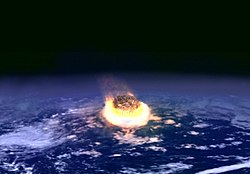
As originally proposed in 1980 by a team of scientists led by Luis Alvarez and his son Walter, it is now generally thought that the K–Pg extinction resulted from the impact of a massive asteroid 10 to 15 km (6 to 9 mi) wide, 66 million years ago, causing the Chicxulub impact crater and devastating the global environment, mainly through a lingering impact winter which halted photosynthesis in plants and plankton. The impact hypothesis, also known as the Alvarez hypothesis, was bolstered by the discovery of the 180 km (112 mi) Chicxulub crater in the Gulf of Mexico's Yucatán Peninsula in the early 1990s. "The temporal match between the ejecta layer, and the onset of the extinctions and the agreement of ecological patterns in the fossil record with modeled environmental perturbations (for example, darkness and cooling), lead us to conclude that the Chicxulub impact triggered the mass extinction. A 2016 drilling project into the Chicxulub peak ring confirmed that the peak ring comprised granite ejected within minutes from deep in the Earth, but contained hardly any gypsum, the usual sulfate-containing sea floor rock in the region: the gypsum would have vaporized and dispersed as an aerosol into the atmosphere, causing longer-term effects on the climate and food chain. In October 2019, researchers proposed the mechanisms of the mass extinction, arguing that the Chicxulub asteroid impact event rapidly acidified the oceans and produced long-lasting effects on the climate.
Other proposed causal or contributing factors to the extinction have included the Deccan Traps and other volcanic eruptions, climate change, and sea level change. However, in January 2020, scientists reported that climate-modeling of the mass extinction event favored the asteroid impact and not volcanism.
A wide range of terrestrial species perished in the K–Pg mass extinction, the best-known being the non-avian dinosaurs, along with many mammals, birds, lizards, insects, plants, and all of the pterosaurs. In the Earth's oceans, the K–Pg mass extinction killed off plesiosaurs and mosasaurs and devastated teleost fish, sharks, mollusks (especially ammonites and rudists, which became extinct), and many species of plankton. It is estimated that 75% or more of all animal and marine species on Earth vanished. However, the extinction also provided evolutionary opportunities: in its wake, many groups underwent remarkable adaptive radiation—sudden and prolific divergence into new forms and species within the disrupted and emptied ecological niches. Mammals in particular diversified in the following Paleogene Period, evolving new forms such as horses, whales, bats, and primates. The surviving group of dinosaurs were avians, a few species of ground and water fowl, which radiated into all modern species of birds. Among other groups, teleost fish and perhaps lizards also radiated into their modern species.
The K–Pg extinction event was severe, global, rapid, and selective, eliminating a vast number of species. Based on marine fossils, it is estimated that 75% or more of all species became extinct.
The event appears to have affected all continents at the same time. Non-avian dinosaurs, for example, are known from the Maastrichtian of North America, Europe, Asia, Africa, South America, and Antarctica, but are unknown from the Cenozoic anywhere in the world. Similarly, fossil pollen shows devastation of the plant communities in areas as far apart as New Mexico, Alaska, China, and New Zealand. Nevertheless, high latitudes appear to have been less strongly affected than low latitudes.
Despite the event's severity, there was significant variability in the rate of extinction between and within different clades. Species that depended on photosynthesis declined or became extinct as atmospheric particles blocked sunlight and reduced the solar energy reaching the ground. This plant extinction caused a major reshuffling of the dominant plant groups. Omnivores, insectivores, and carrion-eaters survived the extinction event, perhaps because of the increased availability of their food sources. Neither strictly herbivorous nor strictly carnivorous mammals seem to have survived. Rather, the surviving mammals and birds fed on insects, worms, and snails, which in turn fed on detritus (dead plant and animal matter).
In stream communities and lake ecosystems, few animal groups became extinct, including large forms like crocodyliforms and champsosaurs, because such communities rely less directly on food from living plants, and more on detritus washed in from the land, protecting them from extinction. Modern crocodilians can live as scavengers and survive for months without food, and their young are small, grow slowly, and feed largely on invertebrates and dead organisms for their first few years. These characteristics have been linked to crocodilian survival at the end of the Cretaceous.
Cretaceous–Paleogene extinction event
The Cretaceous–Paleogene (K–Pg) extinction event, formerly known as the Cretaceous-Tertiary (K–T) extinction event, was a major mass extinction of three-quarters of the plant and animal species on Earth approximately 66 million years ago. The event caused the extinction of all non-avian dinosaurs. Most other tetrapods weighing more than 25 kg (55 lb) also became extinct, with the exception of some ectothermic species such as sea turtles and crocodilians. It marked the end of the Cretaceous period, and with it the Mesozoic era, while heralding the beginning of the current geological era, the Cenozoic Era. In the geologic record, the K–Pg event is marked by a thin layer of sediment called the K–Pg boundary or K–T boundary, which can be found throughout the world in marine and terrestrial rocks. The boundary clay shows unusually high levels of the metal iridium, which is more common in asteroids than in the Earth's crust.
As originally proposed in 1980 by a team of scientists led by Luis Alvarez and his son Walter, it is now generally thought that the K–Pg extinction resulted from the impact of a massive asteroid 10 to 15 km (6 to 9 mi) wide, 66 million years ago, causing the Chicxulub impact crater and devastating the global environment, mainly through a lingering impact winter which halted photosynthesis in plants and plankton. The impact hypothesis, also known as the Alvarez hypothesis, was bolstered by the discovery of the 180 km (112 mi) Chicxulub crater in the Gulf of Mexico's Yucatán Peninsula in the early 1990s. "The temporal match between the ejecta layer, and the onset of the extinctions and the agreement of ecological patterns in the fossil record with modeled environmental perturbations (for example, darkness and cooling), lead us to conclude that the Chicxulub impact triggered the mass extinction. A 2016 drilling project into the Chicxulub peak ring confirmed that the peak ring comprised granite ejected within minutes from deep in the Earth, but contained hardly any gypsum, the usual sulfate-containing sea floor rock in the region: the gypsum would have vaporized and dispersed as an aerosol into the atmosphere, causing longer-term effects on the climate and food chain. In October 2019, researchers proposed the mechanisms of the mass extinction, arguing that the Chicxulub asteroid impact event rapidly acidified the oceans and produced long-lasting effects on the climate.
Other proposed causal or contributing factors to the extinction have included the Deccan Traps and other volcanic eruptions, climate change, and sea level change. However, in January 2020, scientists reported that climate-modeling of the mass extinction event favored the asteroid impact and not volcanism.
A wide range of terrestrial species perished in the K–Pg mass extinction, the best-known being the non-avian dinosaurs, along with many mammals, birds, lizards, insects, plants, and all of the pterosaurs. In the Earth's oceans, the K–Pg mass extinction killed off plesiosaurs and mosasaurs and devastated teleost fish, sharks, mollusks (especially ammonites and rudists, which became extinct), and many species of plankton. It is estimated that 75% or more of all animal and marine species on Earth vanished. However, the extinction also provided evolutionary opportunities: in its wake, many groups underwent remarkable adaptive radiation—sudden and prolific divergence into new forms and species within the disrupted and emptied ecological niches. Mammals in particular diversified in the following Paleogene Period, evolving new forms such as horses, whales, bats, and primates. The surviving group of dinosaurs were avians, a few species of ground and water fowl, which radiated into all modern species of birds. Among other groups, teleost fish and perhaps lizards also radiated into their modern species.
The K–Pg extinction event was severe, global, rapid, and selective, eliminating a vast number of species. Based on marine fossils, it is estimated that 75% or more of all species became extinct.
The event appears to have affected all continents at the same time. Non-avian dinosaurs, for example, are known from the Maastrichtian of North America, Europe, Asia, Africa, South America, and Antarctica, but are unknown from the Cenozoic anywhere in the world. Similarly, fossil pollen shows devastation of the plant communities in areas as far apart as New Mexico, Alaska, China, and New Zealand. Nevertheless, high latitudes appear to have been less strongly affected than low latitudes.
Despite the event's severity, there was significant variability in the rate of extinction between and within different clades. Species that depended on photosynthesis declined or became extinct as atmospheric particles blocked sunlight and reduced the solar energy reaching the ground. This plant extinction caused a major reshuffling of the dominant plant groups. Omnivores, insectivores, and carrion-eaters survived the extinction event, perhaps because of the increased availability of their food sources. Neither strictly herbivorous nor strictly carnivorous mammals seem to have survived. Rather, the surviving mammals and birds fed on insects, worms, and snails, which in turn fed on detritus (dead plant and animal matter).
In stream communities and lake ecosystems, few animal groups became extinct, including large forms like crocodyliforms and champsosaurs, because such communities rely less directly on food from living plants, and more on detritus washed in from the land, protecting them from extinction. Modern crocodilians can live as scavengers and survive for months without food, and their young are small, grow slowly, and feed largely on invertebrates and dead organisms for their first few years. These characteristics have been linked to crocodilian survival at the end of the Cretaceous.
Recent media
Recent media