Hubbry Logo
KarivellurKarivellurMain
Open search
Karivellur
Community hub
Karivellur
logo
8 pages, 0 posts
0 subscribers
Be the first to start a discussion here.
Karivellur
Karivellur
from Wikipedia

Karivellur is a census town and a Gram Panchayat in the Kannur district of Kerala state, India.[1]

Key Information

Location

[edit]

Karivellur is located 47 km north of the district headquarters, Kannur; 10 km from the taluk headquarters, Payyanur; and 535 km from the state capital, Thiruvananthapuram.

Etymology

[edit]

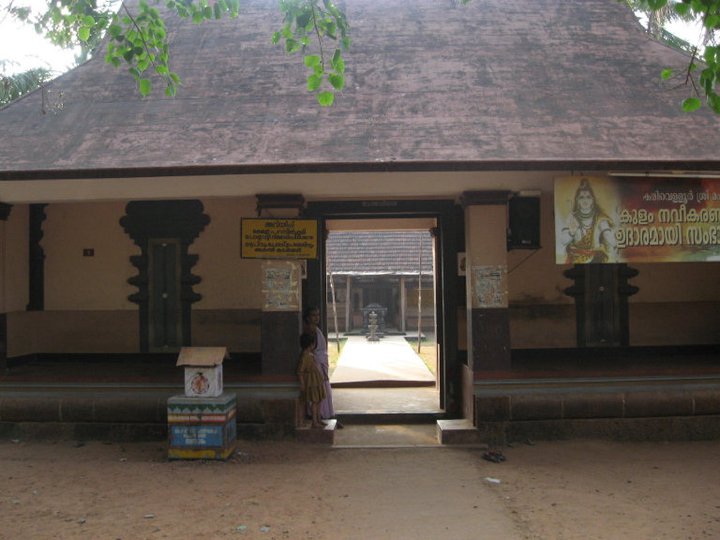
The word karivellur was originated from the Malayalam word "karivellon" (കരിവെള്ളോൻ ), a dialect name of Hindu deity Shiva. There is Shiva temple[2] in the town and the land of Shiva is later named as Karivellur.

Demographics

[edit]

As of 2011 India census, Karivellur census town had population of 13,498 which constitutes 6,252 males and 7,246 females. Karivellur town spreads over an area of 11.33 km2 with 3,463 families residing in it. The male female sex ratio was 1000:1159. Population in the age group 0-6 was 1,194 (8.8%) where 575 are males and 619 are females. Karivellur had overall literacy of 95.5% where male literacy stands at 98% and female literacy was 93.4%. Karivellur-Peralam Grama Panchayat consists of Karivellur census town and Peralam village.[3]

Religion

[edit]

As of 2011 Indian census, Karivellur census town had total population of 13,498, of which Hindus constitute 92.4%, 6.7% Muslims and 0.9% others.[4]

Transportation

[edit]

NH 66 passes through Karivellur town. Goa and Mumbai can be accessed on the northern side and Cochin and Thiruvananthapuram can be accessed on the southern side.[5] The road to the east of Iritty connects to Mysore and Bangalore. The nearest railway station is Payyanur on Shoranur-Mangalore section under Southern Railway. The nearest airport is Kannur, about 65 km away.

See also

[edit]

References

[edit]
Revisions and contributorsEdit on WikipediaRead on Wikipedia
from Grokipedia
Karivellur is a and in the taluk of in the Indian state of , located approximately 45 km north of city and bordering to the north. Covering an area of 11.33 s (as of 2011) with a population of 13,498, it has a of 1,191 per and serves as a northern border panchayat known for its agricultural economy centered on paddy, , and rubber cultivation. Historically, Karivellur gained prominence as a cradle of communism in Kerala, particularly through the Karivellur Struggle (also known as the Karivellur Samaram or Uprising) on December 20, 1946, when local peasants, organized under the Communist Party of India, resisted feudal landlords attempting to seize harvested grains amid post-World War II food shortages, resulting in the martyrdom of two workers and marking a key event in the state's anti-feudal movements. The village has remained a stronghold of left-wing politics since its formation as the Karivellur-Peralam Panchayat in 1947, with the Communist Party of India (Marxist) maintaining significant influence, as evidenced by long-serving leaders like K. Narayanan, who presided over the panchayat from 2000 to 2010 and received state-level awards for rural development. Culturally, Karivellur is renowned for its rituals, a traditional ritual art form of , with the Sree Muchilottu Bhagavathi Kshethram serving as the original or "Aadi" temple dedicated to Muchilottu Bhagavathi, the of the Vaniya (trading) community, featuring the Perumkaliyattam, a major festival held every 12 years, typically from early January (such as to 12) that draws thousands for elaborate performances embodying the goddess's mythology and social messages. Other notable sites include the nearby Karivellur Sri Mahashiva Temple and proximity to natural attractions like the Kavvayi Islands, offering backwater boat tours and contributing to the area's emerging eco-tourism.

Geography

Location

Karivellur is a within the Karivellur-Peralam , situated in the taluk of , , , with geographical coordinates approximately at 12°10′N 75°11′E and covering an area of 11.33 km² (2011 ). The town occupies a position on the northern periphery of , sharing its northern boundary with , while lying in close proximity to town about 10 km to the south and the Kavvayi Islands along the nearby backwaters to the west. Karivellur features a characterized by , supporting lush greenery and indicating long-standing environmental features; the area also hosts megalithic sites that reflect ancient human settlements amid this verdant landscape. The region experiences a , marked by high , average annual rainfall exceeding 3,000 mm—primarily during the southwest —and year-round temperatures typically ranging from 24°C to 32°C.

Etymology

The name Karivellur is closely tied to the central Karivellur Mahadeva Temple, a swayambhu (self-manifested) that has historically dominated the village's identity, with the place name emerging from the deity's local epithet as per ancient naming practices. In the broader context of Malabar region's historical naming conventions, many villages, including those in , were named after prominent temple deities, reflecting the centrality of Shaivite worship; no alternative etymological theories have been documented in available historical records.

History

Early History

The region of Karivellur in , , bears evidence of prehistoric human activity dating back to the , with archaeological findings indicating settlement and burial practices from the 4th century BCE to the CE. Clusters of megalithic structures, including umbrella stones (kudakals or dolmens), menhirs, burials, and rock-cut chambers, have been identified in the Karivellur area, reflecting commemorative and funerary traditions typical of communities in northern . These monuments, often comprising orthostats supporting capstones or simple standing stones, served as memorials for the deceased and are part of a broader megalithic landscape in the Malabar region. Local families, such as that of temple priest Narayanan Namboothiri, have played a key role in conserving these sites amid threats from construction and quarrying, preserving at least one surviving kudakal structure over 2,000 years old on their property. During the medieval period, from the 14th to 18th centuries, Karivellur functioned as an agricultural hamlet within the domain of the Chirakkal Kovilakam dynasty, which ruled the region encompassing northern Malabar. The Chirakkal Rajas, successors to the earlier Mushaka dynasty, administered the area from their seat in Chirakkal, fostering a landscape centered on paddy cultivation, coconut groves, and local crafts that supported regional trade networks along the . Traditional accounts preserved in temple histories link Karivellur to the origins of the Muchilot Bhagavathi , revered as the (clan ) of the Vaniya . The Muchilot Bhagavathi temple in Karivellur is regarded as "Aadi Karivellur" (the original Karivellur), marking the site of the first such shrine established following migrations of Vaniya traders and merchants from southern regions, as per traditional accounts. These migrations, intertwined with of divine manifestations and protection, integrated the 's into local rituals, emphasizing themes of and social cohesion among trading castes in . The social fabric of early Karivellur was shaped by Kerala's feudal janmi system, where land ownership was concentrated among Nambudiri Brahmins, Nair chieftains, and royal families like the Chirakkals, who held janmam rights over vast tracts. Tenants, known as kudiyans, cultivated the land under this hierarchy, paying portions of produce as rent while navigating caste-based obligations that reinforced dominance from the onward. In , this structure supported the dynasty's authority, with janmis overseeing agricultural output and artisanal labor, laying the groundwork for enduring agrarian relations in the region.

Karivellur Struggle

The Karivellur Struggle emerged in the aftermath of , during the 1945–46 famine that caused acute grain shortages across Malabar under British administration. Feudal landlords, aligned with the Chirakkal royal household, forcibly seized peasant harvests to stockpile paddy, intensifying food insecurity and exploitation in the region. On December 20, 1946, the uprising unfolded as a protest organized by the (CPI) and the Abhinava Bharat Yuvak Sangham, supported by the local Karshaka Sangham peasant union. Led by figures such as A. V. Kunhambu, K. Krishnan Master, and P. Kunhiraman, hundreds of peasants—including women and children—marched to the Kuniyan riverbank near landlord estates to block the transport of seized grains. The confrontation turned violent when feudal enforcers and the intervened, firing on the crowd and killing two peasants, Thidil Kannan and Keeneri Kunhambu, while injuring many others. These martyrs are commemorated annually through observances. Key participants included local leaders from the , who mobilized against the janmi (landlord) system's excesses. The event is recognized as a major peasant uprising in Malabar, demanding land redistribution, tenancy rights, and amid colonial-feudal oppression. Immediately following the clash, 197 activists faced arrests and legal trials, with several leaders initially presumed dead. The struggle's immediate aftermath saw local peasants secure control over lands previously monopolized by landlords, marking a tangible victory in Karivellur. It ignited statewide peasant agitations, amplifying calls for agrarian reform and contributing to the legislative framework of Kerala's 1957 land reforms under the first communist-led government. Annual events, beginning in 1947, continue to honor the uprising's role in Kerala's communist and anti-feudal history.

Demographics

Population Characteristics

According to the , the population of Karivellur totaled 13,498, with 6,252 s and 7,246 females. The was 1,159 females per 1,000 males, reflecting a higher female proportion that aligns with broader patterns in where male out-migration for labor opportunities contributes to such demographics. This gender distribution underscores the impact of temporary male in rural-urban fringe areas like Karivellur. The population density stood at 1,191 persons per square kilometer across an area of 11.33 square kilometers. Scheduled Castes accounted for 3.9% of the total (530 individuals), while Scheduled Tribes represented 0.1%. There were 3,463 households in the . Population growth from the 2001 Census, when the area recorded 8,744 residents, reached 54% over the decade, indicating significant expansion prior to its designation as a in 2011. Karivellur functions as a within the Karivellur-Peralam , which encompasses Karivellur and the adjacent Peralam village and had a total of approximately 21,105 as of 2025, per Kerala local self-government department data, showing stability since the 2011 combined figure of 21,105.

Literacy and Languages

Karivellur exhibits high rates, with an overall figure of 95.55% recorded in the 2011 census, exceeding Kerala's state average of 93.91%. Male reached 98.10%, while female was 93.36%, demonstrating a relatively narrow compared to national trends. These rates underscore the effectiveness of sustained educational investments following Kerala's post-independence social reforms, which prioritized universal access to schooling and campaigns across rural areas like Karivellur. The primary language in Karivellur is , spoken as the mother tongue by approximately 99% of residents, consistent with patterns in where accounts for 98.69% of mother tongues. Local dialects reflect influences from the Malabar coastal trade history, blending Dravidian roots with lexical borrowings from , , and other trading languages due to centuries of maritime commerce along the northern coast. English serves a minor role in administration and formal education, while Tamil and appear sporadically owing to the area's proximity to and borders, facilitating cross-border interactions. Local schools have been instrumental in bolstering education access, contributing to Karivellur's elevated through community-focused primary and secondary instruction that aligns with state initiatives for equitable learning opportunities. Culturally, the linguistic landscape enriches local and , where dialect-specific terms rooted in historical and regional contexts preserve communal narratives and oral traditions unique to the Malabar region.

Economy

Agriculture and Crafts

Agriculture in Karivellur primarily revolves around the cultivation of paddy, , , and rubber, which form the backbone of the local rural . These crops are suited to the region's lateritic soils and climate, with paddy fields concentrated in the low-lying valleys and coconut groves widespread across homesteads. Historically, grain production, particularly paddy, played a pivotal role in the area's socio-economic struggles during the , when post-World War II food shortages led to forcible seizures of harvests by landlords and authorities, sparking the iconic Karivellur peasant uprising in 1946. Small-scale supplements agricultural income for communities near the , where traditional methods target species like sardines and prawns in the estuarine ecosystem. The Land Reforms Act of 1957 profoundly transformed in Karivellur by abolishing the janmi () system and redistributing excess holdings to tenant cultivators, enabling the rise of smallholder farming that diversified into cash crops like alongside subsistence paddy. This shift empowered former verumpattamdar (small tenants) and kanamdar (mortgage holders) to own their plots, increasing productivity and reducing feudal exploitation prevalent in Malabar. However, contemporary challenges such as exacerbated by heavy monsoons and laterite mining continue to threaten , prompting efforts to promote vegetative cover for watershed conservation. Cooperatives play a crucial role in sustaining the sector, with organizations like the Karivellur Service Cooperative Bank facilitating crop marketing, distribution, and credit access to bolster rural GDP contributions from . Local crafts complement as vital industries, notably handloom centered in the Vellur and broader Karivellur area. The Karivellur Handloom Weavers Industrial Society produces traditional textiles including sarees, dhotis, and sets using indigenous looms, preserving a heritage craft amid declining demand. rolling remains a prominent home-based occupation, predominantly employing women who roll leaves into slender cigarettes, providing flexible income despite health risks and low wages; notable figures like panchayat leader K. Narayanan began their livelihoods in this trade. These artisanal activities, supported by cooperatives, integrate with farming to form a resilient economic fabric in the panchayat.

Panchayat Initiatives

The Karivellur-Peralam Grama Panchayat has spearheaded several initiatives aimed at fostering socio-economic growth and sustainable in the region. In 2022, the panchayat received the National Award for Rural Development from the , recognizing its efforts in implementing community-approved projects that enhance economic opportunities and livelihoods through participatory governance. It also earned the Child Friendly Grama Panchayat Award in the same year for integrating welfare into local development plans, further underscoring its holistic approach to community progress. Under the leadership of K. Narayanan, who served as panchayat president from 2000 to 2010, the body advanced key and infrastructure projects that laid the foundation for ongoing economic enhancements. Notable among these was the achievement of the Nirmal Gram Puraskar in 2007, awarded by then-President for attaining total coverage, which improved and to support . In 2009, Narayanan received the Rajiv Best Panchayat President Award for exemplary leadership in rural governance, including initiatives that boosted local infrastructure like and systems. Key projects have focused on and rural to bolster farming and economic resilience. The panchayat has implemented decentralized solid systems, emphasizing processing at the community level to reduce environmental near local water bodies like the Kavvayi River, thereby supporting . efforts include and market access improvements funded through central schemes, such as MGNREGA projects for schemes and canal in the panchayat to aid farming efficiency, with ongoing works as of 2025-2026. Additionally, the promotion of eco-tourism has gained momentum with initiatives like the Paliyeri nature walkway, a 600-meter constructed in 2013 through community efforts near backwaters and temple sites, designed to attract visitors while preserving and generating local income. These initiatives have yielded tangible economic impacts, including enhanced livelihoods for rural residents through in infrastructure works and tourism-related activities. MGNREGA integration has provided wage opportunities in green projects, such as waste processing and , contributing to local asset creation like structures as of mid-2025. conservation efforts under the Kerala State Board, including funding for the Local Strategy and Action Plan in Karivellur as of 2023-2024, support sustainable practices aligning with national goals. Funding primarily draws from central schemes like MGNREGA and state panchayat resources, ensuring scalable implementation of these development programs.

Culture and Religion

Temples and Deities

Karivellur features several prominent Hindu temples that underscore the region's deep-rooted Shaivite and other devotional traditions, with forming the predominant faith among over 92% of the local population as of 2011. These sacred sites, integral to community life, include ancient shrines dedicated to major deities and smaller family-oriented worship spaces, often incorporating elements of Malabar's syncretic religious practices. The Karivellur Mahadeva Temple stands as the central shrine in the area, recognized as one of the ancient temples in . Its presiding deity is Lord in the form of a , accompanied by sub-deities such as Ganapathy, Sastha, , and Bhoothanathan. The temple's architecture exemplifies the traditional Kerala style, characterized by sloping roofs, wooden carvings, and a compact rectangular sanctum. The Sree Muchilottu Bhagavathi Kshethram serves as the original or "Aadi" temple dedicated to Muchilottu Bhagavathi, the of the Vaniya (trading) community. This 14th-century is central to the region's traditions and features elaborate rituals embodying the goddess's mythology. Additional religious landmarks include the Ayathravayal Kottam, a temple focused on or ancestral deities, and numerous kavus, or sacred groves, primarily devoted to Bhagavathi worship. These groves, such as those in Karivellur, preserve natural habitats while serving as sites for localized piety, embodying the area's blend of temple-based and nature-centric devotion.

Festivals and Theyyam

Karivellur is renowned for its vibrant annual religious and cultural events, with rituals forming the centerpiece of the region's festive calendar. These performances, held primarily from October to May, transform sacred groves known as into sites of divine invocation, where performers embody deities through elaborate costumes, music, and dance. The festivals blend elements of , , and , reflecting a synthesis of tribal, Dravidian, and traditions unique to . One of the prominent events is the Kaliyattam Theyyam festival at Ayathravayal Kottam Temple, a two-day annual observance in the month of Vrischika (typically December 4 and 5). This ritual honors local deities through performances of s such as Vishnumoorthi, Madayil Chamundi, Vallarkulangara Bhagavathy, and , accompanied by thira chants and offerings from the agricultural community. The festival underscores the temple's role as a muchathu kottam, a platform for communal worship and seasonal gratitude. At Vaniyillam Someswari Temple, the annual festival in March-April features a series of rituals that draw large crowds to witness embodiments of fierce goddesses and warriors. Key performances include Raktha Chamundi, Angakkulangara Bhagavathy, Kattumoorthy, and Karichamundi, where artists don intricate headdresses and face paint to channel divine energy, often resolving local disputes or blessing attendees. This event, tied to ancestral serpent groves, exemplifies 's role in preserving through mime, rhythm, and trance-like devotion. The Perumkaliyattam at Sree Muchilottu Bhagavathi Kshethram, held annually from January 7 to 12, is a major festival attracting thousands for elaborate performances of Muchilottu Bhagavathi, conveying social messages through the goddess's mythology. The tradition in Karivellur, performed exclusively by hereditary artists from communities like the Vannan and Thiyya, transcends hierarchies, allowing participants from all social strata to engage equally in the rituals. Held in family shrines and village kavus, these events foster unity, with over 400 documented forms across the region adapting myths to local contexts, such as the depicting a of . Complementing the religious observances, Karivellur hosts the annual on December 20 to commemorate the 1946 Karivellur Struggle, an agrarian uprising against feudal landlords that marked a pivotal moment in Kerala's anti-feudal movements. The event includes political remembrance activities such as marches and public meetings organized by the Communist Party of India (Marxist).

Administration and Politics

Local Governance

The Karivellur-Peralam , formed in 1947, serves as the primary local administrative body for the region, encompassing an area of 22.24 km² and covering the villages of Karivellur and Peralam in , . As of recent estimates, the panchayat administers a population of approximately 21,105 residents. It is structured into 16 wards—following a redivision from 14 wards ahead of the 2025 local body elections—each represented by an elected member, with overall leadership provided by a president and a council of elected representatives who convene to make decisions on local matters. This setup falls under the Block Panchayat and integrates with the broader administration for coordination on regional development. Under the Kerala Panchayati Raj Act, 1994, the panchayat is responsible for essential local services, including the provision and maintenance of , facilities, street lighting, and minor roads within its . The Act empowers the body to prepare and implement plans for and , such as managing initiatives and basic infrastructure. During the 2020–2025 term, efforts have emphasized efficient service delivery through integration with state-level digital platforms, facilitating online access to services like building permits and grievance redressal. Key administrative functions are supported by the local village office, which handles revenue-related tasks such as maintaining land records, issuing certificates, and collecting taxes on behalf of the state revenue department. This office ensures seamless coordination with the Kannur district collectorate for matters like land revenue assessment and disaster management integration. The panchayat's evolution traces back to post-independence reforms in , where initial setups under the Travancore-Cochin Panchayats Act, 1950, laid the groundwork for local . Significant occurred following the 73rd Constitutional Amendment in 1993, leading to the enactment of the Kerala Panchayati Raj Act in 1994, which devolved greater powers to gram panchayats for and resource allocation. This shift enabled bodies like the Karivellur-Peralam to engage in bottom-up development processes, including annual plans for and welfare schemes.

Political Legacy

Karivellur's political landscape solidified as a communist stronghold following the 1946 Karivellur Struggle, a pivotal peasant uprising against feudal landlords that galvanized the Communist Party of India (Marxist) [CPI(M)] presence in the region. This event transformed the area into a bastion for left-wing politics, with the CPI(M) dominating local governance and mobilizing rural workers through agrarian reforms and anti-imperialist campaigns. Prior to the struggle, in the 1930s and 1940s, the Abhinava Bharat Yuvak Sangham, a youth organization founded in 1934 under leaders like A.V. Kunjambu, played a crucial role in mobilizing young activists and laying the groundwork for communist ideology in Malabar, fostering early resistance against colonial and feudal oppression. The panchayat's electoral history reflects this enduring left dominance, with the CPI(M)-led (LDF) securing uninterrupted victories in local elections since the panchayat's formation in , often without any opposition representation in its wards. Notable figures from Karivellur have risen to prominence within the party, including K. Narayanan, who served as president of the Karivellur-Peralam Panchayat from 2000 to 2010 and later held state-level roles in cooperative and panchayat bodies, exemplifying the region's contribution to 's communist hierarchy. Additionally, Karivellur Murali, a renowned and born to early communist fighters like A.V. Kunjambu, has continued this legacy as a cultural activist blending literary work with political advocacy for leftist causes. The (AIKS), with deep roots in Karivellur's peasant movements, maintains ongoing influence in politics, producing leaders like Vijoo Krishnan, a native of the area and AIKS general secretary, who advocate for farmers' rights on state and national platforms. Recent dynamics, particularly evident in the lead-up to the 2025 local body elections, indicate subtle shifts in Karivellur's political loyalty, with the CPI(M) experiencing vote erosion to opposition parties like the and BJP during the 2024 Lok Sabha polls in the constituency, where rival candidates gained ground in several wards. Despite these signs of diversification—such as increased opposition optimism for the December 2025 panchayat polls in the 16-ward body with 21,105 voters—the legacy of land reforms initiated through the 1946 struggle and subsequent Land Reforms Act of 1963 endures, having redistributed tenancy rights and empowered smallholders in the region, sustaining left-wing support among farming communities.

Transportation

Road Network

Karivellur's road infrastructure is anchored by National Highway 66 (NH 66), a major north-south corridor stretching from to along India's western coast. This highway passes directly through the town, providing seamless connectivity to northern destinations such as and , while facilitating access southward to and . The route enhances regional integration, supporting both daily commutes and long-distance travel within and beyond. Complementing NH 66 are state highways and local roads that link Karivellur to nearby towns, including a 10 km stretch to Payyanur in the north and connections to Taliparamba approximately 27 km away. The Karivellur-Peralam Gram Panchayat maintains several village paths, which are essential for agricultural transport and intra-village mobility, with ongoing tarring projects ensuring better access to farmlands and residential areas. Public transportation is robust, with frequent Kerala State Road Transport Corporation (KSRTC) buses operating along NH 66 and feeder routes, while auto-rickshaws and taxis handle short-distance travel within the town. Traffic volumes often peak during temple pilgrimages, particularly around festivals, influencing local road usage patterns. Recent infrastructure developments include the widening of NH 66 to six lanes in the , with sections near Karivellur—such as from to Muzhappilangad—reaching 78% completion as of October 2025, aimed at improving safety and efficiency. These upgrades, part of a broader 643 km project across set for inauguration in January 2026, bolster by reducing times; for instance, the to city is about 43 km via the enhanced highway. Such improvements not only ease congestion but also support economic activities tied to the region's cultural sites. Karivellur's rail connectivity primarily relies on nearby stations along the Mangalore– main line, operated by Southern Railway. The closest halt station is Chandera, located approximately 2.19 km away, where a limited number of passenger trains stop daily, providing basic access to regional destinations. For more extensive inter-district and interstate travel, residents and visitors typically use Railway Station, situated about 12 km south of Karivellur. This major junction sees over 60 trains daily, including express and superfast services to key cities like , , and , as well as connections to Bengaluru, , and northern . Air travel is facilitated through (CNN), located 36 km southeast of Karivellur and operational since December 9, 2018. The airport offers direct domestic flights to major hubs such as , , Bengaluru, and via airlines like and , supporting efficient connections for business and leisure travel. International routes to the further enhance its role in regional mobility. Integration with local transport includes public buses and auto-rickshaws along National Highway 66 (NH 66), which passes through Karivellur and serves as a feeder route to both rail and air endpoints; for instance, the drive to , another key junction 43 km away, takes about 41 minutes by car. Usage of these links has grown steadily, driven by migrant workers commuting to Gulf countries and increasing tourist influx to Theyyam performance sites, with the airport handling over one million passengers in its first nine months of operation.

References

Add your contribution
Related Hubs
User Avatar
No comments yet.