Hubbry Logo
Kill Van KullKill Van KullMain
Open search
Kill Van Kull
Community hub
Kill Van Kull
logo
8 pages, 0 posts
0 subscribers
Be the first to start a discussion here.
Kill Van Kull
Kill Van Kull
from Wikipedia

40°38′38″N 74°07′12″W / 40.644°N 74.120°W / 40.644; -74.120

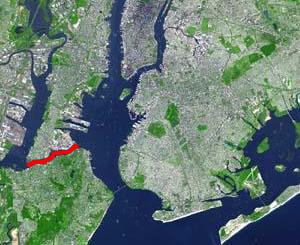
The Kill Van Kull (in red) connects Newark Bay and Upper New York Bay
Map of New York Harbor showing the location of the Kill Van Kull

The Kill Van Kull is a tidal strait between Staten Island, New York, and Bayonne, New Jersey, in the United States. It is approximately 3 miles (4.8 km) long and 1,000 feet (305 m) wide and connects Newark Bay with Upper New York Bay.[1] The Robbins Reef Light is at the eastern end of the Kill, and Bergen Point marks its western end. It is spanned by the Bayonne Bridge and is one of the most heavily traveled waterways in the Port of New York and New Jersey.

Historically, it has been one of the most important channels for the commerce of the region, providing a passage for marine traffic between Upper New York Bay and the industrial towns of northeastern New Jersey. During the colonial era, it played a significant role in travel between New York and the southern colonies, with passengers transitioning from ferries to coaches at Elizabethtown (now Elizabeth).

Since the final third of the 20th century, it has provided the principal access for oceangoing container ships to Port Newark-Elizabeth Marine Terminal, the busiest port facility in the eastern United States, and Howland Hook Marine Terminal. The strait has required continued dredging and deepening to accommodate the passage of ever-larger ships. In many areas, the sandy bottom was excavated down to rock and required blasting.[2][3][4][5] The Bayonne Bridge's deck was raised in 2017 so that New Panamax ships could travel the Kill Van Kull.[6]

Collins Park in Bayonne is situated along the northern shore.

Etymology

[edit]

Kill Van Kull translates as "channel of the ridge" or "pass". Nearby is the Arthur Kill, the name of which is an Anglicization of the Dutch achter kill meaning "back channel", referring to its location "behind" Staten Island.

The name "Kill Van Kull" originated during the early 17th century, during the Dutch colonial era, when the region was part of New Netherland. Places were named by early explorers and settlers in reference to their shape, topography, or other geographic qualities. The area around Newark Bay was termed Achter Col.[7] The bay lies behind Bergen Hill, the ridge of the Hudson Palisades which begins on Bergen Neck, the peninsula between it and the Upper New York Bay. Behind or achter the ridge was a col or mountain pass to the interior.

Kill comes from the Middle Dutch word kille meaning creek. Compare Dordtse Kil in the Netherlands. The bay was known as Cull Bay during the British colonial era.[8]

[edit]

See also

[edit]

References

[edit]
Revisions and contributorsEdit on WikipediaRead on Wikipedia
from Grokipedia
The Kill Van Kull is a tidal strait in the Port of New York and New Jersey that separates , New York, from , and connects Upper New York Bay to . Approximately 3 miles (4.8 km) long and 1,000 feet (305 m) wide, it has been dredged to a controlling depth of 45 to 50 feet (14 to 15 m) to accommodate large vessels. The name originates from Dutch colonial language, with "kill" derived from the Middle Dutch word kille or kil, meaning "channel," "creek," or "riverbed." As one of the most heavily traveled waterways in the port complex, the Kill Van Kull facilitates extensive commercial traffic, including container ships, bulk carriers, and petroleum tankers serving the region's industrial facilities and the largest on the East Coast. It is spanned by key infrastructure such as the , which provides a 215-foot (66 m) vertical clearance following a 2017 roadway raise to allow passage of post-Panamax vessels. The strait is marked by navigational aids, including the Robbins Reef Light at its eastern entrance, and is subject to strong tidal currents that influence vessel operations. Historically, the waterway has played a central role in the commerce of the since the colonial era, evolving from a natural tidal passage used by early settlers to an engineered federal navigation channel maintained by the U.S. Army Corps of Engineers. Major deepening projects, completed in phases through 2011, removed bedrock obstructions via to support modern global trade, underscoring its ongoing economic significance. Ecologically, the surrounding area includes restored wetlands and supports diverse marine life, though it faces challenges from and industrial activity.

Geography

Location and Physical Features

The Kill Van Kull is a approximately 4 miles (6.4 km) long that separates in from in , serving as a vital within the system. It connects at its eastern end, marked by the Robbins Reef Light, to at its western end near Bergen Point. The strait lies at approximately 40°38′38″N 74°07′12″W and is bordered by urban-industrial waterfronts, including the Port Richmond area on and the waterfront on the side. The waterway has an average width of about 1,000 feet (305 m), with the federal navigation channel measuring around 800 feet (244 m) wide. Its depth varies between 35 and 50 feet (10.7–15.2 m), following extensive efforts to maintain , with the authorized federal channel depth at 50 feet (15.2 m) below mean lower low water; an ongoing project started in 2024 aims to deepen it by an additional 5 feet to 55 feet (16.8 m). These dimensions support heavy commercial traffic while accommodating the tidal influences characteristic of the harbor. Geologically, the Kill Van Kull formed as part of the post-glacial estuary following the retreat of the late Wisconsinan glaciation around 18,000 years ago, when rising sea levels flooded glacially scoured valleys. It occupies a bedrock basin overdeepened by glacial activity associated with Hackensack, which drained eastward into Hudson via spillways in the Kill Van Kull. The underlying sediments consist primarily of glacial till, sand, and clay deposits from streams and lake-bottom varves, overlain by post-glacial estuarine silts and clays up to 61 meters thick in places.

Hydrology

The Kill Van Kull functions as a dynamic tidal channel, connecting Upper to , where it experiences mixed semidiurnal influenced by the . The mean is approximately 1.4 meters (4.5 feet), with a diurnal range reaching up to 1.5 meters (5 feet), resulting in significant water level fluctuations that drive navigational dynamics. These generate strong bidirectional currents, with peak speeds up to 2.5 knots during flood and ebb cycles, creating challenging conditions for vessel transit due to the strait's narrowing geometry. As a transitional zone, the strait facilitates from Upper , where ocean-influenced waters mix with fresher inflows from , yielding typical levels of 25-30 parts per thousand (ppt) and relatively weak vertical stratification of up to 1.5 ppt. Sedimentation in the Kill Van Kull arises primarily from natural siltation processes, as suspended sediments transported by upstream rivers and tidal flows accumulate within the channel. Annual sediment loads through the strait are estimated at around 100,000 metric tons, equivalent to thousands of cubic yards, highlighting the ongoing depositional tendencies in this estuarine environment. Basic water quality parameters reflect the strait's estuarine nature, with average temperatures varying seasonally from 10°C in winter to 25°C in summer, and pH levels typically ranging between 7.5 and 8.0, consistent with brackish coastal conditions.

History

Etymology and Early Settlement

The name "Kill Van Kull" derives from Dutch colonial nomenclature, with "kill" originating from the Middle Dutch word kille, meaning a riverbed, water channel, or tidal creek. The full phrase "Kill van Kull" translates to "channel of the pass," from Dutch "Kille van Col," where "col" refers to a pass or ridge, likely alluding to the nearby Bergen Hill in . This name first appears in records from the 17th century, during the era of , as documented in early Dutch maps and narratives of . Prior to European arrival, the waterway served as an important route for the indigenous people, who utilized the surrounding coastal areas, including the straits between what is now and the mainland, for fishing, hunting, and seasonal travel by canoe. Dutch colonization of the region began in earnest in the 1620s, with explorers and traders establishing posts along the and adjacent waterways as part of ; the Kill Van Kull area, positioned between and , facilitated access to fur trading routes and supported early settlements on by the 1630s. The English seized control of in 1664, renaming it New York, but the Dutch linguistic legacy persisted in local geography, including the waterway's name. By the early 1700s, ferries across the Kill Van Kull had become essential for connecting Staten Island to the New Jersey mainland, particularly to Elizabethtown (present-day Elizabeth), enabling commerce and migration while bypassing the congested paths through Manhattan. A notable development occurred in 1777 with the establishment of Decker's Ferry at Port Richmond on Staten Island's North Shore, operated by Isaac Decker, which provided an inn and crossing services amid the Revolutionary War tensions. The strait played a vital role in colonial overland travel to the southern colonies, allowing passengers to ferry across to New Jersey, then proceed by coach along routes like those to Perth Amboy, avoiding the need to navigate Manhattan's urban bottlenecks.

Development and Industrialization

In the , the Kill Van Kull transitioned from a primarily navigational to a burgeoning , driven by the expansion of shipping and rail infrastructure. The rise of maritime commerce along its shores facilitated the establishment of numerous and factories, including the Burlee , Starin , and Van Clief's on Staten Island's North Shore, which supported vessel construction and repair amid growing trade demands. Rail development further integrated the into regional ; for instance, the opened a line in 1864 that enhanced connectivity across the waterway, boosting freight movement between New York and . These changes reflected broader economic shifts, as industrial innovations like dye houses and printing facilities emerged around 1818, drawing workers and spurring shoreline development. Early 20th-century industrialization intensified with major infrastructure projects that solidified the Kill Van Kull's role in interregional transport. The , designed by Swiss-American engineer , was constructed between 1928 and 1931, spanning the strait to link , with and alleviating traffic congestion while accommodating rail and vehicular traffic. Dredging efforts, accelerated by the 1914 opening of the which increased transoceanic traffic, gradually improved the channel from about 15-20 feet deep to around 35 feet by the 1960s. Concurrently, connections to emerging port facilities, such as the development of Port Newark in the 1920s and the expansion of the Port Newark-Elizabeth Marine Terminal in the 1940s, positioned the Kill Van Kull as a vital gateway for wartime and postwar cargo, including oil refining operations along the adjacent . Post-World War II developments marked a pivotal shift toward modern , transforming the into a high-volume shipping . The container boom, pioneered at the Port Newark-Elizabeth Marine Terminal—which became the world's first dedicated in 1962—drove further adaptations, with the Kill Van Kull dredged to 35 feet to handle increasingly larger vessels. This era also spurred urban and industrial growth in surrounding areas, notably at Howland Hook on , where the marine terminal evolved from a 19th-century shipping hub into a key facility for container transfers, supporting regional economic expansion through the late despite periods of decline. Further deepening to 50 feet was completed in phases through 2011 to accommodate post-Panamax vessels. To enable passage of New Panamax ships following the expansion, the Bayonne Bridge's roadway was raised 64 feet to a clearance of 215 feet in 2017.

Crossings and Infrastructure

Bridges

The serves as the sole major fixed crossing over the Kill Van Kull, providing a vital link between , and , New York. This through-, completed in November 1931, spans the strait at a 58-degree angle to the shoreline, with a main arch span measuring 1,675 feet, making it the world's longest arch bridge of its type until 1977. Construction began in September 1928 under the direction of chief engineer Othmar H. Ammann and architect , as a of New York and initiative to integrate the crossing into a broader regional highway system for motor vehicles, bicycles, and pedestrians while reducing dependence on ferry services. The design evolved from early 1920s proposals for a Kill Van Kull Bridge, which initially explored and suspension options before adopting the arch configuration to support four vehicular lanes and provisions for future transit. The project finished ahead of schedule and under budget, reflecting efficient planning amid the onset of the , which led to simplified exposed steelwork on the abutments instead of planned ornamental stone. Originally offering 151 feet of vertical clearance above mean high water, the bridge accommodated maritime traffic along the but became a bottleneck for larger vessels as global shipping evolved. To address this, the undertook the Navigational Clearance Program starting in 2013, raising the roadway by 64 feet at a total project cost of $1.7 billion and completing the work in , thereby increasing clearance to 215 feet—equivalent to that of the —to enable passage of Post-Panamax ships carrying up to 18,000 TEU containers. The bridge carries New York State Route 440 on the New York side and on the New Jersey side, where the routes align at the state border in the channel's center. Handling approximately 11,500 vehicles per day as of 2024, the plays a critical role in regional transportation, supporting commerce and connectivity across the area. It was designated a National Historic Civil Engineering Landmark by the in 1985, recognizing its engineering innovation and enduring significance. No other major bridges cross the , underscoring the Bayonne Bridge's unique position in the infrastructure network.

Ferries and Other Crossings

Ferries have long served as vital crossings over the Kill Van Kull, facilitating travel between and , since the colonial era. One of the earliest documented services was Decker's Ferry, established in the mid-18th century and operated by Decker from 1774 to 1780, which transported passengers and freight across the strait, including connections to . This route evolved over time, with the Bergen Point and Port Richmond Ferry Company formalizing operations by 1873, using steam-powered vessels to carry passengers, vehicles, and goods between Bayonne's Broadway terminal and Port Richmond on . These ferries were essential for regional commerce and travel, offering a direct shortcut that bypassed longer overland or Manhattan-centered routes. In the , the New Blazing Star Ferry emerged as another key service, operating from around 1757 near Tompkinsville (now Linoleumville) and continuing into the early 1800s, distinct from the older Blazing Star route across the adjacent . It handled passengers, freight, and stagecoaches, linking the Kill Van Kull to broader networks toward Paulus Hook, Bergen Neck, and beyond, with operations noted as active by 1769 and persisting until at least 1817. Horse-powered ferries also supplemented these efforts in the late 1830s and early 1840s, primarily moving and cargo before being supplanted by rowboats and scows. By the mid-19th century, steam ferries like the Bergen Point service had modernized the crossings, supporting daily passenger volumes that reflected the growing industrial ties between New York and . The 20th century marked the decline of these ferry operations, accelerated by the construction of fixed infrastructure. Although the opened in 1931, paralleling the primary route, services persisted for vehicular and passenger needs until the early 1960s. The last regular crossings ended in December 1961, as bridges and improved roadways rendered water-based transport obsolete for most local traffic. Today, no active services operate directly across the Kill Van Kull, though regional studies have explored potential revivals, such as extensions of Ferry routes or Hudson County connections that could traverse the strait en route to . Alternative non-water crossings include shoreline and bicycle paths along both the and waterfronts, providing recreational access without spanning the channel.

Channel Maintenance

The maintenance of the Kill Van Kull federal navigation channel is essential for ensuring safe passage for commercial vessels accessing the Port of New York and New Jersey. Dredging efforts have been continuous since the early 20th century, when the channel depth was approximately 25 feet to support growing maritime traffic, including ships utilizing the newly opened in 1914. In 1985, Congress authorized deepening to 45 feet, which was later expanded to 50 feet below mean lower low water (MLLW) starting in the early 2000s to accommodate larger post-Panamax vessels. The major deepening project, managed by the U.S. Army Corps of Engineers (USACE), achieved a controlling depth of 50 feet (52 feet in rock areas) across a 4-mile stretch, with the final contract completed in 2011 and overall harbor improvements finalized by 2016. This established the federal channel at approximately 1,000 feet wide, enabling efficient navigation without significant interruption to port operations. Dredging methods employed by the USACE include hydraulic to remove and controlled blasting to excavate rock outcrops, ensuring the channel remains navigable. Annual maintenance typically removes 150,000 to 280,000 cubic yards of material, addressing ing caused by sedimentation from upstream sources such as the Hudson and Passaic Rivers. For instance, a 2022 maintenance operation removed about 150,000 cubic yards from critical areas. These efforts require coordination with regional infrastructure projects, such as the 2017 roadway raising, which was integrated into a broader $1.6 billion harbor deepening initiative that included $115 million specifically for Kill Van Kull to support taller clearances for supersized ships. Recent initiatives focus on further enhancements for post-Panamax traffic, with the USACE's New York and Harbor Deepening and Channel Improvements Project, proposed in the 2022 , planning to deepen the Kill Van Kull to 55 feet (57 feet in rock). This multi-phase effort, in preconstruction engineering and design as of late 2024 with no construction authorization as of 2025, forms part of a $6.3 billion program spanning 12-15 years to upgrade several channels, with costs for the Kill Van Kull segment exceeding $500 million to handle vessels with drafts up to 50 feet or more. Maintenance continued through 2025, including surveys identifying shoaling in key reaches to guide targeted removals.

Commercial Traffic

The Kill Van Kull serves as a critical maritime corridor for commercial shipping in the Port of New York and New Jersey, facilitating access to major terminals including Port Newark-Elizabeth Marine Terminal, the busiest on the U.S. East Coast and the third busiest in the nation by TEU volume. In 2024, the port handled a record 8.7 million TEUs, underscoring the strait's role in supporting high-volume container traffic. The strait accommodates a diverse array of vessels, including container ships, bulk carriers, tankers, and barges, with post-2017 channel improvements enabling New Panamax vessels up to approximately 1,200 feet in length and capacities exceeding 14,000 TEUs, such as the CMA CGM Brazil with 15,072 TEUs. Commercial operations through the Kill Van Kull contribute significantly to regional and national economies. As of October 2025, this activity supports nearly 580,000 jobs across direct, indirect, and induced sectors in , transportation, and related industries, while generating $18.1 billion in and $57.8 billion in personal and business income. Key facilities like the Howland Hook Marine Terminal, accessible via the strait, specialize in handling containers. Vessel movements in the Kill Van Kull are regulated by the under 33 CFR Part 161, which establishes the (VTS) for the New York area, including the strait from its junction with to the Lehigh Valley Draw Bridge. The VTS monitors and coordinates transits to enhance safety and efficiency, requiring vessels to report positions and comply with directed movements amid the high density of commercial traffic.

Ecology and Environment

Habitats and Wildlife

The Kill Van Kull supports a variety of estuarine habitats, including salt marshes dominated by cordgrass and common reed, tidal flats such as those at Arlington Marsh, and subtidal zones that provide foraging areas for aquatic species. These habitats are integral to the broader complex, encompassing approximately 7.45 square miles of significant area that includes freshwater wetlands and wooded swamps along the strait. Adjacent shorelands, such as the Sharrotts Road area on , feature woods, salt marshes, and mudflats that buffer the waterway and enhance ecological connectivity. Wildlife in the Kill Van Kull reflects the strait's role as a recovering urban , with populations including anadromous like (Morone saxatilis), which utilize the area for juvenile rearing, alongside (Pomatomus saltatrix) and (Brevoortia tyrannus). Benthic communities consist of organisms such as clams, fiddler crabs (Uca spp.), and ribbed mussels (Geukensia demissa), which stabilize sediments and support food webs in tidal flats and marshes. Bird diversity is notable, with wading species like black-crowned night-herons (Nycticorax nycticorax), great egrets (Ardea alba), and snowy egrets (Egretta thula) formerly nesting in heronries on islands in the adjacent , such as Shooters Island, Pralls Island, and Isle of Meadows, which collectively hosted around 1,400 pairs in the mid-1990s but have seen no nesting activity since the early 2000s. These islands now offer suitable habitat for potential recolonization, while wading birds nest on other harbor islands, totaling 1,423 pairs as of 2024. Ospreys (Pandion haliaetus) and other raptors forage along the strait, while gulls, waterfowl, and neotropical migrant songbirds use the wetlands as stopover points within the Estuary's migration corridor along the Atlantic Flyway. Seasonally, the strait serves as spring spawning grounds for anadromous fish like , with juveniles appearing in mid-water trawls during this period. Wading birds concentrate in heronries for nesting from spring through summer, while winter brings concentrations of waterfowl such as (Aythya marila) and American black ducks (Anas rubripes) to the tidal areas. Migratory shorebirds, including black-bellied plovers (Pluvialis squatarola), pass through in fall and spring, utilizing mudflats for foraging.

Pollution and Conservation

The Kill Van Kull experienced severe pollution throughout the , primarily from industrial discharges along its shores, including polychlorinated biphenyls (PCBs), , and other toxic substances that rendered sediments highly contaminated and harmful to benthic organisms. These pollutants accumulated in the waterway due to nearby manufacturing facilities on both the and sides, contributing to widespread ecological degradation in the surrounding estuary complex. Water quality began to improve in the following the enactment of the federal of 1972, which regulated industrial effluents and sewage discharges, leading to reduced contaminant levels and partial remediation of toxic sediments by the . Today, occasional oil spills from commercial vessel traffic and urban runoff remain concerns, though a water assessment indicated compliance with state recreational standards for fecal coliform bacteria while noting elevated nutrient levels, such as total nitrogen concentrations ranging from 0.68 to 1.4 mg/L, which contribute to fair rather than ideal conditions. Conservation initiatives have focused on restoration and protection through programs like the Estuary Program, a partnership between the New York State Department of Environmental Conservation and , which coordinates habitat enhancement and pollution control in the . Efforts include wetland restoration at sites totaling approximately 90 acres near the Kill Van Kull, such as the property in Newark, aimed at improving tidal flows and biodiversity. Protections for bird islands in the adjacent , first established in the 1970s by conservation groups, have safeguarded wading bird colonies from development pressures. Additionally, remediation at sites like the Diamond Alkali complex has addressed legacy contaminants, including dioxins and PCBs, through soil and groundwater cleanup to prevent further migration into the waterway, with a draft restoration plan released as of 2025. These measures have yielded positive outcomes, with fish populations in the Kill Van Kull and broader showing significant rebound since the 1990s due to improved and recovery. Ongoing monitoring tracks climate change impacts, including sea-level rise projected to alter tidal dynamics and inundate low-lying areas, with expanded programs for dissolved oxygen and elevation data to guide adaptive strategies.

References

  1. https://en.wiktionary.org/wiki/Kill_Van_Kull
Add your contribution
Related Hubs
User Avatar
No comments yet.