Hubbry Logo
New York BightNew York BightMain
Open search
New York Bight
Community hub
New York Bight
logo
8 pages, 0 posts
0 subscribers
Be the first to start a discussion here.
New York Bight
New York Bight
from Wikipedia
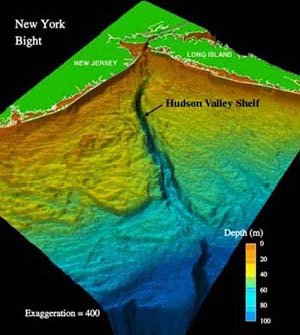
A colorized depiction of the Hudson Canyon and the New York Bight area

The New York/New Jersey Bight is the geological identification applied to a roughly triangular indentation, regarded as a bight, along the Atlantic coast of the United States that extends northeasterly from Cape May Inlet in New Jersey to Montauk Point on the eastern tip of Long Island. As the result of direct contact with the Gulf Stream along the coast of North America, the coastal climate of the bight area is temperate.[1]

Geography

[edit]

The bight is formed by the roughly right-angled intersection of the generally north-south Atlantic coast of New Jersey and the approximately east–west southern coast of Long Island at the mouth of the Hudson River. The New York Bight Apex is the area including and between the Hudson River estuary and the Raritan River estuary extending 6–7 km from the coast, and it includes both the Raritan Bay and the Lower Bay.[2]

Weather

[edit]

The geography of the bight has long been of major concern to meteorologists in the study of tropical storm patterns along the eastern coast of North America. These geographical characteristics of the area are among the primary reasons that, despite its northerly latitude, the New York Metropolitan Area is considered a high danger zone for storm-generated ocean-water surges.[3] Specifically, in the presence of a hurricane off the coast of New Jersey, the easterly cyclonic winds along the northern edge of the storm could drive a strong surge to the west, laterally along the southern coast of Long Island and straight into Lower New York Bay. The angular bend of the New Jersey coast would leave little outlet for the surge, leading to widespread flooding throughout New York City, especially along the southern coast of Staten Island and Manhattan.

Examples of the effects of this phenomenon are the 1893 New York hurricane, in which storm surges of up to 30 feet (9.1 m) were reported,[4][5] and Hurricane Sandy in 2012.

Geology

[edit]

The sea floor of the New York Bight consists largely of continental shelf. It includes the offshore Hudson Canyon, an undersea Pleistocene submarine canyon that was formed by the Hudson River during the ice ages, when the sea levels were lower.[6]

The bight includes major shipping channels that access New York Harbor.

Wind power

[edit]

The Bureau of Ocean Energy Management (BOEM) is a federal agency responsible for determining offshore areas where wind farms may be built on the Outer Continental Shelf.[7]

In March 2021, reports appeared that the Biden administration is considering giving priority designation for offshore wind projects to the New York Bight.[8]

BOEM sells leases to qualified bidders.[9] The waters in New Jersey and New York have been leased to private concerns for the development of US offshore wind farms.[10] The first lease auctions were held in February 2022 for 5.6 gigawatts of power capacity and annual energy production of 19.6 TWh,[11][12] for a total of $4.37 billion, with one area going for over one billion dollars.[13][14] There are six leases in the New York Bight; in 2025, President Trump put all wind power developments in the New York Bight on halt indefinitely.[15]

See also

[edit]

References

[edit]
Revisions and contributorsEdit on WikipediaRead on Wikipedia
from Grokipedia
The New York Bight is a roughly triangular indentation of the Atlantic continental shelf, extending from , New York, to , where the coastline bends eastward, encompassing offshore waters critical for marine circulation and sediment dynamics. Defined under the Marine Protection, Research, and Sanctuaries Act as Atlantic shelf waters off and , it features prominent submarine topography including the , a deep underwater chasm that influences deep-water currents and biodiversity. This region supports vital commercial and recreational fisheries, hosting species such as , , and channeled whelk, with ecological production units overlapping broader Northeast shelf ecosystems. It serves as year-round for endangered fin whales, evidenced by persistent song patterns indicating residency rather than seasonal migration. Historically, the Bight has endured heavy pollution from ocean dumping of sewage sludge and industrial wastes, exceeding a billion gallons daily in past decades, leading to impaired , sediment contamination, and accumulation. Restoration efforts since the , including bans on dumping, have aimed to mitigate these impacts, though vulnerabilities persist from storm surges—as seen in Superstorm Sandy's debris wash-ups—and ongoing threats like loss from coastal development. The Bight's barotropic circulation, driven by winds and tides, underscores its role in regional oceanography, with numerical models revealing complex responses to atmospheric forcing.

Geographical Overview

Location and Boundaries

The New York Bight constitutes a wedge-shaped indentation along the mid-Atlantic coastline of the , extending from the southern tip of , northeastward to Montauk Point on the eastern tip of , New York. This region encompasses roughly 240 miles of sandy shoreline and forms a distinct coastal embayment influenced by the convergence of the and landmasses with the Atlantic . Its boundaries are delineated landward by the coastal shorelines from Cape May Inlet southward toward influences and northward to the Montauk Peninsula, with the core apex centered on and adjacent estuaries such as . Seaward, the bight extends across state waters to the edge, approximately beyond the 100-fathom (183-meter) isobath in federal jurisdiction, incorporating submarine features like the . Jurisdictional divisions overlay these geographical limits, with state waters—extending 3 nautical miles (about 5.6 kilometers) from the baseline—falling under the regulatory authority of New York and for . Federal waters beyond this threshold, comprising the majority of the bight's offshore extent to the continental shelf break, are administered by U.S. agencies including the (BOEM) for resource leasing and environmental oversight on the .

Physical Characteristics

The New York Bight comprises a shallow portion of the continental shelf spanning approximately 15,000 square miles (38,850 square kilometers), extending seaward over 100 miles from the Hudson-Raritan Estuary to the shelf break, bounded by the coasts of New Jersey and Long Island. This region functions as a transitional zone between mid-Atlantic estuaries and the open Atlantic Ocean, with a 240-mile sandy shoreline from Cape May, New Jersey, to Montauk Point, New York. Bathymetrically, the bight features nearshore waters shallower than 10 , deepening to 14-41 across mid-shelf areas, with a prominent midshelf front aligned near the 50- isobath. The inner shelf averages depths of 20-50 , supporting sandy substrates dominated by medium-grained sands, interspersed with pockets, patches, and sand ridges rising 5-30 high. Coastal morphology includes extensive systems, such as those along Long Island's south shore (e.g., Jones Beach, ) and the Jersey Shore, featuring tidal inlets, spits like , and dynamic sand accumulations shaped by wave action. These elements form a low-relief, sandy interrupted by estuaries and embayments. The nearby , indenting the shelf break, influences regional sediment dynamics by serving as a conduit for material transported via the Hudson Shelf , channeling sediments from shallower bight areas to deeper offshore waters and modulating cross-shelf flows. This submarine feature, extending over 500 kilometers, contributes to the bight's role in sediment redistribution without dominating the inner shelf's surficial characteristics.

Geological Foundations

Formation Processes

The New York Bight's originated during the era through the rifting that initiated the opening of the Atlantic Ocean. Late to extension formed rift basins, including the buried New York Bight Basin beneath the modern shelf, as separated from , establishing a framework where post-rift thermal allowed sediment accumulation on the proto-shelf. Pleistocene glaciation further sculpted the region's geology, with multiple advances of continental ice sheets eroding pre-existing strata and depositing glacial sediments. During the around 20,000 years ago, ice lobes overrode the area, incising valleys, transporting debris southward, and laying down till, outwash, and glaciofluvial deposits that blanket much of the shelf; these processes lowered the landscape and prepared the terrain for subsequent . Post-glacial triggered rapid eustatic sea-level rise, with pulses flooding the exposed shelf by approximately 10,000 years ago and stabilizing near modern levels around 6,000 years ago, drowning glacial outwash plains and incised river valleys to create the bight's characteristic embayed morphology. High-resolution seismic reflection profiles and vibracore samples from the inner bight confirm this , showing unconsolidated sands and silts—derived from glacial erosion and reworking—overlying coastal plain strata, with crystalline basement exposed onshore in the adjacent Highlands but buried deeper offshore.

Subsurface Composition

The subsurface beneath the New York Bight consists primarily of unconsolidated sediments overlying and Coastal Plain strata, with or basement rocks at depth. The dominant upper-layer materials are quartz-rich sands and gravels, comprising mixed detritus eroded from Appalachian sources, glacial tills, and exposed Coastal Plain formations, then deposited via fluvial and marine processes during the transgression. These sediments exhibit fine to medium grain sizes with moderate sorting, reflecting dynamic reworking by currents and waves on the inner . Deeper subsurface features include glauconitic silty sands and clay lenses within troughs and stratigraphic layers, overlying strata on [Long Island](/page/Long Island) and Tertiary deposits elsewhere, which form finer-grained accumulations less influenced by recent erosion. Hydrocarbon assessments indicate limited potential within the Bight proper, confined to possible biogenic gas in shallow fine sediments, in contrast to greater conventional resources in adjacent offshore basins like those evaluated in broader USGS Atlantic margin studies. Seismic stability characterizes the region, with low earthquake risk stemming from its intraplate setting distant from plate boundaries; historical records document infrequent, low-magnitude events, and Quaternary activity on identified faults, such as the 50-km-long New York Bight fault with up to 109 m offset, remains inconclusive based on seismic profiles.

Oceanographic Dynamics

Hydrographic Features

The New York Bight is characterized by a dynamic hydrographic regime dominated by the interaction between the cold, fresher originating from the subarctic and warm, saline eddies detached from the , resulting in pronounced mixing zones along the shelf break. This convergence generates variable water properties, with surface typically ranging from 28 to 35 parts per thousand (ppt) due to the dilution of waters (around 35-36 ppt) by Slope Water (often below 34 ppt), and seasonal temperature fluctuations from 5°C in winter to 25°C in summer driven by advective heat transport and surface heating/cooling. Tidal dynamics in the bight are predominantly semi-diurnal, with two high and two low daily, exhibiting a mean range of approximately 1.5 meters that can reach up to 2 meters during spring , particularly amplified in shallower, constricted channels like through frictional and geometric effects that enhance current velocities to 1-2 m/s. Episodic , induced by along-shelf winds and eddy interactions with the shelf topography, periodically draws nutrient-rich deeper waters (e.g., nitrates exceeding 10 μM) into the euphotic zone, sustaining elevated while maintaining average dissolved oxygen concentrations of 6-8 mg/L in well-mixed surface layers, though localized hypoxia risks arise from stratification during calm periods.

Sedimentation Patterns

in the New York Bight is dominated by winter storms, when maximizes and the mixes fully, facilitating the bulk of fine-sediment movement across the shelf. Fine silts originating from rivers such as the Hudson are delivered seaward into the bight, though approximately 40% of input is trapped within the tidal Hudson estuary over timescales of years to decades, with the remainder contributing to shelf deposition patterns. The Hudson Shelf Valley plays a key role in channeling and diverting these fines, often directing them onshore or toward deeper offshore areas rather than uniform lateral spread. Surface waves primarily drive resuspension, particularly in shallow zones under 60 meters depth, where they exceed thresholds for fine and medium sands during storm events. In these areas, resuspension frequency for fine sand (0.125 mm) reaches about 75% at 20-meter depths under prevailing wave conditions, decreasing sharply with depth to around 6% at 60 meters. Storm-induced events episodically redistribute sediments, with prevailing southwestward flows across the bight influencing net pathways, though directional variability from wave approaches prevents dominant unidirectional transport. USGS investigations using reveal contrasting erosion-deposition balances along the bight's margins, with barrier islands like exhibiting post-storm recovery through accretion in select segments via longshore sediment supply, while adjacent mainland coasts experience net . Empirical rates from repeated surveys document substantial volume losses during events like (e.g., widespread ), followed by partial replenishment from offshore sources, highlighting dynamic equilibrium rather than uniform retreat. These patterns underscore barrier systems' resilience to episodic forcing absent anthropogenic alterations. Sand waves and ripples on the inner shelf, formed under combined wave and current influences, maintain sediment mobility while fostering localized stabilization through migration and , countering potential excessive by recycling sands within the shelf system. In areas like Moriches Inlet, these bedforms evolve episodically with storms, preserving overall shelf integrity via balanced transport that aligns with prevailing energy regimes. Such features ensure that, without human interventions like jetties disrupting flows, the bight's sediments achieve erosion-deposition parity over decadal scales.

Climatic Conditions

Atmospheric Patterns

The New York Bight exhibits a temperate maritime climate, moderated by the adjacent and influenced by prevailing that direct mid-latitude cyclones and associated coastal fronts across the region. These synoptic patterns contribute to annual averaging approximately 1000 mm, distributed relatively evenly throughout the year with peaks during and early fall due to frontal passages. Temperature regimes reflect oceanic moderation, with winter lows reaching around -5°C during cold outbreaks and summer highs up to 25°C under high-pressure influences, though averages range from near 0°C in to 25°C in along the coastal zone. High relative , often exceeding 70% annually, fosters localized microclimates, including persistent and reduced diurnal temperature swings over the bight. Seasonal wind variability features southerly flows of 5-10 m/s during summer, augmented by sea breezes and the low-level New York Bight jet that peaks in June-July, contrasting with stronger northerly components in winter driven by cold frontal passages. Advection fog prevails in May-June, forming when warm, moist air advects over cooler shelf waters, as evidenced by climatological analyses of coastal observations.

Extreme Weather Events

The New York Bight experiences recurrent extreme weather events dominated by nor'easters and , which produce intense storm surges, high winds, and wave action due to the region's exposure to Atlantic systems. Nor'easters, driven by extratropical cyclones with persistent northeast winds, typically occur several times per winter, delivering gale-force winds over 17 m/s, heavy precipitation, and rough seas; historical records indicate major nor'easters with significant coastal impacts recur every 1-5 years on average, based on NOAA's catalog of severe winter storms affecting New York since 1980. Hurricanes and post-tropical remnants, less frequent but higher intensity, have struck the area approximately every decade since the mid-19th century, with 16 tropical cyclone events contributing to extreme conditions in New York through 2024 per NOAA data. The bight's and coastline exacerbate these events through a funneling effect, where the concave shelf and near-90-degree angle between and direct wind-forced water toward the apex near , amplifying surge propagation and resonance. This configuration increases effective fetch for wind waves and channels surge energy, leading to water levels rising up to 3-4 meters above normal tides during peak events, as modeled and observed in hindcasts of regional storms. Wind speeds frequently exceed 50 m/s in gusts during hurricanes, with sustained velocities of 25-40 m/s common in nor'easters, driving surface currents up to 2 m/s and waves exceeding 8 meters offshore. For instance, in October 2012 generated peak gusts near 43 m/s along the bight's inner shelf, with storm tides elevating coastal waters by over 4 meters in vulnerable areas due to this amplification. Post-event assessments by the USGS document acute spikes in following these storms, with shoreline retreat rates accelerating due to elevated wave energy and ; for example, Hurricane Sandy's storm tides caused dune breaching and beach narrowing across New York and coasts, altering morphologies that persisted in monitoring data through 2022. Recovery involves gradual sediment infilling from offshore sources, but initial volumes can exceed annual background rates by factors derived from pre- and post-storm surveys, highlighting the bight's vulnerability to repeated high-impact cycles without overlapping chronic sediment dynamics.

Ecological Profile

Biodiversity and Habitats

The New York Bight features diverse marine habitats, including shallow coastal bays with eelgrass () beds, extensive sandy substrates supporting benthic communities, and dynamic shelf-edge zones influenced by . Eelgrass meadows in nearshore areas like Raritan and Bays provide essential structure for epifaunal and infaunal organisms, stabilizing sediments and facilitating nutrient cycling within ecosystems. Sandy bottoms across the inner and mid-shelf host aggregations of infaunal bivalves, such as surf clams (Spisula solidissima), which dominate benthic in depths of 10-50 meters and form part of detrital-based food webs. Shelf-edge processes, including driven by wind and frontal dynamics, promote nutrient entrainment from deeper waters, elevating local primary and supporting blooms that underpin pelagic trophic interactions. Fish assemblages in the Bight exhibit high diversity, with over 300 recorded from New York marine waters, encompassing demersal, pelagic, and estuarine forms as verified by historical and contemporary surveys. Pelagic like (Brevoortia tyrannus) dominate biomass, forming dense schools that transfer energy from planktonic to higher predators through filter-feeding on and . Benthic fish and , including (Disocropus oscellatus) and Jonah crabs (Cancer borealis), occupy structured habitats, with trawl data from NOAA surveys indicating exceeding 100 taxa per stratum in seasonal assessments. These communities reflect stable historical patterns prior to intensive exploitation, with empirical records showing consistent abundance distributions tied to substrate preferences and prey availability. Migratory megafauna, such as North Atlantic right whales (Eubalaena glacialis), seasonally traverse the Bight en route between calving grounds and feeding areas, with acoustic and sighting data confirming presence peaks from February to May and sporadic summer aggregations. Fin whales ( physalus) exhibit year-round occurrence, utilizing the region's productivity for on euphausiids and small , as evidenced by tagging and survey efforts. Avian migrants, including seabirds like common terns (Sterna hirundo), exploit transient prey patches, linking aerial trophic levels to underlying marine productivity. Submarine canyons, such as , amplify habitat heterogeneity by channeling deep-water flows that concentrate benthic and pelagic biota, fostering hotspots for demersal scavengers and suspension feeders.

Fisheries and Resource Dynamics

The New York Bight's fisheries exhibit intricate food web dynamics, wherein forage fish such as Atlantic menhaden (Brevoortia tyrannus) and herring form foundational prey bases sustaining apex predators like striped bass (Morone saxatilis) and bluefish (Pomatomus saltatrix). These mid-trophic forage species channel energy from planktonic production to higher levels, with striped bass relying heavily on them during migratory phases in the Bight's shelf waters, thereby stabilizing predator populations amid seasonal nutrient fluxes. Larval recruitment for key exploited species, including surfclams (Spisula solidissima) and finfishes like (Paralichthys dentatus), is closely linked to shelf currents and eddies, which transport ichthyoplankton over distances exceeding 100 km from offshore spawning grounds to nearshore nurseries. Ichthyoplankton surveys reveal pronounced spatial variability, with distinct assemblages at the shelf break versus inner shelf, influenced by events like warm-core rings that enhance retention or dispersal. Seasonal spawning peaks, as documented in 2021–2023 DNA-barcoded samples identifying 50 across 2,294 specimens, underscore how current-driven modulates year-class strength, with winter lows yielding near-zero larval densities. Stock assessments yield empirical metrics reflecting natural population oscillations; for instance, Mid-Atlantic surfclam , integral to the Bight, registered approximately 0.95 million metric tons in recent evaluations, distributed across sandy substrates with localized peaks supporting density-dependent growth. Finfish like demonstrate cyclic abundance tied to multi-contingent spawning runs, exhibiting nonlinear trends with interannual fluctuations exceeding 20% in indices from EcoMON surveys (1992–present). Population resilience stems from traits like high in bivalves and broadcast-spawning fishes, enabling rebound from variability driven by hydrographic shifts, such as increased days (>50 annually since 2010) that alter larval survival without eroding core dynamics. Ichthyoplankton data indicate 20–50% annual swings in larval flux, attributable to current variability rather than deterministic decline, as evidenced by persistent species overlaps across decades despite shifting assemblages.

Historical Development

Early Human Interactions

The New York Bight's coastal estuaries and bays supported indigenous Algonquian-speaking groups, including the (also known as ), who relied on its marine resources for subsistence from at least the mid-Holocene period. Archaeological evidence from shell middens in the region, such as those on Manhattan Island and , dates to over 8,000 years ago, documenting intensive yet sustainable harvesting of oysters, hard clams, and whelks through layered deposits lacking signs of resource depletion. These sites reflect seasonal camps where processing and tool-making occurred, with associated artifacts like beads indicating early craft production from quahog shells as far back as 4,500 years ago. Indigenous navigation across the bight utilized dugout s crafted from local trees, enabling coastal travel for , waterfowl, and inter-group exchange along routes connecting the Hudson estuary to [Long Island Sound](/page/Long Island Sound). Ethnohistorical accounts, corroborated by archaeological finds of fragments and trade goods like tools, demonstrate the bight's role in pre-contact networks without evidence of large-scale exploitation disrupting ecological balance. European engagement began with Giovanni da Verrazzano's 1524 voyage, when his ship Dauphine entered on April 17, observing its capacious harbor but constrained by the narrow entrance amid prevailing winds and tides. Verrazzano's letter to King Francis I of France detailed the site's potential as a sheltered anchorage, though navigational perils like crosscurrents limited deeper penetration. In 1609, Henry Hudson's Half Moon approached from the south on September 3, contending with shoal-heavy coastal waters en route to the bay, as noted in voyage logs describing soundings to avoid sandbars during anchoring off . These explorations, preserved in primary journals, informed early Dutch colonial charts that positioned the bight as a vital ingress to fur-rich interior rivers, prompting systematic mapping by 1614.

Key Events and Infrastructure Growth

In the mid-19th century, the completion of the in 1825 dramatically increased commercial traffic through , spurring infrastructure expansions to handle growing volumes of larger vessels entering the New York Bight. Dredging operations, led by the U.S. Army Corps of Engineers (USACE), began intensifying post-1850s to deepen channels, as initial harbor depths measured only 10 to 20 feet, limiting access for deeper-draft ships. By the late 19th and early 20th centuries, these efforts doubled depths in key estuary segments, enabling sustained port growth and integration with inland canal networks that funneled goods from the Midwest. The Great New England Hurricane of September 21, 1938, made landfall on as a Category 3 storm, generating storm surges up to 25 feet that flooded coastal areas across the New York Bight, destroyed dunes, inundated streets, and damaged or obliterated 22 stations. This devastation severed rail lines, bridges, and utilities between New York and , prompting immediate federal engineering interventions by USACE, including dune reconstruction and the initiation of flood control measures that evolved into regional and barrier systems. During , emerged as a vital naval nexus in the Bight, with the producing over 140 warships, including battleships like the and carriers, while facilities such as supported anti-submarine patrols and convoy escorts departing for . Postwar suburbanization rapidly transformed coastal fringes, as federal loans and highway expansions facilitated developments like on , constructed from 1947 onward to house over 17,000 families in modular homes along former farmland proximate to the Bight's shores. Into the , USACE-led deepening of the New York and Harbor channels to 50 feet, finalized in September 2016, accommodated post-Panamax container ships following the expanded Canal's opening, with over 40 million cubic yards of material dredged across 40 miles of waterways.

Economic Contributions

Maritime Trade and Ports

The Port of New York and New Jersey, accessed via channels within the New York Bight, functions as a critical hub for containerized cargo and bulk shipping in global logistics networks. In 2024, the port processed 8.7 million twenty-foot equivalent units (TEUs), reflecting an 11 percent rise from 2023 levels and ranking as the third-busiest year in its history. This volume positions it as the leading East Coast and among the top U.S. gateways, handling imports and exports that support regional supply chains for consumer goods, automobiles, and industrial materials. The Ambrose Channel, the primary entrance through the bight into , has been deepened to 53 feet mean lower low water (MLLW), accommodating post-Panamax ships with drafts up to 50 feet and supertankers for oil and refined products. This depth, maintained through ongoing by the U.S. of Engineers, enables direct vessel calls by ultra-large vessels (ULCVs) exceeding 18,000 TEUs capacity, bypassing the need for intermediate transshipment at shallower facilities. Such access leverages the bight's naturally sheltered approaches and tidal dynamics to minimize navigation risks and delays for deep-draft traffic. Deepwater capabilities in the bight confer logistical efficiencies, as larger vessel payloads reduce fuel consumption and handling costs per TEU relative to ports constrained by shallower drafts, which often necessitate partial offloading or rerouting. For instance, the port's supports direct Asia-to-Northeast Corridor routing, avoiding the higher expenses of or West Coast hubs for oversized ships. Throughput has surged since the 2010s, coinciding with post-Panamax expansions including channel deepenings completed in 2016 and the vertical clearance increase to 215 feet. volumes grew from approximately 5.3 million TEUs in 2010 to over 7.8 million by 2023, with accelerated gains post- widening in 2016 enabling larger vessel fleets and service strings. Preliminary 2025 data indicate continued momentum, with first-half volumes reaching 4.4 million TEUs, a 20.9 percent increase over comparable 2019 pre-pandemic figures. These trends reflect investments in terminal capacity, such as additional post-Panamax cranes, sustaining the port's competitiveness amid vessel upscaling.

Commercial Exploitation

The New York Bight supports substantial commercial fishing operations, primarily targeting shellfish such as surf clams (Spisula solidissima), ocean quahogs (Arctica islandica), and Atlantic sea scallops (Placopecten magellanicus). These fisheries leverage the region's productive benthic habitats, with Mid-Atlantic landings—including contributions from the Bight—historically averaging tens of thousands of metric tons annually for key bivalve species, generating ex-vessel revenues on the order of $100 million per year based on NOAA assessments of regional output. The Atlantic sea scallop fishery, in particular, ranks among the most economically significant in the U.S., with national landings exceeding 25 million pounds in the 2023 fishing year, a portion of which originates from rotational areas within the Bight. Vessel monitoring system (VMS) data reveal concentrated effort in the Bight's fisheries, where the broad, shallow —extending up to 100 kilometers offshore—enables elevated catch per unit effort (CPUE) relative to deeper oceanic zones. This accessibility reduces operational costs and fuel demands, allowing trawlers and dredgers to achieve higher yields per haul compared to distant grounds requiring extended voyages, as quantified in spatiotemporal analyses of VMS tracks from commercial vessels operating in the area. Tourism constitutes another major extractive economic activity, centered on the Bight's coastal beaches along the Jersey Shore and . These destinations collectively attract over 100 million visitors annually, including day-trippers and overnight stays, driving direct spending exceeding $10 billion in regional revenue from accommodations, dining, and recreation as of 2024 figures. In alone, coastal areas like Monmouth and Ocean Counties hosted nearly 20 million visitors in recent summers, contributing $8.9 billion in expenditures, while 's beach-oriented tourism added $7.9 billion overall, underscoring the Bight's role in sustaining high-volume seasonal influxes.

Energy Initiatives

Offshore Wind Developments

The Bureau of Ocean Energy Management (BOEM) auctioned six commercial lease areas in the New York Bight in February 2022, encompassing over 488,000 acres and generating $4.37 billion in winning bids from developers including Equinor, Ørsted, and Atlantic Shores. These areas (OCS-A 0538 through OCS-A 0545) hold potential for up to 7 gigawatts (GW) of offshore wind capacity upon full development, with water depths generally ranging from 20 to 40 meters suitable for fixed-bottom monopile foundations. BOEM issued a Record of Decision in December 2024 approving environmental mitigation measures, including mandatory monitoring for marine species and habitat impacts across the lease sites. South Fork Wind, located approximately 35 miles east of Montauk Point in lease area OCS-A 0517, achieved commercial operation in March 2024 after delivering first power in December 2023. The project features 12 11 MW turbines on monopile foundations, with a total capacity of 132 megawatts (MW) powering about 70,000 homes. Empire Wind, spanning lease areas OCS-A 0520 and OCS-A 0521 about 15-30 miles southeast of , targets a combined 2 GW across Empire Wind 1 (816 MW) and Empire Wind 2 (1,260 MW). Construction on Empire Wind 1 resumed in May 2025 following the lifting of a BOEM-issued stop-work order, with cable installation advancing by September 2025 despite supply chain delays including a canceled vessel contract in October 2025. The projects plan to deploy up to 15 MW-class turbines from manufacturers like or GE, secured to monopile foundations in depths averaging 30-35 meters, with full operations targeted for late 2027 pending ongoing federal reviews. Federal court challenges to Empire Wind 1's approvals persisted into October 2025, though a denied requests to pause construction activities.

Comparative Energy Assessments

Historical exploratory drilling for oil and gas in the U.S. Atlantic , encompassing the New York Bight region, conducted primarily in the 1970s and 1980s, revealed limited hydrocarbon yields, with no commercially viable discoveries leading to production. assessments of undiscovered resources in adjacent Mid-Atlantic basins, such as the Baltimore Canyon, estimate mean technically recoverable at approximately 664 million barrels and at 5.8 trillion cubic feet, though development has been constrained by federal moratoria and environmental regulations since 1981. These basins offer potential for extraction that could provide dispatchable energy, contrasting with the intermittent nature of offshore wind in the same area. Offshore wind installations in the New York Bight exhibit capacity factors around 40%, reflecting actual output relative to maximum potential, which is substantially lower than the 50-60% for combined-cycle plants capable of baseload operation. This —driven by variable wind speeds—necessitates compensatory grid measures, including increased reserve margins and backup generation, as highlighted in the New York Independent System Operator's 2025 Power Trends report, which documents rising reliability risks from renewable influx and retiring dispatchable resources. Infrastructure demands further differentiate the options: offshore wind requires extensive high-voltage subsea cables, often spanning 20-50 miles to onshore grids, with associated installation complexities and vulnerability to marine hazards, whereas proven offshore oil and gas platforms employ modular subsea pipelines and fixed structures for scalable, continuous extraction once reserves are confirmed. from nearby basins could integrate via existing pipeline networks, offering higher and on-demand reliability without equivalent cabling needs.

Environmental Challenges

Anthropogenic Impacts

Urban runoff and discharges from the surrounding metropolitan area have introduced substantial loads to the New York Bight, exceeding 200,000 metric tons of annually, which promotes algal blooms and subsequent oxygen depletion through . This has resulted in recurrent hypoxia events, defined as dissolved oxygen levels below 2 mg/L, particularly during summer months when stratification limits reoxygenation; notable incidents include widespread low-oxygen conditions and mortalities documented in 1976. These anthropogenic inputs exacerbate natural stratification tendencies, leading to measurable expansions of hypoxic bottom waters across the Bight's inner shelf. Legacy contaminants from 20th-century industrial activities, including polychlorinated biphenyls (PCBs) and dioxins, persist in Bight sediments, with elevated concentrations in finer-grained muddy deposits near urban outfalls and historical dump sites. These pollutants, discharged via rivers like the Hudson and direct effluents, have contaminated sediments across the broad shelf, with bacterial and metal indicators confirming diffuse patterns. In the Bight Apex, dioxin levels in sediments correlate with ongoing , as evidenced by monitoring data showing exceedances of safety thresholds. Tidal wetland habitats in the New York Bight region have undergone approximately 31% conversion to other uses since the 1880s, with New York State portions experiencing up to 48% loss by the 2000s, primarily through urban development, agriculture, and infrastructure expansion. This habitat alteration, quantified via historical mapping and modern remote sensing including satellite imagery, has reduced nursery grounds for fisheries and buffer capacity against erosion, with losses concentrated in estuarine fringes. Empirical monitoring by the EPA reveals bioaccumulation of PCBs in species such as lobsters, where hepatic tissues in Bight Apex populations exceed action levels, linking sediment legacies to trophic transfer and elevated contaminant burdens in mobile fauna.

Mitigation and Policy Responses

Enforcement of the Clean Water Act (CWA), enacted in 1972, has substantially reduced point-source pollution entering the New York Bight through regulatory permits and investments in . In the and New York-New Jersey Harbor Estuary, industrial discharges and untreated overflows—major contributors to oxygen depletion and bacterial contamination—declined markedly following the of advanced treatment facilities and stricter effluent limits, enabling partial recovery of dissolved oxygen levels and supporting fishable-swimmable standards in monitored segments. Fisheries management under the Magnuson-Stevens Fishery Conservation and Management Act has implemented annual catch quotas and rebuilding plans for overfished stocks in the New York Bight, contributing to stabilization and partial recovery post-1990s collapses driven by excess harvest. For example, spawning stock biomass, which plummeted in the mid-1990s, has steadily increased since quota restrictions and reduced fishing mortality were enforced by the Mid-Atlantic Fishery Management Council, with no longer occurring as of recent assessments. Similarly, stocks in the region have shown biomass gains exceeding rebuilding benchmarks in some cases, though full recovery varies by species due to ongoing recruitment challenges. Superfund program cleanups under the Comprehensive Environmental Response, Compensation, and Liability Act have addressed over 80 hazardous waste sites in New York State with coastal or watershed linkages to the Bight, including high-profile cases like the Gowanus Canal Superfund site where sediment dredging and capping removed thousands of cubic yards of contaminated material since designation in 2010. While these efforts have enabled site reuse and reduced surface risks at many locations—such as soil treatment and disposal at former industrial lagoons—residual groundwater plumes of volatile organics and heavy metals persist at numerous sites, necessitating long-term monitoring and natural attenuation rather than full elimination, as evidenced by ongoing five-year reviews confirming protective but incomplete remediation.

Controversies and Stakeholder Perspectives

Development Versus Conservation Tensions

Proponents of offshore wind development in the New York Bight emphasize economic and strategic benefits, with New York State officials projecting over 10,000 jobs from the sector, spanning construction, manufacturing, operations, and supply chain roles with average salaries around $100,000. These initiatives are framed as bolstering energy security by advancing toward the state's target of 9 gigawatts of offshore wind capacity by 2035, thereby diversifying supply and curtailing dependence on imported fossil fuels. Conservation advocates, including organizations like Clean Ocean Action, counter with apprehensions that turbine installations and subsea infrastructure could fragment marine habitats, disrupt migratory pathways for species such as whales and birds, and impose unquantified long-term ecological costs, prompting calls for moratoriums pending rigorous assessments of sustained output viability. Commercial fishing stakeholders have highlighted sea-use conflicts in 2024-2025 public hearings and legal challenges, testifying that wind lease areas—spanning over 488,000 acres—risk curtailing access to vital grounds in the Bight, where fisheries generate substantial revenue, while turbine arrays may create unsafe navigation conditions and alter aggregation patterns. Groups like the Cooperative have rallied against projects such as Empire Wind, arguing that such restrictions imperil an industry integral to coastal economies without adequate compensation or mitigation precedents.

Empirical Critiques of Renewable Projects

Offshore wind generation in the New York Bight exhibits significant intermittency, with output frequently falling below 10% of during periods of low wind speeds or calm conditions, as evidenced by New York Independent System Operator (NYISO) monitoring of renewable integration trends. This variability necessitates substantial backup from dispatchable sources like to prevent grid instability, increasing overall system costs and reliability risks compared to consistently available baseload power. NYISO's 2025 assessments highlight how rising renewable penetration amplifies these challenges, requiring dynamic reserves and real-time adjustments that dispatchable alternatives avoid. Construction noise from pile driving and vessel operations generates underwater sound levels often exceeding 200 decibels, causing temporary threshold shift hearing damage and displacement in marine mammals such as North Atlantic right whales and humpback whales prevalent in the New York Bight. Bureau of Ocean Energy Management (BOEM) Programmatic Environmental Impact Statement (PEIS) analyses for the region document behavioral disruptions, including avoidance of construction zones up to several kilometers away, contradicting assertions of minimal ecological disturbance by revealing potential long-term habitat fragmentation effects. New York State Energy Research and Development Authority (NYSERDA) studies further indicate localized shifts in fish aggregation and prey distribution linked to noise-induced mammal displacement, impacting commercial fisheries through altered predator-prey dynamics rather than negligible influence. Levelized costs of energy (LCOE) for subsidized offshore wind projects , including those targeting the New York Bight, range from approximately $100 to $115 per megawatt-hour, incorporating federal tax credits under the . This exceeds the unsubsidized LCOE of combined-cycle generation, estimated at $40 to $60 per MWh in recent analyses, due to higher capital expenditures, maintenance, and financing risks inherent to offshore installations. Project-specific overruns are exemplified by the Wind 1 development, which faced a federal halt-work order in April 2025, resulting in a one-month delay and $200 million in added costs from disruptions and contractual disputes. These empirical delays underscore broader vulnerabilities in turbine manufacturing and installation logistics, elevating effective costs beyond initial procurement bids.

References

Add your contribution
Related Hubs
User Avatar
No comments yet.