Hubbry Logo
KintpuashKintpuashMain
Open search
Kintpuash
Community hub
Kintpuash
logo
8 pages, 0 posts
0 subscribers
Be the first to start a discussion here.
Kintpuash
Kintpuash
from Wikipedia

Kintpuash (c. 1837 – October 3, 1873), also known as Kientpoos, Keintpoos, or by his English name Captain Jack, was a prominent Modoc leader from present-day northern California and southern Oregon. His name in the Modoc language translates to "strikes the water brashly." Kintpuash is best known for leading his people in resisting forced relocation during the Modoc War of 1872–1873. Using the rugged terrain of the Lava Beds in California, his small band of warriors held off vastly superior US Army forces for several months. He remains the only Native American leader to be charged with war crimes. Kintpuash was executed by hanging, along with three others, for their role in the deaths of General Edward Canby and Reverend Eleazar Thomas during peace negotiations.

Key Information

Life

[edit]

Modoc Tribe

[edit]

Kintpuash was born around 1837 in Wa’Chamshwash near Tule Lake, in present-day California. The Modocs considered Tule Lake sacred, marking it as the location where the deity Kumookumts began creating the world. In a process likened to basket weaving, Kumookumts started the creation with a hill near the lake, expanding outward to form the land. Modoc territory straddled what is now the California-Oregon border. Known for their craftsmanship, the Modocs wove baskets from tule reeds, reflecting their reliance on the resources of the land. They lived in semi-nomadic bands, migrating seasonally between Mount Shasta and the areas northward beyond the Lost River, sustaining themselves through hunting and gathering. Modoc men hunted deer, antelope, rabbits, and ducks, while women gathered plants such as waterlily seeds and epos root, a dietary staple.[1]

Contact with fur traders began in 1824, about thirteen years before Kintpuash's birth. This interaction brought diseases that significantly reduced the Modoc population, from approximately 1,000 to just 300 by 1860.[2] The discovery of gold in 1851 exacerbated the Modocs' challenges, as settlers disrupted traditional food supplies and claimed fertile lands. In response, the Modocs took defensive actions, including attacking settlers and killing unattended livestock to protect their resources.[3] Kintpuash's early life and the history of the Modoc people reflect the devastating effects of settler encroachment and disease, which significantly reduced their population and disrupted their traditional way of life.

Jack's family—Lizzy (young wife), Mary (his sister), Old Wife and daughter

Rise to leadership

[edit]

Kintpuash demonstrated diplomacy and pragmatism from an early age. He objected to his chief's calls for armed resistance against settlers and the U.S. government, believing that peaceful relations were essential for the tribe's survival. According to historian Gary Okihiro, citing Alfred B. Meacham's writings, in 1852, when Kintpuash was about fourteen, the bodies of eighteen white settlers were discovered in Modoc territory. California militia leader Ben Wright proposed a meeting with Modoc leaders under the pretense of peace talks. However, the meeting was a ruse, and Wright and his men massacred over forty Modocs, including their chief. Wright continued to other Modoc villages, destroying homes and displacing families. In the aftermath, Kintpuash rose to leadership, becoming the new chief of his people.[4]

As chief, Kintpuash established friendships and trade relationships with settlers. The settlers in Yreka mockingly gave him the nickname Captain Jack. He embraced this name, along with settlers' clothing, structures, and wagons. By the time of the U.S. Civil War, tensions between the Modocs and settlers worsened. The Modocs occasionally killed settlers' livestock for food or used their horses without permission. While some settlers saw these actions as compensation for occupying Modoc land, others advocated for Modoc removal.[5] Kintpuash attempted to balance diplomacy and resistance, building relationships with settlers while navigating escalating tensions.

Modoc removal

[edit]

Council Grove Treaty

[edit]

In 1864, Indian Affairs officials in Oregon signed the Council Grove Treaty with the Klamath and an Oregon Modoc band, requiring relocation to the Klamath Indian Reservation. Under pressure, Kintpuash later signed the treaty to protect his California band. The treaty forfeited the Modocs' rights to their ancestral lands near Tule Lake and Lost River in California, granting them land at Klamath instead. However, the Modocs argued that Kintpuash had already signed an agreement with California Indian agents permitting them to remain in their homeland. Facing violence from settlers and government pressure, Kintpuash led his followers to the Klamath Reservation the following year.[6]

Life at Klamath proved difficult. The allocated lands were insufficient for survival, and government efforts to assimilate the tribe through Christianity and capitalism caused further resentment. Rival Klamath tribesmen vandalized and stole from Modoc lands, and supplies promised in the treaty, including horses, wagons, and food, failed to reach the Modocs. Meanwhile, the larger Klamath tribe received federal provisions, further exacerbating tensions.[7]

Return to Lost River

[edit]

In 1865, Kintpuash led his band back to their ancestral home in California. Following the 1869 ratification of the Council Grove Treaty, the Modocs were promised new lands on the Klamath Reservation, and the U.S. government offered food and blankets as incentives for their return. While some Modocs voluntarily returned, forty-five were forcibly relocated. Conditions on the Klamath Reservation continued to be marked by harassment and assimilation efforts, leading to widespread dissatisfaction.[8]

During this period, the Ghost Dance movement, a spiritual and cultural revival led by Paiute prophet Wovoka, spread among tribes in California, Nevada, and Oregon. The movement called for dancing, prayer, and fasting to bring about Native resurgence and the settlers' expulsion. While primarily a spiritual movement, it was also linked to armed resistance and efforts to restore Native sovereignty.[8] This alignment of spiritual and political resistance echoed the broader struggles of the Modocs, who struggled to keep their homeland and autonomy.

In April 1870, conditions at Klamath prompted Kintpuash and approximately 370 Modocs to return to the Lost River Valley. Since newcomers overtook all fertile lands, the Modocs supplemented hunting and gathering by working for settlers. Viewing the departure as defiance, Federal Indian Commissioner Francis A. Walker ordered agents to return the Modocs to Klamath, authorizing the use of force if necessary.[9] This directive set the stage for increased tensions and eventual war between the Modocs and the U.S.

Modoc War, 1872–73

[edit]

Battle of Lost River

[edit]

In the summer of 1872, after two years of the Modocs evading US military forces, the U.S. Indian Bureau once again demanded that the Modocs return to Klamath. Kintpuash refused and instead proposed the establishment of a reservation near Lost River. Although the Indian Bureau expressed openness to the idea, strong opposition from settlers effectively blocked any progress.[10]

On November 29, 1872, an Army unit led by Major James Jackson surrounded Kintpuash's camp to enforce relocation. With no viable alternative, Kintpuash reluctantly agreed to return to Klamath but criticized Jackson's methods, stating that the soldiers’ early morning approach had frightened his people.[10]

L to R, standing: US Indian agent, Winema (Toby) and her husband Frank Riddle; other Modoc women in front (1873)
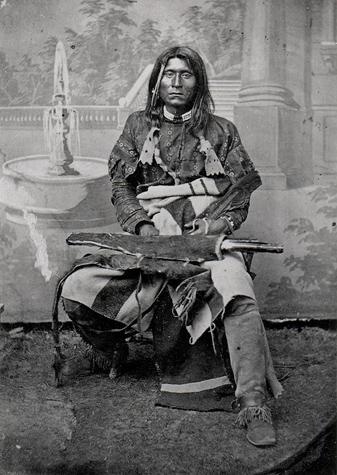
Portrait of Captain Jack, 2nd Chief.

During the disarmament process, Jackson instructed Kintpuash to set down his rifle ceremonially, so other warriors would follow suit. Most of his men also surrendered their weapons, but Scarfaced Charley, a Modoc leader, retained his pistol. When soldiers attempted to disarm him, Scarfaced Charley fired, sparking an exchange of gunfire. One soldier was killed, and others were wounded. Amid the chaos, Kintpuash and his people fled the camp and sought refuge in the nearby Lava Beds, a natural stronghold near Tule Lake.[11]

The following morning, Jackson's forces pursued another Modoc Band led by Hooker Jim. At Hooker Jim's camp, soldiers killed an elderly woman and a baby. Enraged, Hooker Jim and his band retaliated, killing twelve settlers before fleeing to join Kintpuash in the Lava Beds. Kintpuash, distressed by these killings, feared he would be held accountable.[12] The Battle of Lost River marked the beginning of the Modoc War, a conflict that highlighted the Modocs' struggle to retain their homeland and resist U.S. government policies.

Battle of the Stronghold

[edit]

The Lava Beds National Monument in northern California served as a natural fortress for Kintpuash and his band during the Modoc War. The rugged volcanic terrain, later named Captain Jack's Stronghold provided significant defensive advantages. Women and children found shelter in the caves, while Modoc warriors used the terrain to resist Army attacks.[13]

By January 16, over 300 U.S. soldiers arrived to confront the Modocs. Kintpuash advocated for surrender to protect his people, expressing willingness to face consequences alongside those responsible for the settlers' deaths. However, other influential Modoc leaders, including Hooker Jim and Curly Headed Doctor, opposed surrender. In a vote, only fourteen of the fifty-one Modoc warriors supported Kintpuash.[13]

The Army launched an assault on the Modocs the following day. Using the terrain and camouflage, the Modocs repelled the attack, killing thirty-five U.S. soldiers and wounding many more without sustaining casualties. This unexpected defeat prompted the Army to request reinforcements.[14] The battle demonstrated the Modocs' strategic use of their stronghold and their ability to resist overwhelming military pressure.

Peace commission

[edit]

On February 28, 1873, Winema, a Modoc relative married to settler Frank Riddle, visited Kintpuash with a message from President Ulysses S. Grant announcing a peace commission to negotiate under a truce. The commission, aimed at peacefully returning the Modocs to Klamath, included General Edward Canby, clergyman Eleazar Thomas, Klamath Reservation subagent L.S. Dyar, and Kintpuash's friend Alfred B. Meacham, a former Indian Affairs agent for the Modocs. The Modocs sought clarity about the fate of Hooker Jim and his band, who had killed twelve settlers. The commissioners assured the Modocs that Hooker Jim's group would be relocated to a reservation in either Arizona or Indian Territory.[15]

Encouraged, Hooker Jim's group left the Lava Beds and surrendered. Canby, eager for a resolution, sent word to General William Tecumseh Sherman for further instructions. However, Hooker Jim's group encountered an Oregonian who warned them that Oregon authorities intended to hang the Modocs. Terrified, Hooker Jim and his followers fled back to the Lava Beds as Canby left them unattended. Their fears were justified when pressure from Oregon officials led Canby to rescind amnesty.[16] The incident deepened mistrust between the Modocs and U.S. authorities, complicating the peace process and intensifying the conflict.

On March 6, 1873, with the help of his sister Mary, Kintpuash wrote to the peace commissioners, explaining his refusal to surrender his men and questioning why settlers who had killed Modocs were not held accountable. Despite the ongoing truce, Canby positioned reinforcements near the Lava Beds and seized Modoc horses, further straining relations. On April 2, Kintpuash met the commissioners to request the Army's withdrawal and clarify the fate of the wanted Modocs, but Canby rejected both appeals.[17]

Kintpuash later held a private meeting with his friends Meacham and John Fairchild, excluding Canby and Thomas due to mistrust of the military and clergy. He explained his decision to flee during the events at Lost River and renewed his plea for local land or permission to remain in the Lava Beds. Meacham dismissed these requests and insisted the Modocs surrender Hooker Jim and other wanted men. When Kintpuash asked whether soldiers responsible for killing Modoc women and children would be held accountable, Meacham deflected. Frustrated, Kintpuash ended the discussion, saying further tribal deliberation was needed.[18]

After Meacham informed Canby that the Modocs would not surrender Hooker Jim, Canby sent Winema to the Lava Beds with a message offering safety for any Modoc who surrenders. In the ensuing tribal meeting, only eleven members supported surrender. Hooker Jim, Schonchin John, and Curly Headed Doctor opposed, accusing Canby of deceit and threatening to kill anyone who attempted to leave. As Winema departed, a Modoc warned her that Hooker Jim was plotting to assassinate the American negotiators, but Canby dismissed the warning, underestimating the Modocs' desperation.[19] This period marked a breakdown in negotiations and deepened the divide between the Modocs and U.S. authorities, setting the stage for further tragedy.

Assassinations

[edit]

On April 7, 1873, tensions within the Modoc leadership peaked as Hooker Jim and his allies accused Kintpuash of planning to surrender the wanted men. Schonchin John and Black Jim called for the assassination of the commissioners to prevent further military buildup. Kintpuash pleaded for patience, seeking to secure land and amnesty, but Black Jim and others demanded he kill Canby. When he refused, Hooker Jim threatened his life, and Kintpuash was humiliated with women's clothing and insults. To maintain authority and buy time, Kintpuash reluctantly agreed to the assassination.[20]

A meeting with the commission was arranged for April 11, with both sides agreeing to attend unarmed. Despite his agreement, Kintpuash warned of the dire consequences of violence, urging the warriors to abandon their plans to avoid annihilation. Overruled in a vote, he made a final appeal for peace, and the warriors agreed to attempt one last negotiation.[21] This period highlights the deep divisions and growing desperation within the Modoc tribe as pressure from U.S. forces mounted.

On April 11, 1873, Kintpuash and key Modoc leaders—Hooker Jim, Shacknasty Jim, Black Jim, Schonchin John, and Ellen's Man—met with the peace commission. The commissioners were joined by Winema, her husband Frank Riddle, and interpreters Boston Charley and Bogus Charley. According to Jeff C. Riddle, son of Winema and Frank, historian Dee Brown noted that Kintpuash demanded the Modocs remain in their homelands and called for U.S. troops to withdraw. Canby replied that he lacked the authority to grant these requests. Schonchin John threatened to end negotiations unless the Modocs were given Hot Creek, and the soldiers left immediately. When it became clear that Canby would not meet their demands, Kintpuash gave a signal in Modoc, drew a pistol, and fired at Canby. The gun misfired initially but discharged on a second attempt, killing him. Boston Charley killed Thomas, while Meacham, Dyar, Winema, and Riddle survived.[22]

Betrayal

[edit]

Following the assassination, the Modoc warriors quickly retreated to the Lava Beds. Three days later, the U.S. Army launched a massive assault on the area but was unable to locate the dispersed Modocs, who had scattered to avoid capture. However, their situation became increasingly dire as they ran out of water and provisions in the following weeks. Facing inevitable defeat, the unity of the Modocs collapsed. Hooker Jim and his followers abandoned Kintpuash, reducing his forces to fewer than forty warriors.[23]

Seeking a way to save himself, Hooker Jim surrendered to the Army and proposed betraying Kintpuash in exchange for amnesty. On May 27, Hooker Jim located Kintpuash and urged him to surrender. Kintpuash, angered by the betrayal, refused. Days later, exhausted and resigned to his fate, Kintpuash surrendered voluntarily. He was wearing Canby's uniform and stated that he was tired and prepared to face death.[24] This dramatic conclusion marked the end of the Modoc War, one of the most significant Native American uprisings of the 19th century. Kintpuash's resistance and eventual surrender remain a symbol of the Modoc struggle for their homeland and survival in the face of overwhelming odds.

Trial and execution

[edit]
Donald McKay and Jack's capturers
Schonchin and Jack
Captain Jack and Schonchin graves in 2009, Klamath County, Oregon
Repository – California Historical Society (15458104939)
Portrait of Steamboat Frank

Reaction to assassinations

[edit]

The assassination of Canby marked a grim milestone in U.S. history, as he became the first American general to be killed by Native Americans. In response, General William Tecumseh Sherman remarked that annihilating the Modocs would be justified. According to historian Benjamin Madley, citing correspondence between military leaders, the Army decided to halt plans for the extermination of the Modocs after Kintpuash was captured. Several factors influenced this decision. In 1873, Native Americans in California gained the right to serve as witnesses in trials, marking a shift in how their testimony could influence legal outcomes. Additionally, Native advocates lobbied President Grant for clemency, warning that annihilating the Modocs could provoke both domestic and international condemnation. Grant, wary of such a scenario, chose not to pursue a genocidal course of action.[25]

Despite these developments, animosity toward the Modocs persisted. Oregon militiamen attacked a wagon transporting captive Modocs, killing four men and one woman. The conclusion of the Modoc War in 1873 also marked the end of the larger genocidal campaign against California's Native population.[26] The events of the Modoc War remain a stark reminder of the complex and often brutal history of U.S. westward expansion and Native resistance.

Canby's assassination shocked and angered much of the American public, as Canby was a widely respected military veteran who had been wounded during the Civil War. U.S. Attorney General George Henry Williams determined that the captured Modocs would be tried by a military tribunal, under the reasoning that they were prisoners of war from a sovereign nation engaged in conflict with the US. After the Modoc resistance was subdued, the remaining tribe members were transferred to Fort Klamath, where they were confined.[27] During the trial, Kintpuash, Black Jim, Boston Charley, and two younger prisoners, Slolux and Barncho, were prosecuted.

[edit]

The tribunal's judicial panel was composed of five officers, four of whom had been subordinates of Canby. According to historian Doug Foster, who also relied on Meacham's account as well as newspapers, this composition was biased, as these men had motivations to avenge their fallen commander. Additionally, the panel was appointed by Canby's replacement, General Jefferson C. Davis. However, the defendants, unfamiliar with the American legal system, did not object to the proceedings. Elija Steele, Kintpuash's friend from Yreka, sought to secure legal representation for the Modocs by requesting attorney E.J. Lewis. However, Lewis arrived on the trial's final day, and the court refused to reopen proceedings despite being notified in advance that counsel was on the way.[28] This refusal further underscored the irregularities in the trial process.

Under court-martial regulations, the judge advocate was required to ensure the trial's fairness in the absence of legal representation and to prevent the defendants from unintentionally undermining their cases. However, these responsibilities were neglected. The judge advocate approved the commission without informing the defendants that they had the right to replace four out of the five judicial officers. Additionally, the court made no mention of the shackling of prisoners and the use of armed guards, both of which were discouraged by military regulations.[29]

The defendants faced other significant disadvantages during the trial. Foster, citing Meacham, argued that the Modoc defendants were not proficient in English, and their translator, Frank Riddle, broke his neutrality by testifying against them. Out of ignorance of judicial procedures, Kintpuash presented his travel passes, believing they would demonstrate his good reputation among settlers. The military commission dismissed the passes as irrelevant. Kintpuash also argued that the Modocs did not initiate hostilities, stating that war was waged upon him and his people.[30]

Prosecutors relied on the Council Grove Treaty of 1864 to argue their case but omitted mention of the unratified treaty that Kintpuash had signed months earlier. From the Modoc perspective, they had abandoned the second treaty because the U.S. government had already reneged on the first. Without legal representation, critical arguments were left unvoiced, such as the claim that no truce existed when Kintpuash killed Canby. The Modocs maintained that the Army broke the truce by confiscating their horses and encircling the Lava Beds. On April 5, Kintpuash had even notified the commission that the truce agreement had been violated.[31]

Meanwhile, Hooker Jim and his three accomplices, who had betrayed Kintpuash and aligned with the U.S. government, were never tried, further demonstrating the disparity in justice. This was intended to reinforce the notion among Native Americans that working against their tribes in cooperation with the U.S. government could yield benefits. All the defendants—Kintpuash, Black Jim, Boston Charley, and Schonchin John—were found guilty and sentenced to death. However, President Grant commuted the sentences of the younger defendants, Barncho and Slolux, to life imprisonment after receiving appeals for clemency.[32]

Execution

[edit]

On October 3, 1873, the executions were carried out before a large crowd. The spectacle drew widespread attention, with even an Oregon school granting students a holiday to attend. The entire Modoc tribe was forced to witness the hanging of their leaders. The ropes used in the executions and strands of Kintpuash's hair were sold as souvenirs, reflecting the public's morbid fascination.[33] This trial and its aftermath remain a striking example of the injustices faced by Native Americans in the 19th century, highlighting systemic inequities in both judicial and social spheres.

After the executions of Kintpuash and Schonchin John, their bodies were removed from the scaffold, and an Army surgeon decapitated them. The severed heads were sent to Washington, D.C., for scientific purposes. While the San Francisco Chronicle condemned the act as barbaric, the Army and Navy Journal justified it, claiming it was conducted for craniological research. For more than a century, the skulls of the two Modoc leaders were held in the collections of the Army Medical Museum and later transferred to the Smithsonian Institution.[33]

Exile and return

[edit]

Following the executions, the remaining members of Kintpuash's band—comprising thirty-nine men, fifty-four women, and sixty children—were forcibly relocated to Oklahoma Territory. This transfer was intended as a warning to other Native American tribes and to prevent further resistance from the Modocs. In exile, harsh living conditions and disease took a heavy toll, claiming many lives. After decades of hardship, the U.S. government permitted the surviving Modocs to return to Oregon in 1909, where they were allowed to settle on the Klamath Reservation.[33]

Legacy

[edit]
  • The area where the Modoc established their defense is now known as Captain Jack's Stronghold. It is part of the protected area of the Lava Beds National Monument. There is a 2-mile trail through the Stronghold providing views from the Modoc lines and the Army's lines. Visitors can view the caves Captain Jack and Schonchin John used. There is a 3-mile hike out to the Thomas-Wright Battlefield in the Lava Beds giving visitors a view of the battlefield from the Modoc positions.
  • Captain Jack Substation, a Bonneville Power Administration electrical substation, was named in honor of Kintpuash. It is located near what is now called Captain Jack's Stronghold. It forms the northern end of Path 66, a high-power electric transmission line.

See also

[edit]

References

[edit]

Further reading

[edit]
[edit]
Revisions and contributorsEdit on WikipediaRead on Wikipedia
from Grokipedia
Kintpuash (c. 1837 – October 3, 1873), known as Captain Jack to Americans, was a principal headman of the who led a band rejecting the shared Klamath Reservation established by the 1864 treaty due to longstanding enmities with the Klamath tribe and poor conditions there. Returning to ancestral lands along the Lost River in 1870, his group faced encroaching settlers and, on November 29, 1872, repelled a U.S. Army force attempting forced removal, initiating the . In the ensuing conflict, Kintpuash commanded approximately 53 warriors who exploited the rugged Lava Beds terrain for defensive , repulsing assaults such as the January 17, 1873, attack that killed 12 U.S. soldiers and wounded 37, while sustaining minimal losses themselves. The war's turning point came on April 11, 1873, when, compelled by militant subordinates, Modocs under his nominal leadership assassinated peace commissioners General Edward R. S. Canby and Rev. Eleazer Thomas during negotiations under a flag of truce, prompting escalated U.S. operations including the costly April 26 where 24 soldiers died. Scattered after defeats like the Battle of Dry Lake in May 1873, Kintpuash surrendered on June 1 and faced a military commission trial in July without defense counsel, resulting in conviction for and execution by at Fort Klamath alongside three other leaders. The , costing the U.S. around $420,000 largely from winter campaigns, ended with surviving band members exiled to , underscoring the causal chain of treaty non-compliance, territorial disputes, and truce violations in late 19th-century Indian conflicts.

Background and Early Life

Modoc Tribe and Traditional Society

The Modoc inhabited a territory centered on the Lost River sinks, , and adjacent highlands in southwestern and , where they pursued a semi-nomadic economy adapted to the region's wetlands and volcanic plateaus. Primary sustenance derived from fishing , , and suckers in lakes and streams using weirs, nets, and spears; hunting deer, , rabbits, and waterfowl with bows, arrows, and snares; and gathering camas bulbs, seeds, berries, and roots during seasonal rounds that shifted bands from winter villages near water to summer uplands for foraging and hunting. Inter-tribal relations involved recurrent conflicts over resources and territory, particularly with linguistically related Klamath to the north, whose shared Lutuamian language did not preclude raiding and disputes, as well as with southern neighbors like the Shasta and , whom Modoc bands targeted in slave raids to capture women and children for adoption, labor, or trade to networks in exchange for horses, shells, and other valuables—a practice embedded in regional patterns of warfare and economic exchange rather than isolated aggression. Modoc society featured no centralized chieftainship or formal ; instead, it comprised small, autonomous bands of 20 to 100 members, each guided by a la'qi (headman) whose stemmed from demonstrated prowess in warfare, , mediation, and oratory, with collective decisions forged via consensus in councils to accommodate diverse kin interests over hereditary mandates. By the early 19th century, indirect Euro-American contact via fur traders exploring routes introduced firearms and trade goods through intermediary tribes, disrupting local equilibria by escalating inter-tribal arms races and altering resource competition without immediate Modoc integration into the beaver pelt economy. Emigrant trails like the Applegate, opened in the , marked initial settler incursions into Modoc fringes, grazing livestock on traditional grazing lands and sparking sporadic clashes that eroded foraging ranges and heightened vigilance against external pressures.

Kintpuash's Rise to Prominence

Kintpuash was born around 1837 in a Modoc village along the Lost River, near on the present-day Oregon-California border. His Modoc name translated to "Strikes the Water Brashly," indicative of traditional naming tied to personal traits or events. As a young man, Kintpuash interacted frequently with white miners and traders in the vicinity, adopting the moniker "Captain Jack" owing to his habit of wearing a blue military jacket adorned with brass buttons, likely obtained from U.S. soldiers. These encounters acquainted him with Euro-American practices amid escalating settler incursions into Modoc territory, driven by gold rushes and overland trails that disrupted traditional hunting and fishing grounds. By the early 1860s, he had ascended to headman of a Modoc band centered in the Hot Creek and lower Lost River areas, where autonomous tribal groups vied for influence. Kintpuash's prominence stemmed from his adept handling of intra-tribal dynamics and mounting external pressures from ranchers and prospectors coveting the same scarce resources of water and pasturelands essential to Modoc sustenance. He displayed strategic by initially cooperating with federal authorities, including land-leasing arrangements with white neighbors, yet steadfastly resisted full capitulation to relocation demands that threatened core . This balancing act highlighted leadership forged in the crucible of competition over finite environmental assets, rather than spontaneous hostility, positioning him as a key figure amid factional Modoc responses to U.S. expansion.

Pre-War Conflicts and Relocation Efforts

Council Grove Treaty and Reservation Policies

The Treaty with the Klamath and Others, signed on October 14, 1864, at Council Grove on the shore of Klamath Lake in Oregon, committed the Modoc, Klamath, and Yahooskin Paiute tribes to cede territorial claims encompassing over 20 million acres in southern Oregon and northern California—spanning from the Cascade Mountains to Goose Lake and adjacent areas—in exchange for a joint reservation of approximately 1.2 million acres along the eastern shore of Klamath Lake. The agreement, ratified by the U.S. Senate in 1866 and proclaimed in 1870, explicitly required the tribes to relocate to this designated area, forgo off-reservation hunting and fishing rights except as permitted, and adhere to U.S. laws, with provisions allowing additional tribes to join without diluting existing rights. Modoc chiefs, including Keint-poos (Kintpuash), Schon-chin, and others, affixed their marks as signatories, binding the tribe contractually despite internal debates over ceding prime ancestral lands around Lost River and Tule Lake. U.S. policy underpinning the aligned with mid-19th-century federal objectives to consolidate fragmented tribes onto reservations, thereby mitigating empirically tied to nomadic raiding patterns that disrupted settler expansion amid the Civil War-era pressures. To enforce assimilation, the allocated annuities—$80,000 annually for the first five years, decreasing stepwise to $30,000 over 15 years total—earmarked for "beneficial and humane objects," including agricultural implements, , , and such as sawmills and gristmills to transition tribes from and raiding to sedentary farming. This reflected in Indian policy: confining mobile groups reduced intertribal and settler conflicts, as evidenced by pre-reservation data showing Klamath-Modoc raids correlating with resource scarcity, while reservation experiments elsewhere yielded partial self-sufficiency where individual incentives supplanted communal tenure, though success rates remained low overall due to mismatched ecologies and enforcement lapses. Shared occupancy with Klamaths, however, disregarded documented historical enmities rooted in territorial competition and retaliatory between the groups, numerically disadvantaging the smaller Modoc (roughly 500-600 members versus 4,000 Klamaths). Modoc adherence faltered amid grievances over insufficient per-capita allotments, Klamath prioritization in resource distribution, and cultural friction from enforced , with the reservation's timbered, lake-adjacent terrain ill-suited to Modoc preferences for open valley foraging over intensive plowing. Federal agents reported persistent dissatisfaction, including thefts of Modoc by Klamaths and delayed deliveries post-ratification, yet these did not legally vitiate the treaty's mandate for reservation residency. Documented non-compliance ensued, as bands abandoned the reserve for ancestral sites, engaging in depredations that breached stipulations and prompted interventions to restore contractual order. mechanisms hinged on Indian agents' oversight and U.S. troops to expel intruders and compel returns, but empirical shortfalls in consistent provisioning and tribal policing highlighted assimilation's causal vulnerabilities: voluntary contractual breaches by Modocs perpetuated dependency and conflict, contravening policy aims of pacified self-reliance evidenced in marginally productive reservations elsewhere.

Resistance to Relocation and Settler Encroachments

In April 1870, Kintpuash led approximately 371 members of his Modoc band from the Klamath Reservation back to their traditional camps along the Lost River, citing inadequate food provisions, harsh living conditions, and ongoing hostilities with the who dominated the reservation. This relocation violated federal directives to remain on the Yainax sub-reservation, as the band's traditional economy relied on fishing, hunting, and gathering in the Lost River and areas, which were unavailable on the distant Klamath lands allocated under the 1864 treaty. The band's presence in the Lost River Valley exacerbated tensions with white settlers, who had begun establishing ranches and farms in the fertile basin during the 1860s amid Oregon's and California's post-Civil War population expansion; by 1870, , alone reported over 2,500 non-Indian residents, many engaged in cattle ranching that competed directly with Modoc resource use. Kintpuash's group engaged in livestock theft and sporadic ambushes on isolated settler properties, actions settlers viewed as predatory interference with their of the land for agriculture and grazing, rather than mere defense of ancestral rights. These incidents, including unreported raids on ranches near the California-Oregon border in 1871, prompted local complaints to federal agents and highlighted the practical limits of enforcing terms across fragmented tribal territories ill-suited to sedentary farming. In response to escalating settler demands for Modoc removal, volunteer militias formed in 1871–1872 to protect ranches and deter perceived encroachments, reflecting a breakdown in distant federal oversight where Indian agents struggled to mediate amid local imperatives for secure . U.S. Army units from Fort Klamath intervened in spring 1872, attempting to compel Kintpuash's band back to the reservation through escort and negotiation, but these efforts faltered due to administrative delays, insufficient resources, and the band's repeated refusals, underscoring the policy's misalignment with geographic realities favoring consolidated agricultural settlement over dispersed native holdings. Settlers prioritized the valley's productivity for expanding herds—Oregon's cattle population grew from 250,000 in 1860 to over 500,000 by 1870—arguing that unresolved Modoc claims perpetuated instability in an area primed for .

The Modoc War (1872-1873)

Outbreak: Battle of Lost River

On November 29, 1872, U.S. Army forces under Captain James Jackson of the 1st Cavalry, consisting of approximately 36 men, arrived at daybreak at Kintpuash's (Captain Jack's) encampment along the Lost River in southern Oregon, as part of efforts to enforce the Modocs' relocation to the Klamath Reservation per prior treaty obligations. Jackson demanded the Modocs disarm and surrender their leaders for transport to the reservation, but after refusal, a Modoc warrior known as Scarfaced Charley fired the first shot, prompting Lieutenant Frazier A. Boutelle to return fire and escalating into a skirmish where U.S. troops advanced, exchanged volleys, and burned the Modoc lodges. Simultaneously, a group of about 20 armed civilians led by deputy sheriff Eugene F. Hoyt approached a second Modoc camp under Hooker Jim near Stone Bridge to prevent escape, but faced a Modoc counterambush that inflicted heavy losses on the volunteers. The engagements resulted in 12 to 14 U.S. deaths overall—primarily among Hoyt's civilian volunteers—with around 20 wounded, including one soldier killed and seven wounded in Jackson's against Kintpuash's camp; Modoc losses were minimal, with one (One-eyed Watchman) confirmed killed and a few wounded, including Black Jim and Skukum Horse, alongside unconfirmed reports of civilian Modoc casualties. No primary accounts indicate unprovoked Modoc attacks prior to the U.S. arrival and demands, framing the violence as Modoc defensive resistance to federal enforcement amid ongoing disputes over reservation conditions and territorial encroachments, rather than initiating . Jackson's troops secured and burned Kintpuash's village before withdrawing to nearby ranches for reinforcement, while the Modocs, leveraging their knowledge of the local terrain, retreated southward across toward the volcanic Lava Beds' natural fortifications. This outbreak prolonged hostilities by allowing the Modocs to consolidate in defensible positions, where the rugged lava landscape—familiar to them from traditional use—provided cover against larger pursuing forces, though it also isolated their band and escalated the conflict beyond initial relocation aims.

Guerrilla Defense in the Lava Beds Stronghold

Following the initial clashes, Kintpuash's band of approximately 50 to 60 warriors retreated to the Lava Beds in northeastern , establishing a defensive position in the natural fortress known as Captain Jack's Stronghold. This volcanic landscape, characterized by jagged fissures, caves, and rocky outcrops, provided ideal cover for , allowing the Modocs to exploit their superior knowledge of the terrain against larger U.S. forces. On January 17, 1873, U.S. troops under Colonel Frank Wheaton, numbering around 360 soldiers including , , and volunteers, launched a coordinated on the Stronghold from multiple directions. The Modocs, firing from concealed positions within the lava formations, repelled the attack through ambushes and , inflicting heavy casualties—12 killed and 37 wounded—while suffering minimal losses themselves. Fog and the rugged terrain disrupted U.S. coordination and visibility, exposing advancing troops to enfilading fire and forcing a retreat, demonstrating the effectiveness of Modoc defensive strategies rooted in the environment. Subsequent U.S. efforts faced similar challenges, with the Lava Beds' isolation and harsh winter conditions complicating supply lines and maneuvers, prompting escalations including additional reinforcements and artillery like mountain howitzers. The Modocs sustained their resistance through for sustenance and leveraging night movements for repositioning, though their small band's lack of broader tribal support intensified internal strains and resource scarcity. This attritional campaign highlighted the disproportionate toll on U.S. forces, who struggled against a numerically inferior but terrain-adapted opponent, contributing to costs estimated at over $420,000 due to logistical demands in the remote region.

Peace Negotiations and Assassination of Commissioners

In April 1873, President established a peace commission to negotiate an end to the , comprising General Edward Richard S. Canby, Methodist Reverend Eleazar Thomas, Indian superintendent Alfred B. Meacham as chairman, and special agent Leroy S. Dyar. The commission aimed to persuade the Modoc band led by Kintpuash to surrender and relocate to the Klamath Reservation, amid mounting U.S. military pressure and Modoc indictments for prior settler murders. Initial meetings occurred under truce flags at a regulation wall tent—known as the "Council Tent"—erected in the Lava Beds between U.S. Camp Gillem and Kintpuash's Stronghold, beginning April 2, with interpreters Frank and Toby Riddle facilitating dialogue. Kintpuash repeatedly demanded a separate reservation in the Modocs' ancestral Lost River homeland, a concession the commission could not guarantee due to U.S. policy prioritizing consolidated reservations. Despite his advocacy for peace, Kintpuash faced overriding internal dissent from hardline warriors, including Schonchin John of the Hot Creek Band, who viewed negotiation as weakness amid fears of execution and . On April 10, these pressures peaked in a Modoc council where Kintpuash was outvoted and coerced into endorsing violence, contravening traditional norms of unarmed . During the final meeting on , 1873, eight armed Modocs—exceeding the agreed six unarmed representatives—ambushed the commissioners in the tent. Kintpuash shot Canby with a concealed and stabbed him as he fell; Boston Charley fatally shot ; and Schonchin John wounded Meacham multiple times (who survived), while Dyar fled injured. This perfidious breach violated explicit truce assurances, transforming a diplomatic forum into a trap and eliminating unarmed envoys offering the Modocs' last viable path to concessions. The killings stemmed from acute Modoc desperation—unyielding U.S. refusal of territorial , combined with and fears—but strategically alienated potential , as the act defied intertribal against slaying parley leaders, which historically prompted enemy withdrawal rather than escalation. Canby's death, the only Regular Army general felled in any Indian war, provoked national outrage, branding the Modocs as treacherous and galvanizing public and military demands for unconditional subjugation. General William T. Sherman authorized severe reprisals, spurring intensified assaults on the Stronghold from April 15 and hardening resolve against negotiated settlements.

Internal Betrayals and Military Capture

Following the of U.S. peace commissioners on April 11, 1873, fissures within the Modoc leadership deepened, fracturing the group's unity as certain warriors sought personal amnesty to evade execution for their involvement in the killings. Boston Charley and Hooker Jim, prominent among those implicated, surrendered to U.S. troops and supplied critical intelligence on hideouts in the Lava Beds, motivated by rather than to Kintpuash. This defection enabled U.S. forces, bolstered by Warm Springs scouts, to penetrate Modoc defenses that had previously proven impenetrable. In April and May 1873, intensified U.S. operations exploited this intelligence, with troops assaulting scattered camps after the Modocs evacuated their Stronghold positions following clashes on April 15–17. The Hot Creek band, including Hooker Jim, formally surrendered on and guided pursuers to Kintpuash's remnants in exchange for clemency, culminating in his capture on near Willow Creek after months of evasion. These betrayals fragmented the remaining fighters, exposing the fragility of guerrilla reliance on internal solidarity against a U.S. force exceeding 1,000 troops and auxiliaries. By early June 1873, roughly 160 Modocs had surrendered or been captured, with negligible additional combat deaths in the final pursuits, as the emphasis shifted from battle to roundup. The war's toll—72 U.S. deaths (53 soldiers, 17 civilians, 2 scouts) against approximately 15 Modoc warriors—highlighted the asymmetry in manpower and logistics, yet also the Modocs' tactical acumen in inflicting disproportionate losses through ambushes and terrain mastery until self-interested defections undermined their stronghold.

Trial, Execution, and Aftermath

Military Tribunal Proceedings

A military commission convened on July 15, 1873, at Fort Klamath, Oregon, to try Kintpuash (known as Captain Jack) and five other Modoc leaders—John Schonchin, Black Jim, Boston Charley, Shacknasty Jim, and Barncho—for their roles in the Modoc War. The defendants faced charges of murder in violation of the laws of war, specifically the killings of peace commissioners General Edward R. S. Canby and Reverend Eleazar Thomas during truce negotiations on April 11, 1873, along with related acts of hostility against U.S. forces and civilians. The tribunal comprised seven U.S. Army officers, with no jury empaneled and no appointed defense counsel, though the accused were permitted to address the commission through interpreters. Proceedings concluded by July 27, 1873, emphasizing the perfidy of ambushing envoys under a flag of truce as a distinct war crime irrespective of prior conflicts. Key evidence included from A. B. Meacham, the wounded third commissioner who survived the attack and described the ambush in detail, corroborated by Modoc defectors such as Hooker Jim and Bogus Charley, who recounted internal deliberations and the planning to eliminate the commissioners to prolong resistance. Weapons recovered from the lava beds stronghold, including those linked to the shootings, were presented, alongside affidavits detailing the violation of safe-conduct assurances extended to the peace party. Defenses invoked the U.S. initiation of hostilities at the Lost River settlement on November 29, 1872, portraying Modoc actions as defensive retaliation, and questioned the validity of prior relocation demands, but the commission dismissed these as extraneous to the charged truce breach, which independently contravened international norms of warfare. Kintpuash, speaking via interpreters Frank and Toby Riddle, admitted reluctance in ordering the commissioners' deaths but acknowledged complicity under duress from subordinates who threatened him, stating, "They all wanted to murder the peace commissioners; they all advised me to do it," while denying directives for earlier settler murders. He portrayed himself as overruled by hotheads, yet the rejected mitigation based on internal pressures, viewing leadership accountability as paramount. No formal emerged, with emphasis on evidentiary consistency from testimonies despite potential credibility concerns from their surrenders. On July 31, 1873, all six were convicted on all counts and sentenced to , underscoring the U.S. military's stance on enforcing war laws amid frontier pacification efforts.

Execution and Contemporary Reactions

On October 3, 1873, Kintpuash, Schonchin John, Black Jim, and Boston Charley were executed by hanging at Fort Klamath, Oregon, in a public spectacle attended by U.S. soldiers, civilians, tourists, and members of the Modoc and Klamath tribes. The U.S. Army orchestrated the event to maximize visibility, with military orders emphasizing that it should be "as public as possible so that they may be forever terrified by the spectacle," aiming to instill fear among Native groups. Contemporary press coverage largely framed the Modocs as treacherous for assassinating General and Reverend Eleazar Thomas under a flag of truce during peace talks, portraying the executions as justified retribution for violating parley norms. Newspapers escalated the conflict's narrative post-Canby murder, shifting public sentiment toward demands for severe punishment and viewing the military tribunal's swift verdicts as necessary to uphold treaty enforcement and deter similar acts in ongoing Indian wars. While some reports highlighted tribunal biases—such as trials conducted by combatants—the dominant view supported the hangings as exemplifying against perceived barbarism. The federal government's rationale centered on deterrence, with officials arguing that executing the leaders would prevent future resistance to relocation orders and abuses of negotiation protocols, reinforcing U.S. authority amid broader campaigns to subdue non-compliant tribes. This aligned with era-specific views prioritizing rapid suppression to minimize prolonged conflicts, as evidenced by the war's resolution following the captures and the absence of immediate Modoc resurgence in the Lava Beds.

Exile of Survivors and Long-Term Tribal Outcomes

Following the Modoc War, approximately 155 survivors—comprising 42 men, 59 women, and 54 children—were transported from Fort Klamath, , under military guard, departing on October 12, 1873, and arriving at the Quapaw Agency in (present-day ) in early 1874. These exiles faced severe hardships, including inadequate rations of spoiled food, insufficient medical care, and exposure to unfamiliar diseases such as , which contributed to significant mortality rates and a one-third population drop among the group in the years immediately following relocation. Hiram Jones's mismanagement, including of supplies, exacerbated these conditions, leading to his trial and removal from duty. The exile deepened existing factional divisions within the , separating those who had earlier integrated into the Klamath Reservation—traditional rivals under the 1864 treaty—from the Hot Creek band led by Kintpuash, now confined among the and other tribes in a culturally alien environment. U.S. policy aimed at tribal consolidation sought to minimize intertribal conflicts and facilitate oversight, effectively resolving the immediate Lost River disputes by dispersing resistant groups, though at the cost of cultural dislocation and demographic losses; pre-war Modoc numbers, estimated at around 500 for the broader tribe, dwindled further through war casualties and exile-related deaths. Economic adaptation proved challenging, with federal programs enforcing on unsuitable lands yielding inconsistent results; exiles initially relied on subsistence farming and labor for non-Indian , later shifting toward ranching as a more viable pursuit in the Plains environment. By the early , Modoc resilience manifested in community efforts to preserve traditions amid allotment policies, including petitions to federal authorities for recognition of land rights and allotments from Klamath trust funds. In 1909, following Oklahoma's statehood, surviving exiles and their descendants were offered the option to return to the Klamath Reservation in , with about 17 originals still alive; while some repatriated and enrolled under the Klamath Agency, others remained in , forming the basis of the modern Modoc Nation, which continues cattle operations and cultural programs despite ongoing economic constraints. This partial underscored the limits of reversal policies, as had already entrenched dual communities, with the Oklahoma group maintaining distinct identity through federal enrollment separate from Klamath oversight.

Legacy and Historical Assessments

Immediate Post-War Views and Symbolism

In the immediate aftermath of the Modoc War, U.S. military and press accounts frequently portrayed Kintpuash as a cunning yet barbaric figure whose orchestration of General Edward Canby's in April 1873 exemplified treacherous "red Judas" duplicity, framing the act as a that morally justified the campaign's 83 military fatalities and $500,000 cost despite the Modocs' prolonged guerrilla resistance. Popular dime novels, such as Captain Jack; Or, The Modoc's Revenge published in the mid-1870s, romanticized the Lava Beds Stronghold as an exotic fortress while casting Kintpuash as a vengeful savage driven by primal retribution, blending sensationalism with condemnation of Modoc violence to entertain eastern audiences amid ongoing frontier anxieties. Modoc oral histories, preserved through Klamath Basin descendants, depicted Kintpuash primarily as a reluctant defender safeguarding ancestral lands in the Lost River marshes against settler encroachment and unfulfilled promises from 1864, though they acknowledged internal warrior pressures—led by figures like Schonchin John—that coerced him into the commissioners' killing despite his initial advocacy for . These traditions emphasized his strategic acumen in leveraging the lava beds' for six months of against superior U.S. forces, viewing the war's outcome as a tragic consequence of federal intransigence rather than inherent Modoc aggression. Politically, the war symbolized federal resolve in frontier pacification, with Kintpuash's execution on October 3, 1873, alongside three warriors, reinforcing narratives of inexorable U.S. expansion and influencing subsequent assimilation policies by underscoring the perceived futility of armed resistance. The removal of surviving Modocs—155 individuals—to Indian Territory cleared the Oregon-California borderlands, enabling rapid homesteading; by 1880, Modoc County, California, saw settler populations swell as former Modoc territories transitioned to ranching and agriculture under federal land grants.

Modern Interpretations and Balanced Critiques

Modern scholarship on the Modoc War presents a spectrum of interpretations, often polarized between narratives of U.S. expansionism as aggressive imperialism and assessments emphasizing the exigencies of establishing governance amid resistant tribal economies reliant on mobility and intermittent conflict. Progressive-leaning analyses, exemplified by Robert Aquinas McNally's 2017 monograph The Modoc War: A Story of Genocide at the Dawn of America's Gilded Age, frame the conflict as a deliberate extension of genocidal policies, portraying Kintpuash and his band as victims of inexorable settler encroachment that disregarded the 1864 treaty's inadequate provisions for Modoc autonomy on the Klamath Reservation. Such views prioritize systemic U.S. land hunger, citing the war's disproportionate costs—over $1 million and 83 military fatalities—as evidence of punitive overreach against a small group of approximately 50-60 Modoc warriors. However, these interpretations have drawn criticism for underemphasizing Modoc-initiated escalations, including pre-war settler killings and the band's refusal to negotiate relocation despite treaty obligations signed by allied Klamath leaders, which empirically fueled mutual hostilities rather than unilateral aggression. Counterperspectives, often from regional historical societies and military-focused accounts, stress the war's roots in the incompatibility of Modoc seasonal and inter-tribal raiding patterns with sedentary reservation life, necessitating enforcement to secure stability and prevent chronic low-level violence. The April 11, 1873, of peace commissioners under a flag of truce—including General , the only U.S. general killed in the Indian Wars—is near-universally critiqued as indefensible treachery, contravening even indigenous diplomatic customs and shifting moral culpability decisively toward Modoc leadership. Conservative evaluations, such as those in Boyd Cothran's analysis of memory-making, argue that federal intervention was causally essential for rule-of-law imposition, as unchecked Modoc holdouts exemplified broader challenges to where tribal perpetuated raiding economies disruptive to agricultural settlement. These assessments attribute the war's outbreak not solely to treaty flaws—ratified by on July 1, 1866, after Modoc input via interpreters—but to Kintpuash's factional hardline stance against compromise, evidenced by internal band divisions favoring peace. Recent commemorative efforts, including 2023 events marking the 150th anniversary of the executions, underscore Modoc agency and reservation mismanagement—such as resource scarcity on the 1.2 million-acre Klamath tract shared with hostile Klamath—but integrate data on reciprocal violence, debunking portrayals of passive victimization by noting Modoc preemptive strikes like the November 29, 1872, Lost River skirmish that ignited open hostilities. Scholarly debates on the military tribunal, convened July 1873 at Fort Klamath, pivot on procedural rigor versus pragmatic exigency: critics decry it as a "show trial" lacking civilian oversight and full evidentiary standards, with proceedings spanning mere days for six defendants. Yet, empirical outcomes affirm its role in quelling insurgency—surrender followed capture on June 1, 1873, with no resurgence—absent exculpatory proof for principals like Kintpuash, whose involvement in the commissioners' murders was corroborated by survivor testimonies and band confessions, rendering prolonged risks untenable amid ongoing threats. Mainstream academic sources, potentially influenced by institutional emphases on colonial critique, often amplify procedural flaws while marginalizing the tribunal's deterrent effect, as evidenced by the swift exile of 153 survivors to on October 4, 1873, which stabilized the region without further major conflict.

References

Add your contribution
Related Hubs
User Avatar
No comments yet.