Hubbry Logo
KnackwurstKnackwurstMain
Open search
Knackwurst
Community hub
Knackwurst
logo
8 pages, 0 posts
0 subscribers
Be the first to start a discussion here.
Knackwurst
Knackwurst
from Wikipedia

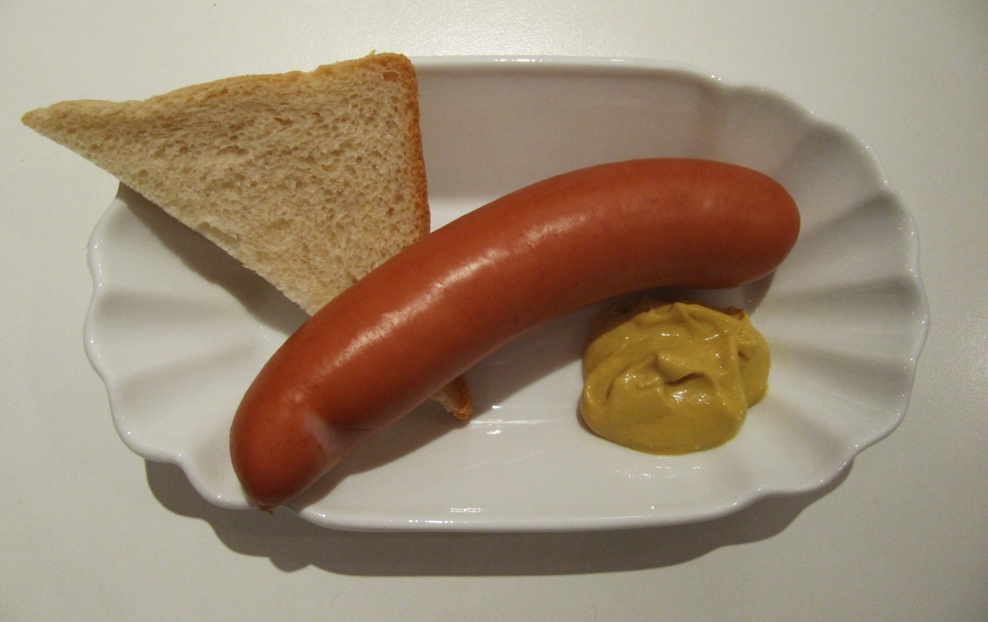
Knackwurst as typically served as a snack in Hamburg, Germany, on classic German dishware

Knackwurst (German pronunciation: [ˈknakˌvʊʁst] ) (in North America sometimes spelled knockwurst (listen) refers to a type of sausage of northern German origin from the mid-16th century. The many available varieties depend on the geographical region of their production.

Etymology and pronunciation

[edit]

The German noun Knackwurst—which, in English, is sometimes corrupted as knockwurst—comes from the German verb knacken (listen) ("to crack") or the adjective knackig (listen) ("crisp"). This refers to the swelling of the sausage during the process of cooking, so that the skin becomes pressurized and balloon-like, and tends to "pop", often exploding the juices, when bitten into (authentic example: listen). (Cf. the British term "banger".) Etymologically, the term "knackwurst" arose in Germany in the middle of the 16th century.[1] In Germany, all different kinds of Knackwürste are abbreviated Knacker (listen).[2]

Knackwurst in Germany & Austria

[edit]

Numerous regional varieties of knackwurst exist in Germany. They all differ from knackwurst varieties sold in Austria. There, a knackwurst always refers to a sausage containing bacon and added potato starch. In addition to the term "knackwurst", common names are "Salzburger" or "Schübling".[3]

As a specialty in Hamburg, scalded Knackwurst served with mustard and half a slice of white bread is a popular snack for lunch. It is also sold at the Hamburger Dom, the largest Volksfest in northern Germany, under various, sometimes poetic, names like Domknacker, Hamburger Knacker, or Hafenlümmel (literally: harbour tyke).[4]

In Austria, Knackwurst is jokingly referred to as a Beamtenforelle (literally civil servant's trout).[5] The term can be traced back to Julius Raab, former Chancellor of Austria, whose favourite dish is reported to have been Knackwurst.[6][7] This term was in reference to the modest earnings of civil servants at the time.[8]

Knake in Sweden

[edit]

A knake refers to a short, plump and dark sausage which is produced by Holmgrens in the Swedish city of Lund. It is a Lund speciality and dates back to the 1910s. Today's recipe is dated to the 1960s.[citation needed]

Knockwurst in the US

[edit]
Knockwurst on a Sailor sandwich

In North America, a knockwurst refers to a short, plump sausage originating from northern Germany. It contains ground veal, ground pork, and fresh garlic stuffed into hog casings.[9]

As part of the production process, the sausages are aged for two to five days, then smoked over oak wood. Knockwurst is often prepared highly seasoned.[10]

Knockwurst is sometimes cut in half lengthwise before serving,[11] for example when served on a sailor sandwich.[12]

See also

[edit]

References

[edit]
Revisions and contributorsEdit on WikipediaRead on Wikipedia
from Grokipedia
Knackwurst, also spelled knockwurst, is a traditional German renowned for its short, thick form and distinctive snappy texture that produces a cracking sound when bitten, deriving its name from the German verb knacken, meaning "to crack," combined with wurst for . Originating in the region of , it is primarily composed of finely ground and , though variations may incorporate , and is heavily seasoned with , along with spices such as salt, pepper, and occasionally or mustard seeds. The production of knackwurst involves mixing the ground meats with seasonings, stuffing the mixture into natural hog casings to form links typically 4 to 6 inches long, and then lightly aging the sausages for a few days before smoking them over wood, which imparts a reddish-orange hue and a firm, juicy interior. Unlike fresh sausages like , knackwurst is preboiled or fully cooked during processing, making it ready to eat after gentle reheating methods such as pan-frying, , or , though it should not be overcooked to preserve its crisp casing. Some artisanal versions undergo light for added tanginess, enhancing flavor complexity without extending curing time. In , knackwurst is commonly served hot with , boiled potatoes, or mustard, often as part of hearty dishes like a mixed platter or in traditional festivals such as , and it has influenced American regional foods, particularly in communities where it appears in similar preparations. Its bold profile and smoky essence distinguish it from milder sausages, contributing to its enduring popularity as a versatile, flavorful staple in both European and immigrant-influenced diets.

Definition and Characteristics

Description

Knackwurst is a short, thick sausage originating from the region in . It is characterized by its plump, cylindrical shape, typically measuring around 10-15 cm in length and featuring a diameter that gives it a robust, hearty appearance. This form distinguishes it from longer, slimmer sausage varieties common in . The sausage is produced as an emulsion-style product, where the meat is finely ground and blended into a smooth, homogeneous mixture. Primarily composed of pork and veal, the finely minced ingredients create a velvety interior texture that contrasts with the exterior casing. This composition ensures a consistent mouthfeel, setting it apart from coarser-ground sausages. A key feature of knackwurst is its snappy, natural casing, which produces a distinctive cracking when bitten into, contributing to its name. The term "knackwurst" derives from the German "knacken," meaning to crack, alluding to this audible snap.

Physical Properties

Knackwurst features a firm yet juicy interior encased in a crisp natural hog casing, which delivers an audible "knack" or snap upon biting that releases flavorful juices. This snappy quality contributes to its distinctive eating experience, setting it apart from softer sausages. In appearance, Knackwurst presents a cylindrical and plump shape, typically measuring shorter and thicker than standard frankfurters, with a reddish-brown hue resulting from the process. The flavor profile of Knackwurst is characterized by prominent garlicky notes, complemented by mild spices such as pepper, yielding a rich, savory taste derived from its finely emulsified blend of meats. As a smoked sausage, Knackwurst benefits from preservation through , allowing it to last 1 week when refrigerated (unopened) or 1 to 2 months when frozen, provided it is stored properly in airtight packaging.

History and Etymology

Origins

Knackwurst emerged in the mid-16th century in the region of , where local butchers developed it as a short, plump, garlicky using finely ground and . It originated in the 16th century as a rare treat reserved for royals. This innovation built upon medieval sausage-making traditions prevalent in the area, which emphasized grinding meat with spices and stuffing it into casings as a practical method for preserving limited resources in agrarian communities. The evolved as a smoked variety particularly suited to the cold, damp climates of , allowing for extended shelf life without and providing a portable protein source during harsh winters.

Name and Pronunciation

The term "Knackwurst" derives from the German words "knacken," meaning "to crack" or "to " in reference to the audible of the when bitten, and "Wurst," meaning "." An alternative etymological root links it to "knackig," an adjective denoting "crisp" or "snappy," which similarly evokes the texture and the casing. This onomatopoeic naming highlights the sausage's distinctive firm, edible skin that produces a cracking during consumption. In , "Knackwurst" is articulated as approximately [ˈknakˌvʊʁst], with a short, sharp "a" in the first (rhyming with "knock"), a hard "k" sound, and a rolled or uvular "r" in "wurst," often rendered phonetically as "KNAHK-vurst" for English speakers. In English, particularly in North American contexts, it is commonly anglicized as "knockwurst," pronounced /ˈnɑːkwɜːrst/ or roughly "NOK-wurst," reflecting adaptations during 19th-century German waves. The term first appeared in English records around 1851, coinciding with increased migration that popularized German culinary terms . Linguistically, "Knackwurst" emerged as a coinage in mid-16th-century , capturing the sensory experience of the sausage in its nomenclature. This distinguishes it from related sausages like "," whose name stems from "braten" (to fry or roast) combined with "Wurst," emphasizing preparation method over texture. Such naming conventions in German sausage terminology often prioritize functional or auditory qualities, aiding regional identification without overlap in etymological intent.

Production

Ingredients

Traditional Knackwurst is composed primarily of and , with a total content of around 25-30% from the meats, essential for the sausage's juicy texture and characteristic snap. The shoulder provides robust flavor and marbling, while the contributes tenderness and a finer to the . Key seasonings define the sausage's bold profile, with fresh garlic serving as the dominant aromatic element, complemented by salt for preservation and enhancement, white pepper for subtle heat, and nutmeg for warm, earthy notes; variations may include caraway seeds to add herbal undertones. These spices are finely ground and mixed into the meat to ensure even distribution and intensify the garlicky essence during cooking. For binding, ice water or is incorporated during grinding and mixing to form a stable that binds the proteins and maintains smoothness, while natural hog casings provide the edible exterior that contributes to the signature "" or crack upon biting. Traditional formulations eschew artificial preservatives, relying instead on curing salts like Powder #1 for safety and color retention without compromising authenticity. Although and dominate modern and historical recipes, some older variations incorporate for added depth, particularly in regional German preparations.

Manufacturing Process

The manufacturing process of Knackwurst begins with the preparation of the meat mixture through grinding and emulsification to achieve its characteristic smooth texture. The selected , typically and sometimes or , are first chilled to maintain structural integrity, then coarsely diced and ground using a fitted with a 3-5 mm plate to produce a fine consistency suitable for emulsification. This ground meat is subsequently transferred to a bowl chopper or high-speed mixer, where it is combined with crushed ice, salt, and spices; the ice keeps the temperature below 15°C (59°F) to prevent fat separation, while the chopping action incorporates air and binds the proteins into a glossy, stable resembling soft in texture. Once emulsified, the mixture is stuffed into natural hog casings of 28-32 mm diameter using a stuffer, ensuring no air pockets are introduced to avoid bursting during subsequent steps; the filled casings are then linked into short, plump segments. The filled sausages are then lightly aged for a few days to develop flavor before proceeding to . After stuffing and aging, the sausages are dried for about 24 hours at around 18°C (64°F). They then undergo cold in a dedicated smokehouse at 15-20°C (59-68°F) for about 12 hours using beechwood shavings, which imparts a subtle smoky flavor and aids in preservation by depositing compounds on the surface—a technique rooted in historical German sausage-making practices. Following smoking, the links are optionally poached in water heated to 80°C (176°F) until the internal temperature reaches 68°C (154°F), ensuring the product is fully cooked while retaining juiciness. The entire process from grinding to completion typically spans 1-2 days after the aging and drying periods, after which the Knackwurst is cooled rapidly and stored refrigerated.

Regional Variations

In and

In , Knackwurst is traditionally a smoked made primarily from and , heavily seasoned with , along with salt, pepper, and other spices, and encased in natural hog or casings for a characteristic snap when bitten. The meat mixture typically includes a combination of , belly, and for a balanced texture, with the sausage briefly cooked and then cold-smoked over beechwood to impart a subtle aromatic flavor, aligning with longstanding German sausage-making that emphasize regional wood types for . This preparation method protects Knackwurst as part of 's codified sausage traditions, where adherence to historical recipes ensures authenticity in artisanal production. Regional specialties highlight variations across and into . In , particularly the region, Knackwurst is notably plumper and shorter, originating as a 16th-century with an emphasis on coarse grinding and intense for a robust, garlicky profile suited to the area's hearty cuisine. Southern variants, such as those from , maintain a finer texture but retain the smoking tradition, often produced artisanally in small batches to preserve local flavors. In , Knackwurst differs markedly as a milder, unsmoked resembling a smaller , composed of , , , and , sometimes incorporating regional herbs like or for a subtler seasoning that complements Viennese or Tyrolean dishes. Production of Knackwurst reflects a blend of artisanal and industrial practices, with favoring small-scale, handcrafted methods using local meats and traditional smoking chambers, while northern regions like rely on larger industrial facilities for efficiency. In 2019, Brühwürste—including Knackwurst—accounted for about 7.1 kg of the average sausage consumption in , part of a total sausage output of approximately 1.56 million tons. Under and German regulations, Knackwurst labeling requires compliance with the Leitsätze für Fleisch und Fleischerzeugnisse, mandating a minimum of 7.5% connective tissue-free protein (bindegewebseiweißfreies Fleischeiweiß) in the final product, with higher standards (at least 12%) for protected variants like Thüringer Knackwurst to ensure quality and prevent misleading claims. These rules, enforced via the Regulation (No. 1169/2011), also demand clear indication of content and additives if they exceed specified thresholds, safeguarding traditional composition amid commercial production.

In Sweden

In Sweden, the Knackwurst adaptation is known as Knake, a local speciality particularly associated with the city of in the Skåne region. This shorter, plumper, and darker sausage was first produced in the early 1900s by Holmgrens Chark, a company founded in 1898 by Niels Holmgren, who initially sold the sausages from a cart in Lund's main square. Inspired by the traditional German Knackwurst, the Knake retains the characteristic snapping sound when bitten into the casing, but features a unique local recipe developed over time. The current recipe for Knake dates to the and emphasizes a protein-rich composition with low fat content, crafted using a secret blend of spices and without added preservatives. Primarily made from and , it undergoes a handcrafted production process that results in a pungent flavor profile distinct from the garlic-heavy originals. Modern versions are often sold and consumed fresh, with lighter or no smoking compared to traditional methods, allowing for immediate eating without further cooking. The for "Knake" was registered in 1972 by Holmgrens, solidifying its status as a proprietary Lund product. Knake gained widespread popularity in the mid-20th century, starting among construction workers at Lund's university hospital and spreading to other industries across Skåne, where it became an affordable and convenient protein source. Culturally, it holds a prominent place in everyday Swedish life, especially in Lund, often enjoyed fresh on bread paper with mustard during workplace breaks, 50th birthday celebrations, farewells, and student feasts. The formation of the Knakesällskapet (Knake Society) in 1977 underscores its local icon status, and it has received recognition from the Gastronomiska Akademien and Tidning Gourmet for its culinary significance in the smörgåsbord tradition. Holmgrens remains the sole producer, distributing through the Saluhallen market in Lund, their Gastelyckan factory, and select retailers.

In the United States

In the United States, Knackwurst evolved into the anglicized form "Knockwurst" through the influence of 19th-century German immigrants who settled primarily in the Midwest and introduced traditional sausage-making techniques to . These immigrants brought recipes from , adapting them to local ingredients and preferences, with the name "Knockwurst" reflecting phonetic simplification in English-speaking contexts. Commercialization began in the late 19th century as European immigrants, including Germans, established delicatessens that featured smoked sausages like Knockwurst alongside other cured meats. American recipe adaptations often incorporated beef alongside pork and veal to reduce costs and meet dietary needs, resulting in all-beef or beef-pork blends that deviated from the original pork-centric European versions. Kosher versions, made exclusively from beef to comply with Jewish dietary laws, became prominent in urban delis, emphasizing natural curing without nitrates or pork casings. Heavier smoking over woods like oak was employed to enhance flavor and extend shelf life, making the sausages suitable for deli counter display and transportation in pre-refrigeration eras. Knockwurst holds a staple position in both Jewish-American and German-American cuisines, frequently appearing in New York-style delis as a grilled or boiled option paired with or mustard. Major producers like Boar's Head have scaled production using high-quality cuts, maintaining a firm texture and garlic-forward profile derived from old German family recipes. Similarly, Schaller & Weber, founded in 1937 by German immigrant Ferdinand Schaller, has upheld artisanal methods in New York's Yorkville neighborhood, supplying authentic-style Knockwurst to a diverse clientele. Following health movements in the , manufacturers introduced low-fat variants of Knockwurst by using leaner cuts and reducing overall content while preserving the signature snap and seasoning. These adaptations, such as uncured options free of artificial additives and trans fats, align with demands for heart-healthier processed meats without compromising traditional appeal.

Culinary Uses

Preparation Methods

Knackwurst, a smoked and fully cooked , requires gentle heating to preserve its characteristic and flavor without overcooking. Preparation methods focus on reheating to an internal of 74°C (165°F) for safety, using techniques that enhance the casing's crisp texture. involves the sausages in water to evenly heat them through, a traditional approach similar to preparing hot dogs. Place knackwurst in a pot of water brought to a boil, then reduce to a simmer and cook for 10 to 15 minutes until the internal reaches 74°C (165°F). This method maintains juiciness while allowing the flavors to infuse subtly. Grilling or pan-frying adds a charred exterior that accentuates the sausage's . For grilling, preheat to , place the knackwurst on the grates, and turn every 2 minutes for 8 to 10 minutes total, achieving without splitting the casing. Pan-frying follows a similar : heat 1-2 tablespoons of oil over , add the sausages, and cook for 8 to 10 minutes, rotating frequently for even browning. These techniques briefly reference post-cooking texture changes, where the casing firms for the signature "knack." Baking suits incorporation into dishes like casseroles, providing uniform heating. Preheat the oven to 150°C (300°F), arrange the knackwurst on a baking sheet, and cook for 20 to 25 minutes, or until golden and reaching 74°C (165°F) internally. This dry heat method caramelizes the exterior mildly while keeping the interior moist. For safety, pre-cooked varieties like most commercial knackwurst need only reheating to 74°C (165°F) to kill potential bacteria. Raw or uncooked versions, though uncommon, must be thoroughly cooked to 71°C (160°F) to eliminate risks such as trichinosis from pork parasites. Always use a food thermometer to verify doneness.

Serving Suggestions

Knackwurst is traditionally served boiled alongside and boiled or in , providing a balanced meal that highlights its garlicky, smoky flavors. In the United States, it commonly appears in sandwiches on rolls topped with and cheese, or incorporated into salads for a casual lunch option. Classic pairings include sharp mustard such as senf, which complements the sausage's richness, and a crisp beer to cut through its fattiness. A standard serving of 100 grams offers approximately 307 calories and 11 grams of protein, making it a nutrient-dense choice high in protein but also fat. Contemporary recipes often feature Knackwurst grilled and sliced into burgers for added texture, or simmered into hearty soups like or varieties to enhance depth. While vegetarian alternatives to Knackwurst remain rare, plant-based sausages from brands like Field Roast are emerging as substitutes in similar dishes. Portion guidelines typically recommend 1 to 2 sausages per serving, often accompanied by to soak up juices and provide carbohydrates.

Cultural Significance

In Traditional Cuisine

Knackwurst occupies a central role in traditional , especially in the northern regions of its origin, where it serves as a versatile staple for everyday and celebratory meals. Typically prepared by or , it is commonly enjoyed as a alongside crusty , a mug of , , and boiled potatoes, providing a hearty, satisfying dish that embodies the robust flavors of regional fare. This integration reflects the sausage's practicality in home cooking, where its pre-cooked, smoked nature allows for quick preparation without extensive additional cooking. At festive gatherings like , Knackwurst features prominently on menus, often grilled and basted in dark , then served in a with caramelized onions and hot mustard to complement the event's lively atmosphere of and camaraderie. Its presence underscores the sausage's adaptability to communal dining traditions. Beyond festivals, Knackwurst appears at Christmas markets (Weihnachtsmarkt) and regional fairs, grilled on-site as a portable that warms visitors during the chilly season; these markets, dating back to the in some towns, have long highlighted such preserved meats as seasonal highlights. Symbolically, Knackwurst represents northern Germany's emphasis on and innovative preservation techniques, with its smoking process enabling long-term storage of and while maximizing the use of modest ingredients like and spices for bold flavor. This approach mirrors the region's historical reliance on durable foods to sustain families through harsh winters. The production of Knackwurst also carries economic weight, supporting local butchers who uphold artisanal methods amid declining overall meat consumption; demand surges in winter due to sales, helping preserve these small-scale operations as cultural cornerstones.

Global Adaptations

Knackwurst reached and other regions through waves of German immigration during the 19th and early 20th centuries, as settlers brought traditional sausage-making practices to their new homes. , millions of German immigrants arrived between 1820 and , introducing varieties like Knackwurst alongside other sausages that influenced , particularly in Midwestern communities with strong German heritage. Similarly, in , German descendants established producers like Piller's Fine Foods in 1957, using family recipes to create authentic Knackwurst that remains popular today. In , post- German migrants, such as the Knoll family who fled in 1957, adapted smallgoods traditions to local markets, producing Knackwurst and related sausages that blend with Australian culture. Commercial globalization has expanded Knackwurst's availability through exports and localized production by established brands. Companies like Schaller & Weber, founded in New York in 1937 by German immigrants, export traditional Knackwurst-style sausages across , maintaining the original garlic-forward recipe. In the Middle East and Muslim-majority regions, adaptations have emerged to meet dietary needs, with brands like Sharifa producing beef-based Knockwurst using zabiha-certified meat since the early 2000s, distributed in communities and beyond. Since the 2010s, modern innovations have reimagined Knackwurst for contemporary diets, including plant-based versions using and organic ingredients to mimic the snap and flavor of the original. Health-focused variants, such as reduced-sodium Knockwurst, have also gained traction, offering up to 50% less salt than traditional recipes while preserving the emulsified texture. Knackwurst contributes to cultural through its presence in international food festivals, where it showcases German culinary heritage and supports initiatives. Events highlighting European sausages often feature Knackwurst alongside and sides, drawing global visitors and promoting Germany's food traditions abroad.

References

Add your contribution
Related Hubs
User Avatar
No comments yet.