


Community hub
Recent from talks
Contribute something
Nothing was collected or created yet.
Boudin
View on Wikipedia
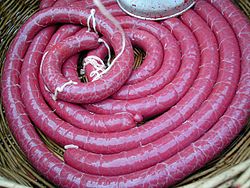
Boudin (French pronunciation: [budɛ̃]) is a type of sausage found in several French-speaking cultures. The added ingredients vary in French, Luxembourgish, Belgian, Swiss, Québecois, Acadian, Aostan, Louisiana Creole, and Cajun cuisine. Some variations such as boudin blanc contain no blood but retain the name.
Etymology
[edit]The Anglo-Norman word boudin meant 'sausage', 'blood sausage', or 'entrails' in general. Its origin is unclear. It has been traced both to Romance and to Germanic roots, but there is not good evidence for either (cf. boudin).[1] The English word pudding probably comes, via the Germanic word puddek for sausage,[2] from boudin.[3]
Some modern chefs, such as John Folse[4] and Olivier Poels, attribute boudin to ancient Greece by way of Aphtonite,[5][6] to whom they attribute the first mention of boudin noir in the Apicius.[7][8]
Types
[edit]
- Boudin ball: A Cajun variation on boudin blanc. Instead of the filling being stuffed into pork casings, it is rolled into a ball, battered, and deep-fried.[9]
- Boudin blanc: Originally, a white sausage made of pork without the blood. Variants include:
- French boudin blanc, with milk. Generally sautéed or grilled.[citation needed]
- Boudin blanc de Liège: A Belgian version similar to French boudin blanc but with marjoram, which has a protected geographical indication.[10][11]
- Cajun boudin blanc, made from a mixture of pork, rice, onions, and seasonings similar to dirty rice and stuffed into sausage casings. Local variations may also include liver or other pork offal, or other meats such as venison,[12] alligator, shrimp, and crawfish,[13][14] and can vary in spiciness.[15]
- Boudin blanc de Rethel (pronounced [bu.dɛ̃ blɑ̃ də ʁə.tɛl]): a traditional French boudin, which may only contain pork meat, fresh whole eggs and milk, and cannot contain any breadcrumbs or flours/starches. It is protected under EU law with a Protected geographical indication status.[16][17]
- Boudin noir: A dark-hued blood sausage, containing pork, pig blood, and other ingredients. Variants of the boudin noir occur in French, Belgian, Cajun and Catalan cuisine. The Catalan version of the boudin noir is called botifarra negra.[18] In the French Caribbean, it is known as boudin Créole[citation needed] or by local names, such as boudin rouge Antillais in Guadeloupe, and infused with spice or rum.[6] In Britain a similar sausage is called "black pudding", the word "pudding" being an anglicized pronunciation of boudin, and probably introduced after the Norman Conquest.[citation needed]
- Boudin vert: A green sausage made of pork meat and cabbage and kale. Popular in the Belgian province of Walloon Brabant and in the Walloon immigrant areas of the Door Peninsula of Wisconsin where it is called Belgian Trippe.
- Boudin valdôtain: with beetroot, spices, wine and beef or pork blood.[20] in the Aosta Valley of Italy.[21]
- Brown-rice boudin: Brown-rice boudin is a less common variation made from brown rice with taste similar to traditional pork boudin.[14]
-
 Boudin balls, made in Marksville, Louisiana.
 -
 A sliced French boudin noir
 -
 Cajun-style smoked boudin blanc
 -

-
 Boudins verts and blancs


In the United States
[edit]The journals of the Lewis and Clark Expedition include an early record of boudin blanc in the Louisiana Territory during an encounter with French fur trapper Toussaint Charbonneau on May 9, 1805, who prepared it using buffalo intestine, meat, and kidney suet, boiled the links, and fried them in bear grease.[22]
The term boudin in the Acadiana region of Louisiana is commonly understood to refer only to boudin blanc, and specifically to the regional combination of rice, pork, and seasonings originally made at rural communal hog butcherings since the 18th century.[23] Also popular is seafood boudin, consisting of crawfish or crab, shrimp, and rice.[13]
Cajun boudin is available most readily in the Acadiana region of southern Louisiana, though it may be found nearly anywhere in "Cajun Country" extending along the coast of the Gulf of Mexico from eastern Texas[13] to western Mississippi.[24] Several Louisiana towns and cities stake claims based on their boudin; Scott, Louisiana, was named "Boudin Capital of the World" in 2012, while Jennings was named "Boudin Capital of the Universe"[25] and former "Boudin Capital of the World" Broussard redesignated itself the "Intergalactic Boudin Capital of Positive Infinity".[26]
There are numerous meat markets and Cajun stores devoted to the speciality, though boudin is also sold from many convenience and grocery stores in other towns and areas along Louisiana's portion of Interstate 10, referred to by the Southern Foodways Alliance and some local tourism bureaus as the Southern Boudin Trail.[27][28][29] Since Cajun boudin freezes well, it can be shipped outside the region if made and packaged in a federally approved facility.[30]
Boudin noir is available in Illinois in the Iroquois County towns of Papineau and Beaverville, with their Quebecois heritage. The dish is the featured cuisine at the annual Beaverville Founder's Day, held the second weekend of September. People travel from hundreds of miles to partake of the boudin.[31]
"Le Boudin"
[edit]Boudin gave rise to "Le Boudin", the official march of the French Foreign Legion. "Blood sausage" is a colloquial reference to the gear (rolled up in a red blanket) that used to top the backpacks of Legionnaires.[32] The song makes repeated reference to the fact that the Belgians do not get any "blood sausage", since the king of the Belgians at one time forbade his subjects from joining the Legion (the verse says "ce sont des tireurs au cul").[citation needed]
See also
[edit]
References
[edit]- ^ Trésor de la langue française, s.v. "boudin"
- ^ Collins English Dictionary, 3rd edition, 1991
- ^ Oxford English Dictionary, 3rd edition, 2007, s.v. "pudding"
- ^ Maloney, Ann (October 31, 2017). "At Boudin, Bourbon & Beer, an ancient dish gets a modern twist". The Times-Picayune. Retrieved July 18, 2023.
- ^ Ricotta, Julien (February 13, 2021). "Quelle est la différence entre le boudin noir et le boudin blanc?". Europe 1 (in French). Retrieved July 18, 2023.
- ^ a b Banigan, Melissa (May 4, 2017). "Boudin: A Story Of Sausage, Slavery And Rebellion In The Caribbean". The Salt. National Public Radio. Retrieved July 18, 2023.
- ^ Thayer, Bill. "Apicius, De Re Coquinaria — Book II". LacusCurtius. Retrieved July 18, 2023.
- ^ Mac Con Iomaire, Máirtín (2019). "Preface". The Black and White Cookbook. Technological University Dublin. pp. 3–8. doi:10.21427/0hnp-6472.
- ^ Michael Stern (May 7, 2009). 500 Things to Eat Before It's Too Late: And the Very Best Places to Eat Them. Houghton Mifflin Harcourt. ISBN 978-0-547-05907-5. Retrieved November 24, 2009.
- ^ "Une association veut une appellation protégée pour le boudin blanc de Liège" [An association wants a protected designation for the boudin blanc de Liège]. RTBF (in French). November 12, 2019. Retrieved July 18, 2023.
- ^ Boudin blanc de Liège (Report) (in French). Association des Producteurs de Boudin blanc de Liège. February 2022. Retrieved July 18, 2023.
- ^ McNulty, Ian (November 7, 2022). "How Cajun sausage links friends, family, football rituals across Louisiana". The Times-Picayune. Retrieved July 18, 2023.
- ^ a b c Shattuck, Harry (February 17, 2011). "Louisiana's famous boudin tells the story of Cajun country". Houston Chronicle. Retrieved July 18, 2023.
- ^ a b "Boudin". Archived from the original on August 24, 2011. Retrieved August 5, 2011.
- ^ Carriker, Bob (November 16, 2006). "Boudin by the Bite". New Orleans Magazine. Retrieved July 18, 2023.
- ^ "Boudin Blanc". Cooking2000.com (in French). Retrieved January 8, 2008.
- ^ "Boudin Blanc Rethel". Je découvre la France.com (in French). Archived from the original on January 4, 2008. Retrieved January 8, 2008.
- ^ "Sea Bass with Blood Sausage and Sea Urchins (Llobarro, Cruixent de Botifarra Negra, Eriçons de Mar, i Salsa de Pa Torrat)". Saveur. Retrieved July 18, 2023.
- ^ Reid, J.C. (March 17, 2023). "Boudin rouge is a rare find in Louisiana's Cajun country". Houston Chronicle. Retrieved July 18, 2023.
- ^ "The Boudin". Valle d'Aosta. Retrieved July 18, 2023.
- ^ Chaberge, Marie Claire. À La Decouverte des Produits Valdotains de la tradition aux DOP et aux DOC (PDF) (Report) (in French). Assessorat régional de l'agriculture et des ressources naturelles. pp. 36–37.
- ^ Lewis, Meriwether (May 9, 1805). "The Journals of Lewis and Clark".
Capt C. killed 2 bucks and 2 buffaloe, I also killed one buffaloe which proved to be the best meat, it was in tolerable order; we saved the best of the meat, and from the cow I killed we saved the necessary materials for making what our wrighthand cook Charbono calls the boudin blanc, and immediately set him about preparing them for supper; this white pudding we all esteem one of the greatest delacies of the forrest, it may not be amiss therefore to give it a place.
{{cite journal}}: Cite journal requires|journal=(help) - ^ Carriker, Robert (August 30, 2019). "Desperately Seeking Boudin". 64 Parishes. Louisiana Endowment for the Humanities. Retrieved July 18, 2023.
- ^ "New Cajun specialty meats store opens in Vidalia". The Natchez Democrat. August 23, 2008. Retrieved July 18, 2023.
- ^ Montagne, Renee (April 13, 2012). "La. Town Named 'Boudin Capital Of The World'". Morning Edition. National Public Radio. Retrieved July 18, 2023.
- ^ Salinas, Claire (March 2, 2015). "Around Louisiana". Louisiana Life. Retrieved July 18, 2023.
- ^ "Southern Boudin Trail". Southern Foodways Alliance. April 13, 2006. Retrieved July 18, 2023.
- ^ Vowell, Jason (June 23, 2021). "Fear and Loathing on the Boudin Trail". Country Roads. Retrieved July 18, 2023.
- ^ Mcleod, Gerald E. (July 7, 2023). "Day Trips: Southwest Louisiana Boudin Trail". The Austin Chronicle. Retrieved July 18, 2023.
- ^ Comeaux, Ray (January 22, 2009). "Ray Comeaux" (PDF) (Interview). Interviewed by Mary Beth Lasseter. Southern Foodways Alliance.
- ^ Sier, Renee. "Taste for boudin sausage is in blood". Daiily Journal. Retrieved 14 December 2021.
- ^ Douglas Porch, French Foreign Legion at the Encyclopædia Britannica
External links
[edit] Media related to Boudin at Wikimedia Commons

| Overview |  | ||||
|---|---|---|---|---|---|
| Fresh sausage | |||||
| Dry sausage |
| ||||
| Smoked sausage | |||||
| Cooked sausage | |||||
| Cooked smoked sausage | |||||
| Precooked sausage | |||||
| Grilled sausage | |||||
| Related articles | |||||

| Ingredients |  | |
|---|---|---|
| Methods | ||
| Dishes | ||
| Chefs | ||
| See also | ||
Boudin
View on GrokipediaEtymology and Origins
Linguistic Roots
The word boudin derives from Old French boudin, first attested between 1268 and 1271 in Étienne Boileau's Livre des métiers, where it denotes a blood sausage prepared by charcutiers in Paris.[8] This term likely stems from a Vulgar Latin diminutive botellinus, formed from Latin botellus ("small sausage"), itself a diminutive of botulus ("intestine" or "sausage"), evoking the practice of stuffing animal casings.[9] An alternative etymological theory posits an onomatopoeic origin from a root bod- expressing swelling or inflation, akin to Old French boudine ("belly" or "navel"), reflecting the sausage's plump form.[10] The Latin roots tie boudin to ancient Roman culinary traditions, where botelli—blood-based stuffed sausages—feature prominently in the 1st-century CE compilation De Re Coquinaria (known as Apicius), including recipes for spiced blood puddings encased in intestines. These practices influenced medieval European sausage-making, with the term entering Old French via Romance languages during the early Middle Ages.[11] Semantically, boudin initially signified a literal "blood sausage" in 13th-century trade regulations but broadened in medieval texts to encompass any stuffed intestine, regardless of filling.[8] By the 14th century, this evolution appears in French culinary literature, such as Le Ménagier de Paris (ca. 1393), which details preparations of boudin noir (blood sausage) using pig's blood, fat, and spices, and boudin blanc (white sausage) without blood.[12]Historical Development
Boudin, a type of blood or white sausage, first emerged in medieval France during the 12th to 15th centuries as an accessible peasant food, crafted from animal offal and blood to maximize the use of slaughtered livestock. This rustic preparation, particularly boudin noir made with pig's blood, fat, and fillers, served as a nutritious and economical staple for rural communities where resources were scarce.[13][14] Blood sausages like boudin were common among European peasants, providing a method to preserve perishable parts of the animal through stuffing into casings, thus extending shelf life without advanced refrigeration.[15] The dish's spread occurred through French colonial expansion in the 18th century, when Acadian exiles—known as Cajuns—fled British persecution in Nova Scotia and resettled in Louisiana, carrying their culinary traditions with them. Adapting to local ingredients such as rice, these settlers evolved boudin into a distinctly Cajun form, blending French techniques with New World availability to create a rice-stuffed variant that became integral to regional identity.[14][16] By the 19th century, boudin appeared in French regional cookbooks, where it was praised for its role in food preservation, allowing communities to store meat safely during lean seasons through smoking or salting processes. Chefs and poets, such as Achille Ozanne, documented preparations in verse, underscoring its cultural significance in provincial cuisine.[17] Following World War II, boudin underwent commercialization in both Europe and the United States, transitioning from home production to factory-scale manufacturing starting in the 1950s. In Louisiana, figures like Arneastor Johnson advanced commercial sales through grocery outlets in the 1940s, leading to widespread availability by mid-century, while in France, industrial charcuterie expanded to meet growing urban demand.[14]Culinary Forms
Boudin Blanc
Boudin blanc is a traditional French white sausage characterized by its absence of blood, distinguishing it from darker variants and resulting in a pale color and milder flavor profile. The primary ingredients include lean pork meat or other white meats such as veal or poultry, pork fat for richness, milk or cream for creaminess, and seasonings like parsley, onions, shallots, and spices such as nutmeg, white pepper, and salt. Eggs are often incorporated to bind the mixture, while some recipes add breadcrumbs or starch for texture, ensuring the sausage remains smooth and emulsion-like without the metallic notes from blood.[18][19][20] Preparation begins with finely grinding the meat and fat to create a stable emulsion, typically by chilling the ingredients and mixing them progressively with milk or cream to achieve a velvety consistency. The mixture is then stuffed into natural casings and poached gently in water or a milk-water blend at around 75-85°C for 20-40 minutes to cook through without bursting, yielding a tender interior. For serving, boudin blanc is often pan-fried in butter or clarified fat until golden, enhancing its subtle, creamy taste that pairs well with apples, potatoes, or simply mustard. This method preserves the sausage's delicate texture and prevents it from drying out.[21][22][23] In France, regional styles highlight local adaptations, such as the boudin blanc de Rethel from the Champagne-Ardenne region, which holds Protected Geographical Indication (PGI) status since 2002 and is made from pork meat, pork fat, milk, eggs, salt, pepper, and shallots or onions for a slightly firmer, elegant texture often enjoyed during winter festivities.[20][24][25] A luxury variation of boudin blanc, often wrapped in caul fat and incorporating black truffles for an earthy aroma, is available in upscale French charcuterie, typically presented as linked pairs with a creamy, firm consistency suited to fine dining. These styles underscore the sausage's versatility in French charcuterie traditions.[19] Nutritionally, boudin blanc tends to be higher in fat due to its pork fat and cream content—often around 15-20 grams per 100-gram serving—while being lower in iron compared to blood-based sausages, as it lacks the iron-rich porcine blood that contributes significantly to the mineral content in those variants. A typical 100-gram serving provides 200-300 calories, with the majority deriving from fats, making it a richer but less heme-iron-dense option in charcuterie selections.[26][27]Boudin Noir
Boudin noir is a traditional French blood sausage characterized by its rich, dark color and robust flavor derived from coagulated pig's blood. The core ingredients typically include fresh pig's blood, which constitutes about 30-50% of the mixture, pork fat for creaminess, and fillers such as cream, bread crumbs, or oatmeal to bind the texture. Spices like black pepper and nutmeg are commonly added to enhance the savory profile, often alongside onions for subtle sweetness.[13][28][29] The preparation begins by mixing the blood with the fat, fillers, and seasonings, then stuffing the blend into natural hog casings. The sausages are then gently simmered in water or stock at around 80-90°C for 20-40 minutes until the blood coagulates, resulting in a dense, sliceable texture with a distinctive metallic tang from the iron-rich blood. Unlike the lighter, milk-based boudin blanc, boudin noir offers a softer, more pudding-like consistency that firms upon cooking.[30][31][32] Regional variations across France highlight local ingredients and preferences, contributing to diverse flavor profiles. Regional variations across France may incorporate local ingredients such as cream, apples, or chestnuts to enhance flavor. These adaptations underscore boudin noir's versatility while maintaining its foundational blood-based character.[33][28] From a health perspective, boudin noir is notably high in iron, with levels typically ranging from 6 to 17 mg per 100 g serving, which can meet or exceed the daily recommended intake (8-18 mg for adults) depending on portion size—making it a valuable source for addressing deficiencies. However, its consumption carries risks of bacterial contamination, such as Salmonella or E. coli from raw blood, necessitating thorough cooking to at least 71°C internal temperature to ensure safety. Typical serving sizes range from 100-150 g to moderate its high fat and salt content, which can contribute to elevated calorie intake if overconsumed.[29][32][34]Rice-Based Boudin
Rice-based boudin represents a distinctive American adaptation of the traditional sausage, originating in 19th-century Louisiana among Acadian (Cajun) communities as a thrifty way to utilize pork scraps and incorporate locally abundant rice.[35] This version draws brief influence from the French boudin but substitutes rice as the primary filler, creating a moister texture suited to the region's ingredients and cooking style.[14] The core ingredients include cooked rice, ground pork liver and other pork scraps, onions, green onions, and Cajun spices such as cayenne pepper and thyme, often enhanced with bell peppers, celery, parsley, and garlic for added depth.[36] These components are simmered together to develop flavors before the pork is ground and mixed with the cooked rice, forming a cohesive filling that balances the richness of the meat with the neutral starchiness of the rice.[37] Preparation involves stuffing the rice-meat mixture into natural hog casings, followed by steaming to set the sausage or grilling for a crisp exterior, ensuring the filling remains tender and integrated.[36] The resulting boudin has a moist, spicy flavor profile from the cayenne and other seasonings, commonly enjoyed as individual links squeezed from the casing or formed into fried balls for snacks.[14] A typical 100g link provides approximately 250 calories, reflecting its hearty yet economical composition.[38]Regional Variations
In France
Boudin occupies a central role in the regional cuisines of northern and central France, particularly in areas like Normandy, Picardy, and Champagne-Ardenne, where it features prominently as a component of charcuterie platters alongside pâtés, terrines, and cured meats. In these regions, boudin noir and boudin blanc are valued for their rich textures and flavors, derived from pork blood or lean meats respectively, and are often prepared fresh by local butchers to highlight seasonal ingredients.[39] During holiday traditions, especially Christmas Eve (Réveillon), boudin is a customary dish in northern French households and bistros, served as part of multi-course meals that emphasize family gatherings and regional specialties. For instance, in Normandy, boudin noir is grilled or pan-fried and paired with simple accompaniments to balance its earthiness, reflecting the area's agrarian heritage and emphasis on pork products. This festive inclusion underscores boudin's status as a comforting, accessible delicacy that bridges everyday fare with celebratory occasions.[40][41] Certain varieties benefit from protected designations to preserve traditional methods and quality. The boudin blanc de Rethel, originating from the Ardennes in northern France, received Protected Geographical Indication (PGI) status from the European Union in 2001, ensuring production adheres to specific standards using local pork, milk, and eggs without additives like starch. This recognition highlights Rethel's historical expertise in white sausage-making, dating back to the 17th century, and supports artisanal producers in maintaining authenticity amid commercial pressures.[42][20] France's boudin production reflects its cultural importance, with approximately 22,500 tons manufactured annually as of 2014, including 15,200 tons of boudin noir and 7,300 tons of boudin blanc, primarily from pork-based recipes. These figures, driven by demand in northern and central markets, indicate boudin's scale as a everyday and festive food, with output concentrated among specialized charcutiers.[43] In bistro settings across these regions, boudin is classically paired with sautéed apples to contrast its savoriness with fruity sweetness, as in the iconic boudin noir aux pommes, or served alongside mashed potatoes for a hearty meal. It also complements regional wines such as Beaujolais or Normandy cider, enhancing its role in casual dining that celebrates France's charcuterie tradition without ostentation.[44][45]In Louisiana and Cajun Culture
In 20th-century Louisiana, boudin became a cornerstone of Cajun culinary tradition, emerging from communal boucheries—seasonal hog slaughters where Acadian families maximized resources by incorporating pork scraps, rice, and spices into the sausage. These events, rooted in the frugal practices of exiles who arrived in the 1760s, transformed European blood sausage recipes into a rice-heavy version by the early 1900s, with the first documented rice inclusion appearing in 1939. By mid-century, boucheries had evolved into social rituals that reinforced community bonds, producing boudin as a versatile dish for immediate consumption or preservation.[14] Roadside stands proliferated in the latter half of the 20th century, turning boudin into an accessible symbol of Cajun ingenuity and hospitality along highways in Acadiana. Vendors at places like meat markets and gas stations offered steaming links fresh from the pot, often eaten on the go without utensils, embodying the region's emphasis on simple, flavorful fare derived from local agriculture. This commercialization, pioneered in the 1940s by figures like Arneastor Johnson at Johnson's Grocery in Eunice, shifted boudin from purely domestic production to a marketable product that sustained rural economies.[46][14] Boudin plays a central role in Cajun cultural events, prominently featured at festivals that celebrate the area's heritage, such as the Jambalaya Festival in Gonzales, which began in 1968 and includes Cajun staples amid cook-offs and music. Similarly, the Scott Boudin Festival, held annually since 2013, highlights the sausage through competitions, live Cajun bands, and family activities, drawing thousands to honor Acadiana's traditions. These gatherings underscore boudin's place in communal joy, with events often incorporating dances and storytelling that trace back to Acadian roots.[47][48] Economically, boudin supports a network of local meat processors in Acadiana, where production in Scott alone surpasses 4 million pounds annually as of 2023, fueling jobs and tourism via trails like the Cajun Boudin Trail. This scale reflects the sausage's transition from boucherie byproduct to a high-demand item shipped nationwide, bolstering small businesses amid the region's agricultural economy.[49] As a social emblem, boudin represents Cajun resilience, born from the Acadians' adaptation to harsh bayou life after their 18th-century expulsion from Canada, and is commonly shared at family boucheries, tailgates, and holidays to foster unity and pride in heritage. Eaten casually at gatherings, it evokes stories of survival and resourcefulness, with regional debates over the "best" recipe highlighting cultural identity without diminishing its unifying role.[50][14]International Adaptations
In the Caribbean, boudin has been adapted as a symbol of cultural fusion stemming from French colonialism and the African diaspora during the 1700s. Introduced by French colonists to territories like Guadeloupe and Haiti, the sausage evolved through the labor and ingenuity of enslaved Africans, who incorporated local spices and techniques to create versions that blend European blood sausage methods with African flavor profiles, including hot peppers and aromatic herbs. This adaptation often results in boudin noir or boudin blanc served as street food, highlighting themes of rebellion and resilience in post-slavery societies.[51] Through immigration, boudin has spread to Canada, particularly Quebec, where it mirrors traditional French styles brought by early settlers from regions like Normandy and Brittany in the 17th century. In Quebecois cuisine, boudin is typically a blood sausage made with pork blood, fatback, onions, and spices like cloves, produced during seasonal pig slaughters and celebrated in local boucheries and festivals. This production sustains the French culinary diaspora, with modern artisans maintaining recipes dating back to the founding of New France.[52] Modern fusions of boudin have emerged globally since the 2010s, incorporating local ingredients into innovative dishes. In Australia, chefs have hybridized boudin noir with native produce, such as pairing it with pickled rhubarb and roast duck for a contemporary twist that combines French charcuterie with Australian seasonality. Similarly, Mexican-inspired hybrids blend boudin concepts with chorizo spices like cumin and chiles, creating rice-stuffed sausages that reflect cross-cultural immigration influences in urban markets.[53] In Vietnam, dồi huyết is a pork blood sausage adapted with regional flavors and often served with fish sauce-based dipping sauces, coexisting with pre-colonial Asian blood sausage practices.[54]Preparation and Ingredients
Traditional Recipes
Traditional recipes for boudin emphasize careful handling of ingredients to preserve texture and flavor, with methods varying by type to suit the primary components like blood, lean meat, or rice. These preparations require natural hog casings and a meat grinder or food processor for achieving the desired consistency. The processes below outline classic techniques passed down in French and Cajun traditions.Boudin Noir
The preparation of boudin noir begins with creating a flavorful broth to cook the pork components. In a large cast-iron pot, prepare a bouillon using pot-au-feu vegetables such as carrots, leeks, celery, and onions, along with salt and pepper; submerge pieces of pork like shoulder or neck in the broth and simmer gently for about 2 hours until tender. While the meat cooks, sauté finely chopped onions in butter until translucent to develop a sweet base. Blood collection is critical and occurs during slaughter: immediately after exsanguination, collect fresh pig's blood in a clean container, stirring continuously with a wooden spoon or adding a pinch of salt to prevent clotting, ensuring it remains fluid for incorporation.[55] Grind the cooked, cooled pork with pork fatback to a coarse texture, then mix in the sautéed onions, fresh blood (typically in a 1:1 ratio with meat by volume), and seasonings like salt, pepper, nutmeg, and sometimes cream or breadcrumbs for binding. Stuff the mixture into prepared hog casings using a sausage stuffer, tying off into 12- to 18-inch links, and poach in simmering water (around 80-85°C or 176-185°F) for 20-30 minutes until the internal temperature reaches at least 71°C (160°F), avoiding a full boil to prevent bursting.[56]Boudin Blanc
Boudin blanc relies on an emulsified mixture of lean pork and dairy for its delicate, creamy profile. Start by cooking diced lean pork filet or veal in milk infused with sliced onions, a bouquet garni (thyme, bay leaf, parsley), and white peppercorns; simmer gently for 1-1.5 hours until the meat is tender and the liquid reduces slightly. Cool the mixture, then finely grind or process the pork with the cooking liquid, incorporating soaked bread crumbs or panade (breadcrumbs moistened with milk), eggs for binding, and seasonings such as salt, white pepper, nutmeg, and sometimes finely chopped truffles or shallots for aroma. The key to the emulsion is gradual incorporation: blend the ground meat with fat (like pork back fat) and dairy at low speed to create a smooth paste that holds together without separating.[57] Fill natural casings loosely to allow for expansion, twisting into short links, and poach in a shallow bath of hot water (below boiling, around 80°C or 176°F) for 15-20 minutes until the internal temperature reaches at least 71°C (160°F), pricking casings lightly if needed to release air and prevent bursting during the gentle simmer.[58]Rice-Based Boudin
In the Louisiana Cajun tradition, rice-based boudin incorporates cooked rice as the primary binder for ground pork and offal. Boil long-grain white rice in seasoned water until fully cooked and fluffy, typically using a 1:2 rice-to-water ratio for about 20 minutes, then drain and set aside to cool.[59] Separately, simmer pork shoulder or butt with pig or chicken liver, along with the Cajun trinity of diced onions, celery, and green bell peppers, in water or stock for 1.5-2 hours until the meat is fall-apart tender and the vegetables are soft.[59] Grind the cooked pork and liver coarsely, reserving some cooking liquid, then combine with the boiled rice (aiming for a 1:1 ratio by volume), chopped green onions, parsley, and spices including salt, black pepper, cayenne, and garlic powder for heat and savoriness.[59] Mix thoroughly, adding reserved liquid if needed to achieve a moist but firm stuffing consistency, before filling hog casings and linking into 6-inch portions by twisting or tying. Poach the stuffed links in salted water at 74-77°C (165-170°F) for 10 minutes until the internal temperature reaches at least 71°C (160°F).[59] Safety is paramount in boudin preparation, particularly for blood-based varieties. Always source fresh blood from inspected animals at a reputable butcher or processor to minimize bacterial risks like Salmonella, as blood can harbor pathogens if not handled promptly after collection.[55] Cook all types to an internal temperature of at least 160°F (71°C), verified with a food thermometer, to ensure destruction of potential contaminants in ground meats and blood components.[60]Modern Variations
In recent years, plant-based versions of boudin have gained popularity, particularly among vegan and vegetarian consumers seeking alternatives to traditional meat-filled sausages. These innovations often replicate the texture and color of classic boudin noir using ingredients like beets for a reddish hue mimicking blood and lentils or mushrooms for a hearty, meat-like consistency. For instance, recipes featuring lentils combined with rice and spices have emerged as accessible home preparations, while commercial vegan boudin balls made with black-eyed peas and mushrooms offer a Cajun-inspired twist without animal products. Such adaptations have proliferated since the mid-2010s, driven by growing demand for sustainable and ethical food options in regions like New Orleans, where chefs have experimented with fully plant-based renditions.[61] Health-conscious reforms of boudin have focused on reducing fat content through poultry substitutes, appealing to U.S. markets where calorie awareness is high. Turkey-based boudin, incorporating ground turkey instead of pork, is leaner than traditional pork versions, thanks to turkey's lower fat profile. These low-fat variants, often seasoned with Cajun spices and mixed with rice, have become more common in American grocery stores and restaurants by 2024, providing a lighter option while retaining the sausage's signature flavor. Chicken substitutes follow a similar approach, further minimizing saturated fats for dieters and those managing cholesterol.[62] Commercial production has expanded boudin's accessibility through branded, ready-to-eat products in both the U.S. and France. In the United States, brands like DJ's Boudain offer pre-cooked links and bulk cases of original and smoked varieties, distributed nationwide for easy heating and serving. Similarly, Savoie's Foods provides authentic Cajun boudin sausages in various flavors, available in supermarkets across the South. In France, Fabrique Delices produces pre-cooked boudin blanc and boudin noir packs, made with pork or chicken and natural spices, which are shelf-stable when refrigerated and ideal for quick meals. These products emphasize traditional techniques while ensuring convenience for modern consumers.[63][64][65] Global culinary trends have led to innovative fusions incorporating Asian elements into boudin, blending Cajun staples with bold flavors from East Asia. In fusion restaurants, particularly Korean-Cajun establishments, rice-based boudin is infused with kimchi for a tangy, fermented kick, creating dishes like kimchi boudin balls or japchae-stuffed links that marry spicy heat with umami depth. Examples include offerings at KJUN in New York City, where boudin balls pair with Korean anchovy aioli, and food trucks like The Cajun Asian, featuring boudin egg rolls with Asian-inspired seasonings. These adaptations highlight boudin's versatility, appealing to diverse palates in urban dining scenes since the late 2010s.[66][67]Cultural Significance
In French Tradition
In French tradition, boudin holds a prominent place in regional festivals and village fairs, where it symbolizes abundance and communal feasting rooted in medieval practices. The annual Foire au Boudin in Mortagne-au-Perche, Normandy, established in the early 16th century but with origins tracing back several centuries earlier, celebrates boudin noir as the centerpiece of three days of tastings, competitions, and artisan displays, drawing producers from across Europe to honor this pork blood sausage as a marker of prosperity and rural bounty.[68][69] These events, including similar fairs in other regions like the Perche area, underscore boudin's role in fostering social ties and economic exchange, evoking the Middle Ages' emphasis on preserved meats as symbols of harvest wealth and survival through winter.[70] Literarily, sausages appear in French works as an emblem of rustic, earthy life, particularly in François Rabelais' Gargantua and Pantagruel, where they feature in vivid scenes of carnivalesque banquets and the famous "sausage war" in Book IV, portraying the sausage as a grotesque yet vital element of peasant vitality and excess.[71] Such depictions highlight the integration of sausages into the fabric of provincial French existence, contrasting urban refinement with the raw, flavorful traditions of the countryside. Economically, boudin embodies France's charcuterie heritage, with the charcutiers' guild formalized in the 15th century to regulate pork processing and sales, including blood sausages like boudin, ensuring quality and monopolizing the trade against competitors such as poulterers.[72][73] This guild system, persisting into modern times, elevated boudin from a humble preservation method to a protected craft, reflecting France's longstanding valorization of artisanal meatwork as a pillar of national identity. In contemporary French cuisine, boudin bridges tradition and innovation, appearing in Michelin-starred dishes that refine its rustic profile for haute gastronomy. French chefs, such as those at Paris bistronomies, similarly elevate boudin noir in tasting menus, incorporating it into refined preparations like pairings with confit onions or truffles, thus sustaining its cultural relevance in elite dining.[74]In American Cuisine
In American cuisine, boudin has evolved from a traditional Cajun staple into a versatile element of Southern food culture, particularly in Louisiana where it is commonly served at diners, barbecue joints, and as an appetizer in New Orleans establishments. Its integration dates back to the early 20th century, with butchers and markets in areas like Scott, Louisiana—proclaimed the "Boudin Capital of the World"—offering it alongside everyday meals, reflecting its role in resource-efficient home and community cooking that utilized local pork and rice. By the mid-1900s, places like Billy's Boudin & Cracklins popularized it as a grab-and-go item at roadside stands and small eateries, embedding it in the casual dining scene of the South.[75] Media exposure has further boosted boudin's profile in broader U.S. food culture, with features on television shows like Diners, Drive-Ins and Dives highlighting innovative preparations at spots such as Piece of Meat Butcher in New Orleans, where it appears in dishes like spicy shrimp boudin and sausage meat pies. Adapted versions also appear in regional American cookbooks, emphasizing its adaptability beyond traditional recipes, while its presence in episodes focusing on pork-centric meals has introduced it to national audiences since the show's early seasons in the 2000s. This visibility has contributed to its spread outside Louisiana, appearing in Southern fusion menus at urban restaurants.[76][77] Post-2000s, boudin has experienced market growth through the rise of food trucks and online vendors, making it more accessible across the South and beyond, with specialty producers shipping nationwide to meet demand for authentic Cajun flavors. It ties into Cajun festival traditions, where it is often sampled alongside other regional dishes. Common pairings underscore its comfort food status, such as serving it with cracklins for a crunchy contrast, alongside cold beer at barbecues, or sliced into gumbo for added texture and savoriness in hearty stews.[35][78]Symbolic Uses
In French slang, the expression "faire du boudin" denotes sulking or pouting, a usage that originated in the 19th century and derives from the imagery of stuffing a blood sausage, evoking the swelling of cheeks in a childish display of discontent.[79][80] It can also imply forming a tight-knit clique or group, similarly drawing on the notion of compactly filling or packing together like sausage casings.[79] Within French military slang, particularly in the Foreign Legion, "boudin" refers to a soldier's rolled-up blanket or gear pack carried atop the backpack, resembling a sausage in shape and serving as portable equipment essential for marches; this ties to its role as a metaphor for rations or provisions due to the sausage's practicality as compact, enduring field food.[79] In pop culture, "boudin" symbolizes excess or traditional French quirkiness. The term carries gender-specific connotations in Quebec French, where "boudin" evolved in the 20th century as a derogatory label for a promiscuous woman, stemming from the sausage's shape in popular insult usage.[81]References
- https://en.wiktionary.org/wiki/boudin
- https://fr.wiktionary.org/wiki/boudin