Hubbry Logo
DebrecenerDebrecenerMain
Open search
Debrecener
Community hub
Debrecener
logo
8 pages, 0 posts
0 subscribers
Be the first to start a discussion here.
Debrecener
Debrecener
from Wikipedia
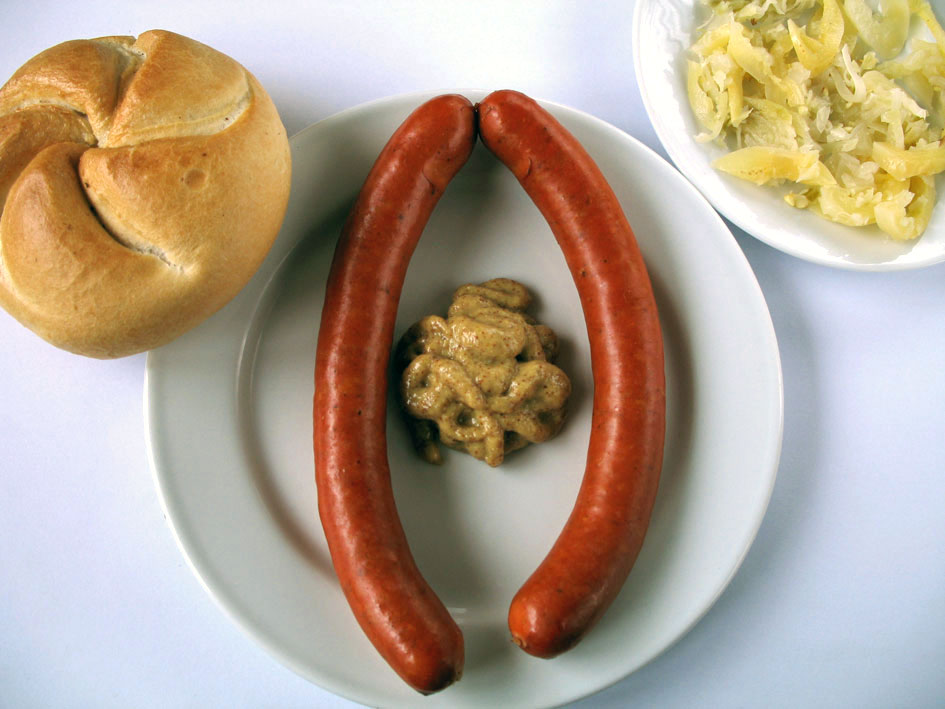
Debrecener sausages in a plate
Debreceni (indicated by green arrows) atop a wood platter (festival of meat) at a Hungarian restaurant

A debrecener (Hungarian: debreceni virsli, German: Debre(c)ziner, Italian: Salsiccia di Debrecen) is a pork sausage of uniform fine texture and reddish-orange colour, named after the Hungarian city of Debrecen.[1] The sausages are heavily spiced with paprika and other seasonings, like garlic, pepper and marjoram.[2] Usually they contain tiny pieces of pork fat as well. They are usually unsmoked or lightly smoked, and sold in pairs joined at one end. Traditional cooking technique calls for the Debreceni to be transversely slashed at intervals and baked, broiled, or fried. The sausage tends to curl away from the slashes, creating a linked series of sausage coins.[3]

Although originating in Eastern Hungary, this sausage spread to and has become popular in virtually every part of the former Austro-Hungarian Empire (including Austria, Northern Italy, Croatia, Slovenia, Poland, the Czech Republic, Slovakia, Western and Central Romania and Western Ukraine) and adopted into those cuisines. In Poland, it is called "Debreczyńska". In Bulgaria a derivative sausage is called debartsini (Bulgarian: дебърцини) and is widely offered by mass charcuterie.

See also

[edit]

References

[edit]
Revisions and contributorsEdit on WikipediaRead on Wikipedia
from Grokipedia
A Debrecener, also spelled Debreziner or known in Hungarian as Debreceni kolbász, is a lightly smoked sausage featuring a uniform fine texture, reddish-orange color derived from , and a spicy, hearty flavor. It originates from the Hungarian city of and gained widespread popularity across the former . The sausage is primarily made from , often blended with and for added richness, and seasoned with ingredients such as , sweet or hot , natural spices, and curing salt to enhance flavor and preservation. Preparation involves mincing and emulsifying the meat mixture with ice to a fine consistency, stuffing it into natural casings (typically 22-26 mm diameter), followed by a process of reddening, , light for color and aroma, and cooking to an internal of 72°C. This results in a parboiled product that is thin and versatile, with a unit weight of around 70-80 grams when linked in pairs. In culinary tradition, Debrecener is commonly served boiled or fried at sausage stands, paired with , mustard, ketchup, or , reflecting its role as a quick in regions like and parts of . It also appears in dishes such as or stews, underscoring its integration into . Variations exist, including all-beef versions for dietary preferences, and the sausage's contents and smoking intensity can differ by producer or country, though the core paprika-infused profile remains defining. Culturally, it symbolizes the shared culinary heritage of the Austro-Hungarian era, with Debrecen's influence extending to the Austrian sausage register, where it has been officially recognized since 1921.

History and Origin

Etymology and Naming

The Debrecener sausage, known in Hungarian as debreceni kolbász, derives its name directly from the city of in eastern , where it originated. The adjective "debreceni" in Hungarian signifies "from Debrecen" or "of Debrecen," reflecting the sausage's strong association with the region's culinary traditions. This etymological root ties the product to its geographic birthplace, emphasizing local identity in Hungarian food nomenclature. Historical references to the Debrecener first appear in 19th-century Hungarian texts, which describe local sausages produced in the area as distinctive regional specialties. These early mentions highlight the sausage's emergence during a period of growing meat processing industries in , particularly influenced by immigrant expertise in the city. By the mid-19th century, Debrecen's role as a market hub facilitated the documentation and popularity of such products in culinary writings. The name underwent adaptations in neighboring regions, notably as "Debreziner" in German-speaking areas of and Germany. This variation arose from linguistic influences within the (1867–1918), where cultural and trade exchanges spread across the empire, leading to localized pronunciations and spellings while retaining the core reference to .

Development in Hungary

The Debrecener sausage emerged in the early in , eastern , as a spiced sausage developed amid the region's expanding processing activities. Local traditions of sausage-making, enhanced by the widespread adoption of as a key spice following its cultivation in nearby areas, transformed it into a distinctive product featuring a reddish-orange hue and bold flavors. This period saw increased commercial production, with the sausage gaining recognition at Debrecen's great markets, where it was introduced to German-speaking traders and buyers by mid-century. In the late 1800s, Hungarian artisan butchers and organized groups of local women played a pivotal role in promoting recipes through weekly markets and fairs, elevating it from a household item to a commercial staple. These efforts standardized preparation techniques, emphasizing beef-pork blends, , and secret spice mixes dominated by ground red pepper, while ensuring quality control in sales. The growing , bolstered by immigrant influences such as Friulian families establishing salami factories around 1850–1880, indirectly supported broader sausage innovations in , though Debrecener remained a local focused on smoked, paired varieties. Post-World War II nationalization of Hungary's meat sector shifted production to state-run factories, introducing uniform standards that disseminated the nationwide and solidified its status as a . In 2015, it received formal recognition as a Hungarikum, affirming its protected regional heritage and traditional methods.

Spread Beyond Hungary

The Debrecener sausage, originating from , began its spread beyond national borders in the , facilitated by cultural and economic exchanges within the and later the (1867–1918), when it was adopted in neighboring regions. In , it appeared on street carts as early as the , reflecting the empire's integration of Hungarian culinary traditions. By 1875, advertisements in promoted "genuine Debrecziner" sausages, indicating early commercialization. This adoption led to local variants, such as the Austrian Debreziner, which was officially codified in the Austriacus in 1921, establishing standardized production methods distinct from the Hungarian original. In , the sausage gained popularity under the name Debreziner, influenced by trade fairs and migrations within the empire, where German intermediaries from , , and helped disseminate it. By the 1920s, regional adaptations emerged, often milder in spice to suit local tastes, and it became a staple in southern German markets. The Austro-Hungarian Empire's dissolution in did not halt this expansion; instead, it embedded the Debreziner in Central European sausage traditions, with ongoing production in both countries. Hungarian migration waves in the early further propelled the Debrecener's global reach, particularly to the , , and . Between 1870 and 1920, over one million immigrated to the , often preserving Hungarian culinary traditions in ethnic communities. Similar patterns occurred in during the , as Hungarian settlers introduced elements of their to networks. In , the sausage arrived via both direct Hungarian migration and German intermediaries, leading to localized production by mid-century. These immigrant communities maintained cultural links through food, often adapting it with available ingredients while retaining its paprika-infused profile. Hungary's accession to the in 2004 marked a significant boost to commercial exports, easing trade barriers and increasing demand across member states. Post-1990s integration efforts enhanced quality standards and , with Hungarian production—including Debrecener variants—rising steadily. By 2023, Hungary exported approximately sausages and similar products valued at around $147 million annually, with much directed to EU neighbors like and . This export growth underscored the Debrecener's role in Hungary's agro-food sector, supported by industrial scaling from firms like Debrecen Hús Zrt., established in 1894. In the , the Debrecener contributed to broader discussions on Central European within frameworks, aligning with recognitions like Austria's 2024 inscription of Viennese sausage stand on its national list. While not individually listed, its designation as a Hungarikum in 2015 highlighted its national significance and supported preservation efforts amid global dissemination.

Characteristics

Ingredients and Composition

The Debrecener sausage, known in Hungarian as Debreceni kolbász, is primarily made from , with the meat mixture typically comprising 70-80% shoulder and belly to provide a balance of lean meat and natural content. In standard recipes, this equates to approximately 700 grams of butt and 300 grams of per of total meat. Some variants incorporate , using a ratio of about 70% to 30% for added firmness and depth of flavor. All-pork versions, often considered premium, utilize 100% including Mangalitsa for enhanced quality. Essential spices define the sausage's profile, with sweet added at around 0.5-0.6% by weight (approximately 5-6 grams per kilogram) to achieve the signature reddish-orange hue and mild heat. Other seasonings include crushed (0.5-0.8% by weight), ground (0.2%), and (approximately 0.1%), alongside salt at 1.8-2.5% for curing and . These proportions ensure a harmonious blend without overpowering the meat's natural taste. Binders and additives in traditional formulations focus on natural elements: ice water or crushed ice (up to 15% of the mixture) aids emulsification during processing, while incorporated fat (20-30% of the total) enhances juiciness and . Authentic recipes eschew artificial preservatives, opting instead for natural curing salts like Cure #1 in controlled amounts to maintain safety and tradition. The meat undergoes a fine grind, typically through a 3-5 mm plate after an initial coarser pass, creating a smooth, emulsified texture that sets the Debrecener apart from rougher Hungarian varieties such as the csabai kolbász. This method promotes even distribution of and spices for consistent .

Appearance and Flavor Profile

The Debrecener sausage is characterized by its distinctive reddish-orange hue, derived primarily from the generous use of in its seasoning. This vibrant color permeates the fine, uniform texture of the meat, which is encased in a natural hog casing that provides a subtle translucency when raw or lightly cooked. Typically measuring 10-15 cm in length and about 3 cm in diameter, the sausages are often produced in pairs joined at one end, giving them a compact and recognizable form that sets them apart from chunkier varieties. In terms of texture, the Debrecener offers a smooth and snappy bite, with no visible chunks of , resulting from its finely ground and beef mixture that ensures even distribution throughout. This creates a juicy interior that remains soft and tender even after cooking, contrasting with coarser sausages by providing a more refined . The flavor profile of the Debrecener is mildly smoky and spicy, dominated by the earthy warmth of and the pungent sharpness of , with milder notes of pepper and adding depth. This combination delivers a mild heat rather than overwhelming spiciness, balanced by the subtle sweetness of the , while the or wood smoking imparts a rich, aromatic smokiness. When cooked, the sausage releases an enticing aroma of smoked and , enhancing its sensory appeal and making it a standout in dishes where its juices contribute to the overall savoriness.

Nutritional Aspects

Nutritional values for Debrecener sausage vary by producer and formulation. A typical serving provides approximately 285 kcal per 100 g, primarily derived from its high content of 25 g per 100 g and protein at 14 g per 100 g. These macronutrients make it a calorie-dense , with fats contributing the majority of energy and protein supporting muscle maintenance. Carbohydrates are minimal at 1 g per 100 g, reflecting the sausage's meat-based composition without significant starchy additives in traditional formulations. Key micronutrients in the Debrecener include iron, sourced from the , at around 1.15 mg per 100 g, which aids in oxygen transport and prevents . It also contains , typically 0.5–1.3 mcg per 100 g, essential for nerve function and production. However, the curing process results in high sodium levels, approximately 880–928 mg per 100 g serving, which can contribute to elevated if consumed excessively. As a product, the Debrecener is unsuitable for vegetarians or vegans. It is often gluten-free in versions without fillers, though some commercial recipes incorporate them for texture. Potential allergens include and spices commonly used in . Compared to other smoked sausages, its content is relatively moderate at 25 g per 100 g—lower than varieties exceeding 30 g—but higher than fresh cuts like tenderloin (10–15 g per 100 g) due to added during production.

Preparation and Production

Traditional Manufacturing Process

The traditional manufacturing process of Debrecener sausage, rooted in 19th-century Hungarian artisanal practices in , emphasizes precise meat preparation to achieve a juicy, emulsified texture while preserving the sausage's characteristic spiciness. High-quality or butt (typically 60-70% of the mix) and or (30-40%, including back fat) are selected, trimmed of excess sinew, and cut into 2-3 cm cubes. The meat and fat are partially frozen for 1-2 hours to firm them up, facilitating clean grinding and preventing smearing. Grinding follows using manual hand-crank or early mechanical grinders, common in historical Debrecen workshops. Lean meat is passed through a 3-5 mm plate, while fat is ground through a 4-6 mm plate for even dispersion and fine emulsification. This ensures the fat integrates without separating during later steps. The ground components are then combined in a chilled mixing bowl with salt (1.8-2%), cure #1 (for nitrite preservation at 2.5 g/kg meat), and a small amount of ice-cold (about 1-2% of meat weight) or crushed . is strictly controlled below 6°C (43°F) throughout mixing to maintain emulsion stability and avoid fat meltdown, often achieved by adding ice incrementally while by hand or paddle until the mass becomes sticky and cohesive—typically 5-10 minutes. Spices, including ground sweet (2-3%), (0.5-1%), (0.2-0.5%), and occasionally , are incorporated during this phase for flavor binding. Curing is achieved by the added curing salt; no extended curing is needed. Emulsification is achieved through this cold mixing process, where serves as both a binder and coolant, creating a smooth yet slightly coarse paste that holds together without additional binders. The mixture, now at 25-30% fat content for succulence, is immediately stuffed into casings (22-26 mm ) using a horn or manual stuffer to form 15-20 cm lengths, with care to eliminate air pockets for uniform cooking. In early production, this was done in small batches of 10-50 kg in Debrecen's local markets and family operations, relying on seasonal slaughters. Following stuffing, the sausages undergo a brief for 1 hour at in a well-ventilated area, allowing the casings to adhere and initial flavor compounds to develop. This step, essential for texture, contrasts with post-1950s industrial lines that scaled production to thousands of kilograms daily using automated grinders and stuffers, though traditional methods persist in artisanal settings.

Smoking and Curing Techniques

The curing for Debrecener sausage is integrated into the mixing with nitrite curing salt, which preserves the product, enhances color stability, and ensures microbial safety. Following preparation, the sausages undergo light warm at 50-70°C for 30-60 minutes to impart a subtle smoky flavor and partial cooking. or wood is traditionally used for this purpose, producing a mild aroma that complements the sausage's paprika-forward profile. Historically, smoking was conducted over open fires using local hardwoods, a method rooted in ancient Hungarian preservation practices that relied on natural airflow and variable conditions for flavor development. In modern production, controlled smoking chambers ensure consistency in , , and density, reducing variability and meeting standards while preserving the traditional taste, followed by cooking to an internal of 72°C.

Home and Commercial Production

Home production of Debrecener sausage, also known as Debreceni kolbász, allows enthusiasts to replicate the traditional Hungarian recipe on a small scale using basic equipment. A typical 5 kg batch begins with 3.5 kg of pork butt and 1.5 kg of or back fat, ground separately through a with plates of 3-5 mm for the lean meat and 4-6 mm for the fat. Seasonings include 90 g salt, 12.5 g #1, 10 g ground pepper, 30 g sweet paprika, 40 g crushed , and 75 ml water; the lean meat is mixed with salt, , and water until sticky before incorporating spices and fat. The mixture is stuffed into 22-26 mm natural casings using a manual stuffer to form 20 cm links, then hung for an hour at room temperature. Safety is paramount in home production to prevent bacterial contamination, particularly from pathogens like . Cure #1 (containing ) must be used precisely at 2.5 g per kg of to inhibit , and all equipment, including grinders and stuffers, should be sanitized with hot soapy water and bleach solution before and after use. should be kept below during grinding and mixing, and the final product smoked at 48-60°C followed by cooking in 80°C water to an internal temperature of 68°C. Home producers often adjust recipes for customization, such as reducing salt to 70 g for lower sodium content or varying levels for milder flavor, enabling personalization not feasible in . Commercial production of Debrecener sausage occurs in large Hungarian facilities, particularly in regions like and the Northern Great Plain, where historical factories like the 19th-century Vidoni salami plant evolved into modern operations employing for efficiency. Companies such as MCS Vágóhíd Zrt. utilize advanced meat processing lines for grinding, emulsifying, and , ensuring consistent and distribution across batches. Automated systems seal sausages in synthetic or natural casings under vacuum for extended and compliance, contrasting with manual home methods by prioritizing uniformity in weight, color, and spice intensity to meet international standards. These factories produce Debrecener alongside other varieties, with historical precedents like the Boschetti plant outputting 400 tons annually by 1880, scaled up today through mechanized lines. Key differences between and commercial production lie in scale, control, and consistency: batches offer flexibility for dietary adjustments like less salt or additive-free formulations, but require manual labor and risk variability in texture, while commercial processes employ industrial emulsifiers and to achieve uniform products that adhere to regulations, often using synthetic casings for predictable sizing. In , sausage holds protected status under the national Traditions, Tastes, Regions (TTR) program established in , which mandates traditional recipes, regional ties, and specific labeling for authenticity, such as "Debrecen delicate " to denote origin from the Northern Great Plain. Since 's accession in 2004, producers must comply with hygiene and labeling directives (e.g., Regulation (EC) No 853/2004), but Debrecener lacks full PGI recognition, unlike Gyulai kolbász; this national protection influences commercial labeling to prevent misuse of the name and supports tourism-linked sales.

Culinary Uses

Traditional Dishes and Pairings

The Debreceni sausage is a staple in traditional Hungarian stews such as , a summer dish combining sliced peppers, tomatoes, onions, and the sausage, often finished with eggs for added richness. This preparation highlights the sausage's paprika-infused flavor, creating a vibrant, spicy that embodies . Variations include incorporating the sausage into , where it adds smokiness to the paprika-based broth with potatoes and onions. Grilled Hungarian sausages, including Debreceni, paired with offers a contrasting tangy acidity to its spiced profile, commonly enjoyed as a simple yet hearty meal. Common accompaniments emphasize the sausage's bold taste, such as fresh crusty for sopping up juices and mustard for a sharp bite. In goulash iterations, it is sometimes served alongside pickled vegetables like beets or cucumbers to balance the richness. A classic beverage pairing is Hungarian beer, such as Dreher lager, whose malty notes complement the sausage's smokiness and spice without overpowering it. In Debrecen's markets and street stalls, the is a regional specialty, typically fried hot and served with raw onions for crunch and freshness, reflecting local vendor traditions. This quick preparation is popular among locals and visitors alike, often consumed on-site as affordable . Twentieth-century Hungarian cookbooks, such as the Hungarian Specialities Cookery Book, feature the in layered dishes like rakott kaposzta (cabbage pie) with and , intended for festive gatherings or family meals. These recipes underscore its role in celebrations, including modern festivals like the Debreczeni ZAMAT event and the annual Debrecziner Gourmet Festival (as of 2025), where paired sausages are showcased with regional wines and spirits.

Cooking Methods

Debrecener sausage, being a fully cooked and smoked product, requires reheating methods that preserve its juicy texture and enhance its spicy, paprika-infused flavor without overcooking. Common techniques include , pan-frying, , and , each suited to different culinary contexts while ensuring . Grilling is a popular method to achieve a crisp exterior on Debrecener, applying direct for 10-15 minutes while turning occasionally to promote even browning and crisping of the natural casing. For added authenticity in Hungarian-style preparation, pan-frying in provides uniform browning and infuses a subtle richness, cooking over medium for about 8-12 minutes until heated through. Boiling suits incorporation into soups or stews, where the sausages are simmered in or for 8-10 minutes until reaching an internal temperature of 75°C, allowing flavors to meld without bursting the casing. Baking offers uniform cooking, particularly in casseroles, by placing the sausages in an oven preheated to 180°C for 15-20 minutes, ensuring even heat distribution. Regardless of method, always verify an internal temperature of at least 74°C (165°F) to eliminate any potential risks from reheating pre-cooked , as recommended by guidelines for ground and products.

Serving Suggestions

Debrecener is commonly presented sliced thinly on platters alongside dill pickles, onions, and fresh , making it a staple appetizer at Hungarian gatherings such as wine festivals. It also features prominently on charcuterie-style boards known as hidegtál, where it is arranged with an assortment of cheeses like Hungarian trappista or international varieties such as cheddar, accompanied by mustards and pickled for a balanced cold plate. In contemporary settings, Debrecener can be incorporated into lighter meals by thinly slicing it into salads reminiscent of , combining the sausage's paprika-infused flavor with vinaigrette-dressed greens, onions, and cheeses for a refreshing dish. Alternatively, it lends itself to wraps, where grilled or pan-fried slices are tucked into flatbreads with fresh and tangy sauces, offering a portable option for casual lunches. A standard portion consists of 2-3 sausages per serving, depending on whether presented whole or sliced, to provide satisfying yet not overwhelming amounts. Seasonally, Debrecener is enjoyed hot during winter months as part of hearty, warming presentations in stews or soups, emphasizing its smoked depth when served steaming alongside . In contrast, during summer, it is favored cold for picnics, sliced and packed in coolers with accompaniments like cheeses and pickles for easy outdoor enjoyment. In Hungarian tradition, etiquette calls for slicing the sausage lengthwise before serving to expose the interior texture and facilitate even distribution of flavors, often done tableside for communal meals. Debrecener pairs particularly well with , enhancing its spicy notes in informal settings.

Cultural and Economic Significance

Role in Hungarian Cuisine

The Debreceni sausage, originating from the city of in eastern , integrates seamlessly into both everyday Hungarian meals and celebratory feasts, underscoring its status as a versatile culinary staple. In daily routines, it is often grilled or fried and paired simply with mustard and fresh bread for affordable, hearty lunches, or simmered into comforting stews like —a and pepper —or paprika-spiced potatoes. During traditional winter slaughters known as disznóvágás, which function as communal family holidays, the sausage is crafted in abundance from fresh pork, preserving excess meat for consumption throughout the year and fostering social bonds through shared preparation and feasting. This practice highlights its role in sustaining households across seasons. Symbolizing the vibrant identity of eastern Hungarian culture, the Debreceni embodies regional pride and is officially recognized as a Hungarikum, a designation for authentic Hungarian specialties that preserve national heritage. It prominently features in folk festivals, such as the annual Debrecziner Gourmet Festival held in Debrecen's Nagyerdő park, where local chefs present innovative yet tradition-rooted dishes, drawing crowds to celebrate the city's gastronomic legacy amid wine tastings and cooking demonstrations. This event, along with broader festivals, reinforces the sausage's position as a cultural emblem of community and resilience in Hungarian traditions. The Debreceni sausage serves as a foundational element in many sausage-centric dishes across , influencing recipes that leverage its distinctive spicy, paprika-driven profile for depth and flavor. For instance, it elevates layered casseroles and soups like lebbencs, a barley-based regional specialty, by adding smoky richness that balances starchy components and underscores the sausage's adaptability in building layered, comforting meals. Historically, the Debreceni sausage has functioned as an essential, affordable protein source, particularly during 20th-century periods of economic hardship and food scarcity in , when its smoking and curing techniques enabled long-term preservation without . Rooted in 19th-century Debrecen traditions of annual pig slaughters, it provided a reliable, nutrient-dense option for working-class families amid and communist-era shortages, transforming modest cuts into a durable staple that supported nutritional needs and culinary continuity.

International Recognition and Exports

The Debrecener sausage, known internationally as "Debreziner," has gained recognition beyond , particularly in German-speaking countries where the name derives from its origins in , and it has spread to other global markets through culinary adaptation and migration. In 2015, it was designated a "Hungarikum," a national value highlighting its cultural significance, which has bolstered its profile in international food discussions and festivals. Efforts to protect its authenticity include the establishment of the Debrecen Double Sausage Codex in 2015, which standardizes quality, appearance, and production to safeguard its reputation amid growing global interest. While it lacks EU Protected (PGI) status—unlike fellow Hungarian varieties such as Gyulai and Csabai kolbász—consumer studies indicate strong potential value from such protection, with Hungarian shoppers willing to pay premiums for PGI-labeled sausages. This national framework has supported its entry into international competitions, where Hungarian producers, including those specializing in Debrecener styles, have earned medals in events like the DFV-AAMP Quality Competition. Exports of , including Debrecener, primarily target , the , and the , driven by demand from immigrant communities and food enthusiasts. In 2019, Hungary's total sausage exports reached approximately €105 million (US$115.64 million), reflecting steady growth of 13.25% from 2017, with Debrecener contributing through branded products available in ethnic markets and specialty retailers abroad. These shipments have sustained momentum into the 2020s, supported by producers such as Pap Sausage Maker, who expanded facilities with grants to meet overseas demand. The sausage has appeared in global media, such as a 2014 feature on Debrecen's vibrant food scene, highlighting its role in local festivals and its appeal to international visitors. Hungarian diaspora communities in the and actively preserve its authenticity, incorporating it into traditional dishes at events and markets, which helps maintain cultural ties. Challenges include counterfeits in non-EU markets, where imitation products dilute the brand without adhering to the codex standards, prompting ongoing advocacy for stronger international protections. Despite this, the Debrecener's distinctive paprika-spiced profile continues to foster its export growth and cross-cultural appreciation, with adaptations to regulations enhancing its market position as of 2025.

Modern Adaptations and Variations

In response to dietary requirements in kosher and markets, variations of the Debrecener have been developed using exclusively or in combination with lamb to comply with religious slaughter standards and avoid . Similarly, halal-certified versions incorporate and , maintaining the traditional paprika-based seasoning while ensuring pork-free composition. These adaptations preserve the sausage's reddish-orange hue and fine texture, often through the use of substitutes where needed. Low-fat versions of Debrecener-style sausages have emerged to appeal to health-conscious consumers, with some producers formulating blends containing less than 10% using and while retaining the signature spices. Plant-based vegan mimics replicate the Debrecener's profile using textured for texture and beet juice for the characteristic color, alongside and for flavor authenticity. Additional herbs such as can be incorporated in these vegan formulations to enhance aroma, diverging from the traditional base. In American processing, Debrecener sausages are typically produced in larger sizes, such as foot-long links (approximately 30 cm), to suit local preferences and portion expectations. Since the 2010s, trends in Debrecener production have emphasized organic certifications and sustainable sourcing, driven by consumer preferences for environmentally responsible as evidenced in choice experiments evaluating attributes like protected geographical indications and labels. These developments align with broader gastronomic shifts, including innovations like pálinka-infused variants introduced at festivals starting in 2009.

References

Add your contribution
Related Hubs
User Avatar
No comments yet.