Hubbry Logo
Knowledge graph embeddingKnowledge graph embeddingMain
Open search
Knowledge graph embedding
Community hub
Knowledge graph embedding
logo
8 pages, 0 posts
0 subscribers
Be the first to start a discussion here.
Knowledge graph embedding
from Wikipedia
Embedding of a knowledge graph. The vector representation of the entities and relations can be used for different machine learning applications.

In representation learning, knowledge graph embedding (KGE), also called knowledge representation learning (KRL), or multi-relation learning,[1] is a machine learning task of learning a low-dimensional representation of a knowledge graph's entities and relations while preserving their semantic meaning.[1][2][3] Leveraging their embedded representation, knowledge graphs (KGs) can be used for various applications such as link prediction, triple classification, entity recognition, clustering, and relation extraction.[1][4]

Definition

[edit]

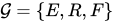
A knowledge graph is a collection of entities , relations , and facts .[5] A fact is a triple that denotes a link between the head and the tail of the triple. Another notation that is often used in the literature to represent a triple (or fact) is . This notation is called the Resource Description Framework (RDF).[1][5] A knowledge graph represents the knowledge related to a specific domain; leveraging this structured representation, it is possible to infer a piece of new knowledge from it after some refinement steps.[6] However, nowadays, people have to deal with the sparsity of data and the computational inefficiency to use them in a real-world application.[3][7]

The embedding of a knowledge graph is a function that translates each entity and each relation into a vector of a given dimension , called embedding dimension.[7] It is even possible to embed the entities and relations with different dimensions.[7] The embedding vectors can then be used for other tasks.

A knowledge graph embedding is characterized by four aspects:[1]

  1. Representation space: The low-dimensional space in which the entities and relations are represented.[1]
  2. Scoring function: A measure of the goodness of a triple embedded representation.[1]
  3. Encoding models: The modality in which the embedded representation of the entities and relations interact with each other.[1]
  4. Additional information: Any additional information coming from the knowledge graph that can enrich the embedded representation.[1] Usually, an ad hoc scoring function is integrated into the general scoring function for each additional information.[5][1][8]

Embedding procedure

[edit]

All algorithms for creating a knowledge graph embedding follow the same approach.[7] First, the embedding vectors are initialized to random values.[7] Then, they are iteratively optimized using a training set of triples. In each iteration, a batch of size triples is sampled from the training set, and a triple from it is sampled and corrupted—i.e., a triple that does not represent a true fact in the knowledge graph.[7] The corruption of a triple involves substituting the head or the tail (or both) of the triple with another entity that makes the fact false.[7] The original triple and the corrupted triple are added in the training batch, and then the embeddings are updated, optimizing a scoring function.[5][7] Iteration stops when a stop condition is reached.[7] Usually, the stop condition depends on the overfitting of the training set.[7] At the end, the learned embeddings should have extracted semantic meaning from the training triples and should correctly predict unseen true facts in the knowledge graph.[5]

Pseudocode

[edit]

The following is the pseudocode for the general embedding procedure.[9][7]

algorithm Compute entity and relation embeddings
    input: The training set , 
           entity set , 
           relation set ,     
           embedding dimension 
    output: Entity and relation embeddings

    initialization: the entities  and relations  embeddings (vectors) are randomly initialized

    while stop condition do
          // Sample a batch from the training set
        for each  in  do
              // Sample a corrupted fact 
             
        end for
        Update embeddings by minimizing the loss function
    end while

Performance indicators

[edit]

These indexes are often used to measure the embedding quality of a model. The simplicity of the indexes makes them very suitable for evaluating the performance of an embedding algorithm even on a large scale.[10] Given as the set of all ranked predictions of a model, it is possible to define three different performance indexes: Hits@K, MR, and MRR.[10]

Hits@K

[edit]

Hits@K or in short, H@K, is a performance index that measures the probability to find the correct prediction in the first top K model predictions.[10] Usually, it is used .[10] Hits@K reflects the accuracy of an embedding model to predict the relation between two given triples correctly.[10]

Hits@K

Larger values mean better predictive performances.[10]

Mean rank (MR)

[edit]

Mean rank is the average ranking position of the items predicted by the model among all the possible items.[10]

The smaller the value, the better the model.[10]

Mean reciprocal rank (MRR)

[edit]

Mean reciprocal rank measures the number of triples predicted correctly.[10] If the first predicted triple is correct, then 1 is added, if the second is correct is summed, and so on.[10]

Mean reciprocal rank is generally used to quantify the effect of search algorithms.[10]

The larger the index, the better the model.[10]

Applications

[edit]

Machine learning tasks

[edit]

Knowledge graph completion (KGC) is a collection of techniques to infer knowledge from an embedded knowledge graph representation.[11] In particular, this technique completes a triple inferring the missing entity or relation.[11] The corresponding sub-tasks are named link or entity prediction (i.e., guessing an entity from the embedding given the other entity of the triple and the relation), and relation prediction (i.e., forecasting the most plausible relation that connects two entities).[11]

Triple Classification is a binary classification problem.[1] Given a triple, the trained model evaluates the plausibility of the triple using the embedding to determine if a triple is true or false.[11] The decision is made with the model score function and a given threshold.[11] Clustering is another application that leverages the embedded representation of a sparse knowledge graph to condense the representation of similar semantic entities close in a 2D space.[4]

Real world applications

[edit]

The use of knowledge graph embedding is increasingly pervasive in many applications. In the case of recommender systems, the use of knowledge graph embedding can overcome the limitations of the usual reinforcement learning,[12][13] as well as limitations of the conventional collaborative filtering method.[14] Training this kind of recommender system requires a huge amount of information from the users; however, knowledge graph techniques can address this issue by using a graph already constructed over a prior knowledge of the item correlation and using the embedding to infer from it the recommendation.[12] Drug repurposing is the use of an already approved drug, but for a therapeutic purpose different from the one for which it was initially designed.[15] It is possible to use the task of link prediction to infer a new connection between an already existing drug and a disease by using a biomedical knowledge graph built leveraging the availability of massive literature and biomedical databases.[15] Knowledge graph embedding can also be used in the domain of social politics.[4]

Models

[edit]
Publication timeline of some knowledge graph embedding models. In red the tensor decomposition models, in blue the geometric models, and in green the deep learning models. RESCAL[16] (2011) was the first modern KGE approach. In[17] it was applied to the YAGO knowledge graph. This was the first application of KGE to a large scale knowledge graph.

Given a collection of triples (or facts) , the knowledge graph embedding model produces, for each entity and relation present in the knowledge graph a continuous vector representation.[7] is the corresponding embedding of a triple with and , where is the embedding dimension for the entities, and for the relations.[7] The score function of a given model is denoted by and measures the distance of the embedding of the head from the embedding of tail given the embedding of the relation. In other words, it quantifies the plausibility of the embedded representation of a given fact.[5]

Rossi et al. propose a taxonomy of the embedding models and identifies three main families of models: tensor decomposition models, geometric models, and deep learning models.[5]

Tensor decomposition model

[edit]

The tensor decomposition is a family of knowledge graph embedding models that use a multi-dimensional matrix to represent a knowledge graph,[1][5][18] that is partially knowable due to gaps of the graph describing a particular domain thoroughly.[5] In particular, these models use a third-order (3D) tensor, which is then factorized into low-dimensional vectors that are the embeddings.[5][18] A third-order tensor is suitable for representing a knowledge graph because it records only the existence or absence of a relation between entities,[18] and so is simple, and there is no need to know a priori the network structure,[16] making this class of embedding models light, and easy to train even if they suffer from high-dimensionality and sparsity of data.[5][18]

Bilinear models

[edit]

This family of models uses a linear equation to embed the connection between the entities through a relation.[1] In particular, the embedded representation of the relations is a bidimensional matrix.[5] These models, during the embedding procedure, only use the single facts to compute the embedded representation and ignore the other associations to the same entity or relation.[19]

  • DistMult[20]: Since the embedding matrix of the relation is a diagonal matrix,[5] the scoring function can not distinguish asymmetric facts.[5][19]
  • ComplEx[21]: As DistMult uses a diagonal matrix to represent the relations embedding but adds a representation in the complex vector space and the hermitian product, it can distinguish symmetric and asymmetric facts.[5][18] This approach is scalable to a large knowledge graph in terms of time and space cost.[21]
  • ANALOGY[22]: This model encodes in the embedding the analogical structure of the knowledge graph to simulate inductive reasoning.[22][5][1] Using a differentiable objective function, ANALOGY has good theoretical generality and computational scalability.[22] It is proven that the embedding produced by ANALOGY fully recovers the embedding of DistMult, ComplEx, and HolE.[22]
  • SimplE[23]: This model is the improvement of canonical polyadic decomposition (CP), in which an embedding vector for the relation and two independent embedding vectors for each entity are learned, depending on whether it is a head or a tail in the knowledge graph fact.[23] SimplE resolves the problem of independent learning of the two entity embeddings using an inverse relation and average the CP score of and .[7][18] In this way, SimplE collects the relation between entities while they appear in the role of subject or object inside a fact, and it is able to embed asymmetric relations.[5]

Non-bilinear models

[edit]
  • HolE:[24] HolE uses circular correlation to create an embedded representation of the knowledge graph,[24] which can be seen as a compression of the matrix product, but is more computationally efficient and scalable while keeping the capabilities to express asymmetric relation since the circular correlation is not commutative.[19] HolE links holographic and complex embeddings since, if used together with Fourier, can be seen as a special case of ComplEx.[1]
  • TuckER:[25] TuckER sees the knowledge graph as a tensor that could be decomposed using the Tucker decomposition in a collection of vectors—i.e., the embeddings of entities and relations—with a shared core.[25][5] The weights of the core tensor are learned together with the embeddings and represent the level of interaction of the entries.[26] Each entity and relation has its own embedding dimension, and the size of the core tensor is determined by the shape of the entities and relations that interact.[5] The embedding of the subject and object of a fact are summed in the same way, making TuckER fully expressive, and other embedding models such as RESCAL, DistMult, ComplEx, and SimplE can be expressed as a special formulation of TuckER.[25]
  • MEI:[27] MEI introduces the multi-partition embedding interaction technique with the block term tensor format, which is a generalization of CP decomposition and Tucker decomposition. It divides the embedding vector into multiple partitions and learns the local interaction patterns from data instead of using fixed special patterns as in ComplEx or SimplE models. This enables MEI to achieve optimal efficiency—expressiveness trade-off, not just being fully expressive.[27] Previous models such as TuckER, RESCAL, DistMult, ComplEx, and SimplE are suboptimal restricted special cases of MEI.
  • MEIM:[28] MEIM goes beyond the block term tensor format to introduce the independent core tensor for ensemble boosting effects and the soft orthogonality for max-rank relational mapping, in addition to multi-partition embedding interaction. MEIM generalizes several previous models such as MEI and its subsumed models, RotaE, and QuatE.[28] MEIM improves expressiveness while still being highly efficient in practice, helping it achieve good results using fairly small model sizes.

Geometric models

[edit]

The geometric space defined by this family of models encodes the relation as a geometric transformation between the head and tail of a fact.[5] For this reason, to compute the embedding of the tail, it is necessary to apply a transformation to the head embedding, and a distance function is used to measure the goodness of the embedding or to score the reliability of a fact.[5]

Geometric models are similar to the tensor decomposition model, but the main difference between the two is that they have to preserve the applicability of the transformation in the geometric space in which it is defined.[5]

Pure translational models

[edit]

This class of models is inspired by the idea of translation invariance introduced in word2vec.[7] A pure translational model relies on the fact that the embedding vector of the entities are close to each other after applying a proper relational translation in the geometric space in which they are defined.[19] In other words, given a fact, the embedding of the head plus the embedding of the relation should equal the embedding of the tail.[5] The closeness of the entities embedding is given by some distance measure and quantifies the reliability of a fact.[18]

TransE embedding model. The vector representation (embedding) of the head plus the vector representation of the relation should be equal to the vector representation of the tail entity.
  • TransE[9]: Uses a scoring function that forces the embeddings to satisfy a simple vector sum equation in each fact in which they appear: .[7] The embedding will be exact if each entity and relation appears in only one fact, and so in practice is poor at representing one-to-many, many-to-one, and asymmetric relations.[5][7]
  • TransH[29]: A modification of TransE for representing types of relations, by using a hyperplane as a geometric space.[29] In TransH, the relation embedding is on a different hyperplane depending on the entities it interacts with.[7] So, to compute, for example, the score function of a fact, the embedded representation of the head and tail need to be projected using a relational projection matrix on the correct hyperplane of the relation.[1][7]
  • TransR[30]: A modification of TransH that uses different spaces embedding entities versus relations,[1][19] thus separating the semantic spaces of entities and relations.[7] TransR also uses a relational projection matrix to translate the embedding of the entities to the relation space.[7]
  • TransD:[31] In TransR, the head and the tail of a given fact could belong to two different types of entities. For example, in the fact, Obama is a person and USA is a country.[31][7] Matrix multiplication is an expensive procedure in TransR to compute the projection.[7][31] In this context, TransD uses two vectors for each entity-relation pair to compute a dynamic mapping that substitutes the projection matrix while reducing the dimensional complexity.[1][7][31] The first vector is used to represent the semantic meaning of the entities and relations, the second to compute the mapping matrix.[31]
  • TransA:[32] All the translational models define a score function in their representation space, but they oversimplify this metric loss.[32] Since the vector representation of the entities and relations is not perfect, a pure translation of could be distant from , and a spherical equipotential Euclidean distance makes it hard to distinguish which is the closest entity.[32] TransA, instead, introduces an adaptive Mahalanobis distance to weights the embedding dimensions, together with elliptical surfaces to remove the ambiguity.[1][7][32]

Translational models with additional embeddings

[edit]

It is possible to associate additional information to each element in the knowledge graph and their common representation facts.[1] Each entity and relation can be enriched with text descriptions, weights, constraints, and others in order to improve the overall description of the domain with a knowledge graph.[1] During the embedding of the knowledge graph, this information can be used to learn specialized embeddings for these characteristics together with the usual embedded representation of entities and relations, with the cost of learning a more significant number of vectors.[5]

  • STransE:[33] This model is the result of the combination of TransE and of the structure embedding[33] in such a way it is able to better represent the one-to-many, many-to-one, and many-to-many relations.[5] To do so, the model involves two additional independent matrix and for each embedded relation in the KG.[33] Each additional matrix is used based on the fact the specific relation interact with the head or the tail of the fact.[33] In other words, given a fact , before applying the vector translation, the head is multiplied by and the tail is multiplied by .[7]
  • CrossE:[34] Crossover interactions can be used for related information selection, and could be very useful for the embedding procedure.[34] Crossover interactions provide two distinct contributions in the information selection: interactions from relations to entities and interactions from entities to relations.[34] This means that a relation, e.g.'president_of' automatically selects the types of entities that are connecting the subject to the object of a fact.[34] In a similar way, the entity of a fact inderectly determine which is inference path that has to be choose to predict the object of a related triple.[34] CrossE, to do so, learns an additional interaction matrix , uses the element-wise product to compute the interaction between and .[5][34] Even if, CrossE, does not rely on a neural network architecture, it is shown that this methodology can be encoded in such architecture.[1]

Roto-translational models

[edit]

This family of models, in addition or in substitution of a translation they employ a rotation-like transformation.[5]

  • TorusE:[35] The regularization term of TransE makes the entity embedding to build a spheric space, and consequently loses the translation properties of the geometric space.[35] To address this problem, TorusE leverages the use of a compact Lie group that in this specific case is n-dimensional torus space, and avoid the use of regularization.[1][35] TorusE defines the distance functions to substitute the L1 and L2 norm of TransE.[5]
  • RotatE:[36] RotatE is inspired by the Euler's identity and involves the use of Hadamard product to represent a relation as a rotation from the head to the tail in the complex space.[36] For each element of the triple, the complex part of the embedding describes a counterclockwise rotation respect to an axis, that can be describe with the Euler's identity, whereas the modulus of the relation vector is 1.[36] It is shown that the model is capable of embedding symmetric, asymmetric, inversion, and composition relations from the knowledge graph.[36]

Deep learning models

[edit]

This group of embedding models uses deep neural network to learn patterns from the knowledge graph that are the input data.[5] These models have the generality to distinguish the type of entity and relation, temporal information, path information, underlay structured information,[19] and resolve the limitations of distance-based and semantic-matching-based models in representing all the features of a knowledge graph.[1] The use of deep learning for knowledge graph embedding has shown good predictive performance even if they are more expensive in the training phase, data-hungry, and often required a pre-trained embedding representation of knowledge graph coming from a different embedding model.[1][5]

Convolutional neural networks

[edit]

This family of models, instead of using fully connected layers, employs one or more convolutional layers that convolve the input data applying a low-dimensional filter capable of embedding complex structures with few parameters by learning nonlinear features.[1][5][19]

  • ConvE:[37] ConvE is an embedding model that represents a good tradeoff expressiveness of deep learning models and computational expensiveness,[18] in fact it is shown that it used 8x less parameters, when compared to DistMult.[37] ConvE uses a one-dimensional -sized embedding to represent the entities and relations of a knowledge graph.[5][37] To compute the score function of a triple, ConvE apply a simple procedure: first concatenes and merge the embeddings of the head of the triple and the relation in a single data , then this matrix is used as input for the 2D convolutional layer.[5][18] The result is then passed through a dense layer that apply a linear transformation parameterized by the matrix and at the end, with the inner product is linked to the tail triple.[5][19] ConvE is also particularly efficient in the evaluation procedure: using a 1-N scoring, the model matches, given a head and a relation, all the tails at the same time, saving a lot of evaluation time when compared to the 1-1 evaluation program of the other models.[19]
  • ConvR:[38] ConvR is an adaptive convolutional network aimed to deeply represent all the possible interactions between the entities and the relations.[38] For this task, ConvR, computes convolutional filter for each relation, and, when required, applies these filters to the entity of interest to extract convoluted features.[38] The procedure to compute the score of triple is the same as ConvE.[5]
  • ConvKB:[39] ConvKB, to compute score function of a given triple , it produces an input of dimension without reshaping and passes it to series of convolutional filter of size .[39] This result feeds a dense layer with only one neuron that produces the final score.[39] The single final neuron makes this architecture as a binary classifier in which the fact could be true or false.[5] A difference with ConvE is that the dimensionality of the entities is not changed.[18]

Capsule neural networks

[edit]

This family of models uses capsule neural networks to create a more stable representation that is able to recognize a feature in the input without losing spatial information.[5] The network is composed of convolutional layers, but they are organized in capsules, and the overall result of a capsule is sent to a higher-capsule decided by a dynamic process routine.[5]

  • CapsE:[40] CapsE implements a capsule network to model a fact .[40] As in ConvKB, each triple element is concatenated to build a matrix and is used to feed to a convolutional layer to extract the convolutional features.[5][40] These features are then redirected to a capsule to produce a continuous vector, more the vector is long, more the fact is true.[40]

Recurrent neural networks

[edit]

This class of models leverages the use of recurrent neural network.[5] The advantage of this architecture is to memorize a sequence of fact, rather than just elaborate single events.[41]

  • RSN:[41] During the embedding procedure is commonly assumed that, similar entities has similar relations.[41] In practice, this type of information is not leveraged, because the embedding is computed just on the undergoing fact rather than a history of facts.[41] Recurrent skipping networks (RSN) uses a recurrent neural network to learn relational path using a random walk sampling.[5][41]

Model performance

[edit]

The machine learning task for knowledge graph embedding that is more often used to evaluate the embedding accuracy of the models is the link prediction.[1][3][5][6][7][19] Rossi et al.[5] produced an extensive benchmark of the models, but also other surveys produces similar results.[3][7][19][26] The benchmark involves five datasets FB15k,[9] WN18,[9] FB15k-237,[42] WN18RR,[37] and YAGO3-10.[43] More recently, it has been discussed that these datasets are far away from real-world applications, and other datasets should be integrated as a standard benchmark.[44]

Table summary of the characteristics of the datasets used to benchmark the embedding models.
Dataset name Number of different entities Number of different relations Number of triples
FB15k[9] 14951 1345 584,113
WN18[9] 40943 18 151,442
FB15k-237[42] 14541 237 310,116
WN18RR[37] 40943 11 93,003
YAGO3-10[43] 123182 37 1,089,040
Table summary of the memory complexity and the link prediction accuracy of the knowledge graph embedding models according to Rossi et al.[5] in terms of Hits@10, MR, and MRR. Best results on each metric for each dataset are in bold.
Model name Memory complexity FB15K (Hits@10) FB15K (MR) FB15K (MRR) FB15K - 237 (Hits@10) FB15K - 237 (MR) FB15K - 237 (MRR) WN18 (Hits@10) WN18 (MR) WN18 (MRR) WN18RR (Hits@10) WN18RR (MR) WN18RR (MRR) YAGO3-10 (Hits@10) YAGO3-10 (MR) YAGO3-10 (MRR)
DistMul[20] 0.863 173 0.784 0.490 199 0.313 0.946 675 0.824 0.502 5913 0.433 0.661 1107 0.501
ComplEx[21] 0.905 34 0.848 0.529 202 0.349 0.955 3623 0.949 0.521 4907 0.458 0.703 1112 0.576
HolE[24] 0.867 211 0.800 0.476 186 0.303 0.949 650 0.938 0.487 8401 0.432 0.651 6489 0.502
ANALOGY[22] 0.837 126 0.726 0.353 476 0.202 0.944 808 0.934 0.380 9266 0.366 0.456 2423 0.283
SimplE[23] 0.836 138 0.726 0.343 651 0.179 0.945 759 0.938 0.426 8764 0.398 0.631 2849 0.453
TuckER[25] 0.888 39 0.788 0.536 162 0.352 0.958 510 0.951 0.514 6239 0.459 0.680 2417 0.544
MEI[27] 0.552 145 0.365 0.551 3268 0.481 0.709 756 0.578
MEIM[28] 0.557 137 0.369 0.577 2434 0.499 0.716 747 0.585
TransE[9] 0.847 45 0.628 0.497 209 0.310 0.948 279 0.646 0.495 3936 0.206 0.673 1187 0.501
STransE[33] 0.796 69 0.543 0.495 357 0.315 0.934 208 0.656 0.422 5172 0.226 0.073 5797 0.049
CrossE[34] 0.862 136 0.702 0.470 227 0.298 0.950 441 0.834 0.449 5212 0.405 0.654 3839 0.446
TorusE[35] 0.839 143 0.746 0.447 211 0.281 0.954 525 0.947 0.535 4873 0.463 0.474 19455 0.342
RotatE[36] 0.881 42 0.791 0.522 178 0.336 0.960 274 0.949 0.573 3318 0.475 0.570 1827 0.498
ConvE[37] 0.849 51 0.688 0.521 281 0.305 0.956 413 0.945 0.507 4944 0.427 0.657 2429 0.488
ConvKB[39] 0.408 324 0.211 0.517 309 0.230 0.948 202 0.709 0.525 3429 0.249 0.604 1683 0.420
ConvR[38] 0.885 70 0.773 0.526 251 0.346 0.958 471 0.950 0.526 5646 0.467 0.673 2582 0.527
CapsE[40] 0.217 610 0.087 0.356 405 0.160 0.950 233 0.890 0.559 720 0.415 0 60676 0.000
RSN[41] 0.870 51 0.777 0.444 248 0.280 0.951 346 0.928 0.483 4210 0.395 0.664 1339 0.511

Libraries

[edit]

See also

[edit]

References

[edit]
[edit]
Revisions and contributorsEdit on WikipediaRead on Wikipedia
from Grokipedia
Knowledge graph embedding (KGE) is a technique that projects and relations from a —structured representations of real-world facts as (head , relation, tail )—into low-dimensional continuous vector spaces, preserving their semantic and structural relationships to enable efficient and tasks. This embedding process transforms symbolic knowledge into numerical representations, facilitating operations like , where missing connections in incomplete graphs are inferred, and triple classification, which verifies the validity of factual . By capturing relational patterns through mathematical formulations, such as translations or rotations in embedding spaces, KGE addresses the sparsity and incompleteness inherent in large-scale knowledge graphs like or Freebase. The development of KGE traces back to the popularization of knowledge graphs by Google's Knowledge Graph in 2012, with foundational work emerging in 2013 through the TransE model, which represents relations as translations between head and tail entity vectors in Euclidean space. Subsequent advancements expanded the representational paradigms: translational models like RotatE (2019) model relations as rotations to handle complex symmetries, while semantic matching approaches, such as DistMult (2015) and ComplEx (2016), employ bilinear or Hermitian dot products to score triples and capture antisymmetric relations. Further innovations incorporate geometric structures, including hyperbolic embeddings for hierarchical data (e.g., MuRP, 2019) and neural architectures like ConvE (2018), which use convolutional networks for expressive pattern recognition. These methods are typically trained via energy-based scoring functions minimized over observed triples, often using negative sampling to handle scalability in graphs with millions of entities. KGE has broad applications across , powering tasks in systems by enabling multi-hop reasoning over embedded facts, recommendation engines that leverage relational paths for personalized suggestions, and for and disambiguation. In domains like and cybersecurity, embeddings support through biological relation inference and threat detection via in knowledge bases. Despite challenges such as handling temporal dynamics or multi-modal , ongoing research integrates KGE with large language models to enhance factual accuracy and reasoning capabilities in real-world systems.

Fundamentals

Definition

Knowledge graph embedding (KGE) is a technique that maps and relations from a into low-dimensional continuous vector spaces, aiming to preserve the inherent semantic and structural relationships of the graph. This process represents discrete symbolic elements—such as (nodes) and relations (edges)—as dense numerical vectors, enabling computational models to capture relational semantics through proximity and transformations in the embedding space. For instance, seminal approaches like TransE interpret relations as operations, where the vector of a head entity plus a relation vector approximates the tail entity's vector. The primary motivation for KGE lies in facilitating tasks on structured knowledge by converting data into numerical representations suitable for operations like similarity computation, inference, and prediction. Traditional knowledge processing often struggles with the sparsity and heterogeneity of data, but embeddings allow for scalable integration with neural networks and other algorithms, supporting applications such as and entity resolution. This numerical encoding bridges the gap between discrete graph structures and continuous vector-based learning paradigms, enhancing efficiency on large-scale datasets. A key prerequisite for KGE is the structure of knowledge graphs, which are typically modeled as directed multi-relational graphs composed of factual triples in the form (head , relation, tail ), such as (, capitalOf, ). In this framework, embeddings ensure that valid triples maintain low scoring functions (e.g., via distance metrics), while invalid ones score higher, thereby encoding the graph's semantics. For the example triple (, capitalOf, ), the embedding might satisfy h+rt\mathbf{h} + \mathbf{r} \approx \mathbf{t}, where h\mathbf{h}, r\mathbf{r}, and t\mathbf{t} are the vector representations of Paris, capitalOf, and , respectively, with the relation acting as a vector .

Historical Overview

The development of knowledge graph embedding (KGE) draws early inspiration from advancements in word embeddings, particularly the model introduced in 2013, which demonstrated the power of learning dense vector representations from unstructured text data to capture semantic relationships. This approach influenced KGE by highlighting the potential of low-dimensional embeddings to model relational structures, adapting neural techniques from to structured knowledge graphs. A foundational milestone in KGE emerged with the RESCAL model in 2011, proposed by et al., which introduced bilinear to represent multi-relational data in graphs, enabling collective learning across relations through a three-way . Building on this, the TransE model by Bordes et al. in 2013 marked the advent of translational models, treating relations as translations in space to model interactions simply and scalably, setting a benchmark for subsequent geometric approaches. The period from 2011 to 2015 focused primarily on and geometric methods, such as RESCAL's bilinear formulations and early translational variants, emphasizing efficient representation of static graphs with limited relational . Between 2016 and 2020, KGE evolved through neural enhancements, integrating components like convolutional and recurrent networks to handle more expressive relation modeling and improve accuracy on larger graphs. Models during this era, such as those incorporating semantic matching and neural tensor layers, addressed limitations in earlier geometric approaches by capturing nonlinear interactions, driven by the growing scale of knowledge bases. Post-2020, the field shifted toward dynamic and multimodal embeddings to accommodate evolving knowledge graphs like , incorporating temporal dynamics and multi-source data (e.g., text and images) for more robust representations. From 2021 onward, integrations with large language models (LLMs) and techniques have further advanced KGE, enabling few-shot adaptation and contextual enrichment of embeddings for complex reasoning tasks.

Knowledge Graphs

Structure and Components

A is a multi-relational that represents structured through interconnected facts about real-world . It consists of as nodes, relations as labeled directed edges connecting these nodes, and facts encoded as in the form (head , relation, tail ), often denoted as (h, r, t). Formally, a can be represented as G=(E,R,T)G = (E, R, T), where EE is the set of , RR is the set of relations, and TT is the set of . The core components of a knowledge graph include entities, relations, and literals. Entities represent real-world objects or abstract concepts, such as people (e.g., ), places (e.g., Princeton), or organizations (e.g., ). Relations capture semantic connections between entities, exemplified by predicates like "bornIn" linking a person to a location or "worksAt" associating an individual with an institution. Literals serve as attribute values for entities, typically simple data types like strings, numbers, or dates (e.g., the birth date "1879-03-14" for ), extending the graph's expressiveness beyond entity-to-entity links. Prominent examples of knowledge graphs include Freebase, DBpedia, , Google's , and YAGO. Freebase, a collaboratively built database, contained approximately 1.9 billion facts across diverse domains as of 2013 before its integration into Google's . DBpedia extracts structured data from ; as of the 2016-04 release, it yielded about 9.5 billion RDF triples in multiple languages, focusing on encyclopedic knowledge. , a multilingual collaborative project, hosts over 119 million items and approximately 1.65 billion statements as of August 2025, enabling reusable data across Wikimedia projects and beyond. Other notable examples include Google's , which powers search and integrates billions of facts, and YAGO, which combines and for high-coverage knowledge. Knowledge graphs exhibit key properties that define their architecture and utility. Heterogeneity arises from the diverse types of entities and relations, incorporating varied domains , , and science within a single structure. Incompleteness is inherent, as these graphs rarely capture all possible facts about the world, operating under an open-world assumption where missing triples do not imply falsehood. Multi-hop relations enable complex inferences by chaining multiple edges, such as deriving indirect connections like "colleagueOf" through paths involving "worksAt" and shared institutions.

Representation Challenges

Knowledge graphs (KGs) often exhibit high dimensionality and extreme sparsity, particularly in large-scale instances comprising billions of triples, which complicates efficient storage and traversal. For example, real-world KGs like those used in industry applications can encompass over a billion entities and tens of billions of assertions, demanding scalable architectures to handle the sheer volume without prohibitive computational overhead. This sparsity arises because most possible entity-relation-entity triples are absent, leading to graphs where the majority of connections are unrepresented, exacerbating challenges in capturing comprehensive relational structures. The semantic complexity of KGs stems from their multi-relational nature, where entities are linked through diverse relations that may exhibit hierarchies, asymmetries, and the need for multi-hop inferences. Hierarchical relations, such as taxonomic structures (e.g., "is-a" links between concepts), require representations that preserve subsumption and , while asymmetries in relations (e.g., directed edges like "parent-of" versus "child-of") demand models sensitive to directionality and order. Multi-hop inferences, involving reasoning across multiple relations, further intensify this complexity, as the exponential growth in possible paths over large graphs hinders accurate semantic capture. KGs are inherently incomplete, with numerous missing facts that reflect the open-world assumption where unobserved may still hold true, necessitating approaches for inferring latent connections. This incompleteness is prevalent in practical settings, where coverage gaps persist despite integrating multiple data sources, as seen in enterprise KGs striving to encompass exhaustive relationships. Heterogeneity in KGs arises from diverse types—ranging from textual descriptions to images and numerical attributes—and varying relation semantics across domains, which complicates unified representation. Such diversity often involves multi-modal , where fusing structured with unstructured content (e.g., documents or ) introduces alignment difficulties due to mismatched formats and contexts. Real-world KGs are prone to and errors, stemming from inconsistencies in source , such as contradictory assertions or inaccuracies during extraction. In industry-scale deployments, ingesting from multiple noisy providers leads to challenges in entity disambiguation and , where ambiguous references (e.g., multiple entities sharing names) propagate errors throughout the graph.

Embedding Process

General Procedure

The general procedure for embedding transforms the discrete, symbolic structure of a knowledge graph into continuous low-dimensional vector representations that capture semantic relationships between entities and relations. This process enables machines to perform tasks like and entity resolution by learning latent features from the graph's factual triples. The workflow is iterative and scalable, typically implemented using frameworks that handle large-scale data efficiently. The procedure commences with graph preprocessing, where entities and relations are distinctly identified as nodes and labeled edges, respectively, and factual —expressed as (head , relation, tail )—are extracted to form the core training data. This step cleans and standardizes the input , removing duplicates or inconsistencies to ensure reliable representations. graphs fundamentally consist of these interconnected components, providing the relational facts necessary for . Subsequently, an appropriate embedding model is selected, followed by training to optimize the latent vectors. Training operates in a supervised paradigm, leveraging positive triples observed in the graph and contrasting them against negative triples to refine embeddings that distinguish valid from invalid relations. Optimization minimizes a loss over these triples using stochastic gradient descent (SGD) or its variants, iteratively adjusting vectors to better encode the graph's semantics. The input comprises the extracted knowledge graph triples, while the output yields dense latent vectors eh\mathbf{e}_h for entities and er\mathbf{e}_r for relations in a shared vector space. To manage computational efficiency in sparse graphs with millions of entities, negative sampling is a key consideration: it generates negative examples on-the-fly by randomly corrupting positive triples, such as replacing the head or tail entity, rather than exhaustively sampling from the full entity set. After training, embeddings are generated for known entities and relations in transductive models. For novel entities or relations in inductive settings, specialized mechanisms—such as feeding new triples, structural context, or textual descriptions into graph neural network-based models—allow projection into the existing , enabling extension to dynamic or evolving knowledge graphs. Post-processing may refine the resulting embeddings for practical use in downstream applications. A high-level pseudocode outline for the training phase of a generic embedding model is provided below, emphasizing the batch-wise optimization loop:

Initialize embeddings $\mathbf{e}_h$ for all entities and $\mathbf{e}_r$ for all relations randomly For each epoch in 1 to max_epochs: Shuffle the set of positive triples For each batch of positive triples $(h, r, t)$: Generate negative triples by randomly sampling replacements for h or t (e.g., k negatives per positive) Compute loss aggregating scores over the positive and negative triples Perform gradient update on embeddings using SGD or backpropagation

Initialize embeddings $\mathbf{e}_h$ for all entities and $\mathbf{e}_r$ for all relations randomly For each epoch in 1 to max_epochs: Shuffle the set of positive triples For each batch of positive triples $(h, r, t)$: Generate negative triples by randomly sampling replacements for h or t (e.g., k negatives per positive) Compute loss aggregating scores over the positive and negative triples Perform gradient update on embeddings using SGD or backpropagation

This structure supports efficient convergence on large datasets.

Mathematical Foundations

Knowledge graph embedding models project entities and relations into a continuous , typically Rd\mathbb{R}^d, where dd is the embedding dimension. The foundational principle involves defining a scoring function f(h,r,t)f(h, r, t) that evaluates the plausibility of a triple (h,r,t)(h, r, t), with h,tRdh, t \in \mathbb{R}^d as entity embeddings and rRdr \in \mathbb{R}^d (or a compatible structure) as the relation embedding. For true triples observed in the knowledge graph, the objective is to minimize f(h,r,t)f(h, r, t), while maximizing it for false or corrupted triples to capture semantic relationships through geometric operations, such as where h+rth + r \approx t or element-wise hrth \odot r \approx t. The training process optimizes an objective function that enforces this distinction via a loss term, commonly a margin-based derived from pairwise objectives in . The general form of the loss is L=(h,r,t)T(h,r,t)T[γ+f(h,r,t)f(h,r,t)]+L = \sum_{(h,r,t) \in \mathcal{T}} \sum_{(h',r,t') \in \mathcal{T}'} \left[ \gamma + f(h', r, t') - f(h, r, t) \right]_+ where T\mathcal{T} denotes the set of true triples, T\mathcal{T}' the set of negative (false) triples, γ>0\gamma > 0 is a margin hyperparameter ensuring separation between positive and negative scores, and +=max(0,x)_+ = \max(0, x) is the function. This formulation derives from the need to rank true triples higher than negatives; for instance, in translation-based models, it penalizes cases where the transformed head does not closely approximate the for true relations but does for false ones. The over negatives can be approximated to reduce complexity, leading to efficient optimization via . Negative sampling generates T\mathcal{T}' by corrupting true , such as replacing the head with a random hh' to form (h,r,t)(h', r, t) or the tail with tt' to form (h,r,t)(h, r, t'), enabling contrastive learning that contrasts true against plausible but incorrect ones without enumerating all possible invalid . This approach, rooted in efficient training for large-scale graphs, typically samples a fixed number of negatives per positive triple and avoids sampling existing true to maintain focus on discriminative boundaries. To mitigate in high-dimensional spaces, regularization is incorporated, often as an L2 penalty on the embeddings: Lreg=λ(h22+r22+t22)L_{\text{reg}} = \lambda \sum (\|h\|^2_2 + \|r\|^2_2 + \|t\|^2_2), where λ>0\lambda > 0 is a regularization . The complete objective then becomes L+LregL + L_{\text{reg}}, promoting sparse and generalizable representations while preserving the geometric structure of the embeddings. In -based formulations, the scoring function f(h,r,t)f(h, r, t) is interpreted as an term, where lower indicates higher plausibility, facilitating probabilistic extensions like softmax over scores for triple . This perspective unifies distance-based and similarity-based models under a common framework for modeling relational inference.

Evaluation Metrics

Link prediction in knowledge graph embedding evaluates a model's ability to infer missing relations between entities by scoring potential triples and ranking candidates. A primary metric for this task is Hits@K, which quantifies the proportion of correct entities that appear among the top K predicted candidates for each test triple. Formally, for a test set TT of size T|T|, Hits@K is defined as: Hits@K=1TtT1{rank(t)K}\text{Hits@K} = \frac{1}{|T|} \sum_{t \in T} \mathbb{1} \{\text{rank}(t) \leq K\} where 1\mathbb{1} is the that equals 1 if the rank of the correct triple tt is at most K, and 0 otherwise; ranks are determined by scoring all possible replacements for the missing head or in held-out test triples and sorting in descending order of plausibility. This metric primarily measures the precision of top-ranked predictions, emphasizing whether correct links are retrieved early in the ranking, which is crucial for applications requiring few high-confidence suggestions. Common variants include Hits@1 (exact top prediction accuracy), Hits@3, and Hits@10, with the latter often reported in early seminal works to balance computational feasibility and coverage of plausible candidates; these are computed separately for head and tail predictions and typically averaged. Hits@K's strengths lie in its simplicity and interpretability, making it particularly intuitive for recommendation-like scenarios where users interact with a small set of top suggestions, such as in search engines. It is commonly evaluated on benchmark datasets like FB15k-237, a cleaned subset of Freebase with 14,541 entities, 237 relations, and 272,115 training triples designed to mitigate inverse relation leakage in tasks.

Ranking Metrics

Ranking metrics in knowledge graph embedding evaluation assess the overall quality of predicted rankings for missing entities or relations in link prediction tasks, providing aggregate measures across test triples. These metrics are essential for comparing embedding models, as they quantify how well the model positions correct answers relative to incorrect candidates under a ranking paradigm. The Mean Rank (MR) computes the average ranking position of the correct entity across all test triples, where a lower value indicates superior performance. Formally, for a test set TT of size T|T|, it is defined as MR=1TtTrank(t),\text{MR} = \frac{1}{|T|} \sum_{t \in T} \text{rank}(t), with rank(t)\text{rank}(t) denoting the position of the correct entity in the ranked list for triple tt. This metric, introduced in the context of knowledge graph completion, emphasizes the absolute positioning of correct answers but can be influenced by the total number of candidates. The Mean Reciprocal Rank (MRR) extends this by averaging the reciprocal of the ranks, which gives more weight to higher-ranked correct answers and ranges from 0 to 1, with higher values preferred. It is calculated as MRR=1TtT1rank(t).\text{MRR} = \frac{1}{|T|} \sum_{t \in T} \frac{1}{\text{rank}(t)}. MRR penalizes low ranks more severely than MR due to the inverse relationship, making it particularly useful for applications prioritizing top results; it has become a standard alongside MR in embedding benchmarks. Evaluations often distinguish between raw and filtered settings to address biases from existing true triples. In the raw setting, rankings include all possible candidates, potentially penalizing models for true but unseen facts. The filtered setting, by contrast, excludes known true triples (e.g., those in training, validation, or test sets) from the ranking before assessing the correct entity's position, providing a fairer measure especially for symmetric relations; this protocol is widely adopted in benchmarks like FB15k-237 and WN18RR. MR captures broad positioning trends, while MRR highlights the impact of poor top placements, offering complementary insights into model effectiveness. However, both metrics are sensitive to dataset characteristics, such as entity count and relation diversity, which can skew results across domains.

Embedding Models

Tensor Decomposition Models

Tensor decomposition models represent a (KG) as a three-mode adjacency tensor XRE×R×E\mathbf{X} \in \mathbb{R}^{| \mathcal{E} | \times | \mathcal{R} | \times | \mathcal{E} | }, where E\mathcal{E} denotes the set of and R\mathcal{R} the set of relations, with Xijk=1X_{ijk} = 1 if there exists a triple (ei,rj,ek)(e_i, r_j, e_k) and 0 otherwise. These models learn low-dimensional latent representations by factorizing the tensor into and relation factors, enabling scoring of potential triples through reconstruction. RESCAL, introduced in 2011, is a foundational bilinear model that factorizes the tensor by representing entities as column vectors h,tRd\mathbf{h}, \mathbf{t} \in \mathbb{R}^d and relations as full matrices MrRd×d\mathbf{M}_r \in \mathbb{R}^{d \times d}. The scoring function for a triple (h,r,t)(h, r, t) is given by
f(h,r,t)=hMrt,f(h, r, t) = \mathbf{h}^\top \mathbf{M}_r \mathbf{t},
which computes a bilinear form to measure plausibility. Training minimizes a reconstruction loss, such as the squared Frobenius norm XX^F2\| \mathbf{X} - \hat{\mathbf{X}} \|_F^2, where X^\hat{\mathbf{X}} is the reconstructed tensor from the factors, often optimized via alternating least squares or gradient-based methods. This approach allows RESCAL to capture asymmetric and complex relational patterns through the full relation matrices.
DistMult extends RESCAL by imposing a diagonal structure on the relation matrices to reduce parameters and improve efficiency, assuming relations are symmetric. Entities and relations are embedded as vectors h,r,tRd\mathbf{h}, \mathbf{r}, \mathbf{t} \in \mathbb{R}^d, with the scoring function simplifying to
f(h,r,t)=hdiag(r)t=i=1dhiriti,f(h, r, t) = \mathbf{h}^\top \operatorname{diag}(\mathbf{r}) \mathbf{t} = \sum_{i=1}^d h_i r_i t_i,
equivalent to the of element-wise products. It is trained using pairwise losses, such as margin-based objectives with negative sampling, to rank observed triples higher than corrupted ones. DistMult achieves strong performance on datasets with symmetric relations while scaling better than RESCAL due to fewer parameters.
For non-bilinear extensions, the Canonical Polyadic (CP) decomposition provides a multi-way factorization of the tensor as a sum of rank-one components:
Xk=1rukvkwk,\mathbf{X} \approx \sum_{k=1}^r \mathbf{u}_k \circ \mathbf{v}_k \circ \mathbf{w}_k,
where \circ denotes the , and uk,vk,wk\mathbf{u}_k, \mathbf{v}_k, \mathbf{w}_k are latent factor vectors for entities, relations, and entities, respectively. In the KG context, this yields a scoring function f(h,r,t)=khkrktkf(h, r, t) = \sum_k h_k r_k t_k, treating embeddings as vectors in a lower rank rdr \leq d. CP is trained via methods like alternating least squares to minimize reconstruction error, offering a parsimonious alternative to full matrix factorizations.
These models are interpretable, as the factorized components directly correspond to latent patterns in the data, and hold as early approaches (primarily pre-2015) that established tensor factorization for KG embedding. However, they struggle with antisymmetric relations—RESCAL can model them but at high computational cost due to dense matrices, while DistMult and CP enforce or linearity that limits expressiveness for directional patterns like "parent-of."

Geometric Models

Geometric models in knowledge graph embedding interpret relations as geometric transformations between entity embeddings in a vector space, enabling relational reasoning through operations like translations and rotations. These approaches typically embed entities and relations as points or vectors, scoring triples based on how well the transformation aligns the head and tail entities. A seminal translational model is TransE, which represents relations as translations such that the embedding of the head entity h\mathbf{h} plus the relation embedding r\mathbf{r} approximates the tail embedding t\mathbf{t}, formalized as h+rt\mathbf{h} + \mathbf{r} \approx \mathbf{t}. The scoring function measures the plausibility of a triple (h,r,t)(h, r, t) using the L1 or L2 distance h+rt\| \mathbf{h} + \mathbf{r} - \mathbf{t} \|, with lower distances indicating valid relations. TransE effectively models symmetric relations (where rr can be zero or bidirectional) and antisymmetric relations (where h+rt+r\mathbf{h} + \mathbf{r} \neq \mathbf{t} + \mathbf{r}) by leveraging the additive structure, though it struggles with more complex patterns like one-to-many relations. To address limitations in handling hierarchical and multi-relational structures, extensions like TransH and TransR introduce projections into relation-specific subspaces. TransH projects embeddings onto a relation-specific defined by a normal vector wr\mathbf{w}_r, allowing translations on that plane while preserving meanings across relations; the projected head and tail are computed as h=hhTwrwr\mathbf{h}_\perp = \mathbf{h} - \mathbf{h}^T \mathbf{w}_r \mathbf{w}_r and similarly for t\mathbf{t}_\perp, with scoring via h+rt\| \mathbf{h}_\perp + \mathbf{r} - \mathbf{t}_\perp \|. This enables better modeling of relations where have multiple roles. TransR further separates and relation spaces by projecting into a relation-specific space via a Mr\mathbf{M}_r, yielding h=Mrh\mathbf{h}_\perp = \mathbf{M}_r \mathbf{h} and t=Mrt\mathbf{t}_\perp = \mathbf{M}_r \mathbf{t}, then applying translation h+rt\| \mathbf{h}_\perp + \mathbf{r} - \mathbf{t}_\perp \|. These projections improve performance on datasets with diverse relation types, such as and Freebase, by capturing manifold structures. Roto-translational models extend this paradigm by incorporating rotations for cyclic and compositional patterns. RotatE embeds entities and relations in complex space, treating relations as rotations where the head rotated by the relation angle approximates the tail, scored as hrt\| \mathbf{h} \circ \mathbf{r} - \mathbf{t} \|, with \circ denoting the Hadamard product that applies element-wise phase rotations. This formulation naturally models (180-degree rotations), inversion (reciprocal angles), and composition (angle addition), outperforming translational models on benchmarks like WN18RR and YAGO3-10. For hierarchical knowledge graphs, semantic matching models like MuRP leverage to embed entities in the Poincaré ball, where distances grow exponentially to better represent tree-like structures. MuRP transforms head embeddings via relation-specific Möbius transformations and minimizes hyperbolic distances to tail embeddings, enabling efficient capture of multiple hierarchies in large graphs like . These models are trained using margin-based losses, such as L=(h,r,t)T,(h,r,t)T[γ+d(h,r,t)d(h,r,t)]+\mathcal{L} = \sum_{(h,r,t) \in \mathcal{T}, (h',r,t') \in \mathcal{T}'} [\gamma + d(h,r,t) - d(h',r,t')]_{+}, where γ\gamma is the margin, dd is the geometric distance, T\mathcal{T} are positive , and T\mathcal{T}' are negatives; this encourages valid translations or rotations while separating invalid ones. Geometric models scale well to large knowledge graphs due to their parameter efficiency and interpretable operations.

Neural Network Models

Neural network models in knowledge graph embedding utilize architectures, such as convolutional layers, graph convolutions, and tensor operations, to capture intricate patterns and interactions among entities and relations that simpler models may overlook. These approaches enable the learning of non-linear representations, facilitating better handling of complex relational semantics in knowledge graphs. Unlike translation-based or geometric methods, neural models process embeddings through multiple layers, allowing for hierarchical feature extraction and improved expressivity in tasks. Convolutional neural network-based models, exemplified by ConvE, apply 2D convolutions to concatenated and reshaped embeddings of the head entity and relation to model multi-relational dependencies and capture multi-hop reasoning patterns. In ConvE, the head entity embedding h\mathbf{h} and relation embedding r\mathbf{r} are reshaped into 2D matrices MhM_h and MrM_r, concatenated, and convolved with filters ω\omega, followed by vectorization and a WW to score against the tail entity embedding t\mathbf{t}. The scoring function is given by E(h,r,t)=σ(vec(σ(([Mh;Mr]ω))W)t),E(h, r, t) = \sigma \left( \text{vec} \left( \sigma \left( ([M_h; M_r] * \omega) \right) W \right) \mathbf{t} \right), where σ\sigma denotes a non-linear activation like ReLU, enabling the model to extract local interaction features efficiently. ConvE achieves state-of-the-art performance on datasets like FB15k-237 with significantly fewer parameters than prior models, demonstrating its parameter efficiency for high-indegree nodes. Graph neural network models, such as Relational Graph Convolutional Networks (R-GCN), extend convolutional operations to multi-relational graphs by propagating messages across edges labeled with different relations, thereby aggregating neighborhood information while respecting relational heterogeneity. In R-GCN, node embeddings are updated through relation-specific transformations during : for each layer, the embedding of a node vv is computed as hv(l+1)=σ(W0(l)hv(l)+rRuNr(v)1cv,rWr(l)hu(l))\mathbf{h}_v^{(l+1)} = \sigma \left( \mathbf{W}_0^{(l)} \mathbf{h}_v^{(l)} + \sum_{r \in \mathcal{R}} \sum_{u \in \mathcal{N}_r(v)} \frac{1}{c_{v,r}} \mathbf{W}_r^{(l)} \mathbf{h}_u^{(l)} \right), where Nr(v)\mathcal{N}_r(v) denotes neighbors under relation rr, Wr(l)\mathbf{W}_r^{(l)} are relation-specific matrices, and cv,rc_{v,r} normalizes for degree. This propagation mechanism allows R-GCN to effectively model the graph structure for tasks like and entity classification, outperforming baselines on knowledge bases such as Freebase. For modeling sequential and compositional relations, neural tensor network (NTN) approaches employ higher-order tensor operations within a neural framework to capture non-linear interactions between pairs under a given relation. NTN represents entities using averaged word vectors and scores a triple (h,r,t)(h, r, t) via a relation-specific tensor layer that combines bilinear terms and linear projections: E(h,r,t)=urTtanh(hTMrt+Vr[h;t]+br),E(h, r, t) = \mathbf{u}_r^T \tanh \left( \mathbf{h}^T \mathbf{M}_r \mathbf{t} + \mathbf{V}_r [\mathbf{h}; \mathbf{t}] + \mathbf{b}_r \right), where Mr\mathbf{M}_r is a tensor for the relation rr, Vr\mathbf{V}_r handles outer products, and ur\mathbf{u}_r, br\mathbf{b}_r are learnable parameters. This enables transitive reasoning over sequential relations, such as inferring from birthplace, by leveraging shared lexical statistics without external text corpora, achieving high accuracy on benchmarks like and Freebase. Capsule network-based models like CapsE incorporate capsule layers to model part-whole hierarchies in relations, routing lower-level features into higher-level capsules to preserve structural information in embeddings. In CapsE, the concatenated embeddings of head h\mathbf{h}, relation r\mathbf{r}, and tail t\mathbf{t} are processed through a convolutional layer with multiple filters to generate feature maps, which are then transformed into capsules via , yielding a plausibility score as the norm of the output vector: E(h,r,t)=capsnet(ReLU([h;r;t]ω)),E(h, r, t) = \left\| \text{capsnet} \left( \text{ReLU} ([\mathbf{h}; \mathbf{r}; \mathbf{t}] * \omega) \right) \right\|, where capsnet\text{capsnet} denotes the capsule network with routing. This approach excels at capturing hierarchical relational patterns, outperforming prior models on WN18RR and FB15k-237 for completion. Overall, models offer advantages in handling non-linearity and compositionality compared to geometric models, as their layered architectures with non-linear activations allow for more expressive modeling of complex entity-relation interactions and composite patterns that rigid geometric transformations struggle to represent.

Recent Advances in Models

Recent advances in knowledge graph embedding have increasingly incorporated large language models (LLMs) to enhance zero-shot and fine-tuned representations, enabling more flexible and context-aware embeddings without extensive retraining on graph . For instance, approaches like KG-HTC integrate knowledge graphs into LLMs for zero-shot hierarchical text classification by leveraging LLM-generated relation representations, achieving improved performance on tasks requiring relational understanding. Similarly, zrLLM employs LLMs to generate zero-shot embeddings for temporal knowledge graphs by inputting textual descriptions of relations, demonstrating superior accuracy on benchmarks like ICEWS compared to traditional methods. A 2025 survey highlights how LLM fine-tuning, building on earlier BERT-like models such as KG-BERT, allows for prompt-based scoring of , formalized as f(h,r,t)=similarity(LLM(h,r),t)f(h, r, t) = \text{similarity}(\text{LLM}(h, r), t), where hh, rr, and tt denote head entity, relation, and entity, respectively, thus facilitating scalable zero-shot . To address dynamic and temporal aspects of evolving knowledge graphs, frameworks have emerged as a key innovation since 2023. MetaHG, introduced in 2024, applies to capture local and global interactions in time-varying graphs, enabling adaptive embeddings that handle insertion and deletion of facts with up to 15% improvement in mean reciprocal ranking (MRR) on dynamic datasets like ICEWS-14. This approach contrasts with static models by learning initialization parameters that generalize across temporal snapshots, effectively modeling relation evolution. Complementing this, MetaTKG++ (2024) incorporates evolving factors into meta-knowledge for temporal reasoning, outperforming baselines like TTransE on tasks by integrating historical patterns into few-shot . Multimodal extensions have gained traction, particularly in biomedical domains, where embeddings integrate textual descriptions, images, and graph structures for richer representations. BioKGC (2024), a path-based reasoning model for biomedical knowledge graphs, fuses textual and structural data to predict complex interactions, achieving higher hits@10 scores on datasets like BioKG for tasks. In a similar vein, PT-KGNN (2024) pre-trains graph neural networks on biomedical knowledge graphs to learn structural representations, resulting in enhanced node classification accuracy by 10-20% over unimodal baselines. These methods address the limitations of triple-based s by embedding diverse modalities into a unified space, supporting applications like . Beyond traditional triple structures, recent models from 2023 onward emphasize reasoning over n-ary facts and multi-hop paths to capture complex relations. A 2023 tutorial on reasoning beyond triples outlines embedding techniques for n-ary facts, such as NaLP, which models the semantic relatedness among role-value pairs in n-ary facts using neural composition and . The 2025 survey on n-ary categorizes inductive methods like StarE, which use path-based reasoning to infer missing arguments in n-ary tuples, yielding up to 25% better F1 scores on benchmarks with sparse facts. These advancements enable that reason over interconnected paths, enhancing interpretability in large-scale graphs. Scalability concerns have driven lightweight and efficient embedding strategies, particularly for quality assessment and advanced reasoning. The Lightweight Embedding Method for KG Quality Evaluation (LEKGQE), proposed in 2025, uses kernel-based approximations to generate compact representations for detecting inconsistencies, reducing embedding dimensions while improving F1 scores on benchmarks like FB15k. Meanwhile, Ne_AnKGE (2025) introduces negative sample analogical reasoning to bolster base embedding models like RotatE, mitigating positive sample scarcity and achieving modest gains in MRR (e.g., up to 2% on FB15k-237) on benchmarks like WN18RR and FB15k-237 by inferring contrasts from negated analogies. These techniques prioritize efficiency without sacrificing semantic fidelity, making them suitable for real-time applications.

Applications

Machine Learning Integration

Knowledge graph embeddings serve as powerful feature representations that extend beyond core knowledge graph tasks, enabling integration into broader pipelines for enhanced performance in downstream applications. These low-dimensional vectors capture semantic relationships between entities and relations, allowing them to be fed directly into traditional classifiers or neural models to leverage structured knowledge in data-scarce environments. By transforming graph structures into continuous spaces, embeddings facilitate the incorporation of relational context into models, improving tasks that rely on entity understanding and . In node classification, embeddings provide rich node features derived from multi-relational graph convolutions, which are then processed by classifiers such as softmax layers to assign labels to entities. For instance, the Relational Graph Convolutional Network (R-GCN) utilizes entity embeddings to propagate information across relation types, enabling effective classification on knowledge graphs like Freebase and . Similarly, in recommendation systems, embeddings model user-item interactions through relation paths, where techniques like Knowledge Graph Attention Networks (KGAT) embed user preferences and item attributes to predict preferences by aggregating neighborhood relations. This path-based approach enriches sparse user profiles with semantic connections from the graph. Feature engineering benefits significantly from embeddings, which replace manual crafting of relational features with automated vector representations suitable for classical algorithms. In entity resolution, embeddings are concatenated with attribute similarities to form input vectors for supervised classifiers like Random Forests, as demonstrated in the EAGER framework, which resolves entities across knowledge graphs by learning from topological and semantic proximities. Ensemble methods further amplify this by fusing KG embeddings with text-based representations; for example, enriching BERT with TransE-derived entity embeddings improves by injecting relational knowledge into layers, enhancing semantic understanding in tasks like book categorization. Practical examples include , where embeddings enable triple retrieval and ranking for natural language queries, as in the Knowledge Embedding based Question Answering (KEQA) framework, which uses TransE embeddings to match questions to fact triples on datasets like WebQuestions. For , embeddings detect outliers by measuring deviations in relational patterns; context-dependent methods embed graph neighborhoods to identify inconsistencies in dynamic knowledge graphs using models like RotatE. These integrations yield improved generalization on sparse data, as embeddings propagate from dense subgraphs to underrepresented entities, mitigating cold-start problems in recommendation and classification.

Practical Deployments

Knowledge graph embeddings have been deployed in search engines to enhance entity search and disambiguation. For instance, Google's Knowledge Graph integrates embedding techniques to resolve ambiguities in user queries by representing entities and relations as vectors, enabling more accurate retrieval of relevant information. This approach improves semantic understanding in large-scale search systems by predicting links between entities in real-time queries. In recommendation systems, companies like and Amazon leverage relational embeddings derived from knowledge graphs for personalized suggestions. Netflix employs graph neural networks on knowledge graphs to generate embeddings that capture co-engagement and semantic links between content entities, resulting in up to 35% improvement in similarity-based recommendations. Tools like DGL-KE, available on AWS, support training knowledge graph embeddings to model product relationships and user interactions, enhancing cross-domain recommendations on large-scale platforms handling billions of transactions. In the biomedical domain, knowledge graph embeddings facilitate by modeling protein interactions and molecular relations. Recent advances, such as those using BioKG (a biomedical ), apply embeddings to predict drug-target interactions. A 2025 study demonstrated that knowledge-guided graph learning on biomedical KGs enhances target prioritization by 26% in identifying novel drug candidates. Financial applications include fraud detection using temporal embeddings on transaction graphs. These embeddings capture evolving patterns in heterogeneous transaction data, enabling real-time ; for example, a temporal-aware framework combining embeddings with variable change analysis has been shown to score high-risk transactions with improved precision in banking . Case studies highlight scalability in tools and enterprise KGs. embeddings, through projects like the Wikidata Embedding Project, provide vector representations for and entity disambiguation, supporting AI applications in and visualization across Wikimedia's open knowledge base. In enterprise settings, scalable embedding methods like DGL-KE allow processing of massive KGs with billions of triples, as demonstrated in deployments where embeddings improve recommendation efficiency without sacrificing accuracy.

Implementations

Open-Source Libraries

Several open-source Python libraries have emerged to simplify the implementation of (KG) embeddings, enabling researchers and practitioners to train models, evaluate performance, and experiment with datasets without building everything from scratch. These libraries focus on core KG embedding tasks, such as , and integrate seamlessly with popular ecosystems. AmpliGraph is an open-source library that leverages neural models, primarily based on , to generate KG embeddings for relational representation learning. It supports models like DistMult and ComplEx, as well as geometric models such as TransE and RotatE, allowing users to train embeddings for tasks like . AmpliGraph includes utilities for loading standard datasets and computing evaluation metrics, making it suitable for . As of February 2024, the latest release is version 2.1.0. PyKEEN (Python KnowlEdge EmbeddiNgs) is a modular, PyTorch-based package designed for training and evaluating a wide range of KG embedding models, with strong emphasis on reproducibility and extensibility. It excels in supporting models, including variants of TransE and more advanced architectures, and provides built-in benchmarks, via tools like Optuna, and training procedures. PyKEEN's function streamlines experimentation, from data loading to result reporting. As of April 2025, the latest release is version 1.11.1, including enhancements for negative sampling solutions. OpenKE is a lightweight, open-source toolkit developed for efficient KG representation learning, offering implementations of foundational models in the Trans series (e.g., TransE, TransH, TransR). It supports both and backends, along with optimized C++ components for faster training on large graphs, and includes pretrained embeddings for . OpenKE emphasizes simplicity for embedding low-dimensional vector representations of entities and relations. These libraries commonly provide access to pre-built datasets, such as WN18RR for wordnet-based relations and subsets of YAGO for broad factual , facilitating standardized . They also integrate evaluation metrics like (MRR) and Hits@K, enabling direct assessment of model performance on held-out test sets. Installation for all three is straightforward via pip: pip install ampligraph for AmpliGraph, pip install pykeen for PyKEEN, and pip install openke for OpenKE. For training on custom KGs, users typically load triples from files (e.g., in RDF or tab-separated format) and fit a model. A representative example using AmpliGraph for TransE on the WN18RR dataset is:

python

import numpy as np from ampligraph.datasets import load_wn18rr from ampligraph.latent_features import TransE # Load dataset dataset = load_wn18rr() X_train = dataset.data['train'] # Initialize and train model model = TransE(batches_count=100, seed=0, epochs=100, k=100, eta=5, loss='multiclass_nll') model.fit(X_train) # Evaluate on test set X_test = dataset.data['test'] ranks = model.calibrate(X_test, early_stopping=False)

import numpy as np from ampligraph.datasets import load_wn18rr from ampligraph.latent_features import TransE # Load dataset dataset = load_wn18rr() X_train = dataset.data['train'] # Initialize and train model model = TransE(batches_count=100, seed=0, epochs=100, k=100, eta=5, loss='multiclass_nll') model.fit(X_train) # Evaluate on test set X_test = dataset.data['test'] ranks = model.calibrate(X_test, early_stopping=False)

Similar pipelines exist in PyKEEN (e.g., pipeline(model='TransE', dataset='WN18RR')) and OpenKE (via configuration files for model setup and training commands). These tools support custom KG input by specifying entity/relation mappings and triple arrays, allowing adaptation to domain-specific graphs.

Frameworks and Tools

The Deep Graph Library (DGL) is a Python framework that facilitates the development of (GNN)-based embeddings, emphasizing scalability and GPU acceleration for large-scale datasets. Through its dedicated DGL-KE package, DGL enables efficient training of embedding models like TransE and RotatE by leveraging multi-GPU parallelism and optimized sampling techniques, achieving up to 5x speedups over competing implementations on knowledge graphs with hundreds of millions of triples. This makes DGL particularly suitable for workflows involving GNN architectures that capture relational structures in knowledge graphs. PyTorch Geometric extends the ecosystem with specialized modules for graph convolutions and knowledge graph embedding tasks, allowing seamless integration of models such as RotatE and DistMult into broader pipelines. It supports heterogeneous graph representations common in knowledge graphs, enabling developers to apply convolutional layers for entity and relation encoding while benefiting from PyTorch's and tensor operations. Neo4j, a leading , incorporates embedding capabilities via its Graph Data Science (GDS) library, which includes plugins and procedures for extracting and storing embeddings directly within the database environment. The GDS Embeddings functionality supports models like TransE for and node similarity tasks, allowing embeddings to be computed in-database and queried efficiently for applications such as recommendation systems. Benchmark suites like KG-Bench provide standardized datasets and evaluation protocols for assessing knowledge graph embedding models, particularly on node classification tasks within RDF-encoded graphs. It includes diverse knowledge graph datasets such as WN18RR and FB15k-237, enabling comparative analysis of embedding quality across metrics like accuracy and mean reciprocal rank, which helps identify strengths in relational reasoning. Integrations with large language models (LLMs) via Hugging Face's ecosystem have emerged as hybrid tools for enhancing embeddings, particularly since 2024. Frameworks like KG-Adapter utilize Hugging Face's Transformers library to inject graph embeddings into LLMs as adapter modules, encoding entities and relations for improved factual reasoning without full model fine-tuning. These tools support workflows where embeddings from s augment LLM prompts.

Challenges and Future Directions

Current Limitations

One major limitation of knowledge graph embedding techniques is their scalability to large-scale graphs. Methods often incur high computational costs and memory demands during training, particularly for billion-scale knowledge graphs like Wikidata, which contains over 16 billion RDF triples as of April 2025, exceeding the capabilities of many existing models that are typically evaluated on smaller benchmarks such as FB15k with only a few million triples. For instance, translation-based models like TransE exhibit space complexities of O((n + m)d), where n denotes the number of entities, m the relations, and d the embedding dimension, leading to growth in resource needs as graph size increases. This restricts practical deployment in domains requiring real-time processing of massive, sparse data structures. Interpretability remains a persistent challenge, as many neural network-based embedding models operate as black boxes, obscuring the semantic reasoning behind relation predictions and entity representations. This lack of transparency is exacerbated by the limited incorporation of auxiliary information, such as entity types or relation paths, which reduces the explainability of embeddings derived solely from surface-level triples. While tools like GNNExplainer provide some post-hoc insights, they often trade off against model performance, hindering trust in high-stakes applications. Embeddings also inherit and amplify biases present in the underlying knowledge graph data, raising fairness concerns. For example, social biases in datasets like DBpedia can propagate into vector representations, favoring entities with more available information and disadvantaging underrepresented groups, such as through cultural or gender stereotypes encoded in relational patterns. Traditional methods struggle to detect and mitigate these issues due to data sparsity, leading to unfair outcomes in downstream tasks like recommendation systems. Handling dynamic knowledge graphs poses another key limitation, as most embedding models assume static structures and fail to accommodate temporal evolution in evolving domains like social networks. This results in outdated representations when facts change over time, with approaches like puTransE offering partial online learning but lacking robust stability for continuous updates. Consequently, performance degrades on time-sensitive applications without explicit temporal modeling. Finally, evaluation practices exhibit significant gaps, with an over-reliance on link prediction tasks that do not capture the full spectrum of embedding utility. Metrics like and Hits@10 dominate benchmarks, often ignoring multi-relational, multi-modal, or temporal aspects, leading to incomplete assessments of model robustness across diverse scenarios. Emerging frameworks like kgbench aim to address this, but remains elusive. One prominent emerging trend in knowledge graph embedding involves synergies with large language models (LLMs), where LLMs enhance embedding processes through zero-shot and few-shot learning capabilities, enabling dynamic injection and improved in sparse graphs. Recent surveys highlight how LLMs can refine embeddings by generating contextual triples or aligning textual descriptions with graph structures, particularly in applications like and entity resolution, leading to improvements in accuracy on standard benchmarks. This integration leverages LLMs' parametric to address KG incompleteness, fostering hybrid systems that combine symbolic reasoning with neural representations. Federated learning has gained traction for developing privacy-preserving in distributed knowledge graphs, allowing collaborative training across decentralized nodes without sharing raw data. Methods such as relation embedding aggregation in federated settings protect against reconstruction attacks while maintaining embedding quality, as demonstrated in frameworks like FedR, which reduce privacy leakage compared to centralized approaches. This trend is particularly vital for sensitive domains like healthcare, where embeddings must comply with regulations like GDPR, enabling scalable, secure KG construction from siloed sources. Multimodal extensions represent a growing direction, integrating visual and textual modalities into KG embeddings to create holistic representations that capture richer semantics beyond textual . Approaches like vision-aligned knowledge graphs fuse image embeddings with relational data via cross-modal , improving multimodal knowledge graph completion by 10-25% on benchmarks like DB15K. These extensions enable embeddings to handle diverse data types, such as images and descriptions, enhancing downstream applications in and . In explainable AI, attention mechanisms are increasingly applied to KG embeddings to provide interpretable insights into relational inferences, highlighting influential paths and interactions. Models incorporating criss-cross attention, for instance, disentangle high- and low-level features in embeddings, offering transparency in predictions on datasets like FB15k-237. This focus addresses the black-box nature of traditional embeddings, promoting adoption in high-stakes fields like and through traceable decision rationales. Early explorations in quantum-inspired techniques promise faster geometric operations for KG embeddings, drawing on quantum principles like superposition to optimize high-dimensional representations. Post-2024 works propose variational quantum circuits for embedding generation, potentially reducing from exponential to polynomial in entity scale, as shown in preliminary simulations on small-scale graphs. These methods, while nascent, hint at hardware-accelerated embeddings for large KGs, bridging classical neural approaches with quantum efficiency.

References

  1. https://www.wikidata.org/wiki/Wikidata:Statistics
  2. https://www.wikidata.org/wiki/Wikidata:Embedding_Project
Add your contribution
Related Hubs
User Avatar
No comments yet.