


Community hub
Recent from talks
Contribute something
Nothing was collected or created yet.
Komos
View on Wikipedia


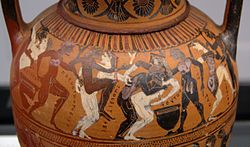
The kōmos (Ancient Greek: κῶμος; pl.: kōmoi) was a ritualistic drunken procession performed by revelers in ancient Greece, whose participants were known as kōmasts (κωμασταί, kōmastaí). Its precise nature has been difficult to reconstruct from the diverse literary sources and evidence derived from vase painting.
The earliest reference to the kōmos is in Hesiod's Shield of Herakles, which indicates it took place as part of wedding festivities (line 281). And famously Alcibiades gate-crashes the Symposium while carousing in a kōmos. However, no one kind of event is associated with the kōmos: Pindar describes them taking place at the city festivals (Pythian 5.21, 8.20, Olympian 4.9), while Demosthenes mentions them taking place after the pompe and choregoi on the first day of the Greater Dionysia (Speeches 21.10), which may indicate the kōmos might have been a competitive event.
The kōmos must be distinguished from the pompe, or ritual procession, and the chorus, both of which were scripted. The kōmos lacked a chorus leader, script, or rehearsal.[1] In the performance of Greek victory odes (epinikia) at post-Game celebrations for winning athletes, the choral singers often present themselves as kōmasts, or extend an invitation to join the kōmos, as if the formal song were a preliminary to spontaneous revelry.[2] Nevertheless, some kōmoi were expressly described as "semnoí" ("modest", "decent"), which implies that standard kōmoi were anything but.
Demosthenes upbraids the brother-in-law of Aeschines for not wearing a mask during the komos, as was the custom (On the Embassy 19.287),[3] suggesting costume or disguise may have been involved. The playing of music during the kōmos is also mentioned by Aristophanes (Thesmophoriazusae 104, 988) and Pindar (Olympian 4.9, Pythian 5.22). There are also depictions of torch-lit processions in vase painting, yet it is not always clear from the evidence of vases if they depict symposia, choruses or kōmoi.
It is now widely thought that kōmos and κωμῳδία – komoidia, "comedy", are etymologically related, the derivation being komos + ᾠδή - o(i)de, "song" (from ἀείδω – aeido, "sing"). However, in part III of the Poetics, Aristotle records the tradition that the word kōmoedia derives from the Megaran mime that took place in the villages of Sicily, hence from κώμη – kōme (the Dorian word for village[4]). Nevertheless, it remains unclear exactly how the revel-song developed into the Greek Old comedy of the Dionysian festival in the 6th century BC.
See also
[edit]Notes
[edit]
- ^ Rothwell, p8
- ^ Goldhill, Simon (1991). The Poet's Voice: Essays on Poetics and Greek Literature. Cambridge University Press. p. 135. ISBN 978-0-521-39570-0.
- ^ Rothwell maintains there is some ambiguity to this, see note 7 p.214
- ^ The SOED cites both etymologies.
References
[edit]- Kenneth S. Rothwell Jr. ‘’Nature, Culture and the Origins of Greek Comedy: A Study of Animal Choruses’’. CUP 2006.

Komos
View on GrokipediaEtymology and Terminology
Linguistic Origins
The term komos (κῶμος) in ancient Greek denotes a revel or band of revelers, with its etymology remaining uncertain among scholars. One hypothesis traces it back to the Proto-Indo-European root ḱems-, meaning "to announce" or "to proclaim," via an intermediate form ḱómso-. This derivation suggests an original connotation of a proclaimed or heralded gathering, evolving in Greek to signify an organized procession of merrymakers, possibly reflecting a structured social announcement of festivity. Other suggestions include a Pre-Greek substrate origin. The word's earliest attestations appear in the Homeric epics, where it is used metaphorically to describe groups in motion. This usage implies an early association with orderly collective movement, bridging martial and celebratory contexts in epic poetry.[5] Related terms include the verb komazein (κομάζειν), meaning "to revel" or "to carouse," which derives directly from komos and appears in classical literature to describe participatory revelry. Additionally, kōmē (κώμη), denoting a village or rural settlement, shares phonetic and semantic proximity, potentially linking komos to localized communal festivals in early Greek society, though direct etymological ties remain debated.[6] Phonetic variations of komos occur across ancient Greek dialects, with the Attic form consistently rendered as κῶμος, featuring a long omega (ω) for the stem vowel. In Ionic dialect, as preserved in Homeric and Herodotus, it appears similarly but may exhibit smoother aspiration or vowel lengthening in epic verse, reflecting the dialect's influence on early literary Greek.[7]Core Definitions and Variations
In ancient Greek culture, the komos (κῶμος) primarily denoted a nocturnal procession of intoxicated revelers, known as komasts (κωμαστής), who moved through city streets singing, dancing, and engaging in boisterous behavior as a form of ritual celebration often linked to Dionysian rites.[1] This mobile event typically followed indoor gatherings and emphasized communal joy, phallic symbolism, and temporary inversion of social norms, occurring in contexts such as festivals or private festivities.[8] Participants carried torches, cups, and instruments, creating a noisy, performative spectacle that blurred lines between ritual and social excess.[9] The term exhibited variations in usage across texts, sometimes referring to the procession or the band of revelers themselves, and at other times to the specific songs or odes (komastic lyrics) sung during the event.[9] In poetry, for instance, Anacreon's fragments portray the komos as a genre of revel song, often composed in ithyphallic meter to evoke rhythmic, phallic dancing and erotic themes, as seen in fragment 78 D. (PMG 431).[1] Similarly, Theognis' elegies describe the komos as an extension of sympotic gatherings, capturing its vibrant, disruptive energy in lines 501–512, where it appears as a lively intrusion of collective festivity into private spaces.[8] These nuances highlight the komos as both a physical act and a poetic motif celebrating uninhibited camaraderie. Distinct from related concepts, the komos contrasted with the symposion, an intimate, stationary drinking party held indoors among aristocratic males, which often preceded but did not encompass the outdoor procession's public mobility and clamor.[8] It also differed from the thiasos, a more formalized Dionysian parade or worship cohort involving ecstatic dance and divine entourage, whereas the komos prioritized informal, street-based revelry and mockery among peers.[1] Some scholars suggest possible shared roots with koinos ("common"), emphasizing the communal nature of the komos in fostering group bonds through shared transgression.[9]The Ritual Practice
Structure and Participants
The komos ritual in ancient Greece typically began as a transition from the symposion, a structured indoor drinking party where participants reclined on couches and consumed wine in measured rounds, evolving into a boisterous outdoor procession once the formal symposium concluded.[1] This shift marked a release of inhibitions, with the group—known as komasts—spilling into the streets in a mobile, celebratory formation that included elements like phallophoria (carrying phalluses) and sometimes a preceding sacrifice.[1] The sequence often featured a pompe (procession) accompanied by torch-bearing to illuminate the path, flute-playing on the aulos for rhythmic support, and the performance of improvised phallic songs in ithyphallic meter.[1][4] Participants in the komos were primarily adult males, often the same young aristocratic symposiasts who had gathered indoors, forming a choral group that embodied communal revelry sacred to Dionysus.[1][10] Key roles included the exarchos, or lead singer, who directed the chorus and initiated songs, while others acted as phallophoroi (phallus-bearers) or ithyphalloi, carrying prominent erect phalluses as symbols of fertility and mockery.[1][10] Women were generally excluded, though the performances drew on traditions like those in Sappho's choral songs adapted for male groups.[10] The chorus as a whole sang and danced collectively, often adorned with garlands to evoke Dionysian imagery.[1] Central activities during the komos involved rhythmic dancing in phallic or circular formations (such as the kyklioi choros), which emphasized group cohesion and sexual symbolism, alongside verbal exchanges like aiskhrologia (obscene ridicule) directed at passersby or households.[1] Komasts might issue challenges, perform mock assaults, or deliver serenades at doors, blending humor, provocation, and tôthasmos (audience mocking) to heighten the festive chaos.[1] These elements created a dynamic, interactive procession that invoked ritual communion through wine, song, and movement.[10] The komos generally occurred post-dusk, extending into the night with torchlight guiding the revelers, and could last several hours depending on the group's energy and destination.[4] In scale, it varied from intimate groups of symposiasts continuing their private celebration to larger public processions during festivals like the Dionysia, involving choruses from the broader polis.[1]Social and Ceremonial Context
The komos was primarily associated with Dionysian festivals in ancient Greece, particularly the Anthesteria on its first day, the Pithoigia, when new wine was released from storage jars in honor of Dionysus, and the City Dionysia, where processional elements preceded theatrical competitions and sacrifices to the god.[1] These rituals framed the komos as a ceremonial opening to communal worship, blending libation and revelry to invoke divine favor for the vintage and civic harmony.[1] Socially, the komos reinforced male bonds through collective participation in song, dance, and procession, fostering group identity amid ritualized excess that temporarily inverted everyday norms via licensed transgression (hybris) and verbal abuse (aiskhrologia).[1] This carnivalesque inversion served ceremonial purposes, such as marking seasonal transitions and communal purification, while phallic symbols carried in processions invoked fertility and agricultural abundance under Dionysus's patronage.[1][11] Ceremonial variations distinguished rural komoi, held during the Rural Dionysia in winter demes outside Athens with localized processions emphasizing agricultural themes, from urban ones in the City Dionysia, which integrated elite symposia spilling into public parades before theater.[1][11] Rural forms often featured improvised phallic songs by ithyphalloi choruses in animal disguises, while urban komoi linked sympotic drinking parties to grander civic displays.[1] Gender dynamics in the komos were exclusively male, with participants—typically adult citizens—forming choruses that embodied phallic potency and virility, excluding women from the core rite.[1] Women, such as maenads, engaged in parallel but separate Dionysian processions, maintaining ritual segregation while complementing the male-focused fertility invocations.[1]Representations in Art and Iconography
Vase Painting Evidence
Depictions of the komos in Attic vase painting, primarily in black-figure and red-figure techniques, provide the most extensive visual evidence for this Dionysian revelry, capturing its exuberant and often chaotic nature. Komasts—male revelers typically shown as youths or bearded men—are frequently portrayed nude or wearing short tunics, emphasizing their uninhibited state. Common motifs include figures holding skyphoi (deep drinking cups), lyres, or auloi (double flutes), with scenes illustrating stumbling, dancing, or embracing, which convey the drunken procession's disorderly progression through streets after a symposium. These elements appear across various vase shapes, such as amphorae, kraters, and kylikes, highlighting the komos as a social and ritualistic extension of sympotic drinking.[12][13] The chronology of these representations peaks during the 6th and 5th centuries BCE, aligning with the Archaic to Classical transition in Greek art, where black-figure styles give way to the more detailed red-figure technique, allowing for nuanced expressions of movement and emotion in revelry scenes. Early black-figure examples from the late 6th century often feature padded dancers in stylized, silhouetted forms, evolving into the more naturalistic red-figure portrayals of the early 5th century that depict individualized figures and dynamic interactions. This shift reflects broader cultural changes in portraying Dionysian excess, from ritualistic formality to vivid social commentary.[14][15] Key examples illustrate these motifs vividly. An Attic red-figure neck-amphora attributed to the Berlin Painter (ca. 480–470 BCE), now in the Archäologisches Museum Frankfurt (inv. β 409), shows a youth playing a lyre alongside a wreathed old man in a komos procession, capturing the musical and generational aspects of the revel with elegant linearity typical of the artist's style. Similarly, a red-figure kylix by the Brygos Painter (ca. 490 BCE), in the Museo Archeologico Nazionale, Florence (inv. 3921), depicts a bearded komast with a stick alongside a female aulos-player in an intimate revel scene suggestive of serenading, emphasizing the erotic undertones through detailed figures and reserved red backgrounds. Such vases underscore the komos as a nocturnal, music-driven procession.[16][17] Symbolic elements in these paintings further highlight the komos's ties to fertility and Dionysian chaos, with phalloi often carried upright by komasts as prominent attributes. These oversized, erect symbols, sometimes attached to poles or worn as costumes, appear in both black- and red-figure scenes from the 6th to 5th centuries BCE, serving apotropaic and celebratory functions linked to agricultural abundance and ritual inversion of norms. For instance, phallic processions in komos contexts evoke the god's ecstatic worship, blending revelry with sacred disorder.[18][19]Sculpture and Other Forms
Representations of the komos appear in various sculptural media beyond vase painting, including terracotta figurines and reliefs that capture the revelry's dynamic energy. In Archaic Corinth, coroplasts produced terracotta figurines of komasts, often depicted as obese, padded dancers in lively, drunken poses, emphasizing the ritual's festive and exaggerated physicality.[20] These small-scale sculptures, typically molded and painted, reflect the komos's role in Dionysiac celebrations, with figures shown staggering or dancing in groups, their forms highlighting the participants' inebriated abandon. Examples from the Isthmian sanctuary near Corinth illustrate this tradition, where the figurines served as votive offerings or decorative items in sanctuaries.[20] Reliefs on grave stelai from Classical Athens sometimes feature banquet scenes transitioning to komastic elements, such as figures rising with lyres or flutes, symbolizing the deceased's participation in eternal festivity, though these are rarer and more restrained than free-standing sculptures.[21] In Roman-era adaptations, mosaics from Greco-Roman sites like Antioch preserve komos-like scenes through Dionysiac imagery. The 2nd–4th century CE floor mosaics from Antioch's affluent villas depict satyrs and maenads in procession, dancing with thyrsos and tambourines, evoking the komos's chaotic joy amid vine motifs and wine imagery.[22] A notable example is the mosaic of a dancing satyr and maenad, where the satyr's exuberant pose mirrors the drunken komast, set against a backdrop of revelry that underscores the theme's endurance into late antiquity. Minor arts, such as engraved gems and metalwork, further document komasts in compact processions. Intaglio gems from the Hellenistic period show komasts marching with torches or aulos players, carved in chalcedony or jasper to serve as seals or amulets.[23] Bronze and silver metalwork, including fibulae and mirrors from Etruscan-influenced contexts, feature etched or embossed komasts in linear processions, highlighting the motif's portability across media.[24] Over time, komos representations evolved from the energetic, caricatured carvings of the Archaic period—focused on communal exuberance—to the more introspective and elegant interpretations in Hellenistic and Roman works, where individual emotion and narrative depth tempered the raw vitality.[1] This shift mirrors broader artistic trends toward realism and psychological nuance, while maintaining the komos's core association with Dionysiac liberation.Links to Theater and Comedy
Evolution into Comic Performances
The komos, as a ritualistic procession of revelers involving song and dance during Dionysian festivals, served as a direct precursor to the choral elements in ancient Greek comedy. Aristotle attributes the origins of comedy to the leaders of phallic komoi, improvised performances featuring humorous and satirical songs that were integral to Dionysian celebrations in many Greek cities.[25] These processions, characterized by their boisterous and often obscene nature, provided the foundational structure for comic choruses, where participants would mock individuals and societal norms under the guise of festivity.[1] In the 6th century BCE, komoi were prominent features of rural Dionysia festivals, particularly in Attica, where local choruses performed phallic songs and processions to honor Dionysus, fostering a tradition of communal satire and revelry. By the early 5th century BCE, as theatrical competitions formalized at the urban City Dionysia in Athens around 486 BCE, these ritual elements evolved into structured comic performances, with poets like Cratinus and Eupolis adapting the komos into dramatic choruses that integrated narrative plots. This transition marked comedy's shift from spontaneous rural rites to a professional art form, where the chorus retained the mobile, interactive quality of the original komos. Aristophanes' plays exemplify this evolution, with scenes mimicking komos processions to evoke the ritual's spirit within theatrical contexts. In Acharnians (425 BCE), the protagonist Dikaiopolis leads a phallic procession with songs and dances that parody festival rituals, directly echoing the komos while advancing the comic plot through satirical commentary on war and peace. Such integrations highlight how Old Comedy preserved the procession's exuberant, audience-engaging energy, transforming it into a vehicle for political and social critique.[1] Structurally, the komos influenced the development of the parabasis in comedy, where the chorus breaks the fourth wall to address the audience directly, akin to the interactive addresses in ritual processions. This parallels the exit processions (exodos) in tragedy, but in comedy, it amplified the komos-derived elements of direct mockery and communal participation, allowing the chorus to step forward in a formalized yet riotous manner. The persistence of these features underscores the komos's role in bridging ritual and theater, ensuring comedy's roots in Dionysian revelry remained evident even as the genre matured.[26]Phallic Song Traditions
Phallic songs formed a central musical element of the komos, typically structured as scolia—short, convivial drinking songs—featuring repetitive phallic refrains that invoked Dionysus to promote fertility and abundance.[1] These refrains often celebrated the phallus as a symbol of vitality, with examples preserved in ancient fragments such as PMG 851a ("Come on, up, make plenty of room for the god!") and PMG 851b ("For you, Bakkhos, we give this shining musical presentation"), where the god is entreated for bountiful harvests and communal joy.[1] In oratorical evidence, Demosthenes quotes komastic hymns from groups like the Ithyphalloi, Autolekythoi, and Triballoi in his speech Against Konon (54.16–17), illustrating their obscene, rhythmic content during nocturnal processions.[1] The performance style emphasized interactive choral dynamics, with an exarchos (song leader) initiating verses in a call-and-response format, to which the chorus replied in unison, amplifying the ritual's energy.[1] These songs frequently incorporated aiskhrologia (ritual obscenity) and tôthasmos (mockery), delivering satirical jabs at bystanders or social norms, as noted in Athenaeus (622d), where revelers ridiculed passersby to heighten the festive inversion.[1] This participatory structure, often accompanied by flute or lyre, transformed the komos into a mobile, ecstatic enactment blending song, dance, and phallic display. Ritually, these songs served to invoke agricultural prosperity and communal catharsis, channeling Dionysiac excess to avert misfortune and ensure fertility through the symbolic power of the phallus.[1] By inverting everyday decorum via explicit lyrics and behaviors, participants achieved a collective release, reinforcing social bonds and seasonal renewal during festivals like the Anthesteria or rural Dionysia.[1] Such phallic song traditions are parodied in comedic adaptations, such as Aristophanes' Acharnians (241–279), where phallic hymns parody ritual origins.[1]Mythological Aspects
Personification as a Deity
In Greek mythology, Komos is personified as a minor deity overseeing nocturnal revelry and embodying the exuberant spirit of the komos ritual, a festive procession associated with Dionysian celebrations. Often identified with the Roman god Comus, he symbolizes merrymaking, festivity, and the chaotic joy of communal indulgence, distinguishing himself as a figure of human excess rather than the more bestial nature of satyrs.[4] Komos is primarily regarded as the son of Dionysus, serving as his cup-bearer in divine retinue, a role that underscores his close association with wine-fueled ecstasy. In later traditions, such as those reflected in John Milton's 17th-century masque Comus, he is alternatively depicted as the offspring of Dionysus and the sorceress Circe, blending themes of enchantment and revelry.[4] Classical literature provides sparse but evocative mentions of Komos, notably in Nonnus' Dionysiaca (5th century CE), where he appears amid a triumphant divine procession following Zeus's victory over Typhon; here, Ares is transformed into Komos, joining Nike in a scene of victorious festivity that highlights his role in celestial merrymaking. Unlike the hybrid, woodland satyrs who represent primal instincts, Komos is portrayed in more anthropomorphic terms, often as a winged youth, emphasizing civilized yet unrestrained human carousing over animalistic urges.[27][4]Attributes and Associations
Komos is typically depicted in ancient art as a winged youth embodying intoxication, often shown reclining languidly on the ground with a torch in hand, his head sunk in drunken repose.[4] This imagery, drawn from descriptions in Philostratus the Elder's Imagines (1.2, 3rd century CE), emphasizes his association with nocturnal revelry, sometimes portraying him crowned with roses to symbolize the excesses of wine-fueled merriment.[4] He occasionally appears as a satyr-like figure with asses' ears, further linking him to the wild, transformative aspects of Dionysian ecstasy.[4] As a divine companion, Komos served as the son and cup-bearer to Dionysus, the god of wine, participating in his ecstatic processions alongside satyrs, bacchantes, and silens.[4] He was closely linked to Gelos, the personification of laughter, with whom he was sometimes equated in Dionysus' retinue, highlighting the joyous, uproarious nature of his domain.[4] In one brief account, he is identified as the offspring of Dionysus, reinforcing his integral place within the god's divine family.[4] In Roman tradition, Komos found a counterpart in Comus, a figure of licentious revelry who inspired John Milton's 1634 masque Comus, where he appears as an enchanter tempting virtue with sensual pleasures, directly deriving from the Greek god of festivity.[28] This portrayal adapts Komos' ancient attributes to allegorize the dangers of excess, positioning Comus as the son of Bacchus (Dionysus) and Circe.[28] Komos lacked dedicated temples or major shrines, instead being honored through Dionysus' rites of wine-drinking and communal feasting.[4]Historical and Cultural Significance
Role in Ancient Greek Society
The komos played a significant role in reinforcing homosocial bonds among elite males in ancient Greek society, particularly through its association with sympotic gatherings that emphasized camaraderie and shared revelry. In Plato's Symposium, after an evening of drinking and philosophical discourse, Socrates and Aristodemus depart at dawn for the Lyceum, illustrating the extension of sympotic fellowship into public space.[29] This practice, often involving aristocratic youth groups known as ithyphalloi, cultivated ties of loyalty and initiation among peers, serving as a mechanism for social cohesion within the upper classes.[1] In civic life, the komos integrated into democratic festivals during Athens' Golden Age in the 5th century BCE, where it promoted a sense of equality through collective indulgence and excess, temporarily blurring status distinctions in public celebrations like the Dionysia. These processions, featuring choral songs and dances, functioned as communal offerings that reinforced civic unity and fertility rites, allowing participants from various strata to engage in sanctioned disorder as a form of social release.[1] However, the komos also carried risks of violence and disruption, as rowdy groups occasionally engaged in assaults or property damage, prompting legal responses to such disruptions, including hubris charges for drunken assaults by elite groups.[1] Class variations were evident, with elite komoi often more organized and performative among youth, while lower-class versions were less ritualized but still participatory in festivals.[1] The komos further entrenched patriarchal structures by largely excluding women from participation, confining them to parallel, segregated rituals that highlighted gender divisions in civic and social spheres. Male-dominated processions reinforced exclusivity, with women barred from these public male displays, in contrast to female-only festivals like the Thesmophoria, where women conducted their own secretive gatherings focused on fertility and domestic concerns.[1] This separation underscored the komos's role in upholding male authority and homosocial networks, limiting women's agency to private or ritualized contexts.[30]Modern Interpretations and Legacy
In the late 19th and early 20th centuries, scholars like Jane Ellen Harrison interpreted the komos as a key element in the ritual substratum of Greek religion, linking it to fertility rites through its Dionysian associations with communal ecstasy and renewal. In her Prolegomena to the Study of Greek Religion (1903), Harrison described the komos as emerging from primitive processional rites that invoked agricultural abundance and purification, viewing it as a vestige of pre-Olympian fertility cults where revelry symbolized the earth's regenerative forces. This perspective influenced the Cambridge Ritualists, emphasizing the komos's role in transitioning from agrarian magic to formalized worship. Later, anthropologist Victor Turner's theory of liminality, developed in works like The Ritual Process (1969), has been applied to the komos's inversive qualities, portraying it as a "betwixt and between" phase where social hierarchies dissolve into egalitarian communitas during nocturnal processions, fostering temporary anti-structure amid Dionysian excess.[31][1] The komos's legacy extends to Renaissance and modern cultural forms, inspiring adaptations that blend revelry with moral allegory. John Milton's masque Comus (1634) draws directly from the ancient komos tradition, reimagining the Greek revel as a seductive, Bacchic figure embodying intemperance and societal corruption, thereby critiquing aristocratic festivities through a Christian lens while echoing Plato's sympotic descriptions. This influence persists in contemporary carnival traditions, where Dionysian komoi are seen as precursors to carnivalesque inversions of norms, featuring masks, processions, and licensed transgression to affirm communal bonds before Lenten restraint, as evident in Greek Apokries celebrations.[32] Recent archaeological work, such as the 2011 analysis of Late Archaic pottery from a house near the Athenian Agora, has revealed komast imagery on cups used in private sympotic contexts, underscoring the role of such imagery in domestic social practices.[33] Scholarly debates continue to center on the komos's dual nature as erotic spectacle versus instrument of social cohesion, with feminist critiques underscoring its gender exclusions. While phallic processions and ithyphallic songs emphasized male bonding and fertility, they often marginalized women to roles as entertainers or objects of pursuit, reinforcing patriarchal structures in sympotic culture.[1] Feminist scholars argue that this exclusion perpetuated women's subordination, as komoi reinforced homosocial networks that limited female agency beyond domestic spheres, prompting reevaluations of Dionysian rituals as sites of gendered power dynamics rather than universal liberation.[34][35]References
- https://commons.wikimedia.org/wiki/File:Berlin_Painter_-_ARV_202_82_-_youth_with_lyra_and_old_man_at_the_komos_-_Frankfurt_AM_%CE%B2_409_-_04.jpg
- https://commons.wikimedia.org/wiki/File:Brygos_Painter_-_ARV_372_31_-_komast_and_female_flute-player_-_love-making_-_Firenze_MAN_3921_-_04.jpg