Hubbry Logo
LDS Conference CenterLDS Conference CenterMain
Open search
LDS Conference Center
Community hub
LDS Conference Center
logo
8 pages, 0 posts
0 subscribers
Be the first to start a discussion here.
LDS Conference Center
from Wikipedia

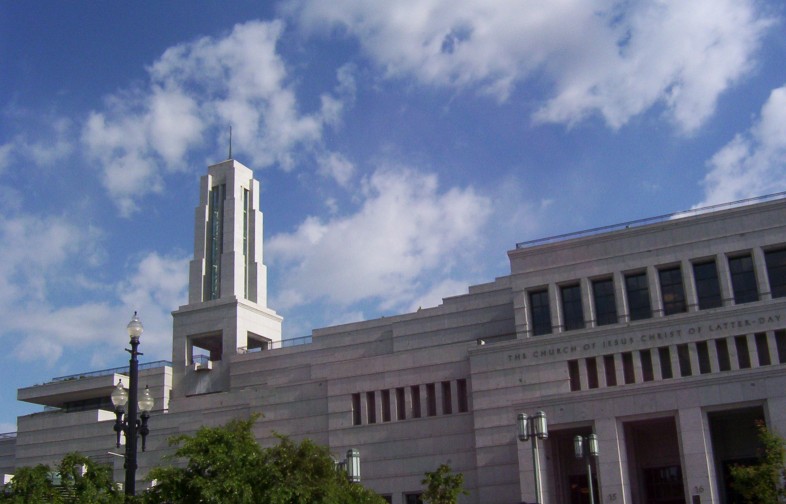
View of Conference Center spire taken from the south, from North Temple St., Salt Lake City, Utah.

Key Information

The Conference Center, in Salt Lake City, Utah, is the premier meeting hall for the Church of Jesus Christ of Latter-day Saints (LDS Church). Completed in 2000, the 21,000-seat Conference Center replaced the traditional use of the nearby Salt Lake Tabernacle, built in 1868, for the church's twice-yearly general conference and other major gatherings, devotionals, and events.[4][5]

Features

[edit]

The 1,400,000-square-foot (130,000 m2) Conference Center seats 21,200 people in its main auditorium. This includes the rostrum behind the pulpit facing the audience, which provides seating at general conference for general authorities and general officers of the church and the 360-voice Tabernacle Choir at Temple Square. The auditorium is large enough to hold a Boeing 747 in the space between the seats and the rear of the stage.[4] All seats in the audience have an unobstructed view of the pulpit because the roof is held up by radial trusses.[6] The balcony is supported by a series of 34 cantilevers.[6] This construction method allows the balcony to sink 58 inch (16 mm) under full capacity. Behind the podium is a 7,708-pipe and 130-rank Schoenstein pipe organ. Underground is a parking garage that can hold 1,400 cars. A modernist, three-story chandelier hangs in a skylight in the interior of the building. A waterfall descends from the spire. City Creek flows in a rough-hewn riverbed, complementing the Conference Center.

On the third floor of the Conference Center there are busts of current and past church presidents and photographs of church leaders; photographs of female church leaders were added in 2014.[7]

Because the building sits near the base of Salt Lake City's Capitol Hill, the roof is landscaped for attractiveness, an extension of the Gardens at Temple Square. About 3 acres (12,000 m2) of grass and hundreds of trees have been planted on the roof. Twenty-one native grasses were employed to conserve water and showcase local foliage. The rooftop garden includes a central garden of rectangular planters of aspen and conifers with long runnels and basins of water.[8] The landscaping is meant to echo the mountains and meadows of Utah.

Conference Center Theater

[edit]
The Conference Center Theater

Attached to the main building on the northwest corner is the 900-seat Conference Center Theater that can be used as a dedicated theater or as an overflow room.[9]

Planning and construction

[edit]

Plans "for construction at some indefinite date of a 30,000-seat auditorium of the block north of Temple Square" were first announced at the October 1951 General Conference by church president David O. McKay as part of his worldwide building effort.[10][11] The designs were solicited by church architect Leland A. Gray in the early 1990s, in conjunction with Gordon B. Hinckley who then became church president in 1995.[12] The LDS Church originally sought a 26,000-seat building no more than 75 feet (23 m) high in accord with zoning regulations for the church-owned 10 acres (40,000 m2) block immediately north of Temple Square.

Hinckley publicly announced the project in the April 1996 general conference. The final plans, completed in late 1996, featured 21,200 seats in the main hall, with 905 in the side theater. The design of the Conference Center was accomplished by Portland, Oregon-based Zimmer Gunsul Frasca Partnership.[13] Auerbach & Associates of San Francisco was responsible for theater design and architectural lighting.[14]

Contracting for the building was done by Jacobsen, Layton, and Oakland—three Salt Lake City construction firms.[15] The three companies submitted a joint bid in order to compete with national firms. The companies jointly operated under the name "Legacy Constructors" after winning the contract in late 1996.

Demolition of existing LDS Church properties on the site began May 1997. Deseret Gym—a YMCA-like gymnasium—and the Mormon Handicraft store had to be razed for the project.

Ground was broken July 24, 1997. This date coincided with the 150th anniversary of Mormon pioneers entering the Salt Lake Valley, an event celebrated in Utah as Pioneer Day.

Little Cottonwood Canyon controversy

[edit]
Conference Center from its southwest corner

Although the Conference Center is a modern steel truss and rebar-based design without need for masonry support, the LDS Church sought slabs of quartz monzonite, a form of granite, to clad all exterior walls. Specifically, the church wanted granite to match rock quarried more than a hundred years earlier to build the adjacent Salt Lake Temple. Therefore, the church requested a permit to quarry granite from Little Cottonwood Canyon southeast of Salt Lake City. The Salt Lake County Commission granted a two-year permit on condition that extraction not interfere with the ski season. Critics of the extraction argued that the quarry harmed the environment and burdened residents while endangering drivers through Little Cottonwood Canyon below.

Quarrying began May 28, 1998. The quarry location was further up the canyon from where stone was extracted for the Salt Lake Temple.[16] Although court filings challenged the legality of extracting the granite (specifically attacking Salt Lake County's authority to issue permit), the project was interrupted only by winter weather. The church finished quarrying by November 1999. Over 300,000 square feet (28,000 m2) of granite was extracted. The granite was quarried by Idaho Travertine (now Yellowstone Rock) and subsequently cut into slabs at their Idaho Falls Facility for use as the facade of the building. There was not enough granite extracted from the Little Cottonwood Canyon quarry for the entire project, so extra granite was brought in from the mid-west and used for the flooring.

The green roof of the Conference Center

Completion

[edit]

The Salt Lake City Tornado hindered construction on August 11, 1999. Construction cranes toppled at the work site, and four injuries to crew were reported.

Construction was complete enough for the building to be used for the 170th annual general conference on April 1 and 2, 2000. The pipe organ was not yet operational, so the Mormon Tabernacle Choir was accompanied by an electric organ amplified through the center's speaker system. Hinckley remarked in his opening address that over 370,000 people had inquired about tickets for the center's inaugural general conference. He also related that a black walnut tree that he had planted decades earlier in his backyard provided wood for the pulpit of the new center.

The Conference Center was completed later in the year and formally dedicated on October 8, during the 170th semiannual general conference. As part of the event, the dedicatory prayer was followed by a "hosanna shout"—a show of gratitude that dates to the early days of the Latter Day Saint movement. The shout involves participants waving white handkerchiefs while repeating "Hosanna, hosanna, hosanna, to God and the Lamb" three times. Though it had been used in public before, such as during the capstone ceremony for the Salt Lake Temple and at the church centennial celebration in 1930, before this public broadcast of the hosanna shout, some assumed it was exclusively related to temple dedications, which are not accessible to non-Latter-day Saints. The Conference Center dedication demonstrated that the hosanna shout, although considered sacred by the Latter-day Saints, is not necessarily used exclusively in temple-related settings.

Schoenstein Organ at the Conference Center

[edit]

This organ is internationally significant, both because of its role in accompanying choirs in conferences, and also in that it is one of only a few organs in the world that has registers of pipes extending down into the 64' series, the 64' Contra Trombone and 64' Contra Gamba, which both extend 4 pipes down to GGGGG#, 13 semitones below the lowest note on a standard piano. The tallest pipe used to produce this note is approximately 40 feet (5 stories) tall. This organ also has many other unique features, including full-compass manual 32' reed and flute registers, double expression, and many heroic voices on high pressure. High pressures are used throughout the organ due to the monumental amount of sound needed to project out into an auditorium of this size.[citation needed]

See also

[edit]

References

[edit]

Further reading

[edit]
[edit]
Revisions and contributorsEdit on WikipediaRead on Wikipedia
from Grokipedia
The Conference Center is a multipurpose facility owned and operated by The Church of Jesus Christ of Latter-day Saints, located at 60 North Temple in , , immediately north of the within . Completed in 2000 after construction began in 1997, it primarily hosts the church's semiannual general conferences in April and October, which are worldwide broadcasts featuring addresses from church leaders. The center's main auditorium seats 21,000 people, making it one of the largest dedicated assembly halls for religious gatherings, and it replaced the adjacent —built in 1867—for these events due to growing attendance needs. Spanning 1.4 million square feet across one city block, the structure incorporates granite quarried from the same deposits as the and features column-free multilevel balconies for unobstructed views. Notable elements include a Schoenstein with over 7,000 pipes, an 850-seat theater for performances such as , and a rooftop garden offering terrace views of the temple and valley. Dedicated by church president , the facility also functions as a primary visitor arrival point for , providing free public tours and accommodating diverse events while emphasizing acoustic excellence and structural durability.

History

Planning and Announcement

In the early 1990s, leaders of The Church of Jesus Christ of Latter-day Saints identified the Salt Lake Tabernacle's seating capacity of approximately 6,500 as inadequate for general conference attendance, as swelling crowds—driven by rapid global church growth from under 5 million members in 1980 to over 10 million by 2000—regularly exceeded available space, leaving thousands unable to participate in person despite high demand for these semiannual gatherings. On April 6, 1996, during the opening session of the church's April general conference, President formally announced plans for a new multipurpose facility to seat more than 20,000, explicitly stating it would be constructed without debt using funds from members' contributions, reflecting the church's longstanding policy of in major building projects. Hinckley highlighted the Tabernacle's acoustic limitations and spatial constraints while underscoring the need for a venue that maintained spiritual symbolism amid modern functionality. The project site was selected on the block north of along North Temple Street in , prioritizing adjacency to the church's historic core for logistical efficiency, visitor access, and alignment with doctrines emphasizing centralized gatherings in a consecrated area. This location leveraged existing infrastructure while avoiding urban expansion, with preliminary land assembly involving church-owned properties dating back to earlier acquisitions.

Construction Process

Groundbreaking for the LDS Conference Center occurred on July 24, 1997, coinciding with the 150th anniversary of the arrival of Latter-day Saint pioneers in the . Construction proceeded under the oversight of The Church of Jesus Christ of Latter-day Saints, utilizing a of three local firms—Zimmer, Gunnell, and Frasca—to manage the project, enabling substantial completion by April 1, 2000, in under three years despite the facility's scale. This rapid timeline was facilitated by coordinated scheduling and on-site efficiency, with minimal reported disruptions to traffic, as work focused on a full city block north of . The project demanded approximately 116,000 cubic yards of , equivalent to filling a football field two stories deep, to form the 1.4-million-square-foot structure, including its innovative column-free main spanning vast unobstructed sightlines. addressed seismic risks in the zone through extensive use of structural lightweight to reduce dead loads and enhance resilience, supporting loads up to 525 pounds per square foot on the roof while accommodating the column-free spans. At peak activity, nearly 1,000 workers were on site daily, coordinating pours, framing with and trusses exceeding 1,170 tons, and excavation of 750,000 cubic yards of earth. Total costs were reported at approximately $240 million, funded entirely from church reserves without external subsidies or , reflecting disciplined internal . Logistics for materials emphasized local sourcing where feasible, with mixes optimized for the project's demands, though specific supply chains were not publicly detailed beyond the aggregate volumes.

Completion and Dedication

The Conference Center achieved substantial completion in early 2000, enabling the installation of its 21,000 fixed seats, organ assembly, and acoustic testing to ensure optimal sound distribution throughout the vast auditorium. These final preparations transitioned the structure from construction to operational status, with systems rigorously tested for the demands of large-scale assemblies. The building hosted its first event during the 170th Annual General Conference of The Church of Jesus Christ of Latter-day Saints on April 1–2, 2000, accommodating overflow attendance beyond the capacity of the adjacent while demonstrating the venue's readiness for worship and address delivery. Formal dedication occurred on October 8, 2000, during the Sunday morning session of the 170th Semiannual General Conference, conducted by Church President , who prayed over the facility and highlighted its capacity to support doctrinal instruction amid the Church's expansion to 11,068,861 members worldwide as of December 31, 2000. Integrated broadcast infrastructure facilitated simultaneous worldwide dissemination, including high-definition digital signals for HDTV via and early feeds on Church websites, reaching millions in real time and marking a technological advancement in global access.

Architectural Design and Features

Main Auditorium

The main serves as the primary assembly space within the LDS Conference Center, accommodating 21,000 fixed seats arranged in a tiered configuration that ensures unobstructed sightlines to the central from every position. This design eliminates interior support columns through cantilevered balconies supported on one side, optimizing visibility for large-scale gatherings focused on religious oratory and musical performances. Acoustic performance is engineered for versatility, balancing clarity for spoken addresses with suitable for choral and orchestral music via passive elements and an electronic enhancement system. The hall incorporates features like diffusers and resonators to control sound distribution, achieving effective tailored to the venue's dual purposes without excessive echo. Technical infrastructure supports global accessibility, including 58 interpretation booths equipped with monitors and audio controls for real-time translation into multiple languages during events. screens and broadcast capabilities further enable simultaneous viewing and dissemination, aligning with the facility's role in church-wide communications independent of external production dependencies.

Schoenstein Organ

The Schoenstein organ in the LDS Conference Center was commissioned from Schoenstein & Co. of and constructed between 2000 and 2003, featuring 130 ranks and 7,708 pipes distributed across seven divisions controlled by a five-manual console. Its design adheres to the American Romantic style, emphasizing symphonic versatility through a broad palette of tonal colors, including reed and string stops scaled for dynamic projection in the 21,000-seat auditorium. The instrument's pipework, including a rare 64-foot Contra Violone rank among its lowest extensions, provides a pedal range extending two octaves below that of the adjacent organ, enabling deeper bass fundamentals for accompanying large choral ensembles and orchestras during broadcasts. are positioned in elevated chambers flanking and above the stage to ensure balanced sound dispersion throughout the hall, with the Grand Solo division isolated in a dedicated for independent volume control. , powered by six electric blowers delivering variable wind pressures up to 5.5 inches, facilitates precise registration changes and rapid response, critical for real-time adjustments in live general conference settings. First publicly demonstrated in October 2000 ahead of full completion, the organ integrates with the auditorium's acoustics to produce sustained, enveloping tones without electronic augmentation, underscoring the preference for mechanical pipe organs in LDS traditions. Its commissioning reflects deliberate engineering to surpass electronic alternatives in harmonic richness and spatial immersion, as evidenced by its deployment in biannual conferences since dedication.

Conference Center Theater

The Conference Center Theater is an auxiliary 850-seat venue attached to the northwest corner of the in , , designed primarily for dramatic presentations, musicals, and smaller church-related events. Completed in 2000 alongside the main facility, it provides a more intimate space contrasting the 21,000-seat , enabling focused productions without the scale required for general conferences. Equipped with computer-controlled lighting and sound systems comparable to Broadway theaters, the venue features a stage suitable for theatrical performances, including fly systems for scenery and sets. Its flexible seating arrangement supports diverse event formats, such as devotionals, youth gatherings, and cultural arts productions sponsored by The Church of Jesus Christ of Latter-day Saints. The theater's independent acoustic design allows for simultaneous operations with the main hall, minimizing interference through structural separation and isolation techniques. Notable inaugurating events include the musical drama Savior of the World: His Birth and Resurrection, performed from November 28 to December 30, 2000, which highlighted the space's capabilities for narrative-driven church pageants depicting scriptural themes. Subsequent uses encompass funerals for church leaders, such as that of Sister Patricia T. Holland in 2023, and multimedia presentations like the film Why Temples Matter in 2020, underscoring its role in targeted spiritual and educational programming. During the , select general conference sessions were recorded in the theater to accommodate limited attendance while maintaining broadcast quality. This versatility reflects the church's emphasis on adaptable facilities for generational outreach through performance arts and devotionals.

Additional Facilities and Engineering

The Conference Center includes four acres of rooftop gardens designed as an alpine meadow, featuring over 60 species of native wildflowers and 25 varieties of native grasses to evoke Utah's natural landscapes while providing panoramic views of Temple Square and the Salt Lake Temple. These terraces utilize lightweight expanded shale aggregates for soil, enabling self-sustaining vegetation that requires minimal maintenance and approximately 50 percent less water than conventional landscaping in the region's arid conditions. An underground parking structure provides capacity for 1,300 vehicles, integrated into the building's basement levels to support high-volume attendance without surface disruption in . Engineering resilience was demonstrated during construction when an F2 tornado struck the site on August 11, 1999, toppling a 200-foot crane and scattering materials, but no fatalities occurred at the location owing to swift worker evacuation and site protocols. The incident highlighted the project's adaptive planning, allowing resumption without long-term delays.

Usage and Events

General Conferences

The Conference Center has hosted the semiannual general conferences of The Church of Jesus Christ of Latter-day Saints since April 2000, marking a shift from the adjacent to accommodate larger in-person audiences. The main auditorium's 21,000 seats enable attendance exceeding the Tabernacle's capacity of approximately 6,500, allowing for broader participation among church members during these worldwide leadership meetings. General conferences occur during the first full weekends of and , comprising five two-hour sessions over and , including addresses by the church president, apostles, and other leaders. Admission requires tickets distributed through local church units, with standby lines for overflow seating in adjacent venues when demand exceeds capacity. Following capacity restrictions implemented during the , full seating returned for the 2024 conference, the first unrestricted attendance since 2019. Sessions are broadcast live in over 90 languages to millions of viewers globally via television, radio, , and , extending doctrinal instruction beyond physical attendees. Central to each session are prophetic addresses delivering guidance on , church administration, and moral principles, often accompanied by musical performances from The Tabernacle Choir at Temple Square. The choir, numbering around 360 singers, performs hymns and sacred pieces, supported by the venue's advanced acoustics and the Schoenstein , enhancing the ritualistic and inspirational elements of the proceedings. These elements underscore the conferences' role in unifying the church's approximately 17 million members through shared worship and instruction.

Non-Church Events and Rentals

The Conference Center is reserved primarily for events sponsored by The Church of Jesus Christ of Latter-day Saints, with rentals for non-church purposes unavailable to maintain the venue's dedication to religious functions and doctrinal alignment. Public access occurs via free guided tours and select church-produced performances open to all, such as organ recitals in the main auditorium and broadcasts of , but these do not involve external commercial leasing. Content guidelines prohibit events conflicting with church teachings, ensuring the 21,000-seat facility upholds its sacred role over revenue generation. Limited exceptions include church-affiliated contributions to civic occasions, such as performances by the and Orchestra at during the , where they participated in four concerts with guest artists alongside appearances, drawing public audiences while prioritizing ecclesiastical oversight. Similarly, annual ticketed events like the 's concerts, held in the since the center's opening, generate modest income through sales but remain under church control, with proceeds supporting operations rather than external lessees. These secondary uses complement the center's core programming without taxpayer support, as the privately owned structure—built and maintained by church funds—contributes to City's tourism economy. , encompassing the center, attracts 3 to 5 million visitors yearly, including those attending public church events, fostering economic activity through increased local spending on lodging and services. This model avoids public burden while selectively extending the venue's reach for compatible, non-exclusive gatherings post-2000, such as overflow community viewings of broadcasts, though always subordinate to religious priorities.

Controversies

Little Cottonwood Canyon Granite Quarrying

The Church of Jesus Christ of Latter-day Saints sought granite boulders from its privately owned land at the mouth of for the Conference Center's exterior veneer, proposing to split and transport approximately 12,000 tons without blasting to minimize disturbance. In March 1998, Salt Lake County approved the conditional-use permit after environmental assessments concluded negligible impacts, including limited vegetation removal and no significant erosion or habitat disruption. Environmental activists and local residents opposed the project, arguing it risked watershed contamination, increased truck traffic endangering canyon users, and established a precedent for further extraction in a sensitive alpine area supplying Salt Lake City's water. Church officials rebutted these claims by citing the canyon's history of large-scale quarrying for the Salt Lake Temple from the 1850s to 1890s, which involved extracting millions of tons yet left no verifiable long-term ecological deficits, as evidenced by the site's current status as a preserved historical monument amid intact watershed function. A by opponents to halt operations was dismissed by a state judge in 1998, who ruled that regulatory processes had been adequately followed and environmental protections upheld. The granite was successfully harvested and hauled in multiple truckloads to the site, yielding empirical outcomes that contradicted speculative harm predictions, with no recorded permit violations or measurable adverse effects on or local ecology during or after extraction.

Construction Incidents and Delays

During construction of the Conference Center, the most notable incident occurred on August 11, 1999, when an F2 tornado struck , toppling a 200-foot crane at the site and scattering scaffolding and materials. Of over 1,000 workers on site, only two sustained minor, non-life-threatening injuries, with no fatalities reported from the event. The tornado, a rare occurrence in the region, was deemed an act of unforeseen weather rather than a of site protocols, as the crane was slated for removal prior to the storm but had not yet been dismantled. Cleanup efforts enabled rapid resumption of work, with the site sustaining limited damage to roofing and exterior elements, allowing to proceed without major structural setbacks or regulatory interventions. No OSHA violations or citations directly tied to the incident were documented, and operations aligned with safety standards, facilitating a return to schedule within days. The project's overall safety record remained strong, with no worker deaths or substantial lawsuits recorded across the three-year build from to 2000, outcomes attributable to rigorous private oversight amid a high-risk urban environment. Minor logistical hurdles, such as sourcing specialized components, were managed without extending the timeline or exceeding the , underscoring effective coordination in a complex, custom-engineered endeavor. The absence of protracted delays or escalated incidents contrasts with industry averages for comparable large-scale projects, where weather-related disruptions often compound into cost overruns and heightened hazards.

Legacy and Impact

Operational and Cultural Significance

The Conference Center marked its 25th anniversary on April 1, 2025, having hosted general conferences biannually since its dedication in April 2000, with 1,755 talks delivered in the venue by October 2024. This operational continuity supports the logistical demands of The Church of Jesus Christ of Latter-day Saints' semiannual worldwide gatherings, accommodating up to 21,000 attendees per session in a facility designed for efficient broadcast production. Post-2020 adaptations, including persistent in over 70 languages via Church platforms, have expanded doctrinal dissemination to the Church's 17.5 million members as of December 2024, enabling hybrid participation that mitigates geographic barriers amid sustained membership growth. As a cultural anchor, the Center fosters community cohesion through free guided and self-guided public tours offered daily, emphasizing spiritual edification via exhibits on and doctrine without commercial elements. These initiatives prioritize non-member engagement and member reinforcement of practices, reflecting a commitment to over exclusivity. In-person general conference attendance reached 94,965 across five sessions in April 2025—the highest since pre-pandemic levels—demonstrating the venue's capacity to facilitate broad participation, countering notions of insularity with empirical surges in on-site engagement enabled by its scale. This logistical inclusivity causally aids retention by allowing larger cohorts to experience live proceedings, correlating with stable global adherence patterns in a growing .

Architectural and Economic Contributions

The LDS Conference Center's main assembly hall exemplifies innovative structural engineering through its column-free design, spanning over 175 feet to accommodate 21,000 seats with unobstructed sightlines, a feat achieved using steel trusses and lightweight concrete mixes. This approach addressed the challenge of building atop an existing theater while maximizing openness, setting a precedent for large-scale, pillarless venues that prioritize visibility and capacity without compromising acoustics or aesthetics. The hall, recognized as the world's largest indoor column-free theater upon completion in 2000, demonstrated how advanced materials like expanded shale clay slag (ESCS) enabled lighter, stronger concrete for such expansive spans. Sustainability features further distinguish the , including a recycled water system for landscaping that reduces demand on municipal supplies in water-scarce , aligning with broader efficiency goals akin to modern standards. These elements minimize environmental strain while supporting the building's operational needs, such as irrigating extensive roof gardens and terraces that integrate with Salt Lake City's urban fabric. Economically, the $240 million construction, completed in 2000 and entirely funded by The Church of Jesus Christ of Latter-day Saints through member tithes without taxpayer involvement, stimulated local employment and materials sectors during its three-year build. Ongoing events, particularly the semiannual general conferences, drive significant ; a single weekend can generate up to $20 million in direct out-of-state spending on lodging, dining, and transport, contributing to annual economic activity exceeding $50 million when accounting for both sessions and additional rentals. This private investment has avoided public fiscal burdens, with the durable structure requiring no government maintenance subsidies, underscoring long-term cost efficiencies from high-quality, self-sustaining assets over initial outlays criticized by some as extravagant.

References

Add your contribution
Related Hubs
User Avatar
No comments yet.