Hubbry Logo
Leucine-rich repeatLeucine-rich repeatMain
Open search
Leucine-rich repeat
Community hub
Leucine-rich repeat
logo
8 pages, 0 posts
0 subscribers
Be the first to start a discussion here.
Leucine-rich repeat
Leucine-rich repeat
from Wikipedia
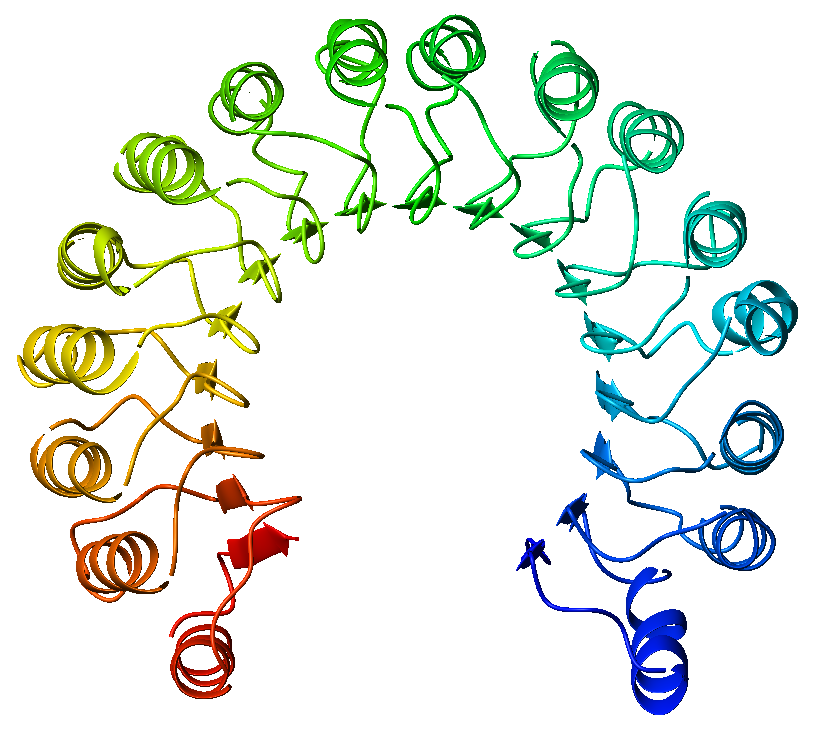
An example of a leucine-rich repeat protein, a porcine ribonuclease inhibitor
Identifiers
SymbolLRR_1
PfamPF00560
Pfam clanCL0022
ECOD207.1.1
InterProIPR001611
SCOP22bnh / SCOPe / SUPFAM
Membranome605
Available protein structures:
Pfam  structures / ECOD  
PDBRCSB PDB; PDBe; PDBj
PDBsumstructure summary
Leucine rich repeat variant
a leucine-rich repeat variant with a novel repetitive protein structural motif
Identifiers
SymbolLRV
PfamPF01816
Pfam clanCL0020
InterProIPR004830
SCOP21lrv / SCOPe / SUPFAM
Membranome737
Available protein structures:
Pfam  structures / ECOD  
PDBRCSB PDB; PDBe; PDBj
PDBsumstructure summary
LRR adjacent
internalin h: crystal structure of fused n-terminal domains.
Identifiers
SymbolLRR_adjacent
PfamPF08191
InterProIPR012569
Membranome341
Available protein structures:
Pfam  structures / ECOD  
PDBRCSB PDB; PDBe; PDBj
PDBsumstructure summary
Leucine rich repeat N-terminal domain
dimeric bovine tissue-extracted decorin, crystal form 2
Identifiers
SymbolLRRNT
PfamPF01462
InterProIPR000372
SMARTLRRNT
SCOP21m10 / SCOPe / SUPFAM
Membranome127
Available protein structures:
Pfam  structures / ECOD  
PDBRCSB PDB; PDBe; PDBj
PDBsumstructure summary
Leucine rich repeat N-terminal domain
the crystal structure of pgip (polygalacturonase inhibiting protein), a leucine rich repeat protein involved in plant defense
Identifiers
SymbolLRRNT_2
PfamPF08263
InterProIPR013210
SMARTLRRNT
SCOP21m10 / SCOPe / SUPFAM
Available protein structures:
Pfam  structures / ECOD  
PDBRCSB PDB; PDBe; PDBj
PDBsumstructure summary
Leucine rich repeat C-terminal domain
third lrr domain of drosophila slit
Identifiers
SymbolLRRCT
PfamPF01463
InterProIPR000483
SMARTLRRCT
SCOP21m10 / SCOPe / SUPFAM
Available protein structures:
Pfam  structures / ECOD  
PDBRCSB PDB; PDBe; PDBj
PDBsumstructure summary
LRV protein FeS4 cluster
a leucine-rich repeat variant with a novel repetitive protein structural motif
Identifiers
SymbolLRV_FeS
PfamPF05484
Pfam clanCL0020
InterProIPR008665
SCOP21lrv / SCOPe / SUPFAM
Available protein structures:
Pfam  structures / ECOD  
PDBRCSB PDB; PDBe; PDBj
PDBsumstructure summary

A leucine-rich repeat (LRR) is a protein structural motif that forms an α/β horseshoe fold.[1][2] It is composed of repeating 20–30 amino acid stretches that are unusually rich in the hydrophobic amino acid leucine. These tandem repeats commonly fold together to form a solenoid protein domain, termed leucine-rich repeat domain. Typically, each repeat unit has beta strand-turn-alpha helix structure, and the assembled domain, composed of many such repeats, has a horseshoe shape with an interior parallel beta sheet and an exterior array of helices. One face of the beta sheet and one side of the helix array are exposed to solvent and are therefore dominated by hydrophilic residues. The region between the helices and sheets is the protein's hydrophobic core and is tightly sterically packed with leucine residues.

Leucine-rich repeats are frequently involved in the formation of protein–protein interactions.[3][4]

Examples

[edit]

Leucine-rich repeat motifs have been identified in a large number of functionally unrelated proteins.[5] The best-known example is the ribonuclease inhibitor, but other proteins such as the tropomyosin regulator tropomodulin and the toll-like receptor also share the motif. In fact, the toll-like receptor possesses 10 successive LRR motifs which serve to bind pathogen- and danger-associated molecular patterns.

Although the canonical LRR protein contains approximately one helix for every beta strand, variants that form beta-alpha superhelix folds sometimes have long loops rather than helices linking successive beta strands.

One leucine-rich repeat variant domain (LRV) has a novel repetitive structural motif consisting of alternating alpha- and 310-helices arranged in a right-handed superhelix, with the absence of the beta-sheets present in other leucine-rich repeats.[6]

Associated domains

[edit]

Leucine-rich repeats are often flanked by N-terminal and C-terminal cysteine-rich domains, but not always as is the case with C5orf36

They also co-occur with LRR adjacent domains. These are small, all beta strand domains, which have been structurally described for the protein Internalin (InlA) and related proteins InlB, InlE, InlH from the pathogenic bacterium Listeria monocytogenes. Their function appears to be mainly structural: They are fused to the C-terminal end of leucine-rich repeats, significantly stabilising the LRR, and forming a common rigid entity with the LRR. They are themselves not involved in protein-protein-interactions but help to present the adjacent LRR-domain for this purpose. These domains belong to the family of Ig-like domains in that they consist of two sandwiched beta sheets that follow the classical connectivity of Ig-domains. The beta strands in one of the sheets is, however, much smaller than in most standard Ig-like domains, making it somewhat of an outlier.[7][8][9]

An iron sulphur cluster is found at the N-terminus of some proteins containing the leucine-rich repeat variant domain (LRV). These proteins have a two-domain structure, composed of a small N-terminal domain containing a cluster of four Cysteine residues that houses the 4Fe:4S cluster, and a larger C-terminal domain containing the LRV repeats.[6] Biochemical studies revealed that the 4Fe:4S cluster is sensitive to oxygen, but does not appear to have reversible redox activity.

See also

[edit]

References

[edit]
[edit]
Revisions and contributorsEdit on WikipediaRead on Wikipedia
from Grokipedia
Leucine-rich repeats (LRRs) are versatile structural motifs consisting of tandem arrays of 20–30 sequences that are highly enriched in the hydrophobic residue , forming a characteristic curved, horseshoe-shaped domain in proteins across , , , and animals. These repeats typically feature a conserved β-strand region followed by a variable loop, with the overall structure stabilized by hydrophobic interactions and often capped by amino- and carboxy-terminal domains containing cysteine-rich motifs for additional stability. LRRs serve primarily as scaffolds for protein–protein and protein– interactions, enabling diverse biological functions including recognition in innate immunity, , , and developmental processes. In humans, genome-wide analyses have identified approximately 375 LRR-containing proteins, which can be classified into seven major categories based on repeat type and flanking domains, such as typical (T), (S), and cysteine-containing (CC) classes, with many exhibiting transmembrane or intracellular localization. Notable examples include the Toll-like receptors (TLRs), which mediate immune responses to microbial ligands, and NOD-like receptors (NLRs), involved in intracellular sensing and regulation. Beyond immunity, LRR proteins contribute to neuronal development, such as through leucine-rich repeat transmembrane proteins that regulate formation, and to extracellular matrix organization via small leucine-rich proteoglycans like , which modulate assembly and signaling. The evolutionary adaptability of LRRs arises from their modular nature, allowing repeat number and sequence variation to fine-tune binding specificity, which has led to their expansion in eukaryotic genomes for specialized roles in host defense and tissue homeostasis. Structural studies, including crystal structures of LRR domains, reveal that the concave β-sheet face often forms the primary interaction surface, while the convex side accommodates variability for diversity. Dysregulation of LRR proteins is implicated in diseases ranging from autoimmune disorders and infections to neurodegeneration, underscoring their biomedical significance.

Structure and Composition

Primary Sequence Motif

The leucine-rich repeat (LRR) is a short typically comprising 20-30 , characterized by a high content of residues arranged in a repetitive pattern that forms the core structural unit of LRR-containing proteins. This motif is defined by a highly conserved segment (HCS) with the consensus sequence LxxLxLxxNxL, where L denotes or similar hydrophobic amino acids (isoleucine, valine, or phenylalanine), N represents asparagine or polar substitutes (threonine, serine, or cysteine), and x indicates any amino acid. The HCS spans 11 residues and is flanked by a more variable segment (VS), allowing for functional diversity while maintaining the motif's integrity. LRRs display notable variability in repeat length and sequence conservation depending on the class, which influences their overall architecture and specificity. For instance, the typical (T) class features longer repeats of about 29 residues, whereas bacterial (S) LRRs are shorter, averaging 22 residues. Other classes, such as ribonuclease inhibitor-like (RI), cysteine-containing (CC), SDS22-like, and plant-specific (PS), exhibit distinct consensus variations within the VS, such as insertions of cysteine or altered polar residues, but all retain the core HCS pattern. This classification arises from sequence alignments across diverse proteins, highlighting how subtle changes in the VS modulate binding properties without disrupting the leucine framework. Non-leucine residues within the motif, particularly the conserved asparagine in the HCS, contribute to sequence stability by enabling potential hydrogen bonding interactions that reinforce repeat packing. In model proteins like the porcine ribonuclease inhibitor (RI), sequence alignments reveal 15 tandem LRRs, each adhering closely to the consensus with periodic leucines and asparagines, demonstrating the motif's repetitive nature and conservation. Such examples underscore the LRR's role as a versatile, modular sequence element in protein evolution.

Three-Dimensional Architecture

The three-dimensional of leucine-rich repeat (LRR) domains is characterized by the folding of each repeat into a β-α structural unit, where a short β-strand is followed by an α-helix connected by loops. The β-strands align in parallel to form a concave β-sheet face, while the α-helices pack against the convex face, creating an elongated scaffold that facilitates curved overall geometries. In proteins containing multiple LRRs, these units assemble into a superhelical or horseshoe-shaped structure, typically comprising 8 to 40 repeats that wrap around a central axis. This provides a versatile framework for molecular recognition, with the concave surface often serving as a binding interface due to its extended, gently curved profile. The stability of LRR domains arises from a hydrophobic core formed by the conserved residues, which interdigitate between adjacent repeats to shield the interior from . Additionally, a network of hydrogen bonds, often involving side chains of conserved residues at a specific position within the repeat (forming an "asparagine ladder"), links the backbones of successive β-strands, further rigidifying the . A seminal example is the of porcine inhibitor (RI), determined at 2.5 resolution, which reveals a pronounced horseshoe conformation with an inner of approximately 25 and 15 LRRs arranged in a right-handed . This structure exemplifies how the repetitive β-α units generate the overall curvature without relying on bridges, relying instead on the intrinsic hydrophobic and hydrogen-bonding interactions.

Biological Functions

Protein-Protein Interactions

Leucine-rich repeat (LRR) domains primarily mediate protein-protein interactions through their concave β-sheet surface, which forms the inner face of the characteristic horseshoe-shaped and provides an extended, curved for partners. This interface enables high specificity in recognition, often achieved via variable residues exposed on the β-strands that allow discrimination between similar ligands or proteins. Binding at this concave surface typically involves a combination of electrostatic and hydrophobic interactions, where charged residues like and glutamate contribute to complementary charge patterns, and non-polar contacts stabilize the complex. Variable positions on the concave face, particularly in the β-strand regions, are key to specificity, as they can be diversified to match particular partner surfaces without disrupting the overall . Beyond immunity, LRR domains facilitate and developmental signaling; for example, leucine-rich repeat transmembrane proteins like LAR-RPTPs mediate neurite outgrowth and formation through homophilic interactions. Small leucine-rich proteoglycans such as bind via their LRR domains to regulate assembly. LRR domains support both homotypic and heterotypic interactions, with homotypic dimerization occurring via anti-parallel β-sheet alignment between two LRR solenoids, as observed in the receptor-like GmRLK18-1 where the LRR domains form stable homo-dimers. Heterotypic interactions, conversely, involve binding to non-LRR partners, such as in immune contexts where LRR receptors engage diverse effectors. These interactions often exhibit low initial affinity, with dissociation constants (K_d) in the micromolar range, as seen in the binding of the bacterial flg22 to the plant immune receptor FLS2 (K_d ≈ 1.5 μM), facilitating rapid, transient associations suitable for surveillance functions.

Ligand Recognition and Signaling

Leucine-rich repeat (LRR) domains facilitate the specific recognition of diverse , particularly pathogen-associated molecular patterns (PAMPs), through their characteristic horseshoe-shaped architecture. In Toll-like receptors (TLRs), such as TLR3 and TLR4, the concave inner surface formed by the parallel β-sheet of tandem LRRs serves as the primary binding interface for . For instance, TLR3 binds double-stranded RNA (dsRNA) from viral pathogens along this concave face, with interactions involving hydrogen bonds to residues like , , , and , often mimicking groups via sulfate-binding sites. Similarly, TLR4 recognizes (LPS) from , enabling detection of bacterial invasion. These interactions are highly specific, allowing LRR-containing proteins to distinguish microbial components from host molecules. Upon binding, LRR domains undergo conformational changes that promote receptor dimerization or oligomerization, initiating downstream signaling cascades. In TLR3, dsRNA engagement induces an "m"-shaped homodimer, where the bridges the concave surfaces of two receptor ectodomains, bringing the C-terminal regions into proximity and facilitating transmembrane signaling. For TLR4, LPS binding, often in complex with MD-2, triggers a similar dimeric conformation, altering the accessory protein's structure to stabilize the complex. These changes allosterically activate the intracellular Toll/interleukin-1 receptor (TIR) domains, recruiting adaptor proteins and propagating signals without requiring large-scale rearrangements in the LRR scaffold itself. Such oligomerization ensures efficient signal amplification in response to low concentrations. In the context of innate immunity, LRR-mediated recognition in TLRs activates key signaling pathways, prominently the pathway, to orchestrate inflammatory responses. Dimerized TIR domains recruit MyD88 and TIRAP, forming the myddosome complex with IRAK kinases and TRAF6, which leads to TAK1 activation and subsequent of the IKK complex. This results in IκBα degradation, allowing translocation to the nucleus and transcription of proinflammatory genes like IL-1β and TNF-α. The LRR's role in precise PAMP detection thus bridges extracellular threat sensing to intracellular gene regulation, essential for host defense against infections. Mutations in LRR domains can disrupt recognition, leading to pathological dysregulation of signaling and autoinflammatory or chronic inflammatory conditions. In , an intracellular LRR protein that senses muramyl (MDP) from bacterial via a hydrophobic pocket on its concave surface, common LRR variants such as R702W and G908R impair MDP binding and activation, contributing to by failing to properly regulate gut immunity and tolerance. These loss-of-function alterations highlight the LRR's critical role in maintaining immune , as defective recognition promotes unchecked .

Occurrence and Examples

In Metazoans

In metazoans, leucine-rich repeat (LRR)-containing proteins are abundant and play diverse roles in cellular processes, particularly in multicellular organization and host defense. The encodes approximately 375 LRR-containing proteins, representing about 2% of the total . These proteins are integral to functions ranging from immune recognition to tissue development, with their LRR domains facilitating specific interactions in complex animal tissues. Prominent families of LRR proteins in metazoans include the Toll-like receptors (TLRs), which are crucial for sensing on cell surfaces and in endosomes. Humans possess 10 TLRs (TLR1–TLR10), each with an extracellular LRR domain that recognizes diverse pathogen-associated molecular patterns, initiating innate immune responses. Another key family is the NOD-like receptors (NLRs), which detect intracellular threats such as bacterial effectors and damage-associated patterns. In humans, NLRs like NOD1 and activate and MAPK pathways to induce production and contribute to adaptive immunity. These families underscore the prevalence of LRR motifs in metazoan immunity, where they enable rapid signaling upon ligand binding, as detailed in broader discussions of ligand recognition. Beyond immunity, LRR proteins contribute to cytoskeletal regulation and neural development. Adducins, such as alpha-adducin (ADD1), feature a C-terminal LRR domain that docks onto -spectrin junctions, promoting the assembly and stability of the in erythrocytes and other cells. This LRR-mediated interaction regulates actin filament capping and spectrin recruitment, essential for cell shape maintenance and motility in multicellular contexts. Slit proteins, secreted guidance cues with multiple LRR domains in their N-terminal region, repel axons during neural development by binding (Robo) receptors. In vertebrates, Slit2, for instance, directs commissural pathfinding across the midline, preventing aberrant crossing in the . LRR proteins in metazoans are also linked to diseases, highlighting their functional importance. Mutations in leucine-rich repeat kinase 2 (LRRK2), which fuses an LRR domain with and activities, are the most common genetic cause of late-onset , affecting up to 40% of familial cases in some populations. These mutations, such as G2019S in the domain, disrupt LRR-mediated protein interactions, leading to and dopaminergic neuron loss, with the LRR domain implicated in substrate binding and pathway dysregulation. Such associations emphasize the role of LRR domains in metazoan-specific pathologies involving neuronal and immune .

In Plants and Microbes

In , leucine-rich repeat (LRR) proteins play crucial roles in both development and defense, with over 200 LRR-receptor-like kinases (LRR-RLKs) in the genome, many of which function as sensors for environmental cues and pathogen effectors. These LRR-RLKs often mediate across the plasma membrane, facilitating responses to biotic stresses such as bacterial and fungal infections. A prominent example is the RPM1 protein, an intracellular resistance (R) protein featuring LRR domains fused to nucleotide-binding (NB) and ARC domains, which detects specific effectors like AvrRpm1 and AvrB to trigger effector-triggered immunity (ETI). This recognition leads to hypersensitive cell death and restriction of pathogen spread, highlighting the adaptive role of LRRs in plant innate immunity. Plant genomes exhibit unique adaptations in LRR architecture, including tandem expansions of LRR domains and clusters that enhance diversity recognition. These expansions, often occurring through segmental duplications, allow for rapid evolution of new specificities against evolving microbial effectors, as seen in NB-LRR families where clustered arrangements promote recombination and variation. For instance, in , such tandem arrays contribute to broad-spectrum resistance by enabling multiple LRR variants to collectively survey for diverse avirulence factors. In microorganisms, LRR proteins are frequently associated with virulence and host interaction strategies. In bacteria, internalins such as InlA from contain LRR domains that mediate adhesion to host cell receptors like E-cadherin, promoting bacterial invasion of intestinal epithelial cells during infection. This LRR-mediated binding is essential for , as mutations in the repeat region abolish internalization efficiency. Among fungi and s, LRR-containing proteins serve as effectors or structural components in virulence; for example, in the Phytophthora sojae, an LRR protein is required for zoospore motility, host attachment, and lesion formation on , underscoring its role in infection initiation. These microbial LRRs often mimic host motifs to evade or manipulate plant defenses, contrasting with the defensive roles in plants.

Associated Domains and Evolution

Common Associated Domains

Leucine-rich repeat (LRR) proteins often feature associated domains that enhance or enable specific signaling functions. A prominent example is the LRR C-terminal cap (LRRCT), a conserved motif typically comprising a β-sheet extension and cysteine-rich sequences that flank the C-terminal end of the LRR array. This cap stabilizes the overall horseshoe-shaped LRR structure by shielding hydrophobic residues and forming bonds, thereby preventing proteolytic degradation and maintaining conformational integrity. In nucleotide-binding oligomerization domain-like receptors (NLRs), which contain LRR domains for recognition, death domain superfamily motifs such as CARD (caspase activation and recruitment domain) or PYD (pyrin domain) are commonly fused to the . These domains facilitate homotypic interactions that propagate signals leading to or activation in response to intracellular threats. Receptor-LRR proteins like Toll-like receptors (TLRs) integrate transmembrane helices to anchor the extracellular LRR domain to the cytoplasmic Toll/interleukin-1 receptor (TIR) domain, enabling pathogen detection at the cell surface and subsequent intracellular signaling cascades. In , receptor-like s (RLKs) frequently pair LRR ectodomains with intracellular domains, as exemplified by the brassinosteroid receptor BRI1, where ligand binding to the LRR triggers autophosphorylation of the domain to initiate hormone-mediated growth and stress responses. Functional synergies arise in complexes like SLIT-ROBO, where the LRR domains of the secreted SLIT interact with immunoglobulin-like (Ig-like) domains in ROBO receptors, refining specificity by modulating repulsive signaling at cellular barriers.

Evolutionary Origins and Distribution

Leucine-rich repeats (LRRs) originated in prokaryotes, with evidence of their presence in bacterial proteins predating the divergence of prokaryotes and eukaryotes. Analysis of LRR domains indicates that they existed as independent motifs in ancient prokaryotic lineages, including short linear repeats (SLRs) in bacteria such as and species. These prokaryotic LRRs, often found in over 134 proteins across 54 bacterial species, suggest an early evolutionary role in protein interactions, potentially transferred horizontally to eukaryotic genomes. In eukaryotes, LRRs underwent significant expansion through and diversification events, particularly in multicellular lineages. This proliferation is evident in the increased representation of LRR-containing proteins, which constitute approximately 1-2% of proteomes in vertebrates. For instance, the encodes 375 LRR-containing proteins, reflecting tandem duplications and structural evolution that enhanced their versatility. In contrast, unicellular eukaryotes like harbor only 6 LRR-domain proteins, highlighting the role of multicellularity in driving LRR family growth across kingdoms. LRRs are distributed ubiquitously, appearing in over 60,000 proteins from viruses, , , and eukaryotes, with notable expansion in and animals. LRRs exhibit coevolutionary dynamics with their ligands, particularly in host-pathogen interactions, where arms-race scenarios drive rapid . In plant-pathogen systems, LRR domains in resistance proteins evolve under positive selection to recognize evolving effectors, fostering reciprocal changes in specificity. This pattern underscores the from biotic interactions, contributing to LRR diversification in multicellular organisms.

References

Add your contribution
Related Hubs
User Avatar
No comments yet.