Hubbry Logo
Palace of MoncloaPalace of MoncloaMain
Open search
Palace of Moncloa
Community hub
Palace of Moncloa
logo
8 pages, 0 posts
0 subscribers
Be the first to start a discussion here.
Palace of Moncloa
Palace of Moncloa
from Wikipedia

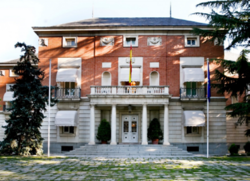
The Palace of Moncloa (Spanish: Palacio de la Moncloa), also known as Moncloa Palace or La Moncloa, is the official residence and workplace of the Prime Minister of Spain. It is located on Puerta de Hierro Avenue in the Moncloa-Aravaca district of Madrid. It has been the official residence of the Prime Minister since 1977, when Adolfo Suárez moved the residence from the Palace of Villamejor.

Key Information

The Palace of Moncloa is part of the Moncloa Complex, which includes 16 buildings, a bunker and a hospital. The Ministry of the Presidency, the Deputy Prime Minister's Office, the Cabinet Office, the Chief of Staff's Office and the Press Office are all located at this complex. The weekly meetings of the Council of Ministers are also held at the complex, in the Council Building.

In Spain, 'Moncloa' is sometimes used as a metonym for the central government, especially when contrasting with the governments of the Autonomous Communities.

History

[edit]
Prime Minister Pedro Sánchez welcoming the President of the Republic of Korea Moon Jae-in at the entrance of Palacio de La Moncloa.
Overview of the Moncloa Complex

The Moncloa Palace was originally a farm for agricultural use, which, due to its good situation, later became a palace-house. In 1660 it was bought by Gaspar de Haro y Guzmán, Marquis of Carpio and Eliche, owner of the neighboring orchard of La Moncloa, a name that came from its former owners, the Counts of Monclova, which later gave rise to Moncloa, as known today.

When the two gardens were joined, Gaspar de Haro had a palace built on the highest part of the land, known first as Eliche's Palace and also as Painted House, in reference to the frescoes that adorned the exterior walls, and later as Palace of La Moncloa.

The Palace passed through different owners until reaching María del Pilar Teresa Cayetana de Silva Álvarez de Toledo, 13th Duchess of Alba de Tormes. After her death without descendants in 1802, King Charles IV acquired the mansion and the orchard and added it to the Royal Site of La Florida, which was then named the Royal Site of La Moncloa. In 1816, King Ferdinand VII ordered the restoration of the palace.

Thirty years later, Queen Isabella II ceded the property of La Moncloa to the State, and it went on to become part of the Ministry of Development. The palace was restored again in 1929, when it was reopened as a museum.

The Palace was destroyed during the Siege of Madrid in the Spanish Civil War.[1]

A decade after its destruction, the architect Diego Méndez built, between 1949 and 1953, the present building following the model of the Casa del Labrador of Aranjuez. Then it was destined to official residence of heads of State in visits to Spain and high personalities.

By a law of July 15, 1954, the Moncloa Palace and its gardens, with an area of 58,293.81 square meters and adjoining the four cardinal points with land of the University City of Madrid, was integrated into the National Heritage. The new design was adapted to the new functions assigned to the palace, which was inaugurated by Francisco Franco in 1953. On June 3, 1954, arrived the palace's first visiting foreign head of state, Rafael Leonidas Trujillo; on November 28, 1976, the last one, Carlos Andrés Pérez.

In 1977, Prime Minister Adolfo Suárez moved the headquarters of the Presidency of the Government, located until then in the central Villamejor Palace, to the far more remote La Moncloa. The change occurred for security reasons, in the face of concern that an attack against the young prime minister, newly appointed by King Juan Carlos I. With the new palace was also established on it the official residence for the Prime Minister and his family.

Renovations

[edit]

Since 1977, successive prime ministers have consistently ordered renovations and expansions of the complex. Adolfo Suarez ordered the construction of a tennis court and the renovation of the pool. He also ordered the old main courtyard be covered, which would later become the famous Hall of Columns.

During his brief tenure as prime minister in the early 1980s, Leopoldo Calvo-Sotelo installed more bedrooms on the third floor for his eight children as well as a music room. Felipe González arrived in 1982 and cultivated a small orchard of bonsais. González's major contribution, though, was the construction of an underground bunker inspired by his memory of the coup d'état attempt of February 23, 1981. He also built a new building close to the presidential residence to host the Council of Ministers, dedicating the main building to serve more as the private residence of the prime minister.

José María Aznar, Ana Botella, their three sons and two cocker dogs lived at Moncloa between 1996 and 2004. Aznar was responsible for the construction of a game room for his children as well as a paddle tennis court to practice his favorite sport. Sonsoles Espinosa, wife of the Prime Minister José Luis Rodríguez Zapatero, decided to radically renovate the private rooms. She favored a minimalist style, painting the rooms light colors, changing classic furniture for different designs (but retaining certain pieces such as the table of General Narváez, a gift from Juan Carlos I to Adolfo Suárez located in the Prime Minister's Office) and hung pictures of contemporary artists on the walls. Mariano Rajoy and his wife did not make many changes that are known beyond swapping out the vases.[2]

Public access and security

[edit]
Map of the property

Accessibility

[edit]

Before September 19, 2018, entrance to the palace by the public was not allowed. Only accredited personnel like journalists or public servants were allowed to enter, along with universities, high schools and primary schools students. These latter usually make a short tour to know the gardens and the Press Center.

Since September 2018, the new PM (Pedro Sánchez) has allowed the public to visit the complex – not only the Press Room and the Council Room, but also the main buildings of the complex, including the Deputy PM's Office, the Ministry of the Presidency building and the Prime Minister's Chief of Staff's Office. [3][4]

There is a tradition in summertime by which the prime minister makes a tour through the Palace with the children of the employees of the complex.[5][6]

The requirements to visit the governmental complex is to be a Spanish citizen or to live in Spain, ask for a date, show the guards your ID, and leave in the entrance all electronic devices.

Security

[edit]

The security of the complex is carried out by the Department of Security of the Presidency of the Government, a government body responsible for the protection of the Prime Minister, Deputy Prime Minister, Government's Ministers and former Prime Ministers, along with their families. It also gives protection to the Moncloa Complex and the private and public residences of the members of the Government.

The security agents come from the Civil Guard and the National Police Corps.

Buildings in the Moncloa Complex

[edit]

Council Building

[edit]
Council Building
View toward the Council Building

The building was built in 1989 during the premiership of Felipe González in order to differentiate the residential and working areas of the palace.[7]

The Prime Minister's Office maintains an agreement with the Reina Sofía Museum under which the decoration of the building is composed of works of this museum. The artistic collection consists of more than 140 works by authors such as Joan Miró, Eduardo Chillida, Julio González, Pablo Palazuelo or Antoni Tàpies, among others. It also has numerous furniture belonging to the National Heritage.

Council Room

[edit]

The main room of the building is the Council Room, where the meetings of the Council of Ministers are held.

Tapestry Room

[edit]

The Tapestry Room is one of the biggest rooms in the building. It is used for receptions, official events and, occasionally, for press conferences.

Tàpies Room

[edit]

The Tàpies Room is an area where the Prime Minister receives guests.

Vice Presidency Building

[edit]
Vice Presidency Building

It is one of the newest buildings of the Complex. It was built in 2006 under the premiership of José Luis Rodriguez Zapatero. This building currently houses the Deputy Prime Minister's Office.[7]

Seeds Building

[edit]
Seeds Building

The Seeds Building was built in 1950 as part of the Ministry of Agriculture. Its name is because it was the place where the seeds were once stored.

It currently hosts the personal Cabinet of the Office of the Prime Minister. On the first floor is the office of the Chief of Staff, an office that was used in the 1980s by Alfonso Guerra, and before by Joaquín Garrigues Walker with prime minister Adolfo Suárez.[7]

INIA Building

[edit]
INIA Building

The INIA building was built in 1953 by the architect José Azpiroz. It receives this name for having housed the National Institute of Agrarian Research (INIA). It is also known as the Monastery of the Presidency because for its resemblance to a monastery.[8]

It is currently the headquarters of the Ministry of the Presidency.[7]

General Commission Room

[edit]

Inside of the INIA building takes place the meetings of the General Commission of Secretaries of State and Undersecretaries, the body responsible for preparing the matters to be discussed in the Council of Ministers.

Press Building

[edit]
Press Centre

It was built in 1950 as another branch of the Ministry of Agriculture, formerly the laboratory where seeds were analyzed. When the government's headquarters were moved to Moncloa, it housed the Information Office. Between 1988 and 1993, and between 2000 and 2002, the building was the headquarters of a ministerial department when the Information Office was elevated to the rank of a Ministry.

Currently, the building houses the Secretariat of State for Press. Among its rooms are the Press Room, where journalists have their own place to work, and the Press Centre, where the Spokesperson and other ministers hold the press briefing after meetings of the Council of Ministers.[8]

Other buildings

[edit]

The whole complex is composed of 16 buildings where the different services of the Prime Minister's Office are distributed, such as security, protocol, health service, etc.

Prime Minister's Office

[edit]

The Prime Minister's Office lies within the Moncloa Palace. It is staffed by a mix of career Civil Servants and Advisers. The highest ranking of the Office is the Chief of Staff, which is a political appointment on which the rest of the Office officials depend.

References

[edit]
[edit]
Revisions and contributorsEdit on WikipediaRead on Wikipedia
from Grokipedia
The Palace of Moncloa (Spanish: Palacio de la Moncloa) is the official residence and principal workplace of the , functioning as the headquarters for the and associated executive offices in Madrid's Moncloa-Aravaca . Originally developed as a 17th-century country estate known as the Royal Site of La Moncloa, the structure was largely destroyed during the and subsequently rebuilt between 1949 and 1954 by architect Diego Méndez in a neo-Herrerian style, adopting severe facades and classical proportions inspired by earlier . Designated as the Prime Minister's official seat in 1977 amid Spain's , the palace complex encompasses administrative buildings for the , national security operations, and ceremonial spaces used for receiving foreign dignitaries, while also supporting limited public access through guided tours under the Moncloa Open program to promote governmental transparency.

Historical Development

Origins as Royal Site

The site of what would become the Palace of Moncloa originated as a royal property in the early 17th century, initially known as the Huerta de Fuente El Sol, encompassing agricultural lands northwest of . This estate remained under crown ownership until King Felipe III sold it to a military captain to fund war expenditures around , after which it transitioned to private noble hands. A modest palacete, or small palace, known as the Casa Pintada, was constructed on the huerta in the late by Gaspar de Haro y Guzmán, leveraging the site's elevated position and proximity to for recreational use. The property saw enhancements under subsequent owners, notably the 13th Duchess of Alba, María Cayetana de Silva, who expanded and decorated the structure in 1783. Following the duchess's death without direct heirs in 1802, King Carlos IV purchased the palacete and its 28-hectare huerta for approximately 300,000 reales, integrating it into the royal estate network to link the adjacent Real Sitio de la Florida with emerging developments in the area. This acquisition established the site's formal status as the Real Sitio de la Moncloa, envisioned as a verdant extension for royal leisure and urban connectivity, though prior Bourbon monarchs like Carlos III had influenced through infrastructure such as roads and fountains in the broader Moncloa vicinity during the 1760s–1780s.

Destruction in the Spanish Civil War

The Real Sitio de la Moncloa, the original 17th-century palace complex, was located within 's University City, a strategic area that transformed into a primary frontline during the (1936–1939). After the Nationalist advance in late 1936, Francoist forces seized portions of the university grounds, holding the palace vicinity as a vulnerable salient extending into Republican-controlled from November 1936 onward. To deny the site to advancing Nationalists, Republican defenders unleashed sustained artillery fire and implemented mining operations against it. One documented action entailed detonating a tunnel beneath the palace cellars loaded with approximately 10 tons of explosives, entombing 15 soldiers from the Sixth Tabor of Regulares de Alhucemas and the Batallón de Toledo. Military assessments by March 1938 recorded extensive structural damage from these engagements, compounded by aerial bombings and ground combat throughout the Siege of Madrid. The relentless fighting culminated in the palace's near-total ruin by the war's conclusion in March 1939, necessitating its demolition due to irreparable harm. This devastation mirrored the broader toll on Madrid's heritage, where artillery, aviation strikes, and tactical demolitions felled or severely impaired scores of protected edifices amid the protracted urban siege.

Franco-Era Reconstruction

![Fachada_Moncloa.png][float-right] Following the devastation of the original palace during the Siege of Madrid in the Spanish Civil War (1936–1939), the site remained in ruins until the Franco government authorized its reconstruction in 1949. The initiative stemmed from the regime's interest in restoring symbolic national properties near Madrid, providing a venue proximate to Franco's primary residence at the Pardo Palace for hosting dignitaries. Architect Diego Méndez González oversaw the project, drawing on historical plans to reconstruct the neoclassical structure originally designed by Francisco Sabatini in the late . Construction employed contemporary materials while aiming for fidelity to the pre-war appearance, including the restored facade and principal salons, though interior adaptations accommodated official receptions and guest accommodations. The work concluded in 1953, with inaugurating the palace on May 26 of that year. Intended as a guesthouse for foreign heads of state rather than Franco's personal use, the rebuilt palace hosted early visits such as that of U.S. President in 1959, underscoring its role in Franco-era diplomacy. The reconstruction exemplified efforts to reclaim and repurpose royal sites for state functions, avoiding the opulence of pre-republican eras in favor of functional aligned with the regime's self-image. No major expansions occurred during this phase, preserving the core layout amid Spain's economic constraints of the 1940s and early 1950s.

Architectural Features

Design and Layout

The Palace of Moncloa's current structure, rebuilt from 1949 to 1954 on the ruins of the pre-Civil War building, adopts a neoclassical style with symmetrical proportions, emphasizing classical elements such as pilasters, cornices, and a central pedimented on the main facade. Architect Diego Méndez González directed the reconstruction, incorporating remnants of the original 18th-century design while creating a modern palatial edifice suited for official use. The building spans three main floors plus a , with a rectangular footprint measuring approximately 100 meters in length, flanked by lateral wings that enclose interior courtyards for light and ventilation. The layout functionally separates official and private domains: the ground floor accommodates ceremonial spaces, including reception halls, dining rooms, and audience chambers designed for state functions, with high ceilings and ornate detailing to convey grandeur. Upper floors house the prime ministerial residence, comprising family apartments, offices, and personal quarters, accessible via private staircases and elevators to maintain separation from public areas. This vertical zoning, established during the rebuild, optimizes and , with the basement serving utility and storage purposes. Interior circulation follows , with a central on the ground linking key rooms like the main salon and access points, while secondary corridors branch to ancillary spaces. The design prioritizes natural light through large windows and views, reflecting rational planning influenced by 20th-century adaptations of historical Spanish palace . Subsequent renovations, such as those in the 1970s and 1980s, refined the layout without altering the core spatial organization.

Interior Highlights

The Tapestry Room (Salón de Tapices), located in the building adjacent to the palace, stands out for its collection of historic Gobelin and Flemish tapestries dating to the , originally from royal collections. This expansive space, measuring approximately 300 square meters, hosts official receptions, ceremonial events, and occasional press conferences, reflecting neoclassical decorative elements with silk damask wall coverings and crystal chandeliers added during post-war reconstructions. The Tàpies Room (Sala Tàpies), named after Catalan artist , features modern artworks including pieces from the artist's collection loaned from the Reina Sofía Museum, with rotations occurring under successive such as and in 2019. Primarily used for bilateral meetings between the Prime Minister and foreign leaders or dignitaries, the room embodies a blend of contemporary against a backdrop of functional, minimalist interiors designed for . The Council Room (Sala de Reuniones del Consejo de Ministros) serves as the primary venue for weekly Cabinet meetings, equipped with a long table seating up to 22 ministers and featuring audio-visual systems installed in the 1980s under . Its restrained decor, including portraits of Spanish monarchs and prime ministers, underscores its role in executive decision-making since the building's completion in 1989. Within the palace proper, the Prime Minister's private residence spans two floors with eight bedrooms and nine bathrooms in a neoclassical style, though interiors have been personalized by occupants, such as Felipe González's additions of furnishings and José María Aznar's garden extensions influencing adjacent spaces. Access remains restricted, limiting public knowledge to official disclosures.

Surrounding Grounds and Estate

The Palace of Moncloa is surrounded by an enclosed estate comprising approximately 56,000 square meters of land, including landscaped gardens, green zones, and recreational areas such as tennis courts. These grounds, walled and secured separately from the broader Moncloa Complex, were redeveloped during the 1949–1954 reconstruction under Francisco Franco's regime, restoring elements of the original royal site's layout while adapting it for modern governmental use. The design emphasizes privacy and security, with tree-lined paths, lawns, and ornamental plantings that provide both aesthetic appeal and functional space for the prime minister's residence. The estate's terrain integrates historical features from the pre-Civil War Real Sitio de la Moncloa, which once included extensive orchards, pine groves, and forested areas, though much was destroyed during the 1936–1939 . Post-war efforts focused on practical restoration rather than lavish recreation, resulting in functional gardens that support limited public access via guided tours under the Moncloa Open program, initiated in 2018. Approximately 33,000 square meters of the estate remain as open green space, underscoring its role in maintaining a secluded environment amid urban . As part of the larger Moncloa Complex spanning roughly 20 hectares overall, the palace grounds contribute to a self-contained governmental enclave, with access restricted for reasons except during designated visits that highlight the gardens' integration with the palace structure. This setup reflects causal priorities of Spanish : prioritizing defensibility and operational efficiency over expansive public landscaping.

The Moncloa Complex

Council and Administrative Buildings

The Building, located within the Moncloa Complex, has served as the primary venue for weekly cabinet meetings since 1977, when the Council relocated to its current headquarters there following the . These sessions, typically held on Tuesdays, convene the and ministers to deliberate on policy, legislative proposals, and executive decisions, as regulated under the 1978 Spanish Constitution. The structure includes a dedicated chamber for these gatherings, equipped for formal proceedings, and its exterior is routinely used for official photographs of the ministers after sessions conclude. Surrounding this central facility, the Moncloa Complex incorporates additional administrative buildings that support the operational needs of the Spanish , accommodating approximately 2,000 staff members across 16 structures dedicated to governmental functions. Key among these are offices for the of the Government, which handle coordination of executive activities; the Secretariat of State for Communication, responsible for press relations and public information dissemination; and the Department of , overseeing internal security policy and coordination. Other facilities, such as those for the Ministry of the Presidency and the Deputy Prime Minister's office, facilitate administrative tasks including policy analysis, legal review, and inter-ministerial liaison, ensuring efficient support for the Prime Minister's duties without overlapping the ceremonial roles of the main palace. These buildings collectively form the bureaucratic backbone of the complex, distinct from residential or diplomatic areas, and have been adapted over time to meet modern administrative demands while maintaining security protocols within the gated estate.

Specialized Research and Support Facilities

The Edificio Semillas, one of the key structures in the Moncloa Complex, originally housed laboratories of the Instituto Nacional de Investigación Agraria during the Franco era, focusing on agricultural experimentation and seed development. In its current role, it functions as a policy think tank and strategic advisory hub for the Prime Minister's inner circle, supporting high-level research and ideation on government initiatives, legislative proposals, and crisis response. This adaptation reflects a shift from empirical agronomic studies to applied political and economic analysis, with spaces repurposed for confidential meetings and data-driven scenario planning. ![Fachada del edificio Semillas][float-right] Support facilities include an underground bunker designed for operations during emergencies, featuring walls up to three meters thick, capacity for over 100 personnel, independent power systems, and provisions such as food stores and even a contingency . Constructed during the period, it integrates communication redundancies and secure command centers to enable decision-making amid threats like nuclear attack or civil unrest. Additionally, the complex maintains an on-site unit to provide immediate medical care for residents, staff, and visitors, ensuring operational resilience without reliance on external services during lockdowns or heightened security protocols. These installations collectively underpin the complex's self-sufficiency, with the and emphasizing defensive and health contingencies, while Semillas advances proactive policy research grounded in empirical review rather than ideological priors.

Media and Press Infrastructure

The media and press infrastructure in the Moncloa Complex is centered on the Edificio Portavoz, which houses the Secretaría de Estado de Comunicación and the primary press room used for official government briefings and announcements. This facility supports daily operations, including post-Council of Ministers press conferences typically held on Mondays, where the government spokesperson addresses journalists on policy decisions and legislative matters. Equipped with dedicated spaces for broadcasts and direct feeds, the press room enables real-time coverage by accredited media outlets, facilitating immediate dissemination of information to the public. Adjacent areas provide workspaces for correspondents, underscoring the complex's role in coordinating communication between the executive and . Press accreditation is administered through the complex's Information Offices, which regulate access for national and international journalists to presidential activities and restricted zones, ensuring secure yet transparent media engagement. These protocols include subscriptions to news bulletins and regulations for foreign correspondents, managed to balance informational access with operational security. In contingency scenarios, the complex's underground incorporates a secondary press room and radio studio to maintain communications during crises, preserving continuity of information flow. This infrastructure reflects the site's evolution into a comprehensive hub for relations since its development.

Official Role and Usage

Residence of the

The Palace of La Moncloa serves as the official residence of the , known as the Presidente del Gobierno, accommodating the officeholder and their immediate family in private quarters separate from areas designated for government operations. This arrangement has been in place since June 1977, when relocated the presidential residence from the smaller Palace of Villamejor in central to the more expansive Moncloa complex, enhancing and amid the . The residential portion occupies upper floors of the palace, featuring family-oriented spaces such as bedrooms, living areas, and personal dining facilities designed for daily life rather than ceremonial use. These apartments provide privacy for the Prime Minister's spouse and children, with current occupant residing there alongside his wife Begoña Gómez and their two daughters since assuming office in June 2018. While the layout supports family routines, including meals and recreation, the residence integrates with heightened security measures, including underground bunkers and controlled access, reflecting its dual role in governance. Successive Prime Ministers have utilized the residence to varying degrees, with most establishing it as their primary home during terms, though some, like , maintained personal properties elsewhere for weekends or post-tenure while using Moncloa for official stays. The setup underscores the palace's evolution from Franco-era official venue—where it hosted events but not as the Caudillo's main domicile, which was the nearby Palace—to a comprehensive base for democratic leaders balancing private and public life.

Operational Functions for Government

The Palace of Moncloa serves as the principal operational center for the of the Spanish , housing the 's offices for directing domestic and , civil and , and state defense. The utilizes dedicated spaces within the palace to coordinate actions, establish political programs, and ensure compliance with policy directives across ministries. This includes daily reviews of intelligence briefs, consultations with senior advisors, and oversight of administrative implementation, enabling real-time executive decision-making. Weekly meetings, ordinarily held on Tuesdays within the Moncloa complex, form a of these operations, where the presides over deliberations on draft laws, decrees, and urgent national matters. These sessions, prepared by the General Commission of Secretaries of State and Under-Secretaries, involve the , vice presidents, and ministers, with minutes recorded and signed post-meeting to formalize decisions. Extraordinary meetings can occur on other days or remotely if circumstances require, underscoring the palace's role in flexible governance response. The broader Moncloa complex bolsters these functions through administrative buildings accommodating around 2,000 personnel engaged in policy analysis, technical support, and coordination tasks essential to presidential operations. Facilities such as the building host these gatherings, while ancillary structures provide logistical and research capabilities, ensuring the executive branch's efficient functioning without reliance on external venues for core activities.

Hosting Diplomatic and Ceremonial Events

The Palace of Moncloa functions as the central location for the to conduct official bilateral meetings and receptions with foreign heads of government and dignitaries, facilitating discussions on , trade, and security. These events typically involve formal welcomes, private talks, and joint press appearances, often held in prominent interiors such as the Tapestry Room (Salón de Tapices), which features historical tapestries and serves as a setting for ceremonial gatherings. Notable examples include the official ceremony and bilateral meeting between Spanish Prime Minister and Turkish President on June 13, 2024, where discussions covered cooperation and economic ties. Similarly, on June 28, 2022, Sánchez hosted U.S. President at the palace for talks on transatlantic alliance and global challenges ahead of the in . In April 2023, Brazilian President engaged in a bilateral dialogue with Sánchez at Moncloa, emphasizing multilateral cooperation on issues like the conflict. Historically, the palace has hosted such engagements since its adaptation as the prime ministerial seat, including U.S. President Dwight D. Eisenhower's meeting with in December 1959, and Russian President Vladimir Putin's talks with Prime Minister in June 2000. These gatherings underscore Moncloa's role in executive diplomacy, distinct from royal ceremonies at the Palacio Real, focusing instead on governmental-level interactions without the full pomp of state visits. Working lunches or informal dinners may accompany these meetings, organized by the President's office to advance bilateral agendas.

Renovations and Modernizations

Initial Post-War Adaptations

The original Palacio de la Moncloa, a neoclassical structure dating back to the , was severely damaged and ultimately dynamited by Republican forces in March 1938 during the , leaving the site in ruins. In 1948, General , as , decided to construct a new palace on the cleared site to serve official functions, addressing the need for a government building near and El Pardo Palace while restoring the area's prestige. This initiative reflected Franco's regime's emphasis on monumental architecture to symbolize national recovery and authority post-war. The reconstruction project was assigned to architect Diego Méndez González, Franco's preferred designer and director of the Valley of the Fallen works, following a design contest he won. Méndez drew inspiration from the neoclassical Casa del Labrador at Palace, creating a single-story structure with symmetrical facades, porticos, and pediments suited to ceremonial and administrative uses, completed between 1949 and 1954. Construction incorporated rigorous historical research into the site's prior layouts, ensuring functional adaptations like expanded reception areas for state events, though interiors initially featured modest furnishings aligned with the era's autarkic policies. Upon inauguration in 1953, the palace was adapted primarily as a summer retreat for Franco and a venue for diplomatic receptions, distinct from his primary residence at El Pardo, with spaces modified for hosting foreign dignitaries and government councils amid Spain's isolation. Early modifications included landscaping the surrounding grounds to echo royal estate traditions, enhancing security perimeters, and installing basic utilities for self-sufficiency, though full operational integration awaited later expansions. These changes prioritized symbolic continuity with Spain's monarchical past while accommodating the regime's centralized governance needs.

Democratic-Era Updates Since 1977

Following the , the Palace of Moncloa underwent functional adaptations in 1977 to establish it as the permanent official residence and primary executive headquarters of the , replacing its prior role under the Franco regime as a guesthouse for visiting foreign leaders and dignitaries. relocated there in June 1977, initiating its use for high-level political negotiations, including the signing of the Moncloa Pacts on October 25, 1977, which required logistical enhancements for multipartisan meetings. These changes included bolstering administrative support spaces and initial security protocols to handle the intensified operational demands of democratic governance. The democratic era has featured incremental expansions to the broader Moncloa Complex, incorporating new administrative edifices to accommodate growing governmental needs. Under (1982–1996), construction began in 1989 on the dedicated building, completed in the early , providing a modern venue for cabinet sessions separate from the palace proper and reflecting the institutionalization of parliamentary practices. Subsequent leaders added recreational and familial facilities; during José María Aznar's administration (1996–2004), a children's playroom and paddle were installed on the grounds to support family life amid official duties. Interior renovations have been periodic, often personalized by incoming administrations to update decor and functionality. A notable overhaul occurred under (2004–2011), directed by Sonsoles Espinosa, who spearheaded extensive restorations to modernize furnishings, artwork placements, and overall aesthetics, addressing perceived outdated elements from prior eras. More recently, under (since 2018), private residential areas received upgrades, including reconfiguration to eight bedrooms, renewal of recreational amenities like tennis courts, and enhancements to an existing underground bunker for emergency preparedness, with reported expenditures exceeding several million euros on these and related maintenance works. These modifications have prioritized comfort, security, and adaptability while preserving the palace's neoclassical core.

Recent Enhancements and Maintenance

In recent years, the Spanish government has allocated significant resources to the upkeep of the Palace of Moncloa's extensive gardens, which span 47,519 square meters and require ongoing professional maintenance to preserve their historical and functionality. In 2023, the Presidency of the Government expended approximately 250,000 euros on garden maintenance services, including , irrigation system repairs, and , contracted through specialized firms to ensure year-round viability despite the site's age and environmental pressures. Under Pedro Sánchez's administration, landscape enhancements have focused on rehabilitating key areas such as the Jardín Alto and Jardín del Pío, involving revalorization efforts like restored pathways, planting initiatives, and structural repairs to combat deterioration from weathering and usage. These works, initiated in the early 2020s, aim to integrate modern practices while respecting the 18th-century French-style design originally laid out by Sabatini. Technical maintenance has included a multi-year awarded in 2021 for the thermal systems across the Moncloa complex, covering heating, cooling, and energy distribution to address inefficiencies in aging infrastructure and comply with updated environmental regulations. This service, managed by engineering firm Fulton, emphasizes preventive conservation to minimize disruptions in the palace's operational capacity. A symbolic addition in May 2025 involved the inauguration of a at the Fuente de within the gardens, honoring poet , which coincided with broader rehabilitation projects but did not entail major structural changes. Overall, these efforts reflect incremental, budget-constrained updates rather than comprehensive overhauls, prioritizing functionality amid fiscal scrutiny.

Security and Public Access

Security Protocols and Infrastructure

The Moncloa Complex employs multilayered security infrastructure, including a dedicated Centro de Mando y Seguridad (CEMAS) that coordinates operational responses, , and threat mitigation across the site, which spans approximately 20 hectares with one-third allocated as a fenced-off perimeter for the prime minister's residence and high-sensitivity areas. This command center was upgraded in October 2023 to integrate advanced monitoring systems and rapid-response capabilities, reflecting the site's status as one of Spain's most fortified government enclosures. Physical barriers consist of high-security fencing, controlled access points, and restricted zones enforced by specialized units from the Policía Nacional and Guardia Civil, with the former handling internal patrols and the latter focusing on perimeter defense and external threats. Protocols mandate pre-visit briefings on compliance rules, prohibiting unauthorized parking or entry, and requiring vehicle inspections at checkpoints. In response to operational gaps, such as a November 2024 incident involving tourists breaching restricted areas via public pathways, authorities augmented personnel and in late 2024, emphasizing intrusion detection in non-public sectors. Further reinforcements occurred in 2025 with additional agents deployed to address heightened threat levels, despite reported delays in overtime compensation. By October 2025, enhanced measures targeted potential unauthorized access to sensitive zones for at least the subsequent two years, incorporating proactive monitoring and layered personnel assignments. These protocols prioritize causal deterrence through redundancy, drawing on empirical assessments of past breaches rather than unverified assumptions of invulnerability.

Policies on Public Visits and Transparency

The Palace of Moncloa maintains restricted public access primarily due to its role as the operational headquarters of the Spanish Presidency, with guided tours available only through the "Moncloa Abierta" program. Launched in its current form in to broaden participation beyond occasional school and university groups, the initiative offers free, 90-minute tours to Spanish citizens and residents, covering select areas such as gardens, the room, and other non-sensitive dependencies. Tours are scheduled irregularly from Monday to Friday on days without official agendas, with advance online registration required and capacities limited to ensure security; no fixed dates or public drop-ins are permitted. The program resumed in October 2025 following periodic pauses tied to governmental priorities, emphasizing controlled openness while prioritizing operational continuity. Transparency policies for the complex fall under Spain's 19/2013 on Transparency, Access to Public Information, and , enacted December 9, 2013, which requires proactive disclosure of administrative data and responses to citizen requests within one month, subject to exemptions for , state secrets, or personal privacy. The of the , overseeing Moncloa, must publish details on budgets, contracts, and high-level visits via the national Transparency Portal, though enforcement relies on the independent Council of Transparency and (CTBG), which resolves appeals against denials. In practice, the CTBG has compelled disclosures on Moncloa-specific matters, including visitor logs from 2024, representation expenses of from 2018 to 2022, and potential resource use for private events in 2025, after initial refusals by the . Critics, including the CTBG itself, have highlighted instances of opacity, such as the Presidency's 2019 pattern of ignoring or delaying information requests, prompting formal rebukes and underscoring tensions between security imperatives and statutory openness. These policies balance public engagement—via limited physical access—with informational mandates, though compliance has varied across administrations, often requiring judicial or oversight intervention for full adherence.

Significance and Criticisms

Symbolic and Institutional Importance

The Palace of Moncloa functions as the official residence and primary workplace of the , serving as the institutional headquarters of the Presidency of the Government since its designation on December 17, 1977, under Adolfo Suárez. This role centralizes executive decision-making, with the holding its regular meetings in dedicated facilities within the complex to deliberate on legislation, policy, and national administration. The palace's administrative infrastructure supports the Prime Minister's authority, reflecting a gradual enhancement of the executive's presidential character in Spain's parliamentary monarchy over the democratic period. Symbolically, the palace embodies the post-Franco democratic transition, most notably as the site of the Moncloa Pacts negotiated and signed on October 25, 1977, which established political consensus on austerity measures, labor reforms, and institutional stabilization to avert economic crisis and facilitate Spain's shift to . These agreements, involving leaders from major parties, underscored the venue's role in forging national unity during a liminal phase of , transforming it into a enduring emblem of consensual governance and the in contemporary . Its use by successive prime ministers since 1978 has reinforced its status as a marker of executive continuity amid political alternance, distinct from the monarch's residence at Zarzuela Palace. Institutionally, the Moncloa complex's expansion has consolidated key government operations, including press briefings and diplomatic coordination, thereby amplifying the Prime Minister's influence in policy formulation and international representation within a where the directs the executive branch under constitutional constraints. This setup aligns with Spain's 1978 Constitution, which vests executive power in the led by the President, with the palace symbolizing the operational independence of civilian authority from historical authoritarian legacies.

Debates on Cost, Opulence, and Accessibility

The maintenance of the Palacio de la Moncloa has drawn criticism for its substantial costs to taxpayers, particularly amid economic challenges such as the and inflation. In 2021, the annual expenses for the presidential complex rose 32% to €42.75 million, covering operations, security, and upkeep, according to execution data. Specific outlays include €250,000 annually for maintenance across 47,519 square meters of landscaped grounds, a figure contested by opposition figures as excessive given public measures. Further expenditures, such as €167,706 for revaluation projects and €234,000 for perimeter wall enhancements in 2024, have fueled debates over prioritizing fiscal restraint. Critics, including conservative media and politicians, have highlighted perceived opulence in the palace's interiors and amenities, arguing they reflect elite detachment from ordinary ' realities. For instance, €6,063 was spent on premium acorn-fed for official events in 2020 despite pandemic restrictions limiting public gatherings, prompting accusations of lavish taxpayer-funded indulgences. Renovations upon Sánchez's 2018 arrival included furniture changes and private zone updates estimated at tens of thousands of euros, with sources close to the administration describing them as "profound" to align with personal tastes. The palace's historic tapestries, artworks, and expansive facilities—originally designed as a 1950s retreat—amplify perceptions of grandeur unsuitable for a modern democratic seat, though defenders note comparable costs for heads-of-government residences in nations like the or . Accessibility remains contentious, balancing security needs with demands for transparency in a taxpayer-funded institution. Historically restricted due to its role as an active governmental hub, the complex opened to guided public visits via the "Moncloa Abierta" program in , allowing 90-minute tours of select areas on non-official days without prior student-only limits, requiring advance reservations. Capacity is capped for safety, and access excludes sensitive zones, leading to critiques from transparency advocates that it symbolizes elite seclusion despite the initiative's expansion. Proponents argue stringent protocols— including perimeter upgrades—are essential given past threats, while opponents question why a democratic venue isn't more routinely open, akin to tourist sites like the Palacio Real.

Political Usage and Controversies

The Palace of Moncloa has served as the official residence and principal workplace of Spain's President of the Government since relocated there on December 15, 1977, replacing the prior residence at the Palace of Villamejor. It functions as the central hub for executive operations, hosting weekly meetings of the in dedicated chambers, diplomatic receptions with foreign heads of state—such as the 2016 bilateral encounter between and —and routine audiences with King Felipe VI, totaling 124 sessions during Pedro Sánchez's tenure through May 2025. The complex also accommodates press briefings and policy announcements, with the government often invoked metonymically as "La Moncloa" in political discourse, underscoring its role in symbolizing national executive authority. Politically, the palace has been the site of pivotal negotiations, including the 1977 Moncloa Pacts, where trade unions, business leaders, and political parties agreed on economic reforms to stabilize the post-Franco transition amid high exceeding 25% and near 5%. These accords, formalized on October 25, 1977, facilitated wage restraints and labor market adjustments in exchange for social protections, averting potential unrest during . However, the venue's exclusivity has drawn criticism for insulating from public scrutiny, with opposition figures arguing it fosters an imperial style detached from parliamentary accountability. Controversies have centered on its use amid scandals, particularly under Sánchez's administration since 2018. In November 2023, tens of thousands protested outside the gates against the Catalan amnesty law, enacted to secure parliamentary support for Sánchez's , highlighting tensions over and regional . During a 2024 investigation into Sánchez's wife, Begoña Gómez, for alleged influence peddling, the isolated himself in the palace for five days, publicly contemplating before reaffirming his commitment, an episode framed by critics as a calculated media strategy rather than genuine introspection. In June 2025, judicial warnings of potential searches at Moncloa in connection with probes into PSOE affiliates escalated debates on executive immunity, marking an unprecedented challenge to the site's sanctity as the 's nerve center. These incidents, often amplified by opposition-led demonstrations, underscore perceptions of the palace as a fortress amid allegations of opacity, though defenders attribute external pressures to partisan attacks on institutional stability.

References

Add your contribution
Related Hubs
User Avatar
No comments yet.