Hubbry Logo
Gauge fixingGauge fixingMain
Open search
Gauge fixing
Community hub
Gauge fixing
logo
8 pages, 0 posts
0 subscribers
Be the first to start a discussion here.
Contribute something
Gauge fixing
Gauge fixing
from Wikipedia

In the physics of gauge theories, gauge fixing (also called choosing a gauge) denotes a mathematical procedure for coping with redundant degrees of freedom in field variables. By definition, a gauge theory represents each physically distinct configuration of the system as an equivalence class of detailed local field configurations. Any two detailed configurations in the same equivalence class are related by a certain transformation, equivalent to a shear along unphysical axes in configuration space. Most of the quantitative physical predictions of a gauge theory can only be obtained under a coherent prescription for suppressing or ignoring these unphysical degrees of freedom.

Although the unphysical axes in the space of detailed configurations are a fundamental property of the physical model, there is no special set of directions "perpendicular" to them. Hence there is an enormous amount of freedom involved in taking a "cross section" representing each physical configuration by a particular detailed configuration (or even a weighted distribution of them). Judicious gauge fixing can simplify calculations immensely, but becomes progressively harder as the physical model becomes more realistic; its application to quantum field theory is fraught with complications related to renormalization, especially when the computation is continued to higher orders. Historically, the search for logically consistent and computationally tractable gauge fixing procedures, and efforts to demonstrate their equivalence in the face of a bewildering variety of technical difficulties, has been a major driver of mathematical physics from the late nineteenth century to the present.[citation needed]

Gauge freedom

[edit]

The archetypical gauge theory is the HeavisideGibbs formulation of continuum electrodynamics in terms of an electromagnetic four-potential, which is presented here in space/time asymmetric Heaviside notation. The electric field E and magnetic field B of Maxwell's equations contain only "physical" degrees of freedom, in the sense that every mathematical degree of freedom in an electromagnetic field configuration has a separately measurable effect on the motions of test charges in the vicinity. These "field strength" variables can be expressed in terms of the electric scalar potential and the magnetic vector potential A through the relations:

If the transformation

is made, then B remains unchanged, since (with the identity )
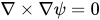
However, this transformation changes E according to

If another change

is made then E also remains the same. Hence, the E and B fields are unchanged if one takes any function ψ(r, t) and simultaneously transforms A and φ via the transformations (1) and (2).

A particular choice of the scalar and vector potentials is a gauge (more precisely, gauge potential) and a scalar function ψ used to change the gauge is called a gauge function.[citation needed] The existence of arbitrary numbers of gauge functions ψ(r, t) corresponds to the U(1) gauge freedom of this theory. Gauge fixing can be done in many ways, some of which we exhibit below.

Although classical electromagnetism is now often spoken of as a gauge theory, it was not originally conceived in these terms. The motion of a classical point charge is affected only by the electric and magnetic field strengths at that point, and the potentials can be treated as a mere mathematical device for simplifying some proofs and calculations. Not until the advent of quantum field theory could it be said that the potentials themselves are part of the physical configuration of a system. The earliest consequence to be accurately predicted and experimentally verified was the Aharonov–Bohm effect, which has no classical counterpart. Nevertheless, gauge freedom is still true in these theories. For example, the Aharonov–Bohm effect depends on a line integral of A around a closed loop, and this integral is not changed by

Gauge fixing in non-abelian gauge theories, such as Yang–Mills theory and general relativity, is a rather more complicated topic; for details see Gribov ambiguity, Faddeev–Popov ghost, and frame bundle.

An illustration

[edit]
Gauge fixing of a twisted cylinder. (Note: the line is on the surface of the cylinder, not inside it.)

As an illustration of gauge fixing, one may look at a cylindrical rod and attempt to tell whether it is twisted. If the rod is perfectly cylindrical, then the circular symmetry of the cross section makes it impossible to tell whether or not it is twisted. However, if there were a straight line drawn along the length of the rod, then one could easily say whether or not there is a twist by looking at the state of the line. Drawing a line is gauge fixing. Drawing the line spoils the gauge symmetry, i.e., the circular symmetry U(1) of the cross section at each point of the rod. The line is the equivalent of a gauge function; it need not be straight. Almost any line is a valid gauge fixing, i.e., there is a large gauge freedom. In summary, to tell whether the rod is twisted, the gauge must be known. Physical quantities, such as the energy of the torsion, do not depend on the gauge, i.e., they are gauge invariant.

Coulomb gauge

[edit]

The Coulomb gauge (also known as the transverse gauge) is used in quantum chemistry and condensed matter physics and is defined by the gauge condition (more precisely, gauge fixing condition)

It is particularly useful for "semi-classical" calculations in quantum mechanics, in which the vector potential is quantized but the Coulomb interaction is not.

The Coulomb gauge has a number of properties:

  1. The potentials can be expressed in terms of instantaneous values of the fields and densities (in International System of Units)[1]

    where ρ(r, t) is the electric charge density, and (where r is any position vector in space and r′ is a point in the charge or current distribution), the operates on r and dr is the volume element at r.

    The instantaneous nature of these potentials appears, at first sight, to violate causality, since motions of electric charge or magnetic field appear everywhere instantaneously as changes to the potentials. This is justified by noting that the scalar and vector potentials themselves do not affect the motions of charges, only the combinations of their derivatives that form the electromagnetic field strength. Although one can compute the field strengths explicitly in the Coulomb gauge and demonstrate that changes in them propagate at the speed of light, it is much simpler to observe that the field strengths are unchanged under gauge transformations and to demonstrate causality in the manifestly Lorentz covariant Lorenz gauge described below.

    Another expression for the vector potential, in terms of the time-retarded electric current density J(r, t), has been obtained to be:[2]

  2. Further gauge transformations that retain the Coulomb gauge condition might be made with gauge functions that satisfy 2ψ = 0, but as the only solution to this equation that vanishes at infinity (where all fields are required to vanish) is ψ(r, t) = 0, no gauge arbitrariness remains. Because of this, the Coulomb gauge is said to be a complete gauge, in contrast to gauges where some gauge arbitrariness remains, like the Lorenz gauge below.
  3. The Coulomb gauge is a minimal gauge in the sense that the integral of A2 over all space is minimal for this gauge: All other gauges give a larger integral.[3] The minimum value given by the Coulomb gauge is
  4. In regions far from electric charge the scalar potential becomes zero. This is known as the radiation gauge. Electromagnetic radiation was first quantized in this gauge.
  5. The Coulomb gauge admits a natural Hamiltonian formulation of the evolution equations of the electromagnetic field interacting with a conserved current,[citation needed] which is an advantage for the quantization of the theory. The Coulomb gauge is, however, not Lorentz covariant. If a Lorentz transformation to a new inertial frame is carried out, a further gauge transformation has to be made to retain the Coulomb gauge condition. Because of this, the Coulomb gauge is not used in covariant perturbation theory, which has become standard for the treatment of relativistic quantum field theories such as quantum electrodynamics (QED). Lorentz covariant gauges such as the Lorenz gauge are usually used in these theories. Amplitudes of physical processes in QED in the noncovariant Coulomb gauge coincide with those in the covariant Lorenz gauge.[4]
  6. For a uniform and constant magnetic field B the vector potential in the Coulomb gauge can be expressed in the so-called symmetric gauge as plus the gradient of any scalar field (the gauge function), which can be confirmed by calculating the div and curl of A. The divergence of A at infinity is a consequence of the unphysical assumption that the magnetic field is uniform throughout the whole of space. Although this vector potential is unrealistic in general it can provide a good approximation to the potential in a finite volume of space in which the magnetic field is uniform. Another common choice for homogeneous constant fields is the Landau gauge (not to be confused with the Rξ Landau gauge of the next section), where and where are unitary vectors of the Cartesian coordinate system (z-axis aligned with the magnetic field).
  7. As a consequence of the considerations above, the electromagnetic potentials may be expressed in their most general forms in terms of the electromagnetic fields as where ψ(r, t) is an arbitrary scalar field called the gauge function. The fields that are the derivatives of the gauge function are known as pure gauge fields and the arbitrariness associated with the gauge function is known as gauge freedom. In a calculation that is carried out correctly the pure gauge terms have no effect on any physical observable. A quantity or expression that does not depend on the gauge function is said to be gauge invariant: All physical observables are required to be gauge invariant. A gauge transformation from the Coulomb gauge to another gauge is made by taking the gauge function to be the sum of a specific function which will give the desired gauge transformation and the arbitrary function. If the arbitrary function is then set to zero, the gauge is said to be fixed. Calculations may be carried out in a fixed gauge but must be done in a way that is gauge invariant.

Lorenz gauge

[edit]

The Lorenz gauge is given, in SI units, by: and in Gaussian units by:

This may be rewritten as: where is the electromagnetic four-potential, μ the 4-gradient [using the metric signature (+, −, −, −)].

It is unique among the constraint gauges in retaining manifest Lorentz invariance. Note, however, that this gauge was originally named after the Danish physicist Ludvig Lorenz and not after Hendrik Lorentz; it is often misspelled "Lorentz gauge". (Neither was the first to use it in calculations; it was introduced in 1888 by George Francis FitzGerald.)

The Lorenz gauge leads to the following inhomogeneous wave equations for the potentials:

It can be seen from these equations that, in the absence of current and charge, the solutions are potentials which propagate at the speed of light.

The Lorenz gauge is incomplete in some sense: there remains a subspace of gauge transformations which can also preserve the constraint. These remaining degrees of freedom correspond to gauge functions which satisfy the wave equation

These remaining gauge degrees of freedom propagate at the speed of light. To obtain a fully fixed gauge, one must add boundary conditions along the light cone of the experimental region.

Maxwell's equations in the Lorenz gauge simplify to where is the four-current.

Two solutions of these equations for the same current configuration differ by a solution of the vacuum wave equation In this form it is clear that the components of the potential separately satisfy the Klein–Gordon equation, and hence that the Lorenz gauge condition allows transversely, longitudinally, and "time-like" polarized waves in the four-potential. The transverse polarizations correspond to classical radiation, i.e., transversely polarized waves in the field strength. To suppress the "unphysical" longitudinal and time-like polarization states, which are not observed in experiments at classical distance scales, one must also employ auxiliary constraints known as Ward identities. Classically, these identities are equivalent to the continuity equation

Many of the differences between classical and quantum electrodynamics can be accounted for by the role that the longitudinal and time-like polarizations play in interactions between charged particles at microscopic distances.

Rξ gauges

[edit]

The Rξ gauges are a generalization of the Lorenz gauge applicable to theories expressed in terms of an action principle with Lagrangian density . Instead of fixing the gauge by constraining the gauge field a priori, via an auxiliary equation, one adds a gauge breaking term to the "physical" (gauge invariant) Lagrangian

The choice of the parameter ξ determines the choice of gauge. The Rξ Landau gauge is classically equivalent to Lorenz gauge: it is obtained in the limit ξ → 0 but postpones taking that limit until after the theory has been quantized. It improves the rigor of certain existence and equivalence proofs. Most quantum field theory computations are simplest in the Feynman–'t Hooft gauge, in which ξ = 1; a few are more tractable in other Rξ gauges, such as the Yennie gauge ξ = 3 (named afer Donald R. Yennie).

An equivalent formulation of Rξ gauge uses an auxiliary field, a scalar field B with no independent dynamics:

The auxiliary field, sometimes called a Nakanishi–Lautrup field, can be eliminated by "completing the square" to obtain the previous form. From a mathematical perspective the auxiliary field is a variety of Goldstone boson, and its use has advantages when identifying the asymptotic states of the theory, and especially when generalizing beyond QED.

Historically, the use of Rξ gauges was a significant technical advance in extending quantum electrodynamics computations beyond one-loop order. In addition to retaining manifest Lorentz invariance, the Rξ prescription breaks the symmetry under local gauge transformations while preserving the ratio of functional measures of any two physically distinct gauge configurations. This permits a change of variables in which infinitesimal perturbations along "physical" directions in configuration space are entirely uncoupled from those along "unphysical" directions, allowing the latter to be absorbed into the physically meaningless normalization of the functional integral. When ξ is finite, each physical configuration (orbit of the group of gauge transformations) is represented not by a single solution of a constraint equation but by a Gaussian distribution centered on the extremum of the gauge breaking term. In terms of the Feynman rules of the gauge-fixed theory, this appears as a contribution to the photon propagator for internal lines from virtual photons of unphysical polarization.

The photon propagator, which is the multiplicative factor corresponding to an internal photon in the Feynman diagram expansion of a QED calculation, contains a factor gμν corresponding to the Minkowski metric. An expansion of this factor as a sum over photon polarizations involves terms containing all four possible polarizations. Transversely polarized radiation can be expressed mathematically as a sum over either a linearly or circularly polarized basis. Similarly, one can combine the longitudinal and time-like gauge polarizations to obtain "forward" and "backward" polarizations; these are a form of light-cone coordinates in which the metric is off-diagonal. An expansion of the gμν factor in terms of circularly polarized (spin ±1) and light-cone coordinates is called a spin sum. Spin sums can be very helpful both in simplifying expressions and in obtaining a physical understanding of the experimental effects associated with different terms in a theoretical calculation.

Richard Feynman used arguments along approximately these lines largely to justify calculation procedures that produced consistent, finite, high precision results for important observable parameters such as the anomalous magnetic moment of the electron. Although his arguments sometimes lacked mathematical rigor even by physicists' standards and glossed over details such as the derivation of Ward–Takahashi identities of the quantum theory, his calculations worked, and Freeman Dyson soon demonstrated that his method was substantially equivalent to those of Julian Schwinger and Sin-Itiro Tomonaga, with whom Feynman shared the 1965 Nobel Prize in Physics.

Forward and backward polarized radiation can be omitted in the asymptotic states of a quantum field theory (see Ward–Takahashi identity). For this reason, and because their appearance in spin sums can be seen as a mere mathematical device in QED (much like the electromagnetic four-potential in classical electrodynamics), they are often spoken of as "unphysical". But unlike the constraint-based gauge fixing procedures above, the Rξ gauge generalizes well to non-abelian gauge groups such as the SU(3) of QCD. The couplings between physical and unphysical perturbation axes do not entirely disappear under the corresponding change of variables; to obtain correct results, one must account for the non-trivial Jacobian of the embedding of gauge freedom axes within the space of detailed configurations. This leads to the explicit appearance of forward and backward polarized gauge bosons in Feynman diagrams, along with Faddeev–Popov ghosts, which are even more "unphysical" in that they violate the spin–statistics theorem. The relationship between these entities, and the reasons why they do not appear as particles in the quantum mechanical sense, becomes more evident in the BRST formalism of quantization.

Maximal abelian gauge

[edit]

In any non-abelian gauge theory, any maximal abelian gauge is an incomplete gauge which fixes the gauge freedom outside of the maximal abelian subgroup. Examples are

  • For SU(2) gauge theory in D dimensions, the maximal abelian subgroup is a U(1) subgroup. If this is chosen to be the one generated by the Pauli matrix σ3, then the maximal abelian gauge is that which maximizes the function where
  • For SU(3) gauge theory in D dimensions, the maximal abelian subgroup is a U(1)×U(1) subgroup. If this is chosen to be the one generated by the Gell-Mann matrices λ3 and λ8, then the maximal abelian gauge is that which maximizes the function where

This applies regularly in higher algebras (of groups in the algebras), for example the Clifford Algebra and as it is regularly.

Less commonly used gauges

[edit]

Various other gauges, which can be beneficial in specific situations have appeared in the literature.[2]

Weyl gauge

[edit]

The Weyl gauge (also known as the Hamiltonian or temporal gauge) is an incomplete gauge obtained by the choice

It is named after Hermann Weyl. It eliminates the negative-norm ghost, lacks manifest Lorentz invariance, and requires longitudinal photons and a constraint on states.[5]

Multipolar gauge

[edit]

The gauge condition of the multipolar gauge (also known as the line gauge, point gauge or Poincaré gauge (named after Henri Poincaré)) is:

This is another gauge in which the potentials can be expressed in a simple way in terms of the instantaneous fields

Fock–Schwinger gauge

[edit]

The gauge condition of the Fock–Schwinger gauge (named after Vladimir Fock and Julian Schwinger; sometimes also called the relativistic Poincaré gauge) is: where xμ is the position four-vector.

Dirac gauge

[edit]

The nonlinear Dirac gauge condition (named after Paul Dirac) is:

References

[edit]

Further reading

[edit]
Revisions and contributorsEdit on WikipediaRead on Wikipedia
from Grokipedia
In the physics of gauge theories, gauge fixing is a mathematical procedure used to eliminate redundant degrees of freedom in field variables by imposing supplementary conditions that select a unique representative from each equivalence class of gauge-equivalent configurations. This redundancy arises because gauge theories, such as electromagnetism and quantum chromodynamics, are invariant under local transformations—known as gauge transformations—that do not alter physical observables like electric and magnetic fields. Without gauge fixing, the fields describing these theories would have infinite equivalent solutions, complicating computations and quantization. Common gauge-fixing conditions include the Coulomb gauge, defined by A=0\nabla \cdot \mathbf{A} = 0 where A\mathbf{A} is the vector potential, which simplifies static problems by decoupling scalar and vector potentials and enabling straightforward Fourier expansions. The Lorenz gauge, μAμ=0\partial_\mu A^\mu = 0, preserves Lorentz invariance and is widely used in relativistic contexts, such as quantum electrodynamics, though it requires careful handling of ghost fields in quantization to maintain unitarity. Other choices, like the unitary gauge in scalar electrodynamics where the scalar field is chosen real and positive, provide local and separable descriptions but may be incomplete in cases with unbroken symmetries or negligible matter fields. Gauge fixing plays a crucial role in the quantization of gauge fields, where methods like the Faddeev-Popov procedure introduce a determinant factor in the path integral to account for the volume of the gauge orbit, ensuring that gauge-equivalent configurations are counted once and yielding well-defined propagators for observables. Importantly, while gauge fixing breaks the explicit gauge symmetry of the Lagrangian, the resulting descriptions remain gauge-invariant for physical quantities, as different gauges yield equivalent results upon appropriate transformations. This framework underpins much of modern particle physics and extends to gravitational theories, highlighting gauge fixing's essential role in bridging theoretical formalism with computable predictions.

Gauge symmetry and freedom

Definition and principles of gauge symmetry

Local gauge invariance constitutes a fundamental redundancy in the mathematical description of physical fields, wherein the governing equations of a theory remain unchanged under local transformations that vary from point to point in spacetime. This symmetry principle ensures that physical predictions are independent of the particular choice of field representation, as long as the transformations preserve the form of the Lagrangian or action. In essence, it reflects the idea that certain aspects of the field variables are unobservable and can be redefined without altering measurable outcomes. The concept originated with Hermann Weyl's 1918 proposal to unify gravitation and electromagnetism through a gauge theory based on local scale (conformal) transformations of the metric tensor. Weyl's framework, though initially unsuccessful as a unified theory due to conflicts with observed atomic spectra, laid the groundwork for modern gauge principles by emphasizing local invariance beyond global symmetries. Subsequently, in the quantum mechanical era, Vladimir Fock in 1926 and Wolfgang Pauli in 1927 refined the notion, reinterpreting gauge invariance as local phase shifts in the wave function of charged particles, thereby linking it directly to electromagnetism within the Schrödinger equation. A prototypical example is the U(1) gauge symmetry underlying quantum electrodynamics, where the phase of the matter field (e.g., the electron wave function ψ\psi) undergoes local transformations ψeiα(x)ψ\psi \to e^{i \alpha(x)} \psi, with α(x)\alpha(x) an arbitrary spacetime-dependent function; this requires the electromagnetic four-potential AμA_\mu to couple to the fields to maintain invariance. In contrast, non-Abelian generalizations appear in Yang-Mills theories, featuring SU(N) internal symmetry groups, as introduced by Chen Ning Yang and Robert Mills in 1954 to describe strong and weak interactions through self-interacting gauge fields. Mathematically, for the Abelian U(1) case in electromagnetism, a gauge transformation acts on the vector potential as AμAμ+μΛ,A_\mu \to A_\mu + \partial_\mu \Lambda, where Λ(x)\Lambda(x) is an arbitrary differentiable scalar function, leaving the physical field strength tensor Fμν=μAννAμF_{\mu\nu} = \partial_\mu A_\nu - \partial_\nu A_\mu invariant. Physically, gauge symmetries connect to conservation laws: the associated global (constant Λ\Lambda) transformations yield conserved charges, such as electric charge, via Noether's first theorem. However, the local nature introduces redundant degrees of freedom in the Lagrangian, corresponding to unphysical polarizations of the gauge fields that must be addressed through gauge fixing techniques.

Implications of gauge freedom in field theories

In gauge theories, the freedom to perform gauge transformations introduces a redundancy in the field variables, where an infinite number of equivalent configurations describe the identical physical situation. This redundancy arises because the equations of motion remain unchanged under local transformations, such as AμAμ+μωA_\mu \to A_\mu + \partial_\mu \omega for Abelian gauge fields, leading to overparameterization that complicates the formulation of initial and boundary conditions. As a result, solving the dynamics becomes mathematically cumbersome, as the system includes superfluous degrees of freedom that do not correspond to observable effects. In classical field theories, gauge freedom manifests as redundancy in the description of potentials, where multiple configurations yield the same physical fields. For instance, in electromagnetism, the four-component vector potential includes unphysical longitudinal and timelike degrees of freedom beyond the two transverse modes required for physical electromagnetic propagation. Without gauge fixing, solutions for the potentials are non-unique, complicating computations, though the gauge-invariant electric and magnetic fields remain transverse for radiation and consistent with special relativity. These redundant modes in the potentials do not carry physical energy or propagate signals but obscure the formulation of unique solutions limited to the observable transverse components. Quantization exacerbates these issues, as gauge freedom generates non-physical states and overcounting in the Hilbert space or path integral formulation. In canonical quantization, the presence of first-class constraints from gauge invariance leads to redundant variables that produce ghost states with negative norms or zero-norm states, necessitating projection onto the physical subspace to ensure unitarity and positive-definiteness. Similarly, in the path integral approach, integrating over all gauge-equivalent field configurations without restriction results in an infinite volume factor, causing divergences and incorrect normalization of amplitudes. Physical observables in gauge theories must be constructed to be gauge-invariant, ensuring they remain unchanged under transformations, while intermediate expressions in calculations generally depend on the choice of gauge. Examples include Wilson loops, which trace the parallel transport of fields around closed paths and serve as order parameters for phenomena like confinement in non-Abelian theories, and scattering amplitudes, which encode interaction probabilities and are independent of gauge details despite relying on gauge-dependent propagators in perturbation theory. This distinction underscores that while gauge freedom simplifies the underlying Lagrangian, it demands careful selection of invariant quantities to extract meaningful predictions. A concrete illustration occurs in quantum electrodynamics (QED), where an unfixed gauge permits spurious solutions that violate causality, such as acausal propagation due to unphysical timelike or longitudinal components in the photon propagator. These artifacts arise from the incomplete constraint of the gauge orbit, allowing non-propagating modes to contribute to Green's functions and potentially leading to inconsistencies in S-matrix elements unless resolved.

Principles of gauge fixing

Motivation and general methods

Gauge fixing arises primarily from the need to eliminate redundant degrees of freedom in gauge theories, where gauge symmetries introduce equivalences among field configurations that do not correspond to distinct physical states. Without fixing, the equations of motion yield infinite families of solutions related by gauge transformations, complicating the identification of unique physical predictions and leading to divergences in quantization procedures, such as path integrals that overcount gauge-equivalent configurations. This redundancy obscures the true dynamical content, making it essential to impose conditions that select a representative from each equivalence class while preserving observable quantities. General methods for gauge fixing involve imposing constraints on the gauge fields, typically algebraic or differential conditions that slice through the space of configurations transversely to the gauge orbits. In classical field theories, these constraints simplify the Hamiltonian formulation by reducing the phase space and enforcing primary constraints like Gauss's law, thereby facilitating solvable dynamics. At the quantum level, more sophisticated techniques are required to maintain unitarity and consistency; the Faddeev-Popov procedure introduces auxiliary ghost fields to compensate for the Jacobian determinant arising from the change of variables in the path integral, ensuring the measure remains well-defined. Additionally, the BRST formalism extends this by embedding a nilpotent symmetry that mimics the original gauge invariance, allowing renormalization while avoiding explicit breaking of the symmetry structure.90065-3)90159-3) Effective gauge choices must preserve the physical content of the theory, ensuring that gauge-invariant observables remain unchanged and that the fixing does not introduce spurious modes or artifacts. A key challenge is avoiding Gribov ambiguities, where multiple field configurations satisfy the same constraint, leading to regions in configuration space where uniqueness fails and potentially affecting non-perturbative aspects like confinement. These criteria guide the selection of gauges suitable for specific computations, balancing computational tractability with theoretical fidelity. Historically, the systematic application of gauge fixing emerged in the 1930s with Enrico Fermi's treatment of quantum electrodynamics, where he first demonstrated how to incorporate gauge conditions into the Hamiltonian to handle the vector and scalar potentials consistently.

An illustrative example in electromagnetism

In classical electrodynamics, Maxwell's equations can be expressed in terms of the scalar potential ϕ\phi and the vector potential A\mathbf{A}, where the electric field is E=ϕ1cAt\mathbf{E} = -\nabla \phi - \frac{1}{c} \frac{\partial \mathbf{A}}{\partial t} and the magnetic field is B=×A\mathbf{B} = \nabla \times \mathbf{A}. These potentials are not unique, as they transform under a gauge transformation AA+χ\mathbf{A} \to \mathbf{A} + \nabla \chi and ϕϕ1cχt\phi \to \phi - \frac{1}{c} \frac{\partial \chi}{\partial t}, where χ\chi is an arbitrary scalar function; this leaves the physical fields E\mathbf{E} and B\mathbf{B} invariant. Without gauge fixing, the equation for the vector potential A\mathbf{A} takes the form of a wave equation with an arbitrary source term: (1ct)2A2A+(1cϕt+A)=4πcj\left( \frac{1}{c} \frac{\partial}{\partial t} \right)^2 \mathbf{A} - \nabla^2 \mathbf{A} + \nabla \left( \frac{1}{c} \frac{\partial \phi}{\partial t} + \nabla \cdot \mathbf{A} \right) = \frac{4\pi}{c} \mathbf{j}, where j\mathbf{j} is the current density. The freedom in choosing the gauge term (1cϕt+A)\nabla \left( \frac{1}{c} \frac{\partial \phi}{\partial t} + \nabla \cdot \mathbf{A} \right) allows solutions that include unphysical longitudinal waves propagating at the speed of light, which do not correspond to observable electromagnetic radiation. To eliminate this redundancy, a simple gauge fixing can be imposed by selecting an appropriate χ\chi. For instance, choosing χ\chi such that ϕ=0\phi = 0 (the temporal or Weyl gauge) decouples the scalar potential, simplifying the equations to focus on A\mathbf{A} alone in certain static or radiation problems. Alternatively, setting A=0\nabla \cdot \mathbf{A} = 0 (a Coulomb-like gauge) separates the longitudinal and transverse components of A\mathbf{A}, allowing the scalar potential to satisfy Poisson's equation 2ϕ=4πρ\nabla^2 \phi = -4\pi \rho independently of A\mathbf{A}, where ρ\rho is the charge density. A concrete illustration arises in the electrostatic field of a point charge qq at the origin, where B=0\mathbf{B} = 0 and E=qr2r^\mathbf{E} = \frac{q}{r^2} \hat{r}. Without fixing, the potentials admit infinitely many solutions, such as ϕ=qr+f(t)\phi = \frac{q}{r} + f(t) and A=cf(t)r^\mathbf{A} = -c f(t) \hat{r}, where f(t)f(t) is arbitrary, as the gradient and time derivative cancel to yield the correct E\mathbf{E}. Imposing the Coulomb gauge A=0\nabla \cdot \mathbf{A} = 0 forces A=0\mathbf{A} = 0 and uniquely determines ϕ=qr\phi = \frac{q}{r} (in cgs units, up to an additive constant fixed by requiring ϕ0\phi \to 0 as rr \to \infty), eliminating the ambiguity and directly linking the potential to the observable field via E=ϕ\mathbf{E} = -\nabla \phi. In relativistic notation, a general gauge condition takes the form μAμ=f(x)\partial_\mu A^\mu = f(x), where Aμ=(ϕ/c,A)A^\mu = (\phi/c, \mathbf{A}) is the four-potential and f(x)f(x) is a specified function chosen to fix the gauge; this removes the redundancy while preserving the physical content of Maxwell's equations.

Gauges in electrodynamics

Coulomb gauge

The Coulomb gauge, also known as the transverse or radiation gauge, is defined by the condition A=0\nabla \cdot \mathbf{A} = 0, where A\mathbf{A} is the vector potential in the expression for the electromagnetic fields, B=×A\mathbf{B} = \nabla \times \mathbf{A} and E=Φ1cAt\mathbf{E} = -\nabla \Phi - \frac{1}{c} \frac{\partial \mathbf{A}}{\partial t}. This condition ensures that the vector potential is purely transverse, eliminating longitudinal components and simplifying the description of electromagnetic waves. Imposing the Coulomb gauge on Maxwell's equations decouples the scalar and vector potentials. The scalar potential Φ\Phi satisfies the Poisson equation 2Φ=4πρ\nabla^2 \Phi = -4\pi \rho, yielding an instantaneous Coulomb potential Φ(x,t)=ρ(x,t)xxd3x,\Phi(\mathbf{x}, t) = \int \frac{\rho(\mathbf{x}', t)}{|\mathbf{x} - \mathbf{x}'|} \, d^3\mathbf{x}', which directly reflects the charge distribution at the same time tt. The vector potential A\mathbf{A} obeys the inhomogeneous wave equation 2A1c22At2=4πcJ,\nabla^2 \mathbf{A} - \frac{1}{c^2} \frac{\partial^2 \mathbf{A}}{\partial t^2} = -\frac{4\pi}{c} \mathbf{J}_\perp, where J\mathbf{J}_\perp is the transverse (divergence-free) component of the current density J\mathbf{J}, obtained by subtracting the longitudinal part. This separation highlights the electrostatic nature of Φ\Phi and the radiative dynamics of A\mathbf{A}. In non-relativistic quantum mechanics, the Coulomb gauge simplifies the Schrödinger equation for particles in an electromagnetic field, as the vector potential enters directly through the minimal coupling ppecA\mathbf{p} \to \mathbf{p} - \frac{e}{c} \mathbf{A}, facilitating calculations in atomic physics where transverse photon interactions dominate. It is particularly suited to radiation problems, as the transverse A\mathbf{A} naturally describes propagating electromagnetic waves with two polarization states. However, the gauge is not Lorentz covariant, meaning the condition A=0\nabla \cdot \mathbf{A} = 0 does not hold in all reference frames, and it introduces non-localities in relativistic quantum field theory due to the instantaneous Φ\Phi. In the Hamiltonian formulation of quantum electrodynamics, the Coulomb gauge leads to a constraint that generates Gauss's law E=4πρ\nabla \cdot \mathbf{E} = 4\pi \rho. Quantally, this is enforced by restricting physical states to those annihilated by the operator G^=E^4πρ^=0\hat{G} = \nabla \cdot \hat{\mathbf{E}} - 4\pi \hat{\rho} = 0, so G^Ψ=0\hat{G} |\Psi\rangle = 0, ensuring gauge-invariant physical observables. The transverse photons are represented by creation and annihilation operators for two helicity states, with the Hamiltonian expressed as a sum of harmonic oscillators H^=d3ppα=1,2a^α(p)a^α(p)\hat{H} = \int d^3p \, |\mathbf{p}| \sum_{\alpha=1,2} \hat{a}^\dagger_\alpha(\mathbf{p}) \hat{a}_\alpha(\mathbf{p}). This setup is applied in atomic physics for modeling electron-photon interactions and in photon propagation studies, where the transverse gauge captures free-field dynamics without longitudinal artifacts.

Lorenz gauge

The Lorenz gauge is a gauge-fixing condition in electrodynamics defined by μAμ=0\partial_\mu A^\mu = 0, where Aμ=(ϕ/c,A)A^\mu = (\phi/c, \mathbf{A}) is the four-potential in Minkowski spacetime with metric signature (+,,,)(+,-,-,-) and c=1c=1 units often adopted for relativity. This condition, also known as the Lorentz-Lorenz gauge, is named after the Danish physicist Ludvig Valentin Lorenz (1829–1891), distinct from the Lorentz transformation named after Hendrik Lorentz despite the phonetic similarity. Lorenz first proposed this gauge in 1867 as part of his general integral solutions to Maxwell's equations using retarded potentials, demonstrating that it simplifies the description of electromagnetic wave propagation. In this gauge, Maxwell's equations decouple into independent wave equations for the components of the four-potential: Aμ=Jμ\square A^\mu = -J^\mu (in natural units with μ0=1\mu_0 = 1), where =μμ\square = \partial_\mu \partial^\mu is the d'Alembertian operator and JμJ^\mu is the four-current. This decoupling preserves full Lorentz invariance, allowing the potentials to transform covariantly under Lorentz boosts while maintaining the gauge condition. The advantages of the Lorenz gauge stem from its covariance, making it particularly suitable for relativistic calculations in classical electrodynamics, such as analyzing radiation fields in vacuum where potentials satisfy homogeneous wave equations far from sources. In quantum electrodynamics (QED), it corresponds to the Feynman gauge (a special case of covariant gauges with parameter ξ=0\xi=0), simplifying Feynman diagram computations by yielding a transverse and Lorentz-invariant photon propagator. The momentum-space photon propagator takes the form igμνk2+iϵ,-i \frac{g_{\mu\nu}}{k^2 + i\epsilon}, where gμνg_{\mu\nu} is the Minkowski metric, kμk^\mu is the four-momentum, and the iϵi\epsilon prescription ensures causality. This form facilitates perturbative expansions in QED, as it avoids mixing longitudinal and transverse polarizations explicitly. Despite these benefits, the Lorenz gauge does not fully eliminate gauge freedom; residual transformations remain possible via gauge functions χ\chi satisfying the homogeneous wave equation χ=0\square \chi = 0, which preserve the condition μAμ=0\partial_\mu A^\mu = 0. These residual degrees of freedom correspond to unphysical modes that must be handled carefully in quantization to ensure physical observables are gauge-invariant.

Covariant and general gauges

R_xi gauges

The R_ξ gauges form a family of covariant gauge choices parameterized by a real number ξ, introduced by Gerard 't Hooft in the early 1970s to establish the renormalizability of spontaneously broken Yang-Mills theories. These gauges generalize the Lorenz gauge and are particularly suited for perturbative calculations in quantum field theories with gauge symmetries, ensuring that Ward identities are preserved and divergences can be systematically subtracted. In these gauges, the gauge-fixing term added to the Lagrangian for a non-Abelian gauge field AμaA_\mu^a (with color index aa) is Lgf=12ξ(μAμa)2,\mathcal{L}_\text{gf} = -\frac{1}{2\xi} \left( \partial^\mu A_\mu^a \right)^2, where the parameter ξ controls the weighting of longitudinal modes. The choice ξ = 1 corresponds to the Feynman-'t Hooft gauge, which simplifies Feynman rules by making the propagator transverse part proportional to the metric tensor gμνg_{\mu\nu}, while ξ = 0 recovers the Landau (or Lorenz) gauge in the appropriate limit, enforcing a stricter transversality condition. In momentum space, the gauge boson propagator takes the form igμν(1ξ)kμkνk2k2+iϵ-i \frac{g_{\mu\nu} - (1 - \xi) \frac{k_\mu k_\nu}{k^2}}{k^2 + i\epsilon} for massless fields, highlighting the interpolation between different transverse and longitudinal contributions depending on ξ. The Faddeev-Popov quantization procedure in R_ξ gauges introduces ghost fields to account for the gauge redundancy, with their Lagrangian derived from the functional determinant of the gauge-fixing condition. In unbroken gauge theories, the ghosts remain massless, but in spontaneously broken cases like the electroweak sector, the ghost masses become gauge-dependent, scaling as ξ times the square of the vector boson mass, which aids in verifying gauge independence of physical amplitudes. This flexibility proves advantageous in perturbation theory, as varying ξ can simplify loop integrals or improve convergence, while the physical S-matrix elements remain independent of ξ due to gauge invariance. R_ξ gauges are standard in perturbative quantum chromodynamics (QCD), where choices like ξ = 1 facilitate gluon self-energy computations, and in electroweak theory, where they ensure consistent treatment of massive W and Z bosons alongside the massless photon.

Temporal gauge

The temporal gauge, also known as the Weyl gauge in some contexts, is defined by the condition A0=0A^0 = 0, where AμA^\mu is the gauge field and the superscript denotes the time component, effectively eliminating the scalar potential ϕ\phi. This choice fixes the gauge by removing the temporal degree of freedom, leaving only the spatial components A\mathbf{A} to describe the dynamics. This gauge is non-covariant under Lorentz transformations, as it privileges a specific time direction, but it simplifies the treatment of time evolution in the Hamiltonian formalism by allowing canonical quantization with straightforward commutation relations for the spatial fields, such as [A^j(x),Π^j(x)]=iδjjδ3(xx)[\hat{A}_j(\mathbf{x}), \hat{\Pi}_{j'}(\mathbf{x}')] = i \delta_{jj'} \delta^3(\mathbf{x} - \mathbf{x}'), where Π^j=Ej\hat{\Pi}_j = -E_j. However, it retains residual gauge freedom under time-independent spatial transformations, AiAi+iλ(x)A_i \to A_i + \partial_i \lambda(\mathbf{x}), which must be addressed to fully specify the gauge. In this framework, Gauss's law, E=ρ\nabla \cdot \mathbf{E} = \rho, emerges as a constraint on the matter fields rather than a dynamical equation, enforced on physical states via E^(x)ψ=0\nabla \cdot \hat{\mathbf{E}}(\mathbf{x}) |\psi\rangle = 0. The spatial components AiA_i then satisfy a wave equation, 2Ai=0\partial^2 A_i = 0, but include longitudinal modes due to the absence of transversality conditions. The temporal gauge offers advantages in scenarios requiring explicit time-dependent evolution, such as light-front quantization of gauge theories, where a variant like A+=0A^+ = 0 (in light-cone coordinates) eliminates unphysical degrees of freedom, yields a trivial vacuum, and simplifies gluon propagators to doubly transverse forms, avoiding ghosts and collinear divergences. It is particularly useful in strong-field quantum electrodynamics (QED), where implementing A0=0A^0 = 0 as a time-independent constraint facilitates the analysis of intense laser-matter interactions without introducing the scalar potential. In particle physics contexts, this gauge avoids complications from instantaneous Coulomb interactions, streamlining Hamiltonian approaches. Despite these benefits, the temporal gauge suffers from limitations, notably the Gribov ambiguity in non-Abelian theories like QCD, where multiple gauge-equivalent configurations satisfy A0=0A^0 = 0, leading to non-unique solutions for gauge-invariant fields and complicating non-perturbative quantization. Its lack of Lorentz invariance also restricts applicability in relativistic calculations requiring manifest covariance. Applications include real-time dynamics in heavy-ion collisions, where Aτ=0A^\tau = 0 (in proper-time coordinates) simplifies numerical solutions of classical Yang-Mills equations on lattices while preserving residual gauge invariance, aiding studies of initial color field evolution in the Color Glass Condensate framework.

Abelian and non-perturbative gauges

Maximal abelian gauge

The maximal abelian gauge (MAG) is a partial gauge-fixing procedure in non-Abelian gauge theories, such as SU(N) quantum chromodynamics (QCD), designed to maximize the contribution of the Abelian (Cartan) subgroup by minimizing the norm of the off-diagonal gluon field components. For instance, in SU(2), this involves suppressing the charged (off-diagonal) gluon fields while preserving the residual U(1) symmetry associated with the neutral (diagonal) gluon. This approach partially fixes the non-Abelian gauge freedom, leaving an unbroken maximal Abelian subgroup intact. The MAG was introduced by Gerard 't Hooft in 1981 within the framework of Abelian projection, as a means to uncover the dual superconductivity mechanism for quark confinement in QCD. 't Hooft proposed that, by projecting the non-Abelian theory onto its Abelian subgroup, magnetic monopoles could emerge as relevant degrees of freedom, analogous to the electric charges in standard superconductivity but dualized to explain the linear confinement potential between quarks. The gauge condition is enforced through a non-linear covariant divergence equation on the off-diagonal fields. Specifically, for the off-diagonal indices i,j=1,,N21i, j = 1, \dots, N^2 - 1 excluding the Cartan directions, it reads (DμAμ)ij=0,(D_\mu A^\mu)^{ij} = 0, where Dμij=δijμig(Tk)ijAμkD_\mu^{ij} = \delta^{ij} \partial_\mu - i g (T^k)^{ij} A_\mu^k is the covariant derivative in the adjoint representation, restricted to the diagonal (Cartan) gluon fields AμkA_\mu^k with kk labeling the Abelian generators. In practice, on the lattice, the MAG is implemented iteratively by maximizing the functional xμReTr(PUμ(x))\sum_x \sum_\mu \operatorname{Re} \operatorname{Tr} (P U_\mu(x)), where PP projects onto the diagonal part of the link variables Uμ(x)U_\mu(x), effectively minimizing the off-diagonal contributions. A key implication of the MAG is the emergence of Abelian monopoles as topological defects in the diagonal photon fields, which condense in the vacuum to produce a dual Meissner effect, expelling color electric fields and enforcing confinement. Lattice studies in the MAG confirm Abelian dominance, where the diagonal gluons and monopoles account for nearly the full string tension in the quark-antiquark potential, supporting the dual superconductor picture. This reveals the non-perturbative structure of QCD, linking it to topological phenomena absent in the perturbative regime. The MAG offers significant advantages in bridging perturbative and non-perturbative analyses of QCD, as the off-diagonal gluons acquire effective masses from interactions with the diagonal sector, resembling a Higgs mechanism that simplifies computations. It is extensively applied in lattice QCD simulations to probe confinement dynamics, monopole condensation, and the infrared behavior of propagators. However, the gauge suffers from persistent Gribov ambiguities, with multiple configurations (Gribov copies) satisfying the fixing condition due to the non-linear nature of the equation, rendering the choice non-unique and complicating interpretations.

Landau gauge

The Landau gauge is a covariant gauge-fixing condition in gauge theories, defined by the transversality requirement μAμ=0\partial_\mu A^\mu = 0, where AμA^\mu is the gauge field. This condition corresponds to the limit ξ0\xi \to 0 in the general RξR_\xi covariant gauges, ensuring a Lorentz-invariant formulation without residual gauge freedom in the photon or gluon propagator. In non-perturbative settings, such as lattice gauge theory, the gauge is selected by minimizing the functional F[Ag]=d4x(μAgμ(x))2F[A_g] = \int d^4x \, (\partial_\mu A^\mu_g(x))^2 over all gauge-equivalent configurations Ag=AgA_g = A^g, where Aμg(x)=g(x)Aμ(x)g1(x)+ig(x)μg1(x)A^g_\mu(x) = g(x) A_\mu(x) g^{-1}(x) + i g(x) \partial_\mu g^{-1}(x) for gg \in the gauge group; this chooses a representative closest to the origin in field space, mitigating Gribov copy ambiguities within the first Gribov region. Although named after Lev Landau, the term "Landau gauge" was introduced by Bruno Zumino in 1960 while studying propagator properties in quantum electrodynamics, where it was highlighted for its utility in analyzing ultraviolet divergences and gauge invariance. It predates widespread use in quantum chromodynamics but became standard in numerical simulations of lattice gauge theories starting in the 1980s, particularly for SU(3) Yang-Mills theory, due to its compatibility with Monte Carlo methods. The minimization of the functional yields stationary points satisfying a Laplace equation for the infinitesimal gauge transformation parameter ω\omega: 2ω=μAμ\partial^2 \omega = \partial_\mu A^\mu, ensuring the transformed field obeys the gauge condition; on the lattice, this is discretized and solved iteratively. This gauge preserves transversality of the fields, making the gluon propagator transverse in momentum space as Dμνab(p)=δab(δμνpμpν/p2)Z(p2)/p2D_{\mu\nu}^{ab}(p) = \delta^{ab} ( \delta_{\mu\nu} - p_\mu p_\nu / p^2 ) Z(p^2) / p^2, and it is unique up to the Gribov horizon, beyond which multiple copies exist but have measure zero on finite lattices. In lattice QCD, the Landau gauge facilitates computations of gluon and ghost propagators, revealing infrared behaviors like scaling (Z(p2)(p2)2κZ(p^2) \sim (p^2)^{2\kappa} with κ0.595\kappa \approx 0.595) or decoupling solutions that inform confinement mechanisms and the Kugo-Ojima criterion for color confinement. It also supports studies of chiral symmetry breaking, quark-gluon vertices, and renormalization constants through gauge-fixed simulations. The gauge's advantages include algorithmic implementability via steepest descent, overrelaxation, or evolutionary optimization methods, allowing efficient handling of large lattices and enabling ratios of gauge-dependent quantities that approximate gauge-invariant observables.

Less common gauge choices

Weyl gauge

The Weyl gauge is a non-covariant gauge-fixing condition in which the temporal component of the gauge field is set to zero, A0=0A^0 = 0. This choice, often combined with additional constraints on the spatial components such as the Coulomb condition iAi=0\partial_i A^i = 0, simplifies the equations of motion for static or time-independent configurations, reducing the dynamics to the spatial vector potential and facilitating Hamiltonian quantization where spatial components serve as coordinates and color electric fields as momenta. The residual gauge freedom in the Weyl gauge is parameterized by a time-independent spatial function χ(x)\chi(\mathbf{x}), under which the spatial components transform as AiAi+iχA^i \to A^i + \partial^i \chi, preserving A0=0A^0 = 0. This leaves a condition on the divergence, iAi=f(χ)\partial_i A^i = f(\chi), where ff arises from the transformation, typically requiring further fixation like the Coulomb condition to eliminate remaining ambiguities. Despite its advantages, the Weyl gauge breaks manifest Lorentz invariance by privileging a time direction, complicating relativistic formulations and introducing longitudinal photon modes that demand careful treatment in quantization. It is also susceptible to Gribov ambiguities and interpretive challenges in curved spacetimes, where the preferred frame may conflict with general covariance. Historically, Hermann Weyl's work on unified theories introduced gauge invariance, bridging classical geometry and field dynamics.

Axial gauge

The axial gauge is a non-covariant gauge fixing condition in quantum field theory, defined by imposing nAa=0n \cdot A^a = 0, where AaA^a is the gauge field, aa labels the color or charge index, and nn is a fixed spacelike four-vector with n20n^2 \neq 0. A special case is the light-cone gauge, where nn is light-like (n2=0n^2 = 0), often chosen as n=(1,0,0,1)n = (1, 0, 0, -1) in Minkowski space with metric signature (+, -, -, -). This gauge choice eliminates one spatial component of the gauge field along the direction specified by nn, simplifying the structure of interactions in non-Abelian theories like quantum chromodynamics (QCD). In the path integral formulation, the Faddeev-Popov determinant for the axial gauge reduces to a form without ghost-gauge boson vertices, as the ghost action becomes SFP=ζa(n)ηaS_{FP} = \int \zeta^a (n \cdot \partial) \eta^a, decoupling ghosts from physical processes at tree level and beyond in certain approximations. This property makes the gauge particularly useful for perturbative calculations, as it removes certain diagrammatic contributions involving ghosts. The axial gauge offers advantages in high-energy physics by avoiding small denominators that arise in other gauges during perturbation theory, particularly when dealing with collinear singularities. It aligns naturally with the infinite-momentum frame, facilitating calculations in the parton model by suppressing interactions that would otherwise mix longitudinal and transverse gluon exchanges. In this frame, the gauge simplifies the evaluation of leading-logarithmic contributions, enhancing computational efficiency for processes involving fast-moving partons. A key feature is the form of the gauge field propagator in momentum space. For the general axial gauge, it is given by Dμνab(p)=iδabp2[gμνnμpν+nνpμnp+n2pμpν(np)2],D_{\mu\nu}^{ab}(p) = -\frac{i \delta^{ab}}{p^2} \left[ g_{\mu\nu} - \frac{n_\mu p_\nu + n_\nu p_\mu}{n \cdot p} + \frac{n^2 p_\mu p_\nu}{(n \cdot p)^2} \right], which satisfies nμDμν=0n^\mu D_{\mu\nu} = 0. In the light-cone gauge, where n2=0n^2 = 0, this simplifies to a two-term expression often used in practice: dμν(k)=gμνnμkνnk,d_{\mu\nu}(k) = g_{\mu\nu} - \frac{n_\mu k_\nu}{n \cdot k}, shifting the poles away from the physical region and aiding in the resummation of soft and collinear emissions. Despite these benefits, the axial gauge introduces singularities when nk=0n \cdot k = 0, corresponding to momenta parallel to nn, which can lead to spurious poles in loop integrals and require regularization techniques such as the Mandelstam-Leibbrandt prescription. These singularities complicate higher-order computations and necessitate careful handling to preserve gauge invariance. Applications of the axial gauge are prominent in deep inelastic scattering (DIS), where it simplifies the computation of structure functions by isolating quark-parton contributions and minimizing gluon exchange effects in the leading twist approximation. It is also employed in transverse momentum dependent (TMD) physics within hadron physics, enabling the factorization of TMD parton distribution functions in processes like semi-inclusive DIS, though modern treatments often incorporate non-light-like variants to address evolution equations. These uses highlight its role in bridging perturbative QCD with non-perturbative hadron structure, an area where further developments are ongoing.

Fock–Schwinger gauge

The Fock–Schwinger gauge is defined by the condition xμAμ=0x^\mu A_\mu = 0, where xμx^\mu represents the spacetime position vector relative to an external source, and AμA_\mu is the four-potential of the electromagnetic field. This gauge was introduced by Vladimir Fock in 1937 in the context of proper time methods for relativistic quantum mechanics, and further developed by Julian Schwinger in 1951 within quantum electrodynamics to address gauge invariance in vacuum polarization calculations. The choice of origin at the external source location makes the gauge particularly suited for theories with prescribed currents or fields, adapting the potential configuration to the source geometry. Key properties of the Fock–Schwinger gauge include its adaptation to inhomogeneous external fields, where it enforces a position-dependent constraint that aligns the potential with the field's spatial structure. In the presence of currents, this condition effectively eliminates the scalar potential component along the position vector from the source, simplifying the vector potential's role in describing transverse field effects. The gauge preserves certain gauge freedoms in sourced theories but breaks translational invariance due to the fixed origin, rendering propagators non-local in position space. A primary advantage of the Fock–Schwinger gauge lies in its simplification of equations of motion for charged particles interacting with intense external fields, such as those in laser-plasma environments, by expressing the potential directly in terms of field strengths without residual gauge ambiguities. It also ensures gauge invariance for observables like pair production rates in strong-field quantum electrodynamics (QED), facilitating exact non-perturbative computations via proper-time methods. Under a gauge transformation to this condition, the four-potential can be expressed as Aμ=GμνJνdτA_\mu = \int G_{\mu\nu} J^\nu \, d\tau, where GμνG_{\mu\nu} is the Green function satisfying the gauge constraint and JνJ^\nu is the external current, with the integral over proper time τ\tau incorporating the source distribution. Despite these benefits, the Fock–Schwinger gauge is inherently non-local because the position-dependent condition leads to Green functions that couple distant points via the fixed origin, complicating momentum-space analyses. It is unsuitable for free-field theories lacking a preferred source position, as the arbitrary origin introduces unphysical artifacts without enhancing calculational efficiency. Applications of the Fock–Schwinger gauge are prominent in strong-field QED, where it simplifies the treatment of electron dynamics in intense laser fields by decoupling longitudinal and transverse components, enabling precise predictions of nonlinear Compton scattering and pair production. In condensed matter physics, it aids modeling of Dirac fermions in graphene subjected to electromagnetic fields, capturing gauge-invariant responses like chiral magnetic effects under strong backgrounds. These uses highlight its role in bridging fundamental QED with applied scenarios involving external sources.

Dirac gauge

The Dirac gauge is an unconventional gauge-fixing condition in which the electromagnetic four-potential AμA^\mu satisfies AμAμ=k2A_\mu A^\mu = -k^2, where k=(m0c2)/ek = (m_0 c^2)/e relates the electron rest mass m0m_0, speed of light cc, and charge ee, thereby ascribing physical significance to the potential. Proposed by Paul A. M. Dirac in 1951 as part of a classical theory of electrons to resolve ambiguities in the uncharged electromagnetic field, this approach extends to constrained Hamiltonian systems by eliminating redundant degrees of freedom while preserving Lorentz invariance in form. This gauge quantizes the gauge freedom in a discrete manner by constraining the potential's norm to a fixed value, thereby avoiding the continuous ambiguities inherent in standard gauge choices and facilitating a transition to quantum descriptions. It proves particularly useful in Dirac's Hamiltonian formulation of quantum electrodynamics (QED), where the subsidiary condition simplifies the treatment of charged particle dynamics without invoking infinite self-energies. Key advantages of the Dirac gauge include its elegant handling of first-class constraints in both QED and general relativity, where it eliminates singularities. This avoids the need for auxiliary fields in perturbation theory and supports Dirac's broader constrained dynamics framework. Despite these strengths, the Dirac gauge remains abstract and less practical for numerical simulations due to its nonlinear constraint and potential non-causality in relativistic settings, limiting its adoption beyond theoretical explorations. Primarily theoretical, it finds applications in constrained Hamiltonian dynamics for singular Lagrangians, early quantum gravity models via Dirac's quantization procedures, and illuminating Dirac's foundational contributions to gauge-invariant formulations in field theory.

Multipolar gauge

The multipolar gauge, also referred to as the Poincaré gauge, is a gauge-fixing condition in classical and quantum electrodynamics tailored for multipole expansions in radiation and molecular physics. It sets the vector potential A(r,t)\vec{A}(\vec{r}, t)
Add your contribution
Related Hubs
Contribute something
User Avatar
No comments yet.
