Hubbry Logo
Lathom HouseLathom HouseMain
Open search
Lathom House
Community hub
Lathom House
logo
8 pages, 0 posts
0 subscribers
Be the first to start a discussion here.
Lathom House
Lathom House
from Wikipedia

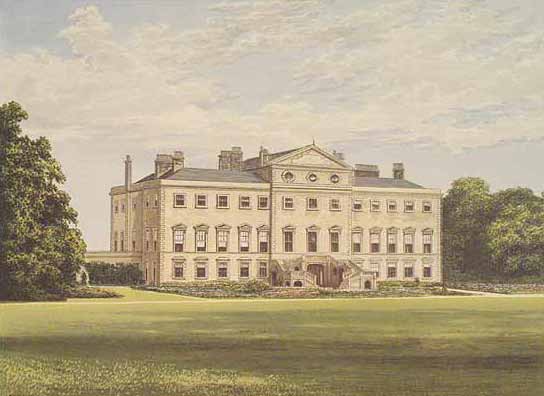
Lathom House, Morris's Country Seats 1880

Lathom House was a large country house in the parish of Lathom in Lancashire, England. Built between 1725 and 1740, the main block was demolished in 1925.

Early history

[edit]
Artist's impression (1864) of Lathom House at the time of the Civil War
Arms of Latham of Latham: Or, on a chief indented azure, three plates. Quartered by Stanley, Earl of Derby

A wooden castle is believed to have stood on the site in mediaeval times. Sir John I Stanley of the Isle of Man (1350–1414), Lord Lieutenant of Ireland and King of Mann married Isabel Latham, daughter and heiress of Sir Thomas Latham of Latham.[1] The stone-built castle known as Lathom House, built by the Stanley family in 1496, had eighteen towers, and was surrounded by a wall six foot thick and a moat eight yards wide, its drawbridge defended by a gateway tower. In the centre of the site was a tall tower known as the Eagle Tower.[2]

In 1554, Protestant martyr George Marsh, was questioned at Lathom House by Edward Stanley, 3rd Earl of Derby before being sent to Lancaster Castle.[3]

Lathom House was the last Royalist stronghold in Lancashire during the English Civil War and was twice besieged by Parliamentarian forces. During the first Siege of Lathom House by Sir Thomas Fairfax in 1644, the house was defended by Charlotte Stanley, Countess of Derby and 300 men who kept possession until Royalist forces under Prince Rupert of the Rhine arrived in the area en route to attack Bolton. After the siege, at Rupert's insistence, the countess and her retinue moved to the Isle of Man, with the defence of the house being entrusted to professional soldiers. In 1645 the house was again besieged by General Egerton with 4000 Parliamentarian soldiers, and was surrendered after a protracted siege after which the fortifications were demolished by the Parliamentarians.[4] James Stanley, 7th Earl of Derby, husband of Charlotte, was beheaded in Bolton by the Parliamentarians in 1651 for treason. The Stanley manors were confiscated by Parliament.[5]

Post Restoration

[edit]
The surviving West Wing of Lathom House

After the Restoration of the monarchy in 1660, Lathom House was returned to the Stanleys and remained with them until 1714 when it passed by the marriage of Henrietta Stanley to John Ashburnham, 3rd Baron Ashburnham who sold it.[5]

It was subsequently bought by Sir Thomas Bootle, MP for Liverpool,[5] who commissioned Giacomo Leoni to rebuild the house as the finest Palladian house in the county. Built over 15 years from 1725–40, its deer park was designed by renowned landscape gardener Humphry Repton.[6]

It passed through his niece to Richard Wilbraham Bootle and their son, Edward, Lord Skelmersdale.[5] The latter's grandson Edward inherited and was made Earl of Lathom. Edward's son, the second earl, was accidentally shot and died in 1910. The last resident of Lathom House was Edward Bootle-Wilbraham 3rd Earl of Lathom (and 4th Baron of Skelmersdale). During the First World War the hall was used for military purposes, mainly the training of horses, and after the war the third earl decided not to renovate and reoccupy it but to live instead at nearby Blythe Hall.[7]

The estate was sold in 1920 to a London consortium. After a brief period as a boys’ school, the main block of the house was demolished in 1925.[8] The estate land of 4000 acres was sold piecemeal, mainly to the tenants. The remaining west wing of the house was converted to apartments.[9]

Archaeology

[edit]
Almshouses near site of house

The ruins of Lathom House were excavated by the Historical Council of Northern Lancashire, in its efforts to reconstruct the 18th-century buildings; the team on site came across medieval foundations and have tried to salvage them. While the main buildings became uninhabitable several decades ago, there are almshouse cottages neighbouring the Lathom Park Chapel.[10]

See also

[edit]

References

[edit]
[edit]
Revisions and contributorsEdit on WikipediaRead on Wikipedia
from Grokipedia
Lathom House was a fortified country house in the parish of Lathom, , , serving as the principal seat of the , Earls of , from the late . Originally constructed as a medieval manor with castle-like features including towers and a , it symbolized the power of the Stanleys, who transformed it into a prominent Northern English residence visited by monarchs such as Henry VII and . The house achieved lasting historical significance during the as a stronghold, most notably during the first of Lathom in 1644, when Charlotte de La Trémoïlle, Countess of Derby, led its defense against a superior Parliamentarian force of around 2,000 men with only a small , employing guerrilla tactics and repelling assaults until relieved by Prince Rupert. A second siege in 1645 resulted in its capture and near-total destruction by Parliamentary forces under Colonel Ralph Assheton. Rebuilt in the between 1725 and 1740 as a grand Palladian mansion, the structure stood until its main block was demolished in 1925 due to decay and financial pressures, leaving only the west wing and associated stables as Grade II* listed remnants amid the former parkland. Today, the site's architectural fragments and historical associations underscore its role in Lancashire's feudal and military heritage, with ongoing efforts by trusts to preserve and interpret its legacy.

Origins and Early Development

Prehistoric and Medieval Foundations

Archaeological surveys at Lathom have uncovered evidence of prehistoric activity dating to approximately 5000 BC, marking the site's earliest known human occupation in the region. This period of settlement transitioned into continuous farming practices, indicating sustained use of the landscape for subsistence long before . The manor of Lathom originated in the Norman era, held initially by Siward, son of Dunning, in thegnage tenure during the reign of Henry II (1154–1189). By the late 12th century, it was under the control of the Lathom family, with Robert Fitzhenry de Lathom—described as lord of Lathom—founding Burscough Priory in or before 1189 and endowing it with lands, the churches of Ormskirk and Flixton, and other grants. Subsequent Lathom lords, including Richard and Robert (sons or brothers in the lineage), confirmed and expanded these donations to the priory, strengthening ecclesiastical ties that underscored the manor's regional influence. By the , Lathom had evolved into a prominent baronial residence for the Lathom family, supported by basic defensive features such as earthwork banks and ditches forming a moated . The manor was held of the of through feudal obligations, including an annual payment of 20 shillings, regular suit at the every six weeks, and at the wapentake every three weeks, reflecting its integral role in local governance and hierarchies. These elements established Lathom's foundational importance as a key feudal holding in prior to its inheritance by later families.

Acquisition and Fortification by the Stanleys

In the late , the manor and estate of Lathom passed to the through the marriage of de Lathom, sole heiress of the ancient Lathom lineage, to Sir John Stanley of Knowsley, likely around 1385. This union integrated Lathom's substantial Lancastrian lands—spanning manors, woods, and agricultural holdings yielding significant feudal revenues—into the rising Stanley patrimony, which already encompassed estates in and . Sir John's military service to , including governance roles in Ireland, further bolstered family resources; in 1405, King Henry IV granted him hereditary lordship over the Isle of Man as reward for quelling rebellions there, providing annual customs duties and feudal incomes estimated in later records at over £1,000, enabling subsequent infrastructural investments without reliance on royal subsidies. Sir John and Isabel's grandson, Thomas Stanley (c. 1435–1504), inherited Lathom amid the Wars of the Roses and leveraged his strategic neutrality—culminating in decisive support for Henry Tudor at the on 22 August 1485—to secure elevation as 1st Baron Stanley in 1456 and, post-victory, as 1st on 27 October 1485, with Lathom designated a principal seat. These honors, tied to Tudor consolidation rather than mere prestige, amplified Stanley influence in , where Lathom's position near the Scottish border and trade routes offered defensive and logistical value. The earldom's creation formalized control over aggregated estates, including Manx revenues and tenancies, generating surpluses that funded defensive upgrades amid lingering Yorkist threats and regional power vacuums. Under the 1st Earl's direction, Lathom underwent major circa 1496, transforming the medieval into a robust quadrangular complex—one of England's larger fortified residences—with a central flanked by at least seven or eight towers (contemporary accounts vary, some citing nine), enclosing walls up to 6 feet thick, and a surrounding fed by local springs for water defense. These enhancements, including towers and walls, prioritized functionality over ornament, reflecting causal imperatives of border security and estate protection in a post-Wars era of feudal consolidation; Bishop Stanley of Sodor and Man later attested in 1562 that the Earl had effectively "built Lathom Hall out of the ground," underscoring the scale of reconstruction from earlier timber-and-earth structures. Funding derived pragmatically from diversified Stanley holdings—Manx customs, rents, and manors—rather than speculative loans, positioning Lathom as a Lancastrian power nexus without overextension.

Architectural and Defensive Features

Medieval Layout and Structures

The medieval Lathom House, erected in the late by Thomas Stanley, 1st Earl of Derby, comprised a fortified with integrated domestic and defensive architecture centered on a principal . This hall formed the core of the complex, flanked by service courts and private chambers typical of high-status late medieval residences, where daily governance and feasting occurred. Enclosing the inner structures were substantial curtain walls reinforced by nine towers, which provided defensive oversight and articulated the site's military character, while a broad enhanced natural barriers against assault. Gatehouses facilitated controlled access, blending functionality with symbolic display of the Stanley family's power. Historical accounts from the early , predating major alterations, document this configuration, emphasizing its scale as among the largest private fortified houses in at the time. A dedicated , founded as a in 1500 by the 1st , adjoined the main buildings and included an attached for distribution, underscoring the site's and charitable dimensions alongside its residential role. Priests endowed for perpetual masses reflected standard late medieval practices for such endowments. Archaeological evidence from geophysical surveys and excavated stone fragments verifies the moat's extent and the walls' robust construction using local , with anomalies indicating tower bases and linear defenses aligned with documentary descriptions. These findings, derived from non-invasive magnetometry and targeted trenching, reveal no significant deviations from the reported medieval footprint, though subsurface preservation varies due to later landscaping.

Military Fortifications and Adaptations

Lathom House was enclosed by a measuring eight yards in width and two yards in depth, which encircled the entire structure and served as a primary barrier against assaults. A spanned the moat, protected by a gateway tower that facilitated controlled access while enabling defensive fire. The outer walls, constructed to a thickness of two yards, supported nine towers positioned to provide enfilading fire, functioning effectively as angular bastions for covering adjacent wall sections against musket-armed attackers. At the center stood the five-staged Eagle Tower, which dominated the internal and offered elevated observation and command positions. Post-1500 enhancements adapted the fortifications for weaponry, with each of the nine towers equipped with six pieces of ordnance—typically three directed toward each facing flank—to counter early threats and provide overlapping fields of fire. towers incorporated marksmen armed with screwed guns and long fowling-pieces, reflecting integration of handheld firearms into the defensive scheme for close-range repulsion of scaling parties or breaches. These towers likely doubled as armories, housing the ordnance and necessary for sustained engagements, as indicated by post-siege sequestration inventories documenting the stock. The site's elevated position on a gentle bluff in enhanced natural defensibility by complicating enemy artillery placement, as slopes limited stable battery positions and exposed approaching forces to . As the principal seat of the Stanley earls, Lathom's location approximately four kilometers east of positioned it to influence loyalties across , a region of divided allegiances where fortified manors like this asserted control over local tenantry and supply routes. Provisions storage, while not itemized in surviving records, was supported by the estate's capacity to sustain a of 118 to 140 servants in the late , implying vaulted cellars and granaries stocked for extended self-sufficiency. Earthworks and palisades supplemented the stone defenses, forming a layered that prioritized attrition over outright impregnability.

Role in the English Civil War

Strategic Context and Preparations

Lathom House served as the ancestral seat of James Stanley, 7th , a prominent leader in northwestern whose control extended to the Isle of Man, providing access to resources for military stockpiling amid the outbreak of the in 1642. Stanley, leveraging his influence over Lancashire's gentry and Catholic supporters, issued warrants from Lathom on 17 August 1642 to muster trained bands at Preston, excluding recusants, and committed to raising 3,000 foot and 500 horse, contributing to an estimated 16,000 men loyal to the king across the county. By October 1642, he summoned additional forces at to integrate with allies from adjacent counties, establishing Lathom as a operational hub for mobilization. Lancashire's allegiances were sharply divided, with four of its six initially favoring the Royalists due to dominance and Catholic enclaves, while and leaned Parliamentarian, as evidenced by early musters and Manchester's resistance to Stanley's attempts to secure it. Royalist garrisons, totaling around 1,400 men across sites like (400), Preston (300), and (200) by December 1642, underscored Lathom's role as a bastion amid Parliamentarian gains, particularly after their consolidation in urban centers. In December 1642, Stanley organized collections yielding £8,700 to sustain 2,000 foot and 400 horse, directing resources toward fortified magazines at Preston, , and to bolster northern defenses. Pre-siege preparations at Lathom intensified by early 1643 with earthwork fortifications enhancing its medieval defenses—a 6-foot-thick wall, 24-foot-wide moat, nine towers each mounting six guns, palisades, and the Eagle Tower—transforming it into a self-sustaining stronghold. By February 1644, the house was provisioned with ample food and arms for a garrison of approximately 300 under Colonel Rawsthorne and Colonel Vere, reinforced by Stanley's wife, Charlotte, Countess of Derby, following his campaigns in the Isle of Man. These measures, documented in Stanley's warrants and correspondence, positioned Lathom as the last major enclave in against encroaching Parliamentarian forces.

The 1644 Siege and Defense

The siege of Lathom House commenced on 28 February 1644, when a Parliamentarian force of approximately 2,000 to 3,000 men under Richard Shuttleworth and John Moore invested the stronghold. Command of the besiegers passed to Rigby by late , who coordinated assaults amid growing numerical superiority. The Royalist garrison, numbering about 300 including officers such as Rawsthorne and Vere, was led by Charlotte Stanley, Countess of Derby, whose husband, James Stanley, 7th Earl of Derby, had departed for the Isle of Man earlier that month. On 11 March, Rigby issued a formal demanding surrender of the , arms, and , which the Countess rejected outright, affirming her intent to hold the position in loyalty to the king regardless of the odds. Subsequent summonses in met similar defiance, with the Countess emphasizing in her responses that personal safety yielded to duty and royal allegiance. She actively rallied the defenders, enlisting women of the household to support logistics and morale, framing the stand as a collective obligation transcending individual peril, as recorded in contemporaneous dispatches attributed to her direction. Parliamentarian tactics included heavy bombardment starting 12 March, with over 100 shots fired alongside stone projectiles and limited grenades, aiming to breach the and palisades but yielding only superficial damage to the fortified structures. Attackers attempted mining operations to drain the , but these faltered due to wet terrain and engineering shortcomings, prompting no effective countermining from the outnumbered . Defenders countered through aggressive sorties, such as one on 26 April that seized an enemy mortar and disrupted siege lines, alongside sustained fire from the that repelled direct assaults. Royalist logs, including accounts from James Chisenhale, report roughly 500 Parliamentarian fatalities from these engagements, against fewer than 10 defender losses, highlighting the efficacy of disciplined resolve and terrain leverage despite vast disparities in manpower and supplies. The prolonged defense, sustained into May through rationing and tactical opportunism, demonstrated how fortified resolve could prolong resistance against superior besieging forces reliant on attrition.

Relief, Capture, and Aftermath

The first siege of Lathom House concluded on 27 May 1644, after approximately three months, when Prince Rupert of the Rhine advanced toward the stronghold with several thousand cavalry and infantry, compelling the Parliamentarian besiegers under Colonel Alexander Rigby to abandon their positions and retreat toward Bolton. Rupert's forces subsequently assaulted Bolton on 28 May, resulting in heavy Parliamentarian losses in what became known as the Bolton Massacre. Royalist narratives, including contemporary accounts of the defense led by Charlotte Stanley, Countess of Derby, portrayed the garrison's resistance as an exemplar of valor, with the countess personally overseeing sorties and fortifications against superior numbers. A second siege commenced in July 1645, following the Parliamentarian victory at Marston Moor, with forces under Sir Thomas Fairfax and others numbering around 4,000 besieging the house, then held by a of about 300 under Ralph Rawstorne. Lacking relief after the Royalist defeat at in June 1645, the defenders endured until supplies dwindled, surrendering on 2 December 1645 on terms that allowed the garrison to march out with arms but required the house's capitulation. Parliamentarian reports, such as those in John Vicars' parliamentary chronicles, framed the holdouts as obstinate and fanatical, contrasting with Royalist emphases on disciplined defiance. Following the surrender, Parliamentarian troops ransacked Lathom House, leading to its —deliberate partial demolition to render it militarily unusable—shortly thereafter, though elements like the reportedly escaped full destruction. James Stanley, 7th Earl of Derby, whose absence during the sieges stemmed from campaigns elsewhere including the Isle of Man, faced execution on 15 October 1651 at 's , with the judgment explicitly linking his fate to prior Royalist actions such as the tied to Lathom's and his broader resistance to .

Post-Civil War Reconstruction

Slighting and Initial Repairs

Following the surrender of Lathom House to Parliamentarian forces on 7 December 1645, the structure underwent systematic to render it indefensible and prevent future use, in line with broader policies toward captured strongholds. Western defences, including key towers and fortified walls, were deliberately demolished shortly thereafter, with archaeological evidence revealing demolition layers containing musket balls and rubble spreads consistent with targeted destruction of military features. By late 1645, the once-formidable complex had been reduced to just two or three surviving timber buildings amid widespread plunder and ruin. Under sequestration, the Stanley estates, including Lathom, faced strict oversight and confiscation risks, limiting any substantive repairs to essential preservation rather than restoration. Core non-military elements, such as the Eagle Tower, endured with minimal intervention, likely repurposed for basic habitation or estate management tied to agricultural tenancies on the surrounding lands. Sequestration accounts from this period document the site's diminished state, emphasizing its neutralization over rehabilitation, as sought to curb resurgence without fully dismantling habitable remnants. The and ensuing restrictions imposed tangible economic strains on the estate's operations, with sequestration disrupting rental income and prompting a failed 1653 for the purchase of Lathom and associated manors by Henry Neville and Anthony Samwell, which ultimately reverted to the . An of £600, charged against Lathom revenues to support the Countess of Lincoln and her children from Sir Robert Stanley's line, further encumbered the property's financial viability during this era of punitive oversight. These measures underscored Parliament's intent to erode the strategic and fiscal base of holdings like the Stanleys', prioritizing long-term debilitation over immediate total erasure.

Restoration-Era Enhancements

Following the Restoration of Charles II in 1660, , 8th , oversaw partial reconstruction of Lathom House to render portions habitable, prioritizing functionality amid financial constraints from wartime losses. Hearth tax assessments recorded only two working hearths in 1664–1665, reflecting limited initial usability, but this rose to 17 by , evidencing swift repairs to domestic wings and core structures. Masons were actively engaged by March 1670/1671 in rebuilding the Eagle Tower, a key central feature, as documented in contemporary correspondence, indicating targeted efforts to stabilize and repurpose surviving medieval elements rather than wholesale rebuilding. resided at Lathom intermittently in the early 1660s, shifting emphasis from defensive militarization to estate administration, including agricultural oversight and revenue recovery across Stanley holdings in . By his death in 1672, these pragmatic measures had restored basic operability to the site, with wooden additions and repaired towers supporting family occupancy. Architectural adaptations trended toward domestic comfort, as inferred from the expanded hearths and persistent use of outlying parks for and , though no major formal gardens are attested before the . Outbuildings likely received incremental for estate operations, aligning with the Stanleys' broader pivot to peacetime agrarian management over . later noted the Eagle Tower and associated wooden structures standing into the early 1700s, underscoring the durability of these modest enhancements.

The 18th-Century House

Construction of the Georgian-Era Building

The Georgian-era Lathom House was constructed between 1725 and 1740 as a complete rebuild of the earlier structures, commissioned by James Stanley, 10th Earl of Derby, following partial works initiated by his predecessor. The project transformed the site into a prominent Palladian mansion, reflecting the architectural trends of the early 18th century in England, with an emphasis on symmetry and classical proportions. Designed by the Venetian architect Giacomo Leoni, the house featured a central flanked by twin segmented colonnades that extended to wings, creating a grand yet balanced facade. This layout drew from Palladian principles, incorporating a pedimented central block and integrated service wings, distinguishing it as one of the county's finer examples of the style. The surrounding deer park was landscaped to complement the house, enhancing its estate-like functionality for the . Construction utilized local stone and materials, aligning with regional practices among Lancashire estates, though specific bills indicate financial strains that contributed to ongoing debts for the earldom. The design prioritized domestic utility over defensive elements, marking a shift from the site's medieval fortifications to a modern country house suited for 18th-century aristocratic life.

Ownership and Usage by Later Earls

Following the sale of the Lathom estate by the heirs of William Stanley, 9th Earl of Derby, to in 1724, the property served as the primary residence for the Bootle family after the construction of the Georgian house between 1725 and 1740. The Bootles maintained the estate with a focus on agricultural productivity, as evidenced by the passage of the Lathom and Enclosure Act in 1778, which enabled the reorganization of open fields into enclosed farms for improved cultivation and livestock management. In the early 19th century, the estate passed through marriage to the Wilbraham family, becoming the Bootle-Wilbraham property. Edward Bootle-Wilbraham (1771–1853) leveraged the estate's position to exert influence in politics, serving as for Westbury from 1795 to 1828 and participating in county governance. The family's social role extended to supporting local tenantry and administrative functions, though primary activities centered on estate oversight rather than frequent grand entertainments. Tithe maps surveyed in 1839 and accompanying apportionments document the surrounding lands predominantly allocated to tenant farms, with plots dedicated to arable, , and uses under leasehold arrangements typical of the period's agricultural . This configuration indicates a pragmatic shift toward income-generating farming operations, with the house itself functioning more as an administrative hub than a constant personal dwelling amid the owners' growing engagements in national affairs. By the mid-19th century, under continued Bootle-Wilbraham —culminating in the creation of the Earldom of Lathom for Edward Bootle-Wilbraham in 1880—the property retained its status as a key local landmark, albeit with episodic occupancy reflective of absentee management patterns common among .

Decline, Demolition, and Legacy

19th-Century Vicissitudes

In the early , Lathom House continued as the principal residence of the Bootle-Wilbraham family, who had inherited the estate through marriage connections to the Stanley lineage following its transfer from the in 1702. Edward Bootle-Wilbraham, created Baron Skelmersdale in 1828, resided there until his death in 1853, after which the property passed to his grandson, Edward George Geoffrey Howard Bootle-Wilbraham (born 1837). The house, set within a large spanning approximately five miles, was maintained as a Renaissance-style with associated domestic , reflecting ongoing family amid regional agricultural and early industrial developments, including collieries established to the south by mid-century. Significant architectural enhancements occurred around 1873, when the house was enlarged by architect Thomas Henry Wyatt, adapting the 18th-century structure designed by Giacomo Leoni to contemporary needs while preserving its Palladian influences. This period coincided with the family's rising political prominence; the younger Edward Bootle-Wilbraham was elevated to of Lathom in 1880 by , affirming the estate's status as a key aristocratic seat in despite broader economic shifts, such as the arrival of the railway to nearby in the 1840s, which facilitated access but did not evidently divert estate resources toward disuse. Visitor descriptions from the era portrayed the property as commanding fine views and well-kept grounds, with no contemporary accounts indicating substantial neglect or decay prior to the . The 1st Earl of Lathom served in high offices, including as from 1896 to 1898, during which time Lathom House functioned as a venue for social and political activities, though primary family focus increasingly shifted toward and other properties. Upon his death in 1898, succession by his son, Edward George Bootle-Wilbraham, the 2nd Earl (born 1864), marked a generational transition without reported conflicts, maintaining the estate's integrity into the . While industrial expansion in surrounding posed potential pressures on traditional landowning economies, estate records and descriptions emphasize continuity rather than acute vicissitudes, with the house remaining a symbol of familial prestige through the century's close.

1925 Demolition and Site Abandonment

In 1925, the main block of Lathom House was systematically demolished following a period of neglect and brief repurposing as a boys' school after the estate's sale in 1920 to a consortium. The razing prioritized economic recovery through the salvage and sale of materials such as stone, timber, and architectural features, reflecting broader interwar pressures on under-maintained country estates unable to generate sufficient income for upkeep amid rising taxes and labor costs post-World War I. The west wing and select outbuildings survived intact, alongside the 15th-century chapel and adjacent almshouses, which were preserved due to their historical significance and emerging statutory protections as Grade II-listed structures. These remnants contrasted with the central , which left the core site cleared without immediate plans for redevelopment. No organized advocacy for heritage preservation materialized at the time, as economic pragmatism overshadowed sentimental or cultural retention arguments. The former house grounds were promptly repurposed for farming, with approximately 4,000 acres of estate land subdivided and auctioned piecemeal for agricultural tenancy, effectively abandoning the site as a unified aristocratic domain. This transition aligned with the era's agrarian shifts and the Derby family's consolidation of holdings elsewhere, forestalling any revival until archaeological interest arose decades later.

Archaeology and Preservation Efforts

Early Investigations

In 1996, the Archaeological Unit conducted a comprehensive desk-based assessment, topographic survey, building recording, , and trial trenching at the site of Lathom House's to evaluate archaeological potential ahead of potential development. The desk-based component reviewed historical documents, cartographic sources, and prior records from the Lancashire Record Office, establishing baseline site layout by cross-referencing with 17th- and 18th-century maps that depicted features and house positions. surveys using magnetometry and resistivity over approximately 2,750 m² detected anomalies consistent with demolition rubble and infilled ditches, while trial trenches revealed a curvilinear rock-cut segment, 13 meters wide and over 1.5 meters deep, southeast of the , aligning with earthworks on topographic plans and supporting tracings of the late-medieval defensive perimeter from historical maps. Subsequent efforts from 1997 to 1999 by the Lathom & District Archaeological Society involved targeted excavations inside and adjacent to the , confirming layers of deliberate from the post-1645 demolition of the 15th-century house's western defenses through stratigraphic analysis of rubble and backfill deposits. In 1998, a joint geophysical and survey by Archaeological Services and the Lathom Society across the and adjacent farmland identified low-resistance anomalies interpreted as infilled arms, alongside potential masonry footings and ditches integrated with earlier map evidence to trace the broader moated platform's outline without uncovering medieval structures. These pre-2000 investigations provided foundational verification of the site's medieval footprint via non-invasive and limited invasive methods, prioritizing documentary and survey data over extensive excavation.

Recent Excavations and Findings

Since 2017, the Lathom Park Trust has coordinated community-led excavations and surveys at the site of the former Lathom House, employing geophysical techniques such as magnetometry and resistance surveys to delineate subsurface features. These efforts, building on earlier trial trenches, have confirmed the location of the late 15th-century fortified residence constructed around 1496 by the , challenging previous uncertainties about its precise footprint beneath later Georgian-era structures. The surveys revealed a substantial exceeding 15 meters in width encircling a sub-circular platform approximately 300 meters in diameter, encompassing areas like the historic to the east and the site of the 18th-century stables to the west. Stone analysis of recovered architectural fragments, funded by the Castle Studies Trust in 2017, identified elements consistent with 15th- and 16th-century construction techniques associated with the Stanleys, including carved panels featuring oak leaves and acorns symbolic of the family's heraldic traditions linked to their "" emblem. Additional artifacts, such as structural debris and sherds indicative of medieval occupation, corroborate the site's attribution to the Stanley , with stratigraphic pointing to the of defenses post-Civil . These findings were detailed in the 2017 Architectural Fragments Survey report and subsequent trust publications up to 2021, emphasizing empirical validation over speculative reconstructions. Current preservation initiatives by the Lathom Park Trust focus on mitigating from agricultural activity and natural weathering, which threaten buried remains, through targeted monitoring and limited intervention without introducing unverified elements like rumored treasures. Methodological rigor in these post-2010 investigations, including integration of cross-referencing with non-invasive , has prioritized verifiable data to refine understandings of the site's layout and phasing.

References

Add your contribution
Related Hubs
User Avatar
No comments yet.