Hubbry Logo
LegongLegongMain
Open search
Legong
Community hub
Legong
logo
8 pages, 0 posts
0 subscribers
Be the first to start a discussion here.
Legong
Legong
from Wikipedia
Legong
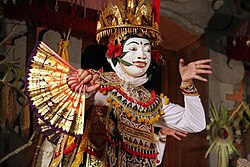
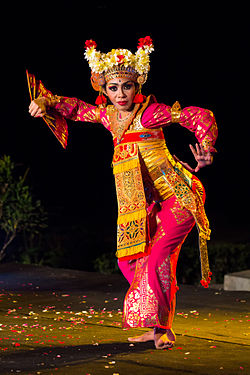
A Balinese adult performer of Legong Bapang Saba
Native nameBalinese: ᬮᬾᬕᭀᬂ, romanized: légong
InstrumentGamelan
InventorBalinese
OriginIndonesia
Three genres of traditional dance in Bali
CountryIndonesia
Reference00617
RegionAsia and the Pacific
Inscription history
Inscription2015 (10th session)
ListRepresentative
Wali Sacred Dances (Rejang, Sanghyang Dedari, Baris Upacara), Bebali Semi sacred Dances (Topeng Sidhakarya/Topeng Pajegan, Gambuh dance drama, Wayang Wong dance drama), Balih-balihan Entertainment Dances (Legong Kraton, Joged Bumbung, Barong Ket)

Legong (Balinese: ᬮᬾᬕᭀᬂ, légong) is a form of Balinese dance. It is a refined dance form characterized by intricate finger movements, complicated footwork, and expressive gestures and facial expressions.

Origins

[edit]

Legong probably originated in the 19th century as royal entertainment. Legend has it that a prince of Sukawati fell ill and had a vivid dream in which two maidens danced to gamelan music. When he recovered, he arranged for such dances to be performed in reality. Others believe that the Legong originated with the sanghyang dedari, a ceremony involving voluntary possession of two little girls by beneficent spirits.[1] Legong is also danced at public festivals. Excerpts from Legong dance dramas are put on for tourists.

Dancers

[edit]
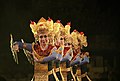
Two pre-adolescent girls performing Legong dance.

Traditionally, legong dancers were girls who had not yet reached puberty. They began rigorous training at about the age of five. These dancers were regarded highly in the society and usually became wives of royal personages or wealthy merchants.[2] They would usually stop dancing after marriage. However, in present, Indonesia dancers may be of all ages;[3] performances by men in women's costumes are also recorded.[4]

Story

[edit]

Classical Legong enacts several traditional stories. The most common is the tale of the East Javanese king of Lasem from the Malat, a collection of heroic romances. He is at war with another king, the father (or brother) of Princess Rangkesari. Lasem wants to marry the girl, but she detests him and tries to run away. Becoming lost in the forest, she is captured by Lasem, who imprisons her and goes out for a final assault against her family. He is attacked by a monstrous raven, which foretells his death.

The dramatics are enacted in elaborate and stylized pantomime. The two little actresses are accompanied by a third dancer called a condong or attendant. She sets the scene, presents the dancers with their fans and later plays the part of the raven.

Types

[edit]

Traditionally, fifteen types of legong dance were known. The duration, movement, and narrative of each type differed. Some, for instance, could last for an hour. These types included:[5]

  • Legong Bapang Sabab
  • Legong Jebog
  • Legong Kraton
  • Legong Kuntir
  • Legong Lasem
  • Legong Raja Cina
  • Legong Semarandana
  • Legong Sudasarna
[edit]

See also

[edit]
[edit]

Legong is mentioned in "I've Been To Bali Too", the single by Australian folk-rock band Redgum from their 1984 album Frontline.

References

[edit]
[edit]
Revisions and contributorsEdit on WikipediaRead on Wikipedia
from Grokipedia
Legong (from Balinese leg, meaning graceful movement) is a classical genre performed primarily by two or three young female dancers, featuring highly stylized, graceful movements with intricate hand gestures, expressive eye work, and geometric patterns that embody the elegance and refinement of Balinese artistry. The dance is secular in nature, classified as balih-balihan ( dance), and is traditionally accompanied by a orchestra, such as the pelegongan or pegulingan ensemble, which provides a melodic and rhythmic foundation through metallophones, gongs, and flutes. Originating in the royal courts of during the late , Legong emerged around 1889, created by dancers Anak Agung Rai Perit and I Dewa Ketut Belacing for the ruler I Dewa Manggis of Gianyar, drawing from the older andir dance form. It achieved its definitive structure between 1916 and 1932, incorporating influences from trance dances like sanghyang dedari and narrative traditions such as gambuh, while evolving into a courtly distinct from sacred rituals. Early performances were reserved for , but by , Legong gained international exposure through exhibitions like the 1931 , contributing to its preservation amid modernization. The dancers, typically pre-adolescent girls trained from a young age, wear elaborate costumes including tight waist belts, long skirts of gold-embroidered fabric in dark green or violet, gilt leather collars, and headpieces adorned with fresh frangipani flowers, often holding fans to accentuate gestures. Common repertoires include narrative pieces like Legong Keraton (based on of a king, princess, and crow) or abstract forms such as Legong Jobog, lasting 30 to 60 minutes and structured with an opening solo, dramatic interplay, and closing epilogue. Regional variations, such as Legong Peliatan from or Legong Saba, highlight local styles and subtle choreographic differences. In Balinese culture, Legong symbolizes beauty, youth, and spiritual harmony, serving as both an offering at temple festivals and a showcase of aesthetic discipline, though its popularity has fluctuated due to and from newer genres like kebyar. Conservation efforts, influenced by Western scholars and performers since the early , have helped sustain its core traditions while adapting it for global audiences.

History

Origins

The origins of Legong are rooted in Balinese legend, as recounted in the Babad Dalem Sukawati, a historical chronicle of the Sukawati kingdom. According to this account, during the reign of King I Dewa Agung Made Karna (1775–1825), the ruler meditated for 40 days and nights at Pura Yogan Agung in Ketewel and experienced a vivid dream of two celestial nymphs adorned in golden headdresses, gracefully dancing to divine music. Upon awakening, the king attributed his spiritual insight to this vision, which inspired the creation of Legong as a sacred tribute; he subsequently instructed court musicians and dancers to recreate the celestial performance, establishing fixed choreography for the dance form. Historically, Legong emerged in the late as an elite courtly in the Sukawati palace, with its definitive form dated to around 1889, when it was choreographed by Anak Agung Rai Perit and I Dewa Ketut Belacing for King Dewa Manggis of nearby Gianyar. This development drew influences from pre-existing Balinese traditions, including the trance-induced movements of the sanghyang dedari ritual—where young girls enter a hypnotic state to channel benevolent spirits—and the narrative gestures and melodic structures of the gambuh dance-drama, which provided a foundation for Legong's stylized storytelling. These elements were secularized and refined into a non-trance performance, distinguishing Legong as a polished balih-balihan () genre while retaining ritualistic grace. In its initial contexts, Legong was performed exclusively for Balinese nobility during palace festivals, ceremonies, and royal gatherings, serving as a symbol of refinement and devotion within the feudal courts of Sukawati and surrounding kingdoms; public viewings were not permitted, emphasizing its status as a privileged art form. The name "Legong" derives from the Balinese words leg, denoting loose or graceful movements, and gong, referring to the orchestra's rhythmic cycles, underscoring the dance's emphasis on fluid, elastic synchronized with musical accompaniment.

Historical Development

Following its emergence in the late 19th century at the Sukawati court, Legong spread to other Balinese royal centers, including the courts of Gianyar and Klungkung (Puri Semarapura), where it was adapted and refined for local performances. In Gianyar, the dance was formalized in 1889 by choreographers Anak Agung Rai Perit and I Dewa Ketut Belacing at the request of ruler I Dewa Manggis, incorporating elements from earlier forms like the mid-19th-century andir dance created by I Gusti Ngurah Jelantik. These refinements included the addition of the condong (attendant) role, first introduced in Sukawati around 1910 and subsequently in Peliatan (1916), Keramas (1927), Saba (1930), and Badung (1932), enhancing the narrative structure and group dynamics. During the Dutch colonial period in the early 20th century, Legong gained exposure beyond Bali through performances organized under colonial auspices, marking its introduction to Western audiences. In 1931, a Balinese dance troupe, including Legong performers, presented at the Paris Colonial Exhibition, captivating European viewers with its grace and leading to stylistic adaptations for international stages, such as simplified narratives to suit shorter formats. Further visibility came via tours to Java and the 1935 silent film Legong: Dance of the Virgins, filmed in Ubud and distributed in Europe and the United States, which prompted Balinese artists to incorporate Western influences like faster tempos while preserving core techniques. These exposures, amid Dutch rule from 1906 onward, spurred innovations in accompaniment, notably in the 1930s when composers like I Wayan Lotring integrated kebyar-style gamelan elements—characterized by dynamic, explosive rhythms—into Legong, as developed by earlier Gong Kebyar pioneers such as I Mario in the 1920s. After Indonesian independence in 1945, Legong underwent standardization and institutionalization to ensure its transmission amid modernization. The establishment of arts academies, including the Institut Seni Indonesia (ISI) in 1967, formalized training curricula that codified Legong techniques, movements, and repertoires, drawing from regional variants to create unified educational standards. This led to the development of new variants, such as Legong Pancer Langit, designed for pedagogical purposes to teach philosophical concepts like (harmony with God, humans, and nature) in academic settings. A pivotal milestone was the 2015 UNESCO inscription of "Three Genres of Traditional Dance in Bali" (ICH-00617) on the Representative List of the of Humanity, recognizing Legong as a semi-sacred form integral to Balinese identity. This designation spurred preservation efforts, including community workshops, digital archiving at ISI , and international performances for , such as the 2023 Jeddah Festival presentation of Legong Pancer Langit to promote Indonesian heritage globally. By 2025, these initiatives have sustained Legong's vitality, with ongoing programs emphasizing youth involvement to counter tourism commercialization.

Description

Technique and Movements

Legong dance is characterized by its refined and intricate physical techniques, emphasizing fluid grace and precise control to convey narrative depth. Central to its style are the mudras, or codified hand and finger positions, which dancers articulate with high precision to symbolize deities, , , and actions in . These gestures, often involving extended or trembling fingers, allow for the of complex narratives such as conflict and without verbal . Similarly, synchronized eye gazes, known as seledet, involve rapid, darting glances that intensify expressions and synchronize with the dancers' unison movements, creating an ethereal, fleeting quality to the performance. The undulating torso movements, achieved through constant weight shifts and subtle bends, contribute to the dance's bird-like grace, evoking a sense of lightness and asymmetry in poses. Footwork is rapid and complicated, forming geometric patterns on the stage while avoiding heavy stomps to preserve the feminine delicacy inherent to Legong. These elements contrast sharply with the vigorous, angular motions of other Balinese forms like Baris, which prioritize power and warrior stances over Legong's emphasis on suppleness and refinement. Stylized forms the core of Legong's expressive vocabulary, where gestures and body isolations fleetingly portray narrative actions, emotions, and natural phenomena, such as a bird's flutter or a character's inner turmoil. Dancers maintain central balance through tensed arms and forward-leaning torsos with bent legs, enabling delicate head tilts and rapid shifts that build rhythmic intensity. Pacing that accelerates alongside cues culminates in climactic, frozen poses, heightening the dramatic tension.

Costumes and Accessories

The traditional attire of Legong dancers embodies opulence and symbolism, beginning with the gelung supit urip headdress, a distinctive twin-tower structure crafted from gold-painted leather or gilded materials, adorned with fresh frangipani flowers and secured by gold sanggul hairpins to evoke divine elegance. The upper body is covered by a kebaya-style prada blouse, featuring intricate gold leaf applications via the prada technique, which involves adhering thin gold foils to cloth for a shimmering effect that signifies purity and festivity. This is paired with a prada sarong, a wrapped skirt similarly embellished with gold motifs, often in dominant gold tones accented by white or yellow to represent sacredness, though vibrant hues like red and gold appear in performances depicting royalty. A sangrai shawl, or tutup dada breast cloth, a narrow strip of prada fabric, drapes over the shoulders and chest, completing the layered ensemble that accentuates graceful movements. Key accessories enhance the ethereal quality of the performance, including the prasi, a fan made from painted palm leaves, wielded to execute dramatic, fluttering gestures that mimic natural elements like birds or flowers in the narrative. Gelang bracelets, constructed from gilded or prada cloth and worn on the upper arms and wrists, along with ornamental sanggul pins in the headdress, symbolize celestial beings and heavenly grace, aligning with the dance's angelic aesthetic. Dancers perform barefoot, allowing direct contact with the performance space to underscore the dance's rooted connection to Balinese earth and spirituality. In the condong role, which precedes the main Legong duet as a servant or attendant, the attire features simpler variations—often in white or pastel shades with reduced gold embellishments—to denote subordinate status and contrast the protagonists' lavish opulence, while retaining core elements like the headdress and for stylistic unity. Over the , Legong costumes adapted to practical needs, incorporating synthetic fabrics and alternatives such as silk-screened gold paper during wartime shortages in the , followed by more resilient materials from the onward to withstand intensive performance schedules, all while maintaining symbolic motifs inspired by Hindu-Balinese iconography like floral and divine patterns.

Music and Accompaniment

The classical form of Legong is primarily accompanied by the semar pegulingan, an ensemble characterized by soft, intricate melodies that emphasize a shimmering, ethereal quality through paired tunings in a five-tone scale. This orchestra features metallophones such as (tuned to 13 keys), , calung, and jegogan for melodic elaboration and interlocking patterns (kotekan); tuned gongs including terimpong, kemplung, kempur, and kelenang for cyclical punctuation; rhythmic support from drums, kajar, and ceng-ceng cymbals; and flutes that add delicate, flowing lines. For faster-paced variants of Legong, such as Kebyar Legong, the provides accompaniment, highlighting dynamic crescendos, abrupt accents, and virtuosic interplay among lighter bronze instruments modified for speed and brilliance. The musical structure of Legong accompaniment relies on colotomic cycles, where large gongs and smaller percussion mark nested time units, creating a repetitive yet evolving framework that supports the dance's narrative flow. drums lead these cycles by signaling transitions between sections, while ceng-ceng cymbals produce ujan patterns—rapid, rain-like bursts—for atmospheric tension and texture. The accompaniment remains purely instrumental, with no vocal elements, allowing the core (pokok) to unfold through heterophonic elaboration by the ensemble. Synchronization between and dance is achieved through variations, shifting from slow andeg (deliberate and flowing) to fast cepat (energetic and impulsive), which mirror the building narrative tension in Legong stories. Specific colotans—gong strikes at cycle endpoints—delineate scene transitions, enabling dancers to align precise gestures with musical peaks and releases. In the 1920s, Balinese musicians like I Wayan Lotring innovated Legong accompaniment by integrating kebyar elements into the palégongan (semar pegulingan variant), introducing rhapsodic melodies, subtle rhythmic shifts, and heightened expressiveness to enhance dramatic interplay with the dance. Figures such as Anak Agung Gede Mandera further supported these developments by preserving and lending classical sets for teaching Legong-related repertoire, bridging traditional and emerging styles.

Performance

Dancers and Training

In traditional Legong performances, the primary dancers consist of two pre-pubescent girls, ideally aged 5 to 10, portraying the main legong roles, often accompanied by a third girl as the condong, or attendant, who introduces and supports the narrative through dance. This trio emphasizes ideals of purity and grace, with the young performers selected for their natural elegance and often retiring after puberty to preserve the dance's symbolic innocence. Training for Legong typically begins at age 5 within sanggar, community-based schools, or compounds in , where aspiring dancers undergo structured instruction under experienced . Sessions occur daily for 2 to 4 hours, emphasizing progressive development of flexibility, endurance, and precise memorization of movements and sequences through oral transmission and hands-on guidance from the , who physically demonstrates and corrects postures. The process fosters both physical prowess and mental discipline, with knowledge passed down verbally without written notation to maintain cultural authenticity. Physical preparation centers on exercises enhancing mobility, such as controlled twisting to achieve fluid, serpentine extensions and isolated movements for expressive head tilts and glances that convey emotion. Mental and spiritual readiness incorporates Balinese Hindu rituals to seek blessings for skill, health, and harmony during training. Since the , contemporary practices have expanded to include adult female dancers and, in some variants, male performers, adapting the form for broader accessibility while retaining core techniques. Career trajectories for Legong dancers traditionally led from palace-based troupes serving royal entertainment to modern professional companies performing at cultural venues like Ubud Palace. Recent curricula in the 2020s integrate health-focused elements, such as balanced strengthening routines to prevent joint strain from repetitive motions, drawing on studies showing Legong training's superiority in improving muscle strength and balance over standard aerobic exercises.

Structure of a Performance

A Legong performance often features three female dancers: two principal who portray the main characters and mirror each other's movements with precise synchronization, and one Condong who serves as a narrator-servant facilitating transitions, though some variants use only two dancers. The ensemble is limited to these dancers, with no chorus, emphasizing intimate dynamics over large-scale spectacle. The structure begins with an opening sequence known as pepeson, where the Condong performs a solo introduction to set the scene, entering gracefully and establishing the ritual atmosphere through fluid, preparatory movements. This is followed by the entrance of the Legong duo, who join in mirrored , initiating the core narrative enactment in the pengawak phase with slow, melodious tempos and the Condong handing props like fans to aid transitions. The performance progresses to the pengecet phase, building intensity with faster rhythms, before reaching the climactic pengipuk phase featuring a or resolution through dynamic poses, where the Condong often assumes a supporting role such as a character to heighten the drama. The piece concludes with a brief pekaad phase, marked by a reverent sembah of prayer and submission, allowing the dancers to exit harmoniously. Accompaniment comes from a ensemble, typically the gong semar pagulingan variant, positioned behind the dancers to create an immersive staging that envelops the performance in layered sound without visual distraction. Performances adapt to venue: in temple odalan ceremonies, audiences are seated in ritualistic settings within courtyards, prioritizing spiritual integration over theatrical flair; on stages for public shows, illumination and framing enhance visibility for larger crowds. A full traditional Legong performance typically lasts 30 to , though shortened versions for tourists may range from 10 to 15 minutes; as of 2025, Legong is often part of 60- to 90-minute shows combining multiple dances at venues like .

Repertoire

Core Narrative

The core narrative of classical Legong draws from the Panji cycle, specifically the tale of the East Javanese king of Lasem, who becomes enamored with Rangkesari of the Daha kingdom. In this story, King Lasem, driven by , abducts the princess against her will, intending to force her into , which sets off a chain of events highlighting themes of passionate desire clashing with personal autonomy. Rangkesari's brother, a valiant warrior prince, embarks on a perilous quest to rescue her, embodying the duty of familial protection and honor. The narrative unfolds without spoken dialogue, conveyed instead through intricate sequences of gestures and movements that depict the emotional turmoil of abduction, lamentation, and impending conflict. As the story progresses, key scenes emphasize the tension between love and fate. Rangkesari expresses her sorrow and resistance in poignant scenes, pleading for release while the king persists in his pursuit, his gestures portraying both ardor and arrogance. The warrior's arrival leads to a dramatic confrontation, where the rivals face off in stylized battle poses, symbolizing the broader struggle between individual will and cosmic order. A pivotal moment occurs when the condong dancer embodies a omen—a fierce messenger, often depicted as a crow—that swoops upon King Lasem as he rides to war, foretelling his doom after his horse stumbles; this intervention underscores the inexorable pull of destiny. The tale culminates in or tragic resolution, with the princess's pleas and the omen's warning evoking a sense of inevitable harmony restored through sacrifice. Symbolically, the narrative weaves Hindu-Balinese moral lessons on , illustrating how human actions must align with natural and divine forces to maintain balance. The , enacted by the condong, serves as a bridge between the earthly realm and the , representing the between humans and nature as a guiding ethical principle. These elements are distilled into 8-10 gesture sequences in the archetypal 8-minute Keraton version, which abbreviates the full story to focus on key dramatic moments like the abduction, , and omen, prioritizing profound emotional depth—such as the king's yielding to fateful —over elaborate plot intricacies.

Variants

Legong encompasses numerous variants, with scholars documenting up to 15 distinct types that adapt the core graceful techniques to different narratives and contexts across . These forms maintain the intricate finger movements and expressive gestures central to the genre, while varying in story emphasis, duration, and regional execution. The most formal and widespread variant is Legong Keraton, a palace-derived performance lasting approximately 8 minutes that centers on the archetypal Lasem-Rangkesari tale of abduction and romance. Performed by three young female dancers—two legong and one condong—this version highlights refined, symmetrical patterns and is accompanied by the Pagulingan ensemble, embodying Balinese royal aesthetics. Legong Lasem represents an extended narrative iteration, running about 12 minutes and based on the tale set in the Lasem region, with heightened focus on the king's descent into madness and the climactic battle sequences. This form expands the dramatic tension of the core story, incorporating more dynamic confrontations between the king, the , and symbolic figures like the ominous . Among other notable types, Legong Jobog, a shorter piece of around 5 minutes, draws from the Ramayana-inspired tale of monkey kings Subali and Sugriwa, depicting their rivalry over a and Subali's fateful defeat by Prince Rama. Up to 15 such variants exist, including 20th-century innovations like Legong Kuntir and Legong Semarandana, some adapted for ritual purposes such as communal healing or offerings. Regional differences further diversify Legong, with southern Balinese styles featuring faster tempos and more vigorous dynamics, contrasted by the slower, gentler interpretations in northern that prioritize lyrical flow. Since the , abbreviated versions have proliferated for tourist audiences, condensing narratives to 10-15 minutes while preserving essential motifs for broader accessibility.

Significance

Role in Balinese Culture

Legong holds a central place in Balinese Hindu society, where it may be performed at temple festivals such as odalan anniversaries, serving to entertain while contributing to communal celebrations and spiritual harmony. As a form of balih-balihan entertainment, it blends aesthetic display with communal reverence. Socially, Legong symbolizes ideal feminine grace and devotion, with its intricate movements by young female dancers embodying characters from Balinese narratives and drawing from tales like the Panji cycle to illustrate themes of , conflict, and . This representation reinforces community cohesion and spiritual balance, positioning the dance as a cultural emblem of refined piety and interpersonal harmony within Balinese traditions. In its educational and communal dimensions, Legong is transmitted through banjar village councils, where rigorous training instills customs and preserves , often emphasizing gender dynamics as female performers channel divine essences. This practice fosters intergenerational continuity, enabling communities to uphold Balinese identity amid evolving social structures. Historically, prior to the , Legong was confined to royal palaces for elite rituals, embodying royal piety and exclusivity as a courtly privilege under aristocratic patronage. Post-World War II, it underwent , expanding to community-based troupes that broadened access and integrated it into wider village life.

Global Recognition and Modern Adaptations

Legong gained international prominence beginning in the through performances by Balinese troupes at major European events, such as the 1931 Paris International Colonial Exposition, where the dance's intricate movements captivated audiences and influenced Western perceptions of Balinese artistry. This exposure continued in the 1950s with a Balinese ensemble's tour across and the in , integrating Legong into global festival repertoires and fostering cross-cultural appreciation. The dance's worldwide recognition was further solidified in 2015 when inscribed "Three genres of traditional dance in "—encompassing sacred, semi-sacred, and entertainment forms including Legong Keraton—on the Representative List of the of Humanity, highlighting its cultural significance and spurring international preservation initiatives. Tourism has profoundly shaped Legong's presentation since the early , with abridged versions emerging in the for visitor concerts in Bali's emerging hubs like and later Kuta, transforming the dance into a key economic driver for local performers while raising concerns over artistic dilution through simplified narratives and shortened durations. By the 1970s, these tourist-oriented adaptations had become fixtures in coastal and inland resorts, generating substantial revenue—contributing to Bali's , which supports dance troupes amid pressures—but often at the expense of traditional depth, as noted by cultural observers critiquing the shift toward over essence. Contemporary hybrid productions blending Legong with modern elements, such as Western , have emerged in Bali's scenes, offering innovative interpretations that appeal to diverse audiences while preserving core gestural vocabularies. In recent decades, Legong has seen experimental adaptations featuring male and adult performers, diverging from its classical emphasis on young dancers to explore , including instances of male dancers in traditional roles. Balinese diaspora communities in and the have established teaching programs to retain the , with groups like N U S A N T A R A Sydney Dance in and Nusantara Dance Company in offering workshops that transmit techniques to second-generation learners, ensuring cultural continuity abroad. Preservation efforts continue amid environmental challenges, with adaptations to materials for costumes. Online platforms like have democratized global access to Legong training as of 2025, with tutorial videos from Balinese instructors enabling remote learners worldwide to study foundational poses and sequences, supplementing in-person transmission.

References

Add your contribution
Related Hubs
User Avatar
No comments yet.