Hubbry Logo
Kuda LumpingKuda LumpingMain
Open search
Kuda Lumping
Community hub
Kuda Lumping
logo
8 pages, 0 posts
0 subscribers
Be the first to start a discussion here.
Kuda Lumping
Kuda Lumping
from Wikipedia
Kuda Lumping
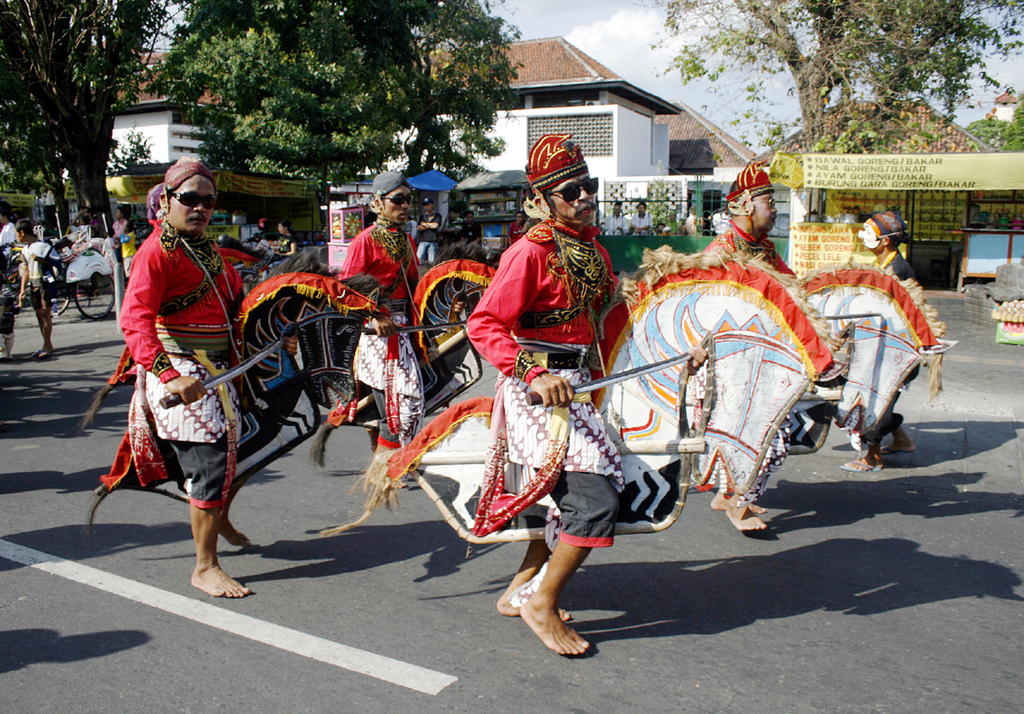
Men ride rattan horses while spectators watch
Kuda Lumping dance during a festival in Yogyakarta, Indonesia
Native nameꦗꦫꦤ꧀ꦏꦺꦥꦁ (Javanese)
Tari Kuda Lumping (Indonesian)
GenreTraditional dance
Instrument(s)Gamelan, Gong, Kendhang, Angklung
InventorJavanese
OriginIndonesia

Kuda Lumping (Javanese: ꦗꦫꦤ꧀ꦏꦺꦥꦁ, Jaran Kepang or Jathilan, Indonesian: Kuda Lumping or Kuda Kepang, English: Flat Horse) is a traditional Javanese dance originated from Ponorogo, East Java, Indonesia depicting a group of horsemen. Dancers "ride" horses made from woven bamboo and decorated with colorful paints and cloth. Generally, the dance portrays troops riding horses, but another type of Kuda Lumping performance also incorporates trances and magic tricks. When the "possessed" dancer is performing the dance in trance conditions, he can display unusual abilities, such as eating glass and resistance to the effects of whipping or hot coals.

Although the dance is native to Java, Indonesia, it is also performed by the Javanese communities diaspora in Suriname, Malaysia and Singapore, popularly known as Kuda Kepang.

Origin

[edit]

The Kuda Lumping is originated in Java island, Indonesian. Two main hypotheses have been proposed. The first suggests that Kuda Lumping may have arisen out of Diponegoro's war against the Dutch colonial forces, as a ritual reenactment of battles. While the second theory suggests that it is based on Mataram-era troops riding against the Dutch.[1]

However, Kuda Lumping is known under different names in different areas of Indonesia. Kuda Lumping is the most common name in West Java, in Central Java it is known as Jaran Kepang or Jathilan in East Java, while in Bali, it is known as Sang Hyang Jaran.[2] In Balinese Sanghyang dance refer to the type of dance involving trance by spirit identified as hyang.

Performance

[edit]
Dancers on stick horses and musicians participating in a Kuda Kepang game in a courtyard of a private house in Java, between 1900 and 1940

Kuda Lumping may be performed in celebration of a special event, such as a boy's circumcision or rite of passage.[3] It may also be performed as entertainment, in a busker style.[1] It is generally performed in a cordoned-off area, with the audience separated from the dancers.[4]

Kuda Lumping is traditionally performed by a group of men drawn from the local community; this group can number from two to eight.[2][4][5] The performers mount rattan horses and dance while traditional instruments such as the angklung, gongs, and dog-dog drums are played.[1][4][5] This portion of the performance ends when a dancer enters a trance, which is traditionally said to be caused by spirit possession.[1] In Sang Hyang Jaran, the audience may participate by forming a chorus and singing.[2]

During their trances, the dancers may pretend to eat grass or drink water, while another performer or shaman uses a whip to direct them. In some performances, dancers may walk on coals or eat glass or fire, which can cause various injuries. The dancers also interact with the audience; in busker performances they may ask for money. In some areas the dancers serve as oracles to deliver prophecies. After awakening from their trances, performers claim not to remember anything done while performing.[1][2]

In East Java, the similar dance is called Jathilan, and is a part of Reog Ponorogo performance. A Jathil is the youthful handsome horsemen riding horses made of weaved bamboo. Unlike common jaran kepang however, jathil never performed trance dances and stunts such as eating glass or walk on fiery charcoal. Traditionally jathilan dance was performed by gemblakan, today Jathil usually performed by female dancers.

Equipment

[edit]
A Kuda Lumping dancer in Mataram, Lombok (1922)
A female dancer showing her rattan horse

Dancers perform using rattan horses, generally colourful and decorated with beads and sequins. Adults use larger horses than children. Children's horses may also be cut from bamboo mats.[6] Performers wear colorful clothes and may occasionally dress as soldiers. The costume may also include small bells strung around the ankle.[1] In comparison to the shaman, the dancers' costumes are more feminized.[7]

Symbolism

[edit]

Henry Spiller suggests that Kuda Lumping represents spiritual power and masculine virility, which is "wild and uncontrolled ... yet ultimately a good thing".[8] Max Richter notes that the erratic movements of the "feminized" dancers may "draw on ideas about the subordinate 'irrational' female", while the slower, more deliberate movements of the shaman "may be seen as masculine and potent". However, he considers this secondary to the conflicts of science versus magic, and good versus bad.[7] He also notes that it serves as a way for young boys to release energy in a non-violent manner.[9] These, of course, are the interpretations of Western academics and do not reflect the views and intentions of the native dancers.

Reception

[edit]

Kuda Lumping is widely popular. But, individual observer opinions vary. Some view it as being related to the evil spirit, while others see it as being a good influence. A shift in meaning, from a mainly spiritual ritual to entertainment, has been noted.[9]

Kuda Lumping has been used as the basis for a dangdut song of the same name.[5]

In August 2025, three men pleaded guilty in the Syariah Court in Batu Pahat, Johor, Malaysia, for charges under Section 3 of the Syariah Criminal Offences Enactment of Johor 1997 of incorrect acts of worship (syirik [ms]) after a video of the men performing Kuda Kepang went viral.[10][11] The Johor Mufti later added that the dance can be preserved due to its cultural heritage but it cannot compromise on Islamic principles.[12]

See also

[edit]

References

[edit]
Revisions and contributorsEdit on WikipediaRead on Wikipedia
from Grokipedia
Kuda Lumping, also known as Kuda Kepang or Jathilan, is a traditional Javanese trance dance and ritual performance originating from Ponorogo in , , in which dancers portray mounted warriors riding intricately woven bamboo or leather horses while entering ecstatic states of induced by rhythmic music and incantations. This ancient art form has roots in pre-Islamic Javanese village culture, possibly as a reenactment of historical battles, and later incorporated Islamic influences through figures like , who is credited with adapting it to propagate the faith and invoke rain in drought-stricken areas. Performances typically feature groups of male dancers clad in vibrant traditional Javanese attire, including sarongs, headdresses, and face paint, who execute dynamic, acrobatic movements to the accompaniment of gamelan-like ensembles with instruments such as the kendhang drum, , saron, and gendang, creating a hypnotic atmosphere that facilitates . Central to Kuda Lumping is the element, where performers, often young men, are believed to be possessed by ancestral spirits or entities—such as monkeys, crocodiles, or the "King of Horses"—leading to extraordinary feats like consuming glass shards, walking on hot coals, or displaying , all interpreted as connections to the spiritual realm rather than mere . Culturally, it symbolizes bravery, communal unity, and harmony between the physical and mystical worlds, serving as a rite for events like circumcisions, weddings, or harvest celebrations, while preserving and social bonds in Javanese society. In contemporary contexts, Kuda Lumping has evolved beyond sacred rituals to include public spectacles and international adaptations, such as performances at festivals in , where troupes like Padepokan Gunung Ukir integrate modern lighting and sound to engage global audiences while retaining its raw, immersive spiritual core. From a psychological perspective, the trance states are recognized in medical literature as culturally bound dissociative experiences, distinct from disorders like due to their temporary nature and ritual purpose.

History and Origins

Etymology and Names

The name "Kuda Lumping" derives from Indonesian and Javanese linguistic roots, where "kuda" means "" and "lumping" refers to "flat" or "plaited," alluding to the flat, woven or props shaped like horses that performers "ride" during the dance. This terminology highlights the distinctive artificial equine elements central to the performance, distinguishing it from live horse rituals in other traditions. Regionally, the dance is known by several alternative names that reflect local dialects and adaptations. In , it is commonly called "Jaran Kepang," with "jaran" denoting "horse" in Javanese and "kepang" signifying "woven" or "plaited," again emphasizing the braided construction of the horse props. In , particularly around Ponorogo, the term "Jathilan" prevails, derived from "jathil," a Javanese word for a spirited or magical , underscoring the trance-inducing aspects of the ritual. Variants such as "Kuda Kepang" appear in Malay-influenced contexts, blending Indonesian "kuda" with Javanese "kepang," while in , it manifests as "Sang Hyang Jaran," linking to pre-Islamic shamanistic practices where "sang " invokes divine spirits and "jaran" means . These naming variations have evolved over time, influenced by linguistic shifts across Java's diverse regions and the dance's spread to Bali and Malay communities, adapting to local phonetic patterns and cultural emphases while retaining core references to the woven horse motif. This nomenclature progression mirrors the performance's transition from ritualistic origins to broader entertainment forms, without altering its foundational symbolic elements.

Historical Development

Kuda Lumping, a traditional Javanese depicting mounted warriors, is traditionally associated with origins in Ponorogo, , though no definitive historical records explain its emergence and it relies on oral traditions. This rural , performed by groups of dancers on woven bamboo "horses," initially served communal purposes in village settings, blending physical agility with ritualistic elements. Its development reflects the broader cultural landscape of , where oral traditions preserved its narratives in the absence of written records. Scholars propose two primary hypotheses for its historical emergence, both tied to resistance against Dutch colonial rule. The first suggests that Kuda Lumping arose as a reenactment of the (1825–1830), led by Prince Diponegoro, symbolizing the valor of Javanese fighters on horseback against European forces; this interpretation underscores the dance's role in fostering communal solidarity and memory of anti-colonial struggles. The second hypothesis links it to earlier conflicts involving troops battling Dutch invaders, portraying the performance as a stylized war game or training simulation from the onward, adapted to local . These theories highlight how the dance encoded historical events through movement and symbolism, though definitive origins remain elusive due to the reliance on oral histories. The dance's foundational elements trace back to pre-Islamic animistic practices in Indonesia, where trance rituals invoked spirits for protection and communal harmony, akin to related forms like the Sanghyang dance. With the spread of Islam in Java from the 15th century, Kuda Lumping adapted by integrating Islamic motifs while preserving its trance-inducing core; traditional accounts credit the Wali Songo saint Sunan Kalijaga with modifying the performance to propagate Islam, including using it to invoke rain in drought-stricken areas. This evolution allowed it to shift from a purely sacred rite—used for village cleansings or spirit appeasement—to a multifaceted entertainment that included acrobatic displays and storytelling at social gatherings. By the early , amid increased mobility and colonial labor migrations, Kuda Lumping proliferated beyond Ponorogo to other parts of , such as and , and reached diaspora communities in and beyond. Javanese migrants carried the practice to , , and , where it adapted to local contexts while maintaining its Javanese essence, contributing to cultural preservation among expatriate groups. This expansion marked a pivotal phase in its development, transforming it from a localized into a broader emblem of Javanese identity.

Performance and Ritual Elements

Structure of a Performance

A typical Kuda Lumping performance involves a small group of 2 to 8 male dancers, led by a dalang or shaman who serves as the spiritual handler and director of the event. The dancers, often young men from a local troupe, use woven horses as props to mimic equestrian movements throughout the sequence. These performances are commonly staged in outdoor village settings, such as squares or tents, during celebratory occasions like circumcisions and weddings, or as street entertainment by itinerant buskers seeking tips from spectators. The performance unfolds in a structured sequence beginning with an opening ritual led by the dalang, who offers incense, prayers, and symbolic items like smoldering charcoal to invoke protective deities and set a sacred tone. This is followed by non-trance dances known as jogetan, where the dancers mount their rattan horses and perform rhythmic, horse-like gallops and marches in circular patterns, accompanied by gamelan music to build energy over 15 minutes to an hour. The progression then shifts to dynamic interludes or selingan, featuring stunts such as ground rolling, mock battles with a barongan tiger puppet, and comedic skits by clown figures like Bancak and Doyok, which heighten theatrical tension and engage the crowd. The climax arrives with the potential onset of trance states, often induced by the dalang's whip signals or specific songs, leading to heightened stunts and spirit interactions that test the dancers' endurance. Audience participation plays a key role here, as spectators may offer items like food or money to provoke or sustain the trance, sometimes even joining the dance if affected. The event concludes with revival rituals, where the dalang recites prayers to guide the dancers out of trance, allowing them to rest and recover, often with no recollection of the intense actions performed. This cyclical flow emphasizes communal harmony and ritual efficacy, blending entertainment with spiritual elements in Javanese tradition.

Trance States and Supernatural Aspects

In Kuda Lumping performances, trance states are induced through a combination of hypnotic music, burning incense, and ritual invocations, allowing dancers to enter altered states of consciousness where they embody horse spirits or ancient warriors. The music, typically featuring Javanese gamelan instruments such as saron, demung, gong, and gendang, accompanies songs like "Hijau-hijau" or "Sampak Songo" that call forth the endang spirits, while the pawang (shaman or handler) burns frankincense and recites mantras to summon these entities, often using a whip to signal their arrival. During , performers exhibit extraordinary behaviors attributed to , including eating broken glass, walking on hot coals, and displaying apparent immunity to or , as the possessing endang—such as wild pig or spirits—takes control of their actions. These manifestations can range from aggressive warrior-like movements to playful antics, like cracking open coconuts with teeth, and dancers often report complete afterward, recalling nothing of the possession. The pawang plays a crucial role in managing the trance, selecting the type of endang spirit to invoke, guiding the dancers' behaviors through commands or offerings like eggs and papaya leaves, and reviving them post-possession via prayers, incantations, or physical interventions to ensure safe return to normal . Culturally, these events are viewed as sacred interactions with ancestral or spirits, rooted in Javanese beliefs in harmony between the human and spirit worlds, though scientific understanding remains limited, with trances classified under but lacking comprehensive studies on underlying mechanisms like or neurological dissociation.

Costumes, Props, and Music

Costumes and Props

The primary prop in Kuda Lumping performances is the kepang, a flat, plaited "" typically measuring 1 to 2 in length, crafted to represent a mounted warrior's steed. These props are commonly made from woven or , though regional variations include buffalo leather or tanned for durability and flexibility during dynamic movements. Kepang are intricately decorated to enhance their visual appeal and ritual significance, featuring vibrant paints in red, black, and white, along with colorful fabrics, mirrors, beads, and sequins that catch the light during performances. Artisans often add details such as rubber ears, eyes, and tails at the rear to mimic a real , secured by a strap over the dancer's shoulder for hands-free manipulation. For younger performers, smaller versions of the kepang are used, constructed from lightweight bamboo mats to suit children's size and energy levels while maintaining the same decorative style. Dancers don vibrant costumes that evoke Javanese warriors, including colorful sarongs wrapped at the hips, often in batik patterns, paired with blangkon headgear featuring feathers or glittering elements for a regal appearance. Some variants incorporate soldier-like uniforms with embroidered vests and scarves, while ankle bells known as ceplok—small metal rings producing rhythmic clinks—adorn the performers' feet to synchronize with movements. These outfits, made from bright fabrics with intricate designs, not only facilitate fluid "riding" motions but also amplify the performance's aesthetic during trance-induced stunts.

Accompanying Music

The accompanying music for Kuda Lumping is performed by a traditional ensemble, featuring core instruments such as the and demung metallophones, gongs for punctuation, and drums to establish rhythm. These elements form an indispensable sonic framework, where the absence of any one instrument can hinder the induction process. In certain regional styles, particularly in areas like Kebumen, shakers are added to enhance the percussive texture. The repertoire consists of hypnotic, repetitive pieces crafted to evoke of , with specific songs serving as invocations for spiritual possession. Notable examples include "Hijau-hijau," " Doyo," and "Sampak Songo," which call upon endang spirits to enter the performers. A signature rhythmic motif, rendered as a sharp "ning-ning-ning" on the , marks the moment of spirit arrival and deepens the . Musically, the pacing starts with deliberate, slow cycles that gradually accelerate to rapid tempos, emulating the gallop of and mirroring the escalating intensity of the . This dynamic progression synchronizes with the performance's flow, amplifying the atmosphere. In modern interpretations, especially in urban or experimental settings, the traditional has incorporated contemporary additions like electric guitars alongside gongs and , fusing istic roots with rock influences to appeal to broader audiences.

Symbolism and Cultural Significance

Symbolic Meanings

In Kuda Lumping, the woven bamboo horse serves as a central symbol of bravery, virility, and spiritual power, embodying the dancer's transformation into a mounted capable of feats. The erratic, horse-like movements during possession further represent untamed energy, mimicking the galloping and charging of a steed in battle while symbolizing the ritual's role in channeling chaotic forces for communal benefit. The performance also highlights gendered dynamics, contrasting chaos with order. This interplay underscores broader Javanese motifs of balance between disruptive and stabilizing forces, where prop reinforces command over the dancers' possessed states. Broader symbolic layers draw from Javanese and historical resistance, portraying as a loyal steed that fosters unbreakable bonds between rider and mount, akin to the camaraderie among warriors in epic tales. Performances often reenact charges, symbolizing defiance against colonial oppressors, as in legends linking the dance to the led by Prince Diponegoro against Dutch forces in the 19th century, where ordinary villagers invoked spiritual strength to challenge elite powers. These motifs transform the ritual into a for communal resilience. Finally, Kuda Lumping functions as a non-violent outlet for aggressive energies, particularly among young males, allowing controlled expressions of violence through trance-induced behaviors like or resistance to handlers, which are ritualistically contained without real harm to participants or spectators. Such dynamics affirm the dance's role in channeling raw vitality into culturally sanctioned forms of power and unity.

Social and Ritual Roles

Kuda Lumping fulfills essential purposes within Javanese communities, such as invoking from spirits, promoting , and ensuring . The ritual leader, or dalang, initiates performances with prayers to safeguard the village and participants from harm. These dances are integral to life-cycle events, including circumcisions, weddings, birthdays, house dedications, and funerals, as well as the annual bersih desa village cleansing ceremony that fosters environmental harmony and agricultural abundance. Performances may also aim to summon rain, supporting harvest cycles and communal sustenance. As a communal practice, Kuda Lumping strengthens village identity and reinforces shared spiritual beliefs through collective engagement with ancestral spirits. Participants experience a sense of unity via synchronized states and actions, which reward group cooperation with interaction. The serves as a vital outlet for expressing suppressed emotions, providing temporary relief from rigid social expectations and enabling cathartic release during performances. This fosters social cohesion, particularly among rural and working-class groups, where troupe members often balance the ritual with everyday labor. Gender dynamics in Kuda Lumping traditionally favor male performers, who embody the roles central to the ritual's spiritual intensity. In , however, female variants have emerged, with all-women ensembles adopting the horse dance to claim agency in possession and adapt the practice to women's social contexts. These groups highlight evolving roles, allowing women to perform feats and enter typically associated with men. Post-Islamization, Kuda Lumping has integrated into syncretic frameworks, merging indigenous with Islamic elements to sustain its relevance in Muslim-majority . Trance masters, or pawangs, often invoke Allah's grace for their abilities, blending prayers with Javanese incantations to align the with devotional . Although some conservative deem impermissible, the dance endures as a cultural bridge, coexisting with Islamic observance.

Regional Variations and Diaspora

Variations in Java and Beyond

Kuda Lumping, also known regionally as Jathilan in , exhibits distinct variations across the island, reflecting local cultural emphases on ritual, performance, and community roles. In , particularly in areas like Ponorogo and , Jathilan performances prioritize theatrical elements over intense states, often incorporating choreographed dances that simulate battles or warrior processions. These shows frequently feature female dancers in preliminary segments, portraying refined or supportive roles, while male performers handle any components to avoid perceived risks to women, such as spiritual vulnerabilities during pregnancy. Additional animal motifs, such as lion-like Singabarong figures or peacock-inspired costumes, enhance the narrative, symbolizing protective spirits or jungle guardians in rituals like bersih desa village cleansings. In , the form known as Jaran Kepang strikes a balance between trance induction and structured , with a strong focus on mimicking equine movements to evoke the grace and power of horses. Performances here, as seen in regions like and , involve both male and female dancers executing agile, dynamic routines—such as tail-flicking gestures or galloping steps—using woven hobbyhorses, often culminating in controlled displays like feats of endurance. This variant maintains significance for social cohesion but adapts theatrical for broader , distinguishing it from the more aggressive East Javanese styles. West Java's Kuda Lumping emphasizes profound experiences, typically performed by male dancers in street-oriented settings that blend communal rituals with public spectacle. In areas like , troupes known as Ebeg or Réak execute intense possession sequences, where performers demonstrate resilience, such as resisting physical harm, under the guidance of a pawang shaman. This regional style heightens the mystical aspects, often occurring in open village spaces to invoke local spirits for protection or celebration, setting it apart from the more formalized Central Javanese presentations. Beyond Java, the tradition extends to Bali as Sanghyang Jaran, a fire-trance variant that intensifies the supernatural elements through ritual dances around bonfires. In Balinese performances, entranced dancers "ride" hobbyhorses while navigating flames, believed to channel divine spirits for warding off calamities or expressing communal gratitude, adapting the Javanese horse motif to Hindu-Buddhist cosmology without gamelan accompaniment in favor of choral singing. This form underscores the dance's pre-Islamic roots while incorporating localized sacred practices. Adaptations in other Indonesian regions, such as Madura near , incorporate Jaranan influences with invocations of local ancestral spirits, blending horse mimicry into hybrid rituals that emphasize regional over pure . Similarly, Sumatran communities show traces of the tradition through syncretic performances that merge Javanese elements with indigenous spirit communications, though these remain less formalized than Javanese variants.

Performances in Diaspora Communities

Kuda Lumping, known locally as Jaran Kepang, spread to communities through Javanese labor migration during the late 19th and early 20th centuries, when tens of thousands of workers from were transported by Dutch colonial authorities to between 1890 and 1939, and by British and Dutch entities to Malaya (now ) and as plantation laborers and settlers. In these regions, the performance evolved as a means of cultural continuity, with groups forming to rehearse and stage shows that reinforced ethnic ties amid broader societal assimilation pressures. In , the dance has been incorporated into the multicultural Creole fabric, often performed at community festivals such as Idul Fitri celebrations, events, and heritage commemorations marking Javanese , where it blends with local to foster social cohesion. Accompanied by Surinamese-Javanese ensembles—typically featuring eight musicians playing adapted instruments like sarons and gongs made from local materials such as oil drums—the music hybridizes traditional Javanese rhythms with Surinamese percussion influences, creating a distinctive sound that sustains the performance's trance-like horse-riding mimicry. These events, organized by socio-cultural associations, highlight the dance's role in preserving Javanese identity for younger generations in a diverse society. In and , adaptations include urban street shows and community gatherings, where troupes perform in city spaces like kampungs and festivals, often toning down elements to align with modern audiences while retaining the woven horse props and dynamic movements. However, these performances have faced religious scrutiny from Islamic authorities due to perceived links to pre-Islamic spiritual practices, leading to restrictions in states like , , and calls for Shariah compliance in 's Malay-Muslim communities. A notable instance occurred in August 2025, when 's Batu Pahat sentenced three men to one month's imprisonment and RM2,000 fines for participating in a viral deemed deviant for involving alleged djinn worship, underscoring ongoing tensions between cultural expression and religious orthodoxy. Despite such challenges, the serves as a vital tool for cultural retention, enabling Javanese descendants to assert their heritage against assimilation in urban multicultural settings.

Modern Reception and Preservation

Contemporary Views and Controversies

In contemporary times, Kuda Lumping has transitioned from a primarily sacred to a form of popular entertainment, often featured in promotions and media adaptations. Since the , performances have been integrated into cultural festivals and tourist events in and , emphasizing spectacle over spiritual elements to attract audiences. This popularization extends to , where the has inspired songs such as "Kuda Lumping" by the group Manis Manja, blending traditional motifs with modern rhythms for commercial appeal. Recent examples include the 2024 music video "Kuda Lumping" by Lennon Tramp featuring The Azhari's, which reinterprets the theme in a contemporary pop context. The practice remains divisive, celebrated by some as a vital aspect of Javanese that preserves local identity and . However, conservative Muslim communities often criticize it as superstitious or linked to "evil spirits" and possession, viewing states and invocations as incompatible with Islamic teachings. This tension has led to bans or restrictions in certain regions, with religious authorities arguing that such elements promote (innovation in religion) or shirk (). A notable recent controversy unfolded in in August 2025, when three men were charged in the Batu Pahat for performing an illicit Kuda Kepang ritual depicted in a , which allegedly involved djinn worship and occurred at a residence in Parit Raja, . The men pleaded guilty to conducting a deviant ceremony between 10 p.m. and 1 a.m. on August 10, resulting in one-month jail terms and RM2,000 fines each, alongside ongoing religious monitoring. In response, Mufti Dr. Mohd Taufik Alwi clarified that while a prohibiting un-Islamic versions has existed since 2009, compliant performances—free of superstition, , or spirit —can continue as , with new guidelines planned to ensure alignment with Shariah principles. Gender dynamics have also sparked ethical debates, particularly with the emergence of female performers in areas like , marking a shift from the traditionally male-dominated form and offering women greater expressive freedom. Critics, however, raise concerns over the exploitation of states for entertainment, where performers—now including women—face risks of , such as consuming glass or enduring whippings, often sensationalized for audience thrill. This has prompted discussions on performer safety and , with some viewing the as diminishing the ritual's integrity and potentially endangering participants.

Preservation Efforts

The Indonesian Ministry of Education, Culture, Research, and Technology (Kemdikbudristek) has played a central role in preserving Kuda Lumping, officially recognizing variants such as Jaranan Tril from as national (ICH) in 2021, under regulations established by the Ministry of Education and Culture in 2018. These efforts include inventorying and designating 289 ICH elements across that year, emphasizing the 's socio-historical and cultural values. Additionally, following Malaysia's 2017 claim to the as Kuda Kepang, the Ministry of Tourism and the Creative Economy Agency coordinated evidence-gathering initiatives to support a potential nomination, aligning with Law No. 28 of 2014 on cultural expression protection. Non-governmental organizations and cultural bodies have complemented these programs through and awareness campaigns to safeguard the tradition's authenticity. At the community level, village troupes and local associations actively train youth to ensure generational transmission, as seen in Mentaraman Village, , where Universitas Brawijaya students through the 2024 Kuliah Kerja Nyata (KKN) program conducted training sessions in Warok Dance—a key element of Kuda Lumping—led by local experts like Santoso and groups such as Turonggo Budoyo. These initiatives, involving weekly practices and participation in village events like Bersih Desa, aim to foster youth engagement and cultural continuity. Digital archiving supports these efforts, with projects in Temanggung, , using and semiotic analysis to create visual media presentations that document performances and preserve the art against external influences. Community-produced documentaries, such as those from Mentaraman, further promote the dance on to broaden awareness. Preservation faces challenges from and modernization, which have reduced rural practitioners and diminished youth interest due to shifting entertainment preferences and resource scarcity for traditional props. To counter this, initiatives blend Kuda Lumping with contemporary arts, such as collaborations between traditional dance and in educational programs and festivals. Successes include events like the 2025 Temanggung Karawitan Festival, where Universitas Gadjah Mada partnered with local artists to feature youth-led performances, revitalizing the tradition and attracting wider audiences to authentic variants.

References

Add your contribution
Related Hubs
User Avatar
No comments yet.