Hubbry Logo
Lesser fish eagleLesser fish eagleMain
Open search
Lesser fish eagle
Community hub
Lesser fish eagle
logo
8 pages, 0 posts
0 subscribers
Be the first to start a discussion here.
Lesser fish eagle
Lesser fish eagle
from Wikipedia

Lesser fish eagle
CITES Appendix II[2]
Scientific classification Edit this classification
Kingdom: Animalia
Phylum: Chordata
Class: Aves
Order: Accipitriformes
Family: Accipitridae
Genus: Icthyophaga
Species:
I. humilis
Binomial name
Icthyophaga humilis
(Müller & Schlegel, 1841)
Subspecies[3]
  • I. h. plumbeus - (Jerdon, 1871)
  • I. h. humilis - (Müller, S & Schlegel, 1841)
Synonyms

Ichthyophaga humilis

the lesser fish eagle with fish kill

The lesser fish eagle (Icthyophaga humilis) is a species of Icthyophaga found in the Indian subcontinent, primarily in the foothills of the Himalayas, and south-east Asia. There are records from Gujarat, Central India and in more recent times from the Kaveri river valley in southern India, although the south Indian records are now thought to come from an isolated population, disjunct from the species' normal range.[4] Some taxonomic authorities place this species in the genus Icthyophaga. Others place it in the genus Haliaeetus.

Lesser fish eagles are fish-eating birds that have feet adapted to aid in gripping slippery fish. They have strongly curved talons,[5] and spicules along the underside of the birds' toes help to grip fish as they pull them from the water.[6]

There are two subspecies: Icthyophaga humilis humilis, which is native to the Malaysian Peninsula, Sumatra, Borneo, and Sulawesi;[5] and Icthyophaga humilis plumbeus, which is native to Kashmir through southeast India, Nepal, and Burma towards Indochina.[5]

Description

[edit]
Lesser fish eagle on the banks of river Kaveri, India
at Jim Corbett National Park

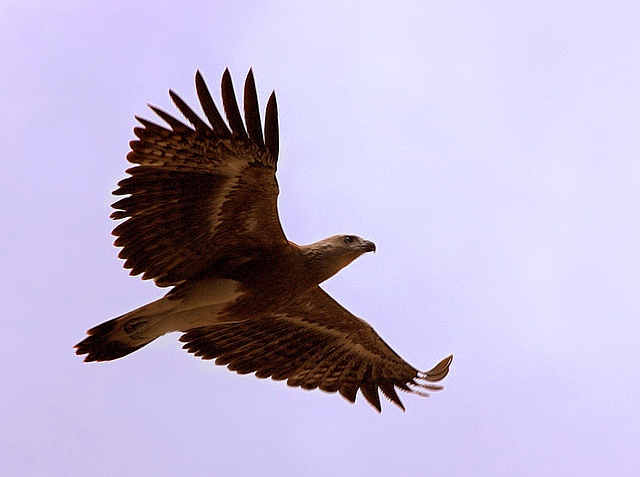
The lesser fish eagle is a medium-sized bird of prey that is primarily gray-brown in colour with broad, blunt wings and coarse featherless legs.[7] They are smaller than the similar Icthyophaga ichthyaetus (grey-headed fish eagle)[8] and may often get confused with the similar species. The lesser fish eagle has a brown breast with white thighs and belly.[6] They have a short, rounded tail with a long neck and a small head.[8] Juvenile lesser fish eagles are similar in appearance to adults, although they have brown eyes whereas an adult has yellow. Adults have a wingspan reaching 1.2 m (3 ft 11 in) and can grow to up to 64 centimetres (25 in) tall.[6]

Diet and feeding habits

[edit]

The lesser fish eagle feeds primarily on fish, which it snatches from the water as it observes them from above on a perch, which may be an overhanging tree or rock in the middle of a stream.[5] They have several personal perches that they often switch between throughout their feeding time.[6] As their diet is primarily fish, lesser fish eagles have large, curved talons specialized for catching fish and taking them from the water.[8]

Habitat

[edit]

They inhabit various forms of rivers, lakes, and wetlands[8] and are seen most often along hill streams and fast moving water.[8] They have been known to reach heights up to 2,400 m, but usually create their habitats below 1,000 m (3,280 ft).[6] Some specific eagles have been recorded to reach heights exceeding 4,000 m (13,120 ft) in Nepal.[8]

Range

[edit]

The lesser fish eagle has been known to live in India and the Kashmir region,[8] spanning eastward into Nepal, China, and other parts of Southeast Asia.[8] In India, they are restricted to the Himalayan foothills and move north-eastern.[6] Adults move south of the Himalayan mountain ranges, but remain partial and altitudinal in the Himalayas throughout the year.[8] They have been known to live in a variety of widespread locations such as Bangladesh and Nepal, to Cambodia, Indonesia, and Vietnam.[6] Researchers believe that there are 1,000 to 10,000 individuals.[8] The numbers of the lesser fish eagle are in decline for various reasons such as habitat loss, human disturbance, as well as hunting and nest robbery.[8] They have recently been listed as Near Threatened by BirdLife International.[8]

Reproduction

[edit]

Although incubation and fledging periods are unknown, the breeding season in the lesser fish eagle begins in March and ends in August for those in Northern India and Nepal,[8] but in other areas, may begin in November and end in April.[8] Roughly 2-4 eggs are laid in a clutch,[8] and their nests consist of sticks and green leaves.[8] After enough use, the nest may reach 1 m across and up to 1.5 m deep.[8]

References

[edit]
Revisions and contributorsEdit on WikipediaRead on Wikipedia
from Grokipedia
The Lesser fish eagle (Ichthyophaga humilis) is a medium-sized raptor in the family , specialized for piscivory with adaptations such as large, curved talons featuring spicules for gripping slippery . It measures 55–65 cm in length, has a wingspan of 120–160 cm, and weighs approximately 780–785 g, with gray- upperparts, a white throat, breast, belly, and thighs, a short rounded , and eyes in adults (brown in juveniles). The exhibits , though less pronounced than in some relatives, and possesses coarse, featherless legs suited to its lifestyle. Native to tropical and subtropical regions of the and , the Lesser fish eagle ranges from the Himalayan foothills in , , and through , , , , , and to (including , , and ). It prefers forested rivers, hill streams, fast-flowing waters, lakes, and wetlands at elevations from up to 2,400 m (occasionally to 4,250 m in ), often perching on overhanging branches or rocks near clear, fish-rich waters. Two are recognized: the nominate I. h. humilis in and I. h. plumbeus in the to Indochina. The is largely sedentary but may wander locally in the non-breeding season, with an estimated extent of occurrence spanning 14,500,000 km². Ecologically, the Lesser fish eagle is almost entirely dependent on fish for its diet, primarily targeting species like , , and barbs weighing 100–300 g, which it captures by swooping from perches to snatch from the water surface; it occasionally takes amphibians or crustaceans. Breeding pairs defend linear territories of 3–5 km along rivers, constructing large nests of sticks and leaves (up to 1 m wide and 1.5 m deep) near water, with clutch sizes of 2–4 eggs laid during March–August in northern ranges or November–April elsewhere; fledging takes about 8 weeks, followed by extended . The species is classified as Near Threatened on the , with a global population size that is unknown and an ongoing decline of 20–29% projected over three generations due to habitat degradation from , , and , as well as threats from , (including pesticides), , and nest disturbance. Conservation efforts focus on protecting riverine forests, monitoring populations in key sites like Cambodia's River (where breeding pairs dropped from 5 in 2007 to none in 2018), and mitigating human impacts, with the species listed on Appendix II.

Taxonomy

Classification

The lesser fish eagle is classified in the order , which encompasses all diurnal including hawks, eagles, and vultures. It belongs to the family , the largest family of raptors known for their hooked beaks, strong talons, and keen eyesight adapted for hunting. The species' binomial name is Icthyophaga humilis, placing it in the genus Icthyophaga, a group of fish eagles that are specialized piscivores with morphological traits such as partially feathered ceres and scaled tarsi suited to aquatic foraging. Two are currently recognized: the nominate I. h. humilis, found in including the , , , and ; and I. h. plumbeus, occurring in the from through southeast , , , , and to Indochina. Within the genus, the lesser fish eagle's closest relative is the (Icthyophaga ichthyaetus), sharing phylogenetic affinities based on molecular analyses that support the monophyly of Icthyophaga as distinct from the broader clade.

Historical taxonomy

The lesser fish eagle was originally described as Falco humilis by Müller and Schlegel in 1841 and subsequently placed within the genus Haliaeetus, which encompassed various eagles including sea eagles. The genus Icthyophaga had been established earlier by in 1843 specifically for fish-eating raptors, but traditional classifications often lumped the lesser fish eagle into Haliaeetus based on morphological similarities such as body size and habitat preferences. A significant reclassification occurred in following a phylogenetic analysis by Lerner and Mindell, which utilized nuclear and sequences from multiple accipitrids. This study revealed that Haliaeetus lato was paraphyletic, with the Asian fish eagles—including the lesser fish eagle—forming a distinct divergent from the true sea eagles, supported by both molecular and morphological evidence such as differences in talon structure and foraging adaptations. The analysis advocated separating the Old World fish eagles into the Icthyophaga to reflect their evolutionary , estimated to have occurred millions of years ago. The genus name Icthyophaga originates from the Greek ichthys (ἰχθύς, meaning "fish") and phagos (φάγος, meaning "eater"), highlighting the species' specialized piscivorous diet. The specific epithet humilis derives from Latin, translating to "humble" or "lowly," presumably in reference to the bird's modest size relative to larger congeners like the African fish eagle. Subsequent genomic work, including Mindell et al. (2018), reinforced this separation by identifying two deeply divergent lineages within the broader haliaeetine group, prompting the formal reinstatement of Icthyophaga for six species, including the lesser fish eagle.

Description

Plumage and morphology

The lesser fish eagle (Ichthyophaga humilis) is characterized by a predominantly gray-brown that provides effective in its riparian habitats. Adults feature darker upperparts, including grayish-brown wings and mantle, with a gray head marked by fine dark streaking and a pale face. The breast is maroon-brown to gray, transitioning to paler underparts dominated by an immaculate white belly, thighs, and undertail coverts that create a sharp contrast. The tail is mottled, with a white base, brown center, and indistinct subterminal band, while in flight, the underwings show mottled patterns with blackish-brown and pale primary bases. Morphologically, the has a compact build with broad, blunt wings for efficient over water, a short rounded , a notably long neck, and a small head that accentuates its streamlined profile. The legs are coarse and entirely featherless, with pale tarsi and toes ranging from dull white to bluish-white, supporting large, strongly curved blackish talons. These talons are specialized for piscivory, featuring rough, thickly barbed soles and minute spicules on the toes to grip slippery securely. Adults possess piercing yellow eyes, enhancing for spotting prey. Juvenile plumage is more uniform and subdued, appearing overall browner and paler than in adults, with a pale brown head and breast, streaked neck sides, white lower belly and undertail coverts, and brown-gray upperparts. The tail is darker with a paler base, and underparts show weak streaking. Juveniles have brown eyes, which transition to yellow in adults, and they retain some juvenile traits during their first molt around one year of age. Sexual dimorphism is limited primarily to size, with females slightly larger than males—males averaging approximately 74% of female body size—but both sexes exhibit nearly identical coloration and patterns.

Size and measurements

The lesser fish eagle measures 55–65 cm in total length. Its ranges from 120–160 cm. The exhibits sexual size dimorphism typical of raptors, with females larger than males; body weight is approximately 780–785 g overall, though males average smaller. Compared to congeners, it is notably smaller than the (Haliaeetus vocifer), which reaches lengths of 63–75 cm and weights up to 3.6 kg, but shares a similar compact, broad-winged build with the (Ichthyophaga ichthyaetus).

Distribution and habitat

Geographic range

The lesser fish eagle (Ichthyophaga humilis) is native to parts of the and , with its range spanning from the Himalayan foothills of and eastward through and to , , , , , and , including islands such as , , and . The species is also present in and occurs as a non-breeding visitor in southern (Hainan), while records from remain uncertain. It is absent from and the central lowlands of , with occurrences limited to the Himalayan foothills, northeastern hill ranges, and the in the south. Two subspecies are recognized, with I. h. plumbeus occurring in the to Indochina, and the nominate I. h. humilis in including . Historically, the range may have been broader, with the species once more common in areas like during the 1940s–1950s and along the River in , but it has contracted in several regions due to human activities such as and habitat alteration. Key populations are concentrated in , where it is recorded from the to southern river valleys, and in , particularly in northern valleys like Hukaung, though distribution remains patchy overall. It occurs as a winter visitor in southern (Hainan), while records from remain uncertain.

Habitat preferences

The lesser fish eagle (Ichthyophaga humilis) primarily inhabits inland freshwater ecosystems, favoring clear, fast-flowing rivers, hill streams, lakes, and wetlands that provide abundant resources. These birds are strongly associated with riverine and riparian forests, where undisturbed woodland fringes offer essential cover and proximity to prey-rich waters. They occasionally utilize forested swamps or dammed reservoirs, particularly in regions like southern , but show geographical variation in habitat use during non-breeding seasons, wandering to open inland water bodies. Although primarily associated with freshwater systems, they occasionally utilize estuaries and mangroves. For effective hunting and nesting, the species requires tall trees or rocky outcrops positioned near edges, allowing them to and scan shallow areas for . Overhanging branches or mid-stream rocks serve as key vantage points from which they launch short sallies to capture prey, emphasizing the need for structurally diverse, forested riparian zones. This preference for elevated es in low-disturbance environments underscores their adaptation to forested lowlands and foothills, avoiding heavily modified or deforested landscapes. In terms of elevation, lesser fish eagles typically occur from sea level up to 1,500 m, though they are recorded up to 4,250 m in . They show a clear preference for freshwater systems, though occasionally using marine-influenced habitats like estuaries.

Behavior

Foraging and diet

The lesser fish eagle's diet consists almost exclusively of . Occasionally, individuals scavenge dead , but there is no evidence of regular consumption of non- prey such as crustaceans, amphibians, or birds. These eagles employ a perch-hunting strategy, positioning themselves on elevated sites such as overhanging trees, rocks, or even man-made structures along water edges to scan for prey in shallow waters. Upon detecting a near the surface, the bird launches a short sally or direct dive, extending its talons to snatch the prey without fully submerging; larger catches may be dragged to shore for consumption. They frequently switch between multiple perches during foraging bouts to optimize visibility. Foraging occurs primarily during daylight hours. The lesser fish eagle's talons and feet are specialized for gripping slippery fish, featuring large, curved claws and spicules on the toes that enhance hold during capture and transport to a for tearing with the bill; these adaptations underscore its piscivorous specialization without reliance on cooperative .

Vocalizations and displays

The lesser fish-eagle produces a variety of vocalizations that serve primarily for communication between pair members, territorial defense, and . The primary call is a striking wailing sound. These calls are typically delivered from a or while soaring and are used to claim , ward off intruders, and maintain contact between mates during or nesting activities. During the breeding season, vocalizations become more frequent and intense, with pairs engaging in mating calls. Females tend to vocalize more during nesting periods, and territorial disputes can involve prolonged bouts of intense calling. Outside the breeding season, the species is generally less vocal, though contact calls help pairs coordinate activities year-round. Juveniles produce softer distress calls as chicks, which elicit parental responses near the nest during early hatching. In addition to vocal signals, the lesser fish-eagle performs visual displays, particularly during to strengthen pair bonds. Pairs engage in soaring together during the breeding season, often accompanied by calling. Such displays are confined to the breeding season and occur alongside vocalizations to facilitate pair coordination and territorial assertion.

Reproduction

Breeding biology

The lesser fish eagle forms monogamous pairs that remain together year-round, though it is unclear if these bonds are lifelong. Up to four birds, possibly including juveniles from prior seasons, may associate with a near the nest site. The breeding season shows regional variation, typically spanning March to August in populations of northern and , while occurring from November to April in southern and Southeast Asian populations, such as those in . During this period, pairs engage in displays involving soaring flights with wings held in a shallow V and legs dangling, often accompanied by vocalizations. Clutch size is usually 2–3 eggs, with records of four. The incubation period remains undocumented for this species, but both parents participate, with the female performing the majority of the duties and the male providing food during periodic relief stints; changeovers occur several times daily and may involve brief aerial exchanges. Chicks fledge after 11–12 weeks, at which point they can fly competently and begin hopping between branches near the nest before departing. In one observed case from southern , a single chick achieved flight at approximately 12 weeks of age.

Nesting and parental care

The lesser fish eagle builds substantial platform nests composed of sticks and lined with green leaves, typically situated in tall, sturdy riverside trees such as or sal at heights of 10–20 m above the ground. These nests, which can measure up to 1 m in width and 1.5 m in depth after repeated use, are often reused annually and enlarged through the addition of more sticks and fresh foliage during the breeding season. Eggs are plain white, sometimes stained, and incubation commences with the laying of the first egg, a behavior that promotes asynchronous hatching. Both parents share incubation duties, with the female taking the primary role while the male supplies most of the food to sustain her during this period; the incubation duration remains undocumented as of 2023 but aligns with patterns in related species. Chicks hatch semi-altricial, requiring brooding by the female for the initial weeks to maintain warmth and protection. Parental care involves both adults delivering fish to the nest, which they tear into small pieces for the chicks—initially by the female, with the male contributing catches; feeding sessions can involve up to 80 pieces per visit, occurring 3–4 times daily. Often only one chick survives to fledging in observed nests. Chicks develop rapidly, with bare heads at around 6 weeks, self-feeding by 8–9 weeks, and fledging at 11–12 weeks, after which parents continue provisioning for an additional period. Breeding success tends to be low, often yielding fewer than one fledged young per attempt, owing to predation from bonnet macaques, other raptors like Brahminy kites, and periodic food shortages exacerbated by river conditions.

Conservation

Population status

The lesser fish eagle (Ichthyophaga humilis) is classified as Near Threatened on the under criteria A2cde+3cde+4cde, with the assessment last updated in 2024. Although the global population size remains unknown due to limited surveys across its extensive range, the is undergoing an ongoing decline suspected to continue at a rate of 20–29% over the past and future three generations (2010–2030). Population densities are generally low, with one breeding pair typically occupying every 3–5 km of fast-flowing river in optimal habitats, though the species is rare and localized in many regions, resulting in fragmented distributions. Monitoring efforts by and regional surveys reveal stable but fragmented populations in some areas, such as parts of and , while declines have been documented elsewhere, including fewer than 1,000 individuals estimated in and a drop from 5 breeding pairs to none along Cambodia's River between 2007 and 2018.

Threats and conservation measures

The lesser fish eagle faces several primary threats that contribute to its ongoing decline across its range. Habitat loss and degradation, primarily from of riverine forests, , , and river damming, have resulted in substantial reductions in suitable nesting and foraging areas, with estimates indicating 24-27% loss of over three generations. from pesticides such as and from upstream activities cloud waterways, impairing the birds' ability to spot and catch fish prey, while directly diminishes available food resources in rivers like the in and those in . Direct hunting and nest poaching occur locally, particularly in (e.g., and ) and parts of and , where eagles are targeted for sport or collection. Secondary threats include , which may alter river flows and water levels, exacerbating habitat instability, and disturbance from activities such as loud noises near nesting sites that heighten alertness in adults without necessarily causing nest abandonment. These factors compound the pressures on the species, leading to population declines in regions like , , , and . Conservation efforts for the lesser fish eagle include its listing under Appendix II, which regulates international trade to prevent . protection is provided within several national parks and reserves, such as and Corbett National Park in , in , Phou Dendin National Protected Area in , and in , where riverine forests are safeguarded from encroachment. Community education programs in aim to raise awareness about threats like and , while ongoing research focuses on population monitoring through surveys and studies of impacts to inform targeted interventions. The future outlook for the lesser fish eagle remains cautious, with potential for downlisting from Near Threatened status if threats are mitigated through expanded protected areas and reduced human impacts; however, continued declines projected at 20-29% over the next few decades underscore the need for intensified monitoring and habitat restoration.
Add your contribution
Related Hubs
User Avatar
No comments yet.