Hubbry Logo
search
logo
1755690

Library of Celsus

logo
Community Hub0 Subscribers
Read side by side
from Wikipedia
Façade of the Library of Celsus at sunset

Key Information

The Library of Celsus (Greek: Βιβλιοθήκη του Κέλσου) is an ancient Roman building in Ephesus, Anatolia, located near the modern town of Selçuk, in the İzmir Province of western Turkey. The building was commissioned in the years 110s CE by a consul of the Roman Empire, Tiberius Julius Aquila Polemaeanus, as a funerary monument for his father Tiberius Julius Celsus Polemaeanus, former proconsul of Asia,[1][2] and completed during the reign of the Roman Emperor Hadrian, sometime after Aquila's death.[3][4]

The Library of Celsus is considered an architectural marvel, and is one of the few remaining examples of great libraries of the ancient world located in the Roman Empire. It was the third-largest library in the Greco-Roman world behind only those of Alexandria and Pergamum, and is believed to have held around 12,000 scrolls.[5] Celsus is buried in a crypt beneath the library in a decorated marble sarcophagus.[6][7] The interior measured roughly 180 square metres (2,000 square feet).[8]

The interior of the library and its contents were destroyed in a fire that resulted either from an earthquake or a Gothic invasion in 262 CE,[9][7] and the façade by an earthquake in the 10th or 11th century.[10] It lay in ruins for centuries until the façade was re-erected by archaeologists between 1970 and 1978.[11]

History

[edit]

Celsus enjoyed a successful military and political career, having served as a commander in the Roman army before being elected to serve as a consul for the Roman Empire in 92 CE.[3] Celsus, a Romanized Greek native of Sardis or Ephesus who belonged to a family of priests of Rome,[1][2] was one of the first men from the Greek-speaking eastern provinces of the Roman Republic to serve as a consul,[1][2] the highest elected office in Imperial Rome.[12] He may have been the first Greek to become a Roman senator, however there is scholarly debate that this may or may not be true.[13] He was later appointed as proconsul, or governor, of Asia, the Roman province that covered roughly the same area as modern-day Turkey.[3] Celsus served as a Roman senator, consul, and praetor, rising through the ranks very quickly.[13] He then retired and returned to Ephesus, his home.

After Celsus' death, his son Tiberius Julius Aquila Polemaeanus commissioned the library in his father's honor, using Greek and Roman techniques.[13] However, it was not completed until after Aquila's death. An inscription records that Celsus left a large legacy of 25,000 denarii to pay for the library's reading material.[4] In Ancient Roman culture, the wealthy and privileged were expected to act as benefactors, and use their wealth for the greater good of the community.[14] This Roman belief expanded to other Roman territories and provinces, such as the Greek city of Ephesus, where Aquila built the library in honor of his father, but also to benefit Ephesus as a whole. The library itself also embodies Roman values of sharing knowledge and growing literacy.[15]

Celsus' family most likely became citizens of the Roman Empire under the reign of the Roman Emperor Tiberius (14–37 CE), as he is named after Tiberius, which may have been to pay homage to the Emperor.[13] The library operated as a public space for the city from its completion around 117–135 until 262 CE.[9] The main floor functioned as a reading room, lit by abundant natural light from the eastern windows. Shelves or armaria set into niches along the walls held papyrus book rolls that visitors could read, though borrowing would not have been permitted because copies of books were rare and labor-intensive to produce. Additional scrolls may have been held in free-standing book boxes placed around the room, in which case the library would have had a holding capacity of up to sixteen thousand scrolls.[16]

The interior and contents of the library were destroyed by fire in 262 CE, though it remains unknown whether this fire was the result of natural disaster or a Gothic invasion, as it seems the city was struck by one of each that year.[7][9] Only the façade survived, until an earthquake in the 10th or 11th century left it in ruins as well.[10] Between 1970 and 1978, a reconstruction campaign was led by the German archaeologist Volker Michael Strocka. Strocka analysed the fragments that had been excavated by Austrian archaeologists between 1903 and 1904.[17] In the meantime, some of the architectural elements had been acquired by museums in Vienna and Istanbul. The absent fragments had to be replaced by copies or left missing.[11] Only the façade was rebuilt, while the rest of the building remains in ruin.

[edit]

Architecture

[edit]
A marble statue of Celsus, which stood in the central niche of the upper storey of the Celsus Library. It is preserved in the Istanbul Archaeological Museum.[6]

The east-facing marble façade of the library is intricately decorated with botanical carvings and portrait statuary. The façade on the outside was built with false perspective, a Greek technique. This means that the inside columns are longer while the outside columns are higher. Though the columns are not identical, the illusion is that they are. This makes the library look larger on the outside and more grand than it actually is.[18] Design features include acanthus leaves, scrolls, and fasces emblems, the latter being a symbol of magisterial power that alludes to Celsus's tenure as a consul.[3] The library is built on a platform, with nine steps the width of the building leading up to three front entrances. These are surmounted by large windows, which may have been fitted with glass or latticework.[19]

Plan of the Library of Celsus

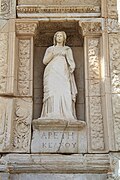
Flanking the entrances are four pairs of Composite columns elevated on pedestals. A set of Corinthian columns stands directly above. The columns on the lower level frame four aediculae containing statues of female personifications of virtues: Sophia (wisdom), Episteme (knowledge), Ennoia (intelligence), and Arete (excellence).[20][21] The four statues of the female virtues are not originals, but were replaced with four random female statues.[22] These virtues allude to the dual purpose of the structure, built to function as both a library and a mausoleum; their presence both implies that the man for whom it was built exemplified these four virtues, and that the visitor may cultivate these virtues in him or herself by taking advantage of the library's holdings. This type of façade with inset frames and niches for statues is similar to that of the skene found in ancient Greek theatres and is thus characterized as "scenographic". The columns on the second level flank four podia, paralleling the aediculae below, which held statues of Celsus and his son.[3] A third register of columns may have been present in antiquity, though today only two remain.[18]

On the inside, there are three levels of bookcases meant to be accessed through stairways.[15] The main staircase was flanked by two inscriptions, one in Greek and the other in Latin, which caters to both Romans and Greeks of all literate classes.[15] There is also a Hellenistic scroll on the doorways that has a Roman symbol, which shows the interaction of both cultures.[13] The features that are Roman are the composite capitals as well as the tripartite theatrical frons scenae.[13] Several Roman motifs appeared throughout the library, including reliefs fashioned after Julius Caesar's that had never been seen before in Ephesus or Asia Minor in general. The interior of the building, which has yet to be restored, consisted of a single rectangular room measuring 17×11 m, with a central apse framed by a large arch at the far wall. The apse contained a podium for a statue, now lost, that likely depicted Celsus, although some scholars have suggested it was Minerva, Roman goddess of wisdom.[23]

A crypt containing Celsus's decorated marble sarcophagus was located beneath the floor of the apse.[24][19] It was unusual in Roman culture for someone to be buried within a library or even within city limits, so this was a special honour for Celsus, reflecting his prominent role as a public official.

The three remaining walls were lined with either two or three levels of niches measuring 2.55×1.1×0.58 m on average, which would have held the armaria to house the scrolls.[25] These niches, which were backed with double walls, may have also had a function to control the humidity and protect the scrolls from the extreme temperature.[26] The upper level was a gallery with a balcony overlooking the main floor, creating a lofty spatial effect inside.[27] It could be reached via a set of stairs built into the walls, which added structural support. The ceiling was flat and may have had a central round oculus to provide more light.[28]

The design of the library, with its ornate, balanced façade, reflects the influence of Greek style on Roman architecture, which reached its height in the second century.

After the Aegean Sea earthquake of October 20, 2020, the performance of the reconstructed library was tested, and it performed well in terms of seismic behavior and the interaction between the adjacent walls and façade.[29]

Portraiture of Celsus

[edit]

The cuirassed statue of Celsus now in the Istanbul Archaeological Museum was one of three statues of the building's patron located on the second level of the façade.[3] He is depicted with a strong jaw, curly hair, and a neat beard, Hellenizing portrait features that echo the stylistic choices of the building's façade.[3] The style imitates traits of Hadrianic imperial portraiture, suggesting that it was sculpted after the lifetime of not only Celsus, but of his son Aquila as well. The choice to depict him in full armor suggests that Celsus's descendants considered his military career memorable and a source of pride.

Commemoration

[edit]

The building's façade was depicted on the reverse of the Turkish 20 million lira banknote of 2001–2005[30] and of the 20 new lira banknote of 2005–2009.[31]

See also

[edit]

Footnotes

[edit]

References

[edit]
[edit]
Revisions and contributorsEdit on WikipediaRead on Wikipedia
from Grokipedia
The Library of Celsus is an ancient Roman building in Ephesus, Anatolia (modern-day Selçuk, Turkey), constructed in the early 2nd century CE as both a monumental tomb for the Roman senator Tiberius Julius Celsus Polemaeanus and a public library that housed over 12,000 scrolls, serving as one of the largest repositories of knowledge in the Roman Empire.[1] Designed to commemorate Celsus, who served as a consul in 92 CE and proconsul of Asia from 105 to 107 CE before his death around 114 CE, the structure blended funerary, cultural, and civic functions, reflecting the Roman emphasis on legacy through architecture and learning.[1] Commissioned by Celsus's son, Tiberius Julius Aquila Polemaeanus—who was a Roman senator and consul suffectus in 110 CE—the library's construction began in 114 CE and was completed around 117 CE, with further enhancements by Aquila's heirs until approximately 135 CE.[1] Located south of the Commercial Agora in Ephesus, a major port city and provincial capital under Roman rule, the building was severely damaged by a fire during the Gothic invasion of 262 CE and its facade later collapsed in an earthquake in the 10th century CE, leaving it in ruins until systematic excavations began in 1903–1904 under Austrian archaeologist Otto Benndorf.[1] Restoration efforts in the 1970s reassembled the facade using original marble fragments, preserving it as a key monument within the UNESCO World Heritage-listed Ancient City of Ephesus.[1][2] Architecturally, the Library of Celsus exemplifies Roman imperial style under Emperor Hadrian (r. 117–138 CE), featuring a grand two-story facade spanning 21 meters in width and rising to about 17 meters in height, adorned with eight Corinthian columns and intricate pediments—triangular on the ends and semicircular in the center—framing niches that originally held bronze statues representing the virtues of Sophia (wisdom), Episteme (knowledge), Ennoia (intelligence), and Arete (virtue), personified as female figures.[1] The interior reading room measured approximately 16.72 by 10.92 meters (about 180 square meters), with a marble-paved floor, high walls lined with niches for scrolls, and innovative double-walled construction to regulate humidity and protect the collection from environmental damage; access was via a nine-step staircase from the agora, emphasizing its public yet elite-oriented design.[1] Below the main chamber lay a crypt containing Celsus's sarcophagus, underscoring the building's dual role as a mausoleum.[1] As a cultural and intellectual hub in the eastern Roman Empire, the Library of Celsus symbolized Roman patronage of Greek learning and civic prestige, attracting scholars and contributing to Ephesus's reputation as a center of early Christianity—traditionally linked to the Apostle Paul and the Council of Ephesus in 431 CE—while its design influenced later Roman libraries and highlighted the empire's fusion of Hellenistic traditions with imperial monumentality.[1][2] Today, it stands as one of the best-preserved ancient libraries, drawing millions of visitors annually and exemplifying the enduring legacy of Roman architectural innovation in the province of Asia.[1]

Historical Context

Ephesus in the Roman Period

Ephesus emerged as a pivotal urban center in the Roman Empire following its designation as the capital of the province of Asia in 27 BCE under Emperor Augustus, solidifying its status as a major port city on the Aegean coast that facilitated extensive maritime trade routes across the Mediterranean.[3] Positioned at the intersection of key land and sea pathways, the city served as a vital hub for commerce, connecting the interior of Asia Minor to international markets, and estimates for its population in the Roman period range from approximately 35,000 to 55,000 inhabitants, though older calculations suggested up to 225,000, making it one of the largest and most prosperous settlements in the eastern provinces.[4] This growth was underpinned by Roman administrative reforms that enhanced local governance and economic integration, transforming Ephesus from a Hellenistic outpost into a cornerstone of imperial infrastructure.[2] Under Roman rule after 27 BCE, Ephesus underwent significant urban development, featuring advanced infrastructure such as multiple aqueduct systems that supplied fresh water to public fountains, baths, and private residences, alongside grand theaters seating up to 25,000 spectators and imposing temples dedicated to imperial and local deities.[5] The Temple of Artemis, renowned as one of the Seven Wonders of the Ancient World, exemplified this blend of architectural splendor, with its massive marble structure symbolizing the city's enduring religious and cultural prestige even as Roman patronage supported its maintenance and expansion.[2] These projects not only improved daily life but also reinforced Ephesus's role as an intellectual nexus, where Greek philosophical traditions merged with Roman legal and rhetorical practices, fostering schools, libraries, and public forums that attracted scholars and elites from across the empire.[6] The city's economy thrived on diverse trade networks, exporting staples like grain and wine from the fertile Cayster River valley while importing luxury goods such as spices and textiles, which circulated through its bustling harbor and market squares.[7] This commercial vitality was periodically disrupted by natural disasters, including a devastating earthquake in 17 CE that razed much of the urban fabric, prompting Emperor Tiberius to provide substantial financial aid for reconstruction efforts that revitalized public buildings and infrastructure.[8] Further impetus came during the reign of Hadrian (117–138 CE), whose visits, notably in 128 CE, spurred a wave of construction projects, including temples and civic monuments, that enhanced Ephesus's monumental landscape and underscored its favored position within the imperial system.[9] In this dynamic environment, prominent local figures like Tiberius Julius Celsus Polemaeanus rose to influence, contributing to the city's cultural and political fabric.[2]

Tiberius Julius Celsus Polemaeanus

Tiberius Julius Celsus Polemaeanus was born around 45 CE in Sardis to a family of Greek origin that had adopted Roman citizenship and customs.[10] His ancestors were Romanized Greeks from a prominent background in the eastern provinces, blending Hellenistic cultural traditions with Roman political integration.[10] Celsus received an education in rhetoric and philosophy, reflecting the intellectual pursuits valued among the elite of Asia Minor during the Roman period.[11] Celsus embarked on a notable political and military career, beginning as quaestor under Emperor Vespasian around 70 CE.[12] He advanced to praetor in the mid-70s CE and served as military tribune in Legio IV Scythica, followed by roles as legatus in provinces including Cappadocia, Moesia, and Dalmatia.[13] Appointed suffect consul in 92 CE, he reached one of the highest honors in the Roman Senate as one of the first individuals of Greek descent to achieve this position.[13] Later, from 105 to 107 CE, he governed as proconsul of Asia, overseeing the key province where Ephesus was a major center.[13] His wealth, amassed through governorships and family estates in the eastern provinces, enabled the assembly of an extensive personal library estimated at 12,000 scrolls, which he bequeathed to Ephesus upon his death.[14] Celsus died in 114 CE, and a crypt within the monument erected by his son in Ephesus served as his tomb, containing his sarcophagus with his remains.[1] Ephesus functioned as his adopted political base amid the city's prominence in Roman Asia.[10]

Construction and Operation

Commissioning and Building

The Library of Celsus was commissioned around 114 CE by Tiberius Julius Aquila Polemaeanus, a Roman consul, as a grand funerary monument dedicated to his father, Tiberius Julius Celsus Polemaeanus, a distinguished senator and proconsul of Asia whose extensive imperial career provided the impetus for such an elaborate tribute.[15][16] The project was initiated shortly after Celsus's death circa 114 CE, transforming a public site in Ephesus into a lasting memorial that combined sepulchral and cultural functions.[1] Funding for the construction derived primarily from Aquila's personal resources, bolstered by his inheritance, while Celsus himself had willed a substantial sum of 25,000 denarii to support the acquisition of scrolls and ongoing maintenance of the library's collection.[17][18] This private patronage underscored the elite status of the Polemaeanus family and their commitment to civic benefaction in the Roman province of Asia.[15] Construction proceeded in distinct phases, beginning with the foundations and the underground crypt housing Celsus's sarcophagus, which were completed between approximately 114 and 117 CE under Emperor Trajan.[15][1] Aquila died before full completion, and the main edifice, encompassing the multi-story reading rooms and monumental entrance, was finished around 135 CE during the reign of Emperor Hadrian by Aquila's heirs.[15][16][17] The library's design embodied Roman imperial architecture, integrating Greek classical elements such as ornate Corinthian orders and symmetrical facades inspired by Hellenistic libraries like those in Pergamon and Alexandria.[1][18] Roman engineers, drawing on provincial expertise in Asia Minor, oversaw the blend of these influences to create a structure that symbolized both imperial power and cultural erudition.[15]

Early Use and Collection

The Library of Celsus officially opened around 135 CE, following the completion of its construction initiated by Tiberius Julius Aquila Polemaeanus in honor of his father, Tiberius Julius Celsus Polemaeanus.[1] It was designed to house Celsus's personal collection of approximately 12,000 scrolls, which encompassed works on philosophy, rhetoric, and various sciences, reflecting the intellectual pursuits of a prominent Roman senator and patron of learning.[1] This collection positioned the library as one of the largest in the Roman Empire, rivaling those in Alexandria and Pergamon in scale and significance.[16] The scrolls were stored using specialized methods to preserve their fragility, placed in wooden armaria—cupboard-like cases—within deep niches carved into the interior walls.[19] These niches were backed by double walls separated by an air gap of about three feet, which helped regulate humidity and temperature, protecting the papyrus from environmental damage in the Mediterranean climate.[20] Access to the upper niches likely involved portable ladders or scaffolding, allowing librarians and users to retrieve materials efficiently while minimizing disturbance to the collection.[21] As a public institution, the library served as a vital center for intellectual activity in Ephesus, offering access to scholars, students, and visitors from across the empire for reading, study, and discourse.[22] It facilitated lectures and the copying of texts, contributing to the dissemination of knowledge in a city renowned for its cultural vibrancy.[23] Strategically located adjacent to the Commercial Agora and near public baths, it integrated seamlessly into daily civic life, enabling seamless transitions between commerce, leisure, and scholarship.[16] The facility operated continuously for about 130 years, functioning as a key repository of Greco-Roman learning until its interruption in 262 CE.[1]

Destruction and Rediscovery

Ancient Demise

The Library of Celsus suffered its primary destruction in 262 CE, when a fire—possibly resulting from a sack of Ephesus by the Heruli, a Gothic tribe, or from an earthquake—severely damaged the library's interior and incinerated much of its collection of over 12,000 scrolls.[1] The blaze, fueled by the wooden elements of the structure and the papyrus scrolls stored within niches, left the reading rooms and storage areas in ruins, though the robust marble facade initially withstood the immediate impact.[16] Archaeological excavations have uncovered charred wooden beams and ash layers within the interior, providing physical evidence of this catastrophic fire and corroborating historical accounts of the events in 262 CE. Following the 262 CE devastation, the library was partially repaired in the late 4th century CE, but it saw further decline during the Byzantine period, with the facade repurposed as the back wall of a nymphaeum (public fountain) along a major street, indicating limited reuse amid the city's Christianization.[24] By the 10th and 11th centuries, successive earthquakes in the region caused the collapse of the facade, reducing the structure to rubble and leading to the quarrying of surviving marble elements for other Byzantine constructions.[21] The once-vast collection of scrolls, renowned for its scholarly value, was irretrievably lost—likely through burning in the 262 CE fire or looting during the invasion—leaving no surviving catalog or remnants to document its contents.[14] Over subsequent centuries, the site accumulated layers of silt from the nearby Cayster River, gradually burying the ruins under meters of sediment; by the 15th century, during the Ottoman era, the library and much of Ephesus lay completely obscured beneath alluvial deposits, forgotten until modern rediscovery.[25]

Modern Excavation

The modern excavation of the Library of Celsus commenced in the mid-19th century as part of broader efforts to uncover the ruins of ancient Ephesus, which had been buried under layers of silt from the Cayster River following its ancient destruction. British archaeologist and engineer John Turtle Wood, sponsored by the British Museum, initiated systematic digs at the site in 1863 and continued until 1874, during which he identified and partially excavated the library's location while primarily searching for the Temple of Artemis. Wood's work revealed initial architectural features and confirmed the presence of the monumental structure amid the overgrown and sediment-covered remains.[26] In 1895, Austrian archaeologist Otto Benndorf, professor at the University of Vienna, launched more targeted excavations on behalf of the newly founded Austrian Archaeological Institute, focusing on the civic center of Ephesus. Benndorf's campaigns, spanning 1895 to 1906, systematically uncovered substantial fragments of the library's iconic two-story facade, including decorative columns, entablatures, and sculptural elements. Among these were four large statues embodying the virtues—Sophia (wisdom), Arete (excellence), Ennoia (understanding), and Episteme (knowledge)—which were transported to the Ephesus Museum in Vienna for preservation.[26] The outbreak of World War I in 1914 interrupted the Austrian excavations, as the region fell within the Ottoman Empire's war zones, suspending fieldwork for over a decade. After the war's end and the founding of the Turkish Republic in 1923, which assumed control over archaeological sites, limited excavations resumed under Austrian auspices in 1926, though efforts through the 1930s remained constrained by political transitions, funding shortages, and logistical challenges.[26] Critical epigraphic evidence emerged during Benndorf's tenure, including dedicatory inscriptions by Tiberius Julius Aquila Polemaeanus honoring his father, Tiberius Julius Celsus Polemaeanus, which detailed the library's construction as a mausoleum and repository of knowledge. These Latin texts, found on architectural fragments and the sarcophagus discovered in 1904, corroborated the building's historical purpose and the familial patronage behind its erection.[15]

Architectural Design

Facade and Exterior

The facade of the Library of Celsus is an imposing east-facing marble structure, measuring 17 meters in height (including the nine-step podium) and 21 meters in width.[27] This orientation allowed morning sunlight to flood the entrance, illuminating the interior in line with Roman design principles for public buildings to benefit early users.[28] The facade draws briefly from broader Roman architectural influences, such as the multi-tiered stage fronts of theaters, to achieve a dramatic visual effect.[18] The two-story appearance employs false perspective for optical illusion, with the upper-level columns physically shorter and slimmer than the lower ones, creating an effect of greater height and depth to exaggerate the building's scale and grandeur.[11] It is articulated by eight lower-level columns in the composite order, arranged in four pairs on pedestals flanking three entrances, topped by eight Corinthian columns on the upper level. Four niches are integrated into the upper level of the design, originally occupied by statues representing the virtues of Sophia, Episteme, Ennoia, and Arete that enhanced the facade's symbolic depth.[16][1] Decorative elements abound, with columns carved in acanthus leaves and vegetation motifs, while friezes along the entablature depict mythological scenes, including Bellerophon riding Pegasus and pairs of Eros and Psyche in flight.[29] These intricate reliefs contribute to the facade's lavish aesthetic, emphasizing themes of knowledge and heroism. From an engineering standpoint, the raised podium base offered stability against seismic activity common in the region, as evidenced by structural analyses of the building's survival through early earthquakes.[30]

Interior Structure

The interior of the Library of Celsus consisted of a single large rectangular hall on the ground floor, measuring approximately 16.7 by 10.9 meters and covering about 180 square meters.[1][18] This space was entered through three doorways in the grand facade, leading into a functional area designed for scholarly activities.[31] At the west end of the hall stood a prominent apse, framed by a large arch, which likely served as a focal point for the room's layout. Beneath this apse was a crypt containing the marble sarcophagus of Tiberius Julius Celsus Polemaeanus, the library's patron, ensuring his eternal presence within the structure.[18][32] The walls of the hall featured three tiers of niches arranged across the ground level, a mezzanine, and an upper gallery, providing extensive storage for scrolls while optimizing the use of vertical space. The interior featured a railed balcony rather than a full second floor, allowing access to the upper niches.[1] These niches, numbering around ten or more per level, were recessed into the walls and backed by double-layered construction to insulate against external humidity and temperature fluctuations, thereby preserving the papyrus documents.[16][29] Access to the upper levels was facilitated by stairways integrated into the design, allowing scholars to reach the mezzanine and gallery along three sides of the room.[18][16] The floor was paved with decorative marble, contributing to the hall's elegant yet practical aesthetic, while the overall interior supported a capacity of approximately 12,000 scrolls, making it one of the largest libraries of its era.[1]

Artistic Features

Statues of Virtues

The Library of Celsus featured four monumental female statues personifying key intellectual virtues, carved from fine white marble. These allegorical figures—Sophia (Wisdom), Episteme (Knowledge), Ennoia (Intelligence), and Arete (Virtue)—were designed to embody the core attributes of the library's patron, Tiberius Julius Celsus Polemaeanus, highlighting the institution's dedication to scholarly pursuits.[16][1] Positioned within the deep niches of the library's grand facade on the lower level, the statues were arranged symmetrically, flanking the three doorways to greet visitors directly. This placement not only enhanced the facade's aesthetic harmony but also symbolically framed the entrance as a portal to enlightenment. The original marble sculptures, recovered during early 20th-century excavations, are now housed in the Ephesos Museum at the Kunsthistorisches Museum in Vienna, with high-quality replicas installed in their original positions at the site in Selçuk to preserve the visual impact.[16] Crafted around 120 CE during the library's construction phase under Emperor Hadrian, the statues exemplify a hybrid artistic style blending Roman imperial realism—evident in their detailed drapery, poised stances, and individualized facial features—with echoes of Greek idealism in their serene, ethereal expressions and proportional grace. This fusion reflects the cultural synthesis of the Roman East, where local Anatolian workshops, likely drawing on traditions from nearby centers like Aphrodisias, produced high-relief sculptures for public monuments. The marble's fine grain and translucency contributed to the figures' lifelike quality, allowing light to play across their surfaces in a manner that evoked divine inspiration.[16][1] Symbolically, the virtues directly honored Celsus's legacy as a statesman and patron of learning, portraying him as an exemplar of intellectual prowess in a funerary context that elevated the library beyond mere storage to a temple of knowledge. This choice echoed longstanding Hellenistic library traditions, such as those at Pergamon and Alexandria, where personifications of wisdom and learning adorned cultural hubs to inspire contemplation and moral elevation among scholars and citizens alike. By inscribing the virtues' names in Greek beneath each figure, the sculptors reinforced their philosophical underpinnings, drawing from Platonic and Stoic ideals to underscore the library's role in perpetuating enlightened discourse.[16][33]

Portraiture and Reliefs

The portraiture in the Library of Celsus prominently featured Tiberius Julius Celsus Polemaeanus himself, serving as a central element of personal commemoration within the structure's design. A key artifact is the cuirassed statue of Celsus, which was originally positioned on the second level of the facade.[34] This marble figure, now housed in the Istanbul Archaeological Museum, embodies Roman senatorial dignity through its military cuirass while incorporating elements suggestive of intellectual pursuits, such as a held scroll, reflecting the patron's role as a collector of knowledge.[1] The statue's style aligns with Hadrianic portraiture, characterized by idealized, Hellenized facial features that blend classical Greek realism with imperial Roman gravitas. Complementing this central portrait were additional statues depicting Celsus himself (three in total) and one of his son Tiberius Julius Aquila Polemaeanus, installed atop the porch roofs of the facade, emphasizing familial legacy and continuity in public benefaction.[35] Such placements personalized the monument, transforming the library into a dynastic tribute amid its role as a knowledge repository. Decorative reliefs further enhanced this commemorative theme, particularly those on the architrave and friezes. These carvings, recovered during the Austrian Archaeological Institute's excavations from 1903 to 1905, featured motifs including bucrania, fruit garlands, acanthus leaves, eagles, and mythical scenes such as Medusa heads and Bellerophon with Pegasus.[27][35][36] The originals of these elements were transported to museums, including Istanbul and Vienna, preserving their intricate details.[37] Artistically, these portraits and reliefs intentionally fused Roman military iconography—evident in the cuirass and fasces motifs—with Greek intellectual traditions, as seen in the scroll-bearing poses, to honor Celsus as a bridge between imperial power and cultural patronage. This synthesis complemented the allegorical statues of virtues on the lower facade, reinforcing the library's dual role as tomb and intellectual center.[1]

Restoration and Preservation

20th-Century Reconstruction

The reconstruction of the Library of Celsus's facade in the 1970s was a major archaeological project led by Volker Michael Strocka of the Austrian Archaeological Institute, spanning from 1970 to 1978. Strocka analyzed and repositioned fragments uncovered during early 20th-century excavations by Austrian teams, incorporating approximately 750 original marble blocks from the site's 29 layers into the rebuilt structure.[27][16] This effort focused exclusively on the facade to restore its iconic two-story appearance, leaving the interior hall in a preserved ruinous state to maintain historical authenticity.[27] The primary technique employed was anastylosis, which involved reassembling genuine ancient fragments in their original positions while supplementing missing elements with newly carved marble sourced from the same quarries, such as Synnada for the honey-colored variety and local Ephesian white marble. For structural stability, concrete cores were integrated behind the facade, ensuring durability against seismic activity common in the region. Challenges included aligning the scattered originals—many of which had been repurposed in medieval structures or dispersed to museums in Vienna and Istanbul—with the documented layout from prior digs, as well as procuring visually identical replacement materials to avoid altering the monument's aesthetic. Funding came primarily from Austrian and Turkish sources, including contributions via the Austrian Archaeological Institute and construction firms like Hochtief AG.[38][17][27] By 1978, the project had successfully elevated the facade to its original height of about 17 meters, transforming the site into a prominent tourist attraction and bolstering Ephesus's designation as a UNESCO World Heritage Site in 2015. The use of distinguishable artificial stone for non-original parts allowed visitors to appreciate both the ancient engineering and modern intervention, enhancing the library's role as a symbol of preserved classical heritage.[27][39]

Recent Conservation Efforts

The reconstructed facade of the Library of Celsus demonstrated remarkable resilience during the 2020 Aegean Sea earthquake, a magnitude 7.0 event centered near Samos Island that caused widespread damage in western Turkey, including minor effects on nearby structures in Ephesus.[40][30] No significant structural harm was reported to the library, attributing its stability to the reinforced design incorporated during the 1970s reconstruction.[30] A 2022 study published in the Journal on Computing and Cultural Heritage analyzed the seismic performance of the reconstructed library using finite element modeling and earthquake acceleration data from the 2020 event, confirming the efficacy of its modern reinforcements in withstanding moderate seismic activity while preserving the ancient aesthetic.[30] The research highlighted how the hybrid masonry system—combining original marble elements with contemporary steel and concrete supports—distributed stress effectively, providing a model for future heritage site retrofitting in seismically active regions.[30] In December 2024, the Austrian Academy of Sciences initiated a major conservation project focused on the library's iconic facade, addressing documented damages such as cracks, scaling, and marble corrosion accumulated over decades of exposure.[41] The multi-year effort, set to conclude by 2027, involves detailed documentation, stabilization of fragile elements, and protective treatments to prevent further deterioration, conducted in collaboration with the Austrian Archaeological Institute and Turkish authorities.[41] The site's popularity exacerbates preservation challenges, with Ephesus attracting approximately 2.7 million visitors in 2024 alone, many drawn to the library as a centerpiece.[42] To counter erosion from foot traffic and environmental factors, site managers have introduced crowd control barriers, restricted access zones around the facade, and LED lighting systems for evening visits that minimize daytime overcrowding and reduce thermal stress on the stone.[43] Looking ahead, ongoing initiatives emphasize digital technologies for long-term safeguarding, including 3D laser scanning and virtual reconstructions to create accurate models for monitoring structural changes and simulating environmental threats.[44] These efforts, part of broader Ephesus digitization projects, aim to mitigate risks from climate change, such as rising humidity and temperature fluctuations that accelerate marble degradation, enabling non-invasive preservation strategies.[45][46] As of November 2025, new visitor routes and previously unseen areas are scheduled to open by the end of the year to improve access and management, while night tours have been extended until November 2, 2025, and the Ephesus Museum reported a 15% increase in visitors during the first quarter of 2025 compared to 2024.[47][48][49]

Cultural Significance and Legacy

Role in Ancient Knowledge

The Library of Celsus stood as the third-largest library in the ancient Greco-Roman world, following only the renowned institutions at Alexandria and Pergamum, and housed an estimated 12,000 scrolls that served as a vital repository for preserving classical knowledge.[1] This substantial collection encompassed diverse subjects, including works on medicine, history, and literature, reflecting the broad intellectual pursuits of the era and ensuring the transmission of Greek and Roman texts across generations.[50] Built between 114 and 135 CE in Ephesus, a key city in Asia Minor, the library exemplified the fusion of Greek paideia—the holistic educational ideal emphasizing rhetoric, philosophy, and cultural refinement—with the Roman imperial framework, thereby reinforcing local civic identity and elite status within the empire.[51][11] As a prominent social and intellectual venue, the library functioned beyond mere storage, acting as a hub for scholarly debates and gatherings that attracted regional intellectuals, including physicians and rhetoricians from Asia Minor. Inscriptions on the structure, including those detailing its foundation and symbolic statues of virtues such as Sophia (wisdom, have sparked scholarly debate on access, with evidence suggesting it was open to a broader public, potentially including women, as Roman libraries often served mixed civic functions in provincial cities.[50] This accessibility underscored its role in promoting communal education and discourse, aligning with the era's emphasis on public benefaction. The library's design and endowment were influenced by earlier imperial projects, such as Trajan's Bibliotheca Ulpia in Rome, which exemplified a model for combining architectural grandeur with ongoing maintenance for book acquisition, funded through endowments like the 25,000 denarii allocated by Celsus' son.[51] Completed under Emperor Hadrian, who actively patronized cultural initiatives across the empire, it symbolized the Hadrianic era's commitment to Hellenic revival and provincial integration, elevating Ephesus as a center of Roman cultural hegemony in the East.[1][50]

Modern Commemoration

The Library of Celsus has been prominently featured on Turkish banknotes as a symbol of national heritage, with its facade depicted on the reverse of the 20 million lira note issued from 2001 to 2005, alongside other Ephesus ruins such as the Temple of Hadrian.[52] This design carried over to the 20 new lira note circulated from 2005 to 2009, emphasizing the structure's enduring cultural significance.[53] In contemporary media, the library appears in educational documentaries that explore ancient Anatolian sites, such as episodes in the "Great Tours TV" series on Ephesus, highlighting its architectural splendor and role in Roman intellectual life.[54] It also features in UNESCO promotional materials for the Ephesus World Heritage Site, which underscore the library's preservation as a testament to Greco-Roman engineering and knowledge dissemination.[2] As an iconic landmark of the Ephesus archaeological site, the Library of Celsus attracts 2 to 3 million visitors annually, serving as a focal point for tourism in the region and drawing crowds to its reconstructed facade (2.7 million in 2024).[55] Replicas of its statues representing virtues like wisdom and valor are displayed in the Ephesus Museum in Selçuk, allowing visitors to appreciate the original sculptural details up close.[56] Academic interest in the Library of Celsus has grown since 2000, with studies examining its architectural rhetoric, social function in Roman Ephesus, and digital reconstruction for heritage preservation.[30] These works, including analyses of its facade as a tool for imperial propaganda, continue to inform broader research on public libraries in the Roman Empire.[11]

References

User Avatar
No comments yet.