



Community hub
Librem 5
View on Wikipedia | |
 | |
| Brand | Purism |
|---|---|
| First released | November 18, 2020 |
| Dimensions | 74×152×15 mm (2.91×5.98×0.59 in)[1] |
| Weight | 262 g (9 oz)[1] |
| Operating system | PureOS/Phosh |
| CPU | NXP i.MX 8M Quad core Cortex-A53, 64bit ARM @max 1.5GHz (auxiliary 266MHz Cortex-M4F) |
| GPU | Vivante GC7000Lite |
| Modem | BroadMobi BM818 baseband |
| Memory | Micron 3GB LPDDR4-3200 DRAM |
| Storage | Kioxia 32GB eMMC flash memory |
| Removable storage | microSD (2TB max) |
| Battery | 4500mAh, user-replaceable |
| Rear camera | Samsung S5K3L6XX 13.25 MP, LED flash |
| Front camera | SK hynix YACG4D0C9SHC 8.0 MP[2] |
| Display | Mantix 144mm (5.7″) 720×1440 TFT |
| Sound | Wolfson Media WM8962 DAC |
| Connectivity | SparkLAN WNFB-266AXI(BT) Wi-Fi 6 802.11 a/b/g/n/ac/ax (2.4GHz/5GHz) and Bluetooth 5.3, 3.5mm headphone/microphone jack, USB-C USB 3.0 PD/DisplayPort, 3FF Smart card reader |
| Data inputs | Sensors:
Other:
|
| Other | haptic motor, notification LED with pulse-width modulation control of RGB color |
The Librem 5 is a smartphone manufactured by Purism that is part of their Librem line of products. The phone is designed with the goal of using free software whenever possible and includes PureOS, a Linux operating system, by default.[3] Like other Librem products, the Librem 5 focuses on privacy and freedom and includes features like hardware kill switches and easily-replaceable components. Its name, with a numerical "5", refers to its screen size, not a release version. After an announcement on 24 August 2017, the distribution of developer kits and limited pre-release models occurred throughout 2019 and most of 2020. The first mass-production version of the Librem 5 was shipped on 18 November 2020.
History
[edit]On August 24, 2017, Purism started a crowdfunding campaign for the Librem 5,[4][5] a smartphone aimed not only to run purely on free software provided in PureOS but to "[focus] on security by design and privacy protection by default". Purism claimed that the phone would become "the world's first ever IP-native mobile handset, using end-to-end encrypted decentralized communication".[6] Purism has cooperated with GNOME in its development of the Librem 5 software. It is planned that KDE and Ubuntu Touch will also be offered as optional interfaces.[7]
The release of the Librem 5 was delayed several times. It was originally planned to launch in January 2019. Purism announced on September 4, 2018 that the launch date would be postponed until April 2019,[8] due to two power management bugs in the silicon and the Europe/North America holiday season. Development kits for software developers, which were shipped out in December 2018[9] were unaffected by the bugs, since developers normally connect the device to a power outlet rather than rely on the phone battery. In February, the launch date was postponed again to the third quarter of 2019, because of the necessity of further CPU tests.[10]
Specifications and pre-orders, for $649, to increase to $699, were announced in July 2019.[11] On September 5, 2019, Purism announced that shipping was scheduled to occur later that month, but that it would be done as an "iterative" process.[12] The iterative release plan included the announcement of six different "batches" of Librem 5 releases, of which the first four would be limited pre-production models. Each consecutive batch, which consisted of different arboreal-themed code names and release dates, would feature hardware, mechanical, and software improvements. Purism contacted each customer that had pre-ordered to allow them to choose which batch they'd prefer to receive. Pre-mass production batches, in order of release, included code names "Aspen", "Birch", "Chestnut", and "Dogwood". The fifth batch, "Evergreen", would be the official mass-production model, while the sixth batch, "Fir", would be the second mass-production model.
On September 24, 2019, Purism announced that the first batch of limited-production Librem 5 phones (Aspen) had started shipping.[13][14] A video of an early phone was produced[15] and a shipping and status update was released soon after.[16][17] However, it was later reported that the Aspen batch had been shipped only to employees and developers. On November 22, 2019, it was reported that the second batch (Birch) would consist of around 100 phones and would be in the hands of backers by the first week of December.[18] In December 2019, Jim Salter of Ars Technica reported "prototype" devices were being received; however, they were not really a "phone" yet. There was no audio when attempting to place a phone call (which was fixed with a software update a few weeks later[19]), and cameras didn't work yet.[20] Reports of the third batch of limited pre-mass-production models (Chestnut) being received by customers and reviewers occurred in January 2020.[21] By May 2020, TechRadar reported that the call quality was fine, though the speaker mode was "a bit quiet", and volume adjustment did not work. According to TechRadar, the 3 to 5-hour battery time and the inability of the phone to charge while turned on was "A stark reminder of the Librem 5's beta status".[22]
On November 18, 2020, Purism announced via press release that they had begun shipping the finished version of the Librem 5, known as "Evergreen".[23][24] Following its release, in December 2019, Purism announced that it will offer a "Librem 5 USA" version of the phone for the price of $1999, which is assembled in the United States for extra supply chain security.[25] According to Purism CEO Todd Weaver, "having a secure auditable US based supply chain including parts procurement, fabrication, testing, assembly, and fulfillment all from within the same facility is the best possible security story."[26]
Hardware
[edit]
The Librem 5 features an i.MX 8M Quad Core processor with an integrated GPU which supports OpenGL 3.0, OpenGL ES 3.1, Vulkan 1.0 and OpenCL 1.2 with default drivers;[27] however, since the driver used is the open source Etnaviv driver, it currently only supports OpenGL 2.1 and OpenGL ES 2.0.[28][2] It has 3 GB of RAM, 32 GB of eMMC storage, a 13 MP rear camera, and an 8 MP front camera. The left side of the phone features three hardware kill switches, which cut power to the camera and microphone, Wi-Fi and Bluetooth modem, and the baseband modem.[29]) The device uses a USB-C connector for charging. The 144 mm (5.7-inch) IPS display has a resolution of 1440×720 pixels. It also has a 3.5 mm TRRS headphone/mic jack, a single SIM slot, and a microSD card slot.[14]
Battery
[edit]The Librem 5 is powered by a lithium-ion battery. The capacity of the battery was 2000 mAh in earliest development batches,[30] which was increased to 4500 mAh in the mass-production batch. The battery is designed to be user-replaceable. The battery is unique to Librem 5 and cannot be replaced by any other battery type. In addition, Purism ships replacement batteries only within the US unless combined with another device.[31]
Mobile security
[edit]
The hardware features three hardware kill switches that physically cut off power from both cameras and the microphone, Wi-Fi and Bluetooth, and baseband processor, respectively. Further precautionary measures can be used with Lockdown Mode, which, in addition to powering off the cameras, microphone, WiFi, Bluetooth and cellular baseband, also cuts power to the GNSS, IMU, ambient light and proximity sensor. This is possible due to the fact that these components are not integrated into the system on a chip (SoC) like they are in conventional smartphones. Instead, the cellular baseband and Wi-Fi/Bluetooth components are located on two replaceable M.2 cards, which means that they can be changed to support different wireless standards.[14][32] The kill switch to cut the circuit to the microphone will prevent the 3.5 mm audio jack being used for acoustic cryptanalysis.[33]
In place of an integrated mobile SoC found in most smartphones, the Librem 5 uses six separate chips: i.MX 8M Quad, Silicon Labs RS9116, Broadmobi BM818 / Gemalto PLS8, STMicroelectronics Teseo-LIV3F, Wolfson Microelectronics WM8962, and Texas Instruments bq25895.[2]
The downside to having dedicated chips instead of an integrated system-on-chip is that it takes more energy to operate separate chips, and the phone's circuit boards are much larger. On the other hand, using separate components means longer support from the manufacturers than with mobile SoCs, which have short support timelines.[34] According to Purism, the Librem 5 is designed to avoid planned obsolescence and will receive lifetime software updates.[35]
The Librem 5 is the first phone to contain a smartcard reader, in which an OpenPGP card can be inserted for secure cryptographic operations.[14] Purism plans to use OpenPGP cards to implement storage of GPG keys, disk unlocking, secure authentication, a local password vault, protection of sensitive files, user persons, and travel persons.[36]
To promote better security, all the source code in the root file system is free/open source software and can be reviewed by the user. Purism publishes the schematics of the Librem 5's printed circuit boards (PCBs) under the GPL 3.0+ license,[37] and publishes x-rays of the phone,[38] so that the user can verify that there haven't been any changes to the hardware, such as inserted spy chips.[39]
Software
[edit].jpg)
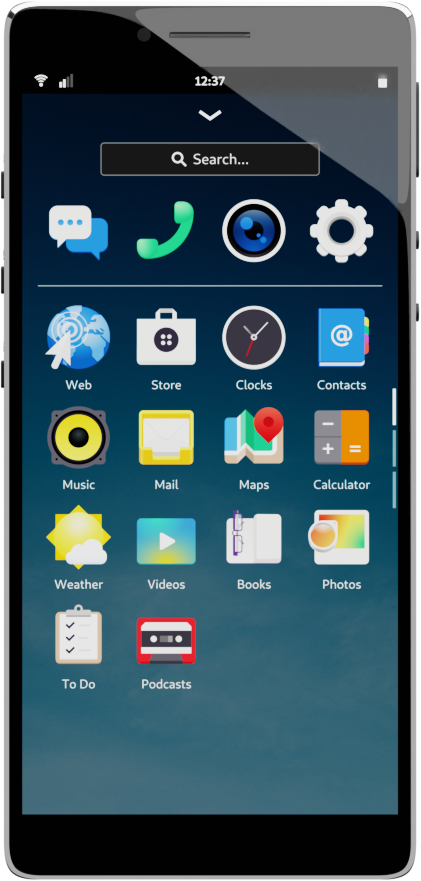
The Librem 5 ships with Purism's PureOS, a Debian GNU/Linux derivative. The operating system uses a new mobile user interface developed by Purism called Phosh, a portmanteau from "phone shell". It is based on Wayland, wlroots, GTK 3, and GNOME.[41] Unlike other mobile Linux interfaces, such as Ubuntu Touch and KDE Plasma Mobile, Phosh is based on tight integration with the desktop Linux software stack, which Purism developers believe will make it easier to maintain in the long-term and incorporate into existing desktop Linux distributions. Phosh has been packaged in a number of desktop distros (Debian, Arch, Manjaro, Fedora and openSUSE) and is used by eight of the sixteen Linux ports for the PinePhone.[42]
The phone is a convergence device:[43][44] if connected to a keyboard, monitor, and mouse, it can run Linux applications as a desktop computer would. Many desktop Linux applications can run on the phone as well, albeit possibly without a touch-friendly UI.[14]

Purism is taking a unique approach to convergence by downsizing existing desktop software to reuse it in a mobile environment. Purism has developed the libhandy library (now replaced with Libadwaita) to make GTK software adaptive so its interface elements adjust to smaller mobile screens.[45] In contrast, other companies such as Microsoft and Samsung with Ubuntu (and Canonical before Unity8) tried to achieve convergence by having separate sets of software for the mobile and desktop PC environments. Most iOS apps, Android apps and Plasma Mobile's Kirigami implement convergence by upsizing existing mobile apps to use them in a desktop interface.[42]
Purism claims that the "Librem 5 will be the first ever Matrix-powered smartphone, natively using end-to-end encrypted decentralised communication in its dialer and messaging app".[46][47]
Purism was unable to find a free/open-source cellular modem, so the phone uses a modem with proprietary hardware, but isolates it from the rest of the components rather than having it integrated with the system on a chip (SoC). This prevents code on the modem from being able to read or modify data going to and from the SoC.[14][48]
See also
[edit]
References
[edit]- ^ a b "Frequently Asked Questions". Librem 5 Community Wiki. 9 January 2019. Archived from the original on October 28, 2021. Retrieved 2021-06-10.
- ^ a b c Batto, Amos. "Comparing specs of upcoming Linux phones". Purism forum. Retrieved 2020-09-03.
- ^ PureOS successfully applied to be recognized as a free-software-only operating system and is listed among the (very few) Linux distributions endorsed by the Free Software Foundation (see: "Free GNU/Linux distributions". Free Software Foundation. Retrieved 6 October 2021.).
- ^ "Purism Unveils Plans to Build Librem 5, the World's First Encrypted, Open Smartphone Ecosystem Giving Users Complete Device Control". Purism. 24 Aug 2017.
- ^ Claburn, Thomas (21 Oct 2017). "Wanna exorcise Intel's secretive hidden CPU from your hardware? Meet Purism's laptops". The Register. Retrieved 2019-11-15.
- ^ "Librem 5". Purism.
The Librem 5 phone will be the world's first ever IP-native mobile handset, using end-to-end encrypted decentralized communication over the Internet.
- ^ Vaughan-Nichols, Steven (2018-04-24). "Ubuntu Touch lives on in Purism's Librem 5 smartphone". ZDNet. Retrieved 2019-10-08.
- ^ Tung, Liam (2018-09-05). "Linux phone battery bug: Purism's Librem 5 delayed until April 2019". ZDNet. Retrieved 2019-10-08.
- ^ Sriram Ramkrishna (2018-12-18). "Librem 5 dev kits are shipping!". Purism.
- ^ Weaver, Todd (2019-02-21). "Massive Progress, Exact CPU Selected & Minor Shipping Adjustment". Retrieved 2019-10-08.
- ^ "Linux Smartphone Librem 5 is Available for Preorder". It's Foss. August 2019. Retrieved 2019-11-04.
- ^ Weaver, Todd (September 5, 2019). "Librem 5 Shipping Announcement". Purism. Retrieved January 8, 2020.
- ^ "First Librem 5 Smartphones are Shipping". Purism. 2019-09-24. Retrieved 2019-10-08.
- ^ a b c d e f Amadeo, Ron (2019-09-26). "Purism's Librem 5 phone starts shipping—a fully open GNU/Linux phone". Ars Technica. Retrieved 2019-10-08.
- ^ "Purism Shows Off The Librem 5 Linux Smartphone In Action". Phoronix. Retrieved 2019-11-04.
- ^ "Purism Provides Update On Librem 5 Shipping, Known Issues". Phoronix. Retrieved 2019-11-04.
- ^ Medley, Sam. "Hands-on video of the Librem 5 Linux phone shows improvements, but there is a lot of work left to do". Notebookcheck. Retrieved 2019-11-04.
- ^ Salter, Jim (2019-11-22). "The Librem 5 has been "shipping" for a month—but not to backers". Ars Technica. Retrieved 2019-11-22.
- ^ "Is phone call audio working for Birch devices now? (maybe after these fixes?)". Purism community. 2019-12-11. Retrieved 2022-08-25.
- ^ Salter, Jim (2019-12-02). "Librem 5 backers have begun receiving their Linux phones". Ars Technica. Retrieved 2020-01-05.
- ^ Amadeo, Ron (January 24, 2020). "Librem 5 phone hands-on—Open source phone shows the cost of being different". Ars Technica. Retrieved January 8, 2021.
- ^ Cawley, Christian (May 4, 2020). "Librem 5 review". TechRadar. Retrieved 13 August 2020.
- ^ Hamner, David (November 18, 2020). "Librem 5 Mass Production Phone Has Begun Shipping" (Press release). Retrieved December 19, 2020.
- ^ Nestor, Marius (November 18, 2020). "Purism's Librem 5 Mass Production Linux Phone Begins Shipping to Customers". 9to5Linux. Retrieved December 19, 2020.
- ^ Humphries, Matthew (December 6, 2019). "American-Made Librem 5 Phone Costs $1,999". PCMAG. Retrieved 2020-01-05.
- ^ Rankin, Kyle (December 5, 2019). "Librem 5 USA". Purism.
- ^ "Purism Confirm Final Specs for the Librem 5". 29 July 2019.
- ^ "Etnaviv Gallium3D Is Almost To OpenGL 2.0 Compliance".
- ^ "Purism Librem5 modem revealed, will provide LTE and GPS support". TuxPhones. 2 April 2019.
- ^ "Birch - Purism - Librem products documentation". Archived from the original on 2023-05-21. Retrieved 2023-04-08.
- ^ "Librem 5 (Evergreen) Battery – Purism".
- ^ Rankin, Kyle (11 March 2019). "Lockdown Mode on the Librem 5: Beyond Hardware Kill Switches". Purism.
- ^ Mathews, Lee (2018-08-31). "Now Hackers Can Spy On You By Listening To Your Screen". Forbes. Retrieved 2019-03-13.
- ^ Batto, Amos (2020-08-15). "Adding kill switches to protect your privacy is not as simple as you might think". Retrieved 2020-09-03.
- ^ Rankin, Kyle (2020-05-14). "Librem 5 Longevity: Solving The Problem of Disposable Technology". Purism. Retrieved 2020-09-03.
- ^ Rankin, Kyle (2020-08-15). "Your Own Personal Enclave: The Smart Card Reader on the Librem 5". Purism. Retrieved 2020-09-03.
- ^ "Librem 5 schematic". source.puri.sm. Retrieved 2020-09-03.
- ^ "Librem 5 Phone – Birch". developer.puri.sm. Retrieved 2020-09-03.
- ^ Packham, Sean (2019-12-02). "A Different Kind of Transparency". Purism. Retrieved 2020-09-03.
- ^ "Librem 5 design report #5". Purism (company). 10 May 2018. Retrieved 30 May 2020.
- ^ "Phosh". developer.puri.sm.
- ^ a b Batto, Amos (5 August 2020). "The strategic advantages of Phosh for mobile Linu". WordPress.
- ^ Jose, Manuel (2019). "Purism: A Linux OS is talking Convergence again".
- ^ Larabel, Michael. "Purism's PureOS Proclaims Convergence Success For Mobile & Desktop Support". Phoronix.
- ^ Plazas, Adrian (17 June 2019). "The New libhandy 0.0.10". Purism.
- ^ "Librem 5". Purism. Retrieved 9 October 2019.
- ^ "The Librem 5 from Purism: A Matrix Native Smartphone". Matrix.org blog.
- ^ Faerber, Nicole (4 September 2018). "Progress update from the Librem 5 hardware department". Purism.
External links
[edit]
(non-Android) Linux-powered devices | ||||||||||||||
|---|---|---|---|---|---|---|---|---|---|---|---|---|---|---|
| Computers, components |
|  | ||||||||||||
| Accessories |
| |||||||||||||
| Discontinued | ||||||||||||||
✝ Excluding Android devices. | ||||||||||||||
Librem 5
View on GrokipediaDevelopment History
Announcement and Crowdfunding (2017)
Purism announced the Librem 5 on August 24, 2017, positioning it as the world's first encrypted, open-source smartphone ecosystem designed to provide users with complete control over their devices. The initiative aimed to counter corporate surveillance by prioritizing free and open-source software (FLOSS) and privacy-respecting hardware, enabling end-to-end encrypted communications via a Matrix-powered dialer and messaging system, alongside support for PureOS or other GNU/Linux distributions. Priced starting at $599 for early backers, the project emphasized user sovereignty, allowing individuals to run auditable code without proprietary dependencies that could enable data collection by manufacturers or third parties.[10] To fund development and gauge market interest, Purism launched a self-hosted crowdfunding campaign on the same date, targeting $1.5 million to initiate fabrication and prototype production. The effort quickly surpassed expectations, raising over $1.6 million by early October 2017, which enabled resumed supplier negotiations, advanced prototyping, and community-driven software development with an upstream-first approach. Stretch goals outlined further enhancements, such as VoIP integration at $4 million and Android app compatibility in isolation at $10 million, reflecting ambitions to expand functionality while maintaining open standards.[11][10] Central to the Librem 5's promises were hardware kill switches to physically disconnect the camera and microphone, WiFi/Bluetooth, and cellular baseband, ensuring no remote activation of surveillance capabilities even if software were compromised. Initial hardware previews indicated compatibility with GSM, UMTS, and LTE networks, with subsequent updates confirming plans for an NXP i.MX 8M processor to support efficient, open-source-friendly computing. These features underscored a commitment to avoiding planned obsolescence through modular, repairable design and ongoing software support, distinguishing the device from proprietary smartphones reliant on vendor-locked ecosystems.[10][12][13]Production Delays and Challenges (2018–2019)
Following the successful crowdfunding campaign in 2017, Purism shifted from initial prototypes based on the NXP i.MX6 processor to the more advanced i.MX8M Quad SoC for the final Librem 5 design, aiming for improved 64-bit processing, quad-core GPU support, and lower power consumption to enable convergence features like desktop-mode functionality on phone hardware.[14] This transition prioritized components compatible with free software ecosystems, including verifiable hardware that avoided proprietary firmware blobs where possible.[14] A key design decision involved physically separating the cellular modem from the main SoC via a USB bus rather than integrating it directly, enhancing baseband isolation for security and reducing risks from untrusted proprietary code, though this required sourcing off-the-shelf modules compatible with open Linux drivers.[14] Similarly, WiFi and Bluetooth were implemented via SDIO interface using solutions like Redpine Signals to minimize runtime firmware dependencies.[14] In September 2018, Purism announced a three-month production delay, pushing initial shipping from January to April 2019, primarily due to silicon errata in the i.MX8M Quad SoC—specifically bugs e11174 and e11171—that caused severe battery drain, depleting the battery in under an hour even in idle states.[15] [14] [16] These hardware-level flaws, documented by NXP, stemmed from power management defects incompatible with the Librem 5's efficiency requirements for extended mobile use and convergence scenarios.[17] Additional timeline pressures arose from seasonal manufacturing constraints, including December holidays and February's Chinese New Year, exacerbating supply chain dependencies for custom, auditable components.[14] Engineering challenges compounded these issues, as integrating the i.MX8M with upstream Linux kernels required ongoing work on drivers, such as kernel 4.18 bring-up and support for the etnaviv GPU driver via Mesa, to achieve full open-source functionality without vendor blobs.[18] Purism's commitment to Respects Your Freedom (RYF) certification criteria from the Free Software Foundation necessitated rigorous sourcing of verifiable parts, limiting options to suppliers providing auditable hardware over cheaper, opaque alternatives optimized for proprietary Android ecosystems.[14] [19] With a small in-house team handling custom PCB design and convergence goals—enabling the phone to function as a full desktop via external peripherals—these factors introduced causal delays beyond standard smartphone production, where large firms leverage economies of scale and closed-source shortcuts.[20] Purism maintained transparency through detailed blog updates detailing hardware progress and setbacks, contrasting with criticisms from observers who attributed delays to overoptimistic timelines given the niche market's constraints on resources and expertise.[14] [15] While some community forums highlighted risks of underestimating open hardware complexities, Purism's approach reflected first-principles prioritization of user sovereignty over expedited delivery, though it strained pre-order fulfillment expectations set during crowdfunding.[21] By late 2018, development kits were shipped to select partners for software testing, allowing parallel progress on PureOS integration amid hardware hurdles.[22]Initial Release and Shipping (2019–2020)
Following the shipment of development kits throughout 2018 and early 2019, Purism initiated production of initial consumer batches, designated by code names such as "Birch," with the first units shipping to early crowdfunding backers in late September 2019.[6] [23] These early deliveries served as hardware validation for the final design, confirming key specifications including a quad-core NXP i.MX 8M Quad processor, 3 GB of LPDDR4 RAM, and 32 GB of eMMC storage, as verified in hands-on evaluations from late 2019 onward.[24] [25] The standard Librem 5 was priced at $699 for general backers, reflecting the original crowdfunding retail target after early-bird discounts of $599 expired in early 2019, while a premium "Librem 5 USA" variant—emphasizing assembly in the United States for enhanced supply chain security and reduced reliance on overseas manufacturing—was announced in December 2019 at $1,999.[26] [27] This U.S.-assembled configuration aimed to mitigate risks associated with global component sourcing, though initial shipments remained focused on the standard model produced overseas.[28] Mass production of the consumer version ramped up in 2020, with broader shipments to remaining backers and new orders commencing in mid-to-late November, following iterative hardware refinements from early batches.[29] Early units highlighted the device's repairability features, particularly the user-replaceable 4,500 mAh battery, which could be swapped without specialized tools beyond basic access to the rear panel, distinguishing it from sealed competitors and supporting long-term hardware maintenance.[30] Independent teardowns in early 2020 affirmed this design, noting modular components like the battery and modem for straightforward field replacement.[31]Post-Release Updates and Availability (2021–2025)
Following its initial shipments, the Librem 5 remained available for purchase through Purism's official channels, with standard pricing stabilized at $699 for the base model as of May 2024, including periodic flash sales dropping to $599 in April 2024 to boost accessibility.[32][26] By mid-2025, the device continued sales at this entry-level price point, targeting users prioritizing open-source hardware and software over mainstream performance, though a USA-made variant launched at $1,999 to address supply chain concerns.[33][28] Production batches ensured ongoing stock without backorders exceeding standard lead times, reflecting Purism's commitment to niche demand in the privacy-centric market despite limited mass appeal.[1] Software refinements centered on PureOS upgrades, with Purism funding the transition to the Crimson release cycle, incorporating Debian-based enhancements for stability and features like automatic suspend and VPN integration by mid-2025.[34][35] Community-driven contributions via forums supplemented these efforts, enabling over-the-air package updates through standard tools likeapt or the software store, ensuring compatibility with evolving Linux mobile standards without requiring full reflashing.[36] These iterations addressed post-release usability, such as improved image builds for arm64 architecture and Phosh shell reliability, positioning the Librem 5 as a foundational device in the GNU/Linux phone landscape.[37]
Hardware saw no substantive revisions, maintaining the original i.MX 8M Quad processor and 3 GB RAM configuration, but firmware adjustments enhanced operational reliability, including modem updates for consistent wake-from-suspend during calls and general bootloader tweaks accessible via serial download mode.[38][39] Experimental community mods, like integrating a SIM8202G 5G modem on Mobian distributions, demonstrated extensibility without official hardware changes, aligning with broader Linux ecosystem experiments in 2025.[40][41]
In security evaluations, the Librem 5's cellular modem isolation—physically separating the baseband processor from the main CPU via dedicated hardware—earned it top rankings in 2024 analyses, with Purism citing it as the leading secure phone due to this design alongside kill switches and auditable PureOS code.[42] Independent reviews in 2025 echoed this for privacy-focused users, highlighting its role amid rising demand for de-Googled, open alternatives in the Linux mobile surge, though broader adoption remained constrained by ecosystem maturity.[43][44][45]