Hubbry Logo
Piston pumpPiston pumpMain
Open search
Piston pump
Community hub
Piston pump
logo
8 pages, 0 posts
0 subscribers
Be the first to start a discussion here.
Piston pump
Piston pump
from Wikipedia
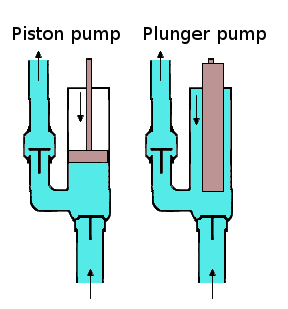
Piston pump compared to a plunger pump

A piston pump is a type of positive displacement pump where the high-pressure seal reciprocates with the piston.[1] Piston pumps can be used to move liquids or compress gases. They can operate over a wide range of pressures. High pressure operation can be achieved without adversely affecting flow rate. Piston pumps can also deal with viscous media and media containing solid particles.[2] This pump type functions through a piston cup, oscillation mechanism where down-strokes cause pressure differentials, filling of pump chambers, where up-stroke forces the pump fluid out for use. Piston pumps are often used in scenarios requiring high, consistent pressure and in water irrigation or delivery systems.[3]

Types

[edit]

The two main types of piston pump are the lift pump and the force pump.[4] Both types may be operated either by hand or by an engine.

Lift pump

Lift pump

[edit]
Force pump

In a lift pump, the upstroke of the piston draws water, through a valve, into the lower part of the cylinder. On the downstroke, water passes through valves set in the piston into the upper part of the cylinder. On the next upstroke, water is discharged from the upper part of the cylinder via a spout. This type of pump is limited by the height of water that can be supported by air pressure against a vacuum.

Force pump

[edit]

In a force pump, the upstroke of the piston draws water, through an inlet valve, into the cylinder. On the downstroke, the water is discharged, through an outlet valve, into the outlet pipe.

Piston pumps may be classified as either single-acting and single-effect (the fluid is pumped by a single face of the piston, and the active stroke is in only one direction) or double-acting and double-effect (the fluid is pumped by both faces of the piston, and the strokes in both directions are active).

Calculation of delivery rate

[edit]

The calculation of a piston pump's theoretical delivery rate is relatively simple.

Single-acting pumps

[edit]

In a single acting pump, only one side of the piston is in contact with the fluid. As a result of this, only one stroke is a delivery stroke. The theoretical delivery rate can be calculated by using the following equation:[5]
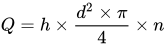
Where Q is the delivery rate, d is the diameter of the piston, h is the stroke, and n is the rpm. If the pump has multiple cylinders, Q is multiplied by the number of cylinders.

Double-acting pumps

[edit]

In a double acting pump, both sides of the piston are in contact with the fluid. As a result of this, both strokes are delivery strokes. An approximation of the delivery rate is given by the following equation:[5]
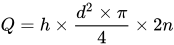
However, this equation fails to take into consideration the volume taken up by the piston rod. The true delivery rate can be calculated accordingly:

Display of the delivery of a single-acting pump (left) and a double-acting pump (right) in relation to the movement of the crankshaft.

d1 is equal to the diameter of the piston rod.

Fluctuation in delivery rate

[edit]

The piston in a plunger and piston pump does not move at a constant velocity and as a result of this the pressure and delivery fluctuate over the duration of the stroke. The following diagram shows the relation between the angle of the crankshaft and the delivery rate of a single-acting and double-acting pump. The line shows the average delivery rate of the pump. These fluctuations in pressure and delivery can cause undesired effects such as water hammer and thus are generally mitigated by the installation of an air-filled accumulator. The delivery can be further smoothed out by the use of multiple cylinders that are offset from one another.

As a result, the actual delivery rate is often smaller and can be found by the following equation:

Qs is the actual delivery rate, Q is the theoretical rate, and λ is the loss coefficient.

Others

[edit]

See also

[edit]

References

[edit]
Revisions and contributorsEdit on WikipediaRead on Wikipedia
from Grokipedia
A piston pump is a positive displacement pump that utilizes one or more reciprocating within to draw in and discharge , providing precise control over flow rates and pressures in various industrial applications. These pumps operate through a cyclic process: during the suction , the retreats to create a that pulls into the via an inlet , while the discharge forces the out through an outlet under pressure, ensuring a consistent volume displacement per cycle. The mechanism is typically driven by a motor or connected to a or , with check (such as ball or reed types) preventing backflow and maintaining unidirectional movement. Piston pumps are classified into several types based on design and orientation, including axial piston pumps—where pistons align parallel to the drive shaft for compact, high-efficiency operation in hydraulic systems—and radial piston pumps, featuring pistons arranged perpendicular to the shaft for superior high-pressure performance. Other variants include plunger pumps (using a stationary for abrasive fluids), duplex or triplex configurations for smoother flow, and specialized circumferential piston pumps with rotating bi-piston rotors for handling viscous or shear-sensitive materials. Common applications span in and , oil and gas operations like , chemical processing, , and food/pharmaceutical industries for precise dosing of liquids or slurries. They excel in scenarios requiring high pressures typically ranging from a few bar to over 300 bar, flow rates varying from low to hundreds of m³/hr depending on , and compatibility with viscosities from 1 to over cP; some types can handle fluids with solids up to several centimeters in size. Key advantages include high (up to 95-99% at low viscosities), durability in harsh environments, and reversible flow in some designs without mechanical alterations, though they may involve higher maintenance due to wear on seals and valves, potential noise from reciprocation, and limitations in handling very high flow rates compared to centrifugal pumps.

Fundamentals

Definition and Principles

A piston pump is a type of positive displacement pump that utilizes the of one or more pistons within cylinders to displace a fixed volume of fluid per cycle. This mechanical action traps and transports the fluid, ensuring precise control over the volume moved, which is particularly advantageous for applications requiring consistent delivery against varying pressures. The fundamental operating principles of a piston pump revolve around alternating intake and discharge strokes. During the intake stroke, the piston retracts, creating a vacuum in the cylinder that draws fluid in through an inlet valve while the discharge valve remains closed. In the subsequent discharge stroke, the piston advances, pressurizing the fluid to open the discharge valve and expel it, thereby trapping and mechanically propelling the fluid without relying on kinetic energy impartation, unlike dynamic pumps. This cyclic process repeats, generating flow through direct volumetric displacement rather than acceleration of the fluid. Piston pumps are reciprocating positive displacement pumps that employ linear back-and-forth piston motion. This distinguishes them from centrifugal pumps, which accelerate fluid to create and exhibit flow rates that vary inversely with system ; in contrast, piston pumps maintain a nearly constant flow rate independent of discharge , provided the drive speed remains steady. A key performance metric for piston pumps is , defined as the ratio of the actual fluid volume displaced to the theoretical volume based on piston displacement and speed. This efficiency is primarily affected by internal leaks across piston seals and the of the , which can reduce the effective output, especially under high pressures or with viscous fluids. Typical volumetric efficiencies range from 85% to 95% in well-maintained units, underscoring the importance of seal integrity for optimal operation.

Historical Development

The piston pump traces its origins to , where of invented the first known force pump in the . This device featured a twin-cylinder design with pistons operated by levers, creating suction through valves to draw in water and force it out under pressure via a directional pipe. The innovation laid the foundation for positive displacement pumping, enabling reliable water lifting for applications such as and . By the 1st century AD, Romans adapted and widely employed similar force pumps, often constructed from wood or , to drain water from mines and support aqueduct maintenance, addressing the challenges of deep excavation and urban water supply. During the medieval and periods, piston pump technology advanced in the Islamic world, with significant refinements occurring in the . In the 16th century, polymath Taqi al-Din Muhammad ibn Ma'ruf described a sophisticated six-cylinder pump in his treatise Al-Turuq al-Saniya fi al-'alat al-ruhaniya, powered by a waterwheel and featuring synchronized pistons via a for enhanced continuous flow. This design improved upon earlier two-cylinder models by al-Jazari, increasing capacity and efficiency for water raising in agricultural and urban settings. By the , such pumps had become widespread in European mining operations, where they were essential for shafts and galleries, often powered by animal or mechanisms to support expanding extractive industries. The marked a pivotal for pumps, driven by integration with emerging steam technology. In 1712, developed the atmospheric engine, which incorporated a -cylinder mechanism to create vacuum and drive pumps for mine drainage, allowing deeper extraction and fueling Britain's industrialization. A key milestone was the introduction of double-acting in the mid-18th century, which enabled fluid displacement on both strokes for more continuous flow, as refined in early steam-driven pumping systems. further enhanced these designs in the 1770s through systematic experiments, optimizing valve timing, insulation, and boiler efficiency to achieve higher pressures and lifts in mining applications, with one engine at Longbenton demonstrating 25% greater efficiency. In the 20th century, piston pumps shifted toward hydraulic applications, with axial designs emerging as a major advancement. The first variable axial piston pump using a swashplate was patented in 1893 by William Cooper and George Hampton, but practical hydraulic implementations proliferated post-1920s through companies like Vickers, which developed balanced pumps for industrial machinery, leveraging oil for better lubrication and sealing. By the 2000s, modern iterations incorporated advanced materials such as carbon composites and PTFE in seals and pistons, enabling high-pressure operations exceeding 2000 bar in oilfield environments for enhanced durability and reduced friction.

Design and Operation

Key Components

The piston serves as the primary displacing element in a piston pump, consisting of a component that reciprocates within the cylinder to create and move through and discharge strokes. Typically made from durable materials such as hardened or to withstand high pressures up to 3500 psi, the piston ensures reliable displacement while resisting . In applications requiring chemical resistance, pistons are used for their superior resistance and thermal stability. The , or barrel, provides the for the piston's motion, featuring precision-bored bores to minimize leakage and ensure efficient . Constructed from that is often precision-honed or ground for tight sealing, the may include replaceable liners to protect against abrasion and extend . Valves are essential for directing unidirectional flow, comprising inlet and outlet check valves such as , reed, or plate types that open and close automatically to prevent during operation. -type valves, with seats made from lapped or , are common for their reliability in high-pressure environments. The crankshaft or swash plate mechanism converts rotary input motion from the drive source into linear reciprocating action for the piston, often linked via connecting rods or a shoe plate to transmit force effectively. In reciprocating designs, the crankshaft rotates to drive the piston rod. Swash plates in axial configurations allow variable stroke lengths for adjustable displacement. Seals and packing, including O-rings, piston rings, and gland packing, are critical for containing fluid under pressure and minimizing leakage at interfaces like the piston rod. Materials such as PTFE (Teflon) or rubber/plastic compounds provide excellent corrosion resistance and low friction, with metal-to-metal options using alloy steel for ultra-high-pressure applications. The encloses and supports all internal components, while the drive mechanism—typically an , , or manual —provides the power input for operation. Fabricated from rust-resistant alloys, the ensures structural integrity in demanding industrial settings.

Working Mechanism

pumps function through a cyclic process of and expulsion driven by the piston's movement within a . The mechanism relies on positive displacement, where the piston's motion traps a fixed volume of and forces it outward under . The operational cycle begins with the intake , during which the retracts, creating a partial in the that causes the pressure to drop below atmospheric levels; this draws fluid into the through the inlet . In the subsequent discharge , the advances, compressing the trapped fluid and expelling it through the outlet , thereby generating high pressures up to 1000 bar in certain designs. Piston pumps are classified as single-acting or double-acting based on their fluid delivery configuration. Single-acting pumps utilize only one side of the piston for displacement, producing one delivery per full cycle. Double-acting pumps, however, employ both sides of the piston through seals and additional valving to achieve delivery on both strokes, thereby doubling the output volume per cycle while necessitating more intricate valving arrangements. Reciprocating motion, the foundational movement in many piston pumps, involves linear back-and-forth travel of the , typically powered by a that converts rotary input into this ; this setup is particularly suited to low-speed operations requiring . Alternatively, in rotary-type piston pumps, the barrel rotates around the while pistons reciprocate within their bores, promoting smoother flow by reducing the intermittency of traditional reciprocation. A complete cycle concludes as the piston returns to the intake position following a full stroke or shaft revolution, with the design inherently yielding pulsatile flow due to the discrete phases of fluid displacement.

Types

Reciprocating Piston Pumps

Reciprocating piston pumps are positive displacement devices that utilize linear motion of a piston within a cylinder to transfer fluids, making them suitable for low-to-medium pressure applications in fluid handling. These pumps operate by creating alternating suction and discharge phases through the piston's reciprocating action, delivering a fixed volume per stroke regardless of system pressure. They are distinguished by their simple, robust design, which relies on check valves to control fluid flow direction, and are commonly employed in water supply and basic pumping tasks. Lift pumps represent a suction-based variant of reciprocating piston pumps, where the upward stroke of the piston creates a partial in the , allowing to push from the source into the pump up to the level. This mechanism limits the effective suction head to approximately 10 meters at , as it depends solely on without generating discharge pressure beyond the pump outlet. Typically used in shallow wells or sumps, lift pumps feature a foot at the inlet to prevent and a bucket in the piston to retain during the downward , ensuring no buildup of pressure in the delivery line. In contrast, force pumps employ a pressure-based operation, where the downward stroke of the piston actively compresses the fluid to overcome elevations or resistances exceeding atmospheric limits, delivering it through a discharge line under sustained pressure. These pumps incorporate check valves at both the suction inlet and discharge outlet to maintain unidirectional flow, with the piston forcing fluid past the discharge valve while the suction valve closes. Force pumps enable higher heads and are integral to systems requiring pressurized output, such as elevated water distribution. Construction of reciprocating piston pumps typically involves a single or multiple cylinders oriented vertically or horizontally, with the piston's driven by manual levers, engines, or electric motors connected via crankshafts and connecting rods. The cylinders are sealed with packing glands to minimize leakage, and check valves—often or types—are positioned to handle clean, non-abrasive fluids effectively. These pumps exhibit high flow pulsation due to the discrete and discharge strokes, which can be mitigated in multi-cylinder designs but generally suits them for applications avoiding valve clogging from particulates. A representative example is the hand-operated reciprocating bilge pump used on ships, which features a simple vertical and drive to remove accumulated , typically delivering 10-50 liters per minute at low pressures during manual operation at around 50 strokes per minute.

Axial Piston Pumps

Axial pumps feature a design in which multiple pistons are arranged in a circular pattern within a rotating barrel that is aligned parallel to the . The pistons reciprocate axially as the barrel rotates, drawing in and expelling fluid through ports in a stationary plate. This configuration enables continuous operation and is particularly suited for hydraulic systems requiring variable flow rates. In these pumps, displacement is adjusted by altering the , typically through a tilted swash plate in inline designs or a bent-axis . The swash plate, which is angled relative to the , causes the pistons to follow an elliptical path, with the tilt angle determining the from 0% to 100% for precise flow control without the need for throttling valves. Fixed displacement variants maintain a constant for steady output, while variable types allow dynamic adjustment to match system demands, enhancing energy efficiency in applications like speed control. Bent-axis designs position the barrel at a fixed angle to the shaft, using connecting rods to drive the pistons, which provides superior transmission compared to inline swash plate models. These pumps excel in hydraulic systems due to their high overall , often exceeding 90%, and ability to operate at pressures of 200-400 bar continuously, with some bent-axis models reaching up to 420 bar. Their compact makes them ideal for mobile equipment, where space constraints are common. For instance, in machinery such as excavators, axial piston pumps deliver flow rates ranging from 50 to 500 liters per minute, enabling responsive control of hydraulic actuators.

Radial Piston Pumps

Radial piston pumps feature a design where multiple , typically numbering 5 to 12, are arranged radially around a central within a star-shaped block. This configuration allows the pistons to extend and retract to the shaft axis, driven by an eccentric shaft or rotating cam that imparts orbital motion to generate displacement. The pistons operate in individual cylinders, with their ends often contacting a thrust ring or cam surface to ensure synchronized movement during rotation. These pumps primarily deliver fixed displacement, where each displaces a consistent of per shaft , resulting in a total output determined by the number of pistons and their length. The multi-piston arrangement inherently minimizes flow pulsation compared to single-piston designs, as the sequential action of the pistons provides a more uniform delivery, enhancing smoothness in operation. This fixed-volume characteristic suits applications requiring steady, predictable flow under load. Radial piston pumps excel in high-pressure environments, capable of operating up to 700 bar, making them robust for demanding . Their design incorporates large ports and robust construction, which facilitate handling viscous fluids or those containing abrasives without excessive wear or clogging. Subtypes include crank-guided variants, where an eccentric drive directly actuates the via a mechanism, and stationary cylinder types, in which the cylinder block remains fixed while the pistons rotate around it. These configurations optimize for low-speed, high-torque performance in heavy-duty settings. Representative examples include pumps in diesel engines and hydraulic presses in , where these pumps handle flow rates of 10 to 100 L/min at extreme pressures to drive precise, forceful operations. Their emphasis on durability and pressure resistance positions them as ideal for low-speed industrial tasks, such as metal forming and clamping systems.

Performance Analysis

Delivery Rate Calculations

The delivery rate of a piston pump, also known as the flow rate, represents the volume of displaced per unit time and serves as a fundamental performance metric. For reciprocating pumps, the theoretical delivery rate assumes ideal conditions with no losses, based on the swept volume of the during its . In single-acting reciprocating pumps, where is delivered only during one direction of the (typically the forward ), the theoretical delivery rate QQ is calculated as Q=ALN60Q = \frac{A \cdot L \cdot N}{60}, where AA is the cross-sectional area in m², LL is the length in m, and NN is the number of per minute. This formula derives from the volume swept per (Vs=ALV_s = A \cdot L) multiplied by the frequency (N/60N/60 per second), yielding flow in m³/s for incompressible . For double-acting reciprocating piston pumps, which deliver in both directions of the stroke, the theoretical delivery rate doubles to Q=2ALN60Q = 2 \cdot \frac{A \cdot L \cdot N}{60}, but this must account for dead space—the unswept in cylinders, valves, and piping that reduces effective output. Dead space is typically subtracted within the adjustment rather than directly from the , as it varies with . The derivation remains rooted in the total swept per cycle, assuming incompressible and complete operation. In rotary piston pumps, such as axial and radial configurations, the delivery rate adapts to the rotational motion, with multiple pistons contributing to output per revolution. The theoretical delivery rate is given by Q=nASRPM60Q = \frac{n \cdot A \cdot S \cdot \mathrm{RPM}}{60}, where nn is the number of pistons, AA is the piston area in m², SS is the effective length in m, and RPM is the rotational speed in . This equates to the total displacement volume per revolution (Vg=nASV_g = n \cdot A \cdot S) times the rotational (RPM/60 revolutions per second), again for incompressible fluids in m³/s. For axial piston pumps, SS often relates to the angle, while in radial designs, it corresponds to the eccentricity of the piston . The actual delivery rate incorporates volumetric efficiency ηv\eta_v, defined as the ratio of actual to theoretical flow, yielding Qactual=QηvQ_\mathrm{actual} = Q \cdot \eta_v. Typical values of ηv\eta_v range from 0.85 to 0.98, depending on factors like leakage, compressibility, and manufacturing tolerances; higher values (0.93–0.98) are common in well-maintained axial piston pumps under ideal conditions. This efficiency factor quantifies deviations from the ideal swept volume due to internal leaks and , ensuring practical performance predictions. All derivations assume incompressible fluids, with adjustments needed for compressible media via compressibility factors.

Efficiency and Fluctuations

Piston pumps exhibit flow and fluctuations primarily due to the discrete delivery of their reciprocating , which result in intermittent displacement rather than continuous flow. These generate pulses, with flow pulsation rates reaching up to 23% in typical axial designs under standard operating conditions. In single-acting configurations, where is delivered only during one direction of the , these pulsations are amplified, leading to higher variations compared to double-acting setups. Efficiency in piston pumps is characterized by mechanical and volumetric components, with mechanical efficiency (η_m), defined as the ratio of hydraulic power output to input shaft power, typically ranging from 80% to 90% in well-designed axial piston units. Hydraulic losses arise from in moving parts such as and , as well as internal leakage, which can be modeled as ΔQ = k * ΔP, where ΔQ is the leakage flow rate, k is the leakage coefficient dependent on clearances and fluid , and ΔP is the differential across the leakage path. (η_v) accounts for these leakage and compressibility effects, often exceeding 95% at moderate pressures but declining with increasing load. To mitigate pulsations and achieve near-steady flow, several strategies are employed, including the use of hydraulic accumulators that absorb pressure spikes by storing and releasing fluid energy. Pulsation dampeners, such as diaphragm or types, further smooth flow by providing a compliant volume that attenuates wave propagation in the system. Additionally, multi-piston designs with phased operation—where pistons are angularly offset to overlap delivery strokes—significantly reduce ripple amplitude, often lowering pressure pulsation rates by over 30% compared to fewer-piston configurations. The overall of a piston pump, given by η_total = η_v * η_m, integrates these factors and typically peaks above 90% under optimal conditions but drops with increasing operating speed or due to heightened leakage and losses. For instance, at pressures around 400 bar, overall can fall below 90%, with further reductions at higher speeds where dynamic losses intensify. In extreme cases, such as 500 bar operation, may decrease by more than 10% relative to lower pressures, impacting total performance. These fluctuations induce that propagate through the system, accelerating in components like hoses, valves, and , which can lead to premature failure in prolonged operation. For sensitive applications, such as precision machinery or high-pressure , measures are essential to minimize these effects and ensure system longevity.

Applications and Considerations

Industrial Applications

In the water and wastewater sector, reciprocating piston pumps serve as lift and force pumps for municipal and systems, offering reliable performance in transferring water from sources to treatment facilities and distribution networks. These pumps excel at handling high heads, typically up to 100 meters or more in configurations, which enables efficient elevation of water for urban and agricultural needs. Radial and axial piston pumps play a in the oil and gas industry, particularly for high-pressure injection during operations, where they deliver fracking fluids at pressures such as 500 bar to rock formations and enhance extraction efficiency. Their durable construction supports the injection of chemicals and muds under extreme conditions in upstream processes. In and , axial piston pumps provide precise control in machinery such as hydraulic presses, injection molding equipment, and lifts, allowing adjustable flow rates to match operational demands in and assembly lines. This variability ensures responsive performance in dynamic industrial environments. Corrosion-resistant piston pumps are essential in chemical processing for dosing viscous fluids and slurries, maintaining accurate metering in reactors and pipelines while withstanding exposure to aggressive substances like acids and pastes. Specialized designs, such as those with robust materials, enable handling of high-density mixtures without degradation. Compact radial piston pumps are deployed in marine and automotive applications, including fuel injection systems that deliver precise high-pressure fuel to engines and bilge pumps for onboard water management. In marine settings, they power auxiliary hydraulic systems for steering and winches, while their space-efficient design suits automotive fuel delivery under varying loads.

Advantages and Limitations

Piston pumps offer significant advantages in applications requiring , with capabilities reaching up to 1000 bar, making them suitable for demanding hydraulic systems where other pump types may falter. Their self-priming nature allows them to lift fluids from below the pump level without external assistance, enhancing operational flexibility in various setups. Additionally, they provide accurate metering for dosing applications by delivering precise, repeatable volumes of fluid, which is essential for processes like chemical injection. Piston pumps also handle viscous fluids effectively due to their positive displacement mechanism, maintaining consistent performance even with high-viscosity media such as oils or slurries. In terms of reliability, piston pumps demonstrate long in clean systems, often exceeding under proper , contributing to their in controlled environments. This longevity stems from robust construction, particularly in axial and radial variants optimized for minimal wear. However, piston pumps exhibit limitations, including that necessitates dampening mechanisms to achieve steady output, as detailed in performance analyses of flow fluctuations. Their design requires higher for seals and valves, which can lead to leaks or reduced if not addressed regularly. Compared to centrifugal pumps, they are less efficient at low pressures, where centrifugal types excel in high-flow scenarios with smoother operation. Cost considerations include a higher initial investment due to complex , though they offer lower in high-head applications; additionally, they generate notable noise and vibration, particularly at elevated speeds. In comparisons, piston pumps surpass gear pumps for pressures exceeding 100 bar, providing superior pressure handling and control, but they are inferior to centrifugal pumps for continuous high-flow needs where steady, non-pulsating delivery is prioritized.

References

Add your contribution
Related Hubs
User Avatar
No comments yet.