Hubbry Logo
SwashplateSwashplateMain
Open search
Swashplate
Community hub
Swashplate
logo
8 pages, 0 posts
0 subscribers
Be the first to start a discussion here.
Swashplate
Swashplate
from Wikipedia
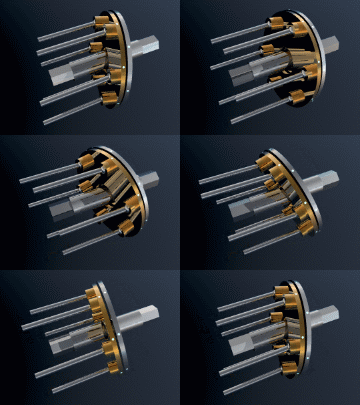
Swashplate animation. The rotating shaft and plate are shown in silver. The fixed plate is shown in gold and six shafts each take a reciprocating motion from points on the gold plate. The shafts might be connected to pistons in cylinders. Note the power may be coming from the shaft to drive the pistons as in a pump, or from the pistons to drive the shaft rotation as in an engine

A swashplate, also known as slant disk, is a mechanical engineering device used to translate the motion of a rotating shaft into reciprocating motion, or vice versa. The working principle is similar to crankshaft, Scotch yoke, or wobble, nutator, and Z-crank drives in engine designs. It was originally invented to replace a crankshaft, and is one of the most popular concepts used in crankless engines. It was invented by Anthony Michell in 1917.[1][2]

Construction

[edit]

A swashplate consists of a disk attached to a shaft. If the disk were aligned perpendicular to the shaft, then rotating the shaft would merely turn the disk with no reciprocating (or swashplate) effect. But instead the disk is mounted at an oblique angle, which causes its edge to appear to describe a path that oscillates along the shaft's length as observed from a non-rotating point of view away from the shaft. The greater the disk's angle to the shaft, the more pronounced is this apparent linear motion. The apparent linear motion can be turned into an actual linear motion by means of a follower that does not turn with the swashplate but presses against one of the disk's two surfaces near its circumference. The device has many similarities to the cam.

Uses

[edit]

Swashplates can be used in an axial engine in place of a crankshaft to translate the motion of a piston into rotary motion. Such engines are the only variation of the cam engine to have any success. Internal combustion engines and Stirling engines have been built using this mechanism. Duke Engines has been working on such a platform since 1993.[3]

The axial piston pump drives a series of pistons aligned parallel with a shaft through a swashplate to pump a fluid.[4] A common example of a swashplate application in a fluid pump is the compressor of a present-day automobile air conditioning system. By varying the angle of the swashplate, the pistons' stroke (and, therefore, the compressor's cooling capacity) can be dynamically adjusted.

A helicopter swashplate is a pair of plates, one rotating and one fixed, that are centered on the main rotor shaft. The rotating plate is linked to the rotor head, and the fixed plate is linked to the operator controls. Displacement of the alignment of the fixed plate is transferred to the rotating plate, where it becomes reciprocal motion of the rotor blade linkages. This type of differential pitch control, known as cyclic pitch, allows the helicopter rotor to provide selective lift in any direction. The swashplate can also transfer a combined static pitch increase to all rotor blades, which is known as collective pitch.

Nutating flowmeters and pumps have similar motions to the wobble of a swashplate, but do not necessarily transform the motion to a reciprocating motion at any time.

Active electronically scanned array (AESA) radars are flat plates that can scan up to sixty degrees in any direction from directly ahead of them. By mounting an AESA radar on a swashplate, the swashplate angle is added to the electronic scan angle. The typical swashplate angle chosen for this application is 40 degrees, enabling the radar to scan a total angle of 200 degrees out of 360.[5]

References

[edit]
[edit]
Revisions and contributorsEdit on WikipediaRead on Wikipedia
from Grokipedia
A swashplate, also known as a slant disk, is a device that translates rotational motion of a shaft into parallel to the shaft's centerline, or conversely, transmits inputs from a stationary frame to a rotating component. It typically consists of an angled plate or disk fixed to a rotating shaft, with an outer race or bearing that precesses or tilts to generate in connected elements such as pistons or linkages. This mechanism enables precise control and efficient in various applications, distinguishing it from other motion converters like crankshafts by its ability to produce motion aligned with the rotation axis. In , the swashplate is a critical component of systems, where it converts pilot control inputs from the non-rotating into motion for the rotating main rotor blades. It comprises two primary parts: a stationary swashplate, mounted around the main rotor mast and connected to cyclic and controls via pushrods, and a rotating swashplate, which turns with the mast and links to horns through pitch links. By tilting and sliding as a unit, the swashplate adjusts cyclically for directional control (roll and pitch) and collectively for altitude changes, allowing stable flight operations. This is essential for ranging from small unmanned aerial vehicles to large transport models, as seen in NASA's Ingenuity Mars helicopter, where the upper swashplate manages rotor pitch via servo motors for flight stability. Beyond , swashplates find prominent use in hydraulic and pneumatic systems, particularly in axial pumps and compressors. In these devices, the swashplate's angle determines stroke length, enabling for efficient fluid handling at speeds of 800–4000 rpm. For instance, in vehicle compressors, it drives pistons connected by shoes and a retracting ring, optimizing performance through features like enhanced designs that can increase efficiency by up to 12.7%. Such applications highlight the swashplate's versatility in converting rotary drive into linear force, supporting compact, high-power machinery in industrial and automotive sectors.

History

Invention by Anthony Michell

Anthony George Maldon Michell (1870–1959) was an Australian mechanical engineer renowned for his innovations in bearings and engines. Born on 21 June 1870 in , , to Australian parents, he moved to Victoria as a child and graduated from the with a Bachelor of in 1895 and a Master of in 1899. Michell established himself as a consulting engineer in , specializing in hydraulic and mechanical systems, including irrigation and water supply projects. His early career included work on regenerative pumps and a stint as a patent examiner, but he gained prominence through his 1905 invention of the tilting-pad , which addressed axial loads in systems and generated significant royalties by . This experience with efficient load distribution in high-thrust applications, such as ship engines, motivated his later designs for balanced mechanisms. In 1917, Michell invented the swashplate as a core component of his crankless , filing Australian No. 4627 on 19 for "Improvements in Mechanism for the Transmission of Power." The described a tilted "slant disc" mounted obliquely on the , which converted the linear reciprocation of in an axial arrangement into rotary motion, eliminating the traditional . This design used slipper pads on the —drawing from his principles—to transfer loads directly to the swashplate via an oil film, avoiding side on the walls and achieving perfect primary and secondary balance at all speeds. The swashplate's oblique plane ensured pure harmonic piston motion, making it suitable for compact, vibration-free axial engines. Michell secured patents for the crankless engine design in multiple countries, including the United States and United Kingdom, to protect its international application. In the U.S., his mechanism was detailed in Patent US1613116A, granted in 1926 but building on the 1917 Australian filing, which emphasized the swashplate's role in multi-piston coordination for internal combustion cycles. Early prototypes focused on compressors by 1919–1920, with initial internal combustion engine tests following shortly after. To commercialize the invention, Michell founded Crankless Engines (Australia) Pty Ltd on 24 August 1920 in Melbourne's Fitzroy suburb, initially as a private company that converted to public status in 1922 with £100,000 capital. The firm established workshops at 129 Greeves Street and built over 45 machines by the mid-1920s, including an 8-cylinder automotive prototype in 1923 (Machine No. 12) and a 70 hp tested in around 1923–1924. These early engines demonstrated the swashplate's efficiency in load transfer without side thrust, though commercialization faced challenges from economic pressures.

Development in Engines and Helicopters

Following Anthony Michell's foundational 1917 patent for the swashplate mechanism, its commercialization began in the with the development of practical engines. In 1927, Michell's eight-cylinder static barrel swashplate engine was produced by the Crankless Engine Company, which he founded in 1920 to exploit the design. This featured pistons acting directly on a tilted swashplate at 22.5 degrees, eliminating the and significantly reducing vibration compared to conventional designs. It found application in , where the low-vibration characteristics were particularly advantageous for shipboard use. In the 1930s and , swashplate technology saw further integration into axial internal-combustion engines, building on Michell's axial configuration to enable compact, balanced power delivery. Concurrently, the mechanism was adapted for Stirling engines, with Research Laboratories initiating swashplate drive concepts in the to convert reciprocating motion into rotation while maintaining sealed, efficient operation. A notable later revival occurred with Duke Engines' prototypes, which began development in 1993 and demonstrated valveless axial swashplate designs for high and torque. The swashplate mechanism for helicopters was first proposed by Russian aerodynamicist Boris Nikolaevich Yuryev in 1911, enabling cyclic and collective pitch control of the rotor blades. The transition to helicopter applications emerged in the 1940s, drawing from earlier innovations. Influenced by Igor Sikorsky's designs, the swashplate was incorporated for cyclic and pitch control, enabling precise blade adjustments. This culminated in its standard use in post-World War II , such as the (introduced in 1942), the first production , which employed a magnesium-alloy swashplate assembly for flight control. Key milestones included helicopter-specific patents in the 1940s and 1950s, such as Harold F. Pitcairn's 1944 design for rotor pitch control, which was transferred to the U.S. government during and licensed to Sikorsky and Bell. By the Korean War era (1950–1953), swashplate-equipped helicopters like the and Hiller H-23 Raven were widely adopted by U.S. military forces for evacuation, reconnaissance, and rescue missions, marking the mechanism's maturation in operational aviation.

Design and Construction

Core Components

The core of a swashplate assembly varies by application but generally consists of an angled disk (the swashplate) fixed to a rotating shaft and a follower interface for connected elements. In axial pumps and engines, the swashplate is typically a single rotating plate mounted obliquely to the drive shaft, with piston shoes or slippers maintaining sliding contact on its surface to convert rotation into . In helicopter systems, it comprises a rotating swashplate connected to the mast and a stationary swashplate that receives control inputs, with pitch links serving as the follower interface. Assembly of these components emphasizes precision to ensure smooth operation and minimal . Bearings, such as or roller types, support and tilting; in variable-displacement designs, they enable angle adjustments, while configurations use spherical bearings or sleeves between plates to accommodate and prevent metal-to-metal contact. Linkages like pushrods connect to actuators in setups, while general designs may incorporate control mechanisms for angle variation. Centering devices, such as anti-drive links in s or pivots in pumps, maintain alignment during operation. Materials for swashplate construction prioritize durability under cyclic loading and sliding contact. Steel and aluminum alloys, such as 390-T6 aluminum for plates and 52100 for shoes, are commonly used to balance strength, weight, and resistance to wear. points are incorporated at sliding interfaces, like between slippers and the plate surface, to minimize and extend component life. In generic construction, the oblique angle of the swashplate—typically set between 10 and 30 degrees—is established during assembly by mounting the disk at the desired tilt relative to the shaft axis, which directly influences the amplitude of in connected followers. This setup ensures reliable motion translation across various mechanical systems, with variations such as dual-plate configurations in applications adapting the core design for enhanced control.

Types and Variations

Swashplates in axial pumps and engines are primarily categorized into fixed-angle and variable-angle designs. Fixed-angle swashplates feature a constant tilt relative to the cylinder barrel, delivering unchanging lengths and thus constant displacement for applications requiring steady hydraulic flow, such as in fixed-displacement axial pumps used in medium- to high-pressure systems. In contrast, variable-angle swashplates incorporate mechanisms like hydraulic actuators or control s to adjust the tilt angle, enabling dynamic variation of strokes and output flow from maximum down to near zero, which supports load-adaptive performance in variable-displacement pumps. Helicopter swashplates typically employ a dual-plate configuration, consisting of a stationary lower plate linked to flight controls and a rotating upper plate connected via bearings to the mast, allowing coordinated plate movement while accommodating rotation. A notable variation is the flybarless (FBL) swashplate, which omits the stabilizing flybar in favor of direct electronic servo inputs for precise control, particularly in small-scale unmanned designs. Geometric variations in swashplate design, often tailored for remote-controlled (RC) helicopter models, include 90-degree configurations for standard cyclic pitch mixing with aligned servo geometry, 120-degree setups for balanced force distribution across three servos to minimize strain, and 180-degree arrangements for opposed servo placements that simplify mechanical linkages. These adaptations optimize servo efficiency and control symmetry in compact systems. Additional adaptations encompass single-plate swashplates for basic reciprocating mechanisms in engines, where a solitary inclined plate directly drives piston motion without dual elements. Wobble-plate variants, functioning as single-sided alternatives to conventional swashplates, appear in automotive compressors to generate axial reciprocation through a nutating disc rather than a fully rotating one.

Operating Principles

Motion Conversion Mechanics

The swashplate mechanism converts rotary motion from an input shaft into reciprocating or tilting motion. In axial piston pumps and engines, a stationary oblique disk is mounted at a fixed to the shaft via pivots on the . As the shaft and attached cylinder barrel rotate, the orbiting , connected via to the tilted swashplate surface, reciprocate axially within their bores due to the plate's inclination, generating linear displacement parallel to the shaft centerline. This sliding contact at the piston shoes ensures smooth motion proportional to the disk's and tilt . Multiple arranged around the shaft reciprocate in phase opposition, enabling efficient volume displacement. In dual-plate configurations, as used in control, a stationary plate is linked to a rotating oblique plate through bearings, enabling the stationary plate to tilt and transmit angular control inputs to the rotating component while accommodating the shaft's continuous . For reciprocating motion conversion, the swashplate's tilt imparts axial pushes to , forcing them to extend and retract. shoes, typically featuring ball-and-socket joints, maintain sliding contact with the disk's surface to follow its tilt. In tilting mechanics, particularly for control, inputs raise or lower the entire swashplate assembly along the shaft to uniformly increase or decrease pitch angles across all connected elements, altering overall magnitude. Cyclic inputs, by contrast, tilt the assembly in specific directions, producing differential angles that vary cyclically as the rotating plate spins, thereby directing vector for directional control. Friction arises at sliding interfaces, such as piston shoes against the swashplate face or bearings between dual plates, necessitating continuous lubrication to reduce energy losses, heat generation, and wear during high-speed operation. Proper lubrication maintains low-friction contact, preserving mechanical efficiency and longevity.

Mathematical Modeling

The mathematical modeling of a swashplate focuses on its kinematics, which convert rotational motion into linear reciprocation through the geometry of the tilted disk. The derivation begins with the vector projection of the swashplate's rotation axis onto the piston's axial path. Consider the swashplate tilted at an angle β relative to the perpendicular of the drive shaft axis, with the piston contact point at a radial distance r from the shaft center. As the swashplate rotates by an azimuthal angle ψ (or equivalently, as the barrel rotates relative to a stationary swashplate), the projection of the tilted plane onto the axial direction yields a sinusoidal variation in piston position. Specifically, the instantaneous axial displacement x(ψ) of the piston from its mean position is given by x(ψ) = r tan(β) cos(ψ), where the tan(β) term arises from the slope of the tilted plane, and cos(ψ) captures the harmonic nature of the rotation. This leads to the full axial stroke h, defined as twice the amplitude of the motion, expressed as h = 2 r tan(β). For small tilt angles (β << 1 rad), tan(β) ≈ β ≈ sin(β), providing a linear approximation commonly used in preliminary design, but the exact form accounts for the oblique geometry without approximation. This model assumes rigid body motion and neglects slipper dynamics or elastic deformations, which are secondary effects in basic kinematics. In applications requiring , such as axial pumps or engines, the stroke h directly influences the swept volume per , V = (π d²/4) h, where d is the ; however, the core kinematic relation remains tied to the tilt angle β for control of output flow or power. For control, the swashplate's tilt translates pilot inputs into cyclic variations in angle. The kinematic relation for the θ is θ = θ₀ + A sin(ψ - φ), where θ₀ is the collective pitch angle (uniform across blades), A is the cyclic determined by the swashplate tilt magnitude, ψ is the rotor angle, and φ is the control phase angle set by the direction of tilt (e.g., fore-aft or lateral). This derives from the swashplate's non-rotating ring displacing pitch links vertically as a function of sin(β) projected onto the rotating frame, producing the sinusoidal pitch variation that tilts the rotor disk for directional control. The A is proportional to r sin(β) / l, where l is the effective pitch link , ensuring the pitch change aligns with the tilted thrust vector. Load analysis on the swashplate incorporates force balances to determine operational s and stability. The force on each is F_piston = P A_piston, where P is the fluid and A_piston is the piston cross-sectional area, representing the primary hydraulic load driving reciprocation. The resulting T on the swashplate, which must be counteracted by the control mechanism, is T = ∑ F_piston r cos(β), summing over all pistons with the cos(β) factor accounting for the reduced moment arm due to the tilt (the axial component projects orthogonally to the radius). This balance is critical for sizing actuators in variable-displacement systems, as it increases with and decreases with tilt angle, potentially leading to if not compensated. In steady-state operation, the net is zero when hydraulic forces balance control inputs, derived from equilibrium of moments about the swashplate pivot.

Applications

In Axial Engines and Pumps

In axial engines, the swashplate serves as a key mechanism for converting the linear of pistons into rotary motion along the engine's central shaft, eliminating the need for a traditional and enabling a more compact layout. This design arranges pistons radially around the shaft in a barrel configuration, allowing for opposed or multi-cylinder setups that balance forces inherently. A seminal example is Anthony Michell's crankless engine, patented in 1922 (US Patent 1,409,057) and prototyped as an eight-cylinder model by 1927, where pistons directly engage a tilted swashplate angled at approximately 22.5 degrees to drive the output shaft. This configuration supports both internal combustion and operations, promoting vibration-free performance due to the symmetric arrangement and even firing intervals. Modern implementations, such as those developed by Duke Engines since 1993, further leverage the swashplate in axial prototypes to achieve high in valveless, four-stroke designs. These engines feature five cylinders aligned axially, with the swashplate facilitating direct piston-to-shaft motion conversion, resulting in reduced weight, lower vibration, and improved efficiency compared to conventional inline engines. Duke's prototypes demonstrate power outputs up to 215 horsepower from a 3-liter displacement while maintaining compact dimensions suitable for automotive and applications. In axial pumps, the swashplate enables by allowing the plate's tilt angle to adjust the pistons' , thereby controlling fluid flow rate without altering shaft speed. This is particularly useful in hydraulic systems, where pumps like Liebherr's DPVO series use a swashplate for open-circuit, high-pressure operations up to 420 bar. The theoretical flow rate QQ can be expressed as Q=(πD24)Nsin(β)×ZQ = \left( \frac{\pi D^2}{4} \right) N \sin(\beta) \times Z, where DD is the piston bore diameter, NN is the rotational speed in , β\beta is the swashplate angle, and ZZ is the number of pistons; this formula highlights how tilting the swashplate from 0° (zero flow) to its maximum angle scales output up to 100% capacity. A common application is in compressors, such as Toyota's swashplate models, which adjust the plate angle via electromagnetic clutches or hydraulic controls to match cooling demands and optimize . Control of the swashplate in these pumps typically involves hydraulic actuators or pressure-compensating mechanisms that respond to system demands, tilting the plate to vary displacement dynamically while minimizing energy loss. This adaptability makes swashplate axial pumps ideal for heavy machinery and mobile , offering stable flow with reduced pulsation compared to fixed-displacement alternatives.

In Helicopters

In helicopters, the swashplate serves as the primary mechanism for translating pilot control inputs into changes in main , enabling precise flight control in such as single- configurations. It consists of a stationary lower plate mounted around the main mast, which receives inputs from the cyclic and controls via pushrods and mixing units or servos, and an upper rotating plate connected to the horns through pitch links. This design allows for continuous 360-degree cyclic control without mechanical interference between the stationary inputs and the rotating . The collective pitch function is achieved through vertical translation of the entire swashplate assembly along the mast, which uniformly adjusts the pitch angle of all main blades to vary overall lift and enable altitude control. This upward or downward movement, driven by the collective lever, increases or decreases thrust symmetrically across the disk. Cyclic pitch control involves tilting the swashplate in the desired direction, which cyclically varies the angles as the rotor rotates, creating a differential lift between the advancing and retreating blades to tilt the rotor disk and provide directional control in roll and pitch. Yaw control is typically managed separately via the , but the swashplate's cyclic tilting contributes to overall attitude stability. The swashplate mechanism became standard in single-rotor helicopters following its adoption in designs during the 1940s. A prominent example is the Bell UH-1 Iroquois, introduced in the 1960s, where the swashplate integrates with hydraulic servos for collective and cyclic inputs to support utility and transport missions. In radio-controlled (RC) model helicopters, cyclic-collective-pitch-mixing (CCPM) configurations use three non-orthogonal servos linked to the swashplate to simultaneously handle cyclic and collective commands, reducing servo load and improving control efficiency.

Other Uses

Beyond their primary roles in engines, pumps, and rotorcraft, swashplates find application in specialized systems for motion control and fluid handling. In active electronically scanned array (AESA) radars, a mechanical swashplate mechanism tilts the antenna array to enable wide-angle beam steering, achieving up to a 200° field of regard with a 40° plate tilt angle. This hybrid approach combines electronic beamforming with mechanical repositioning, reducing the need for extensive electronic phase shifters in military phased-array systems like the Eurofighter Typhoon's ECRS Mk 2 radar, thereby enhancing scan coverage and operational flexibility. As of September 2024, the ECRS Mk 2 radar featuring a swashplate mechanism achieved its first flight on a Eurofighter Typhoon testbed, demonstrating advanced beam steering capabilities. In multistage air compressors, swashplate designs facilitate high-pressure gas compression across multiple cylinders of varying sizes, with the plate's adjustable angle enabling to optimize output based on demand. This adjustment alters stroke length, allowing control over or air flow while adhering to the first law of for work done on the gas during compression cycles. Such compressors are commonly used in systems, where they maintain efficient cooling by modulating capacity without a . Emerging applications include robotic actuators, where swashplates provide precise control over reciprocating in displacement-controlled hydraulic systems, offering energy efficiency and high accuracy for manipulators. Prototypes have explored swashplate integration in automotive mechanisms to enable dynamic adjustment of valve lift and duration in axial configurations. Niche implementations appear in floating cup pumps for high-pressure hydraulics, featuring swashplate-mounted cup elements that pair with pistons equipped with dual sealing rings to minimize leakage under extreme pressures up to 450 bar (continuous) or 500 bar (peak). These designs, often with spherical piston heads forming tight seals against the floating cups, excel in compact, high-efficiency fluid power systems for industrial and mobile equipment.

Advantages and Disadvantages

Benefits

Swashplate designs offer significant compactness and high due to their axial arrangement, which aligns pistons parallel to the output shaft, reducing overall volume compared to traditional mechanisms in engines and pumps. This configuration enables a smaller , making it suitable for space-constrained applications such as heavy machinery and systems. In axial piston pumps, the swashplate's supports high power-to-weight ratios, allowing efficient operation under demanding conditions like equipment. The balanced forces in swashplate mechanisms minimize and , as the axial layout reduces side loads and harmonics that are common in offset piston designs. This attribute is particularly beneficial in marine applications, where Michell crankless engines utilized swashplates to eliminate inherent in systems, enhancing durability in ship . Similarly, in compressors, the swashplate's smooth reciprocation lowers operational , improving passenger comfort and meeting regulatory standards. Adjustability is a key advantage, with the variable swashplate angle enabling precise control of displacement from 0% to 100% without throttling, which optimizes across load ranges. In hydraulic pumps, this allows for seamless adaptation to varying flow and demands, achieving up to 10-15% energy savings in partial-load operations compared to fixed-displacement alternatives. In radar systems employing mechanical steering, swashplate-based arrays provide extended scan ranges over purely electronic methods by enabling lightweight, compact beam tilting with reduced failure risk.

Limitations

Swashplate systems in axial pumps and rotors are prone to due to high sliding contact between components such as shoes and the swashplate surface, where three-body predominates from particles in the . This is exacerbated in low-viscosity fluids, as insufficient hydrodynamic fails to maintain an adequate oil film thickness, leading to direct metal-to-metal contact and potential slipper burning. In pumps, the required oil film is governed by principles like the , which models pressure distribution to predict minimum film thickness under varying loads and speeds, but deviations from optimal conditions accelerate and degradation. The mechanical complexity of swashplate assemblies, involving dual plates connected by bearings and multiple actuators, significantly increases the parts count and elevates risks, particularly in applications where exposed linkages contribute to drag and maintenance demands. Common modes include bearing deformation from uneven loads and faults that disrupt pitch control, necessitating robust to detect early wear in swashplate components. Variable swashplate angles impose stringent containment requirements, as axial loads from forces or thrust can destabilize the plate without adequate support, potentially leading to misalignment or . In designs employing secondary swashplates for enhanced control, the housing must counteract these forces to maintain stability across the operational tilt range, often requiring reinforced structures to prevent axial play under high-pressure conditions in pumps. Performance limitations of swashplate systems include reduced efficiency in pumps when operating with high-viscosity fluids exceeding typical thresholds (e.g., above 150 cSt), where increased viscous between and the plate elevates energy losses and lowers delivery rates. Additionally, the maximum is constrained to approximately 30 degrees in most axial pumps and rotors, limiting applications requiring extreme angular displacements, such as advanced scanning mechanisms in systems. To mitigate these challenges, engineering solutions incorporate like fiber-reinforced composites for swashplates, which reduce weight and improve fatigue resistance while lowering overall system inertia in helicopters. In flybarless (FBL) helicopters, digital controls enhance precision by electronically stabilizing swashplate inputs, compensating for mechanical tolerances and reducing failure risks through real-time adjustments. Hybrid electro-mechanical designs further address limitations by integrating electronic actuators with traditional plates, offering fault-tolerant operation and reduced mechanical complexity in actuation systems.

References

  1. https://handwiki.org/wiki/Engineering:Swashplate_(aeronautics)
Add your contribution
Related Hubs
User Avatar
No comments yet.