Hubbry Logo
Reciprocating motionReciprocating motionMain
Open search
Reciprocating motion
Community hub
Reciprocating motion
logo
8 pages, 0 posts
0 subscribers
Be the first to start a discussion here.
Reciprocating motion
from Wikipedia
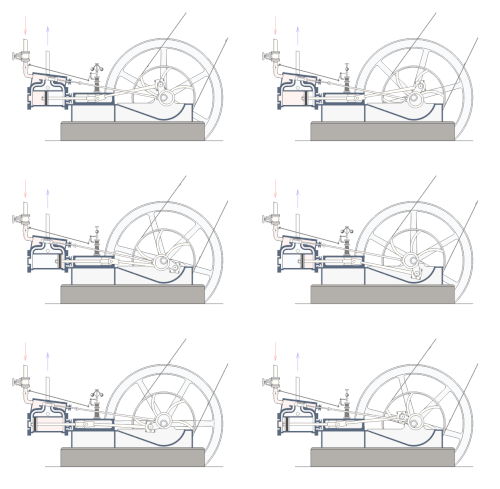
Double-acting stationary steam engine demonstrating conversion of reciprocating motion to rotary motion. The piston is on the left, and the crank is mounted on the flywheel axle on the right
Machine demonstrating the conversion of rotary motion to reciprocating motion using gears. The bottom pair of gears drives the mechanism

Reciprocating motion, also called reciprocation, is a repetitive up-and-down or back-and-forth linear motion. It is found in a wide range of mechanisms, including reciprocating engines and pumps. The two opposite motions that comprise a single reciprocation cycle are called strokes.[citation needed]

A crank can be used to convert into reciprocating motion, or conversely turn reciprocating motion into circular motion.[citation needed][1]

For example, inside an internal combustion engine (a type of reciprocating engine), the expansion of burning fuel in the cylinders periodically pushes the piston down, which, through the connecting rod, turns the crankshaft. The continuing rotation of the crankshaft drives the piston back up, ready for the next cycle. The piston moves in a reciprocating motion, which is converted into the circular motion of the crankshaft, which ultimately propels the vehicle or does other useful work. [citation needed]

The reciprocating motion of a pump piston is close to but different from, sinusoidal simple harmonic motion. Assuming the wheel is driven at a perfect constant rotational velocity, the point on the crankshaft which connects to the connecting rod rotates smoothly at a constant velocity in a circle. Thus, the displacement of that point is indeed exactly sinusoidal by definition. However, during the cycle, the angle of the connecting rod changes continuously, so the horizontal displacement of the "far" end of the connecting rod (i.e., connected to the piston) differs slightly from sinusoidal. Additionally, if the wheel is not spinning with perfect constant rotational velocity, such as in a steam locomotive starting up from a stop, the motion will be even less sinusoidal. [citation needed]

See also

[edit]
  • Oscillation – Repetitive variation of some measure about a central value
  • Stroboscope – Instrument used to make a cyclically moving object appear to be slow-moving, or stationary
  • Reciprocating saw – Type of machine powered saw
  • Reciprocating engine – Engine utilising one or more reciprocating pistons
  • Rotary reciprocating saw – Type of mechanical saw
  • Agitation – Device or mechanism which shakes or stirs something
  • Scotch yoke – Mechanism to convert between rotational and reciprocating motion
  • Crank – Arm attached to a rotating shaft for circular motion
  • Crankshaft – Mechanism for converting reciprocating motion to rotation
  • Swashplate – Mechanism to convert between reciprocating and rotary motion
  • Trip hammer – Type of blacksmithing tool
  • Slider-crank linkage – Mechanism for converting rotary motion into linear motion
  • Straight line mechanism – Mechanisms generating real or approximate straight line motion
  • Reciprocating compressor – Device used to pump gases at high pressure
  • Sun and planet gear – Type of gear used in early beam engines

References

[edit]
Revisions and contributorsEdit on WikipediaRead on Wikipedia
from Grokipedia
Reciprocating motion, also known as reciprocation, is a repetitive back-and-forth or up-and-down linear movement of an object or component along a straight path. This type of motion is characterized by periodic reversal of direction, distinguishing it from continuous rotary or unidirectional linear motion, and is fundamental to many mechanical systems. In and physics, reciprocating motion is commonly generated through mechanisms that convert rotational motion into linear , with the slider-crank mechanism serving as the standard example, where a rotating crank drives a sliding via a . This conversion enables efficient in devices requiring precise linear displacement. Key principles governing reciprocating motion include , which analyzes position, velocity, and acceleration as functions of time or crank , and dynamics, which accounts for forces, , and vibrations arising from abrupt direction changes at the motion's endpoints. Reciprocating motion finds extensive applications across industries, particularly in internal combustion engines, where pistons undergo linear reciprocation to convert combustion pressure into rotational crankshaft motion via the Otto or Diesel cycles. It is also essential in reciprocating pumps and compressors, which use or diaphragm movement to displace fluids or gases under , achieving capabilities up to 40,000 psi in compressors. Other notable uses include systems that transform vehicle suspension into usable and material testing machines that simulate cyclic loading. Despite its efficiency, reciprocating motion often introduces challenges like higher vibration levels compared to rotary systems, necessitating design considerations for and balance.

Fundamentals

Definition

Reciprocating motion, also known as reciprocation, refers to a repetitive back-and-forth or up-and-down along a straight path, typically constrained by mechanical elements such as guides or linkages. This type of motion is inherently oscillatory in nature, where an object or component reverses direction at defined endpoints, often driven by external forces or connected rotating parts to achieve periodicity. Unlike continuous , which proceeds in one direction without reversal, reciprocating motion cycles repeatedly between two extremes, making it essential for applications requiring intermittent linear displacement. In , reciprocating motion is distinguished from rotational motion, which involves continuous circular movement around an axis, such as in a or . While rotational motion generates through , reciprocating motion produces linear and is frequently used to convert rotational input into linear output, or vice versa, via mechanisms that impose straight-line constraints. This conversion is crucial in systems where pure rotation would be inefficient or impractical for the task at hand. Common examples of reciprocating motion include the within a cylinder of an or , where the piston moves linearly to compress or expand gases during each cycle. Another everyday illustration is the needle of a , which drives up and down in a straight path to pierce fabric repeatedly. These examples highlight how reciprocating motion enables precise, controlled linear actions in both industrial and devices. To describe reciprocating motion quantitatively without delving into derivations, key terms include , which measures the maximum displacement from the equilibrium position to an extreme; period, the time required for one complete back-and-forth cycle; and stroke length, the total distance traveled between the two reversal points. These parameters provide a foundational framework for analyzing the motion's scale and timing, with mathematical models further detailing their interrelationships in subsequent kinematic studies.

Historical Development

The understanding of reciprocating motion traces back to ancient feats, where early devices utilized it for fluid displacement. Around 250 BCE, of invented the , featuring reciprocating pistons in cylinders to draw in and expel water, marking the earliest known application of linear oscillatory motion in pumping. This invention demonstrated the potential of reciprocating mechanisms for directed flow, influencing subsequent hydraulic technologies. The marked a pivotal era for harnessing reciprocating motion in power systems. In the 1760s, , while repairing a , conceived the separate condenser to address thermal inefficiency, patenting it in 1769. By isolating condensation from the main , Watt's design allowed the to reciprocate without repeated heating and cooling, reducing fuel consumption by about 75% (increasing by a factor of about four) and enabling practical rotary power from via linkages. These improvements transformed steam engines into versatile drivers of machinery, fueling industrial expansion through the 1780s and beyond. The 19th and early 20th centuries saw reciprocating motion central to innovations. In 1876, Nikolaus Otto patented the first successful , where a reciprocating compressed and ignited fuel-air mixture to produce power cycles, laying the foundation for automotive propulsion. This engine marked a shift from external to internal , with widespread adoption by the 1880s. Subsequently, in the 1890s, refined the concept with his compression-ignition engine, patented in 1892 and first operational in 1897, using higher compression ratios in the reciprocating for greater on heavy fuels. Diesel's powered ships, locomotives, and factories, extending reciprocating principles to diverse heavy-duty applications. Post-World War II, reciprocating motion retained prominence in and amid technological shifts. In , air-cooled horizontally opposed piston engines, embodying reciprocating principles, became the enduring standard for light aircraft, sustaining reliable for civilian and training uses into the late despite jet dominance in . In industrial , reciprocating actuators like pneumatic cylinders proliferated from the , enabling precise linear motions in assembly lines and robotic manipulators to support efficiency.

Kinematics

Displacement and Position

In reciprocating motion, particularly in mechanisms like the crank-connecting rod-piston assembly, the displacement of the piston from a reference point, such as top dead center (TDC), is given by the function s(θ)=r(1cosθ)+ll2r2sin2θs(\theta) = r (1 - \cos \theta) + l - \sqrt{l^2 - r^2 \sin^2 \theta}
Add your contribution
Related Hubs
User Avatar
No comments yet.