Hubbry Logo
Fielding (cricket)Fielding (cricket)Main
Open search
Fielding (cricket)
Community hub
Fielding (cricket)
logo
8 pages, 0 posts
0 subscribers
Be the first to start a discussion here.
Fielding (cricket)
Fielding (cricket)
from Wikipedia

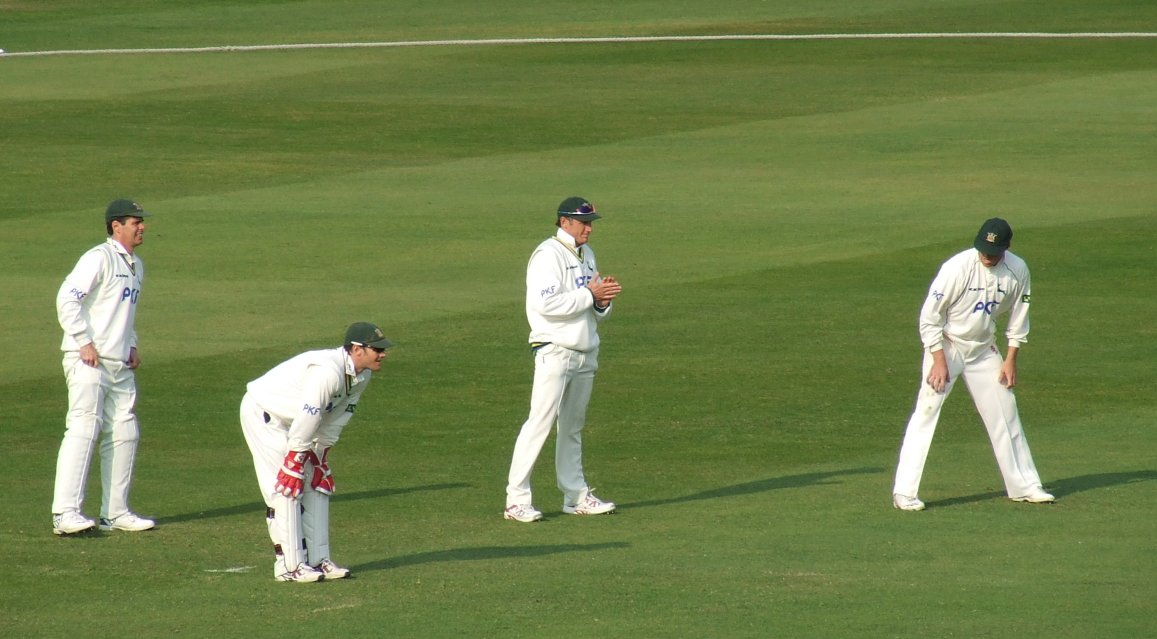
A wicket-keeper (bending down) and three slips wait for the next ball. The batter – out of shot – is a left-hander.

Fielding in the sport of cricket is the action of fielders in collecting the ball after it is struck by the striking batter, to limit the number of runs that the striker scores and/or to get a batter out by either catching a hit ball before it bounces, or by running out either batter before they can complete their current run. There are a number of recognised fielding positions and they can be categorised into the offside and leg side of the field. Fielding also involves trying to prevent the ball from making a boundary where four "runs" are awarded for reaching the perimeter and six for crossing it without touching the grass.

A fielder may field the ball with any part of their body. However, if, while the ball is in play, they wilfully field it otherwise (e.g. by using their hat) the ball becomes dead and five penalty runs are awarded to the batting side, unless the ball previously struck a batter not attempting to hit or avoid the ball. Most of the rules covering fielders are set out in Law 28 of the Laws of cricket. Fake fielding is the action when a fielder makes bodily movements to feign fielding to fool batters into making mistakes and is a punishable offence under the ICC rules.[1]

Fielding position names and locations

[edit]
Fielding positions for a right-handed batter
Some historic fielding position names, from the 1893 publication The reliable book of outdoor games

There are 11 players in a team: one is the bowler and another is the wicket-keeper, so only nine other fielding positions can be occupied at any time. Where fielders are positioned is a tactical decision made by the captain of the fielding team. The captain (usually in consultation with the bowler and sometimes other members of the team) may move players between fielding positions at any time except when a bowler is in the act of bowling to a batter, though there are exceptions for fielders moving in anticipation of the ball being hit to a particular area.[2]

There are a number of named basic fielding positions, some of which are employed very commonly and others that are used less often. However, these positions are neither fixed nor precisely defined, and fielders can be placed in positions that differ from the basic positions. The nomenclature of the positions is somewhat esoteric, but roughly follows a system of polar coordinates – one word (leg, cover, mid-wicket) specifies the angle from the batter, and is sometimes preceded by an adjective describing the distance from the batter (silly, short, deep or long). Words such as "backward", "forward", or "square" can further indicate the angle.

The image shows the location of most of the named fielding positions based on a right-handed batter. The area to the left of a right-handed batter (from the batter's point of view – facing the bowler) is called the leg side or on side, while that to the right is the off side. If the batter is left-handed, the leg and off sides are reversed and the fielding positions are a mirror image of those shown.[3]

Catching positions

[edit]

Some fielding positions are used offensively. That is, players are put there with the main aim being to catch out the batter rather than to stop or slow down the scoring of runs. These positions include Slip (often there are multiple slips next to each other, designated First slip, Second slip, Third slip, etc., numbered outwards from the wicket-keeper – collectively known as the slip cordon) meant to catch balls that just edge off the bat; Gully; Fly slip; Leg slip; Leg gully; the short and silly positions. Short leg, also known as bat pad, is a position specifically intended to catch balls that unintentionally strike the bat and leg pad, and thus end up only a metre or two to the leg side.[4]

Other positions

[edit]
  • Wicket-keeper
  • Long stop, who stands behind the wicket-keeper towards the boundary (usually when a wicket-keeper is believed to be inept; the position is almost never seen in professional cricket). It was an important position in the early days of cricket, but with the development of wicket-keeping techniques from the 1880s, notably at first by the Australian wicket-keeper Jack Blackham, it became obsolete at the highest levels of the game.[5] The position is sometimes euphemistically referred to as very fine leg. An example of this position taking a wicket in the modern game occurred during the England vs India test match in July 2025. Washington Sundar was attempting to smash quick runs in a final wicket partnership, bowler Jofra Archer asked for and received a long stop after a swipe off the first ball, the next ball was an attempted pull shot that flew off the top edge of the bat and went into the hands of Harry Brook standing behind the wicket keeper.[6]
  • Sweeper, an alternative name for deep cover, deep extra cover or deep midwicket (that is, near the boundary on the off side or the on side), usually defensive and intended to prevent a four being scored.
  • Cow corner, an informal jocular term for the position on the boundary between deep midwicket and long on.
  • On the 45. A position on the leg side 45° behind square, defending the single. An alternative description for backward short leg or short fine leg.

The bowler after delivering the ball must avoid running on the pitch, and so usually ends up fielding near silly mid on or silly mid off. Fast bowlers will continue running to exit the pitch and only change direction for balls dropped in front of the wicket. Spin bowlers with the slowest run-ups will usually cease their movement immediately after their delivery, planting their feet before the ball arrives to the batsman to react to a ball hit back up the pitch toward them. The bowler is generally understood to have the responsibility to defend the stumps at the non-strikers end of the pitch and so after a shot is made they will return to the stumps to catch any incoming throw, on rare occasions where a wicket-keeper has fallen or had to run to gather the ball the bowler may be the closest to the non-strikers stumps as well and so will move to the other end of the pitch. Once the play is dead they will walk back toward their bowling mark. In the laws of cricket the ball play is considered dead after the runners have ceased attempting to score and the ball has been returned to either the wicket-keeper or the bowler.

Modifiers

[edit]
Example of two close fielders: a short leg and a silly point stand close to the batters on either side of the pitch. They are both wearing protective equipment (helmets and leg pads). The wicket-keeper is 'standing up' to the stumps, and the square leg umpire is also visible.
Saving one or On the single
As close as the fielder needs to be to prevent the batters from running a quick single, normally about 15–20 yards (14–18 m) from the wicket.
Saving two
As close as the fielder needs to be to prevent the batters from running two runs, normally about 50–60 yards (46–55 m) from the wicket.
Right on
Literally, right on the boundary.
Deep, long
Farther away from the batter.
Short
Closer to the batter.
Silly
Very close to the batter, so-called because of the perceived danger of doing so.[7]
Square
Somewhere along an imaginary extension of the popping crease.
Fine
Closer to an extension of an imaginary line along the middle of the pitch bisecting the stumps, when describing a fielder behind square.
Straight
Closer to an extension of an imaginary line along the middle of the pitch bisecting the stumps, when describing a fielder in front of square.
Wide
Further from an extension of an imaginary line along the middle of the pitch bisecting the stumps.
Forward
In front of square; further towards the end occupied by the bowler and further away from the end occupied by the batter on strike.
Backward
Behind square; further towards the end occupied by the batter on strike and further away from the end occupied by the bowler.

Additionally, commentators or spectators discussing the details of field placement will often use the terms for descriptive phrases such as "gully is a bit wider than normal" (meaning they are more to the side than normal) or "mid off is standing too deep, they should come in shorter" (meaning they are too far away and should be positioned closer to the batter).

Restrictions on field placement

[edit]

Fielders may be placed anywhere on the field, subject to the following rules. At the time the ball is bowled:

  • No fielder may be standing on or with any part of their body over the pitch (the central strip of the playing area between the wickets). If their body casts a shadow over the pitch, the shadow must not move until after the batter has played (or had the opportunity to play) at the ball.
  • There may be no more than two fielders, other than the wicket-keeper, standing in the quadrant of the field behind square leg. See Bodyline for details on one reason this rule exists.
  • In some one-day matches:
    • During designated overs of an innings (see Powerplay), there may be no more than two fielders standing outside an oval line marked on the field, being semicircles centred on the middle stump of each wicket of radius 30 yards (27 m), joined by straight lines parallel to the pitch. This is known as the fielding circle.
    • For overs no. 11–40 (powerplay 2), no more than four fielders should be outside the 30-yard circle.
    • For overs no. 41–50 (powerplay 3) maximum of five fielders are allowed to be outside the 30-yard circle.
The restriction for one-day cricket is designed to prevent the fielding team from setting extremely defensive fields and concentrating solely on preventing the batting team from scoring runs.

If any of these rules is violated, an umpire will call the delivery a no-ball. Additionally a player may not make any significant movement that is not in response to the striker's actions after the ball comes into play and before the ball reaches the striker. If this happens, an umpire will call and signal 'dead ball'. For close fielders, anything other than minor adjustments to stance or position in relation to the striker is significant. In the outfield, fielders may move in towards the striker or striker's wicket; indeed, they usually do. However, anything other than slight movement off line or away from the striker is to be considered significant.

Tactics of field placement

[edit]

With only nine fielders (in addition to the bowler and wicket-keeper), there are not enough to cover every part of the field simultaneously. The captain of the fielding team must decide which fielding positions to use, and which to leave vacant. The placement of fielders is one of the major tactical considerations for the fielding captain.

Attacking and defending

[edit]
Marcus Trescothick fields at slip during a Twenty20 match.

An attacking field is one in which fielders are positioned in such a way that they are likely to take catches, and thus likely to get the batter out. Such a field generally involves having many fielders close to the batter. For a pace bowler, an attacking field will usually include multiple slips (termed a cordon) and a gully; these are common positions for catching mishit shots. For a spin bowler, attacking positions include one or two slips, short leg or silly point.

A defensive field is one in which most of the field is within easy reach of one or more fielders; the batter will therefore find it difficult to score runs. This generally involves having most fielders some distance from, and in front of, the batter, in positions where the ball is most likely to be hit. Defensive fields generally have multiple fielders stationed close to the boundary rope to prevent fours being scored, and others close to the fielding circle, where they can prevent singles.

Many elements govern the decisions on field placements, including: the tactical situation in the match; which bowler is bowling; how long the batter has been in; the wear on the ball; the state of the wicket; the light and weather conditions; or the time remaining until the next interval in play.

Off- and leg-side fields

[edit]

Another consideration when setting a field is how many fielders to have on each side of the pitch. With nine fielders to place, the division must necessarily be unequal, but the degree of inequality varies.

When describing a field setting, the numbers of fielders on the off side and leg side are often abbreviated into a shortened form, with the off side number quoted first. For example, a 5–4 field means 5 fielders on the off side and 4 on the leg side.

Usually, most fielders are placed on the off side. This is because most bowlers tend to concentrate the line of their deliveries on or outside the off stump, so most shots are hit into the off side.

When attacking, there may be 3 or 4 slips and 1 or 2 gullies, potentially using up to six fielders in that region alone. This would typically be accompanied by a mid off, mid on, and fine leg, making it a 7–2 field. Although there are only two fielders on the leg side, they should get relatively little work as long as the bowlers maintain a line outside off stump. This type of field leaves large gaps in front of the wicket, and is used to entice the batters to attack there, with the hope that they make a misjudgment and edge the ball to the catchers waiting behind them.

As fields get progressively more defensive, fielders will move out of the slip and gully area to cover more of the field, leading to 6–3 and 5–4 fields.

If a bowler, usually a leg spin bowler, decides to attack the batter's legs in an attempt to force a stumping, bowl him behind their legs, or induce a catch on the leg side, the field may stack 4–5 towards the leg side. It is unusual to see more than five fielders on the leg side, because of the restriction that there must be no more than two fielders placed behind square leg.

Sometimes a spinner will bowl leg theory and have seven fielders on the leg side, and will bowl significantly wide of the leg stump to prevent scoring. Often the ball is so wide that the batter cannot hit the ball straight of mid-on while standing still, and cannot hit to the off side unless they try unorthodox and risky shots such as a reverse sweep or pull, or switch their handedness. The batter can back away to the leg side to hit through the off side, but can expose their stumps in doing so.

The reverse tactic can be used, by fast and slow bowlers alike, by placing seven or eight fielders on the off side and bowling far outside off stump. The batter can safely allow the ball to pass without fear of it hitting the stumps, but will not score. If they want to score they will have to try and risk an edge to a wide ball and hit through the packed off side, or try to drag the ball from far outside the stumps to the sparsely populated leg side.

Another attacking placement on the leg side is the leg side trap, which involves placing fielders near the boundary at deep square and backward square leg and bowling bouncers to try to induce the batter to hook the ball into the air. For slower bowlers, the leg trap fieldsmen tend to be placed within 10–15 m from the bat behind square, to catch leg glances and sweeps.

Protective equipment

[edit]
A silly point (far) and a short leg (near) fielding for Nottinghamshire. Both are wearing helmets. The wicket-keeper's shin pads are on the outside of their trousers, but the fielders must fit their guards underneath their clothing.

No member of the fielding side other than the wicket-keeper may wear gloves or external leg guards, though fielders (in particular players fielding near to the bat) may also wear shin protectors, groin protectors ('boxes') and chest protectors beneath their clothing. Apart from the wicket-keeper, protection for the hand or fingers may be worn only with the consent of the umpires.[8]

Fielders are permitted to wear a helmet and face guard. This is usually employed in a position such as silly point or silly mid-wicket, where proximity to the batter gives little time to avoid a shot directly at their head. If the helmet is only being used for overs from one end, it will be placed behind the wicket-keeper when not in use. Some grounds have purpose-built temporary storage for the helmet, shin pads etc., in the form of a cavity beneath the field, accessed through a hatch about 1 m (3 ft) across flush with the grass. 5 penalty runs are awarded to the batting side should the ball touch a fielder's headgear whilst it is not being worn, unless the ball previously struck a batter not attempting to hit or avoid the ball. This rule was introduced in the 19th century to prevent the unfair practice of a fielder using a hat (often a top hat) to take a catch.[8]

As cricket balls are hard and can travel at high speeds off the bat, protective equipment is recommended to prevent injury. There have been a few recorded deaths in cricket,[9] but they are extremely rare, and not always related to fielding.[10]

Fielding skills

[edit]

Fielding in cricket requires a range of skills.

Close catchers require the ability to be able to take quick reaction catches with a high degree of consistency. This can require considerable efforts of concentration as a catcher may only be required to take one catch in an entire game, but their success in taking that catch may have a considerable effect on the outcome of the match.

Infielders field between 20 and 40 yards away from the batter. The ball will often be hit at them extremely hard, and they require excellent athleticism as well as courage in stopping it from passing them. Infield catches range from simple, slow moving chances known as "dollies" to hard hit balls that require a spectacular diving catch. Finally, infielders are the main source of run outs in a game of cricket, and their ability to get to the ball quickly, throw it straight and hard and make a direct hit on the stumps is an important skill.

Outfielders field furthest from the bat, typically right on the boundary edge. Their main role is to prevent the ball from going over the boundary and scoring four or six runs. They need good footspeed to be able to get around the field quickly, and a strong arm to be able to make the 50–80-yard throw. Outfielders also often have to catch high hit balls that go over the infield.

Fielding specialities

[edit]

Many cricketers are particularly adept in one fielding position and will usually be found there:

  • Slips and bat pad require fast reactions, an ability to anticipate the trajectory of the ball as soon as it takes the edge, and intense concentration. Most top slip fielders tend to be top-order batters, as these are both skills that require excellent hand–eye coordination. Wicket-keepers and bat-pad tend to be amongst the shortest players of the team.
  • It is common for the captain of a team to position themselves at slip or a similar close in fielding position. This enables them to remain close to the bowler, wicket-keeper and central umpire and to be able to survey the field from a central location in a similar manner to the batsman. It also reduces the energy they use during fielding as such positions are unlikely to require significant running or needing to shuttle back and forth swapping sides of the pitch when the batting partnership is one right and one left handed batter. Australian and New South Wales captain Mark Taylor was a specialist first slip fielder during his long career as an opening batsman. In his first match as the One-Day International captain for Australia he took four catches at first slip against the West Indies, and in Test Matches he effected 157 catches with a significant amount at first slip.
  • Pace bowlers will often be found fielding in the third man, fine leg and deep backward square positions during the overs between those they are bowling. These positions mean that they are at the correct end for their bowling over. They should see relatively little fielding action with plenty of time to react, allowing them to rest between overs.[11] They also usually have an ability to throw the ball long distances accurately.
  • Players noted for their agility, acceleration, ground diving and throwing accuracy will often field in the infield positions such as point, cover and mid-wicket. In short forms like T20 and One-Day internationals, the fastest players on a team will be used as "sweepers", on the sides the field at the very edge of the boundary where their pace can enable them to stop a ball from going for 6 or 4 runs.

Players are not selected purely because of their fielding skills in modern organised cricket. All players are expected to win their place in the team as a specialist batter, bowler or all-rounder. Due to the lack of restrictions on substitute fielders some teams will use a well regarded fielder from local club sides as an 'emergency fielder', who temporarily takes the place of another player and is prohibited from bowling, batting or acting as captain. An example of this was in the 2005 Ashes series with England using Gary Pratt, a 24 year old batter who was already past the peak of his batting career in first class cricket. Pratt fielded a quick single from Damien Martyn then threw down the stumps to dismiss Australian Captain Ricky Ponting.

Wicket-keepers were the one exception to the rule, as their specialist position was viewed as being so important that fielding as a keeper was more important than their batting, although they were still generally expected to be competent enough to play at the #7 position in the batting order, before the usual four bowlers. Jack Russell and Alec Stewart were in a constant selection battle for England's wicket-keeper position, with Stewart's superior batting competing with Russell who was considered the best wicket-keeper in the world. The back and forth over who should keep wickets lasted for Russell's entire test career from 1989 through to his retirement in 1998. In the early 2000's the role of Wicket-keeper-batter was introduced with the success of the heavy hitting Adam Gilchrist, elevating the expectations on the batting side of a wicket-keeper while retaining high level fielding ability. Wicket-keepers are allowed to bowl though this is extremely rare at higher levels, and no serious attempt has been made to use a wicket-keeper as a regular bowler in top level international cricket.

Throwing a cricket ball

[edit]
Jonty Rhodes, who typically fielded at backward point, has been fielding coach for South Africa, Mumbai Indians and Kenya.

There have been many competitions for throwing a cricket ball the furthest distance, particularly in the earlier years of the game. Wisden describes how the record was set around 1882, by one Robert Percival at Durham Sands Racecourse, at 140 yards and two feet (128.7 m). Former Essex all-rounder Ian Pont threw a ball 138 yards (126.19 m) in Cape Town in 1981.[citation needed] There are unconfirmed reports that Jānis Lūsis, the non-cricketer Soviet javelin thrower, who won the Olympic gold medal in 1968, once threw a ball 150 yards.[12]

Specialist fielding coaches

[edit]

The use of specialist fielding coaches has become more prevalent since the turn of the 21st century, following the trend of specialist batting and bowling coaches within professional cricket. According to cricket broadcaster Henry Blofeld, "Dressing rooms were once populated by the team and the twelfth man, one physiotherapist at most, perhaps a selector and the occasional visitor. That was all. Now, apart from the two main coaches, there are 'emergency fielders' galore; you can hardly see yourself for batting, bowling, fielding coaches, psychoanalysts and statistical wizards and a whole army of physiotherapists".[13] Baseball fielding coaches have been sought out for this purpose before.[14]

See also

[edit]

References

[edit]
[edit]
Revisions and contributorsEdit on WikipediaRead on Wikipedia
from Grokipedia
Fielding in cricket is the of the fielding team's players to retrieve, stop, and return the after it has been struck by the batsman, with the primary objectives of limiting the scoring of runs and effecting dismissals such as catches, run-outs, or stumpings by the wicket-keeper. The fielding side comprises 11 players in total, including the bowler (who delivers the ) and the wicket-keeper (positioned behind the stumps), leaving nine other fielders responsible for covering various areas of the oval-shaped field of play. This aspect of the game demands high levels of athleticism, including agility, speed, and hand-eye coordination, as fielders must react quickly to unpredictable ball trajectories while adhering to the . Fielding positions are strategically placed by the to counter the batsman's strengths and the bowler's style, categorized broadly into close-in catchers, infield stoppers, and boundary protectors. Close positions, such as slips (behind the batsman on the ) and (near slips but wider), target edges from the bat, while aggressive spots like silly point or silly mid-on position fielders perilously close to the batsman for quick reactions to mistimed shots. Infield roles include point (behind square on the ) and cover (straighter on the ) to intercept ground shots, mid-on and mid-off (aligned with the bowler), and leg-side equivalents like and mid-wicket. occupy deeper spots such as long-on, long-off, deep square leg, and fine leg to chase aerial or rolling balls toward the boundary, preventing fours or sixes. Under the governed by the (MCC), fielders may use any part of their body to field the ball but cannot wilfully obstruct the batsman or use unfair means, such as throwing the ball at the batsman. Only the wicket-keeper is permitted gloves or external leg guards, while other fielders may wear protective pads on fingers or hands but no gloves. In limited-overs international matches regulated by the (ICC), fielding restrictions limit the number of fielders outside a 30-yard circle during powerplay overs—typically no more than two in the first ten overs of an ODI—to encourage aggressive batting, with no more than five permitted on the at any time. These rules ensure fair play and have evolved to emphasize fielding's growing tactical importance, particularly in shorter formats where exceptional fielding can decisively influence match outcomes.

Field Positions

Standard Position Names

In cricket, the standard fielding positions refer to the conventional names and locations assigned to the nine fielders (in addition to the bowler and wicketkeeper) on the oval-shaped field, which is approximately 450 feet in diameter. These positions are defined relative to the batsman facing the bowler, with the field divided into the (the side away from the batsman's body, to the right for a right-handed batter) and the (or on side, closer to the batsman's legs, to the left for a right-handed batter). The total of 11 players forms a strategic arrangement, with the wicketkeeper positioned directly behind the stumps immediately behind the batsman, and the bowler at the opposite end of the 22-yard pitch. The following table outlines the core standard positions, their typical locations, and brief descriptions of their placement:
PositionLocation Description
SlipsClose behind the batsman on the , 2-4 fielders positioned to catch edges from the bat; first slip closest to the wicketkeeper, progressing to fourth slip farther out.
Behind the batsman on the , between point and slips, slightly wider and deeper than slips to intercept angled shots or deflections.
PointOn the , level with the batsman or slightly behind, about 15-20 yards from the pitch, covering cuts and drives square of the .
CoverOn the , forward of point, around 20-25 yards from the batsman, positioned to stop straight drives and cover drives.
Mid-offStraight on the , aligned with the bowler, about 25-30 yards from the pitch, to field lofted shots or straight drives.
Mid-onStraight on the , mirroring mid-off, about 25-30 yards from the batsman, covering on-drives and straight shots.
Mid-wicketOn the , forward of , around 20-25 yards from the batsman, to stop flicks and on-drives.
On the , perpendicular to the pitch behind the batsman, about 15-20 yards away, covering square shots and glances.
Fine legOn the , behind but closer to the fine line (near the ), around 20 yards deep, to catch or stop fine glances.
Long-offDeep on the , near the boundary straight of mid-off, to prevent boundaries from aerial drives.
Long-onDeep on the , near the boundary straight of mid-on, mirroring long-off for leg-side boundaries.
Deep Deep on the , near the boundary at , to field powerful square pulls or hooks.
Third manBehind point on the , near the boundary, patrolling the edge for deflections or controlled shots.
A typical 11-fielder layout for a right-handed batsman might place the wicketkeeper behind the stumps, slips and close behind on the , point and cover forward on the , mid-off and mid-on straight ahead, mid-wicket and on the , with long-off, long-on, deep , and third man positioned deeper toward the boundary to balance close catching and boundary protection. Many position names originated in the 18th and 19th centuries, reflecting the field's or the risk involved. For instance, "slips" derives from fielders in to catch glancing blows off the bat's edge, a term in use by the early 1800s. "" comes from the narrow channel-like area between point and slips, historically called "short third man" before evolving in the mid-19th century. "Point" traces back to the 18th century as the "point of the bat," where the fielder stood to intercept the ball's . Terms like "silly" in positions such as silly mid-on or silly point (close-infield spots) emerged in the 19th century, denoting the perceived foolishness of standing riskily near the batsman to induce mistimed shots. Positions are mirrored for left-handed batsmen: the off side shifts to the batsman's left, and the leg side to the right, requiring fielders like slips and point to adjust accordingly to maintain coverage. For example, what is point for a right-hander becomes a leg-side equivalent for a left-hander.

Catching Positions

Catching positions in cricket are specialized fielding spots positioned close to the batsman, primarily to intercept edges or mishits from the bat, particularly against spin or . These positions demand exceptional reflexes, soft hands, and mental focus due to their proximity to the action, often within 15 yards of the stumps. The close-in nature allows fielders to react quickly to deflections that might otherwise evade deeper positions, making them crucial for taking wickets in the early overs or during defensive phases. The slip cordon, consisting of first slip, second slip, third slip, and occasionally fourth slip, is positioned behind the batsman on the , directly behind the wicketkeeper. The first slip stands closest to the keeper, focusing on faint edges, while subsequent slips fan out wider to cover thicker edges or snicks. Leg slip mirrors this on the , targeting glances or deflections off the pads. These positions evolved in the as bowlers developed swing and seam movement, with early accounts from the describing slips as essential for exploiting the newly prominent "snick" dismissal; by the 1880s, teams routinely employed multiple slips against fast bowlers like . Gully, positioned slightly wider and forward of the slips, specializes in catching thick edges that fly between slip and point, requiring the fielder to dive or react to unpredictable trajectories. Forward of the wicket, silly point patrols the near the batsman, poised to pouch top-edged drives or deflections from aggressive shots. Silly mid-on and silly mid-off occupy similar hazardous spots on the leg and s, respectively, often against spin where batters play forward defensively. Short leg, or leg slip variant, crouches on the to catch bat-pad snicks, a position popularized in the for leg-spinners. Leg combines elements of short leg and , targeting leg-side deflections. All these roles are inherently risky, with fielders unprotected or lightly padded, emphasizing the need for bravery and precision honed through drills. Slips are responsible for a significant portion of dismissals in , particularly against pace bowling. In shorter formats like T20 cricket, catching positions are less frequently employed compared to Tests, where slips dominate due to the emphasis on swing and seam in longer innings; T20 sides often reduce the slip cordon to one or none, favoring deeper points or covers to prevent boundaries, though gully remains a staple for cross-bat shots. This adaptation reflects the format's pace, with close catchers appearing more in powerplays or against slower bowlers. Test matches, by contrast, see up to four slips as standard, underscoring the positions' role in patient wicket-taking.

Infield and Outfield Roles

In cricket fielding, the infield refers to the area within approximately 30 yards (27.43 meters) of the stumps at either end of the pitch, forming a semi-circular restriction zone used primarily in limited-overs formats to regulate fielder placement. This inner zone demands fielders with agility and quick reflexes, as positions like cover point are strategically placed to intercept aggressive drives and prevent the batsman from taking quick singles. In contrast, the encompasses the outer portion of the ground beyond this 30-yard , extending to the boundary rope, where fielders focus on retrieving balls hit with greater power and distance. The primary responsibilities of infielders include stopping ground shots, effecting run-outs through direct hits on the stumps, and applying pressure by limiting easy runs between the wickets. For instance, a fielder at mid-on in the infield might charge forward to field a straight drive, backing up throws to prevent overthrows while supporting close-in catchers. Outfielders, however, prioritize boundary protection, diving to save fours or executing long, accurate throws back to the wicketkeeper to restrict the batsman's scoring opportunities. Positions such as deep mid-wicket exemplify this role, where the fielder positions themselves to lofted shots toward the leg-side boundary, often requiring strong throwing arms to return the ball swiftly. Pitch conditions significantly influence the balance between infield and outfield deployments; on slower, turning pitches, captains often pack the infield with additional fielders to capitalize on and increase chances of dismissals via catches or run-outs. In faster, bouncy conditions, more fielders may shift to the to counter aerial drives. Format-specific adjustments further shape these roles—in One Day Internationals (ODIs), fielding restrictions mandate at least five infielders during non-powerplay overs, leading to a "packed infield" that emphasizes run prevention over boundary sweeping. Hybrid roles bridge the infield and , with versatile fielders known as sweepers patrolling wide arcs in the outer ring to cover multiple spots, such as transitioning from deep to third man based on the batsman's tendencies. These players combine the quick footwork of infielders with the endurance needed for retrievals, enhancing overall team flexibility without violating placement rules.

Placement Rules and Restrictions

Fielder Limits and Boundaries

In , the (ICC) enforces fielding limits through its playing conditions, which supplement the () to ensure fair play and balance between batting and bowling. A core restriction across all formats, detailed in Law 28.4 of the , prohibits more than two fielders—excluding the wicket-keeper—from standing behind the popping crease on the on side () at the instant of the bowler's delivery. This rule prevents the fielding side from overly protecting the area directly behind the striker, promoting more aggressive batting. Similarly, Law 28.4 limits the total number of fielders on the to no more than five at delivery, with violations resulting in a call by the and potential five-run penalties for deliberate or repeated breaches. In limited-overs formats, additional zonal restrictions apply using a 30-yard (27.43-meter) circle centered on each middle stump and marked by white lines or dots at five-yard intervals. For One Day Internationals (ODIs), Clause 28.7 of the ICC Men's Standard ODI Playing Conditions (effective July 2025) mandates fixed fielding restrictions: during the first 10 overs, only two fielders may be positioned outside this circle; during overs 11 to 40, a maximum of four fielders are allowed outside; and during overs 41 to 50, up to five fielders are permitted outside. Test matches do not impose these circle-based limits, relying solely on the general MCC Laws, though the first 10 overs conceptually align with early-innings dynamics without formal Powerplay enforcement. For Internationals (T20Is), the ICC Men's T20I Playing Conditions in Clause 28 specify that during the Powerplay (first six overs), only two fielders are permitted outside the 30-yard , with no further Powerplay options available. In the remaining overs, five fielders may operate outside the , maintaining the structure while applying the circles throughout. For shortened T20I matches as of July 2025, powerplay length is rounded to the nearest ball rather than over. Breaches of these circle restrictions at the instant of delivery prompt the bowler's-end to call a , which counts as an extra and may qualify as a wide if the ball passes wide of the striker, potentially awarding additional runs to the batting side. Fielders must also adhere to boundary positioning rules under Law 19 of the MCC Laws, requiring them to remain within the field of play at all times, defined by ropes, flags, or other markers. No fielder may stand on or over the boundary line, as any contact must occur while grounded inside the playing area; violations can nullify catches or award boundary runs. In June 2025, the ICC updated these conditions to clarify airborne fielding at boundaries: a fielder touching the while airborne beyond the boundary must land entirely inside the field before any further contact, or the catch is invalid and scored as a boundary. Historically, ODI fielding restrictions evolved significantly in October 2011 when the ICC streamlined Powerplays to two blocks (mandatory and optional batting powerplay) and increased the non-Powerplay limit to five fielders outside the 30-yard , up from the prior allowance of four in inter-Powerplay overs. This shift, part of broader efforts to enhance match excitement post-2011 , reduced the number of mandatory Powerplay segments from four and eliminated fixed restrictions in the final 10 overs, allowing more flexible defensive setups. In October 2017, the ICC further simplified the rules by removing the optional batting powerplay, establishing the current fixed restrictions of maximum two fielders outside the for overs 1-10, four for overs 11-40, and five for overs 41-50, which remain in effect as of 2025. Violations of any limits, including historical iterations, consistently incur no-balls or extras, with umpires enforcing compliance to uphold the game's integrity.

Umpire Enforcement and Penalties

Umpires are responsible for ensuring compliance with fielding restrictions throughout a match, with the square-leg tasked specifically with monitoring the positions of fielders relative to the 30-yard . This calls and signals "no ball" if an infringement occurs, such as more than two fielders outside the during the powerplay overs in limited-overs formats. The bowler's-end supports this by tracking overall placements and using verbal ranging calls to coordinate with the square-leg , particularly for counts of fielders behind the batsman's popping crease. Enforcement begins with pre-over inspections, where umpires visually assess and signal the number of fielders outside the restricted areas—often using arm gestures to indicate counts to the fielding and scorers. If a fielder crosses the return crease or enters the protected pitch area prematurely before the bowler's delivery stride is completed, the umpire immediately calls "," halts play, and requires the field to be reset without awarding runs from that delivery. In limited-overs cricket, a for fielding restriction violations also triggers a on the next delivery, enhancing the penalty's impact. Penalties escalate for deliberate or repeated violations under Law 42 of the , which addresses unfair play; umpires award five penalty runs to the batting side, warn the fielding , and may restrict further breaches with additional sanctions on subsequent offenses. Controversies in the early , including teams manipulating placements to obstruct batting momentum during one-day internationals, prompted the ICC to introduce stricter monitoring protocols and higher penalties, such as consistent five-run extras for powerplay breaches after warnings. The integration of technology has bolstered enforcement, with the third umpire reviewing boundary-related fielding decisions via video replays since the early 2000s; was incorporated for precise ball trajectory analysis in boundary catch referrals starting in 2008, allowing umpires to determine if a fielder remained within the field of play. This system ensures accurate adjudication of close calls, reducing disputes over fielder positions near ropes.

Tactical Field Settings

Attacking Configurations

Attacking configurations in cricket fielding involve strategic placements that cluster fielders in close proximity to the batsman, aiming to capitalize on edges, deflections, or mistimed shots to secure wickets rather than merely restricting runs. These setups are particularly employed during phases when the side seeks to apply pressure, such as early in an or against a batsman vulnerable to specific deliveries. By positioning multiple fielders in catching spots, the tactic increases the probability of dismissals, though it risks conceding boundaries if the batsman plays aggressively. A prominent attacking setup is the slip cordon, typically used for seam or fast bowlers to exploit edges off the bat. This involves placing three or four slips behind the batsman on the off-side, adjacent to the wicketkeeper, to catch glancing shots induced by away-swing or seam movement. For instance, packed off-side fields often include slips, , and point to cover potential deflections from inswingers or cutters, creating a dense barrier that forces the batsman into tentative play. Leg-side traps, conversely, are tailored for spinners, with fielders at short leg, leg slip, and positioned to snare bat-pad catches or glances from balls turning into the right-hander. These configurations must comply with format-specific fielding restrictions, such as a maximum of four fielders outside the 30-yard circle during middle overs (11-40) in ODIs and up to five during death overs (41+), or five outside after the powerplay in T20s, while never exceeding five on the . Historical examples illustrate the evolution of such tactics. The "Bodyline" field, employed by during the 1932–33 Ashes series against , featured aggressive leg-side clusters including short leg and multiple leg slips to trap deflections from fast, short-pitched deliveries aimed at the batsman's body. Devised by captain to counter , this setup led to numerous wickets but sparked controversy due to its intimidating nature and injuries, ultimately prompting changes to cricket laws on fielder limits. In modern T20 cricket, aggressive fields adapt these principles for high-scoring formats, often packing the off-side with extra cover and deep point to pressure batsmen into lofted shots, while leg-side traps remain for spin in the middle overs. Factors influencing these setups include the bowler's type and the batsman's identified weaknesses. Fast bowlers typically warrant deeper slip cordons to target loose drives, whereas spinners benefit from tighter leg-side placements to exploit turning balls against batsmen weak on the . Captains adjust based on pitch conditions and bowler accuracy, packing fields more densely when swing or seam is pronounced, or against batsmen prone to edging through poor footwork. Success metrics underscore their effectiveness; in from 2013 to 2017, slips and accounted for 32% of all catches off , demonstrating higher dismissal rates in attacking configurations with four or more slips compared to spread fields.

Defensive and Side-Specific Setups

In defensive fielding setups, the primary objective is to prevent runs rather than prioritize wicket-taking opportunities, typically achieved by spreading fielders across the outfield to patrol boundaries and restrict scoring through boundaries or quick singles. This configuration often features fewer close-in catchers, with positions like deep , long-on, and third man positioned to intercept drives and cuts, thereby forcing batsmen into less productive ground shots. For instance, in scenarios where a team is defending a modest total, captains may opt for a deep point and fine leg to cover wide angles, minimizing the risk of easy boundaries while allowing infielders to chase and stop rolling balls. The balance between off-side and leg-side fielders is a key tactical consideration, traditionally favoring a split (more on the off-side for right-handed batsmen) to protect against the dominant cover drives and square cuts that characterize most scoring shots, while adhering to the rule of no more than five fielders on the at any time. This setup accounts for the natural angles of pace and , where off-side protection is denser due to the batsman's tendency to play away from their body; however, adjustments are made for left-arm bowlers, who may prompt a shift to bolster leg-side cover with positions like a short midwicket or deep backward to counter the away-swinger's drift. In matches against left-handed batsmen, the split often reverses to 4-5, emphasizing slips and on the to exploit mirror-image vulnerabilities. Format-specific adaptations influence defensive setups significantly; in T20 cricket, fields are positioned deeper to counter aggressive big-hitting, with outfielders like long-off and deep midwicket pulled back 70-80 yards from the batsman to save sixes, reflecting the format's emphasis on high strike rates over containment. One-day internationals (ODIs), by contrast, have evolved from the 1970s' more attacking defaults—where fields were compact to force errors—to modern defensive spreads in the powerplay overs, incorporating sweepers at the edge of the inner circle to curb aerial shots amid slower outfields. Test matches, meanwhile, maintain a more static defensive posture during long sessions, with straight fielders like mid-on and mid-off reinforced to dry up singles and promote fatigue-induced mistakes. These shifts highlight how pitch conditions and match phase dictate depth. Captains must navigate balancing acts in defensive setups based on the match situation, such as protecting a lead by clustering fielders straight behind the wicket (e.g., deep fine leg and long leg) to block leg-side nurdles while maintaining off-side patrols. This decision-making weighs bowler strengths—fast bowlers might demand wider slips coverage—against batsman tendencies, with analytics from tools like Hawk-Eye informing adjustments to plug scoring zones; for example, during a chase, a defensive side-on setup might feature four outfielders on the leg side to neutralize sweep shots from spin. Such configurations underscore the captain's role in adapting to real-time dynamics, ensuring run prevention without exposing vulnerabilities to counterattacks.

Protective Equipment

Types of Gear

Fielders in cricket employ a range of protective gear to mitigate risks from high-speed deliveries, particularly in close-in positions where impacts are more likely. Core items include helmets equipped with visors or grilles to shield the head and face from direct hits, padded gloves exclusively for wicketkeepers to cushion catches behind the stumps, that wrap around the upper legs to absorb blows, abdominal protectors (often box-style for males) to safeguard the torso and , and internal shin pads that fit under trousers for lower leg protection without external visibility. These items are designed to balance safety with the need for agility during fielding movements. The materials used in this gear have evolved significantly since the , when heavy leather and cane constructions dominated, offering basic padding but restricting movement. By the 2000s, advancements introduced lightweight composites like carbon fiber shells for helmets and high-density inserts for guards, reducing weight while enhancing impact resistance and breathability. This shift was driven by growing awareness of head and body injuries, with the (ICC) mandating compliance with the British Standard BS7928:2013 for helmets in elite from October 2015 onward, applying to fielders in high-risk close positions to ensure standardized protection. Position-specific variations highlight the demands of roles; wicketkeeper gloves feature extra webbing between the thumb and fingers for superior ball control and are far bulkier than any hand protection allowed for other fielders, who are prohibited from wearing gloves under Law 28 to maintain fairness in catching. Thigh guards and abdominal protectors are more commonly used by close fielders like slips or short legs, where deflections from the bat pose threats, while shin pads suit outfielders diving on hard pitches. Notable incidents, such as close fielders struck on the helmet during fast bowling spells, have underscored gear's role in averting serious injury, prompting ongoing refinements like reinforced visors. Beyond core protective items, fielders rely on non-protective aids for performance and endurance, such as spiked shoes with metal or rubber studs for enhanced grip on grass turfs during quick stops and throws, and broad-spectrum applied to exposed to prevent sunburn during extended exposure in sunny conditions. These aids support safe, effective fielding without altering the game's protective regulations.

Regulations and Usage

The (ICC) mandates the use of helmets for fielders in designated high-risk positions to mitigate injury risks from fast-paced deliveries. Specifically, under the updated playing conditions effective from October 2023, fielders positioned close to the on the must wear helmets when the batter faces fast bowlers, as determined by the . This rule applies to close-in positions on the , such as short leg, during fast bowling spells, ensuring protection against head impacts from edges or mishits. All protective helmets used in international cricket must comply with the British Standard BS 7928:2013 certification, which specifies impact resistance and retention system requirements to withstand forces from cricket balls traveling at high velocities. Non-compliant helmets are prohibited, and umpires are empowered to inspect and enforce this standard before play commences or during intervals. Additionally, the ICC regulations prohibit loose or unsecured gear on fielders that could intentionally or accidentally dislodge the , such as dangling straps or unsecured , to prevent unfair interference under Law 37 of the MCC , which governs . Accidental contact with fallen equipment is not penalized if it does not deliberately alter the 's path. In practice, fielders are advised to don immediately upon assuming close positions during , particularly in short leg, and remove them only when retreating to safer distances or during slower . If equipment becomes damaged mid-over, such as a cracked , the fielder may signal the for a brief substitution with approved spare gear from the boundary, without halting play unduly, to maintain game flow while prioritizing safety. For outfielders, are optional but recommended in scenarios involving aggressive throwing or potential deflections, with lightweight models preferred to avoid impeding mobility and throwing accuracy. These mandates trace back to enhanced protocols following the 2014 death of from a , prompting the ICC in 2015 to require all international players to use compliant during batting and close fielding, with full enforcement by 2017. The 2023 expansion to mandatory leg-side close fielding reflected ongoing data from the ICC's , which analyzed impact forces and rates to justify broader application. Non-compliance incurs official warnings, escalating to match suspensions under ICC regulations.

Fielding Techniques

Ground Fielding and Stopping

Ground fielding involves fielders intercepting and halting balls that travel along the ground after being struck by the batsman, a fundamental that prevents easy runs and maintains on the batting side. Effective stopping requires a low, athletic stance to react quickly to the 's path, with fielders positioned to attack rather than wait passively. This technique minimizes the distance the ball travels unchecked, allowing for prompt retrieval and potential run-outs. Core methods emphasize proper body positioning for reliable stops. Fielders adopt a split-step stance with weight on the balls of the feet, knees bent, and hips lowered to create a balanced base for lateral or forward movement. Upon spotting the ball, they advance aggressively while maintaining a low center of gravity, bending the knees further to position the body as a backstop behind the hands. This ensures the ball is contained even if not cleanly gathered, reducing the risk of it deflecting away for additional runs. On harder surfaces, such as or , fielders may employ a palm-down hand placement to slap the ball downward and prevent excessive bounce, adapting to the faster, truer roll compared to natural grass where the ball slows and grips more readily. Pickup variations follow the stop to facilitate quick throws. For short distances, fielders use an underarm flick, scooping the with fingers downward and releasing from a low position to maintain momentum without rising fully. Overarm pickups are preferred for longer efforts or when speed is critical, involving a fluid motion where the is collected outside the front foot, followed by one or two momentum-building steps before release. Common errors include tentative approaches leading to fumbles, particularly on wet pitches where slippery conditions cause the to skid unpredictably and hands to lose grip, often resulting in mishandled stops that concede singles. Training drills reinforce these skills, with the "one-bounce" practice—a staple in modern coaching—simulating ground shots by having bowlers deliver balls that bounce once before fielders stop and retrieve them under pressure. Originating in structured coaching programs from the late 20th century, such drills build reaction time and precision, directly contributing to run prevention; studies indicate top fielders save approximately 1.2 runs per match through superior ground work compared to average performers. Adaptations for surfaces are key in drills, using softer hand placements on grass to account for variable bounce versus firmer techniques on astroturf to handle rapid travel.

Catching Methods

Catching in involves securing the airborne ball to dismiss the batsman, requiring precise hand positioning, body movement, and to handle varying trajectories and speeds. For low catches, fielders typically form a "" with their hands by placing thumbs together and fingers spread upward, creating a stable pocket to absorb the ball's impact and prevent it from popping out. This technique is essential for straightforward chances close to the ground, allowing the fielder to cushion the ball softly while maintaining visual contact until possession is secure. In contrast, high catches demand the "reverse " method, where fingers point upward and palms face the sky, enabling the fielder to judge the ball's descent at eye level and reduce the risk of it bursting through tense fingers. For challenging edges in positions like the slips, fielders often employ a "slip cradle" technique, positioning hands with fingers pointing slightly downward and palms upward to form a scooping shape that accommodates seam-induced deviation and low, fast-moving balls. Diving sideways is common for sharp chances, where the fielder extends fully while keeping eyes on the ball, using one-handed or two-handed grasps to intercept trajectories that would otherwise evade standard positioning. These methods emphasize relaxed hands to "give" with the ball's momentum, minimizing drops from rigidity. Catches range from "dollies"—simple, regulation chances requiring minimal adjustment—to "screamers," spectacular efforts involving dives or reflexes under extreme pressure. Difficulty escalates with factors like ball speed; an edge off a 90 mph delivery can reach slips in under 0.5 seconds, demanding sub-0.3-second reactions for elite fielders due to the short distance from bat to hand. Seam movement adds unpredictability, forcing split-second adjustments, while aerial juggles at boundaries test balance and multiple touches to prevent sixes. Notable historical feats highlight mastery of these techniques, such as Ravindra Jadeja's diving catch in the 2021 IPL match against , where he flung himself rightward to pouch Chris Gayle's edge low at point, showcasing and extension under lights. Training progresses from basic partner tosses to build hand-eye coordination, advancing to drills like ramp rebounds or slip cradle simulations that mimic irregular bounces, and culminating in high-speed machine feeds for screamers. Dropped catches can decisively cost matches, as seen in the 2019 ICC Cricket World Cup where Pakistan's 14 shelled chances across the tournament contributed to their elimination, allowing opponents like to capitalize on extra lives. In the final between and , minimal drops still amplified pressure, underscoring how even one error in a tied can alter outcomes via boundary countback.

Throwing and Run-Outs

In cricket fielding, is a critical that enables fielders to return the swiftly to the wicketkeeper or bowler, aiming to runs or effect dismissals. Overarm throws are primarily used for maximum distance, allowing fielders positioned in the deep to propel the up to 80 yards from the boundary to the stumps, leveraging body rotation and arm speed for power. In contrast, sidearm throws, executed with the arm parallel to the ground, prioritize accuracy over distance, particularly for infield fielders targeting quick releases under pressure. The standard grip for both techniques is seam-up, where the fingers are placed across the seam with the seam oriented vertically to promote a straight and minimize deviation in flight. A run-out dismissal occurs when the fielding team breaks the stumps with the ball while a batsman is out of their crease during a run attempt, requiring precise timing and execution. A direct hit, the most decisive form, involves the thrown ball striking and dislodging the bails without first bouncing off the ground, demanding the fielder aim low at the base of the stumps to maximize contact probability. For balls fielded deep in , relay throws are employed, where an outer fielder throws to an intermediate point—often another outfielder or —who then forwards it rapidly to the non-striker's end or stumps, reducing the time available for batsmen to complete quick singles or twos. In One Day Internationals (ODIs), run-outs constitute approximately 5% of all batsman dismissals, underscoring their rarity but high impact in turning matches. Effective throwing techniques emphasize body alignment and follow-through to ensure accuracy and prevent wild throws that can gift extra runs to the batting side. Fielders align their non-throwing shoulder toward the target upon picking up the , step forward with the opposite foot, and complete a full follow-through—extending the arm and torso in the direction of release—to maintain control and power. Since the , advancements in video have refined these , enabling coaches and players to dissect of throws frame-by-frame, identify flaws in alignment or release, and iteratively improve performance, leading to more consistent direct hits across professional levels. As of 2025, innovations include AI-powered motion tracking and wearable sensors for real-time feedback on throw , alongside environment-specific drills such as split-second boundary rope checks to counter lighting effects in venues like Dubai International Stadium. A landmark example of throwing prowess in run-outs is ' effort during the match between and at , where he sprinted from cover, dived full-length, and underarmed a direct hit to dismiss , breaking the stumps with the batsman short of his ground. This athletic display, combining speed, pickup, and precise throwing, revolutionized perceptions of fielding, inspiring a global shift toward aggressive, athletic standards that prioritized quick releases and direct hits over conservative play.

Coaching and Development

Specialist Fielding Coaches

Specialist fielding coaches in cricket are dedicated support staff members who concentrate solely on elevating fielders' performance, setting them apart from batting or coaches by prioritizing aspects such as agility, quick reactions, and synchronized team positioning during matches. Their work often involves leading group sessions to build collective awareness in while addressing individual weaknesses to prevent lapses like misfields or dropped catches. Key responsibilities encompass detailed video analysis of fielding errors, such as reviewing dropped catches frame-by-frame to identify technical flaws, and crafting tailored development plans for players based on their roles in the field. These coaches also collaborate with head coaches and captains to align fielding setups with broader strategies, ensuring placements optimize run-saving and wicket-taking opportunities during . In modern setups, particularly in T20 leagues like the IPL, specialists such as Carl Hopkinson for in 2025 exemplify this integration, focusing on high-pressure scenarios unique to short-format . The role of specialist fielding coaches gained prominence in the post-2000 era, coinciding with the explosive growth of T20 cricket, which demanded sharper athleticism and tactical adaptability from fielders. This shift was further propelled by advancements in data analytics, allowing coaches to quantify fielding contributions through metrics like expected runs saved, leading to more professionalized training regimens across international and franchise teams. The impact is evident in cases like Pakistan's national team, where dedicated fielding coaching under Steve Rixon from 2016 transformed them from a side prone to errors into one with elite standards, evidenced by improved catch success rates and fewer misfields in international fixtures. Prominent figures include , a legendary fielder turned coach who has influenced teams like the national side and IPL franchises through his expertise in dynamic fielding tactics. In India, T. Dilip has served as the national team's fielding coach since 2022, implementing rigorous programs that enhanced their outfield prowess during major tournaments. Additionally, , as India's head coach from 2017 to 2021, championed fielding as a core team strength, closely partnering with specialists like R. Sridhar to foster a culture of excellence that contributed to fewer errors in high-stakes matches.

Training Drills and Practices

Training drills and practices for fielding in cricket emphasize repetitive, skill-specific exercises to build technique, speed, and under simulated match conditions. These routines typically occur in team sessions lasting 30-60 minutes, focusing on individual proficiency before integrating group dynamics. Core drills target fundamental actions like stopping, catching, and throwing, progressing from isolated repetitions to high-intensity scenarios that mimic game pressure. One essential drill is pressure catching, where fielders receive multiple balls in rapid succession—often three or more—to simulate the urgency of close-field positions like slips or short leg. In the triple pressure catching variation, a coach or partner throws balls from varying angles and heights, requiring the fielder to catch and return quickly without dropping, enhancing reflexes and composure. This , commonly used in professional setups, improves catch success by forcing focus amid fatigue, with sessions involving 20-30 repetitions per player. Throw-downs serve as a key practice for ground fielding and stopping, where a coach throws the low and hard from 15-20 meters, compelling fielders to dive or roll to intercept and throw back to a target stump. This builds body positioning and quick release, particularly for infielders, with variations including sidearm feeds to replicate awkward bounces. Sessions often incorporate 50-100 throws per player, emphasizing clean stops to prevent byes. Circuit training integrates and through rotational stations, such as a 20-minute loop covering ground fielding, short throws, and sprints with 100 total throws across groups of 6-8 fielders. Each station lasts 2-3 minutes, promoting full-body conditioning while honing fielding specifics like lateral movement and accurate returns. This method, standard in club and international programs, boosts overall athleticism for prolonged match efforts. Progressive methods start with beginner techniques like palm rolls, where fielders use both hands to gently stop and roll the ball back, fostering basic control without risk of fumbles. As skills advance, drills evolve to one-handed pickups and dives, then boundary simulations involving long chases and relay throws to prevent fours. Bowling machines deliver balls at variable speeds (up to 120 km/h) for reaction practice, allowing controlled repetition to refine timing in catching or stopping. These layered approaches ensure steady skill development from novices to elites. Since the early 2020s, (VR) simulations have emerged as a modern tool for fielding training, enabling players to predict and react to catch trajectories in immersive environments. Systems like those developed for academies project virtual balls with realistic spin and pace, training cognitive anticipation without physical wear. Team practices, such as awarding "fielding medals" in international matches by teams like and similar recognitions in leagues like the IPL, motivate excellence by recognizing top performers per match based on catches and stops, fostering a culture of accountability. Improvements in fielding are measured through metrics like drop rates—calculated as successful catches divided by opportunities, with elite targets below 10% drops (e.g., 0.9 efficiency for one drop per 10 chances)—and throw accuracy, aiming for 70% hits on stumps from 30 meters. These quantifiable benchmarks, tracked via video analysis or apps in training, allow coaches to monitor progress and adjust routines.

References

Add your contribution
Related Hubs
User Avatar
No comments yet.