Hubbry Logo
search
logo
37817

Lunar Module Eagle

logo
Community Hub0 Subscribers
Read side by side
from Wikipedia

Eagle
Part of Apollo 11
Eagle at Tranquility Base, July 20, 1969.
Neil Armstrong photographs Buzz Aldrin.
TypeLunar module
ClassApollo Lunar Module
ManufacturerGrumman
Specifications
Launch mass33,294.5 lb (15,102.1 kg)[1]
History
DeployedJuly 20, 1969; 56 years ago (July 20, 1969)
Fate
  • Ascent stage: Abandoned in lunar orbit; current location unknown
  • Descent stage: Landed at Tranquility Base; still there

Lunar Module Eagle (LM-5) is the spacecraft that served as the crewed lunar lander of Apollo 11, which was the first mission to land humans on the Moon. It was named after the bald eagle, which was featured prominently on the mission insignia. It flew from Earth to lunar orbit on the command module Columbia, and then was flown to the Moon on July 20, 1969, by astronaut Neil Armstrong with navigational assistance from Buzz Aldrin. Eagle's landing created Tranquility Base, named by Armstrong and Aldrin and first announced upon the module's touchdown.

The name of the craft gave rise to the phrase "The Eagle has landed", the words Armstrong said upon Eagle's touchdown.[2]

Flight

[edit]

Eagle was launched with Command Module Columbia on July 16, 1969, atop a Saturn V launch vehicle from Launch Complex 39A, and entered Earth orbit 12 minutes later. Eagle entered lunar orbit on July 19, 1969. On July 20, Neil Armstrong and Buzz Aldrin entered into the LM and separated it from Command Module Columbia. Eagle was landed at Tranquility Base at 20:17:40 UTC on July 20, 1969, with 216 pounds (98 kg) of usable fuel remaining. After the lunar surface operations, Armstrong and Aldrin returned to the Lunar Module Eagle on July 21, 1969. At 17:54:00 UTC, they lifted off in Eagle's ascent stage to rejoin Michael Collins aboard Columbia in lunar orbit.

After the crew re-boarded Columbia, the Eagle ascent stage was abandoned in lunar orbit. The location of its impact on the Moon's surface during an orbit decay is unknown.[3] Studies of Eagle's estimated orbital trajectory have suggested that the spacecraft may still be in orbit as of 2021.[4]

[edit]

See also

[edit]

Notes

[edit]

References

[edit]

Further reading

[edit]
Revisions and contributorsEdit on WikipediaRead on Wikipedia
from Grokipedia
The Lunar Module Eagle was the spacecraft that served as the crewed lunar lander for NASA's Apollo 11 mission, achieving the first human landing on the Moon on July 20, 1969, in the Sea of Tranquility.[1] Piloted by Commander Neil Armstrong and Lunar Module Pilot Edwin "Buzz" Aldrin Jr., Eagle separated from the Command and Service Module Columbia—piloted by Michael Collins—and executed a powered descent to the surface after a 756-second engine burn, touching down approximately four miles from the planned site at coordinates 0° 41' 15" N, 23° 26' E.[1] This historic event enabled Armstrong's famous first steps on the lunar surface, fulfilling President John F. Kennedy's goal of landing humans on the Moon before the end of the 1960s.[1] Manufactured by Grumman Aircraft Engineering Corporation in Bethpage, New York, Eagle (designated LM-5) was a two-stage vehicle comprising a descent stage for landing and surface operations and an ascent stage for returning the crew to lunar orbit.[2] The module stood 7.0 meters (23 feet) tall with a width of 4.2 meters (14 feet) for the main body, expanding to 9.4 meters (31 feet) with deployed landing legs, and had a dry mass of approximately 4,213 kg (9,287 lb) unfueled, increasing to about 15,100 kg (33,300 lb) fully loaded with propellants, crew, and equipment.[3] It featured a pressurized cabin with 4.53 cubic meters of habitable volume, a 100% oxygen atmosphere, and life support for two astronauts for up to 33 hours, though the Apollo 11 crew spent 21 hours and 36 minutes on the surface.[4] Powered by hypergolic propellants in the descent propulsion system (using Aerozine 50 and nitrogen tetroxide) and a similar ascent engine, Eagle also included reaction control thrusters for maneuvering and four triangular landing legs with probes to signal touchdown.[5] During the mission, Armstrong and Aldrin conducted a 2.5-hour extravehicular activity (EVA), deploying the Early Apollo Scientific Experiments Package (EASEP)—including a passive seismic experiment and laser ranging retroreflector—and collecting 21.5 kg (47.5 lb) of lunar soil and rock samples.[1][6] Eagle's ascent stage lifted off from the Moon at 124 hours and 22 minutes mission elapsed time, rendezvousing and docking with Columbia after two orbits; it was subsequently jettisoned into lunar orbit, while the descent stage remained at Tranquility Base as a launch platform.[1] As the culmination of the Apollo program's lunar landing efforts, Eagle symbolized a pivotal engineering achievement, with its successful operation validating the lunar orbit rendezvous technique and enabling subsequent Apollo missions.[2]

Design and Development

Overview and Naming

The Lunar Module Eagle was designated LM-5, the fifth vehicle in the series constructed by Grumman Aerospace Corporation under contract to NASA.[3] The name "Eagle" was selected by Apollo 11 crew members Neil Armstrong and Buzz Aldrin in February 1969, inspired by the bald eagle featured on the mission patch as a symbol of the United States, drawing from the presidential seal and national emblem.[7] The callsign "Eagle" was employed throughout the mission for communications.[1] As the lander for Apollo 11, Eagle achieved the historic distinction of being the first crewed spacecraft to land on the Moon on July 20, 1969.[1] This accomplishment fulfilled the national objective set by President John F. Kennedy in his May 25, 1961, address to Congress, calling for a crewed lunar landing before the end of the 1960s.[1] Eagle employed a two-stage configuration, with the descent stage facilitating powered landing on the lunar surface and the ascent stage enabling liftoff to rendezvous with the command module in orbit.[5] Both stages utilized hypergolic propellants—Aerozine 50 as fuel and nitrogen tetroxide as oxidizer—for reliable ignition without an external source.[8]

Technical Specifications

The Lunar Module Eagle (LM-5), designed for the Apollo 11 mission, had a launch mass of 15,118 kg, which included the crew, equipment, and propellants.[3] Its dry mass was approximately 4,274 kg, comprising a descent stage dry mass of about 2,034 kg and an ascent stage dry mass of roughly 2,191 kg.[3] These masses reflected the vehicle's lightweight aluminum alloy construction, optimized for lunar operations while supporting two astronauts and their gear. In terms of dimensions, Eagle stood 7.04 m tall from the base of the descent stage to the top of the ascent stage, with a maximum diameter of 4.22 m for the cylindrical sections.[3] The descent stage featured four articulated landing legs that deployed to a width of 9.4 m across the footpads, providing stability on the uneven lunar terrain.[3] Propulsion systems included a throttleable descent propulsion system (DPS) engine capable of up to 10,000 lbf (44.5 kN) of thrust, using Aerozine 50 fuel and nitrogen tetroxide oxidizer stored in tanks holding approximately 8,210 kg of propellant.[3][9] The ascent propulsion system (APS) employed a fixed-thrust engine delivering 3,500 lbf (15.6 kN), also hypergolic, to lift the upper stage from the surface.[3][8] Power was supplied by six silver-zinc batteries—four 400 Ah in the descent stage and two 296 Ah in the ascent stage—providing 28 V DC at a total nominal capacity of 2,192 Ah to support all electrical systems.[10] The environmental control system (ECS) sustained two astronauts for up to 48 hours, incorporating oxygen supplies, lithium hydroxide canisters for CO₂ removal, water-glycol cooling loops, and waste management provisions within a pressurized cabin volume of 235 cubic feet.[3] Specific to Eagle, modifications from prior tests included increased thermal insulation on the landing gear struts (from 29.4 lb in Apollo 9 and 10 to 68.4 lb) to better withstand descent engine plume heating, along with lengthened lunar surface sensing probes to 5.6 feet on three legs for improved touchdown detection.[11] The Apollo Guidance Computer featured 36,864 words of read-only memory (ROM) in core rope format, enabling autonomous navigation, guidance, and control during descent and ascent.[12]

Manufacturing and Preparation

Construction Process

The Lunar Module Eagle (LM-5) was assembled by the Grumman Aircraft Engineering Corporation at its primary facility in Bethpage, New York, under the terms of a NASA contract awarded on November 7, 1962, for the design, development, and production of 15 lunar modules. This contract initiated the overall program, but fabrication of the flight hardware for Eagle, the first operational vehicle intended for crewed lunar landing, began in 1967 following the completion of earlier test articles (LM-1 through LM-4). Approximately 8,000 Grumman employees contributed to the effort across engineering, manufacturing, and quality assurance roles, ensuring rigorous adherence to specifications derived from the modular two-stage design heritage.[13][2] Assembly proceeded in phases, commencing with the descent stage in 1968, which formed the base structure housing the landing gear, propellant tanks, and propulsion systems. Key components, including the primary pressure vessels for fuel and oxidizer storage, were fabricated in-house at Grumman, while critical subsystems like the descent propulsion engine were supplied by subcontractor Aerojet General Corporation under a dedicated development agreement. The descent stage's octagonal aluminum alloy framework was constructed using aircraft-style riveting and welding techniques to achieve the lightweight yet durable structure required for lunar operations. Once completed, the ascent stage—containing the crew cabin, ascent engine from Bell Aerosystems, and life support systems—was integrated atop the descent stage, with interconnecting umbilicals and structural mating performed in a controlled cleanroom environment to prevent contamination.[14][15][16] Structural assembly of Eagle was finalized by late 1968, culminating in integration tests at the Grumman facility on December 13, 1968, which verified the mated stages' mechanical integrity and subsystem interfaces. The entire production process for each lunar module, including Eagle, fell within an average cost of approximately $38 million per unit under the fixed-price incentive contract structure, reflecting the economies achieved after initial development investments. This milestone positioned Eagle as the pioneering flight-qualified lunar module, ready for shipment to NASA's Kennedy Space Center—the ascent stage departed Grumman on January 7, 1969, arriving on January 8, followed by the descent stage on January 12, 1969—for final spacecraft stacking and preparations.[17][18][19]

Testing and Modifications

Following the completion of construction in late 1968, the Lunar Module Eagle (LM-5) underwent rigorous ground testing at Grumman Aircraft Engineering Corporation's facilities in Bethpage, New York, and NASA's White Sands Test Facility in New Mexico. At Grumman, a series of 16 drop tests were conducted in 1968 using a structural test vehicle to validate the landing gear's integrity under simulated lunar impact conditions, with accelerations up to 12 g's confirming the crushable aluminum honeycomb struts' performance. Vibration and acoustic tests were performed to simulate launch environments, exposing the module to progressive-wave acoustic excitation levels exceeding 140 dB to ensure structural resilience. At White Sands, reaction control system (RCS) tests verified thruster performance and plume deflectors, incorporating modifications like added liners to the liquid hydrogen feed ducts based on prior Apollo hardware evaluations. Thermal-vacuum tests, drawing from Lunar Module Test Article (LTA-8) certifications at the Manned Spacecraft Center in 1968, confirmed Eagle's ability to maintain cabin pressure and subsystem functionality in vacuum conditions down to 10^-5 torr.[20][21] Eagle benefited from flight heritage gained during Apollo 9 (March 1969), which tested LM-3 in Earth orbit, and Apollo 10 (May 1969), a lunar orbit rehearsal with LM-4 that identified docking challenges. These missions revealed issues with the probe-and-drogue docking mechanism, such as hard contacts during alignment, prompting Grumman and NASA to refine the capture latches and extend the probe's retraction sequence for smoother engagements in subsequent vehicles, including Eagle. Altitude chamber tests at Kennedy Space Center in early 1969 verified cabin integrity under vacuum, simulating depressurization to below 0.1 psi while testing valve assemblies and extravehicular mobility units, ensuring no leaks or microbial contamination risks. These tests, completed by March 1969, confirmed Eagle's environmental control system reliability for lunar vacuum exposure.[22][23][10] Modifications to Eagle included the addition of a contingency samples kit in the ascent stage, comprising document bags and tools for rapid collection of up to 15 pounds of lunar material in case of abbreviated surface operations, integrated during final assembly. Propellant loading was adjusted to optimize descent and ascent profiles: the descent stage carried 6,975 pounds of Aerozine 50 fuel and 11,209 pounds of nitrogen tetroxide oxidizer, while the ascent stage held 2,020 pounds of fuel and 3,218 pounds of oxidizer, fine-tuned based on Apollo 10's orbit insertion data to reduce velocity penalties by targeting a 65.7 by 53.7 nautical mile lunar orbit. Other updates from Apollo 10 lessons included replacing the Mylar thermal blanket on the descent stage with an ablative paint to prevent flaking and radar interference and installing RCS plume deflectors at the launch site. In June 1969, final checkouts at Kennedy Space Center encompassed plugs-out integrated tests, landing gear functionality verification, and solar simulation exposures to assess thermal protection under full-spectrum sunlight, ensuring all systems were launch-ready without anomalies.[10][17][24]

Apollo 11 Mission Role

Journey to Lunar Orbit

The Lunar Module Eagle was stacked with the Command Module Columbia on January 29, 1969, at NASA's Kennedy Space Center, forming the core of the Apollo 11 spacecraft assembly that would later be integrated atop the Saturn V launch vehicle.[1] On July 16, 1969, at 13:32 UTC, the fully assembled Apollo 11 stack lifted off from Launch Complex 39A at Kennedy Space Center aboard Saturn V SA-506, marking the beginning of Eagle's journey to the Moon.[1] The launch propelled the spacecraft into an initial Earth parking orbit at an altitude of approximately 190 kilometers, where it completed two orbits to verify systems performance before proceeding.[25] Following the parking orbit phase, the S-IVB third stage of the Saturn V executed the translunar injection burn at 2 hours, 44 minutes, and 14 seconds into the mission, accelerating the spacecraft to escape velocity and placing it on a free-return trajectory toward the Moon.[26] This trajectory, designed as a safety measure to loop around the Moon and return to Earth without further propulsion if needed, covered the approximately 384,400-kilometer distance to the lunar vicinity in about 76 hours.[27] Throughout the translunar coast, Eagle remained docked to Columbia, with the combined spacecraft traveling along this hybrid free-return path that balanced fuel efficiency and mission flexibility.[25] On July 18, approximately 56 hours into the flight, the crew powered up Eagle for the first time by transferring electrical power from Columbia through the docking tunnel, initiating systems activation and checkout procedures.[1] Astronauts Neil Armstrong and Buzz Aldrin, entering the module in their spacesuits, conducted detailed checks of critical subsystems, including communications links with ground control and the descent propulsion system, confirming operational readiness without anomalies.[1] These evaluations ensured Eagle's environmental control, guidance, and propulsion systems were functioning nominally for the upcoming orbital maneuvers. Eagle continued to remain attached to Columbia as the spacecraft approached the Moon, culminating in lunar orbit insertion on July 19 at 17:22 UTC, when the service propulsion system fired for 357.5 seconds to capture the stack into an initial elliptical orbit of 313 by 113 kilometers around the lunar surface.[1][28] This insertion marked the end of the translunar phase, positioning Eagle for its subsequent role in the mission while still integrated with the command module.[10]

Descent and Landing

The Lunar Module Eagle undocked from the Command Module Columbia on July 20, 1969, at approximately 17:44 UTC (100 hours, 12 minutes ground elapsed time), initiating the final preparations for descent to the lunar surface. Following undocking, pilot Michael Collins in Columbia performed a separation maneuver at 18:11 UTC (100:39:50 GET), applying a delta-V of about 0.76 m/s to achieve a safe distance of roughly 335 meters. This maneuver positioned Eagle, crewed by commander Neil Armstrong and lunar module pilot Buzz Aldrin, for the subsequent Descent Orbit Insertion (DOI) burn, which lowered the perilune to 15.7 km while maintaining an apolune of 105 km, setting up a highly elliptical orbit for the powered descent phase approximately six hours later.[29][30] The powered descent initiation (PDI) began at 19:46 UTC (102:33:07 GET) near perilune at an altitude of approximately 16 km over the lunar nearside, with Eagle's descent propulsion system (DPS) engine igniting at 10% throttle for initial braking before ramping up to full power, producing 31 kN of thrust. As the module descended, the landing radar acquired a signal on the lunar surface at approximately 1,800 meters altitude, providing critical velocity and height data to the guidance computer despite initial discrepancies of up to 900 meters between radar and inertial measurements. However, at around 500 meters altitude (102:44:45 GET), Armstrong detected that the automatic guidance was directing Eagle toward a boulder-strewn area near West Crater, prompting a manual override to take control of the descent.[31] Armstrong's manual piloting extended the descent by about 30 seconds, navigating past the hazardous terrain and selecting a smoother site in the southwestern Mare Tranquillitatis, while Aldrin monitored systems and called out descent rates. The DPS engine was throttled down to as low as 10% during the final approach to control touchdown velocity, with the module touching down at 20:17:40 UTC (102:45:40 GET) at coordinates 0.67408°N, 23.47297°E, approximately 7.6 km downrange from the planned site. Armstrong radioed Mission Control, "Houston, Tranquility Base here. The Eagle has landed," confirming success with just 30 seconds of usable fuel remaining—equivalent to about 98 kg—averting an abort that would have been mandatory moments later.[32][30][10]

Surface Operations

Following touchdown, astronauts Neil Armstrong and Buzz Aldrin utilized the Lunar Module Eagle as a base of operations for scientific exploration and sample collection on the lunar surface in the Sea of Tranquility. The crew conducted two extravehicular activities (EVAs) totaling approximately 6 hours, while the Eagle's cabin provided shelter, life support, and a rest area during the overall surface stay of 21 hours 36 minutes. The life support system, including oxygen, water, and thermal control, sustained the crew effectively throughout this period, enabling them to return 21.5 kilograms of lunar rocks and soil for Earth-based analysis.[1][33] The first EVA began at 02:56 UTC on July 21, 1969, shortly after a post-landing systems check, and lasted 2 hours 31 minutes. Armstrong descended the ladder first, followed by Aldrin, marking the initial human exploration of another world. Key tasks included deploying the United States flag near the Eagle to symbolize the achievement, positioning the television camera on the modularized equipment stowage assembly (MESA) to transmit live footage to Earth, and collecting a contingency sample of lunar soil and rocks. These efforts prioritized immediate documentation and basic geological sampling while the astronauts tested mobility in the 1/6th gravity environment.[32][34] After re-entering the Eagle for a 7-hour rest period, during which the crew slept, ate dehydrated meals, and monitored systems from the cabin, the second EVA commenced at approximately 11:16 UTC on July 21, 1969, and extended for 3 hours 49 minutes. Armstrong and Aldrin ventured farther from the Eagle, up to 60 meters, to deploy the Early Apollo Scientific Experiments Package (EASEP), which included the Passive Seismic Experiment for detecting lunar seismic activity, the Laser Ranging Retroreflector (LRRR) for precise Earth-Moon distance measurements, and the solar wind composition experiment—a foil sheet to capture solar particles for later analysis. They also gathered additional documented samples, including a core tube extraction, to augment the collection with diverse regolith and basalt fragments, for a total of 21.5 kg from both EVAs. This phase emphasized instrument setup for long-term data return via radio signals to Earth.[32][34][35] The Eagle's interior, approximately 4 square meters in volume, functioned as a habitat for the full surface duration, with the crew using it for decompression, suit maintenance, and brief physiological recovery between EVAs. Total rest time inside exceeded 15 hours, including sleep and preparation, underscoring the module's role in supporting human physiology under vacuum and extreme temperature conditions ranging from -150°C to 120°C. The operations concluded successfully, yielding foundational insights into lunar geology and seismology without any major anomalies.[1][34]

Ascent and Rendezvous

Following approximately 21 hours and 37 minutes on the lunar surface, the ascent stage of Lunar Module Eagle lifted off from Tranquility Base on July 21, 1969, at 17:54:00 UTC. The ascent propulsion system engine ignited nominally, providing a thrust of about 16,000 newtons in the low-gravity environment, and burned for 435 seconds until cutoff at 18:01:15 UTC, achieving an initial orbit of approximately 89 by 17 kilometers with a velocity of 1.85 km/s.[10][36] The trajectory employed a direct ascent profile, reaching a maximum altitude of about 15 km during the initial phase before settling into the low lunar orbit. Rendezvous with the Command and Service Module Columbia required three primary reaction control system burns: the coelliptic sequence initiation at 125:19 GET (approximately 21:51 UTC) to circularize the orbit, the constant differential height maneuver at 126:18 GET (22:50 UTC) to match altitudes, and the terminal phase initiation at 127:04 GET (23:36 UTC) to close the distance, supplemented by two minor midcourse corrections totaling less than 2.5 ft/s. These maneuvers, guided by the rendezvous radar and onboard computer, successfully aligned Eagle with Columbia's 30 by 112 km orbit despite minor deviations in velocity residuals.[10][36] Docking occurred at 21:35 UTC on July 21, after roughly 3 hours and 41 minutes of rendezvous operations, with Command Module Pilot Michael Collins manually guiding Columbia to contact at a relative velocity of 0.03 m/s. The probe-and-drogue mechanism latched successfully on the first attempt, and the crews—Neil Armstrong and Buzz Aldrin from Eagle, and Collins from Columbia—verified a hard dock before opening the hatches around 21:48 UTC. Crew transfer, including samples and equipment, was completed by approximately 21:55 UTC, allowing Armstrong and Aldrin to rejoin Collins in Columbia.[10][36][1] The ascent stage was jettisoned at 23:41 UTC on July 21, using the reaction control system to impart a 0.67 m/s velocity change, leaving it in a 101 by 87 km lunar orbit. Its subsequent fate remains unknown, with analyses suggesting it either persists in a long-term orbit or eventually impacted the lunar surface, though no precise location has been confirmed.[10][36]

Post-Mission Fate and Legacy

Component Outcomes

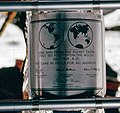
The descent stage of the Lunar Module Eagle remained at Tranquility Base after the ascent stage departed with astronauts Neil Armstrong and Buzz Aldrin on July 21, 1969. This stage, which facilitated the powered descent and landing, now marks the historic site of humanity's first lunar steps and bears the Apollo 11 commemorative plaque affixed to one of its landing gear struts. The stainless steel plaque, measuring 9 by 7.75 inches, reads: "Here men from the planet Earth first set foot upon the Moon July 1969 A.D. We came in peace for all mankind," accompanied by the signatures of Armstrong, Aldrin, Michael Collins, and President Richard Nixon.[37] The descent stage's exterior features a multilayer thermal blanket composed of aluminized Kapton, Mylar, and other insulating materials to shield against radiant heat from the lunar surface and engine plume pressures during touchdown. This protection ensured the stage's stability in the vacuum and temperature extremes of the Moon, where daytime surface temperatures exceed 250°F (121°C). The site has been imaged multiple times by NASA's Lunar Reconnaissance Orbiter (LRO) since 2009, with high-resolution photographs confirming the descent stage's position at coordinates 0.67408° N, 23.47297° E, alongside nearby artifacts like the Lunar Ranging Retroreflector and preserved astronaut footprints. Subsequent missions, including orbital observations during Apollo 15 and 16, contributed to early documentation of the Tranquility Base area through panoramic and mapping photography.[5][38][39] The ascent stage of Eagle was jettisoned into lunar orbit following its docking with the Command Module Columbia on July 21, 1969, at an initial altitude of approximately 9 nautical miles (17 km). Abandoned without attitude control or propulsion after separation, its trajectory was influenced by lunar mascons and gravitational perturbations, leading to an unpredictable evolution. As of 2025, the stage's location remains unconfirmed; traditional models predicted an orbital decay and surface impact within months, but recent analyses indicate it may have entered a stable, eccentric orbit persisting for decades or potentially escaped into a heliocentric path. A 2021 orbital mechanics study, using post-mission tracking data and simulations, determined that the stage's low initial perigee and solar radiation pressure could have preserved it in lunar orbit rather than causing an immediate crash, though no direct observations verify this.[40][41][42] No post-mission imaging of the ascent stage has been achieved, as its orbital path diverged from predictable tracking parameters available at the time, and modern orbiters like LRO have not detected it amid the Moon's debris environment. Efforts to locate it continue through archival data reanalysis and future missions, but its small size—about 12 feet (3.7 m) tall—and reflective surfaces complicate detection from Earth-based telescopes.[40] Beyond the primary stages, the Apollo 11 crew discarded numerous minor components on the lunar surface to reduce mass for ascent, including lunar overshoes, portable life support system backpacks, urine and emesis collection bags, tools like tongs and a gnomon for sampling, and conveyor bags for equipment transfer. NASA's comprehensive catalogue documents at least 47 such artifacts at Tranquility Base, ranging from scientific instruments to personal waste disposal devices, and provide enduring evidence of the mission's operations. These items, scattered within a few hundred meters of the descent stage, have been partially resolved in LRO images, highlighting their role in preserving the site's historical integrity.[39]

Historical and Cultural Impact

The successful landing of the Lunar Module Eagle on July 20, 1969, enabled the first human steps on the Moon, fulfilling a key objective of the Apollo program and marking a pivotal advancement in space exploration by demonstrating the feasibility of crewed lunar missions.[1] This achievement not only expanded human presence beyond Earth but also catalyzed international collaboration in space science, inspiring a sense of global unity as an estimated 600 million people worldwide watched the event live on television.[43] Among the mission's most enduring iconic elements is Neil Armstrong's declaration upon stepping onto the lunar surface: "That's one small step for [a] man, one giant leap for mankind," a phrase that has become synonymous with human ambition and exploration.[44] The Eagle is also prominently featured in the Apollo 11 mission patch, depicted as an American eagle carrying an olive branch toward the Moon, symbolizing peaceful intent and national pride in the endeavor.[7] Replicas and modified hardware representing Eagle are preserved as legacy artifacts in major institutions, including the National Air and Space Museum's Lunar Module 2, altered to resemble Eagle for public display, and exhibits at the Kennedy Space Center Visitor Complex that commemorate the module's role in the landing.[45][46] In 2019, NASA's announcement of the Artemis program, named for Apollo's mythological twin sister, explicitly referenced the Apollo 11 legacy to underscore continuity in lunar exploration goals. The lunar samples collected near Eagle's landing site, totaling about 21.5 kilograms from Apollo 11, provided foundational evidence for lunar geology, revealing the Moon's basaltic composition and supporting theories of its volcanic history and formation from a giant impact with Earth.[6] As of 2025, the Apollo 11 site at Tranquility Base is under consideration for heritage protection, with initiatives like the Artemis Accords promoting preservation of such locations in line with the Outer Space Treaty to safeguard historical artifacts from future missions. In January 2025, the World Monuments Fund included the Moon, encompassing Tranquility Base, on its biennial Watch list of at-risk cultural heritage sites to highlight threats from unregulated space activities.[47][48][49]

References

User Avatar
No comments yet.