Hubbry Logo
Apollo command and service moduleApollo command and service moduleMain
Open search
Apollo command and service module
Community hub
Apollo command and service module
logo
8 pages, 0 posts
0 subscribers
Be the first to start a discussion here.
Contribute something
Apollo command and service module
from Wikipedia

Apollo command and service module
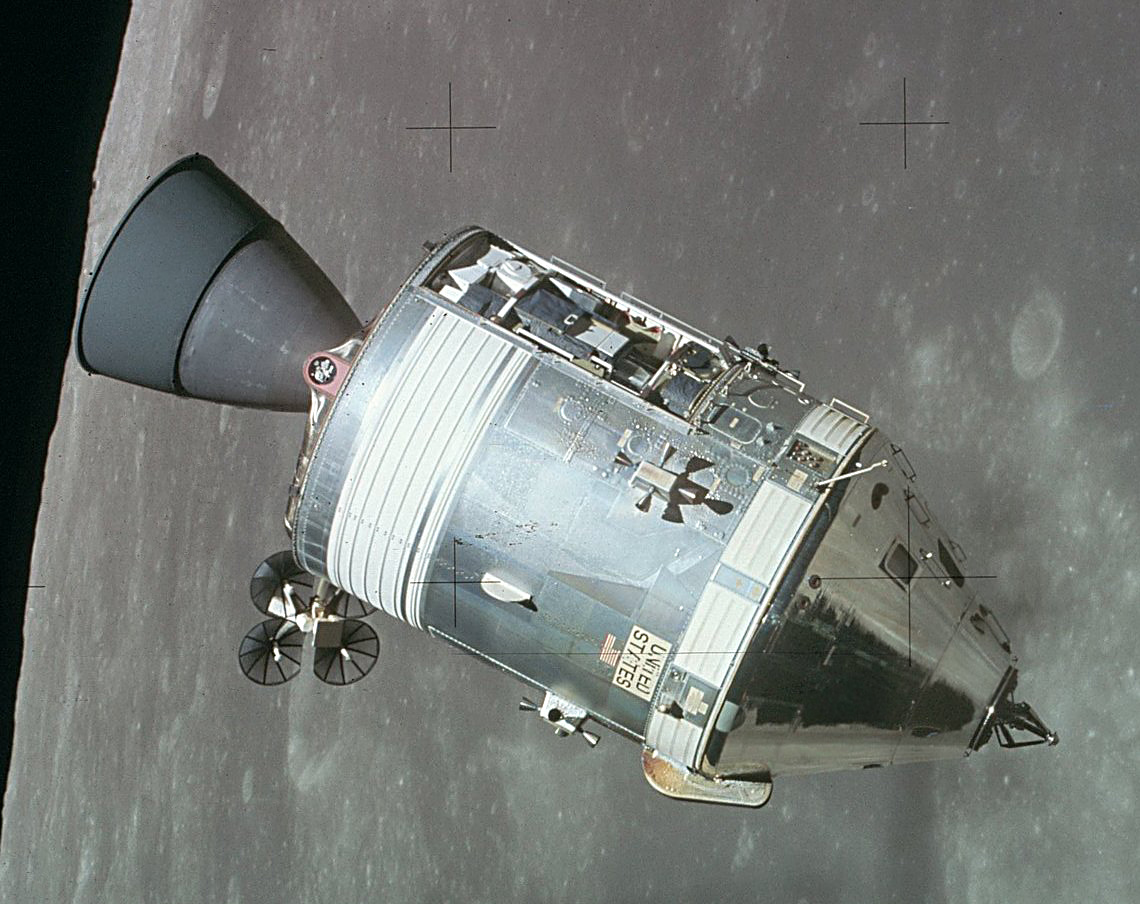
Apollo CSM Endeavour in lunar orbit during Apollo 15
ManufacturerNorth American Aviation
DesignerMaxime Faget
Country of originUnited States
OperatorNASA
ApplicationsCrewed cislunar flight and lunar orbit
Skylab crew shuttle
Apollo–Soyuz Test Project
Specifications
Spacecraft typeCapsule
Launch mass32,390 lb (14,690 kg) Earth orbit
63,500 lb (28,800 kg) Lunar
Dry mass26,300 lb (11,900 kg)
Payload capacity2,320 lb (1,050 kg)
Crew capacity3
Volume218 cu ft (6.2 m3)
Power3 × 1.4 kW, 30 V DC fuel cells
Batteries3 × 40 ampere-hour silver zinc battery
RegimeLow Earth orbit
Cislunar space
Lunar orbit
Design life14 days
Dimensions
Length36.2 ft (11.0 m)
Diameter12.8 ft (3.9 m)
Production
StatusRetired
Built35
Launched19
Operational19
Failed2
Lost1
Maiden launchFebruary 26, 1966 (AS-201)
Last launchJuly 15, 1975 (Apollo–Soyuz)
Last retirementJuly 24, 1975
Service Propulsion System
Powered by1 × AJ10-137[1]
Maximum thrust91.19 kN (20,500 lbf)
Specific impulse314.5 s (3.084 km/s)
Burn time750 s
PropellantN2O4/Aerozine 50
Related spacecraft
Flown withApollo Lunar Module
Configuration

Apollo Block II CSM diagram
← Gemini spacecraft Orion (spacecraft)

The Apollo command and service module (CSM) was one of two principal components of the United States Apollo spacecraft, used for the Apollo program, which landed astronauts on the Moon between 1969 and 1972. The CSM functioned as a mother ship, which carried a crew of three astronauts and the second Apollo spacecraft, the Apollo Lunar Module, to lunar orbit, and brought the astronauts back to Earth. It consisted of two parts: the conical command module, a cabin that housed the crew and carried equipment needed for atmospheric reentry and splashdown; and the cylindrical service module which provided propulsion, electrical power and storage for various consumables required during a mission. An umbilical connection transferred power and consumables between the two modules. Just before reentry of the command module on the return home, the umbilical connection was severed and the service module was cast off and allowed to burn up in the atmosphere.

The CSM was developed and built for NASA by North American Aviation starting in November 1961. It was initially designed to land on the Moon atop a landing rocket stage and return all three astronauts on a direct-ascent mission, which would not use a separate lunar module, and thus had no provisions for docking with another spacecraft. This, plus other required design changes, led to the decision to design two versions of the CSM: Block I was to be used for uncrewed missions and a single crewed Earth orbit flight (Apollo 1), while the more advanced Block II was designed for use with the lunar module. The Apollo 1 flight was cancelled after a cabin fire killed the crew and destroyed their command module during a launch rehearsal test. Corrections of the problems which caused the fire were applied to the Block II spacecraft, which was used for all crewed spaceflights.

Nineteen CSMs were launched into space. Of these, nine flew humans to the Moon between 1968 and 1972, and another two performed crewed test flights in low Earth orbit, all as part of the Apollo program. Before these, another four CSMs had flown as uncrewed Apollo tests, of which two were suborbital flights and another two were orbital flights. Following the conclusion of the Apollo program and during 1973–1974, three CSMs ferried astronauts to the orbital Skylab space station. Finally in 1975, the last flown CSM docked with the Soviet craft Soyuz 19 as part of the international Apollo–Soyuz Test Project.

Before Apollo

[edit]

Concepts of an advanced crewed spacecraft started before the Moon landing goal was announced. The three-person vehicle was to be mainly for orbital use around Earth. It would include a large pressurized auxiliary orbital module where the crew would live and work for weeks at a time. They would perform space station-type activities in the module, while later versions would use the module to carry cargo to space stations. The spacecraft was to service the Project Olympus (LORL), a foldable rotating space station launched on a single Saturn V. Later versions would be used on circumlunar flights, and would be the basis for a direct ascent lunar spacecraft as well as used on interplanetary missions. In late 1960, NASA called on U.S. industry to propose designs for the vehicle. On May 25, 1961 President John F. Kennedy announced the Moon landing goal before 1970, which immediately rendered NASA's Olympus Station plans obsolete.[2][3]

Development history

[edit]

When NASA awarded the initial Apollo contract to North American Aviation on November 28, 1961, it was still assumed the lunar landing would be achieved by direct ascent rather than by lunar orbit rendezvous.[4] Therefore, design proceeded without a means of docking the command module to a lunar excursion module (LEM). But the change to lunar orbit rendezvous, plus several technical obstacles encountered in some subsystems (such as environmental control), soon made it clear that substantial redesign would be required. In 1963, NASA decided the most efficient way to keep the program on track was to proceed with the development in two versions:[5]

  • Block I would continue the preliminary design, to be used for early low Earth orbit test flights only.
  • Block II would be the lunar-capable version, including a docking hatch and incorporating weight reduction and lessons learned in Block I. Detailed design of the docking capability depended on design of the LEM, which was contracted to Grumman Aircraft Engineering.

By January 1964, North American started presenting Block II design details to NASA.[6] Block I spacecraft were used for all uncrewed Saturn 1B and Saturn V test flights. Initially two crewed flights were planned, but this was reduced to one in late 1966. This mission, designated AS-204 but named Apollo 1 by its flight crew, was planned for launch on February 21, 1967. During a dress rehearsal for the launch on January 27, all three astronauts (Gus Grissom, Ed White and Roger Chaffee) were killed in a cabin fire, which revealed serious design, construction and maintenance shortcomings in Block I, many of which had been carried over into Block II command modules being built at the time.[citation needed]

After a thorough investigation by the Apollo 204 Review Board, it was decided to terminate the crewed Block I phase and redefine Block II to incorporate the review board's recommendations. Block II incorporated a revised CM heat shield design, which was tested on the uncrewed Apollo 4 and Apollo 6 flights, so the first all-up Block II spacecraft flew on the first crewed mission, Apollo 7.[citation needed]

The two blocks were essentially similar in overall dimensions, but several design improvements resulted in weight reduction in Block II. Also, the Block I service module propellant tanks were slightly larger than in Block II. The Apollo 1 spacecraft weighed approximately 45,000 pounds (20,000 kg), while the Block II Apollo 7 weighed 36,400 lb (16,500 kg). (These two Earth orbital craft were lighter than the craft which later went to the Moon, as they carried propellant in only one set of tanks, and did not carry the high-gain S-band antenna.) In the specifications given below, unless otherwise noted, all weights given are for the Block II spacecraft.[citation needed]

The total cost of the CSM for development and the units produced was $36.9 billion in 2016 dollars, adjusted from a nominal total of $3.7 billion[7] using the NASA New Start Inflation Indices.[8]

Command module (CM)

[edit]
Command module interior arrangement

The command module was a truncated cone (frustum) with a diameter of 12 feet 10 inches (3.91 m) across the base, and a height of 11 feet 5 inches (3.48 m) including the docking probe and dish-shaped aft heat shield. The forward compartment contained two reaction control system thrusters, the docking tunnel, and the Earth Landing System. The inner pressure vessel housed the crew accommodation, equipment bays, controls and displays, and many spacecraft systems. The aft compartment contained 10 reaction control engines and their related propellant tanks, freshwater tanks, and the CSM umbilical cables.[9]

Construction

[edit]

The command module was built in North American's factory in Downey, California,[10][11] and consisted of two basic structures joined together: the inner structure (pressure shell) and the outer structure.[citation needed]

The inner structure was an aluminum sandwich construction consisting of a welded aluminum inner skin, adhesively bonded aluminum honeycomb core, and outer face sheet. The thickness of the honeycomb varied from about 1.5 inches (3.8 cm) at the base to about 0.25 inches (0.64 cm) at the forward access tunnel. This inner structure was the pressurized crew compartment.[citation needed]

The outer structure was made of stainless steel brazed-honeycomb brazed between steel alloy face sheets. It varied in thickness from 0.5 inch to 2.5 inches. Part of the area between the inner and outer shells was filled with a layer of fiberglass insulation as additional heat protection.[12]

Thermal protection (heat shield)

[edit]
Command module reentering the atmosphere at a non-zero angle of attack in order to establish a lifting entry and control the landing site (artistic rendition)

An ablative heat shield on the outside of the CM protected the capsule from the heat of reentry, which is sufficient to melt most metals. This heat shield was composed of phenolic formaldehyde resin. During reentry, this material charred and melted away, absorbing and carrying away the intense heat in the process. The heat shield has several outer coverings: a pore seal, a moisture barrier (a white reflective coating), and a silver Mylar thermal coating that looks like aluminum foil.[citation needed]

The heat shield varied in thickness from 2 inches (5.1 cm) in the aft portion (the base of the capsule, which faced forward during reentry) to 0.5 inches (1.3 cm) in the crew compartment and forward portions. The total weight of the shield was about 3,000 pounds (1,400 kg).[12]

Forward compartment

[edit]

The 1-foot-11-inch (0.58 m)-tall forward compartment was the area outside the inner pressure shell in the nose of the capsule, located around the forward docking tunnel and covered by the forward heat shield. The compartment was divided into four 90-degree segments that contained Earth landing equipment (all the parachutes, recovery antennas and beacon light, and sea recovery sling), two reaction control thrusters, and the forward heat shield release mechanism.[citation needed]

At about 25,000 feet (7,600 m) during reentry, the forward heat shield was jettisoned to expose the Earth landing equipment and permit deployment of the parachutes.[12]

Aft compartment

[edit]

The 1-foot-8-inch (0.51 m)-tall aft compartment was located around the periphery of the command module at its widest part, just forward of (above) the aft heat shield. The compartment was divided into 24 bays containing 10 reaction control engines; the fuel, oxidizer, and helium tanks for the CM reaction control subsystem; water tanks; the crushable ribs of the impact attenuation system; and a number of instruments. The CM-SM umbilical, the point where wiring and plumbing ran from one module to the other, was also in the aft compartment. The panels of the heat shield covering the aft compartment were removable for maintenance of the equipment before flight.[12]

Earth landing system

[edit]
The Apollo 15 Command Module splashes down in the Pacific Ocean, 1971.
Scale model of the Apollo command and service module at the Euro Space Center in Belgium

The components of the ELS were housed around the forward docking tunnel. The forward compartment was separated from the central by a bulkhead and was divided into four 90-degree wedges. The ELS consisted of two drogue parachutes with mortars, three main parachutes, three pilot parachutes to deploy the mains, three inflation bags for uprighting the capsule if necessary, a sea recovery cable, a dye marker, and a swimmer umbilical.[citation needed]

The command module's center of mass was offset a foot or so from the center of pressure (along the symmetry axis). This provided a rotational moment during reentry, angling the capsule and providing some lift (a lift to drag ratio of about 0.368).[13] The capsule was then steered by rotating the capsule using thrusters; when no steering was required, the capsule was spun slowly, and the lift effects cancelled out. This system greatly reduced the g-force experienced by the astronauts, permitted a reasonable amount of directional control and allowed the capsule's splashdown point to be targeted within a few miles.[citation needed]

At 24,000 feet (7,300 m), the forward heat shield was jettisoned using four pressurized-gas compression springs. The drogue parachutes were then deployed, slowing the spacecraft to 125 miles per hour (201 kilometres per hour). At 10,700 feet (3,300 m) the drogues were jettisoned and the pilot parachutes, which pulled out the mains, were deployed. These slowed the CM to 22 miles per hour (35 kilometres per hour) for splashdown. The portion of the capsule that first contacted the water surface contained four crushable ribs to further mitigate the force of impact. The command module could safely parachute to an ocean landing with only two parachutes deployed (as occurred on Apollo 15), the third parachute being a safety precaution.[citation needed]

Reaction control system

[edit]

The command module attitude control system consisted of twelve 93-pound-force (410 N) attitude control thrusters, ten of which were located in the aft compartment, plus two in the forward compartment. These were supplied by four tanks storing 270 pounds (120 kg) of monomethylhydrazine fuel and nitrogen tetroxide oxidizer, and pressurized by 1.1 pounds (0.50 kg) of helium stored at 4,150 pounds per square inch (28.6 MPa) in two tanks.[citation needed]

Hatches

[edit]

The forward docking hatch was mounted at the top of the docking tunnel. It was 30 inches (76 cm) in diameter and weighed 80 pounds (36 kg), constructed from two machined rings that were weld-joined to a brazed honeycomb panel. The exterior side was covered with 0.5-inch (13 mm) of insulation and a layer of aluminum foil. It was latched in six places and operated by a pump handle. The hatch contained a valve in its center, used to equalize the pressure between the tunnel and the CM so the hatch could be removed.[citation needed]

The unified crew hatch (UCH) measured 29 inches (74 cm) high, 34 inches (86 cm) wide, and weighed 225 pounds (102 kg). It was operated by a pump handle, which drove a ratchet mechanism to open or close fifteen latches simultaneously.[citation needed]

Docking assembly

[edit]

Apollo's mission required the LM to dock with the CSM on return from the Moon, and also in the transposition, docking, and extraction maneuver at the beginning of the translunar coast. The docking mechanism was a non-androgynous system, consisting of a probe located in the nose of the CSM, which connected to the drogue, a truncated cone located on the lunar module. The probe was extended like a scissor jack to capture the drogue on initial contact, known as soft docking. Then the probe was retracted to pull the vehicles together and establish a firm connection, known as "hard docking". The mechanism was specified by NASA to have the following functions:[citation needed]

  • Allow the two vehicles to connect, and attenuate excess movement and energy caused by docking
  • Align and center the two vehicles and pull them together for capture
  • Provide a rigid structural connection between both vehicles, and be capable of removal and re-installation by a single crewman
  • Provide a means of remote separation of both vehicles for the return to Earth, using pyrotechnic fasteners at the circumference of the CSM docking collar
  • Provide redundant power and logic circuits for all electrical and pyrotechnic components.[citation needed]

Coupling

[edit]

The probe head located in the CSM was self-centering and gimbal-mounted to the probe piston. As the probe head engaged in the opening of the drogue socket, three spring-loaded latches depressed and engaged. These latches allowed a so-called 'soft dock' state and enabled the pitch and yaw movements in the two vehicles to subside. Excess movement in the vehicles during the 'hard dock' process could cause damage to the docking ring and put stress on the upper tunnel. A depressed locking trigger link at each latch allowed a spring-loaded spool to move forward, maintaining the toggle linkage in an over-center locked position. In the upper end of the lunar module tunnel, the drogue, which was constructed of 1-inch-thick aluminum honeycomb core, bonded front and back to aluminum face sheets, was the receiving end of the probe head capture latches.[citation needed]

Retraction

[edit]

After the initial capture and stabilization of the vehicles, the probe was capable of exerting a closing force of 1,000 pounds-force (4.4 kN) to draw the vehicles together. This force was generated by gas pressure acting on the center piston within the probe cylinder. Piston retraction compressed the probe and interface seals and actuated the 12 automatic ring latches which were located radially around the inner surface of the CSM docking ring. The latches were manually re-cocked in the docking tunnel by an astronaut after each hard docking event (lunar missions required two dockings).[citation needed]

Separation

[edit]

An automatic extension latch attached to the probe cylinder body engaged and retained the probe center piston in the retracted position. Before vehicle separation in lunar orbit, manual cocking of the twelve ring latches was accomplished. The separating force from the internal pressure in the tunnel area was then transmitted from the ring latches to the probe and drogue. In undocking, the release of the capture latches was accomplished by electrically energizing tandem-mounted DC rotary solenoids located in the center piston. In a temperature degraded condition, a single motor release operation was done manually in the lunar module by depressing the locking spool through an open hole in the probe heads, while release from the CSM was done by rotating a release handle at the back of the probe to rotate the motor torque shaft manually.[14] When the command and lunar modules separated for the last time, the probe and forward docking ring were pyrotechnically separated, leaving all docking equipment attached to the lunar module. In the event of an abort during launch from Earth, the same system would have explosively jettisoned the docking ring and probe from the CM as it separated from the boost protective cover.[citation needed]

Cabin interior arrangement

[edit]
Main control panel
Original cockpit of the command module of Apollo 11 with three seats, photographed from above. It is located in the National Air and Space Museum, the very high resolution image was produced in 2007 by the Smithsonian Institution.

The central pressure vessel of the command module was its sole habitable compartment. It had an interior volume of 210 cubic feet (5.9 m3) and housed the main control panels, crew seats, guidance and navigation systems, food and equipment lockers, the waste management system, and the docking tunnel.

Dominating the forward section of the cabin was the crescent-shaped main display panel measuring nearly 7 feet (2.1 m) wide and 3 feet (0.91 m) tall. It was arranged into three panels, each emphasizing the duties of each crew member. The mission commander's panel (left side) included the velocity, attitude, and altitude indicators, the primary flight controls, and the main FDAI (Flight Director Attitude Indicator).

The CM pilot served as navigator, so his control panel (center) included the Guidance and Navigation computer controls, the caution and warning indicator panel, the event timer, the Service Propulsion System and RCS controls, and the environmental control system controls.

The LM pilot served as systems engineer, so his control panel (right-hand side) included the fuel cell gauges and controls, the electrical and battery controls, and the communications controls.

Flanking the sides of the main panel were sets of smaller control panels. On the left side were a circuit breaker panel, audio controls, and the SCS power controls. On the right were additional circuit breakers and a redundant audio control panel, along with the environmental control switches. In total, the command module panels included 24 instruments, 566 switches, 40 event indicators, and 71 lights.

The three crew couches were constructed from hollow steel tubing and covered in a heavy, fireproof cloth known as Armalon. The leg pans of the two outer couches could be folded in a variety of positions, while the hip pan of the center couch could be disconnected and laid on the aft bulkhead. One rotation and one translation hand controller was installed on the armrests of the left-hand couch. The translation controller was used by the crew member performing the transposition, docking, and extraction maneuver with the LM, usually the CM Pilot. The center and right-hand couches had duplicate rotational controllers. The couches were supported by eight shock-attenuating struts, designed to ease the impact of touchdown on water or, in case of an emergency landing, on solid ground.

The contiguous cabin space was organized into six equipment bays:

Guidance and navigation equipment
  • The lower equipment bay, which housed the Guidance and Navigation computer, sextant, telescope, and Inertial Measurement Unit; various communications beacons; medical stores; an audio center; the S-band power amplifier; etc. There was also an extra rotation hand controller mounted on the bay wall, so the CM Pilot/navigator could rotate the spacecraft as needed while standing and looking through the telescope to find stars to take navigational measurements with the sextant. This bay provided a significant amount of room for the astronauts to move around in, unlike the cramped conditions which existed in the previous Mercury and Gemini spacecraft.
  • The left-hand forward equipment bay, which contained four food storage compartments, the cabin heat exchanger, pressure suit connector, potable water supply, and G&N telescope eyepieces.
  • The right-hand forward equipment bay, which housed two survival kit containers, a data card kit, flight data books and files, and other mission documentation.
  • The left hand intermediate equipment bay, housing the oxygen surge tank, water delivery system, food supplies, the cabin pressure relief valve controls, and the ECS package.
  • The right hand intermediate equipment bay, which contained the bio instrument kits, waste management system, food and sanitary supplies, and a waste storage compartment.
  • The aft storage bay, behind the crew couches. This housed the 70 mm camera equipment, the astronaut's garments, tool sets, storage bags, a fire extinguisher, CO2 absorbers, sleep restraint ropes, spacesuit maintenance kits, 16mm camera equipment, and the contingency lunar sample container.

The CM had five windows. The two side windows measured 9 inches (23 cm) square next to the left and right-hand couches. Two forward-facing triangular rendezvous windows measured 8 by 9 inches (20 by 23 cm), used to aid in rendezvous and docking with the LM. The circular hatch window was 9 inches (23 cm) in diameter located directly over the center couch. Each window assembly consisted of three thick panes of glass. The inner two panes, which were made of aluminosilicate, made up part of the module's pressure vessel. The fused silica outer pane served as both a debris shield and as part of the heat shield. Each pane had an anti-reflective coating and a blue-red reflective coating on the inner surface.

Specifications

[edit]
Apollo 14 command module Kitty Hawk at Kennedy Space Center, Florida.
Apollo 15 command module Endeavour at the National Museum of the United States Air Force, Dayton, Ohio
  • Crew: 3
  • Crew cabin volume: 210 cu ft (5.9 m3) living space, pressurized 366 cu ft (10.4 m3)
  • Length: 11.4 ft (3.5 m)
  • Diameter: 12.8 ft (3.9 m)
  • Mass: 12,250 lb (5,560 kg)
    • Structure mass: 3,450 lb (1,560 kg)
    • Heat shield mass: 1,869 lb (848 kg)
    • RCS engine mass: 12 × 73.3 lb (33.2 kg)
    • Recovery equipment mass: 540 lb (240 kg)
    • Navigation equipment mass: 1,113 lb (505 kg)
    • Telemetry equipment mass: 440 lb (200 kg)
    • Electrical equipment mass: 1,540 lb (700 kg)
    • Communications systems mass: 220 lb (100 kg)
    • Crew couches and provisions mass: 1,210 lb (550 kg)
    • Environmental Control System mass: 440 lb (200 kg)
    • Misc. contingency mass: 440 lb (200 kg)
  • RCS: twelve 93 lbf (410 N) thrusters, firing in pairs
  • RCS propellants: MMH/N
    2
    O
    4
  • RCS propellant mass: 270 lb (120 kg)
  • Drinking water capacity: 33 lb (15 kg)
  • Waste water capacity: 58 lb (26 kg)
  • CO2 scrubber: lithium hydroxide
  • Odor absorber: activated charcoal
  • Electric system batteries: three 40 ampere-hour silver-zinc batteries; two 0.75 ampere-hour silver-zinc pyrotechnic batteries
  • Parachutes: two 16.5-foot (5.0 m) conical ribbon drogue parachutes; three 7.2-foot (2.2 m) ringslot pilot parachutes; three 83.5-foot (25.5 m) ringsail main parachutes[15]

Sources:[16][17]

Service module (SM)

[edit]
Block II service module interior components

Construction

[edit]

The service module was an unpressurized cylindrical structure with a diameter of 12 feet 10 inches (3.91 m) and 14 feet 10 inches (4.52 m) long. The service propulsion engine nozzle and heat shield increased the total height to 24 feet 7 inches (7.49 m). The interior was a simple structure consisting of a central tunnel section 44 inches (1.1 m) in diameter, surrounded by six pie-shaped sectors. The sectors were topped by a forward bulkhead and fairing, separated by six radial beams, covered on the outside by four honeycomb panels, and supported by an aft bulkhead and engine heat shield. The sectors were not all equal 60° angles, but varied according to required size.

  • Sector 1 (50°) was originally unused, so it was filled with ballast to maintain the SM's center-of gravity.
On the last three lunar landing (I-J class) missions, it carried the scientific instrument module (SIM) with a powerful Itek 24 inches (610 mm) focal length camera originally developed for the Lockheed U-2 and SR-71 reconnaissance aircraft. The camera photographed the Moon; had the S-IVB failed to fire causing the CSM to not leave earth orbit, astronauts would have used it to photograph the Earth.[18][19] SIM also had other sensors and a subsatellite.
  • Sector 2 (70°) contained the service propulsion system (SPS) oxidizer sump tank, so called because it directly fed the engine and was kept continuously filled by a separate storage tank, until the latter was empty. The sump tank was a cylinder with hemispherical ends, 153.8 inches (3.91 m) high, 51 inches (1.3 m) in diameter, and contained 13,923 pounds (6,315 kg) of oxidizer. Its total volume was 161.48 cu ft (4.573 m3)
  • Sector 3 (60°) contained the SPS oxidizer storage tank, which was the same shape as the sump tank but slightly smaller at 154.47 inches (3.924 m) high and 44 inches (1.1 m) in diameter, and held 11,284 pounds (5,118 kg) of oxidizer. Its total volume was 128.52 cu ft (3.639 m3)
  • Sector 4 (50°) contained the electrical power system (EPS) fuel cells with their hydrogen and oxygen reactants.
  • Sector 5 (70°) contained the SPS fuel sump tank. This was the same size as the oxidizer sump tank and held 8,708 pounds (3,950 kg) of fuel.
  • Sector 6 (60°) contained the SPS fuel storage tank, also the same size as the oxidizer storage tank. It held 7,058 pounds (3,201 kg) of fuel.

The forward fairing measured 1 foot 11 inches (58 cm) long and housed the reaction control system (RCS) computer, power distribution block, ECS controller, separation controller, and components for the high-gain antenna, and included eight EPS radiators and the umbilical connection arm containing the main electrical and plumbing connections to the CM. The fairing externally contained a retractable forward-facing spotlight; an EVA floodlight to aid the command module pilot in SIM film retrieval; and a flashing rendezvous beacon visible from 54 nautical miles (100 km) away as a navigation aid for rendezvous with the LM.

The SM was connected to the CM using three tension ties and six compression pads. The tension ties were stainless steel straps bolted to the CM's aft heat shield. It remained attached to the command module throughout most of the mission, until being jettisoned just prior to re-entry into the Earth's atmosphere. At jettison, the CM umbilical connections were cut using a pyrotechnic-activated guillotine assembly. Following jettison, the SM aft translation thrusters automatically fired continuously to distance it from the CM, until either the RCS fuel or the fuel cell power was depleted. The roll thrusters were also fired for five seconds to make sure it followed a different trajectory from the CM and faster break-up on re-entry.

Service propulsion system

[edit]
Engineers at Arnold Air Base with an Apollo service module engine
Apollo Service Module Propulsion System

The service propulsion system (SPS) engine was originally designed to lift the CSM off the surface of the Moon in the direct ascent mission mode,[20] The engine selected was the AJ10-137,[21] which used Aerozine 50 as fuel and nitrogen tetroxide (N2O4) as oxidizer to produce 20,500 lbf (91 kN) of thrust.[22] A contract was signed in April 1962 for the Aerojet-General company to start developing the engine, resulting in a thrust level twice what was needed to accomplish the lunar orbit rendezvous (LOR) mission mode officially chosen in July of that year.[23] The engine was actually used for mid-course corrections between the Earth and Moon, and to place the spacecraft into and out of lunar orbit. It also served as a retrorocket to perform the deorbit burn for Earth orbital flights.

The propellants were pressure-fed to the engine by 39.2 cubic feet (1.11 m3) of gaseous helium at 3,600 pounds per square inch (25 MPa), carried in two 40-inch (1.0 m) diameter spherical tanks.[24]

The exhaust nozzle measured 152.82 inches (3.882 m) long and 98.48 inches (2.501 m) wide at the base. It was mounted on two gimbals to keep the thrust vector aligned with the spacecraft's center of mass during SPS firings. The combustion chamber and pressurant tanks were housed in the central tunnel.

Reaction control system

[edit]
RCS quad containing four R-4D thrusters, as used on the Apollo Service Module

Four clusters of four reaction control system (RCS) thrusters (known as "quads") were installed around the upper section of the SM every 90°. The sixteen-thruster arrangement provided rotation and translation control in all three spacecraft axes. Each R-4D thruster measured 12 inches (30 cm) long by 6 inches (15 cm) diameter, generated 100 pounds-force (440 N) of thrust, and used helium-fed monomethylhydrazine (MMH) as fuel and nitrogen tetroxide (NTO) as oxidizer.[25] Each quad assembly measured 2.2 by 2.7 feet (0.67 by 0.82 m) and had its own fuel, oxidizer, and helium tanks mounted on the inside of an 8-by-2.75-foot (2.44 by 0.84 m) skin panel. The primary fuel (MMH) tank contained 69.1 pounds (31.3 kg); the secondary fuel tank contained 45.2 pounds (20.5 kg); the primary oxidizer tank contained 137.0 pounds (62.1 kg), and the secondary oxidizer tank contained 89.2 pounds (40.5 kg). The propellant tanks were pressurized from a single tank containing 1.35 pounds (0.61 kg) of liquid helium.[26] Back flow was prevented by a series of check valves, and back flow and ullage requirements were resolved by containing the fuel and oxidizer in Teflon bladders which separated the propellants from the helium pressurant.[26]

The four completely independent RCS clusters provided redundancy; only two adjacent functioning units were needed to allow complete attitude control.[26]

The lunar module used a similar four-quad arrangement of R-4D thruster engines for its RCS.

Electrical power system

[edit]
Three of these fuel cells supplied electric power to the spacecraft on lunar flights.

Electrical power was produced by three fuel cells, each measuring 44 inches (1.1 m) tall by 22 inches (0.56 m) in diameter and weighing 245 pounds (111 kg). These combined hydrogen and oxygen to generate electrical power, and produced drinkable water as a byproduct. The cells were fed by two hemispherical-cylindrical 31.75-inch (0.806 m) diameter tanks, each holding 29 pounds (13 kg) of liquid hydrogen, and two spherical 26-inch (0.66 m) diameter tanks, each holding 326 pounds (148 kg) of liquid oxygen (which also supplied the environmental control system).

On the flight of Apollo 13, the EPS was disabled by an explosive rupture of one oxygen tank, which punctured the second tank and led to the loss of all oxygen. After the accident, a third oxygen tank was added to obviate operation below 50% tank capacity. That allowed the elimination of the tank's internal stirring-fan equipment, which had contributed to the failure.

Also starting with Apollo 14, a 400 Ah auxiliary battery was added to the SM for emergency use. Apollo 13 had drawn heavily on its entry batteries in the first hours after the explosion, and while this new battery could not power the CM for more than 5–10 hours it would buy time in the event of a temporary loss of all three fuel cells. Such an event had occurred when Apollo 12 was struck twice by lightning during launch.

Environmental control system

[edit]

Cabin atmosphere was maintained at 5 pounds per square inch (34 kPa) of pure oxygen from the same liquid oxygen tanks that fed the electrical power system's fuel cells. Potable water supplied by the fuel cells was stored for drinking and food preparation. A thermal control system using a mixture of water and ethylene glycol as coolant dumped waste heat from the CM cabin and electronics to outer space via two 30-square-foot (2.8 m2) radiators located on the lower section of the exterior walls, one covering sectors 2 and 3 and the other covering sectors 5 and 6.[27]

Communications system

[edit]
VHF scimitar antennas mounted on the Service Module.

Short-range communications between the CSM and LM employed two VHF scimitar antennas mounted on the SM just above the ECS radiators. These antennas were originally located on the Block I command module and performed a double function as aerodynamic strakes to stabilize the capsule after a launch abort. The antennas were moved to the Block II service module when this function was found unnecessary.

A steerable unified S-band high-gain antenna for long-range communications with Earth was mounted on the aft bulkhead. This was an array of four 31-inch (0.79 m) diameter reflectors surrounding a single 11-inch (0.28 m) square reflector. During launch it was folded down parallel to the main engine to fit inside the Spacecraft-to-LM Adapter (SLA). After CSM separation from the SLA, it deployed at a right angle to the SM.

Four omnidirectional S-band antennas on the CM were used when the attitude of the CSM kept the high-gain antenna from being pointed at Earth. These antennas were also used between SM jettison and landing.[28]

Specifications

[edit]
  • Length: 24.8 ft (7.6 m)
  • Diameter: 12.8 ft (3.9 m)
  • Mass: 54,060 lb (24,520 kg)
    • Structure mass: 4,200 lb (1,900 kg)
    • Electrical equipment mass: 2,600 lb (1,200 kg)
    • Service Propulsion (SPS) engine mass: 6,600 lb (3,000 kg)
    • SPS engine propellants: 40,590 lb (18,410 kg)
  • RCS thrust: 2 or 4 × 100 lbf (440 N)
  • RCS propellants: MMH/N
    2
    O
    4
  • SPS engine thrust: 20,500 lbf (91,000 N)
  • SPS engine propellants: (UDMH/N
    2
    H
    4
    )/N
    2
    O
    4
  • SPS Isp: 314 s (3,100 N·s/kg)
  • Spacecraft delta-v: 9,200 ft/s (2,800 m/s)
  • Electrical system: three 1.4 kW 30 V DC fuel cells

Modifications for Saturn IB missions

[edit]
Apollo CSM in white for a Skylab mission, docked to the Skylab space station

The payload capability of the Saturn IB launch vehicle used to launch the Low Earth Orbit missions (Apollo 1 (planned), Apollo 7, Skylab 2, Skylab 3, Skylab 4, and Apollo–Soyuz) could not handle the 66,900-pound (30,300 kg) mass of the fully fueled CSM. This was not a problem, because the spacecraft delta-v requirement of these missions was much smaller than that of the lunar mission; therefore they could be launched with less than half of the full SPS propellant load, by filling only the SPS sump tanks and leaving the storage tanks empty. The CSMs launched in orbit on Saturn IB ranged from 32,558 pounds (14,768 kg) (Apollo–Soyuz), to 46,000 pounds (21,000 kg) (Skylab 4).

The omnidirectional antennas sufficed for ground communications during the Earth orbital missions, so the high-gain S-band antenna on the SM was omitted from Apollo 1, Apollo 7, and the three Skylab flights. It was restored for the Apollo–Soyuz mission to communicate through the ATS-6 satellite in geostationary orbit, an experimental precursor to the current TDRSS system.

On the Skylab and Apollo–Soyuz missions, some additional dry weight was saved by removing the otherwise empty fuel and oxidizer storage tanks (leaving the partially filled sump tanks), along with one of the two helium pressurant tanks.[29] This permitted the addition of some extra RCS propellant to allow for use as a backup for the deorbit burn in case of possible SPS failure.[30]

Since the spacecraft for the Skylab missions would not be occupied for most of the mission, there was lower demand on the power system, so one of the three fuel cells was deleted from these SMs. The command module was also partially painted white, to provide passive thermal control for the extended time it would remain in orbit.

The command module could be modified to carry extra astronauts as passengers by adding jump seat couches in the aft equipment bay. CM-119 was fitted with two jump seats as a Skylab Rescue vehicle, which was never used.[31]

Major differences between Block I and Block II

[edit]

Command module

[edit]
Block I command module exterior
  • The Block II used a one-piece, quick-release, outward opening hatch instead of the two-piece plug hatch used on Block I, in which the inner piece had to be unbolted and placed inside the cabin in order to enter or exit the spacecraft (a flaw that doomed the Apollo 1 crew). The Block II hatch could be opened quickly in case of an emergency. (Both hatch versions were covered with an extra, removable section of the Boost Protective Cover which surrounded the CM to protect it in case of a launch abort.)
  • The Block I forward access tunnel was smaller than Block II, and intended only for emergency crew egress after splashdown in case of problems with the main hatch. It was covered by the nose of the forward heat shield during flight. Block II contained a shorter forward heat shield with a flat removable hatch, beneath a docking ring and probe mechanism which captured and held the LM.
  • The aluminized PET film layer, which gave the Block II heat shield a shiny mirrored appearance, was absent on Block I, exposing the light gray epoxy resin material, which on some flights was painted white.
  • The Block I VHF scimitar antennas were located in two semicircular strakes originally thought necessary to help stabilize the CM during reentry. However, the uncrewed reentry tests proved these to be unnecessary for stability, and also aerodynamically ineffective at high simulated lunar reentry speeds. Therefore, the strakes were removed from Block II and the antennas were moved to the service module.
  • The Block I CM/SM umbilical connector was smaller than on Block II, located near the crew hatch instead of nearly 180 degrees away from it. The separation point was between the modules, instead of the larger hinged arm mounted on the service module, separating at the CM sidewall on Block II.
  • The two negative pitch RCS engines located in the forward compartment were arranged vertically on Block I, and horizontally on Block II.

Service module

[edit]
Block I service module interior components
  • On the Apollo 6 uncrewed Block I flight, the SM was painted white to match the command module's appearance. On Apollo 1, Apollo 4, and all the Block II spacecraft, the SM walls were left unpainted except for the EPS and ECS radiators, which were white.
  • The EPS and ECS radiators were redesigned for Block II. Block I had three larger EPS radiators located on Sectors 1 and 4. The ECS radiators were located on the aft section of Sectors 2 and 5.
  • The Block I fuel cells were located at the aft bulkhead in Sector 4, and their hydrogen and oxygen tanks were located in Sector 1.
  • Block I had slightly longer SPS fuel and oxidizer tanks which carried more propellant than Block II.
  • The Block II aft heat shield was a rectangular shape with slightly rounded corners at the propellant tank sectors. The Block I shield was the same basic shape, but bulged out slightly near the ends more like an hourglass or figure eight, to cover more of the tanks.

CSMs produced

[edit]
Serial number Name Use Launch date Current location Image
Block I[32][33][34]
CSM-001 systems compatibility test vehicle scrapped[35]
CSM-002 A-004 flight January 20, 1966 Command module on display at Cradle of Aviation, Long Island, New York[36]
CSM-004 static and thermal structural ground tests scrapped[34]
CSM-006 used for demonstrating tumbling debris removal system Command module scrapped;[37] service module (redesignated as SM-010)[33] on display at U.S. Space & Rocket Center, Huntsville, Alabama[38]
CSM-007 various tests including acoustic vibration and drop tests, and water egress training. CM was refitted with Block II improvements.[39] Underwent testing for Skylab at the McKinley Climatic Laboratory, Eglin AFB, Florida, 1971–1973. Command module on display at Museum of Flight, Seattle, Washington[40]
CSM-008 complete systems spacecraft used in thermal vacuum tests scrapped[35]
CSM-009 AS-201 flight and drop tests February 26, 1966 Command module on display at Strategic Air and Space Museum, adjacent to Offutt Air Force Base in Ashland, Nebraska[41]
CSM-010 Thermal test (command module redesignated as CM-004A / BP-27 for dynamic tests);[42] service module never completed[33] Command module on display at U.S. Space & Rocket Center, Huntsville, Alabama[35]
CSM-011 AS-202 flight August 25, 1966 Command module on display on the USS Hornet museum at the former Naval Air Station Alameda, Alameda, California[43]
CSM-012 Apollo 1; the command module was severely damaged in the Apollo 1 fire Command module in storage at the Langley Research Center, Hampton, Virginia;[44] three-part door hatch on display at Kennedy Space Center;[45] service module scrapped[35]
CSM-014 Command module disassembled as part of Apollo 1 investigation. Service module (SM-014) used on Apollo 6 mission. Command module (CM-014) later modified and used for ground testing (as CM-014A).[33] Scrapped May 1977.[32]
CSM-017 CM-017 flew on Apollo 4 with SM-020 after SM-017 was destroyed in a propellant tank explosion during ground testing.[33][46] November 9, 1967 Command module on display at Stennis Space Center, Bay St. Louis, Mississippi[47]
CSM-020 CM-020 flew on Apollo 6 with SM-014.[33] April 4, 1968 Command module on display at Fernbank Science Center, Atlanta
Block II[48][49]
CSM-098 2TV-1 (Block II Thermal Vacuum no.1)[50] used in thermal vacuum tests CSM on display at Academy of Science Museum, Moscow, Russia as part of the Apollo Soyuz Test Project display.[34]
CM-099 2S-1[50] Skylab flight crew interface training;[50] impact tests[33] scrapped[50]
CSM-100 2S-2[50] static structural testing[33] Command module "transferred to Smithsonian as an artifact", service module on display at New Mexico Museum of Space History[50]
CSM-101 Apollo 7 October 11, 1968 Command module was on display at National Museum of Science and Technology, Ottawa, Ontario, Canada from 1974 until 2004, now at the Frontiers of Flight Museum, Dallas, Texas after 30 years of being on loan.[51]
CSM-102 Launch Complex 34 checkout vehicle Command module scrapped;[52] service module is at JSC on top of the Little Joe II in Rocket Park with Boiler Plate 22 command module.[53]
CSM-103 Apollo 8 December 21, 1968 Command module on display at the Museum of Science and Industry in Chicago[49]
CSM-104 Gumdrop Apollo 9 March 3, 1969 Command module on display at San Diego Air and Space Museum[49]
CSM-105 acoustic tests On display at National Air and Space Museum, Washington, D.C. as part of the Apollo Soyuz Test Project display.[54] (Photo)
CSM-106 Charlie Brown Apollo 10 May 18, 1969 Command module on display at Science Museum, London[49]
CSM-107 Columbia Apollo 11 July 16, 1969 Command module on display at National Air and Space Museum, Washington, D.C.[49]
CSM-108 Yankee Clipper Apollo 12 November 14, 1969 Command module on display at Virginia Air & Space Center, Hampton, Virginia;[49] previously on display at the National Naval Aviation Museum at Naval Air Station Pensacola, Pensacola, Florida (exchanged for CSM-116)
CSM-109 Odyssey Apollo 13 April 11, 1970 Command module on display at Kansas Cosmosphere and Space Center[49]
CSM-110 Kitty Hawk Apollo 14 January 31, 1971 Command module on display at the Kennedy Space Center[49]
CSM-111 Apollo Soyuz Test Project July 15, 1975 Command module currently on display at California Science Center in Los Angeles, California[55][56][57] (formerly displayed at the Kennedy Space Center Visitor Complex)
CSM-112 Endeavour Apollo 15 July 26, 1971 Command module on display at National Museum of the United States Air Force, Wright-Patterson Air Force Base, Dayton, Ohio[49]
CSM-113 Casper Apollo 16 April 16, 1972 Command module on display at U.S. Space & Rocket Center, Huntsville, Alabama[49]
CSM-114 America Apollo 17 December 7, 1972 Command module on display at Space Center Houston, Houston, Texas[49]
CSM-115 Apollo 19[58] (canceled) Never fully completed[59] – service module does not have its SPS nozzle installed. On display as part of the Saturn V display at Johnson Space Center, Houston, Texas[60]
CSM-115a Apollo 20[61] (canceled) Never fully completed[59] – internal structures not installed,[62] used for spare parts. Remaining items sent to Japan for exhibition in 1978 and never returned, display at the Space LABO in Kitakyushu,Japan.[63][64]
CSM-116 Skylab 2 May 25, 1973 Command module on display at National Museum of Naval Aviation, Naval Air Station Pensacola, Pensacola, Florida[65]
CSM-117 Skylab 3 July 28, 1973 Command module on display at Great Lakes Science Center, current location of the NASA Glenn Research Center Visitor Center, Cleveland, Ohio[66]
CSM-118 Skylab 4 November 16, 1973 Command module on display at Oklahoma History Center[67] (formerly displayed at the National Air and Space Museum, Washington, D.C.)[68]
CSM-119 Skylab Rescue and ASTP backup On display at the Kennedy Space Center[69]
World map showing locations of Apollo command and service modules (along with other hardware).

See also

[edit]

Footnotes

[edit]
Revisions and contributorsEdit on WikipediaRead on Wikipedia
from Grokipedia
The Apollo Command and Service Module (CSM) was the core crewed spacecraft of NASA's , designed to transport astronauts to , support mission operations, and safely return the crew to Earth. Comprising two main components—the conical Command Module (CM) serving as the astronauts' living quarters, flight control center, and reentry vehicle, and the cylindrical Service Module (SM) providing propulsion, electrical power via fuel cells, oxygen, water, and other essential support systems—the CSM operated as a single unit for most of the mission until separation prior to atmospheric reentry. Developed by (later North American Rockwell), the CSM underwent rigorous testing and evolution from Block I (uncrewed and early configurations) to Block II (crewed lunar-capable versions), enabling it to fulfill the program's goal of landing humans on the . The CSM's development began with NASA's selection of on November 28, 1961, following competitive proposals, with a definitive valued at $938.4 million signed on August 14, 1963—the largest single in history at the time. Key engineering features included the CM's ablative for protecting the crew during reentry at speeds up to 11 km/s, the SM's Service Propulsion System (SPS) main engine delivering 20,500 lbf (91 kN) of using Aerozine 50 and nitrogen tetroxide propellants for trans-Earth injection and midcourse corrections, and reaction control engines for precise attitude control. The spacecraft's environmental control system maintained cabin pressure, temperature, and air quality, while redundant systems ensured reliability across the demanding profile of Earth orbit, , , and return trajectories. The CSM flew on 15 Apollo missions, including uncrewed test flights and all crewed missions from the Earth-orbital shakedown flight of Apollo 7 in October 1968 to Apollo 17's lunar landing in December 1972, where it docked with the Lunar Module, orbited the Moon, and facilitated sample returns totaling 382 kg. Beyond lunar efforts, modified CSMs supported the Skylab orbital workshop missions (Skylab 2, 3, and 4 from 1973 to 1974), providing crew transport, resupply, and repairs to America's first space station, and the Apollo-Soyuz Test Project in July 1975, which achieved the first international crewed space docking with a Soviet Soyuz spacecraft. Notable challenges, such as the Apollo 13 explosion in the SM's oxygen tanks, highlighted the CSM's design robustness, as the crew used the LM as a "lifeboat" while the CM preserved habitability for the return. Overall, the CSM's success demonstrated advanced aerospace engineering, enabling six lunar landings and advancing human spaceflight capabilities.

Historical Background

Pre-Apollo Spacecraft Development

The was established on July 29, 1958, through the , consolidating U.S. aeronautical research efforts in response to the Soviet Union's Sputnik launch. Shortly thereafter, on October 7, 1958, officially initiated as its first human spaceflight program, focusing on developing a single-seat capable of safely launching an into and returning them via a ballistic reentry. The Mercury capsule, designed by Maxime Faget's team at , featured a compact, cone-shaped structure with a blunt base to generate high drag during reentry, addressing the critical challenge of atmospheric heating that could exceed 3,000°F (1,650°C). This single-pilot design prioritized simplicity and reliability for short-duration missions—typically under 24 hours—but highlighted limitations in crew capacity, duration, and maneuverability, necessitating advancements for more ambitious goals like lunar travel. Building on Mercury's successes, launched in 1961 as a bridge to lunar missions, evolving the to accommodate two astronauts for extended flights up to two weeks, thereby testing multi-crew operations and human factors in confined spaces. Gemini addressed Mercury's shortcomings by incorporating rendezvous and docking capabilities with uncrewed targets, essential for assembling larger in orbit—a technique critical for lunar missions but absent in Mercury's suborbital and short orbital profiles. Reentry heating remained a persistent challenge, with both programs relying on ablative heat shields that charred and eroded to dissipate thermal loads, but Gemini's higher velocities and durations pushed material limits further, informing scalable protections for deeper space. Parallel experimental efforts, such as the X-15 hypersonic (1959–1968), provided foundational data on high-speed aerothermodynamics and structural integrity under extreme heating, directly influencing ablative material development for reentry systems. The X-15, reaching speeds over Mach 6, tested turbulent heat-transfer phenomena and early ablator coatings, contributing to the design of heat shields capable of withstanding lunar-return velocities without catastrophic failure. These insights from suborbital rocket planes complemented Mercury and Gemini by validating material behaviors in regimes beyond orbital reentry. As lunar ambitions grew, evaluated mission architectures in the early 1960s, contrasting —which required a massive single to launch the entire to the and back—with Earth-orbit rendezvous (multiple launches to assemble a lunar vehicle in ) and (LOR), where a command module orbited the while a separate lander descended. After rigorous analysis, selected LOR on July 11, 1962, for its efficiency in reducing launch mass and enabling modular design, setting the stage for Apollo's multi-component approach.

Apollo Program Initiation and Spacecraft Selection

The Apollo program was initiated amid heightened Cold War tensions in space exploration, spurred by the Soviet Union's early successes. On April 12, 1961, Soviet cosmonaut Yuri Gagarin became the first human in space aboard Vostok 1, an event that underscored American lagging capabilities following the Sputnik launch in 1957 and intensified pressure on the U.S. to respond decisively. Just over a month later, on May 25, 1961, President John F. Kennedy addressed a joint session of Congress, committing the United States to the goal of "landing a man on the Moon and returning him safely to the Earth" before the end of the decade, framing it as a national imperative to restore U.S. prestige in science and technology. This announcement marked the formal launch of the Apollo program, building on the limitations of prior efforts like Project Mercury's single-crew, short-duration flights and Project Gemini's two-person configuration, which were insufficient for extended lunar missions. To support this ambitious objective, Kennedy requested funding for the space program including $531 million in fiscal year 1962 for new initiatives and an estimated additional $7 billion to $9 billion over the next five years, contributing to NASA's overall FY1962 appropriation of approximately $1.8 billion, with allocations ramping up to approximately $5.4 billion annually by the mid-1960s to cover development, launches, and operations. In July 1961, NASA Administrator James E. Webb, in consultation with Kennedy, established an ad hoc committee under Nicholas E. Golovin to outline the program's structure, leading to the formal organization of the Office of Manned Space Flight and initial planning for a three-man spacecraft capable of supporting lunar travel. By late 1961, preliminary specifications emerged for the Apollo spacecraft, envisioning a command module as the crew's habitat and reentry vehicle, paired with a service module providing propulsion, power, and life support systems essential for the mission's demands. The program's rapid advancement included competitive processes to select prime contractors. NASA issued requests for proposals in August 1961 to 14 major aerospace firms, including Boeing, General Dynamics' Astronautics Division, Lockheed, and Martin, evaluating designs for a versatile, three-crew vehicle with orbital and lunar capabilities. After rigorous review of technical proposals, mockups, and management plans, North American Aviation was awarded the contract for the command and service module (CSM) on November 28, 1961, chosen for its demonstrated expertise in aircraft and missile systems, though the decision drew some internal NASA debate over cost and innovation. This selection solidified the CSM as the program's core spacecraft, setting the stage for subsequent development under the newly formed Apollo Spacecraft Program Office at NASA's Manned Spacecraft Center in January 1962.

Design and Development

Early Design Concepts and Contractors

The initial design of the Apollo command and service module (CSM) featured a cone-shaped command module (CM) for aerodynamic stability during reentry and a cylindrical service module (SM) to house and support systems. This configuration emerged from early studies emphasizing a compact, reentry-capable crew compartment atop a propulsion stage, selected after evaluations of various lunar mission modes in 1961-1962. North American Aviation was awarded the prime contract for the CSM on November 28, 1961, responsible for overall design, integration, and production of both the CM and SM. Aircraft Engineering Corporation, as the lunar module (LM) contractor, collaborated on interface designs to ensure compatibility between the CSM and LM for orbital docking and extraction maneuvers. Subsystem responsibilities included RCA for the , providing radios and for ground and inter-vehicle links, and for the (ECS), which managed cabin atmosphere, temperature, and humidity. Early concepts incorporated a unified stack integrating the upper stage with the CSM for , allowing the CSM to separate and maneuver independently after launch. Docking mechanisms evolved from 1962 studies, with proposing extendable probe-and-drogue systems to capture and latch the LM during rendezvous. The preliminary design review in late 1962 solidified these architectural decisions, confirming the CSM's role in the mode. Budget overruns in 1963, driven by escalating development costs that increased Apollo obligations by 130% from the prior year, prompted partial redesigns to optimize weight and subsystem integration without altering core structures. Early radiation shielding concepts addressed Van Allen belt exposure through the CM's aluminum and ablative , providing sufficient attenuation for the brief transit—estimated at 1-2 rem dose—while prioritizing lightweight materials over heavy shielding. These measures were refined in Block I prototypes but rooted in 1961-1962 analyses of trapped proton and electron fluxes.

Development Timeline and Testing

The development of the Apollo Command and Service Module (CSM) commenced with NASA issuing a letter contract to on November 28, 1961, tasking the company with designing and building the spacecraft as the primary crewed component of the . This marked the formal start of engineering efforts, building on preliminary concepts from earlier NASA studies. By mid-1962, progress advanced to the construction of initial prototypes; the first Block I mockup underwent inspection on July 10, 1962, at in , where NASA officials, including Manned Spacecraft Center Director , reviewed the basic configuration for crew accommodations, systems layout, and interfaces. Prototyping and ground testing intensified in 1963–1965, focusing on subsystems and structural integrity, with early boilerplate models used for preliminary evaluations. A critical phase involved verifying the through uncrewed abort tests using the rocket at , . The , designated A-004, launched on January 20, 1966, successfully demonstrated the command module's separation from a simulated under emergency conditions, reaching an altitude of 34.6 kilometers before parachute deployment and . Complementing this, the A-003 ascent abort test on December 8, 1965—often grouped with 1966 efforts due to its role in the final qualification sequence—simulated a high-dynamic-pressure abort during launch, confirming the escape tower's performance despite minor anomalies in booster separation. These tests validated the CSM's ability to protect the crew in launch emergencies. The first integrated flight test of a production Block I CSM occurred on February 26, 1966, during the unmanned AS-201 suborbital mission atop a launch vehicle from Cape Kennedy's Launch Complex 34. Lasting 37 minutes, the flight reached a maximum altitude of 488 kilometers and downrange distance of 8,472 kilometers, evaluating structural loads, thermal protection during reentry, and service module propulsion; the command module splashed down intact in the Atlantic Ocean, with post-flight analysis confirming the spacecraft's robustness despite minor . A tragic setback occurred on January 27, 1967, when a during a plugs-out ground simulation test of the Block I CSM for at Launch Complex 34 killed astronauts Virgil I. Grissom, Edward H. White II, and . The incident, fueled by a pure-oxygen atmosphere and combustible materials, exposed design flaws in the inward-opening hatch and wiring insulation. NASA's subsequent investigation prompted extensive redesigns for the Block II CSM, including a unified outward-opening hatch for faster egress, non-flammable materials throughout the cabin, improved wiring harnesses, and a shift to a nitrogen-oxygen atmosphere during ground operations—delaying manned flights by over 21 months but enhancing overall safety. Parallel ground testing phases addressed reentry, , and challenges. Drop tests for the landing system began in 1963 using boilerplate command modules dropped from C-133 Cargomaster aircraft over , to qualify the three-parachute deployment sequence and assess water impact loads; the final full-scale test on July 3, 1968, confirmed stability and deceleration within design limits. Thermal-vacuum testing simulated deep-space conditions in large chambers, such as those at the Space Environment Simulation Laboratory (SESL) at NASA's Manned Spacecraft Center (now ), where full-scale CSMs underwent extended exposures to vacuum and temperature extremes from -156°C to +121°C, verifying systems performance for missions like in 1968. Qualification efforts culminated in a comprehensive program, encompassing over 700 dynamic, thermal, and climatic tests on flight hardware to simulate mission profiles. These accumulated thousands of hours in environmental facilities, including vibration tables, acoustic chambers, and altitude simulations at contractor sites like North American's Downey plant, ensuring the CSM met reliability thresholds before integration. Integration with the (as in and AS-204) and later vehicles, starting with AS-501 in 1967, focused on stack-up procedures, umbilical connections, and launch pad operations at , confirming end-to-end compatibility for lunar missions.

Block I and Block II Configurations

The Apollo Command and Service Module (CSM) was developed in two distinct configurations, Block I and Block II, to progressively advance the spacecraft from initial testing to full lunar mission capability. Block I vehicles served primarily for unmanned earth-orbital development flights, such as , , and , which qualified key systems like launch, reentry, and basic propulsion without exposing crews to lunar transit risks. These tests were essential in validating the (LOR) strategy by confirming the CSM's performance in near-Earth conditions, allowing to refine designs iteratively before committing to high-stakes lunar operations. Block I CSM lacked a docking probe and transfer tunnel, as they were not designed for lunar module compatibility, and featured a honeycomb outer structure over a pressure vessel for the command module to ensure durability during early qualification trials. The (ECS) was configured for shorter test durations, prioritizing over extended mission needs. Only a limited number of Block I flight vehicles were produced—three for unmanned tests plus one for the planned crewed AS-204 mission—to focus resources on and risk reduction. The Block II configuration, introduced for crewed lunar flights starting with (AS-205), incorporated major enhancements driven by lessons from Block I tests and the fire. It added a probe-and-drogue docking mechanism in the command module's forward compartment to enable secure coupling with the during transposition, docking, and extraction maneuvers. The command module shifted to an aluminum sandwich structure for the inner and sidewalls, reducing overall mass while preserving structural integrity for and reentry loads. Post-fire redesigns emphasized fire safety, including low-flammability materials like for interiors and beta marquisette for thermal garments, alongside elimination of ignition sources such as exposed wiring and pure oxygen pre-launch environments. A unified hatch replaced the multi-piece Block I design, allowing rapid inward or outward opening in under 5 seconds for emergency egress, with the crew cabin providing 210 cubic feet of habitable volume. Approximately 16 Block II CSMs were built, with 11 supporting the crewed Apollo missions from to 17. The evolution from Block I to Block II represented a critical pivot toward operational reliability, with Block I's earth-bound validations minimizing uncertainties in the LOR approach and Block II's refinements enabling the success of NASA's lunar objectives.
AspectBlock IBlock II
Primary UseUnmanned earth-orbital qualification (e.g., to )Crewed Apollo missions (e.g., onward)
Docking CapabilityNone; no probe or transfer tunnelProbe-and-drogue system for LM interface
CM Structure honeycomb outer shell; steel Aluminum honeycomb inner/outer skins; aluminum
Fire Safety FeaturesStandard materials; multi-piece hatchLow-flammability fabrics; unified quick-open hatch
Production QuantityLimited (4 flight vehicles total)~16 total, 11 for crewed Apollo missions

Command Module (CM)

Construction and Structure

The Apollo Command Module (CM) was designed as a blunt cone-shaped spacecraft, measuring 12.8 feet (3.91 meters) in base diameter and 11.4 feet (3.48 meters) in height, providing a compact, reentry-stable form factor for three astronauts. This configuration optimized aerodynamic performance during atmospheric entry while maintaining structural integrity under launch, spaceflight, and reentry conditions. The overall structure relied on lightweight, high-strength materials to balance mass constraints with durability, essential for the mission's demands. The CM's primary structure centered on an aluminum serving as the habitable core, constructed from a welded aluminum inner skin, an adhesively bonded aluminum core, and an outer aluminum face sheet to form sandwich panels. These panels, varying in thickness from approximately 1 to 2 inches, provided rigidity and leak-proof containment for the of 5 psi. The vessel was divided into three main compartments: a small forward compartment at the apex for recovery equipment, the central compartment housing the astronauts and primary systems, and an aft equipment bay for and guidance components. For the Block II configuration used in lunar missions, the CM's empty weight was approximately 12,250 pounds (5,557 kilograms), reflecting optimizations for reduced mass without compromising strength. Manufacturing occurred at North American Aviation's facility in , where the structure was assembled through a combination of riveting for panel joints and for the honeycomb layers, ensuring precise alignment and load distribution. This process allowed the CM to withstand structural loads up to 8 g during reentry, including deceleration forces and thermal stresses, while the outer layers incorporated panels for added protection against high-velocity impacts in space. The design integrated seamlessly with the thermal protection system, where the aluminum structure supported the overlying ablative materials without direct exposure to reentry heating.

Thermal Protection and Reentry Systems

The thermal protection system of the Apollo command module (CM) primarily consisted of an ablative made from 5026-39, an epoxy-novolac reinforced with 25% fibrous silica by weight, designed to protect the spacecraft during high-speed atmospheric reentry from lunar missions. This material was applied in varying thicknesses across the CM's , reaching up to 2 inches at the apex and approximately 0.85 inches on the conical base, where it was molded into a bonded to the spacecraft's outer mold line. During reentry, ablated in a controlled manner, charring and vaporizing to carry away heat, with the material capable of withstanding peak surface temperatures of around 5,000°F while limiting internal temperatures to safe levels for the crew and structure. The reentry profile for lunar returns involved entry velocities of approximately 36,000 ft/s, corresponding to Mach numbers around 36 at the interface altitude of 400,000 feet, with peak heating and deceleration occurring at about Mach 25. Peak decelerations ranged from 4 to 7 g, depending on the , ensuring the total integrated heat load on the was approximately 10,000 BTU/ft² for the forward-facing areas. This system was complemented by a earth landing capability, providing redundancy for the CM's safe return. Development of the began in the early 1960s, with initial conducted using the hemispherically blunted nose cap of a Pacemaker vehicle during the Pac Fair reentry experiment in 1963, which validated rates and temperature profiles under simulated high-speed conditions. Subsequent ground and flight tests, including those on Apollo missions like , confirmed the material's performance against predicted heating environments. In the 2020s, (CFD) analyses have revisited Apollo reentry data, generating databases for the that affirm Avcoat's , demonstrating it remains competitive with modern ablative alternatives for similar entry profiles due to its proven and insulation properties. The shield was structurally mounted to the CM's via an , integrating seamlessly with the overall conical configuration.

Compartment Layout and Interfaces

The Apollo Command Module (CM) was divided into three primary compartments: the forward compartment at the apex, the central crew compartment, and the aft compartment at the base. This layout facilitated distinct functional zones, with structural bulkheads separating the pressurized crew area from the unpressurized forward and aft sections, ensuring isolation of critical systems while allowing necessary interfaces. The forward compartment, a conical section approximately 1.5 meters in length, housed the docking tunnel and assembly for interfacing with the (LM) or other . Covered by the forward and separated from the crew compartment by a pressure bulkhead, it provided a passageway for crew transfer and contained components of the Landing System, such as deployment mechanisms. The docking , a retractable mechanism, enabled capture and rigidization during rendezvous operations. The crew compartment formed the pressurized core of the CM, offering a habitable volume of 210 cubic feet for the three astronauts, equipped with integrated couches and control interfaces. This spherical section, with a diameter of about 3.9 meters, maintained an Earth-like atmosphere at 5 psi and included access points to adjacent compartments via hatches. The aft compartment, an unpressurized bay encircling the CM's widest section just forward of the main heat shield, accommodated the reaction control system (RCS) engines, propellant tanks, and extensive wiring harnesses. It featured the primary umbilical interface to the Service Module (SM), transmitting power, data, and propulsion signals through a flexible cable bundle secured by pyrotechnic disconnects for stage separation. The RCS cluster, consisting of 10 engines, was mounted peripherally for attitude control, with plumbing and electrical routing integrated into the compartment's aluminum honeycomb structure. In the Block II configuration, used for lunar missions, the layout evolved to include side hatches on the crew compartment for enhanced LM crew transfer and emergency egress, replacing the Block I's inward-opening design with outward-opening, quick-release mechanisms. These changes, implemented post-Apollo 1 fire, also influenced overall mass distribution, with the CM's center of gravity offset by approximately 0.03 diameters from the geometric centerline to achieve a stable reentry trim angle of about 16 degrees. The total pressurized mass was balanced such that the crew compartment contributed roughly 40% of the CM's 5,560 kg launch mass, optimizing aerodynamic stability. Following the Apollo 1 fire investigation, wiring harness routing in the aft and crew compartments was redesigned to minimize fire propagation risks, with bundles segregated, insulated with non-flammable materials, and routed away from potential ignition sources like oxygen lines. This involved compartmentalized trays and redundant shielding, as detailed in post-accident engineering diagrams, ensuring harnesses from the SM umbilical avoided chafing points and high-heat areas.

Docking, Hatches, and Coupling Mechanisms

The Apollo command and service module utilized a probe-and- docking system to facilitate rendezvous and connection with the , enabling crew transfer and joint operations in . The system featured an extendable probe assembly installed in the command module's forward docking tunnel, which mated with a conical assembly in the 's ascent stage. This impact-based design was selected over non-impact alternatives for its simplicity and reliability in achieving precise alignment under orbital dynamics. The docking process began with coarse alignment using the command module's to position the within approximately 10 feet, followed by fine alignment aided by optical sightings through the command module's rendezvous windows and the lunar module's alignment aids. Upon contact, three spring-loaded capture latches on the engaged the drogue's receptacle to establish a soft , preventing rebound. The then retracted via pneumatic gas pressure from pressurized bottles, drawing the forward to close the gap of up to 8 inches and activate 12 peripheral latches on the command module's docking ring for a rigid hard , ensuring structural integrity and a pressurized seal for crew passage. Crew access between modules required removing the and after hard , stowing them in the command module to clear the 32-inch-diameter transfer tunnel. For undocking, the and were reinstalled, preloaded to release the latches, and the extended to separate the by about 6 feet, with any residual forces managed by the ; the final lunar module jettison involved pyrotechnic severance of the docking tunnel interface. The command module's side hatch, measuring approximately 29 inches high by 34 inches wide, served primary roles in extravehicular activities and crew transfers during Earth-orbit tests or contingencies. Following the fire, the hatch design was unified into a single outward-opening structure combining the former inner and middle components, eliminating the complex three-piece inward-opening configuration that had delayed egress. This redesign incorporated 15 perimeter latches operated by a ratchet handle, a nitrogen-powered for rapid opening in under 5 seconds, and a counterbalance mechanism to assist manual operation, with an added pyrotechnic release system for jettisoning the 350-pound hatch in 3 seconds or less. Docking operations demonstrated high reliability across the , with successful hard docks achieved in all nine lunar missions despite occasional challenges. The most notable anomaly occurred during , where capture latch engagement failed in the first five attempts due to binding from foreign material such as particles or debris in the mechanism, requiring manual interventions and thermal cycling by the ; the sixth attempt succeeded after clearing the obstruction. Post-mission analysis led to enhancements like improved cleanliness protocols and modified cam assemblies, preventing recurrence in subsequent flights including missions.

Crew Cabin and Internal Systems

The crew compartment of the Apollo command module (CM) served as the primary habitable environment for the three astronauts, featuring a pressurized cabin with a habitable volume of approximately 210 cubic feet (6 m³). This space was arranged around three contoured couches aligned in a row, with the spacecraft commander positioned on the left, the command module pilot in the center, and the lunar module pilot on the right; these couches provided support during launch, reentry, and high-acceleration phases while allowing reconfiguration for other activities. was accommodated in dedicated , such as the command module food locker containing up to 42 man-meals, oral kits, and utensils, designed for easy access in microgravity. Waste management relied on a simple system including a transfer assembly connected to and plastic fecal collection bags stowed in side compartments to maintain in the confined area. To facilitate daily operations, the cabin included foldable tables that deployed from the walls for meals and work, alongside sleeping restraints that attached to the upper bulkhead or couches, allowing astronauts to secure themselves in a rest position without drifting in zero gravity. These provisions addressed the limited by enabling multifunctional use of the compartment, with stowage nets and lockers integrated into the sidewalls and aft bulkhead to organize and prevent clutter. Post- modifications in 1967 significantly enhanced safety, replacing flammable fabrics and materials with non-combustible alternatives like and components in couches and restraints to reduce hazards in the oxygen-rich atmosphere. The control interfaces were centered on the main instrument panels, including hand controllers for rotational and translational control of the spacecraft's attitude, positioned on the armrests of the commander and pilot couches for intuitive operation during manual maneuvers. The Apollo Guidance Computer (AGC), with 2,048 words of erasable memory (RAM) and integrated into the guidance and navigation system, processed inputs from these controllers and displayed data on dedicated keyboards and screens for mission planning and execution. Caution and warning panels, featuring arrays of indicator lights and switches on the center console, alerted crews to system anomalies with master alarm tones and visual cues, allowing rapid response to issues like pressure loss or electrical faults. Internal life support systems within the cabin included oxygen supply lines from cryogenic tanks, regulated to maintain a 5 psia pure oxygen atmosphere, with backup surge tanks in the forward equipment bay. Potable water was dispensed via a demand system from stowage tanks, providing about 42 pounds per crewmember for the mission duration, cooled and accessible through wall-mounted spigots. The (IMU), a gimbaled platform with gyroscopes and accelerometers mounted on the navigation base behind the couches, supplied precise attitude and data to the AGC for autonomous . These systems integrated with the environmental control setup to sustain , though detailed conditioning occurred via service module interfaces. Ergonomics in the crew cabin design drew from 1960s studies emphasizing human factors, incorporating crew feedback from mockup simulations to mitigate issues like restricted mobility and potential claustrophobia through optimized couch adjustability, window placements for visual relief, and modular stowage that maximized perceived space. Astronaut input during development, such as from early Apollo training, led to refinements in control reach envelopes and restraint comfort, ensuring operational efficiency despite the compact volume.

Reaction Control and Guidance

The Command Module's (RCS) provided three-axis attitude control primarily during reentry and post-separation from the Service Module, enabling precise orientation without reliance on the larger Service Module RCS. It featured 12 thrusters—six in each of two independent subsystems—each producing 100 pounds (445 N) of thrust using hypergolic propellants (fuel) and nitrogen tetroxide (oxidizer). These thrusters were positioned around the Command Module's base in a configuration allowing pitch, yaw, and roll maneuvers, with redundant subsystems for reliability during . The system carried approximately 300 pounds of usable propellant, stored in separate fuel and oxidizer tanks pressurized by gaseous spheres to ensure consistent feed under zero-gravity conditions. The guidance subsystem integrated an (IMU) with a gimbaled platform stabilized by three single-degree-of-freedom gyroscopes, which sensed angular rates and accelerations to maintain an inertial reference frame. Star trackers and a provided optical updates for alignment, capturing star sightings to correct gyro drift over long missions. The (AGC) processed sensor data for autonomous attitude control, interfaced via the Display and Keyboard (DSKY) for crew monitoring and manual overrides, such as direct rotational hand controller inputs in the Stabilization and Control System (SCS) mode. Thruster operations employed pulse-mode firing, where short bursts (typically 80-100 milliseconds) achieved fine rotation rates of 0.1 to 1 degree per second, minimizing propellant waste while enabling smooth attitude adjustments. This capability delivered a total delta-v of approximately 100 m/s, adequate for reentry lift and minor trajectory corrections. The AGC's software included rendezvous algorithms, such as those in Program P40 for targeted burns, with declassified code snippets from the 2010s revealing logic for thruster sequencing and error correction during docking simulations.

Earth Landing and Recovery

The Earth Landing System (ELS) of the Apollo Command Module (CM) facilitated a controlled following atmospheric reentry, utilizing a sequence of to decelerate the from high-speed descent to a safe velocity. At approximately 25,000 feet altitude, the apex cover over the forward compartment was jettisoned, exposing the parachute assembly and allowing deployment of two via mortar fire to stabilize the CM and reduce its velocity from around 300 mph to about 150 mph. Three 25-foot pilot parachutes were then deployed at roughly 10,000 feet to extract and inflate the three main parachutes in a reefed configuration, which fully opened in stages to further slow the descent, achieving a nominal water impact velocity of 15 to 19 mph depending on sea conditions and parachute performance. Post-splashdown recovery procedures were coordinated by the , beginning with (UDT) swimmers descending from recovery helicopters to attach an inflatable flotation collar around the CM's base within about 15 minutes, ensuring buoyancy and stability. The CM featured two stable flotation attitudes—upright or inverted—but if it landed upside down, the Command Module Uprighting System (CMUS) activated three compressed-gas-inflated balloons to right the capsule, supplemented by internal ballast for stability; this mechanism was validated through drop tests conducted in 1965 at 's El Centro facility, simulating reentry conditions and water impact. Swimmers then assisted the crew in opening the hatch, donning life vests, and transferring via basket or swimmer aid to the helicopter, with the CM subsequently hoisted aboard the primary recovery ship, completing the sequence in under 40 minutes as demonstrated in missions like Apollo 16. The ocean-based recovery approach for Apollo missions raised early considerations of environmental effects, including potential marine debris from flotation devices and chemical residues, though capsules were routinely retrieved to minimize pollution. In the 2020s, discussions on capsule retrieval sustainability, drawing from Apollo precedents, have emphasized eco-friendly practices for future programs like , such as biodegradable materials and precise targeting to reduce ecological disruption in oceanic recovery zones.

Specifications

The Apollo Command Module (CM) in its Block II configuration was a conical pressurized measuring 3.48 meters in height and 3.91 meters in base diameter, serving as the crew's living quarters, reentry vehicle, and control center. The dry mass was approximately 5,557 kilograms (12,250 pounds), optimized for lunar mission profiles with a habitable volume of 6 cubic meters supporting three astronauts for up to 14 days. Key performance parameters included the (RCS) providing attitude control with a total delta-v of about 100 meters per second, utilizing 12 thrusters and approximately 136 kilograms of usable hypergolic propellants. The maintained a cabin pressure of 34.5 kPa (5 psia) in a pure oxygen atmosphere, with between 4–32°C (40–90°F).
ParameterValueNotes
DimensionsHeight: 3.48 m
Diameter: 3.91 m
Blunt cone shape for reentry stability.
Dry Mass (Block II)5,557 kgEmpty weight excluding propellants and consumables; reentry mass ~5,800 kg.
Crew Capacity3Designed for missions up to 14 days.
Habitable Volume6 m³ (210 cu ft)Pressurized crew compartment.
RCS Performance12 thrusters (445 N each)
Delta-v: ~100 m/s
Hypergolic propellants (Aerozine 50/N2O4), ~136 kg usable; for attitude control during reentry.
Cabin EnvironmentPressure: 34.5 kPa (5 psia)
Atmosphere: 100% O₂
Temperature: 4–32°C
Supported by SM interfaces during flight; backups for reentry.
Reentry LoadsUp to 8 g decelerationPeak 4–7 g nominal; heat shield withstands ~5,000°F.
These specifications ensured the CM's reliability for lunar missions, where structural integrity, environmental control, and precise attitude management were critical for crew safety and mission success.

Service Module (SM)

Construction and Propellant Systems

The Service Module (SM) featured a cylindrical structure measuring 3.9 meters in diameter and 7.5 meters in length, providing the primary propulsion and support systems for the Apollo spacecraft during translunar and return phases. Constructed with a thin aluminum alloy outer skin stiffened by longitudinal stringers and circumferential rings, the module achieved a lightweight yet robust design capable of withstanding launch vibrations and orbital stresses. When fully fueled, the SM had a mass of approximately 24,500 kilograms (54,000 pounds), including propellants and subsystems. The internal framework consisted of 24 circumferential frames that segmented the cylinder into bays for housing key subsystems, such as electrical power units, fuel cells, and reaction control thrusters, optimizing space and access during assembly and maintenance. At the aft end, a reinforced interstage ring enabled secure attachment to the Saturn V's upper stage via pyrotechnic separation mechanisms, ensuring reliable staging post-translunar injection. This modular construction, fabricated primarily by under oversight, emphasized pressurized compartments for propellant storage amid the unpressurized main volume. Propellants for the SM's propulsion systems were hypergolic mixtures of Aerozine 50 fuel—a 1:1 blend of and —and nitrogen tetroxide (N2O4) oxidizer, selected for their storability and spontaneous ignition without an igniter. These were contained in four principal tanks: two main tanks dedicated to the Service Propulsion System (SPS) positioned centrally for balanced mass distribution, and two auxiliary tanks supporting the (RCS) quads around the periphery. Tank walls, made of or to resist from the aggressive propellants, incorporated anti-slosh baffles and bladders to manage . External surfaces and tanks were protected by (MLI) blankets, comprising up to 20 layers of aluminized Mylar film separated by Dacron spacers, which minimized in the of and maintained propellant temperatures between -7°C and 54°C. Addressing slosh—a potential source of from fluid motion under low-gravity acceleration— conducted extensive modeling and testing in the using scaled tanks and drop towers to simulate microgravity. These efforts developed linearized equations for in cylindrical geometries, predicting wave frequencies and damping to refine tank baffling and ensure center-of-mass predictability during maneuvers; for instance, tests verified that slosh amplitudes remained below 5% of tank diameter under SPS firing conditions. Such analyses, grounded in empirical data from hemispherical-bottomed tank experiments, were critical for certifying the SM's stability across mission profiles.

Service Propulsion System

The Service Propulsion System (SPS) served as the primary propulsion for the Apollo Service Module, enabling critical maneuvers such as following separation from the stage, midcourse corrections, insertion, and trans-Earth injection (TEI). The system featured a single AJ10-137 engine, a pressure-fed bipropellant that burned a mixture of fuel and nitrogen tetroxide oxidizer, ignited hypergolically without an external igniter for reliable multiple restarts. This engine produced a of 20,500 lbf (91 kN) and a of 314 seconds, providing the necessary performance for the spacecraft's mass of approximately 30 metric tons at TEI. The AJ10-137 was mounted at the aft end of the Service Module with a gimbaled capable of ±6.5° deflection in pitch and yaw axes, controlled by hydraulic actuators driven by the spacecraft's auxiliary or the primary guidance and system for precise attitude steering during burns. Operations were designed for single continuous burns lasting up to 800 seconds, though nominal lunar mission burns were shorter—typically around 350 seconds for TEI—to achieve a total delta-v of approximately 3 km/s across the mission profile, including orbit adjustments and return trajectory insertion. The propellants were drawn from integrated tanks within the Service Module structure, pressurized by spheres to maintain flow without turbopumps, ensuring simplicity and reliability in conditions. Unlike auxiliary systems, the SPS lacked a redundant engine, relying instead on mission abort options such as direct insertion aborts or free-return trajectories that could utilize partial burns or the launch vehicle's upper stage if needed early in flight. The 's design emphasized through robust materials and qualification testing, including extensive hot-fire evaluations in that verified performance under simulated space conditions, such as altitude chamber tests exceeding 300 seconds of duration to confirm thermal and structural integrity. Mission data from Apollo flights informed ongoing optimizations to SPS burn profiles, balancing propellant efficiency with trajectory accuracy; for instance, real-time adjustments during Apollo 13's contingency planning demonstrated adaptations like segmented burns to mitigate potential anomalies, though the damaged module precluded major SPS use and shifted reliance to the Lunar Module's propulsion for return. These refinements, derived from telemetry analysis across missions, enhanced predictability for subsequent flights without altering core hardware.

Reaction Control System

The Service Module Reaction Control System (SM RCS) provided primary attitude control and translation maneuvers for the Apollo command and service module stack, particularly suited to the larger mass of the service module. It featured 16 hypergolic , each delivering 100 lbf (445 N) of , organized into four redundant quads positioned at 90-degree intervals around the service module's exterior. Each quad operated independently, with its own set of tanks and pressurization system to enhance reliability during operations such as coarse attitude adjustments, settling for service propulsion system burns, and service module jettison. The used as fuel and nitrogen tetroxide as oxidizer, stored in dedicated tanks separate from those of the service propulsion system, with a typical loaded quantity of 1,342 pounds. This configuration allowed for pulse-mode or steady-state firings, enabling translations like separation from the stage and minor velocity adjustments. The SM RCS contributed approximately 50 m/s of delta-v, supporting mission phases where precise control of the combined was essential. Compared to the command module's RCS, the SM RCS offered higher total output through its additional four thrusters, better accommodating the service module's greater during maneuvers. Flight across Apollo missions showed both systems exhibited low failure rates, with the SM RCS demonstrating consistent performance; for instance, one mission consumed 875 pounds of without anomalies.

Electrical Power and Distribution

The electrical power and distribution system of the Apollo Service Module (SM) relied on three alkaline fuel cells as the primary source of electricity, generating direct current by combining gaseous hydrogen and oxygen reactants in the presence of a potassium hydroxide electrolyte. Each fuel cell stack comprised 31 individual cells connected in series, delivering a nominal output voltage of 28 V DC. The normal operating range for each fuel cell was 0.563 to 1.42 kW, with a peak capability of 2.3 kW, enabling a total system capacity of approximately 4 kW to meet mission demands. These fuel cells operated at efficiencies exceeding 70 percent, converting chemical energy into electrical power while producing water as a byproduct for crew hydration and environmental control. Power distribution occurred through a direct-current subsystem that accepted input from the fuel cells and routed it to two redundant 28 V DC main buses, supplying the Command Module (CM), SM subsystems, and lunar module interfaces during docked operations. Inverters converted DC power to 115 V AC and 26 V AC as needed for specific avionics and instruments, ensuring compatibility across the spacecraft. For reentry and post-separation phases, three silver-zinc batteries in the CM provided backup power, each rated at 400 ampere-hours and isolated from the main buses via switches to preserve fuel cell resources during nominal flight. The system was designed to handle an average continuous load of about 1.5 kW, balancing energy demands from propulsion controls, life support, and communications throughout a typical lunar mission profile. Reliability features included redundant buses, automatic load shedding, and reactant supply monitoring to prevent overloads, contributing to successful performance in most Apollo flights. The fuel cells' water byproduct, generated at rates of 0.68 to 0.91 kg per hour per cell, supported environmental control needs beyond potable supply. However, the Apollo 13 incident underscored risks associated with , as an in one cut off reactant supply to the fuel cells, resulting in rapid power degradation and necessitating emergency procedures. Post-mission analyses led to enhanced designs for subsequent flights, affirming the overall robustness of the power generation approach despite isolated vulnerabilities.

Environmental Control and Life Support

The (ECS) of the Apollo Service Module (SM) was integral to sustaining the crew in the Command Module (CM) by managing atmosphere, thermal conditions, and waste, with primary components housed in the SM to support missions up to 14 days for three astronauts. The system maintained a 100% oxygen atmosphere at approximately 5 psi, removed contaminants like , and provided thermal regulation through integrated loops and storage tanks, drawing on the SM's cryogenic and propellant resources. This setup ensured crew safety and equipment functionality in the vacuum of , with the ECS qualified through extensive ground testing to handle the demands of , , and reentry phases. Central to thermal management were the water-glycol cooling loops, which circulated a 65/35 mixture of and through primary and secondary circuits to dissipate from the crew's pressure suits, potable water chiller, and electronic equipment. The primary loop connected to cold plates and rails for cooling, while the secondary served as a , with rejected to space via external radiators on the SM or a water sublimator during high- periods like launch and reentry. These loops maintained cabin temperatures between 55°F and 90°F (13°C to 32°C), with operational targets around 75°F ±5°F (24°C ±3°C), preventing overheating from metabolic and electrical loads that could exceed 7 kW total. was controlled to 40-70% relative humidity by condensing excess moisture from suit and cabin air in heat exchangers, with condensate drained or repurposed, ensuring comfort and avoiding fogging or corrosion. Atmosphere revitalization relied on supercritical oxygen tanks in the SM's cryogenic storage system, which supplied gaseous oxygen directly to the CM cabin and fuel cells without phase change issues in microgravity. Each of the two primary oxygen dewars held about 323 pounds (147 kg) of at 865-935 psia and -298°F (-183°C), providing metabolic oxygen at roughly 1.8 pounds (0.82 kg) per crewman per day, plus reserves for emergencies and propulsion. Carbon dioxide removal used lithium hydroxide (LiOH) canisters installed in the CM's suit and cabin loops, where exhaled CO2 reacted chemically to form and water, with each canister absorbing up to 0.85 kg of CO2 before replacement—critical during extended operations as demonstrated in contingency adaptations. The subsystem's 14-day capacity extended to water management, with the SM's fuel cells generating potable as a byproduct of electrochemical reactions, producing approximately 1.4 pounds (0.64 kg) per of electricity—sufficient for hydration, food rehydration, and at about 2 gallons (7.6 liters) per day total. This was stored primarily in the CM's 36-gallon (136-liter) but sourced from the SM, with excess vented or used in cooling; the system included filtration to ensure purity, supporting closed-loop efficiency without external resupply. Post-mission analyses of Apollo flights revealed effective microbial control in the closed-loop ECS, with low bacterial and fungal growth attributed to the 100% oxygen environment, filters, and periodic canister changes that minimized contamination risks. Microbiological sampling of , hardware, and cabin air after missions like showed no significant pathogenic proliferation, validating design mitigations such as silver-ion disinfection in water lines and UV exposure limits, though trace biofilms were noted in stagnant areas prompting refinements for future programs. These evaluations confirmed the ECS's robustness, with microbial counts remaining below 10^3 CFU/mL in water systems across multiple flights.

Communications and Instrumentation

The unified S-band system served as the primary communications link for the Apollo command and service module (CSM), integrating voice, , ranging, and tracking functions within a single S-band frequency range of 2.2 to 2.3 GHz for downlink and 2.0 to 2.1 GHz for uplink. A high-gain antenna mounted on the exterior of the Service Module (SM) provided directed transmission with a gain of 20.5 dB, utilizing a 26-inch paraboloid reflector for efficient signal focusing toward Earth-based stations. The system's 20-watt transmitter supported real-time voice conversations, digital data transfer, and ranging signals to enable precise distance measurements by the Manned Space Flight Network (MSFN). Redundancy ensured mission reliability, with two identical S-band transponders installed in the SM to allow automatic or manual switching if one failed, maintaining continuous operation. Omnidirectional antennas on the Command Module (CM) acted as low-gain backups for emergency or acquisition modes when the high-gain antenna was misaligned or unavailable. The unified design integrated SM and CM components seamlessly, sharing power and signal processing for consistent performance across the docked CSM configuration during all mission phases. The instrumentation subsystem monitored vehicle health through more than 160 sensors distributed across the CSM, capturing key parameters such as temperatures in tanks, cabin pressures, and electrical voltages in the power system. These analog inputs were digitized via (PCM) at rates up to 51.2 kbps for high-rate transmission or 1.6 kbps for low-rate backup, multiplexed onto the S-band carrier for downlink to ground stations. Onboard tape recorders, capable of storing up to two hours of PCM data at reduced speeds, captured during line-of-sight blackouts, such as lunar far-side passes, for subsequent playback upon reacquisition. Lunar communications introduced a one-way propagation delay of about 1.3 seconds due to the 384,000 km distance, necessitating buffered commands and delayed responses in mission control interactions. Doppler shifts in the transponded signal frequency provided velocity data for , calculated as freceived=ftransmit×cvcf_\text{received} = f_\text{transmit} \times \frac{c - v}{c} where cc is the (3 \times 10^8 m/s) and vv is the spacecraft's relative to the (positive when approaching). This two-way Doppler measurement achieved accuracies of 0.1 m/s, essential for corrections during translunar coast and insertion.

Specifications

The Apollo Service Module (SM) in its Block II configuration measured 7.5 meters in length and had a diameter of 3.9 meters, forming the cylindrical unpressurized section of the Command and Service Module (CSM) that supported , power, and life support functions during missions. When fully fueled, the SM had a total mass of approximately 24,500 kilograms, with the structural and equipment dry mass accounting for about 6,000 kilograms, leaving the majority dedicated to propellants and consumables. Key performance parameters included the Service Propulsion System (SPS) with a specific impulse (Isp) of 314 seconds, enabling major velocity changes such as trans-lunar injection and trans-Earth injection burns. The Reaction Control System (RCS) provided an additional delta-v capability of approximately 50 meters per second, supporting attitude control and fine translations throughout the mission. Mission endurance was primarily limited by the SPS propellant load of about 18,000 kilograms of hypergolic bipropellants (Aerozine 50 fuel and nitrogen tetroxide oxidizer), which constituted roughly 75% of the SM's fueled mass, highlighting the high propellant mass fraction design optimized for deep-space maneuvers.
ParameterValueNotes
DimensionsLength: 7.5 m
Diameter: 3.9 m
Cylindrical structure attached to the Command Module base.
Fueled Mass (Block II)24,500 kgIncludes ~18,000 kg SPS propellants plus ~300 kg RCS propellants.
SPS PerformanceIsp: 314 s
: 91 kN
Used for primary ; burn duration up to 12.5 minutes.
RCS PerformanceDelta-v: ~50 m/s
16 thrusters (4 quads)
Each quad with 445 N thrusters; total impulse ~3,774 kN·s.
Electrical PowerNominal: ~4 kW (28 V DC)Provided by three fuel cells; peak up to 6.9 kW, with the Command Module relying on this supply via umbilical interface.
Oxygen Capacity326 lb (148 kg) per tank (two tanks total)Cryogenic storage for fuel cells and cabin repressurization; supercritical state at mission start.
The SM's environmental control systems supported uncrewed operations for up to several days post-crew transfer, with limits including cabin temperatures of 4–32°C (40–90°F) and pressure maintenance at 34.5 kPa (5 psia) using residual oxygen and water-glycol cooling loops. These specifications ensured reliable performance across lunar missions, where and power generation were critical for round-trip trajectories.

Mission Adaptations and Production

Modifications for Saturn IB and Other Launchers

The Apollo Command and Service Module (CSM) was adapted for the launch vehicle, a two-stage rocket with a low Earth orbit payload capacity of approximately 21,000 kilograms, to support earth-orbital qualification tests and crewed missions prior to lunar flights on the more powerful . These adaptations focused on optimizing the service module (SM) for shorter mission profiles, reducing overall mass to stay within the Saturn IB's performance envelope while maintaining essential systems for testing. The command module remained largely unchanged, but the SM underwent configuration adjustments to the propellant systems, environmental controls, and structural interfaces. For the initial uncrewed suborbital test flights, and , the SM was fitted with reduced propellant loads in the service propulsion system (SPS) and (RCS) to match the brief flight durations of about 30-40 minutes, allowing evaluation of launch loads, separation dynamics, and reentry performance without the full lunar-capable fuel capacity. These missions demonstrated the CSM's compatibility with the , including successful SPS firings and RCS attitude control, with the lighter propellant configuration providing weight savings of roughly 4,500 kilograms compared to orbital versions. The (ECS) was also scaled for the short exposure times, with limited oxygen and water supplies. Subsequent orbital missions, such as the crewed flight in October 1968, utilized a standard Block II SM but with mission-specific modifications to the ECS for an 11-day duration, including adjusted canisters for and reduced cryogenic oxygen and hydrogen quantities to minimize mass. The electrical power distribution system relied on three fuel cells configured for the shorter operational life, and the communications suite was optimized for continuous ground tracking from . These changes ensured reliable performance during rendezvous simulations with the expended stage and systems checkout, validating the CSM for manned operations. The interface between the CSM and Saturn IB required modifications to the spacecraft/LM adapter (SLA) and interstage structures to accommodate the launch vehicle's dynamics and ensure clean separation from the S-IVB upper stage. The SLA, typically used for lunar missions to house the lunar module, was simplified or omitted for CSM-only flights, and the interstage was reinforced for the Saturn IB's vibration profile during ascent. These adaptations, combined with propellant reductions, enabled the Saturn IB to launch the CSM effectively for developmental testing, paving the way for its integration with the lunar module on Saturn V vehicles. Early planning considered alternative launchers like the for low-cost suborbital CSM tests to accelerate development, which would have necessitated a truncated SM design approximately 4 meters long with minimal propulsion and support systems to achieve weight savings of about 4,500 kilograms and fit the vehicle's approximately 500-kilogram orbital limit. However, these proposals were abandoned in favor of the more capable to align with overall program goals for manned orbital qualification.

Skylab and Apollo-Soyuz Variants

The Apollo Command and Service Module (CSM) underwent specific modifications to support the space station program, transforming it into a dedicated ferry vehicle for crew transport and resupply during three manned missions launched in 1973 and 1974. A key adaptation was the integration with Skylab's Multiple Docking Adapter (MDA), which included an extended docking tunnel approximately 5 meters long to allow safe crew transfer between the docked CSM and the station while maintaining structural integrity and enabling intravehicular activities. The MDA also housed experiment control units, permitting astronauts to monitor and operate Skylab's scientific instruments directly from the CSM interface. To accommodate the CSM's role in long-duration operations, where it remained semi-dormant for up to 84 days while docked, several systems were enhanced for reliability and efficiency. Major changes included modifications to accept electrical power directly from the workshop's solar arrays, reducing reliance on the Service Module's fuel cells and extending operational life; increased stowage for supplies, such as , , and oxygen, to support missions lasting up to three months; and updates to environmental control systems for prolonged dormancy, including enhanced battery capacity and thermal management to prevent degradation during inactive periods. These adaptations ensured the CSM could function as a lifeboat and backup habitat, with the Service Module providing propulsion for rendezvous, docking, and reentry. For the Apollo-Soyuz Test Project (ASTP), the final flight of the CSM in July 1975, modifications focused on enabling international compatibility and safe crew transfer with the Soviet Soyuz spacecraft. The primary change was the addition of a Docking Module, a 1.5-meter diameter, 3-meter long cylindrical adapter equipped with an androgynous docking mechanism that allowed mutual capture without a dedicated probe or drogue on one side, while retaining the standard Apollo probe-and-drogue system on the other. This module also served as an airlock to bridge the pressure differential—Apollo's 5 psi pure oxygen atmosphere versus Soyuz's 10 psi nitrogen-oxygen mix—facilitating a two-day docked period for joint experiments and handshakes. Additional Reaction Control System (RCS) propellant tanks were installed in the Service Module to provide extra maneuvering capability for rendezvous and separation. Further ASTP adaptations included integrated international communications systems in the Docking Module, featuring unified radio, television, and antenna setups for real-time coordination between U.S. and Soviet ground control. The Command Module received minor updates to its docking probe for compatibility testing, though its overall remained unchanged at 5.9 cubic meters. These one-of-a-kind modifications drew from surplus Apollo hardware but were tailored for the non-lunar, Earth-orbital mission profile. The ASTP docking system's design principles, particularly the androgynous interface, influenced subsequent international standards, including the and derivatives used in the 's docking mechanisms.

Production Quantities and Serial Numbers

The production of the Apollo Command and Service Module (CSM) was managed by under a contract valued at approximately $3.8 billion in nominal dollars for development and fabrication of flight and test units. Overall, more than 30 CSMs were built, encompassing both Block I developmental articles and Block II operational configurations, with production concluding in 1975 after the Apollo-Soyuz Test Project (ASTP). Block I CSMs included about 7 development and test units (e.g., CM-012 for ) plus boilerplate test articles for ground testing, vibration analysis, and early uncrewed suborbital flights to validate basic systems without lunar mission capabilities like docking hardware, totaling around 11 units. These included serial numbers such as CM-009 through CM-020 in various test configurations, though not all were flight-qualified. Block II production yielded 19 flight CSMs, designed for crewed operations with enhanced features for lunar rendezvous, docking, and reentry. These were assigned to uncrewed tests (: CM-017/SM-017, : CM-020/SM-014), missions (CM-101/SM-101) through (CM-114/SM-114) (11 units), (CM-116/SM-116), 3 (CM-117/SM-117), and 4 (CM-118/SM-118) (3 units), and ASTP (CM-111/SM-111) (1 unit). Actual spares such as CM-102, CM-105, CM-115, and CM-119 were prepared but unused for flight, reserved for contingency or additional testing. As of November 2025, an inventory of preserved CSM units includes flown and test articles displayed in museums worldwide, with at least 26 Command Modules documented in public collections. Notable examples are summarized below:
Mission/DesignationSerial NumberLocationNotes
CM-101, , First crewed Block II flight CSM.
CM-103, , First lunar orbit mission.
CM-106, Dress rehearsal for lunar landing.
CM-107 ("Columbia"), Iconic mission.
CM-108, Second lunar landing.
CM-112, Precision landing mission.
CM-113, Highland geology exploration.
CM-114, , Final lunar landing.
CM-116, First Skylab crew ferry.
ASTPCM-111, , Docking with Soyuz 19.
(test)CM-020, , GeorgiaUncrewed test.
These preserved units represent key milestones, with many restored for public display to illustrate CSM evolution and mission roles; additional test Block I examples, such as CM-007, are held at facilities like the archives.

Operational Overview

Role in Apollo Lunar Missions

The Apollo Command and Service Module (CSM) functioned as the crew's primary vehicle during the lunar missions, handling for major maneuvers, , and while serving as a docking partner to the (LM). Following separation from the Saturn V launch vehicle, transposition, and docking with the LM (for landing missions), the S-IVB stage executed the (TLI) burn to propel the stacked spacecraft toward the , a role it performed reliably in all nine lunar missions from to Apollo 17. The CSM's Service Propulsion System (SPS) then performed subsequent maneuvers, including Lunar Orbit Insertion (LOI) burns to establish a stable , enabling the LM to detach for descent while the CSM remained in orbit with two or three crew members. After the LM's surface operations, the CSM played a pivotal role in rendezvous and docking, using its Reaction Control System (RCS) thrusters for precise maneuvering to link with the LM's ascent stage, allowing crew transfer and sample return. This process succeeded in 100% of attempts following the initial CSM Earth-orbit tests, with the CSM providing power and guidance support during the linkup. For the return journey, the SPS performed the Trans-Earth Injection (TEI) burn to escape lunar orbit, followed by midcourse corrections and atmospheric reentry via the Command Module's ablative heat shield, culminating in Pacific Ocean splashdown. In the Apollo 13 mission, after the Service Module explosion, the Lunar Module served as a lifeboat, using its Descent Propulsion System for the TEI burn to enable a safe return, while the Command Module was powered down and later reactivated for reentry. Across the program, the CSM's SPS executed approximately 30 burns for LOI, TEI, midcourse corrections, and adjustments, demonstrating high propulsion reliability with no mission failures attributed to the engine. The spacecraft supported mission durations of up to 12 days, as achieved in , with the (ECS) maintaining cabin atmosphere and thermal control without any failures that jeopardized crew safety or mission objectives, based on aggregate from lunar flights.

Post-Apollo Applications and Legacy

Following the conclusion of the Apollo lunar landing missions in 1972, the Command and Service Module (CSM) found continued application in NASA's efforts to extend human spaceflight capabilities. Between 1973 and 1974, modified CSM vehicles supported the space station program, serving as crew transport and logistics modules for three missions that enabled long-duration orbital research. These flights, launched atop rockets, demonstrated the CSM's adaptability for Earth-orbital operations, with crews conducting experiments in microgravity while relying on the module's propulsion and life support systems for up to 84 days. In 1975, the final operational CSM flight occurred during the Apollo-Soyuz Test Project (ASTP), where it docked with the Soviet Soyuz 19 spacecraft in , marking the first international crewed space mission and testing compatible rendezvous and docking procedures. The CSM's role in ASTP highlighted its reliability for joint operations, facilitating a historic crew transfer and joint experiments over nine days. The broader (AAP), initiated in the mid-1960s, leveraged CSM technology to plan extended missions beyond lunar landings, including orbital workshops and Earth-orbital science platforms that evolved into . AAP concepts emphasized reusing CSM components for cost efficiency, such as enhanced service modules for resupply and propulsion, influencing the transition from lunar exploration to sustained orbital presence. The CSM's engineering legacy profoundly shaped subsequent U.S. space vehicles, particularly in thermal protection and environmental systems. Its ablative , which successfully managed reentry heating during lunar returns, informed the development of similar materials for the Orion spacecraft's Thermal Protection System, enabling safe high-speed Earth reentries for deep-space missions. Orion's crew module side hatch design also draws direct heritage from the Apollo CSM, incorporating structural and sealing features for improved pressurization and crew safety. Additionally, the CSM's (ECS), which regulated cabin atmosphere and temperature for multi-day flights, provided foundational principles for Orion's ECS, supporting crewed operations up to 21 days with enhanced redundancy. For the , Apollo CSM rendezvous techniques influenced orbital docking procedures, adapting probe-and-drogue mechanisms for Shuttle operations with space stations and satellites. Across the six successful Apollo lunar landings, the CSM returned approximately 382 kilograms (842 pounds) of lunar rocks, soil, and core samples to , providing invaluable data on the Moon's geology and composition that continues to inform . In the cultural sphere, the CSM became an enduring symbol of the , embodying American ingenuity and the triumph of human exploration during the era. Its conical profile and reentry parachute descent are iconic in media depictions of , inspiring generations through films, , and public exhibits. In the 2020s, NASA's acknowledges the CSM's proven reliability as a benchmark for modern crew vehicles, with engineers applying Apollo-era lessons in and systems integration to enhance Orion's safety margins for lunar returns. CSM artifacts, including command module components and flown hardware, have entered private collections and displays, supporting educational outreach in the burgeoning era of commercial .

References

Add your contribution
Related Hubs
Contribute something
User Avatar
No comments yet.