Hubbry Logo
search
logo
2012997

Macroglossia

logo
Community Hub0 Subscribers
Read side by side
from Wikipedia
Macroglossia
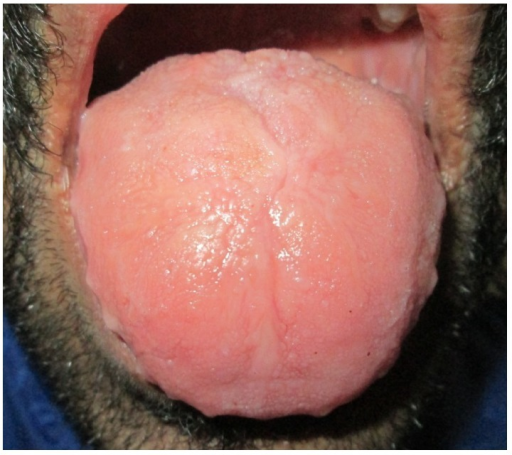
Macroglossia with crenations along the margins and loss of papillae on dorsum surface of the tongue.
SpecialtyMedical genetics Edit this on Wikidata

Macroglossia is the medical term for an unusually large tongue.[1] Severe enlargement of the tongue can cause cosmetic and functional difficulties in speaking, eating, swallowing and sleeping. Macroglossia is uncommon, and usually occurs in children. There are many causes. Treatment depends upon the exact cause.

Signs and symptoms

[edit]
Macroglossia with prognathism and open resting mouth position
Severe macroglossia

Although it may be asymptomatic, symptoms usually are more likely to be present and more severe with larger tongue enlargements. Signs and symptoms include:

A tongue that constantly protrudes from the mouth is vulnerable to drying out, ulceration, infection or even necrosis.[3]

Causes

[edit]

Macroglossia may be caused by a wide variety of congenital and acquired conditions. Isolated macroglossia has no determinable cause.[5] The most common causes of tongue enlargement are vascular malformations (e.g. lymphangioma or hemangioma) and muscular hypertrophy (e.g. Beckwith–Wiedemann syndrome or hemihyperplasia).[3] Enlargement due to lymphangioma gives the tongue a pebbly appearance with multiple superficial dilated lymphatic channels. Enlargement due to hemihyperplasia is unilateral. In edentulous persons, a lack of teeth leaves more room for the tongue to expand into laterally, which can create problems with wearing dentures and may cause pseudomacroglossia.[citation needed]

Amyloidosis is an accumulation of insoluble proteins in tissues that impedes normal function.[6] This can be a cause of macroglossia if amyloid is deposited in the tissues of the tongue, which gives it a nodular appearance. Beckwith–Wiedemann syndrome is a rare hereditary condition, which may include other defects such as omphalocele, visceromegaly, gigantism or neonatal hypoglycemia.[7] The tongue may show a diffuse, smooth generalized enlargement.[3] The face may show maxillary hypoplasia causing relative mandibular prognathism. Apparent macroglossia can also occur in Down syndrome.[8] The tongue has a papillary, fissured surface.[3] Macroglossia may be a sign of hypothyroid disorders.

Other causes include mucopolysaccharidosis,[9] neurofibromatosis,[3] multiple endocrine neoplasia type 2B,[3] myxedema,[3] acromegaly,[3] angioedema,[3] tumors (e.g. carcinoma),[3] Glycogen storage disease type 2,[10] Simpson–Golabi–Behmel syndrome,[5][11] Triploid syndrome,[medical citation needed] trisomy 4p,[medical citation needed] fucosidosis,[medical citation needed] alpha-mannosidosis,[12] Klippel–Trénaunay syndrome,[5] cardiofaciocutaneous syndrome,[5] Ras pathway disorders,[5] transient neonatal diabetes,[5] and lingual thyroid.[13]

Diagnosis

[edit]

Macroglossia is usually diagnosed clinically.[4] Sleep endoscopy and imaging may be used for assessment of obstructive sleep apnea.[2] The initial evaluation of all patients with macroglossia may involve abdominal ultrasound and molecular studies for Beckwith–Wiedemann syndrome.[5]

Classification

[edit]

The ICD-10 lists macroglossia under "other congenital malformations of the digestive system". Definitions of macroglossia have been proposed, including "a tongue that protrudes beyond the teeth during [the] resting posture" and "if there is an impression of a tooth on the lingual border when the patients slightly open their mouths".[5] Others have suggested there is no objective definition of what constitutes macroglossia.[14] Some propose a distinction between true macroglossia, when histologic abnormalities correlate with the clinical findings of tongue enlargement, and relative macroglossia, where histology does not provide a pathologic explanation for the enlargement. Common examples of true macroglossia are vascular malformations, muscular enlargement and tumors; whilst Down syndrome is an example of relative macroglossia.[14] Pseudomacryglossia refers to a tongue that is of normal size but gives a false impression of being too large in relation to adjacent anatomical structures.[4] The Myer classification subdivides macroglossia into generalized or localized.[5]

Treatment

[edit]

Treatment and prognosis of macroglossia depends upon its cause, and also upon the severity of the enlargement and symptoms it is causing. No treatment may be required for mild cases or cases with minimal symptoms. Speech therapy may be beneficial, or surgery to reduce the size of the tongue (reduction glossectomy). Treatment may also involve correction of orthodontic abnormalities that may have been caused by the enlarged tongue.[4] Treatment of any underlying systemic disease may be required, e.g. radiotherapy.[4]

Epidemiology

[edit]

Macroglossia is uncommon, and usually occurs in children.[3] Macroglossia has been reported to have a positive family history in 6% of cases. The National Organization of Rare Disorders lists macroglossia as a rare disease (fewer than 200,000 individuals in the US).[5]

References

[edit]
[edit]
Revisions and contributorsEdit on WikipediaRead on Wikipedia
from Grokipedia
Macroglossia is a rare medical condition characterized by the abnormal enlargement of the tongue, often causing it to protrude beyond the teeth or alveolar ridge, and it is typically a symptom of an underlying disorder rather than occurring in isolation.[1] This enlargement can be congenital, present at birth, or acquired later in life, and it affects children more frequently than adults, with prevalence varying based on associated conditions such as Beckwith-Wiedemann syndrome, where it occurs in approximately 90% of cases.[2][1] The causes of macroglossia are diverse and can be broadly classified into congenital and acquired categories. Congenital macroglossia is frequently linked to genetic syndromes, including Beckwith-Wiedemann syndrome, Down syndrome, congenital hypothyroidism, and mucopolysaccharidoses such as Hurler or Hunter syndrome.[2][1] Acquired forms may result from endocrine disorders like acromegaly or hypothyroidism, infiltrative diseases such as amyloidosis (the most common cause in adults), infections including diphtheria, or benign and malignant tumors like hemangiomas, lymphangiomas, or lymphomas.[1][3] In rare instances, it arises from trauma, postoperative complications, or isolated familial inheritance, with fewer than 50 reported cases of the latter.[4] Symptoms of macroglossia often manifest as functional impairments due to the tongue's size, including difficulties with feeding, speech articulation, and breathing, which can lead to noisy breathing, snoring, excessive drooling, and even life-threatening airway obstruction in severe cases.[4][1] Additional complications may involve dental malocclusion, jaw misalignment, and ulceration of the tongue from friction against the teeth.[4] In infants, it can cause cerebral anoxia if untreated, while in adults, it may contribute to cosmetic concerns and obstructive sleep apnea.[1] Diagnosis typically begins with a thorough clinical evaluation, including a physical examination of the tongue and assessment of protrusion relative to the oral cavity, supplemented by patient history to identify potential underlying conditions.[1] Imaging studies such as computed tomography (CT) or magnetic resonance imaging (MRI) are employed to evaluate the extent of enlargement and rule out tumors, while laboratory tests, including thyroid function assays or biopsies, help pinpoint specific etiologies like hypothyroidism or amyloidosis.[2][1] Treatment strategies prioritize addressing the root cause, with conservative management sufficient in many cases, particularly when the condition improves with facial growth in children.[2] For endocrine-related macroglossia, medications such as thyroxine for hypothyroidism or corticosteroids for inflammatory causes may be prescribed, while orthodontic interventions can correct associated dental issues.[1] Surgical reduction glossectomy is reserved for severe, symptomatic cases—occurring in about 10% of patients—and aims to restore function and aesthetics, with investigational therapies explored through clinical trials for rare forms.[2][4]

Overview and Classification

Definition

Macroglossia is a medical condition characterized by the abnormal enlargement of the tongue, resulting in its protrusion beyond the teeth or alveolar ridge at rest, which may lead to functional impairments or cosmetic concerns.[5] This enlargement can interfere with normal oral function and is typically identified through clinical observation rather than precise measurements, as there is no universally accepted size threshold for a "normal" tongue.[6] Macroglossia is distinguished into two primary categories: true (absolute) macroglossia, which involves genuine hypertrophy or hyperplasia of tongue tissue leading to increased mass, and relative (pseudomacroglossia) macroglossia, where a tongue of normal size appears disproportionately large due to an undersized oral cavity, such as in cases of micrognathia or Pierre Robin sequence.[1] True macroglossia arises from intrinsic growth abnormalities, while relative forms highlight the importance of contextual anatomy in diagnosis.[7] The term "macroglossia" derives from the Greek words "makros" meaning large and "glossa" meaning tongue, reflecting its descriptive origin.[8] Although the condition itself has been documented in medical texts for centuries, with possible early references dating back to around 1550 BC, the modern term was first used in English medical literature in the 1860s, often in association with congenital syndromes.[5][9] Clinically, macroglossia holds significant importance as it can compromise speech articulation, swallowing efficiency, respiratory airflow, and facial aesthetics, particularly in severe cases.[2] It is a rare entity, with congenital forms occurring in approximately 4.63 per 100,000 births and seldom presenting as an isolated anomaly outside of syndromic contexts.[5]

Types

Macroglossia is primarily classified as congenital or acquired based on its onset. Congenital macroglossia is present at birth or manifests in early childhood and is often associated with genetic syndromes, with syndromic forms accounting for approximately 51.9% of congenital cases.[5] Acquired macroglossia develops later in life due to various disease processes, such as metabolic disorders or infiltrative conditions, and is more common in adults.[1] A key distinction within macroglossia is between true macroglossia and pseudomacroglossia (also called relative macroglossia). True macroglossia involves actual enlargement of the tongue through mechanisms like muscular hypertrophy, glandular hyperplasia, or tissue infiltration by pathological substances.[5] In contrast, pseudomacroglossia occurs when a tongue of normal size appears enlarged due to structural discrepancies in the oral cavity, such as jaw hypoplasia (e.g., micrognathia in Pierre Robin syndrome) or habits like prolonged thumb-sucking that displace the tongue forward.[6][10] Regarding etiology, isolated congenital macroglossia is uncommon, comprising about 48.1% of congenital cases and often linked to idiopathic hypertrophy, while syndromic forms are slightly more prevalent and include conditions like Beckwith-Wiedemann syndrome (BWS), which features hemihypertrophy and affects approximately 90% of patients with the syndrome.[5][1] Down syndrome also commonly presents with macroglossia, typically pseudomacroglossia due to hypotonia.[1]

Causes

Congenital Causes

Congenital macroglossia arises from developmental abnormalities present at birth, often linked to genetic, chromosomal, metabolic, or vascular factors that lead to tongue enlargement. These conditions typically manifest in infancy and can significantly impact feeding, breathing, and speech if severe. While isolated congenital macroglossia is rare, it is frequently associated with underlying syndromes or disorders.[1] One of the most common genetic syndromes associated with congenital macroglossia is Beckwith-Wiedemann syndrome (BWS), an overgrowth disorder caused by abnormalities in the 11p15 imprinted region of chromosome 11, including paternal uniparental disomy, loss of maternal allele expression, or gain of paternal allele function. BWS has an incidence of approximately 1 in 13,700 live births and features macroglossia in about 90% of affected individuals, often due to lingual muscular hypertrophy. This enlargement is usually generalized and can protrude beyond the lips, contributing to the syndrome's characteristic facial asymmetry.[11][12][13] Chromosomal disorders, particularly Down syndrome (trisomy 21), also frequently present with relative macroglossia, where the tongue appears disproportionately large due to hypotonia, a small oral cavity, and midfacial hypoplasia rather than absolute tissue overgrowth. Down syndrome occurs in about 1 in 700 live births, and relative macroglossia is a common feature, exacerbating oral motor challenges. This feature is evident from birth and may worsen with age if not managed.[14][15] Metabolic and endocrine conditions, such as congenital hypothyroidism and mucopolysaccharidoses (e.g., Hurler or Hunter syndrome), can cause macroglossia through myxedematous infiltration or glycosaminoglycan accumulation in the tongue. Congenital hypothyroidism affects approximately 1 in 2,000 to 4,000 newborns and is routinely screened for via newborn thyroid-stimulating hormone (TSH) levels to prevent complications; untreated cases lead to coarse facial features including tongue enlargement. Early detection and levothyroxine treatment typically resolve the macroglossia. Mucopolysaccharidoses are lysosomal storage disorders that lead to tongue enlargement via metabolic deposits.[16][1] Vascular and hamartomatous lesions, including hemangiomas and lymphangiomas, represent another key congenital etiology, often causing focal or diffuse tongue enlargement through abnormal proliferation of vascular or lymphatic tissues. Lymphangiomas, benign congenital malformations, are particularly noted for leading to macroglossia in pediatric cases, with potential airway obstruction if extensive. These lesions are present at birth and may grow rapidly in the first year of life.[1][17][18] Congenital causes predominate in the pediatric population, highlighting the importance of early genetic and syndromic evaluation for accurate diagnosis and management.[1][19]

Acquired Causes

Acquired macroglossia refers to postnatal enlargement of the tongue resulting from various secondary conditions, distinct from congenital forms present at birth. These causes are more prevalent in adults and account for a significant portion of cases, with amyloidosis and endocrinopathies being among the most common etiologies identified in systematic reviews.[19][1] Infiltrative disorders, particularly amyloidosis, represent a leading acquired cause, occurring in 10-25% of systemic amyloidosis cases where amyloid proteins deposit in the tongue tissue, leading to firm enlargement and potential nodular appearance. Primary (AL) amyloidosis, associated with plasma cell dyscrasias, and secondary (AA) amyloidosis, linked to chronic inflammation, both contribute to this infiltration, often manifesting as the initial clinical sign in adults.[20][5][1] Endocrine and metabolic disturbances also drive acquired macroglossia through hormonal imbalances or metabolic accumulations. Acromegaly, caused by excess growth hormone from a pituitary adenoma, results in gradual tongue hypertrophy alongside coarsening facial features, with macroglossia reported in 54-69% of patients. Acquired hypothyroidism or myxedema can lead to tongue swelling due to mucopolysaccharide deposition in the connective tissues, though less common than in congenital forms.[20][5][1] Neoplastic processes cause macroglossia via mass effect or direct invasion, comprising about 6.7% of acquired cases in diagnostic reviews. Lymphomas, plasmacytomas, and carcinomas of the tongue or adjacent structures infiltrate or compress lingual tissues, leading to asymmetric enlargement; for instance, non-Hodgkin lymphoma may present with diffuse tongue involvement in immunocompromised individuals.[19][5] Inflammatory and infectious conditions contribute through edema, abscess formation, or chronic inflammation, though they are less frequent. Bacterial infections such as syphilis or tuberculosis can cause granulomatous enlargement, while viral associations like COVID-19 have been noted in isolated adult cases, potentially via inflammatory cytokines. Actinomycosis, a chronic bacterial infection, may lead to suppurative masses in the tongue.[1][5] Iatrogenic and traumatic factors induce macroglossia via mechanical injury or therapeutic side effects. Postoperative complications, such as lingual edema following neurosurgery or intubation, occur in approximately 1% of prone procedures due to venous congestion or direct pressure. Radiation therapy to the head and neck can result in fibrotic hypertrophy, while trauma from hemorrhage or hematoma formation causes acute or persistent swelling. Myopathies, including inflammatory types like amyloid-associated, account for around 4% of cases through muscular infiltration.[1][5][19] Acquired macroglossia may also result from drug-induced angioedema, particularly associated with angiotensin-converting enzyme inhibitors (ACEIs) such as lisinopril. This bradykinin-mediated form can cause acute or subacute tongue swelling (macroglossia), sometimes isolated or prominent in the tongue, leading to speech difficulties, protrusion, and potential airway compromise. Unlike the chronic hypertrophy in acromegaly, this is fluid-based edema that typically improves within days to weeks after discontinuing the offending drug, though recurrences are possible even after cessation. It is included in the differential diagnosis for acquired macroglossia in adults, especially in patients on antihypertensive therapy.

Pathophysiology

Mechanisms of Enlargement

Macroglossia arises through distinct biological mechanisms that lead to tongue enlargement, broadly categorized into true macroglossia, involving intrinsic tissue overgrowth or infiltration, and relative macroglossia, where the tongue appears disproportionately large due to surrounding structural deficiencies. In true macroglossia, enlargement primarily results from cellular proliferation or expansion within the tongue's muscular and glandular components. Hyperplasia, characterized by an increase in cell number, often occurs in glandular tissues, as seen in conditions like Beckwith-Wiedemann syndrome (BWS) where overexpression of insulin-like growth factor 2 (IGF2) drives excessive cell proliferation and tissue growth.[21] Conversely, hypertrophy involves enlargement of existing cells, particularly lingual muscle fibers, through mechanisms such as enhanced protein synthesis or myonuclear addition, commonly observed in endocrine disorders like acromegaly.[22] Tissue infiltration represents another key mechanism, where abnormal deposits disrupt the normal architecture of the tongue, causing stiffness, reduced elasticity, and eventual protrusion. Amyloid fibrils, for instance, accumulate extracellularly in amyloidosis, leading to distortion of soft tissues and organomegaly by interfering with cellular function and increasing tissue volume.[23] Similarly, glycosaminoglycans (GAGs) build up in lysosomal storage disorders such as mucopolysaccharidoses, depositing within the tongue's connective and muscular structures to induce swelling and impaired mobility.[24] These infiltrative processes not only expand the tongue's size but also alter its biomechanical properties, contributing to functional protrusion. Vascular contributions to enlargement stem from abnormal angiogenesis and blood vessel proliferation, resulting in diffuse swelling. Hemangiomas and other vascular malformations, such as cavernous hemangiomas or lymphangiomas, create localized or widespread vascular channels that fill with blood or lymph, leading to progressive tissue expansion and a spongy texture.[1] These lesions often involve dilated lymphatic and vascular structures, promoting edema and hypertrophy of surrounding tissues through chronic vascular engorgement.[25] In relative macroglossia, or pseudomacroglossia, the tongue itself remains of normal size and volume, but mandibular hypoplasia or a small oral cavity creates the illusion of enlargement by limiting space for tongue positioning. This relative disproportion is frequently assessed using cephalometric analysis, which measures skeletal relationships such as mandibular length and tongue-to-jaw ratios to confirm the absence of intrinsic tongue overgrowth.[26][27] Underlying these mechanisms are key molecular pathways involving growth factors and genetic regulation. IGF2 overexpression, often due to imprinting errors at the 11p15 locus in BWS, promotes hyperplasia by enhancing cell proliferation and inhibiting apoptosis through interactions with cell cycle regulators like p57Kip2.[28] In acromegaly, excess growth hormone stimulates hepatic and local production of IGF-1, which mediates muscular hypertrophy via insulin-like receptor signaling, leading to widespread soft tissue growth including the tongue.[22] These pathways highlight how dysregulated growth signaling can independently drive the cellular and tissue changes central to macroglossia.

Associated Syndromic Features

Macroglossia serves as a prominent syndromic feature in several genetic disorders characterized by multisystem involvement, often contributing to the overall clinical presentation and management challenges.[1] Beckwith-Wiedemann syndrome (BWS), an overgrowth disorder caused by dysregulation of imprinted genes on chromosome 11p15, frequently manifests with macroglossia in approximately 90% of cases, serving as a hallmark sign alongside macrosomia, omphalocele, and visceromegaly.[11] This tongue enlargement, often evident at birth, arises from hyperplasia, exacerbating feeding and respiratory difficulties in infancy.[29] Individuals with BWS also face an elevated cancer risk, particularly Wilms tumor occurring in about 7% of cases, necessitating vigilant tumor surveillance protocols.[30] In Down syndrome (trisomy 21), macroglossia—typically relative due to a small oral cavity rather than absolute enlargement—coexists with hypotonia, congenital cardiac defects such as atrioventricular septal defects, and intellectual disability, affecting up to 1 in 700 live births.[1] The protruding tongue in these patients often compounds airway obstruction, contributing to obstructive sleep apnea and upper respiratory infections.[14] Mucopolysaccharidoses (MPS), a group of lysosomal storage disorders, prominently feature macroglossia due to glycosaminoglycan accumulation in tongue tissues, leading to infiltration and progressive enlargement. In MPS I (Hurler syndrome), this occurs alongside skeletal dysplasia, corneal clouding, and hepatosplenomegaly, while MPS II (Hunter syndrome) shares similar traits including coarse facial features and joint stiffness, though it spares corneal involvement and follows X-linked inheritance.[31][32] The resulting macroglossia frequently precipitates obstructive sleep apnea through mechanical airway compromise.[33] Simpson-Golabi-Behmel syndrome, an X-linked overgrowth condition driven by mutations in the GPC3 gene encoding glypican-3, includes macroglossia as a core feature amid pre- and postnatal overgrowth, cardiac anomalies like ventricular septal defects, and supernumerary nipples.[34] These GPC3 mutations disrupt cell signaling pathways, promoting excessive tissue growth including in the tongue.[35] Macroglossia serves as a diagnostic clue for multisystem disorders beyond isolated tongue pathology, with overlaps in phenotypes like those seen in BWS and Simpson-Golabi-Behmel syndrome.[36]

Signs and Symptoms

Oral and Functional Manifestations

Macroglossia often leads to significant speech impediments, primarily manifesting as dysarthria and lisping due to the tongue's enlarged size and persistent protrusion, which disrupts normal articulation and phonation.[1] These issues arise from the mechanical interference of the oversized tongue with oral movements required for clear speech production.[26] In children with conditions like Beckwith-Wiedemann syndrome (BWS), where macroglossia is prevalent in up to 90% of cases, speech therapy is commonly needed, with approximately 40% of affected individuals requiring intervention to address ongoing articulation difficulties.[1] Overall, functional speech impairments are reported in a substantial proportion of macroglossia cases, contributing to communication challenges that can persist without management.[37] Feeding and swallowing difficulties, known as dysphagia, are particularly pronounced in infants with macroglossia, where the protruding tongue hinders effective latching and bolus coordination during meals.[1] This often results in excessive drooling, or sialorrhea, due to impaired oral containment and increased saliva production from constant tongue positioning.[26] In severe cases, these challenges elevate the risk of aspiration, where food or saliva enters the airway, potentially leading to respiratory complications such as pneumonia.[38] Poor weight gain and failure to thrive are common outcomes in affected infants, as the effort required for feeding exacerbates nutritional deficits.[1] Dental and periodontal problems frequently develop from the chronic pressure exerted by the enlarged tongue against the teeth and jaws, leading to malocclusion such as anterior open bite and Class III skeletal patterns.[26] In BWS patients, for instance, about two-thirds exhibit macroglossia-associated anterior open bite, where the front teeth fail to meet due to tongue thrust.[37] Additional issues include tooth spacing abnormalities and mandibular prognathism, as the tongue's force promotes forward displacement of the lower jaw over time.[1] These structural changes can accelerate periodontal strain and contribute to long-term orthodontic needs, as well as ulceration of the tongue from friction against the teeth.[1][26] Airway obstruction is a critical functional concern in macroglossia, often presenting as snoring and obstructive sleep apnea (OSA), particularly in severe cases where the tongue base collapses posteriorly during sleep.[1] In children with BWS and macroglossia, the prevalence of sleep-disordered breathing, including OSA, reaches approximately 48%, with infants under 6 months at highest risk for significant apnea-hypopnea index elevations.[39] This obstruction can progress to life-threatening scenarios, such as total nasopharyngeal blockage, especially in supine positions or during anesthesia.[26] In conditions like acromegaly, airway compromise affects roughly half of patients, complicating ventilation and increasing intubation risks.[1] Cosmetic concerns from visible tongue protrusion are common, particularly in children, where the altered facial profile can lead to psychological distress and diminished self-esteem.[1] The prominent tongue often draws social attention, exacerbating emotional impacts in pediatric populations with congenital macroglossia.[26] These aesthetic issues frequently motivate surgical considerations alongside functional improvements.[1]

Systemic and Developmental Impacts

Macroglossia in syndromic conditions such as Beckwith-Wiedemann syndrome (BWS) often contributes to developmental delays through early feeding challenges that hinder adequate nutrition and growth. In BWS, macroglossia affects approximately 90% of cases and can obstruct the airway or interfere with suckling, leading to prolonged feeding times, inadequate caloric intake, and failure to thrive in infancy.[1][11] These issues necessitate multidisciplinary interventions, including specialized feeding techniques or nutritional support, to mitigate growth faltering. Additionally, speech and language development may be impaired due to altered tongue mobility and positioning, with around 40% of affected children requiring speech therapy to address articulation difficulties and improve communication skills.[37] Respiratory complications arise from macroglossia-induced upper airway obstruction, particularly in conditions like BWS and acromegaly, where it predisposes individuals to obstructive sleep apnea (OSA). OSA results in recurrent episodes of chronic hypoxia, which can elevate pulmonary artery pressure and increase the risk of pulmonary hypertension through mechanisms involving hypoxic pulmonary vasoconstriction and endothelial dysfunction.[1][40] In acromegaly, macroglossia contributes to OSA in up to 50% of patients, exacerbating systemic hypoxemia and potentially leading to right heart strain if untreated.[1][41] Nutritional deficits are common due to persistent feeding inefficiencies, such as difficulty in bolus formation and swallowing, which reduce overall intake and heighten the risk of vitamin deficiencies.[1] In the context of hypothyroidism, where macroglossia arises from mucopolysaccharide deposition in tongue tissues, these feeding barriers can further compound metabolic slowdown, potentially worsening hypothyroid symptoms like fatigue and growth impairment if nutritional status deteriorates.[1][42] Psychological effects of macroglossia often manifest in adolescents as self-consciousness over visible tongue protrusion, contributing to anxiety, social withdrawal, and increased vulnerability to bullying, which negatively impacts overall quality of life. Studies on oral health-related quality of life in syndromic macroglossia indicate that visible dentofacial alterations, including macroglossia, are associated with emotional distress and reduced psychosocial well-being.[1][37] In acromegaly, macroglossia accompanies broader growth hormone excess, leading to disproportionate somatic overgrowth, including visceromegaly and skeletal changes that manifest as joint arthropathy and reduced mobility. This condition promotes cartilage hypertrophy and osteoarthritis-like changes in weight-bearing joints, contributing to chronic pain and functional limitations as part of the systemic gigantism-like phenotype.[1][22]

Diagnosis

Clinical Assessment

Clinical assessment of macroglossia begins with a detailed history to determine the onset, potential etiology, and associated features. Congenital macroglossia is typically evident at birth or in early infancy, often linked to genetic syndromes, while acquired forms may develop gradually in adulthood due to infiltrative processes or endocrine disorders.[1] Family history is crucial, as isolated macroglossia can follow an autosomal dominant pattern, and syndromic associations like Beckwith-Wiedemann syndrome (BWS) may show hereditary patterns across generations.[5] Associated symptoms include feeding difficulties, snoring from airway obstruction, speech impediments, and growth abnormalities such as macrosomia in BWS or hypotonia in Down syndrome.[1][43] The physical examination focuses on evaluating tongue size and its relationship to surrounding structures. Macroglossia is clinically identified by protrusion of the tongue beyond the incisors or alveolar ridge at rest, indicating true enlargement rather than positional issues.[5] Assessment includes measurement of tongue protrusion and evaluation of jaw-tongue disproportion, where a small mandible (micrognathia) can cause relative macroglossia, as seen in Pierre Robin sequence.[1] Inspection and palpation of the oral cavity provide further characterization. The tongue is examined for asymmetry, ulceration, or color changes, such as bluish hues suggesting vascular lesions like hemangiomas. Palpation assesses firmness: infiltrative causes like amyloidosis yield a firm, rubbery texture, while vascular malformations feel soft or compressible.[5][1] Sublingual glands are palpated for displacement, confirming true macroglossia over relative forms.[44] Syndromic screening involves identifying associated dysmorphic features to guide etiology. In suspected BWS, examine for ear creases or pits, which occur in up to 76% of cases, alongside macroglossia present in 90%. For Down syndrome, check for Brushfield spots—speckled iris discolorations seen in 35-78% of affected individuals—and relative tongue enlargement due to midfacial hypoplasia.[43][1][45] Differential diagnosis during assessment distinguishes macroglossia from mimics through observation. Relative macroglossia from micrognathia is noted by posterior tongue displacement against a small jaw, while habits like tongue thrusting may cause apparent protrusion without intrinsic enlargement, resolvable by correcting the behavior.[1][44]

Diagnostic Tests

Diagnosis of macroglossia often requires a combination of imaging, laboratory, and specialized tests to confirm the condition and elucidate underlying etiologies such as infiltrative diseases, neoplasms, or genetic syndromes.[1] Imaging modalities play a central role in evaluating tongue enlargement. Magnetic resonance imaging (MRI) is preferred for its superior soft tissue resolution, allowing visualization of infiltration, tumors, or diffuse enlargement; in amyloidosis, T2-weighted sequences typically reveal hyperintensity due to protein deposition.[1][46] Computed tomography (CT) is useful for assessing bony relationships and calcifications adjacent to the tongue, particularly in cases suspecting mandibular involvement or vascular anomalies.[1] Ultrasound serves as an initial, non-invasive option for detecting vascular lesions, such as hemangiomas or lymphatic malformations, by demonstrating irregular vascular patterns on color Doppler.[47] Laboratory investigations target potential systemic causes. Thyroid function tests, including thyroid-stimulating hormone (TSH) and free thyroxine (T4), are essential to identify hypothyroidism, which can lead to myxedematous enlargement of the tongue.[1][48] For suspected genetic syndromes like Beckwith-Wiedemann syndrome (BWS), methylation-specific multiplex ligation-dependent probe amplification (MS-MLPA) of the 11p15 region is recommended to detect imprinting defects.[11] In cases of amyloidosis, serum protein electrophoresis helps identify monoclonal gammopathy, supporting the diagnosis of light-chain (AL) amyloidosis.[49] Biopsy provides definitive histopathological confirmation for neoplastic or infiltrative processes. Fine-needle aspiration is employed for accessible lesions to assess for malignancy, while excisional biopsy may be necessary for larger or indeterminate masses.[1] For amyloidosis, tissue samples stained with Congo red exhibit apple-green birefringence under polarized light, confirming extracellular amyloid deposits.[1] Functional tests evaluate associated complications, particularly airway obstruction. Polysomnography is indicated to diagnose obstructive sleep apnea (OSA), quantifying apnea-hypopnea index and oxygen desaturation in patients with macroglossia-related upper airway compromise.[50] Cephalometry, via lateral skull radiographs, aids in distinguishing relative macroglossia from true enlargement by measuring tongue position relative to the mandible and pharyngeal airway space.[26] Recent advances in genetic diagnostics include next-generation sequencing (NGS) panels for syndromic overgrowth disorders, enabling comprehensive screening of multiple genes associated with macroglossia, such as those in the BWS spectrum.[11]

Management and Treatment

Conservative Management

Conservative management of macroglossia prioritizes non-invasive approaches to treat underlying etiologies and mitigate symptoms such as airway obstruction, feeding difficulties, and speech impairments, particularly in cases linked to endocrine disorders like hypothyroidism or syndromic conditions.[1] Medical therapy targets reversible causes; for instance, levothyroxine replacement is administered in hypothyroidism-associated macroglossia to address mucopolysaccharide deposition and reduce tongue swelling.[1] In amyloidosis, chemotherapy regimens, such as those targeting plasma cell dyscrasias, form the cornerstone of systemic treatment to halt amyloid production, though radiation therapy is not recommended for tongue involvement due to lack of efficacy.[51] For malignant neoplastic macroglossia, chemotherapy or radiation may be used adjunctively based on tumor histology to control growth without immediate resection, while benign vascular lesions such as hemangiomas or lymphangiomas are typically managed surgically.[52] Supportive care includes speech therapy to manage dysarthria through targeted articulation exercises that strengthen tongue mobility and coordination, improving speech clarity in affected children.[7] Orthodontic appliances, such as palatal expanders, are employed to counteract malocclusion and dental misalignment caused by chronic tongue pressure against the teeth and jaws.[53] Lifestyle interventions encompass continuous positive airway pressure (CPAP) devices to alleviate obstructive sleep apnea by maintaining airway patency in infants and children with macroglossia-related obstruction.[50] Nutritional support involves supplemental feeds or specialized positioning during meals to address feeding challenges and ensure adequate growth in infants.[54] Ongoing monitoring is essential for syndromic macroglossia, such as in Beckwith-Wiedemann syndrome, where regular abdominal ultrasounds are performed every three months until age 8 to screen for associated tumors like Wilms tumor.[11] Pharmacologic interventions include botulinum toxin injections into the salivary glands to temporarily reduce excessive drooling in severe sialorrhea cases.[55]

Surgical Interventions

Surgical interventions for macroglossia primarily involve reductive procedures to address severe cases where conservative measures fail, particularly when tongue enlargement leads to airway obstruction or functional impairments such as obstructive sleep apnea (OSA). Partial glossectomy is the most common approach, involving the removal of excess tongue tissue to restore normal proportions and function.[56] One standard technique is anterior wedge resection, where a V-shaped incision is made along the midline of the tongue's anterior portion to primarily reduce its length and overall volume, typically aiming for a 20-30% reduction while preserving mobility and sensation. This method is indicated for true macroglossia in conditions like Beckwith-Wiedemann syndrome (BWS), especially when severe protrusion causes OSA or feeding difficulties.[56][57] For macroglossia associated with vascular lesions, such as hemangiomas or lymphatic malformations, minimally invasive options like laser ablation or radiofrequency ablation (RFA) are employed to target and shrink abnormal tissue with reduced bleeding risk compared to traditional excision. These techniques, including pulsed-dye laser or bipolar radiofrequency plasma ablation (coblation), allow precise volumetric reduction of superficial lesions while minimizing damage to surrounding structures.[58][59][60] In cases of relative macroglossia, where the tongue appears disproportionately large due to an underdeveloped mandible rather than absolute enlargement, orthognathic surgery such as mandibular advancement may be performed to expand the oral cavity and alleviate pressure on the tongue; this procedure may be combined with tongue reduction in complex cases to optimize skeletal alignment and prevent relapse.[61][62] Surgical timing in pediatric patients, particularly those with BWS, is typically delayed until ages 2-3 years to allow for potential natural regression of macroglossia, which occurs in a subset of cases managed conservatively. Early intervention before 12 months may be considered for severe airway compromise, but multidisciplinary evaluation is essential to assess growth patterns. Note that macroglossia may be irreversible in some acquired cases like amyloidosis, where conservative measures have limited success.[63][64][40][1] Postoperative outcomes demonstrate significant airway improvements, with studies reporting reductions in the obstructive apnea-hypopnea index by up to 68% and enhancements in oxygenation in the majority of patients. Complications are generally low, including wound dehiscence in about 13.5% of cases and scarring or infection in fewer than 5%, with most resolving without long-term sequelae. Long-term functional outcomes post-surgery often show improved speech and feeding, though some patients may require additional therapies.[40][65][1]

Prognosis and Complications

Long-term Outcomes

In congenital cases of macroglossia, particularly those associated with Beckwith-Wiedemann syndrome (BWS), spontaneous improvement occurs in a substantial proportion due to proportional growth of the orofacial structures, with approximately 72% of cases managed conservatively showing improvements in tongue size and function without surgical intervention by early childhood.[64] Following treatments such as tongue reduction surgery, full resolution of macroglossia-related symptoms is achieved in the majority of patients, with 91% attaining a normal resting tongue position within the dental arch and 88% experiencing no oral-stage feeding difficulties.[66] Functional recovery post-intervention is generally positive, with improvements in speech articulation and reduction in obstructive sleep apnea (OSA) reported in pediatric cohorts managed with procedures like glossectomy.[67] In BWS, survivors exhibit a normal lifespan when adhering to routine cancer screening protocols, as the overgrowth features, including macroglossia, typically normalize by age 8 without impacting overall mortality.[68] Conversely, in Down syndrome, macroglossia often persists as a mild issue into adulthood due to underlying hypotonia, contributing to ongoing subtle speech and articulation challenges despite interventions.[1] Long-term follow-up involves serial tongue measurements using standardized scoring systems like the Beckwith-Ivemark Grading (BIG) scale, which demonstrate sustained reductions in tongue size over time, alongside quality-of-life assessments showing marked enhancements in functional and psychosocial domains, such as improved oral health-related quality of life scores post-treatment.[64] A 2024 case report on multidisciplinary care for macroglossia in BWS described significant gains in speech intelligibility and overall quality of life with no postoperative complications when combining surgical reduction and intensive speech therapy.[69]

Potential Complications

Untreated macroglossia poses significant risks, particularly in infants, where it can lead to chronic aspiration pneumonia due to impaired swallowing and airway obstruction from pooled secretions.[38] Excessive drooling, a common feature, exacerbates oral hygiene challenges by promoting bacterial proliferation, thereby increasing the likelihood of dental caries and gingivitis.[70] Surgical treatments for macroglossia, such as tongue reduction procedures, are associated with postoperative complications including edema, which is the most frequent issue and may require extended intubation to maintain airway patency. A 2025 systematic review reported complication rates including dehiscence (13.5%), infection (1.35%), and recurrence (17.6%).[52][71] Wound infections occur in a subset of cases, typically managed with antibiotics, while nerve injury during surgery can result in taste alterations or sensory deficits.[72][73] In syndromic contexts like Beckwith-Wiedemann syndrome, macroglossia heightens the risk of acute airway crises, such as ventilation and intubation difficulties during medical procedures, often necessitating specialized anesthetic planning.[74] Associated overgrowth syndromes further elevate malignancy risks, with embryonal tumors developing in approximately 5-10% of affected children.[75] Chronic untreated or inadequately managed macroglossia contributes to periodontal disease progression through constant tongue pressure on gingival tissues and entrapment of debris, leading to inflammation and tissue breakdown.[70] The visible and functional impairments can also induce psychological distress, including anxiety and low self-esteem, particularly in children with BWS.[76] These complications are largely preventable through early intervention, with prompt multidisciplinary evaluation recommended for conservative or surgical management to avert long-term sequelae.[77]

Epidemiology

Prevalence and Distribution

Macroglossia is a rare condition, with an overall prevalence estimated at fewer than 5 cases per 100,000 individuals. The birth prevalence of congenital macroglossia, the most common form, is approximately 4.63 per 100,000 live births, based on U.S. data (as of 2018); overall prevalence remains rare, with no significant changes reported as of 2025.[6][78][1] This rarity underscores its status as an uncommon anatomical abnormality, often linked to underlying syndromes rather than occurring in isolation. The majority of cases, around 60-70%, are diagnosed during infancy, primarily due to the prominence of congenital forms that manifest at birth or in the early years of life. Acquired macroglossia, which develops later, tends to peak in adulthood, particularly between 40 and 60 years of age, often in association with endocrine or infiltrative disorders. Gender distribution shows a slight female predominance overall, with isolated congenital cases occurring nearly twice as frequently in females (odds ratio 1.93) compared to males; syndromic forms, such as those in Beckwith-Wiedemann syndrome, exhibit more equal distribution.[1][5][78] Geographically, macroglossia displays no strong ethnic or regional bias worldwide, though U.S. data indicate a higher incidence among African Americans (odds ratio 2.02). Reporting is more frequent in developed countries, attributable to enhanced screening programs, such as those for congenital hypothyroidism in newborns, which facilitate early detection. Temporally, the incidence has remained stable, but diagnostic rates have increased since the 2010s due to advancements in genetic testing that improve identification of associated syndromes.[78][4][79]

Risk Factors and Associations

Macroglossia is influenced by a combination of non-modifiable genetic factors and potentially modifiable environmental influences. Genetic risks prominently include family history of imprinting disorders, such as Beckwith-Wiedemann syndrome (BWS), an overgrowth disorder caused by abnormalities at chromosome 11p15.5; in familial cases involving pathogenic variants in the maternal CDKN1C gene, the recurrence risk to siblings can reach 50%.[11] Chromosomal abnormalities, including trisomy 21 associated with Down syndrome, represent another key non-modifiable risk, often leading to relative macroglossia due to hypotonia and altered oral anatomy.[1] Environmental factors contribute to certain etiologies of macroglossia, particularly through conditions like hypothyroidism. Iodine deficiency, prevalent in endemic areas, impairs thyroid hormone synthesis and increases the risk of congenital hypothyroidism, which can manifest as macroglossia from myxedematous infiltration of the tongue. Assisted reproductive technologies (ART), including in vitro fertilization, have been linked to a heightened risk of BWS and thus macroglossia, with studies reporting up to a 10-fold increase compared to natural conception, likely due to epigenetic alterations at the 11p15.5 locus.[80] Approximately 52% of congenital macroglossia cases in pediatric populations are associated with underlying syndromes, underscoring the syndromic nature of many instances; prominent examples include BWS, in which macroglossia affects approximately 90% of cases and is the most common cause of macroglossia in children, mucopolysaccharidoses, and Pompe disease.[1][78] Relative macroglossia, where the tongue appears disproportionately large without true enlargement, can be exacerbated by obesity through accumulation of adipose tissue in the tongue, which narrows the posterior airway space and heightens risks of obstructive sleep apnea. Comorbidities further elevate susceptibility, particularly in vulnerable groups. Acquired forms of macroglossia are more common in individuals with autoimmune thyroiditis (Hashimoto's disease), where chronic inflammation leads to hypothyroidism and lingual swelling. Although specific odds ratios vary, macroglossia appears more frequent among preterm infants, potentially due to associated immaturity in oral development and higher syndromic overlap. Screening recommendations emphasize early identification in high-risk populations, such as families with a history of imprinting disorders or chromosomal anomalies. The American College of Obstetricians and Gynecologists (ACOG) advocates for prenatal carrier screening and postnatal genetic testing in at-risk pregnancies to detect conditions like BWS, with expanded newborn panels recommended for those with clinical features of overgrowth syndromes.[81]

References

User Avatar
No comments yet.