Hubbry Logo
Superconducting magnetSuperconducting magnetMain
Open search
Superconducting magnet
Community hub
Superconducting magnet
logo
8 pages, 0 posts
0 subscribers
Be the first to start a discussion here.
Superconducting magnet
from Wikipedia
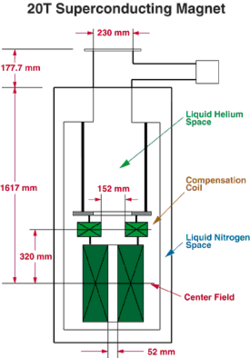
Schematic of a 20-tesla superconducting magnet with vertical bore

A superconducting magnet is an electromagnet made from coils of superconducting wire. They must be cooled to cryogenic temperatures during operation. In its superconducting state the wire has no electrical resistance and therefore can conduct much larger electric currents than ordinary wire, creating intense magnetic fields. Superconducting magnets can produce stronger magnetic fields than all but the strongest non-superconducting electromagnets, and large superconducting magnets can be cheaper to operate because no energy is dissipated as heat in the windings. They are used in MRI instruments in hospitals, and in scientific equipment such as NMR spectrometers, mass spectrometers, fusion reactors and particle accelerators. They are also used for levitation, guidance and propulsion in a magnetic levitation (maglev) railway system being constructed in Japan.

Construction

[edit]

Cooling

[edit]

During operation, the magnet windings must be cooled below their critical temperature, the temperature at which the winding material changes from the normal resistive state and becomes a superconductor, which is in the cryogenic range far below room temperature. The windings are typically cooled to temperatures significantly below their critical temperature, because the lower the temperature, the better superconductive windings work—the higher the currents and magnetic fields they can stand without returning to their non-superconductive state. Two types of cooling systems are commonly used to maintain magnet windings at temperatures sufficient to maintain superconductivity:

Liquid-cooled

[edit]

Liquid helium is used as a coolant for many superconductive windings. It has a boiling point of 4.2 K, far below the critical temperature of most winding materials. The magnet and coolant are contained in a thermally insulated container (dewar) called a cryostat. To keep the helium from boiling away, the cryostat is usually constructed with an outer jacket containing (significantly cheaper) liquid nitrogen at 77 K. Alternatively, a thermal shield made of conductive material and maintained in 40 K – 60 K temperature range, cooled by conductive connections to the cryocooler cold head, is placed around the helium-filled vessel to keep the heat input to the latter at acceptable level. One of the goals of the search for high temperature superconductors is to build magnets that can be cooled by liquid nitrogen alone. At temperatures above about 20 K cooling can be achieved without boiling off cryogenic liquids.[citation needed]

Mechanical cooling

[edit]

Because of increasing cost and the dwindling availability of liquid helium, many superconducting systems are cooled using two stage mechanical refrigeration. In general two types of mechanical cryocoolers are employed which have sufficient cooling power to maintain magnets below their critical temperature. The Gifford–McMahon cryocooler has been commercially available since the 1960s and has found widespread application.[1][2][3][4] The G-M regenerator cycle in a cryocooler operates using a piston type displacer and heat exchanger. Alternatively, 1999 marked the first commercial application using a pulse tube cryocooler. This design of cryocooler has become increasingly common due to low vibration and long service interval as pulse tube designs use an acoustic process in lieu of mechanical displacement. In a typical two-stage refrigerator, the first stage will offer higher cooling capacity but at higher temperature (≈ 77 K) with the second stage reaching ≈ 4.2 K and < 2.0 W of cooling power. In use, the first stage is used primarily for ancillary cooling of the cryostat with the second stage used primarily for cooling the magnet.

Coil winding materials

[edit]

The maximal magnetic field achievable in a superconducting magnet is limited by the field at which the winding material ceases to be superconducting, its "critical field", Hc, which for type-II superconductors is its upper critical field. Another limiting factor is the "critical current", Ic, at which the winding material also ceases to be superconducting. Advances in magnets have focused on creating better winding materials.

The superconducting portions of most current magnets are composed of niobium–titanium. This material has critical temperature of 10 K and can superconduct at up to about 15 T. More expensive magnets can be made of niobium–tin (Nb3Sn). These have a Tc of 18 K. When operating at 4.2 K they are able to withstand a much higher magnetic field intensity, up to 25 T to 30 T. Unfortunately, it is far more difficult to make the required filaments from this material. This is why sometimes a combination of Nb3Sn for the high-field sections and NbTi for the lower-field sections is used. Vanadium–gallium is another material used for the high-field inserts.

High-temperature superconductors (e.g. BSCCO or YBCO) may be used for high-field inserts when required magnetic fields are higher than Nb3Sn can manage.[citation needed] BSCCO, YBCO or magnesium diboride may also be used for current leads, conducting high currents from room temperature into the cold magnet without an accompanying large heat leak from resistive leads.[citation needed]

Conductor structure

[edit]

The coil windings of a superconducting magnet are made of wires or tapes of Type II superconductors (e.g.niobium–titanium or niobium–tin). The wire or tape itself may be made of tiny filaments (about 20 micrometres thick) of superconductor in a copper matrix. The copper is needed to add mechanical stability, and to provide a low resistance path for the large currents in case the temperature rises above Tc or the current rises above Ic and superconductivity is lost. These filaments need to be this small because in this type of superconductor the current only flows in a surface layer whose thickness is limited to the London penetration depth (see Skin effect). The coil must be carefully designed to withstand (or counteract) magnetic pressure and Lorentz forces that could otherwise cause wire fracture or crushing of insulation between adjacent turns.

Operation

[edit]
7 T horizontal bore superconducting magnet, part of a mass spectrometer. The magnet itself is inside the cylindrical cryostat.

Power supply

[edit]

The current to the coil windings is provided by a high current, very low voltage DC power supply, since in steady state the only voltage across the magnet is due to the resistance of the feeder wires. Any change to the current through the magnet must be done very slowly, first because electrically the magnet is a large inductor and an abrupt current change will result in a large voltage spike across the windings, and more importantly because fast changes in current can cause eddy currents and mechanical stresses in the windings that can precipitate a quench (see below). So the power supply is usually microprocessor-controlled, programmed to accomplish current changes gradually, in gentle ramps. It usually takes several minutes to energize or de-energize a laboratory-sized magnet.

Persistent mode

[edit]

An alternate operating mode used by most superconducting magnets is to short-circuit the windings with a piece of superconductor once the magnet has been energized. The windings become a closed superconducting loop, the power supply can be turned off, and persistent currents will flow for months, preserving the magnetic field. The advantage of this persistent mode is that stability of the magnetic field is better than is achievable with the best power supplies, and no energy is needed to power the windings. The short circuit is made by a 'persistent switch', a piece of superconductor inside the magnet connected across the winding ends, attached to a small heater.[5] When the magnet is first turned on, the switch wire is heated above its transition temperature, so it is resistive. Since the winding itself has no resistance, no current flows through the switch wire. To go to persistent mode, the supply current is adjusted until the desired magnetic field is obtained, then the heater is turned off. The persistent switch cools to its superconducting temperature, short-circuiting the windings. Then the power supply can be turned off. The winding current, and the magnetic field, will not actually persist forever, but will decay slowly according to a normal inductive time constant (L/R):

where is a small residual resistance in the superconducting windings due to joints or a phenomenon called flux motion resistance. Nearly all commercial superconducting magnets are equipped with persistent switches.

The heater is nothing more than a small resistive element that warms up by Joule effect; in practice, it must be powered by an external current-controlled supply, typically delivering a few tens of milliamperes at a few volts, in order to drive the superconducting switch above its transition temperature.

Magnet quench

[edit]

A quench is an abnormal termination of magnet operation that occurs when part of the superconducting coil enters the normal (resistive) state. This can occur because the field inside the magnet is too large, the rate of change of field is too large (causing eddy currents and resultant heating in the copper support matrix), or a combination of the two. More rarely a defect in the magnet can cause a quench. When this happens, that particular spot is subject to rapid Joule heating from the enormous current, which raises the temperature of the surrounding regions. This pushes those regions into the normal state as well, which leads to more heating in a chain reaction. The entire magnet rapidly becomes normal (this can take several seconds, depending on the size of the superconducting coil). This is accompanied by a loud bang as the energy in the magnetic field is converted to heat, and rapid boil-off of the cryogenic fluid. The abrupt decrease of current can result in kilovolt inductive voltage spikes and arcing. Permanent damage to the magnet is rare, but components can be damaged by localized heating, high voltages, or large mechanical forces. In practice, magnets usually have safety devices to stop or limit the current when the beginning of a quench is detected. If a large magnet undergoes a quench, the inert vapor formed by the evaporating cryogenic fluid can present a significant asphyxiation hazard to operators by displacing breathable air.

A large section of the superconducting magnets in CERN's Large Hadron Collider unexpectedly quenched during start-up operations in 2008, necessitating the replacement of a number of magnets.[6] In order to mitigate against potentially destructive quenches, the superconducting magnets that form the LHC are equipped with fast-ramping heaters that are activated once a quench event is detected by the complex quench protection system. As the dipole bending magnets are connected in series, each power circuit includes 154 individual magnets, and should a quench event occur, the entire combined stored energy of these magnets must be dumped at once. This energy is transferred into massive blocks of metal which heat up to several hundred degrees Celsius due to the resistive heating, in a matter of seconds. Although undesirable, a magnet quench is a "fairly routine event" during the operation of a particle accelerator.[7]

Quench events are detected by specialized *quench detection systems* (QDS), which monitor the voltage across different sections of a superconducting coil. When part of the coil becomes resistive, a voltage imbalance develops between coil segments; if this exceeds a predefined threshold, the quench protection system is triggered. Once a quench is confirmed, the protection electronics activate heaters or energy-dissipation circuits to safely spread and extract the stored magnetic energy, minimizing the risk of damage.[8]

Magnet "training"

[edit]

In certain cases, superconducting magnets designed for very high currents require extensive bedding in, to enable the magnets to function at their full planned currents and fields. This is known as "training" the magnet, and involves a type of material memory effect. One situation this is required in is the case of particle colliders such as CERN's Large Hadron Collider.[9][10] The magnets of the LHC were planned to run at 8 TeV (2 × 4 TeV) on its first run and 14 TeV (2 × 7 TeV) on its second run, but were initially operated at a lower energy of 3.5 TeV and 6.5 TeV per beam respectively. Because of initial crystallographic defects in the material, they will initially lose their superconducting ability ("quench") at a lower level than their design current. CERN states that this is due to electromagnetic forces causing tiny movements in the magnets, which in turn cause superconductivity to be lost when operating at the high precision needed for their planned current.[10] By repeatedly running the magnets at a lower current and then slightly increasing the current until they quench under control, the magnet will gradually both gain the required ability to withstand the higher currents of its design specification without quenches occurring, and have any such issues "shaken" out of them, until they are eventually able to operate reliably at their full planned current without experiencing quenches.[10]

History

[edit]

Although the idea of making electromagnets with superconducting wire was proposed by Heike Kamerlingh Onnes shortly after he discovered superconductivity in 1911, a practical superconducting electromagnet had to await the discovery of superconducting materials that could support large critical supercurrent densities in high magnetic fields. The first successful superconducting magnet was built by G.B. Yntema in 1955 using niobium wire and achieved a field of 0.7 T at 4.2 K.[11] Then, in 1961, J.E. Kunzler, E. Buehler, F.S.L. Hsu, and J.H. Wernick made the discovery that a compound of niobium and tin could support critical-supercurrent densities greater than 100,000 amperes per square centimetre in magnetic fields of 8.8 teslas.[12] Despite its brittle nature, niobium–tin has since proved extremely useful in supermagnets generating magnetic fields up to 20 T.

The persistent switch was invented in 1960 by Dwight Adams while a postdoctoral associate at Stanford University. The second persistent switch was constructed at the University of Florida by M.S. student R.D. Lichti in 1963. It has been preserved in a showcase in the UF Physics Building.

In 1962, T.G. Berlincourt and R.R. Hake[13] discovered the high-critical-magnetic-field, high-critical-supercurrent-density properties of niobium–titanium alloys. Although niobium–titanium alloys possess less spectacular superconducting properties than niobium–tin, they are highly ductile, easily fabricated, and economical. Useful in supermagnets generating magnetic fields up to 10 teslas, niobium–titanium alloys are the most widely used supermagnet materials.

In 1986, the discovery of high temperature superconductors by Georg Bednorz and Karl Müller energized the field, raising the possibility of magnets that could be cooled by liquid nitrogen instead of the more difficult-to-work-with helium.

In 2007, a magnet with windings of YBCO achieved a world record field of 26.8 T.[14] The US National Research Council had a goal of creating a 30-tesla superconducting magnet.

Globally in 2014, almost six billion US dollars' worth of economic activity resulted for which superconductivity was indispensable. MRI systems, most of which employ niobium–titanium, accounted for about 80% of that total.[15]

In 2016, Yoon et al. reported a 26 T no-insulation superconducting magnet that they built out of GdBa2Cu3O7–x,[16] using a technique which was previously reported in 2013.[17]

In 2017, a YBCO magnet created by the National High Magnetic Field Laboratory (NHMFL) broke the previous world record with a strength of 32 T. This is an all superconducting user magnet, designed to last for many decades. They held the record as of March 2018.

In 2019, a new world-record of 32.35 T with all-superconducting magnet was achieved by the Institute of Electrical Engineering, Chinese Academy of Sciences (IEE, CAS).[18] No-insulation technique for the HTS insert magnet is also used.

In 2019, the NHMFL also developed a non-insulated YBCO test coil combined with a resistive magnet and broke the lab's own world record for highest continuous magnetic field for any configuration of magnet at 45.5 T.[19][20]

A 1.2 GHz (28.2 T) NMR magnet[21] was achieved in 2020 using an HTS magnet.[22]

In 2022, the Hefei Institutes of Physical Science, Chinese Academy of Sciences (HFIPS, CAS) claimed a new world record for the strongest steady magnetic field of 45.22 T reached,[23][24] while the previous NHMFL 45.5 T record in 2019 was actually reached when the magnet failed immediately in a quench.

Uses

[edit]
A magnetic resonance imaging (MRI) scanner using a superconducting magnet. The magnet is inside the doughnut-shaped housing and can create a 3-tesla field inside the central hole.

Superconducting magnets have a number of advantages over resistive electromagnets. They can generate much stronger magnetic fields than ferromagnetic-core electromagnets, which are limited to fields of around 2 T. The field is generally more stable, resulting in less noisy measurements. They can be smaller, and the area at the center of the magnet where the field is created is empty rather than being occupied by an iron core. Large magnets can consume much less power. In the persistent state (above), the only power the magnet consumes is that needed for refrigeration equipment. Higher fields can be achieved with cooled resistive electromagnets, as superconducting coils enter the non-superconducting state at high fields. Steady fields of over 40 T can be achieved, usually by combining a Bitter electromagnet with a superconducting magnet (often as an insert).

Superconducting magnets are widely used in MRI scanners, NMR equipment, mass spectrometers, magnetic separation processes, and particle accelerators.

Rail transport

[edit]

In Japan, after decades of research and development into superconducting maglev by Japanese National Railways and later Central Japan Railway Company (JR Central), the Japanese government gave permission to JR Central to build the Chūō Shinkansen, linking Tokyo to Nagoya and later to Osaka.[citation needed]

Particle accelerator

[edit]

One of the most challenging uses of superconducting magnets is in the LHC particle accelerator.[25] Its niobium–titanium (Nb–Ti) magnets operate at 1.9 K to allow them to run safely at 8.3 T. Each magnet stores 7 MJ. In total the magnets store 10.4 GJ. Once or twice a day, as protons are accelerated from 450 GeV to 7 TeV, the field of the superconducting bending magnets is increased from 0.54 T to 8.3 T.

Fusion reactor

[edit]

The central solenoid and toroidal field superconducting magnets designed for the ITER fusion reactor use niobium–tin (Nb3Sn) as a superconductor. The central solenoid coil carries a current of 46 kA and produce a magnetic field of 13.5 T. The 18 toroidal field coils at a maximum field of 11.8 T store an energy of 41 GJ (total?).[clarification needed] They have been tested at a record current of 80 kA. Other lower field ITER magnets (PF and CC)[clarification needed] use niobium–titanium. Most of the ITER magnets have their field varied many times per hour.

Mass spectrometer

[edit]

One high-resolution mass spectrometer planned to use a 21-tesla SC magnet.[26]

See also

[edit]

References

[edit]

Further reading

[edit]
[edit]
Revisions and contributorsEdit on WikipediaRead on Wikipedia
from Grokipedia
A superconducting magnet is an electromagnet constructed from coils of superconducting wire that, when cooled below a critical temperature, conducts electricity with zero electrical resistance, enabling persistent currents to generate exceptionally strong and stable magnetic fields with negligible energy dissipation. This phenomenon, known as superconductivity, was first discovered in 1911 by Dutch physicist Heike Kamerlingh Onnes, who observed that mercury lost all electrical resistance at approximately 4.2 K when cooled with liquid helium. The underlying principle involves electrons forming Cooper pairs at low temperatures, allowing them to flow without scattering, as explained by Bardeen-Cooper-Schrieffer (BCS) theory in 1957; additionally, the Meissner effect causes superconductors to expel magnetic fields, enhancing their utility in magnet design. Superconducting magnets are characterized by three critical parameters: the critical temperature (T_c, above which resistance returns), the critical magnetic field (H_c, beyond which superconductivity breaks down), and the critical current density (J_c, the maximum current per unit area before quenching). Most practical superconducting magnets employ Type II superconductors, such as niobium-titanium (NbTi) alloys operating at around 4 or niobium-tin (Nb₃Sn) with higher critical fields up to 29 T, embedded in a stabilizing matrix to prevent sudden loss of (quenching). High-temperature superconductors (HTS), like (YBCO), function at 77 using , potentially reducing cooling costs, though they are more brittle and suited to specific applications. Development accelerated in the mid-20th century, with the first persistent-mode superconducting magnets demonstrated in the 1960s, leading to widespread adoption by the 1970s for generating fields unattainable with conventional electromagnets. These magnets are pivotal in numerous fields, including —where they power MRI scanners producing 1.5–7 T fields for non-invasive diagnostics—and , as in the (LHC) at , which uses 8.3 T NbTi dipoles spanning 27 km. Other key applications encompass (NMR) spectroscopy with magnets up to 900 MHz (21 T), transportation systems for frictionless levitation, and fusion energy research requiring fields exceeding 10 T. Their advantages include energy efficiency, compactness, and the ability to maintain fields indefinitely without power input once ramped up, though challenges like cryogenic cooling and quench protection remain central to ongoing advancements.

Principles

Superconductivity Basics

is a quantum mechanical phenomenon observed in certain materials where, below a critical temperature TcT_c, the electrical resistance drops to zero, allowing current to flow without energy loss, and are expelled from the interior of the material. This zero-resistance state was first discovered in 1911 by Dutch physicist , who observed it in mercury cooled to approximately 4.2 K using . The expulsion of , known as perfect , was later identified in 1933 by and Robert Ochsenfeld as the , distinguishing superconductors from mere perfect conductors by actively excluding applied rather than merely retaining trapped flux. Key characteristics of superconductors include zero direct current (DC) resistivity and the , which arises from the formation of Cooper pairs—bound states of electrons that enable coherent motion without scattering. is governed by three critical parameters: the critical temperature TcT_c, above which the material reverts to its normal resistive state; the critical magnetic field HcH_c, beyond which the fails and resistance returns; and the critical current density JcJ_c, the maximum current per unit area that can flow without quenching . These parameters define the operational limits of superconducting states and are interdependent, with their values varying by material and temperature. The microscopic explanation for superconductivity in conventional materials is provided by the Bardeen-Cooper-Schrieffer (BCS) theory, developed in 1957, which posits that electrons form Cooper pairs through an attractive interaction mediated by lattice vibrations (phonons), overcoming their natural repulsion. This pairing opens an energy gap Δ\Delta in the electronic density of states, preventing low-energy excitations that would cause resistance; at absolute zero, the gap is approximately Δ1.76kTc\Delta \approx 1.76 k T_c, where kk is Boltzmann's constant. Superconductors are classified into type I and type II based on their response to magnetic fields. Type I superconductors exhibit a complete Meissner effect up to a single critical field HcH_c, abruptly transitioning to the normal state at low fields (typically below 0.1 T), making them suitable only for weak-field applications. In contrast, type II superconductors allow partial penetration of magnetic fields via quantized vortex lattices in a mixed state between lower (Hc1H_{c1}) and upper (Hc2H_{c2}) critical fields, enabling operation at much higher fields (up to tens of tesla), which is crucial for practical superconducting magnets.

Magnetic Field Generation

Superconducting magnets generate intense magnetic fields through the flow of high currents in coiled superconducting wires, leveraging the principles of electromagnetism. The fundamental mechanism follows Ampère's law, which relates the magnetic field to the enclosed current: for a long solenoid approximation commonly used in magnet design, the axial magnetic field BB inside the coil is given by B=μ0nIB = \mu_0 n I, where μ0\mu_0 is the permeability of free space, nn is the number of turns per unit length, and II is the current in the windings. In superconducting configurations, particularly those operating in persistent mode, this current II circulates indefinitely in closed loops due to zero electrical resistance, maintaining the field without continuous external power input; the loop is typically formed by superconducting joints with resistances below 1012Ω10^{-12} \, \Omega, enabling field stability on the order of parts per million over years. The plays a crucial role in shaping the field distribution by expelling from the interior of the superconductor, resulting in perfect (χ=1\chi = -1) and confining the field to the surface λ\lambda (typically 50–500 nm). This expulsion concentrates the generated field outside the coil assembly, enhancing uniformity and strength in the bore region while preventing penetration into the bulk material, which would otherwise induce resistive losses. In type I superconductors, this leads to complete flux exclusion below the lower critical field Hc1H_{c1}, but practical high-field magnets rely on type II superconductors, where partial penetration occurs via quantized flux vortices. In type II superconductors, flux pinning stabilizes the magnetic field against decay by anchoring these vortices—each carrying a flux quantum Φ0=h/(2e)2.07×1015Wb\Phi_0 = h / (2e) \approx 2.07 \times 10^{-15} \, \mathrm{Wb}—to defects such as dislocations or impurities acting as pinning centers, forming a vortex lattice. The critical state model, developed by Bean, describes this regime: in regions penetrated by flux, the current density reaches the critical value JcJ_c (often 10^8–10^10 A/m² at operating fields), where the pinning force balances the Lorentz force, with JcJ_c related to the hysteresis loss via Jc=ΔM/(d/2)J_c = \Delta M / (d/2) for slab geometry, ΔM\Delta M being the magnetization difference and dd the sample thickness; this model predicts the irreversible magnetization and field profile during ramping. Flux pinning thus enables stable operation up to the upper critical field Hc2H_{c2}, beyond which superconductivity collapses. The maximum achievable field strength in superconducting magnets is fundamentally limited by Hc2H_{c2}, the upper critical field above which superconductivity is destroyed due to the overlapping of normal cores in the vortex lattice, with the field strength given by Hc2Φ0/(2πμ0ξ2)H_{c2} \approx \Phi_0 / (2\pi \mu_0 \xi^2), where ξ\xi is the ; this is typically 10–30 T for low-temperature materials, with practical fields in specialized high-field setups reaching up to approximately 48 T as of 2025, though material Hc2H_{c2} can exceed 100 T in some high-temperature superconductors. geometry further constrains through the load line factor, where the peak field on the conductor Bp=gB0B_p = g B_0 (with g>1g > 1 for solenoids, often 2–4 depending on ), must satisfy Bp/μ0<Jc(Bp,T)B_p / \mu_0 < J_c (B_p, T); optimizing coil layers and bore size balances these to approach but not exceed material limits without quenching.

Types

Low-Temperature Superconductors

Low-temperature superconductors (LTS) are defined as materials exhibiting superconductivity at critical temperatures (T_c) below approximately 30 K, necessitating cryogenic cooling, typically with liquid helium at 4.2 K, to achieve and maintain the superconducting state in applied magnetic fields. These materials form the basis for traditional superconducting magnets, where the low operating temperature ensures high critical current densities (J_c) essential for generating strong magnetic fields. The most commonly used LTS materials in superconducting magnets are the niobium-based alloys NbTi and Nb_3Sn. NbTi, a ductile niobium-titanium alloy, has a T_c of about 9.8 K and supports high J_c values in magnetic fields up to approximately 10 T, making it suitable for a wide range of applications. In contrast, Nb_3Sn, an A15 intermetallic compound, offers a higher T_c of around 18 K and enables operation in fields up to 17–20 T, though its brittleness requires specialized handling during magnet fabrication. Another important LTS material is magnesium diboride (MgB_2), with a T_c of approximately 39 K, allowing operation at intermediate temperatures (10–20 K) using cryocoolers without liquid helium, which reduces costs and logistical challenges. MgB_2 wires are produced via in-situ or ex-situ powder-in-tube methods, often with carbon doping to enhance J_c in fields up to 10–15 T at 20 K, and are applied in compact MRI systems and fault current limiters due to their low cost and non-toxicity. LTS conductors are fabricated as multifilamentary wires, consisting of thousands of fine superconducting filaments embedded in a stabilizing copper matrix to enhance thermal and electrical stability during operation. The copper matrix dissipates heat generated by any normal zones and carries current if the superconductor quenches, with the critical current capacity of the conductor given by Ic=Jc×AscI_c = J_c \times A_{sc}, where JcJ_c is the critical current density and AscA_{sc} is the cross-sectional area of the superconducting material. For NbTi, the wire's ductility facilitates direct winding into coils, while Nb_3Sn precursors are wound first and then heat-treated to form the superconducting phase, a process known as the wind-and-react method. These materials exhibit strong mechanical properties, with NbTi providing high ductility and tensile strength for robust coil construction, though both LTS types are sensitive to mechanical strain, which can degrade J_c—particularly pronounced in the brittle Nb_3Sn. Additionally, exposure to radiation reduces T_c and the upper critical field (B_{c2}) while increasing hysteretic losses, limiting their use in high-radiation environments like particle accelerators. The advantages of LTS include their well-established manufacturing processes, reliability in producing high-field magnets up to 20 T, and relative cost-effectiveness compared to emerging alternatives. However, the necessity of liquid helium cooling incurs significant ongoing costs from boil-off and poses logistical challenges due to helium's scarcity and the complexity of cryogenic systems.

High-Temperature Superconductors

High-temperature superconductors (HTS) are materials that exhibit superconductivity at temperatures above approximately 30 K, significantly higher than those required for low-temperature superconductors, enabling operation with more accessible coolants like liquid nitrogen at 77 K. These materials, primarily ceramic cuprates discovered in the 1980s, have revolutionized magnet design by allowing higher operating temperatures and reduced cryogenic demands. Key HTS materials for superconducting magnets include bismuth-strontium-calcium-copper-oxide (BSCCO) compounds and rare-earth barium copper oxide (REBCO), often exemplified by yttrium barium copper oxide (YBCO) as the prototype for REBCO. BSCCO, such as Bi-2223 with a critical temperature (Tc) of about 110 K, is produced in multifilamentary tapes suitable for winding into coils. YBCO and other REBCO variants have a Tc around 93 K and are fabricated as second-generation coated conductors in flexible tape form, typically 4-12 mm wide with a thin superconducting layer (1-2 μm) deposited on a textured substrate like nickel alloy for enhanced performance. These tapes incorporate artificial pinning centers to maintain high critical current densities (Jc), exceeding 10^6 A/cm² at 77 K in low magnetic fields, enabling efficient current transport in magnet applications. The advantages of HTS materials lie in their ability to operate at liquid nitrogen temperatures, drastically lowering cooling costs compared to helium-based systems, while supporting magnetic fields beyond 20 T in all-HTS configurations and up to 32 T in all-superconducting LTS-HTS hybrid configurations (as of 2021). This tolerance to higher fields and temperatures facilitates compact, high-performance magnets for applications like fusion and medical imaging. However, challenges include strong anisotropy in current-carrying capacity depending on field orientation, elevated AC losses due to flux motion, and manufacturing limitations such as tape brittleness and production scalability for kilometer-long lengths. Recent demonstrations, such as 20 T and 26.8 T REBCO-based magnets achieved in 2024, underscore HTS potential for next-generation systems.

Construction

Materials and Conductors

Superconducting magnets rely on specialized conductors composed of fine superconducting filaments embedded in a normal-metal matrix to enable high current densities while minimizing energy dissipation. These multifilamentary structures, typically consisting of thousands of submillimeter-diameter filaments, are twisted into bundles to reduce alternating-current (AC) losses arising from time-varying magnetic fields. The twisting decouples the filaments electrically and magnetically, limiting interfilament currents that would otherwise generate heat through eddy currents in the surrounding matrix. Coupling losses in such configurations are governed by the mutual inductance MM between filaments, with the induced electromotive force contributing to power dissipation proportional to MdIdtM \frac{dI}{dt}, where dIdt\frac{dI}{dt} is the rate of change of transport current; this loss mechanism is particularly critical in ramping magnets like those in particle accelerators. To ensure operational reliability, these superconducting filaments are encased in stabilizers and matrices made primarily of or aluminum, which provide both thermal and electrical pathways to manage heat generation and current redistribution. Copper matrices, with their high electrical conductivity (residual resistivity ratio >100) and thermal conductivity (~400 W/m·K at 4.2 K), dominate low-temperature superconductor designs, allowing rapid heat dissipation and preventing localized hot spots that could propagate to a quench. Aluminum stabilizers, often used in high-temperature or lightweight applications, offer a lower (2.7 g/cm³ vs. 8.96 g/cm³ for copper) and comparable conductivity after purification, enhancing mechanical flexibility while maintaining stability margins during transient disturbances. The stabilizer-to-superconductor ratio is typically optimized to 1:1 or higher to balance current-carrying capacity with protection. Interlayer insulation in superconducting coils employs organic or inorganic materials to prevent electrical shorts while withstanding high voltages and cryogenic temperatures. Organic insulators like Kapton (polyimide) tape are widely used for their flexibility, adhesion to conductors, and excellent dielectric strength exceeding 200 kV/mm, enabling compact windings without compromising insulation integrity up to 10 kV. Inorganic options, such as ceramic tapes (e.g., alumina- or glass-based), provide superior radiation resistance and thermal stability in extreme environments, with dielectric strengths around 10-20 kV/mm, though they are more rigid and require careful application to avoid cracking. These materials must maintain integrity under repeated thermal cycling and mechanical stress, ensuring interlayer voltages remain below breakdown thresholds. Structural supports counteract the immense Lorentz forces (F=J×B\mathbf{F} = \mathbf{J} \times \mathbf{B}) generated in high-field magnets, where current densities JJ up to 10^9 A/m² interact with fields BB exceeding 10 T, producing stresses over 100 MPa. Epoxy impregnation of coil windings creates a rigid composite structure, bonding turns together to distribute loads and minimize deformation, with resins selected for low viscosity (to ensure void-free filling) and high shear strength (>50 MPa at 4 K). Stainless steel components, such as collars or yokes, provide external reinforcement, pre-stressing coils to compress them against hoop and axial forces, thereby enhancing stability and preventing filament damage from strain. These supports are engineered to limit coil strain below 0.5% to preserve critical current. Material selection involves key trade-offs between , cost, and manufacturability, particularly influenced by purity levels that directly affect the critical TcT_c. Impurities, such as oxygen or carbon in niobium-based alloys, can depress TcT_c by up to 1 per atomic percent, necessitating high-purity precursors (e.g., >99.99% for NbTi) to achieve optimal superconducting properties, though this increases fabrication costs. For like Nb₃Sn, inherent post-heat treatment ( dropping below 1% elongation) precludes standard drawing processes, requiring specialized "wind-and-react" techniques where unreacted precursors are wound into coils before high- reaction (~650°C) to form the A15 phase, balancing field (up to 25 T) against higher production expenses compared to ductile NbTi. These compromises ensure magnets achieve desired fields while remaining economically viable for applications like MRI and fusion.

Cooling Systems

Superconducting magnets require cryogenic cooling to maintain the low temperatures necessary for , typically using liquid cryogens or mechanical cryocoolers to achieve and sustain operating conditions below the critical temperature (Tc) of the conductor materials. For low-temperature superconductors (LTS), at 4.2 K is the standard coolant, immersing the coils in a bath that provides direct thermal contact and stabilizes the system against perturbations. High-temperature superconductors (HTS) often employ at 77 K, which offers a more accessible and cost-effective option due to its higher and availability. Cooling methods include bath cooling, where the magnet is submerged in a static pool of cryogen for uniform dissipation, and forced-flow cooling, which circulates the cryogen—often supercritical —through channels within the coil structure to enhance removal in high-heat-load applications like fusion devices. To minimize parasitic leaks from ambient temperatures, systems incorporate (MLI), consisting of alternating layers of reflective foil and spacer material wrapped around the , which suppresses radiative by factors of 100 or more compared to bare surfaces. Vacuum insulation further reduces conductive and convective losses by evacuating the space between the cold magnet and outer vessel to pressures below 10^{-5} . Mechanical cryocoolers provide an alternative to liquid cryogen supply, enabling closed-loop operation without continuous replenishment. Gifford-McMahon (GM) cryocoolers, using reciprocating pistons to compress and expand helium gas, are widely applied for recondensing boil-off vapors in superconducting magnets, reliably achieving temperatures around 4 K with cooling powers of 1-2 W. Pulse-tube cryocoolers, which eliminate moving parts at the cold end through acoustic wave propagation, offer lower vibration and higher efficiency for long-term use, also reaching below 4 K while minimizing electromagnetic interference in sensitive applications. Recent advancements in pulse-tube designs have improved efficiencies, supporting greater adoption of cryogen-free systems. To prevent —where localized heating drives the conductor normal—magnets operate with a temperature margin (ΔT) of 1-2 below Tc, ensuring sufficient stability against jumps or mechanical disturbances. within composite structures, such as conductor-insulation matrices, follows Fourier's law of conduction, expressed as: q=[k](/page/K)[T](/page/Temperature)\mathbf{q} = -[k](/page/K) \nabla [T](/page/Temperature) where q\mathbf{q} is the heat flux vector, kk is the temperature-dependent conductivity, and T\nabla T is the ; this governs axial and radial cooling in epoxy-impregnated windings, with typical kk values for composites ranging from 0.1 to 1 W/m· at 4 . Key system components include cryostats, which enclose the magnet in a double-walled vessel to maintain the cryogenic environment and support thermal shields at intermediate temperatures (e.g., ) to intercept . Current leads, connecting room-temperature power supplies to the cold coils, are often vapor-cooled, leveraging the capacity of rising vapor to absorb conductive heat input and reduce overall cryogen consumption by up to 90% compared to solid-conduction designs. Challenges in cooling systems encompass helium scarcity, exacerbated by global shortages since the due to production disruptions and rising demand, which as of 2025 has driven prices up by factors of 5-10 and prompted shifts toward cryogen-free technologies. Energy efficiency remains a concern, as cycles for 4 K operation require input powers of typically 1000–3000 W per watt of cooling for commercial systems, necessitating optimized insulation and lead designs for viable long-term deployment. Reliability for extended operation demands robust components to handle cycling and vacuum integrity, with pulse-tube systems showing mean time between failures exceeding 10,000 hours in magnet applications.

Coil Winding and Assembly

The fabrication of superconducting coils begins with precise winding techniques tailored to the magnet's geometry and performance requirements. For configurations, the layer-and-wedge method stacks layers of conductor cables with varying wedge-shaped spacers to optimize distribution and achieve uniform magnetic fields. In magnets, racetrack coils are commonly employed, featuring straight sections connected by curved ends to accommodate high-field geometries, often using double-layer windings for enhanced mechanical stability. During winding, tension is meticulously controlled to prevent strain-induced degradation of the superconductor; for brittle materials like Nb₃Sn, axial and bending strains are limited to below 0.5% to maintain critical . Following winding, the coils undergo impregnation to enhance structural integrity and mitigate vibrations under operational loads. Vacuum-pressure impregnation (VPI) with epoxy resin is the standard process, where the coil is placed in a to remove air and , followed by pressurized of low-viscosity epoxy, which cures to form a rigid composite that bonds turns and damps electromagnetic forces. This method ensures void-free encapsulation, improving electrical insulation and mechanical support while accommodating thermal contraction during cooldown. Coil assembly integrates the impregnated windings into the magnet structure, with choices between modular and monolithic designs influencing manufacturability and field quality. Modular assemblies, composed of multiple pre-fabricated coil blocks, facilitate easier handling, testing, and replacement but require precise alignment to avoid field distortions. Monolithic designs, where coils are wound and assembled as a single unit, offer superior rigidity but pose challenges in scaling for large magnets. Alignment tolerances are typically held to sub-millimeter levels using laser-guided fixtures, and shim coils—auxiliary windings—are incorporated to fine-tune field homogeneity by compensating for geometric imperfections. Electromagnetic stresses during assembly and energization necessitate robust to prevent conductor damage. Hoop stresses arise from the Lorentz forces expanding the coil radially, approximated by the formula σ=B22μ0\sigma = \frac{B^2}{2 \mu_0} where σ\sigma is the hoop stress, BB is the strength, and μ0\mu_0 is the permeability of free space; these stresses can exceed 100 MPa in high-field magnets, requiring external collars or shells for containment. Axial forces, resulting from field curvature at coil ends, push layers apart and are balanced by end spacers or clamping mechanisms to maintain preload. Quality control during and after assembly verifies coil integrity through targeted tests. Insulation resistance and are assessed via high-voltage measurements to detect voids or contaminants, ensuring breakdown voltages above 5 kV/mm. leak checks on the coil's cryogenic confirm rates below 10⁻⁹ mbar·L/s to prevent thermal losses. Initial field mapping, using Hall probes or NMR sensors, maps the distribution to identify deviations and validate shim adjustments before full commissioning.

Operation

Power Supply and Current Modes

Superconducting magnets require specialized power supplies to energize their coils safely and efficiently. These are typically programmable current sources capable of precise control, delivering (DC) with ramp rates generally below 1 A/s to minimize inductive heating and mechanical stresses during field changes. For instance, in a 7 T , recommended ramp rates range from 0.02 A/s near full field to 0.16 A/s at lower fields to prevent excessive voltage across the windings. In steady-state DC operation below the critical current, the voltage across the superconductor is zero (E = 0), as there is no electrical resistance, enabling indefinite current flow without power dissipation in the coil itself. Superconducting magnets operate in two primary current modes: normal (driven) mode and persistent mode. In , an external continuously provides current to the coil, allowing adjustable field strengths for applications requiring variability. Once the desired field is reached, the system can transition to persistent mode for enhanced efficiency and stability, where the current circulates indefinitely in a closed superconducting loop without external power. This is achieved using a persistent current switch, typically a short section of superconducting (e.g., NbTi) connected in parallel with the main coil and equipped with a resistive heater. During ramp-up, the heater warms the switch to its normal resistive state, routing current through the power supply leads; afterward, the heater is turned off, cooling the switch to superconducting and closing the loop. To minimize heat input to the cryogenic environment, current leads connecting the warm to the cold magnet are often made from high-temperature superconductors (high-Tc, such as YBCO or BSCCO), which exhibit low thermal conductivity and resistance only in their normal segments. The load from these leads follows Q = I² R_lead, where R_lead is minimized by optimizing the vapor-cooled or conduction-cooled design, reducing cryogenic consumption by factors of 10 or more compared to conventional metallic leads. Current injection into the persistent mode occurs inductively during the initial ramp-up, with the voltage induced as V = L dI/dt, where L is the magnet's self-inductance. For a coil, L ≈ μ₀ N² A / l, with μ₀ the permeability of free space, N the number of turns, A the cross-sectional area, and l the length; typical values yield L on the order of tens of henries for laboratory magnets. Persistent mode operation provides significant efficiency gains over resistive magnets, reducing steady-state by more than 99% since no continuous power is required to maintain the field, in contrast to the ongoing I²R losses in resistive systems that can exceed kilowatts for comparable fields. This zero-power persistence is particularly valuable in applications like MRI, where operational costs are dominated by rather than .

Quench Events and Protection

A quench in a superconducting magnet occurs when a portion of the conductor transitions abruptly from the superconducting state to the normal resistive state, typically due to a localized heat input that exceeds the available cooling margin and raises the temperature above the critical value. This transition generates resistive heating, which propagates through the coil via adiabatic heating, where the rate of temperature rise follows dTdtρJ2\frac{dT}{dt} \propto \rho J^2, with ρ\rho as the resistivity and JJ as the current density in the normal zone. The propagation velocity depends on factors such as conductor design, operating current, and cooling conditions, often leading to a full magnet quench within milliseconds to seconds if unchecked. Quenches are classified as spontaneous, arising from manufacturing defects, mechanical disturbances, or flux jumps; intentional, triggered deliberately via a dump switch for emergency shutdown; or induced, caused by exceeding the critical threshold. In all cases, the hot-spot temperature in the initial normal zone can rise rapidly to over 100 , far exceeding the bath temperature of 4.2 in liquid helium-cooled systems, potentially damaging the conductor if not limited. The consequences of an unprotected quench include rapid decay of the , generating mechanical stresses from Lorentz forces that can exceed the material's yield strength and cause coil deformation or rupture. Additionally, the sudden resistive heating vaporizes the cryogenic , leading to boil-off that poses asphyxiation risks and requires venting systems. In large-scale systems like the LHC, such events have resulted in sector-wide power losses and repair downtimes, as seen in the 2008 incident where a faulty splice triggered a quench propagating through multiple magnets, releasing approximately 6 tons of . Protection strategies focus on rapid detection and energy dissipation to limit hot-spot temperatures below 150 . Active detection employs voltage taps distributed along the coil to monitor resistive voltage rises, triggering alarms within 10-100 ms of quench onset. Coils are subdivided into sections bridged by parallel resistors, enabling current sharing between superconducting and normal zones to distribute heating evenly and prevent localized overheating. The stored , given by E=12LI2E = \frac{1}{2} L I^2 where LL is and II is current, is extracted by switching in external dump resistors, dissipating it as heat outside the to avoid further damage. Mitigation relies on stability criteria to prevent quench initiation or limit propagation. The adiabatic stability condition, encapsulated by the Stekly parameter α=ρJc2AcuhP(TcTb)\alpha = \frac{\rho J_c^2 A_{cu}}{h P (T_c - T_b)}, must satisfy α<1\alpha < 1, where JcJ_c is critical current density, AcuA_{cu} is copper cross-section, hh is heat transfer coefficient, PP is cooled perimeter, TcT_c is critical temperature, and TbT_b is bath temperature; this ensures Joule heating is balanced by cooling. Dynamic stability extends this by accounting for transient heat pulses, maintaining a minimum propagating zone to recover from disturbances without full quench.

Training and Stability

The training phenomenon in superconducting magnets refers to the process by which the magnet's performance improves over successive quench cycles, allowing it to reach higher operating currents closer to its critical current IcI_c. Initially, quenches occur at currents below IcI_c due to flux jumps—sudden rearrangements of magnetic flux lines that generate localized heating—or mechanical motion of conductor strands, which converts stored elastic energy into thermal disturbances. These events are exacerbated by non-conservative mechanical behavior in the windings, such as slip-stick motion. Through 10 to 100 training cycles, flux pinning in the superconductor enhances, stabilizing the structure and reducing the likelihood of premature quenches, as defects are progressively eliminated or pinned. The quench training curve typically plots the quench current IquenchI_{\text{quench}} against the cycle number, starting with low values that rise rapidly before plateauing at 90-95% of the short-sample critical current IcI_c. This convergence reflects a transition from initial defect-driven quenches to more stable operation, though full IcI_c is rarely achieved due to inherent margins. For instance, the Large Hadron Collider's 1232 dipole magnets required extensive training over years to stabilize, demonstrating the phenomenon's scale in large systems. Acoustic emission diagnostics have been used to monitor these cycles, identifying mechanical events like cracking in impregnation materials that contribute to early quenches. Stability in superconducting magnets is influenced by factors such as mechanical vibrations, which induce heat pulses through conductor motion; radiation damage, which degrades pinning centers and reduces IcI_c; and strand movement within the windings, leading to frictional heating. The minimum propagating zone (MPZ) model provides a theoretical framework for assessing stability, defining the smallest volume where Joule heating from a normal-conducting region balances thermal conduction to the coolant, preventing quench propagation. In this model, the MPZ size depends on material properties like thermal conductivity and specific heat, with stability thresholds calculated as the minimum energy input required for quench initiation, often on the order of 10-1000 μJ depending on conditions. The MPZ concept, originally developed for multifilamentary composites, predicts higher stability in well-cooled, stabilized windings but highlights vulnerabilities to transient disturbances. To enhance training and stability, techniques such as applying pre-stress to the coil structure compress the windings, minimizing strand motion and flux jumps during ramping. Epoxy impregnation locks the conductors in place, reducing frictional losses and mechanical instabilities by forming a rigid composite that withstands Lorentz forces. Overpressure operation, using pressurized helium coolant, improves heat transfer and cryogenic margins, suppressing quench propagation by maintaining effective cooling even under disturbances. These methods have been empirically validated in accelerator magnets, where controlled pre-stress levels—often 100-150 MPa—correlate with reduced training cycles. Over the long term, superconducting magnets can experience performance degradation from cyclic fatigue, where repeated Lorentz loading causes microcracks or delamination in the conductor matrix, lowering IcI_c and necessitating retraining. Poor cooling contact can reduce the minimum quench energy from around 1000 μJ in well-cooled conditions to as low as 10 μJ in adiabatic scenarios. Such effects accumulate in high-duty-cycle applications, requiring periodic retraining to restore margins, as seen in magnets exposed to prolonged operation where splice joints or insulation degrade.

Applications

Medical Imaging and Spectroscopy

Superconducting magnets are essential components in magnetic resonance imaging (MRI) systems, typically operating as solenoidal coils generating static magnetic fields between 1.5 T and 7 T for clinical whole-body scanners. These magnets enable high-resolution imaging of anatomical structures and physiological processes across the human body, with field strengths in this range providing sufficient uniformity for diagnostic scans of organs like the brain, heart, and spine. To ensure patient safety and minimize interference in medical environments, modern MRI superconducting magnets incorporate active shielding, which uses counter-wound coils to confine the fringe field, typically reducing it to less than 5 G at a distance of 5 m from the isocenter. Field homogeneity is achieved through superconducting shim coils, attaining levels below 1 ppm over a 50 cm diameter spherical volume (DSV), which is critical for artifact-free imaging and compliance with safety standards that limit stray fields in accessible areas. Compared to permanent or resistive magnets, superconducting systems allow higher fields, improving signal-to-noise ratio (SNR) proportionally to B3/2B^{3/2}, where BB is the magnetic field strength, thereby enabling advanced applications like functional MRI (fMRI) for mapping brain activity. In nuclear magnetic resonance (NMR) spectroscopy, superconducting magnets produce ultra-high fields up to 31 T (1.3 GHz for ¹H), facilitating detailed analysis of molecular structures in chemical and biological samples by enhancing spectral resolution and sensitivity. These systems often employ cryogen-free designs using high-temperature superconductors, eliminating the need for liquid helium refills and reducing operational costs for laboratory use. Superconducting magnets dominate the clinical MRI market, accounting for over 90% of installed systems due to their superior performance and reliability, with typical costs ranging from $1 million to $3 million per unit depending on field strength and features. This prevalence has significantly advanced diagnostic imaging, allowing for faster scans and higher-quality images that improve patient outcomes in neurology, oncology, and cardiology.

Particle Physics and Accelerators

Superconducting magnets play a pivotal role in particle physics experiments by providing the strong, stable magnetic fields necessary for steering and focusing high-energy particle beams in accelerators and for curving charged particle trajectories in detectors. These magnets enable the achievement of TeV-scale energies in compact facilities, far surpassing the capabilities of conventional electromagnets, which would require impractically large sizes or excessive power consumption. In synchrotrons, dipole magnets bend the beam along a circular path, while quadrupole magnets focus the beam to maintain intensity at collision points; both types rely on low-temperature superconductors like NbTi to generate fields that support relativistic particle momenta. In the Large Hadron Collider (LHC) at CERN, the primary beam steering is accomplished by 1232 superconducting dipole magnets, each producing a central field of 8.3 T using NbTi superconducting cables cooled to 1.9 K. These 15-meter-long, two-in-one dipoles guide protons around the 27 km circumference, allowing beam energies up to 7 TeV per beam. Complementing the dipoles are quadrupole magnets, which provide focusing through field gradients; in the LHC's interaction regions, these gradients reach up to 200 T/m in upgrade designs using Nb3Sn conductors for enhanced performance. The bending radius ρ\rho in synchrotron accelerators is governed by the relation ρ=peB\rho = \frac{p}{e B}, where pp is the particle momentum, ee is the elementary charge, and BB is the magnetic field strength; superconducting magnets with B8B \approx 8 T enable ρ3\rho \approx 3 km for TeV protons, facilitating compact rings that achieve multi-TeV collisions without excessive synchrotron radiation losses. For particle detectors, superconducting solenoids generate uniform axial fields to measure momentum via curvature of charged tracks, with designs emphasizing thin coils to minimize passive material that could degrade resolution through scattering or absorption. In the CMS experiment at the LHC, a 12.5 m long solenoid delivers 4 T over a 6 m bore, weighing 220 tonnes yet constructed with minimal radial depth to preserve detector transparency. Similarly, the ATLAS solenoid provides 2 T in a thinner configuration surrounding the inner tracker, ensuring low material budget for precise tracking. These fields, typically in the 2-4 T range for LHC detectors, allow momentum resolution down to a few percent for particles up to hundreds of GeV. Key challenges in superconducting magnets for accelerators include ensuring radiation hardness against neutron and hadron fluxes that can degrade conductor performance over years of operation, as seen in the LHC's inner triplet quadrupoles exposed to 10^{18} particles. Fast ramping, up to 10 T/s in specialized designs for rapid cycling synchrotrons, demands advanced stabilization to avoid quenching, often addressed through hybrid low-temperature superconductor (LTS) and high-temperature superconductor (HTS) inserts for future upgrades like the High-Luminosity LHC. Quench protection systems are critical in these high-power environments to safely dissipate energies exceeding 1 MJ per magnet. Prominent facilities leveraging these technologies include the LHC, with its 27 km ring enabling the 2012 discovery of the by the ATLAS and CMS collaborations through proton-proton collisions at 8 TeV center-of-mass energy. The Relativistic Heavy Ion Collider (RHIC) at Brookhaven National Laboratory employs over 1,700 superconducting magnets, including NbTi dipoles at 3.4 T, to accelerate heavy ions and study quark-gluon plasma, demonstrating the versatility of superconducting systems in both hadron and heavy-ion physics.

Fusion Energy Systems

Superconducting magnets play a critical role in magnetic confinement fusion devices such as tokamaks and stellarators, where they generate the strong magnetic fields necessary to confine and control hot plasma for sustained fusion reactions. In tokamaks, the primary configuration for major fusion projects, toroidal field (TF) coils produce the dominant poloidal magnetic field component that confines the plasma in a toroidal shape, while poloidal field (PF) coils provide the additional toroidal component to shape and position the plasma away from the vessel walls. These magnets must operate under extreme conditions, including high vacuum, cryogenic temperatures around 4 K, and exposure to intense neutron fluxes from fusion reactions. The International Thermonuclear Experimental Reactor (ITER) exemplifies the application of superconducting magnets in fusion, featuring 18 D-shaped TF coils made from Nb₃Sn superconductor, each weighing approximately 360 tonnes and measuring 17 meters tall by 9 meters wide. These coils are designed to generate a peak magnetic field of 11.8 T at the conductor and store a total magnetic energy of 41 gigajoules across the system, enabling plasma confinement with a central toroidal field of about 5.3 T. The six PF coils, constructed from NbTi superconductor, operate at a maximum field of 6 T and contribute 4 gigajoules of stored energy, primarily for plasma shaping and current drive to maintain stability. In 2025, the central solenoid—the largest pulsed superconducting electromagnet ever built—was completed and delivered to the site, marking a key milestone. However, due to ongoing delays, first plasma is now expected in 2034. Plasma performance in these systems is optimized through the plasma beta (β), defined as the ratio of plasma pressure to magnetic pressure: β=2μ0pB2\beta = \frac{2 \mu_0 p}{B^2} where pp is the plasma pressure, BB is the magnetic field strength, and μ0\mu_0 is the vacuum permeability. Fields in the range of 5-15 T allow β values up to 0.1-0.2, balancing high fusion power density (scaling as B4B^4 at fixed β) with stability limits, while energy confinement time (τ_E) scales empirically with B as τ_E ∝ B^{0.15-0.2} according to international tokamak scaling laws like IPB98(y,2), improving overall fusion gain Q. Design challenges for these magnets include managing nuclear heating from 14 MeV neutrons, which can reach up to 1 W/cm³ in the coil structures nearest the plasma, necessitating advanced shielding and cryogenic cooling to prevent degradation of superconducting properties. Remote maintenance is essential due to high radiation levels, requiring modular coil designs for replacement without full reactor disassembly. For future demonstration reactors like DEMO, high-temperature superconductors (HTS) such as REBCO are targeted to achieve fields exceeding 20 T, enabling compact, higher-performance systems while tolerating elevated nuclear loads. Key projects highlight progress: The SPARC tokamak, developed by Commonwealth Fusion Systems and MIT, uses HTS magnets to achieve a 20 T peak field in a compact design, targeting net energy gain (Q > 1) by the early 2030s as a precursor to ARC, a power plant concept. Compared to copper electromagnets, superconducting magnets enable steady-state operation without ohmic heating losses, reducing power consumption by orders of magnitude and allowing continuous plasma confinement essential for economic fusion viability. Fusion systems employing superconducting magnets offer inherent safety advantages, including low tritium inventory (typically kilograms per reactor, bred ) that minimizes radiological risk in case of leaks, and no meltdown potential due to the absence of self-sustaining chain reactions—disruptions merely quench the plasma without damaging fuel.

Transportation and Levitation

Superconducting magnets play a central role in (EDS) systems for trains, where onboard low-temperature superconducting (LTS) coils, typically made from niobium-titanium alloys cooled by to around -269°C, generate persistent strong magnetic fields. As the train moves, these fields induce currents in conductive guideway coils embedded in the track, creating opposing magnetic fields that provide repulsive lift and lateral guidance through . This configuration allows for a stable gap of approximately 10 cm, enabling high-speed operation without mechanical contact. The levitation principle in these systems relies on dynamic electrodynamic repulsion rather than static effects like the Meissner effect, though flux pinning in type-II superconductors contributes to field stability within the coils. The vertical lift force FzF_z scales approximately with the square of the coil current II and inversely with the distance dd to the guideway, as FzI2/dF_z \propto I^2 / d, allowing for tunable levitation heights and forces that support vehicle weights exceeding 80 tons per car. For stability at high speeds, the guideway features figure-eight-shaped coils that produce restoring forces for both vertical and horizontal deviations. Japan's SCMaglev exemplifies this technology, achieving operational speeds of up to 600 km/h with magnetic fields strong enough to support manned tests at 603 km/h on its dedicated infrastructure. Propulsion in superconducting maglev systems employs linear synchronous motors (LSMs), where alternating currents in the ground-based coils interact with the onboard superconducting magnets to generate thrust via traveling magnetic waves. This contactless method achieves high energy efficiency exceeding 90% due to minimal losses and the lossless persistent currents in the superconductors. In the , the LSM design synchronizes the train's speed with the wave propagation, enabling precise acceleration and deceleration over long distances. Beyond , high-temperature superconducting (HTS) magnets, often using materials like REBCO cooled by , enable compact, high-torque electric motors for . These motors offer power densities up to 10 times higher than conventional designs, reducing size and weight for naval vessels while improving and reducing acoustic signatures. For instance, 36 MW-class HTS motors have been prototyped for ship drives, providing high at low speeds for maneuvering. However, challenges include maintaining cryogenic cooling systems onboard moving vehicles, which adds and requires robust insulation, alongside high initial costs estimated at around $50 million per kilometer for infrastructure due to specialized guideways and . Key deployments of superconducting maglev include Japan's Yamanashi Maglev Test Line, a 42.8 km facility operational since 1997 for validating the system at speeds up to 550 km/h in regular service. This line has facilitated extensive testing of the trains, paving the way for the planned line connecting to by 2035. While non-superconducting systems like the 30 km line demonstrate commercial viability, superconducting variants prioritize ultra-high speeds in dedicated corridors.

History and Advances

Early Discoveries

The discovery of laid the groundwork for superconducting magnets by revealing materials that could conduct electricity without resistance at very low temperatures. In 1911, Dutch physicist observed this phenomenon while studying the electrical properties of mercury cooled with to approximately 4.2 K, where the resistance abruptly dropped to zero. This breakthrough, achieved at the University of Leiden's cryogenic laboratory, marked the first evidence of zero-resistance electrical conduction and opened the door to exploring interactions in such states. A pivotal advancement came in 1933 when German physicists and Robert Ochsenfeld demonstrated that superconductors expel magnetic fields from their interior upon transitioning to the superconducting state, a phenomenon now known as the . Their experiments involved measuring changes in superconducting lead and tin samples cooled below their critical temperatures in the presence of an applied field, revealing perfect rather than mere zero resistance. This field expulsion is essential for generating strong, stable magnetic fields in superconducting devices, distinguishing type-I superconductors and setting the stage for later type-II materials used in magnets. In the mid-1950s, efforts to develop practical superconducting wires began with the work of John K. Hulm at Westinghouse Research Laboratories, who in 1954 explored niobium-zirconium (Nb-Zr) alloys as ductile materials capable of carrying significant currents in . These early experiments produced the first workable superconducting wires by cold-drawing Nb-25% Zr alloys, which exhibited critical fields up to about 10 kG at 4.2 K, enabling the fabrication of solenoids and laying the foundation for scalable magnet production. Theoretical understanding advanced dramatically in 1957 with the Bardeen-Cooper-Schrieffer (, proposed by , Leon N. Cooper, and J. Robert Schrieffer, which microscopically explained as arising from electron-phonon interactions forming Cooper pairs. This framework predicted key properties like the energy gap and isotope effect, providing a quantum mechanical basis for designing materials with enhanced superconducting performance under magnetic fields. During the early 1960s, experimental progress accelerated with J. E. Kunzler's 1961 demonstration that Nb₃Sn could sustain high current densities—over 10⁵ A/cm²—in magnetic fields up to 88 kG at 4.2 K, far surpassing previous limits and enabling persistent current operation in high-field configurations. Concurrently, in 1962, Brian D. Josephson theoretically predicted tunneling of Cooper pairs across thin insulating barriers between , leading to DC and AC Josephson effects that confirmed the macroscopic quantum nature of . These insights from Kunzler and Josephson bridged fundamental physics with practical magnet technology, highlighting pathways for lossless current loops essential to superconducting magnets.

Technological Milestones

In the 1970s, the commercialization of niobium-titanium (NbTi) superconducting alloys marked a pivotal advancement, enabling the construction of large-scale accelerator magnets. This material's and ability to operate at 4.5 K facilitated the development of over 900 dipole magnets, each producing a central field of approximately 4 T, for the collider. The Tevatron achieved initial operation in 1983, demonstrating the feasibility of superconducting magnet systems for high-energy physics applications with sustained performance above 1 TeV by 1985. The 1980s saw significant progress in niobium-tin (Nb3Sn) superconductors, which addressed the field limitations of NbTi by enabling higher critical fields. Development efforts in the United States, , and produced the first 1-meter-long Nb3Sn model magnets that exceeded 10 T in the early 1990s, building on 1980s prototypes and fabrication techniques like . Concurrently, the commercialization of superconducting magnets for advanced rapidly; Instruments delivered the first commercial whole-body MRI scanner in 1980, utilizing NbTi coils cooled by to generate stable fields around 0.15 T. By the 1990s, the design of the (LHC) at formalized the integration of superconducting technologies on an unprecedented scale, with magnet design work commencing in 1994 and focusing on 8.3 T twin-aperture dipoles using NbTi cables. This era also witnessed the standardization of superconducting cables through international efforts, including the establishment of IEC Technical Committee 90 in 1989, which defined specifications for multifilamentary composites to ensure uniformity in performance and manufacturability. Entering the 2000s, operational milestones included the (RHIC) at , which began colliding ions in 2000 using 1,740 NbTi superconducting magnets, including at 3.4 T, to achieve beam energies up to 100 GeV per nucleon. Similarly, the KEKB B-factory at KEK in incorporated superconducting and magnets in its interaction region, operational from 1999 onward, to focus beams and compensate for fields in electron-positron collisions. At the (NHMFL), hybrid magnet technology combined a 11.5 T superconducting outsert with a 33.5 T resistive insert, reaching a world-record steady field of 45 T in a 32 mm bore by 2000. Overcoming key challenges in this period involved innovations in quench protection and cryogenic engineering. Patents such as U.S. Patent 4,189,693, awarded in 1980 for a Fermilab-developed superconducting with integrated quench detection and energy dump systems, improved by rapidly dissipating stored during transitions to normal conductivity. Cryogenic standards evolved through advancements in and delivery, enabling efficient cooling of large magnet arrays at 4.2 while minimizing loads, as detailed in comprehensive reviews of superconducting applications from the 1970s onward.

Recent Developments

In the 2010s, high-temperature superconducting (HTS) magnets achieved significant milestones, exemplified by the National High Magnetic Field Laboratory's (NHMFL) 32 T all-HTS magnet, which became operational in 2021 and marked the first such device in a new class of high-field systems using REBCO-based conductors. This magnet combines REBCO tapes to generate fields unattainable with low-temperature superconductors alone, paving the way for ambitions toward 100 T all-superconducting designs through optimized tape architectures and winding techniques. Advancements in winding methodologies have enhanced magnet reliability, particularly through no-insulation (NI) techniques that enable self-protection during quench events by allowing current to redistribute radially across turns, mitigating hot-spot formation and damage. This approach, applied in REBCO coils, has demonstrated recovery from quenches in fields up to 31 T without external intervention, though it introduces challenges like slower current ramping due to contact resistances. Hybrid magnet configurations, integrating low-temperature superconductor (LTS) outserts with HTS inserts, have pushed boundaries beyond 40 T, as explored in 2023 studies for the (FCC) and high-field facilities. These systems leverage LTS for structural stability at outer radii and HTS for peak fields at the core, achieving solenoids up to 40 T while addressing mechanical stresses from Lorentz forces. Emerging applications are expanding HTS magnet frontiers, including ion traps for that utilize stable fields around 3 T to confine qubits with minimal decoherence. In space propulsion, NASA-backed concepts employ HTS magnets in magnetoplasma thrusters to achieve high exhaust velocities and efficiency, as demonstrated in prototypes for electric propulsion systems. By 2025, iron-based HTS materials have shown progress in high-field tolerance below 55 K, offering alternatives to tapes with potentially higher critical currents under stress, though scalability remains limited. Cost reductions in second-generation () HTS tapes, driven by scaled manufacturing of REBCO conductors, have lowered prices per kilometer while maintaining performance, facilitating broader adoption. However, supply chain vulnerabilities for rare earth elements essential to REBCO, exacerbated by export controls and processing concentrations in , pose ongoing challenges to production reliability and cost stability. In 2025, several milestones further advanced superconducting magnet technology. In August, General Atomics completed the central solenoid for the ITER fusion project, the world's largest and most powerful pulsed superconducting magnet, standing nearly 60 feet tall and weighing over 1,000 tons, designed to induce and sustain plasma currents in tokamak reactors. In September, scientists at the Chinese Academy of Sciences' Institute of Plasma Physics achieved a world-record steady magnetic field of 35.1 T using a fully superconducting magnet with high-temperature superconducting insert coils, surpassing the previous record and supporting applications in fusion and high-field instrumentation. Later in October, researchers at the FAMU-FSU College of Engineering developed a miniature REBCO-based no-insulation superconducting magnet reaching 48.7 T, breaking the prior record for compact high-field magnets and promising applications in fusion energy and medical imaging.

References

Add your contribution
Related Hubs
User Avatar
No comments yet.