Hubbry Logo
MakapuʻuMakapuʻuMain
Open search
Makapuʻu
Community hub
Makapuʻu
logo
8 pages, 0 posts
0 subscribers
Be the first to start a discussion here.
Makapuʻu
Makapuʻu
from Wikipedia

Makapuʻu Beach

Makapuʻu is the extreme eastern end of the Island of Oʻahu in the Hawaiian Islands, comprising the remnant of a ridge that rises 647 feet (197 m) above the sea. The cliff at Makapuʻu Point forms the eastern tip and is the site of a prominent lighthouse. The place name of this area, meaning "bulging eye" in Hawaiian, is thought to derive from the name of an image said to have been located in a cave here called Keanaokeakuapōloli. The entire area is quite scenic and a panoramic view is presented at the lookout on Kalanianaole Highway (State Rte. 72) where the roadway surmounts the cliff just before turning south towards leeward Oʻahu and Honolulu.

The Makapuʻu area is reached approximately 2 kilometers (1.2 mi) east of Waimānalo Beach on Kalanianaole Highway (State Rte. 72) or from the Honolulu side (south shore; Hawaiʻi Kai) travelling east along the same highway beyond Sandy Beach. The Makapuʻu Point State Wayside Park, a 38-acre (15 ha) roadside park, is about midway up the draw on the right-hand side coming from Hawaiʻi Kai.

Features of special interest in this area include:

  • Sea Life Park Hawaii – A large commercial park and aquarium featuring displays and shows of Hawaiian marine life.
Makapuʻu Point lighthouse
  • Makapuʻu Point Lighthouse is a 46-foot-tall (14 m), active United States Coast Guard lighthouse established in 1909. Construction for the lighthouse was prompted by the grounding of the steamer Manchuria in the predawn hours on August 20, 1906 on the reefs off Waimānalo. The lighthouse was automated in 1974 and its keepers quarters demolished in 1987, but the remnants are still visible. The lighthouse contains a roughly 12-foot-tall (3.7 m) French Fresnel hyper-radial lens, the largest lens in use in the United States.[1] The lens is able to magnify and intensify the illumination of a single electrical 1,000-watt, 120-volt light bulb. It was damaged by a vandal firing a bullet at it, but the lens is still in service as it is no longer reproducible. A popular day hike along the access road to the lighthouse begins at a parking lot located south of the Makapuʻu lookout on Kalanianaole Highway. A second trail leads from the remnants of the keepers quarters to the lighthouse, but it is off limits to the public. The lighthouse itself is also off limits to the public and is protected by three locked gates.[2]
  • Makapuʻu Point State Wayside is part of the eastern end of Oʻahu encompassing Makapuʻu Head and the lighthouse at Makapuʻu Point. A paved road, open to the public for foot traffic only, leads out to the Makapuʻu Lighthouse. The trail is roughly 1.75 miles (2.82 km) long and rises mostly heading towards the south along the land-side of the ridge and curves around Puʻu o Kīpahulu (southern end of the ridge), then traverses the ridge bearing right towards the lighthouse, which is closed to the public. A trail leads up from the former Coast Guard residential area to a summit from which the islands of Molokaʻi and Lanaʻi may be seen across the Kaiwi Channel. On particularly clear days, the island of Maui can be visible. Of interest to hikers visiting the wayside park is the possibility of seeing Humpback whales in the waters offshore between the months of November and April. A telescope is available to the public at the summit lookout. There are so-called blowholes along the rocky shore below Makapuʻu Head which are sometimes active.
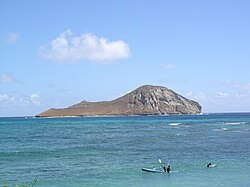
  • Mānana Island is a 63-acre (25 ha) offshore tuff cone known as Rabbit Island because of its resemblance to a large rabbit's head rising out of the sea and because it was once inhabited by introduced rabbits after a rancher released them there. The island is now a protected bird sanctuary and thereby illegal to land there unless you have permission from the Hawaii Department of Land Natural Resources.
  • Kāohikaipu – A low volcanic islet off Makapuʻu Beach Park; also a State Bird Sanctuary.
Makapuʻu Beach from Makapuʻu Point
  • Makapuʻu Beach Park and Kaupō Beach Park – All of the rocky shoreline and pocket beaches between the sea cliffs at Makapuʻu Point and the State Research Pier (Makai Pier) are beach parks open to the public. Wave conditions at Kaupō (western end) are more suited to young beach-goers and poor swimmers. Makapuʻu Beach is a popular body-surfing beach, but the shore break can be dangerous.
  • Makai Pier – A long, concrete pier built by the State of Hawaiʻi to support marine research efforts in the Hawaiian Islands. This pier houses several commercial marine engineering firms and HURL (Hawaiʻi Underwater Research Laboratory).
  • Ka Iwi State Scenic Shoreline - The coastal area that extends from Makapuʻu Point Wayside to Sandy's Beach. Included in this section is Pele's Chair rock formation and the beach/swimming spot that shares the same name.[3]

See also

[edit]

References

[edit]
Revisions and contributorsEdit on WikipediaRead on Wikipedia
from Grokipedia
Makapuʻu is the easternmost point of the island of Oʻahu in the U.S. state of Hawaiʻi, located within the Kaiwi State Scenic Shoreline and featuring a prominent ridge formed from the ancient Koʻolau . This area is renowned for its dramatic coastal landscapes, including steep cliffs, kiawe and cactus vegetation on dry slopes, and panoramic views of the southeastern Oʻahu coastline extending to , , and offshore islets. At the summit of Makapuʻu Point stands the historic Makapuʻu Lighthouse, a 46-foot-tall structure built in 1909 by the U.S. Lighthouse Establishment to guide maritime navigation following the 1906 grounding of the steamer Manchuria nearby. The lighthouse is distinguished by its Hyper-radial Fresnel lens—the largest of its kind in the United States, measuring 12 feet tall and 8 feet wide, hand-crafted in France in 1887 and originally intended for another site before installation via cliff scaling. Automated by the U.S. Coast Guard in 1974, it continues to operate as an active aid to navigation across the Kaiwi Channel, though the structure remains off-limits to visitors due to its cliffside location. The Makapuʻu Point Lighthouse Trail, a paved 2-mile round-trip path with a moderate 500-foot gain, is one of Oʻahu's most popular hikes, offering accessible views of the lighthouse, windward coast, and seasonal humpback whale migrations from to May. The trail, originally constructed for horses and mules to service the lighthouse, now features interpretive signs, guard-railed lookouts, and opportunities to spot native seabirds such as ʻiwa (frigatebirds) and white-tailed tropicbirds in nearby sanctuaries. Geologically, Makapuʻu exposes the interior of the Koʻolau , revealed by the massive Nuʻuanu approximately 2.1–1.8 million years ago, which removed about 40% of the volcano's volume. The cliffs display tholeiitic basalt flows, including olivine-rich oceanites, pāhoehoe, and ʻaʻā lavas, with evidence of a filled , providing critical insights into Hawaiian volcanic evolution and compositional variations from the shield stage. Adjacent to the point, Makapuʻu Beach Park offers a sandy shoreline backed by volcanic cliffs, popular for body and boarding on calm days despite its reputation for powerful shore breaks and unpredictable conditions. The area also holds cultural significance, including historical Hawaiian land reclamations in the 1980s, underscoring its role in broader narratives of Native Hawaiian heritage and .

Geography

Location and Topography

Makapuʻu serves as the easternmost point of Oʻahu in the , situated approximately 12 miles (19 km) east of along the southeastern coastline. Its geographic coordinates are approximately 21°18′36″N 157°38′59″W. Geologically, Makapuʻu is a remnant composed primarily of basaltic , rising 647 feet (197 m) above . It forms part of the ancient Koʻolau , with exposures revealing shield-stage lavas that accumulated through successive eruptions, including pāhoehoe and ʻaʻā flows, and evidence of thermal erosion from activity. The nearby Koko , associated with later rejuvenation-stage , has northernmost vents located offshore near Makapuʻu. The topography of Makapuʻu offers expansive overlooks, including Waimānalo Bay to the north, the Kaʻiwi Channel to the east—affording distant views of Molokaʻi and Lānaʻi islands on clear days—and the rugged southeastern coastline of Oʻahu. It is in close proximity to , located just minutes away along Kalanianaʻole Highway, and encompasses part of the Kaiwi State Scenic Shoreline, a protected coastal area featuring dramatic sea cliffs and azure waters.

Etymology

The name Makapuʻu in the literally translates to "bulging eye," composed of the words maka, meaning "eye," and puʻu, meaning "bulge," "hill," or "swelling." An alternative interpretation is "hill beginning," reflecting the of the point as the eastern terminus of the . This etymology is documented in authoritative Hawaiian lexicographical works, emphasizing the descriptive naming conventions common in indigenous place . (Note: This links to the publisher's page for Place Names of Hawaiʻi by Pukui, Elbert, and Mookini.) The name's origin is associated with a cave called Keanāokeakuaapōloli ("the of the hungry "), where a sacred image or deity representation featuring bulging eyes was reportedly housed, influencing the site's designation. Proper rendering of Makapuʻu includes the ʻokina (ʻ), a consonant essential to Hawaiian since its formalization in the early ; this diacritical mark prevents and distinguishes it from words like makapuu without the stop, thereby safeguarding linguistic accuracy and cultural integrity. The ʻokina's adoption, advocated by scholars like , underscores efforts to revive and standardize the amid historical suppression.

History

Pre-European Settlement

The Waimānalo , encompassing the coastal area around Makapuʻu, supported traditional Hawaiian settlements characterized by dispersed grass huts (hale) dotting the valley floor and adjacent lowlands, forming a densely populated community reliant on integrated and . Villages such as Mahaʻiluna were particularly heavily inhabited, with residents cultivating in extensive loʻi kalo (irrigated pond fields) fed by natural springs and streams, extending approximately two miles across the valley. Makapuʻu, as a prominent coastal , served as a key landmark for fishing activities, where communities established villages like Kaupō near Mānana Island and Kukui adjacent to aquaculture ponds such as Pāhonu, used for rearing green sea turtles (honu) primarily for consumption. Makapuʻu held spiritual significance as a site for fishing shrines, exemplified by the pohaku kuʻula (sacred fish-attracting stone) known as Malei, established according to oral traditions by ʻAiʻai, the son of the god Kūʻula-kai. This white, marble-like stone, set up at the beach below the headland, was dedicated to drawing and multiplying (parrotfish), particularly red and speckled varieties, while creating spawning grounds that extended westward to . Fishermen revered Malei as a female deity, offering sacrifices such as grass-twined bundles to ensure abundant catches, reflecting broader Hawaiian practices of invoking akuakuʻula ( gods) to sustain . In the context of interisland voyaging, Makapuʻu marked the eastern terminus of Oʻahu's windward coast, serving as a critical departure point for waʻa (canoes) navigating the treacherous Kaʻiwi Channel toward Molokaʻi, approximately 26 miles away. Ancient Hawaiians traversed this channel for trade, communication, resource gathering, and military expeditions, viewing control over such waterways as essential to authority over surrounding moana (ocean territories). The headland's visibility aided navigators in aligning with prevailing Kualani winds and swells, though the passage's reputation for violent seas demanded skilled based on celestial and oceanic cues.

European Contact and Lighthouse Era

The arrival of Europeans in the beginning with Captain in 1778 dramatically increased maritime traffic and trade, heightening the risks of shipwrecks along Oʻahu's southeastern coast, including at prominent Makapuʻu Point. By the late , this growing commerce during the era underscored the need for navigational aids, culminating in a formal proposal for a at Makapuʻu in 1888. The petition, signed by numerous sea captains and ship owners following the grounding of the bark S.N. Castle off the point, was presented to Hawaiian authorities to prevent further maritime disasters and support safe passage for vessels entering Harbor. Construction of the Makapuʻu Point Lighthouse was funded by a $60,000 congressional appropriation on June 10, 1906, shortly after the U.S. annexation of in 1898, with work commencing in the summer of 1907 under the oversight of the U.S. Board. The project was completed by 1908, and the lighthouse was first illuminated on October 1, 1909, marking a key development for transpacific shipping routes. The structure features a 46-foot (14 m) cylindrical concrete tower built on a foundation, situated at an that provides a focal height of 420 feet (130 m) above , leveraging the point's natural prominence for visibility up to 28 miles. Early operations relied on a manned crew of keepers who maintained an incandescent oil vapor lamp within a hyper-radial , producing a fixed white light with a characteristic flash pattern. The station was staffed by head keeper George Beazley from 1909 until 1922, among others, ensuring reliable service for incoming vessels. A tragic incident occurred on April 9, 1925, when an explosion from an ignited alcohol burner used to start the lamp critically injured first assistant keeper Alexander Toomey, who succumbed to his burns the following day; second assistant John Kaohimaunu also suffered injuries but survived. The light source transitioned to electric in 1927, enhancing reliability with a radiobeacon addition, though the station remained manned until full automation by the U.S. on January 4, 1974, when it switched to a 1,000-watt electric lamp.

20th-Century Developments

In 1977, the Makapuʻu Point Lighthouse was listed on the , recognizing its architectural and maritime significance as a key constructed in 1909. By the mid-1980s, the lighthouse faced challenges from its isolated location, including a notable vandalism incident in 1984 when a high-powered fired a bullet that pierced the hyper-radial lens, creating a hole that compromised but did not fully disable the irreplaceable optic. In response, the U.S. Coast Guard enhanced remote monitoring from following the station's automation in 1974, though physical security remained limited due to the site's remoteness. A significant administrative change occurred in 1987 when the declared approximately 40 acres surrounding the lighthouse, including the former keepers' dwellings, as surplus property and transferred it to the State of Hawaiʻi. In 1987, following the transfer, led by Dennis "Bumpy" occupied the vacant keepers' houses, asserting ancestral claims to the land, in a that lasted over a month. The state subsequently razed the keepers' houses following the occupation and protests. This transfer facilitated greater public access and preservation efforts, culminating in the late 20th century with Makapuʻu's integration into the Kaiwi State Scenic Shoreline park system, managed by the Hawaiʻi Department of Land and Natural Resources to protect the coastal landscape and historic features.

Cultural Significance

Hawaiian Legends and Mythology

In Hawaiian mythology, Makapuʻu is associated with a powerful , or supernatural being, depicted as a woman with eight bulging eyes who originated from Kahiki () and resided near the cave known as Keakuapōloli, meaning "the cave of the hungry god." This figure's distinctive feature—her protruding eyes—gave the point its name, which translates to "bulging eye," and she was both feared for her fearsome appearance and revered for her exceptional vision that allowed her to gaze toward her homeland across the . According to traditions recorded in the epic of Hiʻiaka, sister of the volcano goddess Pele, Makapuʻu encountered Hiʻiaka and her companion Wahineʻōmaʻo upon their arrival by canoe from Molokaʻi, offering them from the abundant while others fled in terror from her multi-eyed form. Today, lore holds that she remains as a rock formation near the cave, her eight eyes transformed into smaller black stones facing the ocean, symbolizing her eternal watch over the eastern shores. Another key mythological element at Makapuʻu involves the Malei Stone, a white, marble-like pohaku-ia (fish-attracting shrine) established by Aiai, son of the fishing god Ku-ula-kai, upon his arrival at the point. In the legend, Aiai, a renowned for his prowess in , set up the stone to draw and multiply , particularly red and speckled varieties like the (parrotfish), ensuring bountiful catches for the local people. This shrine embodied the spiritual practices of ancient Hawaiian fishers, who would offer prayers and offerings to honor the stone's mana (spiritual power) before venturing into the waters. Collectively, these legends position Makapuʻu as a spiritual guardian of the eastern Oʻahu coast, where the kupua's vigilant gaze and the Malei Stone's influence intertwined to protect and provide for the marine realm, embedding the site deeply in fishing lore as a place of supernatural abundance and oversight.

Modern Hawaiian Activism

The modern Hawaiian sovereignty movement, emerging as a political extension of the Hawaiian Renaissance in the late 1970s, sought to address the systemic land dispossession of Native Hawaiians following the illegal overthrow of the Kingdom of Hawaiʻi in 1893 and its subsequent annexation by the United States in 1898. This era of cultural revitalization, marked by protests against urban development and loss of traditional lands, framed sites like Makapuʻu as potent symbols of ancestral rights and colonial erasure, where Native families had historically maintained connections to the ʻāina (land) through fishing, gathering, and spiritual practices. Activism at Makapuʻu underscored broader demands for self-determination, including the restoration of ceded lands and protection from federal surplus declarations that prioritized non-Native interests. In June 1987, Puʻuhonua Dennis "Bumpy" Kanahele led a group of , including his extended family, in occupying two surplus U.S. houses at Makapuʻu Point, reclaiming what they asserted were ancestral lands tied to Queen Kalama's lineage. The activists filed traditional deeds (kuleana claims) to assert ownership and protested the federal declaration of the properties as surplus land available for public auction, arguing it violated Native rights under and the unratified 1898 Treaty of Annexation. The mostly peaceful occupation, which included women and children and prohibited weapons, lasted several weeks before federal authorities intervened, resulting in arrests including Kanahele's. This action built on the prior transfer of nearby to state control, amplifying calls for equitable Native access. The Makapuʻu occupation galvanized public attention to the Native Hawaiian , where over 50% of kanaka maoli (Native people) faced homelessness or substandard living due to land alienation, and elevated demands for cultural site protections amid threats from development. It contributed to Kanahele's founding of the Nation of Hawaiʻi in 1994, which advanced non-violent models focused on community homesteading and land stewardship. Legal challenges from the event, including defenses by attorney Hayden Aluli, highlighted injustices in federal land management and spurred broader policy discussions on Native self-governance, though the houses were ultimately demolished without restitution.

Attractions

Makapuʻu Point Lighthouse

The Makapuʻu Point , constructed in , features a hyperradiant that stands 12 feet (3.7 m) tall and measures 8 feet wide, making it the largest lens ever installed in a lighthouse. This massive lens, composed of over 1,000 hand-crafted prisms manufactured in , amplifies a light source to produce an intensity of 115,000 , visible for up to 19 nautical miles and serving as a critical for vessels approaching Harbor from the east. Its fixed white —7.5 seconds on and 1.5 seconds off—guides maritime traffic through the challenging Kaiwi Channel. The lighthouse's lighting system has evolved significantly since its inception to enhance reliability and efficiency. Initially powered by an incandescent oil vapor lamp with three 55 mm mantles, the setup was upgraded in 1927 to a 500-watt incandescent electric bulb following the installation of a generating station to support a radiobeacon. The focal plane, positioned at 420 feet (128 m) above sea level. Automation in 1974 eliminated the need for on-site keepers, with remote monitoring from Honolulu ensuring continuous operation. Architecturally, the 46-foot (14 m) cylindrical tower is constructed of , topped by an iron lantern room that houses the oversized lens, which occupies more than a quarter of the interior space. This design exemplifies early 20th-century Board , prioritizing durability against Hawaii's harsh coastal environment while minimizing height to reduce wind exposure at the elevated site. The structure's rarity stems from its unique hyperradiant lens installation, the only one of its kind in the U.S., contributing to its listing on the in 1977 for its and maritime significance. Today, the lighthouse remains an active aid to navigation under the ownership and maintenance of the U.S. Coast Guard's Aids to Navigation Team (ANT) , though the tower is inaccessible to the public for safety and operational reasons. Its enduring role underscores the importance of advanced optical technology in safeguarding Pacific shipping routes.

Hiking Trails and Beach Park

The Makapuʻu Point Lighthouse Trail is a popular 2-mile (3.2 km) round-trip paved path offering a moderate out-and-back hike with an elevation gain of approximately 500 feet (150 m), typically taking 1 to 2 hours to complete. The trail, designed for broad accessibility including strollers and mobility aids due to its fully paved surface, ascends steadily through a series of switchbacks along dramatic sea cliffs, providing panoramic views of Oʻahu's southeastern coastline. Key features enhance the experience for hikers of varying abilities, including interpretive signs detailing and , periodic benches for resting, and a viewing scope at the summit overlook. The culminates at a overlooking the historic Makapuʻu Point , though the structure itself is not open to the public. For those seeking further adventure, an optional side path known as the Makapuʻu Tide Pools branches off near the trail's midpoint, involving a steep 370-foot (113 m) rocky descent to explore vibrant intertidal pools teeming with . Note that this is an unofficial, unmaintained with high risk of or due to loose , slippery conditions, and waves; several fatalities have occurred. This extension requires extreme caution, adding significant difficulty to the overall outing. Adjacent to the trailhead, Makapuʻu Beach Park features a picturesque white-sand beach backed by towering sea cliffs, with approximately 500 feet (150 m) of shoreline. The park is a favored spot for and , drawn by consistent waves and a powerful shore break, while calmer areas support picnicking with provided tables, restrooms, showers, and lifeguard services. Visitors should exercise caution, as strong currents and sudden wave surges pose risks, particularly for inexperienced swimmers. From late through May, the beach and nearby cliffs serve as excellent vantage points for seasonal watching.

Ecology

Terrestrial and Marine Habitats

The terrestrial habitats of Makapuʻu consist primarily of dry coastal , characterized by low-growing vegetation adapted to strong winds, salt spray, and arid conditions on and substrates. Native plants such as naupaka (Scaevola taccada), a salt-tolerant shrub common in nearshore areas, and ʻāweoweo (Chenopodium oahuense), an endemic species found in backshore environments, dominate these zones and contribute to . This forms part of the Kaiwi State Scenic Shoreline, which helps protect against by maintaining vegetative cover along the rugged headlands. Geologically, the area features volcanic cliffs formed from ancient lava flows of the Koko Rift zone, rising up to 500 feet and prone to natural fracturing and due to wave undercutting and seismic activity. These dynamic processes contribute to , isolating plant communities and limiting inland connectivity for native flora, as observed in surveys of the Makapuʻu headlands. Rockfall mitigation efforts, including ongoing stabilization, address these hazards while preserving the natural escarpment. Marine habitats surrounding Makapuʻu include intertidal tide pools along the low rock shelves, which harbor diverse such as crabs, shrimp, mollusks, and echinoderms within algae-covered basins and coral patches like Porites lobata. These pools, accessible via informal trails from the main path, serve as nurseries for juvenile reef species amid fluctuating tides. The adjacent waters form part of the Kaʻiwi Channel, known for its coral reefs and strong currents driven by and channel dynamics, which influence nutrient flow and habitat distribution. Conservation efforts for these habitats gained momentum in the late 20th century through the establishment of the Kaiwi State Scenic Shoreline in the 1990s, evolving into full state park status. In 2023, through Act 235, approximately 340 acres were designated as Kaiwi Coast State Park to further safeguard against urban development and invasive species encroachment. The park's management, under the Hawaii Department of Land and Natural Resources, emphasizes restoration of native vegetation, invasive plant removal, and erosion control to maintain ecological integrity across its approximately 340 acres.

Wildlife Viewing

Makapuʻu offers prime opportunities for observing marine mammals, particularly during seasonal migrations. Humpback whales (Megaptera novaeangliae) migrate to Hawaiian waters from November to May, making the area one of Oʻahu's top shore-based viewing sites along the Kaiwi Channel, with sightings often visible from elevated trails overlooking the ocean. Spinner dolphins (Stenella longirostris) occasionally appear in nearshore waters, adding to the dynamic marine sightings. Seabird diversity is a highlight, with several native species frequenting the skies and nearby offshore islets like Mānana and Kaohikaipu, where nesting colonies thrive. The wedge-tailed shearwater (Ardenna pacifica) is commonly observed during its seasonal presence, soaring over the channel. Red-footed boobies (Sula sula) and sooty terns (Onychoprion fuscatus) nest in large numbers on these islets, with individuals often visible flying near the point. The endangered Hawaiian nēnē (Branta sandvicensis), Oʻahu's state bird, has been sighted along the coastal trails, though it is less common in this lowland area compared to higher elevations. Additional species enhance birdwatching, including white-tailed and red-tailed tropicbirds (Phaethon lepturus and Phaethon rubricauda) gliding gracefully overhead, and great frigatebirds (Fregata minor) utilizing updrafts from the cliffs for soaring displays. In the intertidal zone, visitors can spot crabs such as hermit crabs (Calcinus spp.) and rock crabs (Grapsus tenuicrustatus) scuttling among tide pools accessible near the trail's base. The lighthouse trail serves as a key birdwatching hotspot, where lookouts provide unobstructed views of these species in flight. Optimal viewing relies on preparation and timing aligned with natural cycles. are essential for distant marine and avian observations, while early morning hikes during whale season minimize wind interference and maximize visibility of migrations. These activities contribute to , promoting conservation awareness through guided or self-directed encounters that highlight the region's . is also possible from the adjacent beach park, complementing trail-based observations.

References

Add your contribution
Related Hubs
User Avatar
No comments yet.