Hubbry Logo
Marbled godwitMarbled godwitMain
Open search
Marbled godwit
Community hub
Marbled godwit
logo
8 pages, 0 posts
0 subscribers
Be the first to start a discussion here.
Marbled godwit
Marbled godwit
from Wikipedia

Marbled godwit
Scientific classification Edit this classification
Kingdom: Animalia
Phylum: Chordata
Class: Aves
Order: Charadriiformes
Family: Scolopacidae
Genus: Limosa
Species:
L. fedoa
Binomial name
Limosa fedoa
Range of L. fedoa
  Breeding Range
  Non-breeding Range
Synonyms
  • Scolopax fedoa Linnaeus, 1758

The marbled godwit (Limosa fedoa) is a large migratory shorebird in the family Scolopacidae. On average, it is the largest of the four species of godwit.

Taxonomy

[edit]

In 1750 the English naturalist George Edwards included an illustration and a description of the marbled godwit in the third volume of his A Natural History of Uncommon Birds. He used the English name "The Greater American Godwit". Edwards based his hand-coloured etching on a preserved specimen that had been brought to London from the Hudson Bay area of Canada by James Isham.[2] When in 1758 the Swedish naturalist Carl Linnaeus updated his Systema Naturae for the tenth edition, he placed the marbled godwit with godwits and ibises in the genus Scolopax. Linnaeus included a brief description, coined the binomial name Scolopax fedoa and cited Edwards' work.[3] The marbled godwit is now placed in the genus Limosa that was introduced in 1760 by the French zoologist Mathurin Jacques Brisson.[4][5] The genus name Limosa is from Latin and means "muddy", from limus, "mud". The specific epithet fedoa may be an Old English name for a godwit.[6] The word was mentioned by the English naturalist William Turner in 1544.[7][8]

Two subspecies are recognised:[5]

  • L. f. beringiae Gibson & Kessel, 1989 – breeds in Alaska and winters in the west United States. Averages shorter legs and bill than nominate subspecies.
  • L. f. fedoa (Linnaeus, 1758) – breeds in central, south-central Canada, and the north-central United States, winters in southern United States to northwest South America. A disjunct breeding population breeds in James Bay.

Description

[edit]

The total length is 40–50 cm (16–20 in), including a large bill of 8–13 cm (3.1–5.1 in), and wingspan is 70–88 cm (28–35 in).[9] Body mass can vary from 240 to 520 g (8.5 to 18.3 oz). The average weight of 40 males was 326 g (11.5 oz) and that of 45 females was 391 g (13.8 oz). Bill length is from 73.9 to 131 mm (2.91 to 5.16 in). Among all the members of the sandpiper family, only the curlews attain sizes that significantly exceed this species.[10][11]

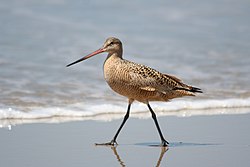
Adults have long blue-grey legs and a very long pink bill with a slight upward curve and dark at the tip. The long neck, breast and belly are pale brown with dark bars on the breast and flanks. The back is mottled and dark. They show cinnamon wing linings in flight.

Distribution and habitat

[edit]

Marbled godwits breed in three distinct areas with their own unique route. The vast majority occur in mid-continental North America, followed by eastern Canada and the Alaska Peninsula, USA. In addition, the largest winter ranges are the Atlantic, Pacific and Gulf coasts of the US and Mexico.[12]

Godwits breeding in the western USA and Canada follow a route through the Utah stopover site, with a final arrival in the winter sites of Mexico and the Caribbean. Species breeding in eastern Canada migrate across the US, and stopover at sites along the Gulf of California and Mexico. Furthermore, those breeding in North and South Dakota winter in coastal Georgia.[12] The Bear River Migratory Bird Refuge located at Great Salt Lake in Utah (USA), is one of the most popular stopover sites for godwits in the spring and fall.

Behavior and ecology

[edit]

Breeding

[edit]

They nest on the ground, usually in short grass.

Food and feeding

[edit]

These birds forage by probing on mudflats, in marshes, or at the beach (see picture below). When the tide is out, they eat. In short grass, they may pick up insects by sight. They mainly eat insects and crustaceans, but also eat parts of aquatic plants.

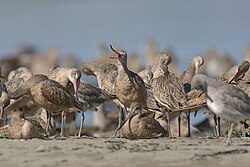
When the tide is in, they roost. They often sleep by standing on one leg and tucking their bill into their body (see picture below).[13]

Conservation

[edit]

Their numbers were reduced by hunting at the end of the 19th century. Although they have recovered somewhat since that time, their population has declined in recent times[when?] as suitable habitat is used for farming.

[edit]

References

[edit]
[edit]
Revisions and contributorsEdit on WikipediaRead on Wikipedia
from Grokipedia
The Marbled godwit (Limosa fedoa) is a large shorebird, measuring about 18 inches (46 cm) in length, with a long, slightly upturned, two-toned bill that is pink at the base and dark-tipped, long pinkish legs, and plumage that is richly buff-brown overall, intricately marbled with darker brown barring and a distinctive cinnamon wash on the underparts and wings, which becomes especially prominent in flight. This species breeds primarily in the shortgrass prairies and wetlands of the northern Great Plains of North America, with smaller populations in the tundra of southwest James Bay, Ontario, and the Alaska Peninsula, where it nests in shallow ground depressions lined with grasses and lichen. During the non-breeding season, Marbled godwits migrate to coastal habitats including mudflats, estuaries, sandy beaches, and shallow marshes along the Pacific, Gulf, and Atlantic coasts from to , though most winter north of , with some reaching . They travel in flocks and exhibit site fidelity, often returning to the same breeding and wintering areas annually, sometimes with the same mate, covering long distances that can span thousands of miles, with Alaskan breeders undertaking particularly epic journeys. primarily on aquatic such as , mollusks, crustaceans, earthworms, and leeches, as well as small and plant tubers—especially during migration—they probe deeply into mud or shallow water (up to 5 inches deep) with their bill or pick prey from the surface, often feeding day or night in groups. Breeding pairs are monogamous for the season and arrive on territories in spring, where males perform elaborate aerial displays up to 300 feet high to attract females; they lay 3–5 eggs (typically 4) of pale buff or greenish-olive color spotted with brown, which both parents incubate for 21–26 days, after which precocial chicks leave the nest within a day and in about 3 weeks, fed by both adults. The global population is estimated at approximately 270,000 mature individuals (as of 2023), considered stable from 1966 to 2015 according to the North American Breeding Survey but now showing declines, with an estimated 20–49% reduction over the past three generations. It faces threats from habitat loss due to agricultural conversion of prairies and degradation of coastal wetlands, as well as historical market in the that reduced numbers before partial recovery. Listed as a of Conservation Concern by the U.S. and Wildlife Service and on the Partners in Flight Yellow Watch List with a Continental Concern Score of 14 out of 20, the is rated Vulnerable by the IUCN (2024) and requires ongoing protection of breeding and stopover habitats to counter declines driven by changes. The oldest recorded Marbled godwit lived at least 15 years and 7 months.

Taxonomy and nomenclature

Classification history

The marbled godwit was first described and illustrated by English naturalist George Edwards in 1750 as the "Greater American " in his work Gleanings of Natural History, based on a specimen from . In 1758, provided the first formal for the species as Scolopax fedoa in the 10th edition of , drawing directly from Edwards' description and illustration of the "Greater American ." The species was subsequently reclassified into the Limosa by Friedrich Gmelin in the 13th edition of in 1789, establishing the current accepted scientific name Limosa fedoa. This placement recognizes the marbled godwit as a member of the family Scolopacidae (sandpipers and allies) within the order . Among the four recognized species in the Limosa, the marbled godwit is the largest on average.

Subspecies

The marbled godwit (Limosa fedoa) is divided into two based on morphological and geographic distinctions. The nominal subspecies, L. f. fedoa, breeds across regions of central , including areas in , , , , , , and , as well as isolated populations in southwestern , . This is characterized by larger overall size, with average measurements including tarsus length of 70.5 mm, wing length of 229.2 mm, and culmen length of 97.1 mm. The subspecies L. f. beringiae is restricted to breeding grounds in western , primarily along the from Ugashik Bay southward to potentially Port Heiden. It is smaller and more compact than L. f. fedoa, exhibiting shorter tarsi (average 62.0 mm), shorter wings (average 216.8 mm), shorter culmen (average 88.5 mm), and greater body mass relative to linear dimensions. patterns are broadly similar between the subspecies, with both displaying the characteristic marbled buff and tones during breeding. The recognition of L. f. beringiae as a distinct was established through morphological analyses demonstrating significant differences (P < 0.001) in skeletal and external measurements, attributed to long-term geographic isolation dating to the Pleistocene era in the region. This split, proposed by Gibson and Kessel in , has been upheld in subsequent ornithological accounts, including Gratto-Trevor (), which confirms the subspecies based on breeding distribution and morphometric data. No substantial genetic studies differentiating the subspecies have been widely documented as of 2020, with divergence primarily supported by morphological evidence. Breeding ranges of the two show no overlap, with L. f. fedoa in interior prairies and L. f. beringiae confined to coastal . During migration and winter, limited overlap occurs along the , where both subspecies have been recorded.

Physical description

Morphology

The marbled (Limosa fedoa) is the largest among the four godwits, characterized by a robust body structure adapted for long-distance migration and wading in shallow waters. Adults measure 40–50 cm in total length, with a ranging from 70–81 cm that supports strong, sustained flight facilitated by pointed wings. The exhibits moderate , with females averaging slightly larger than males in overall size, bill length, tarsus length, and wing chord. Key anatomical features include a long, slightly upturned bill measuring 8–13 cm, ideally suited for probing soft substrates, and a tarsus length of 6–8 cm that contributes to the bird's elevated stance. The legs are long and blue-grey, enabling efficient wading in mudflats and marshes. Body mass varies seasonally and by sex, ranging from 285–454 g overall, with females averaging larger than males, reflecting adaptations to migratory demands and reproductive energy needs.

Plumage and vocalizations

The marbled godwit exhibits distinct seasonal and age-related variations in its , which contribute to its identification and adaptation to environments. In breeding , adults display a rich -buff coloration overall, with dark barring on the wings and tail, and mottled patterns of and dark streaks on the underparts. Upperparts are barred in brown, white, and , while the extensive tones on the underwings become prominent during flight. During the non-breeding season, the plumage becomes duller and more subdued, featuring grayish-brown upperparts with lighter and less distinct barring, and paler underparts showing reduced cinnamon hues. This paler overall tone aids in blending with wintering mudflat and coastal habitats. Juveniles resemble non-breeding adults but possess fresher feathers, with buffy edges on the upperparts creating a scaled appearance and light streaking in cinnamon and brown on the underparts. The mottled brown and buff patterns in all plumages provide effective camouflage against prairie grasslands and mudflats, concealing the birds from predators during nesting and foraging. Vocalizations play a key role in communication for the marbled , particularly in territorial and social contexts. The call consists of a sharp, repeated "rad-i-ca" given by both sexes to signal threats. The characteristic flight call is a hoarse, repeated "ger-whit" or "god-wit," often uttered during migration or . displays involve males performing aerial chases and figure-eight flights while emitting loud, noisy calls to attract females.

Range and habitat

Breeding distribution

The Marbled godwit (Limosa fedoa) primarily breeds in the Prairie Pothole Region, a characterized by numerous shallow wetlands interspersed with grasslands, spanning southern and the northern United States. Core breeding areas include the provinces of , , and in Canada, as well as the states of , , and in the U.S., where the species occupies a significant portion of its continental population. Secondary breeding populations are more localized and disjunct from the primary range. The subspecies L. f. beringiae nests in , particularly along the , supporting an estimated 2,000–3,000 individuals. In , scattered breeding occurs around , including sites in , Québec, and , though these populations remain small and isolated. Within these regions, Marbled godwits select habitats consisting of shortgrass prairies adjacent to shallow, unvegetated , which provide opportunities and nesting cover while avoiding areas dominated by tall that could hinder visibility or access. In optimal conditions, such as those with wetland coverage exceeding 5%, nesting densities can reach 7.2–7.4 pairs per square kilometer, or roughly one pair per 10–14 hectares. Historically, the breeding range extended farther south into and and eastward to , encompassing a broader expanse of native prairies. However, agricultural conversion of these grasslands to cropland has led to significant and loss, resulting in a contraction of the overall breeding extent and more restricted distribution today.

Non-breeding distribution and migration

The marbled godwit (Limosa fedoa) winters primarily along the Pacific, Gulf, and Atlantic coastal regions of , with the majority of individuals concentrated in central and , the Gulf Coast from to , the southeast Atlantic coast, and to southern . Some birds extend their range into , though vagrants occasionally reach north of . Migration from breeding grounds in the northern and regions occurs southward from late August to October, with birds arriving at wintering sites between September and November. Northward migration takes place from to May, with departures from wintering areas typically between late and early May and peaks in April. Birds from interior breeding populations often undertake long-distance flights across the to reach Gulf Coast wintering sites, while western populations follow coastal or interior routes along the Pacific. Key stopover sites include the Bear River Migratory Bird Refuge in , which hosts large numbers of southbound and northbound migrants, as well as coastal estuaries such as those in (e.g., ) and (e.g., Morro Bay and ). These sites provide critical resting and refueling opportunities during the journey. Subspecies exhibit distinct migratory patterns: the nominate subspecies L. f. fedoa, breeding in the mid-continent prairies, migrates to both Pacific and Gulf Coast wintering areas, while L. f. beringiae from the primarily follows Pacific routes to winter along the coasts of Washington, , and . During migration, marbled godwits engage in direct, strong flights averaging 50–60 km/h, often traveling in loose flocks that facilitate navigation over varied terrains.

Habitat preferences

The marbled godwit primarily breeds in native shortgrass prairies interspersed with complexes, such as those in the Prairie Pothole Region of the northern . These habitats feature shallow , including ephemeral, temporary, and seasonal potholes with water depths typically less than 10 cm, which provide safe nesting conditions by limiting access for some predators while allowing access. Nesting occurs on the ground in areas of short, sparse vegetation, with pairs selecting sites where grass height is under 15 cm to facilitate predator detection in open landscapes. During the non-breeding season, marbled godwits shift to coastal environments, favoring tidal mudflats, salt marshes, and other coastal wetlands where they in shallow waters up to belly-deep. These birds roost on dry ground in salt meadows or in shallow water above the flats during high to avoid submersion. The shows a strong preference for open, unobstructed areas across both seasons, avoiding habitats with vegetation exceeding 30 cm in height, which could hinder visibility and increase predation risk. Habitat suitability is heavily influenced by , particularly in breeding areas where wetter conditions in potholes support the necessary shallow-water ; droughts reduce availability and hydroperiods, potentially leading to significant loss. Projections indicate that under scenarios with rising temperatures and minimal increases, marbled godwit breeding in the Prairie Pothole Region could decline by up to 57% by mid-century due to drier conditions. The (Limosa fedoa beringiae) differs in its breeding preferences, utilizing edges of tussock , moist meadows dominated by graminoids and dwarf shrubs, and rare dwarf shrub-willow habitats along the .

Behavior and ecology

Breeding biology

The marbled godwit exhibits a monogamous breeding system, with pairs typically forming long-term bonds that often reunite in subsequent seasons, though they separate outside the breeding period. Recent studies indicate high annual adult survival rates of approximately 90-95% and mate fidelity with about 85% of pairs reuniting, contributing to population stability in habitats. begins upon arrival at breeding grounds and involves elaborate aerial displays, where males ascend to heights of up to 300 feet (90 meters), circle the territory with slow wingbeats, and emit loud calls to attract females; ground-based behaviors include chases between potential mates and ritualized nest-scraping ceremonies performed by both sexes. Vocalizations, such as the distinctive "ger-whit" and "cor-ack" calls, play a key role in these displays to signal territory and mate availability. Nesting sites are selected in expansive shortgrass prairies or wet meadows, often more than 200 meters from water, in areas with sparse vegetation cover (less than 35 cm tall and under 40% dead plant material) to facilitate detection of predators. The male initiates several shallow ground scrapes, which the female inspects and modifies into the final nest by lining it with bits of grass, lichens, or other vegetation; these nests are simple depressions, typically 10-15 cm in diameter. Females lay a clutch of 4 eggs (range 3-5), with laying occurring from mid-April to early June in southern populations and slightly later northward, at intervals of about 1-2 days per egg; one brood is produced per season, though renesting may occur if the first attempt fails. Both parents share incubation duties, which last 22-24 days, with the female often handling daytime shifts and the male nighttime; the incubating bird remains motionless even when approached closely to avoid detection. Upon hatching, the precocial chicks are covered in down, have open eyes, and are mobile, departing the nest within 24 hours to follow their parents while independently. Fledging occurs at 25-30 days post-hatching, though full may take longer; persists for up to 40 days, with both adults initially brooding and defending the brood, but the female typically abandons the family after 15-26 days, leaving the male to provide remaining protection. Breeding success is heavily impacted by predation from mammals and as well as adverse weather events like heavy rains or droughts that nests or hinder chick . Among subspecies, the population (Limosa f. beringiae) initiates breeding earlier, often in late April, compared to mid-May starts in populations, reflecting adaptations to local and availability.

Foraging and diet

The marbled godwit forages primarily by probing soft substrates such as , , or prairie soils with its long, slightly upturned bill, often while walking or running through shallow water up to belly depth. This technique allows it to detect and extract buried prey by touch, as the bill's sensory capabilities enable localization of without visual cues; it may also glean from the water surface, ground, or , or occasionally catch small in shallow areas. Feeding activity peaks during low tide on coastal flats, where birds follow receding waters to access exposed foraging grounds, and can occur day or night. During the breeding season on prairie wetlands and grasslands, the marbled godwit's diet shifts to terrestrial and freshwater prey, consisting mainly of such as beetles, flies, and grasshoppers, along with earthworms extracted from moist soils; small amounts of plant matter, including roots and seeds from sedges or pondweeds, may supplement this. In non-breeding periods on coastal mudflats, estuaries, and beaches, it consumes , including worms, small bivalve mollusks, crustaceans like crabs, and earthworms, with occasional small or plant tubers during migration. The requires substantial daily intake to support its long migrations, with observed feeding rates averaging around 53 prey items per minute in optimal conditions, though failure rates can reach 11 attempts per minute; overall, devote a significant portion of their time—up to 61% during fall—to . Key adaptations include the bill's tactile sensitivity for detecting hidden prey and its upturned shape, which facilitates deep probing and extraction from dense substrates, while long legs enable wading in varying water depths.

Social and migratory behavior

The marbled godwit exhibits distinct seasonal shifts in , transitioning from relatively solitary or small groups during the post-breeding period to highly gregarious on migration and wintering grounds. Post-breeding, individuals or small units remain loosely associated in low-density areas before joining larger aggregations as they move southward. During non-breeding seasons, flocks commonly number in the hundreds to thousands, particularly at key staging sites in southern , northeastern , and central , where counts can reach 500–1,600 birds accounting for turnover. This gregariousness peaks in wintering areas such as southern and western , where large flocks form in coastal wetlands and mudflats, enhancing site fidelity and social cohesion among individuals returning to the same locations annually. Roosting behavior in non-breeding flocks is communal and adapted for , with birds often standing on one leg while tucking the bill under the scapulars during rest periods, a posture that minimizes loss in exposed coastal environments. These roosts occur at high on elevated structures like scrublands, salt ponds, docks, jetties, rooftops, or shallow waters, where flocks gather to avoid disruptions; for instance, marked individuals show strong to specific roost sites in areas like and . Aggression remains rare outside breeding contexts, though mild territorial displays may occur when individuals defend personal space within dense roosting or groups, promoting overall tolerance in mixed aggregations. Migratory flocks of marbled godwits typically travel in loose, extended lines with irregular fronts that undulate and periodically break as birds advance, facilitating coordinated movement without rigid formations. These flocks flush collectively in response to predators, circling in the air before resettling, a observed during both northbound and southbound migrations peaking in –May and , respectively. relies on visual cues such as landmarks, with flocks exhibiting direct, swift flight patterns along mid-continental routes from breeding grounds to coastal wintering sites in the U.S., , and occasionally . In late summer staging areas, such as southern potholes, flocks of dozens to hundreds use open habitats to reduce predation risk from raptors like marsh hawks, underscoring the adaptive value of during migration. Social interactions within and between species emphasize tolerance, as marbled godwits frequently associate with other shorebirds like whimbrels (Numenius phaeopus) and long-billed curlews (Numenius americanus) in mixed flocks along coastlines during migration and winter. Nasal calls, such as "ah, ha" or "ahk," serve to signal low aggression when joining groups, minimizing conflicts in shared habitats. While intraspecific aggression is infrequent, these vocalizations and loose associations allow for efficient resource sharing in dynamic environments like estuaries and mudflats.

Conservation

The marbled godwit experienced severe population declines in the late 19th and early 20th centuries due to intensive market hunting, which drastically reduced numbers from historically abundant levels across its breeding range. By the early 1900s, breeding populations had been extirpated from parts of the , including , , and , with overall numbers recovering slowly after hunting regulations were enacted. Estimates suggest a partial rebound to approximately 140,000–200,000 individuals by the early 2000s, though not to pre-hunting abundances. Current global population estimates stand at around 270,000 mature individuals, based on 2023 assessments. The is structured into two main subpopulations: a larger mid-continental group and a smaller, isolated one in (1,000–3,000 birds). In 2024, the uplisted the marbled godwit to Vulnerable status, citing an ongoing decline driven by rapid reductions observed in monitoring data. Recent trends indicate a concerning 17% decline in mature individuals over the 1994–2021 period, with steeper losses in non-breeding areas holding the bulk of the population. Winter counts along the show significant annual decreases, including -5.8% per year in and -19.7% per year in the from 2011–2019. While populations appear stable in core breeding regions, the Alaskan subpopulation's trend remains uncertain due to limited data. Adult survival rates are relatively high at 0.92–0.95 annually, as documented in a long-term study of breeders. Population monitoring relies on programs such as the North American Breeding Bird Survey for breeding trends and Christmas Bird Counts for wintering aggregations, both of which provide reliable indices for detecting changes. These efforts, combined with transect surveys in key non-breeding sites, underpin the 2024 IUCN assessment of continued decline.

Threats

The primary threat to the marbled godwit stems from habitat loss and degradation, particularly the conversion of native prairies to agriculture in the Prairie Pothole Region, where grasslands have declined by approximately 79 percent since the early 1800s. Wetland drainage and consolidation in this region have further reduced available breeding and foraging areas, as marbled godwits rely on prairie-wetland complexes for nesting and chick-rearing. These changes fragment habitats, isolating populations and limiting access to essential resources. Climate change exacerbates habitat pressures through increased droughts that diminish water levels in prairie potholes, reducing availability for breeding. In , models project that the species could lose more than half of its current breeding distribution by 2050 due to these shifts, with no offsetting gains in suitable areas. Additional risks include at coastal stopover sites, where oil spills can contaminate foraging areas and directly affect birds during migration and wintering. disturbance from also disrupts nesting and roosting, particularly in staging habitats. Historically, unregulated market hunting in the 19th and early 20th centuries severely depleted populations, though hunting has been closed since the 1916 Migratory Bird Treaty. Predation rates have risen due to , allowing greater access for mammalian predators such as red foxes, , and raccoons to ground nests in developed or altered landscapes. Avian predators, including and common ravens, further threaten eggs and chicks in open habitats. Emerging concerns involve wind energy development in breeding and migration corridors, where turbines may create barriers or increase collision risks, though current studies suggest limited immediate impacts on occupancy.

Conservation measures

The Marbled Godwit is listed as Vulnerable on the due to ongoing population declines, with an estimated 20-49% reduction over three generations from 1994 to 2021. In the United States, it receives federal protection under the Migratory Bird Treaty Act of 1918, which prohibits the take, including killing or capture, of migratory birds without authorization. Internationally, the species is included in Appendix II of the Convention on Migratory Species, promoting cooperative conservation across 132 parties. Habitat initiatives emphasize wetland restoration and grassland protection in breeding areas, particularly through the Prairie Pothole , which targets large contiguous landscapes in the northern to support shorebird nesting. Conservation easements in the U.S. and , such as those under the U.S. and Wildlife Service Partners for and Wildlife Program and Canada's Green Cover program, have protected millions of acres of prairie habitat by 2025, including over 3 million acres under the Prairie Habitat Joint Venture's implementation plan. Monitoring and research efforts include annual surveys via the North American Breeding Bird Survey and Christmas Bird Count, coordinated by the U.S. Geological Survey and to track population trends and habitat use. Satellite tagging studies, initiated in the mid-2000s and expanded by the USGS Science Center, have revealed migratory connectivity and stopover sites since 2015, informing targeted protections. The Western Hemisphere Shorebird Reserve Network designates key sites like Bear River Migratory Bird Refuge as hemispheric reserves, supporting international coordination for staging and wintering habitats across the U.S., , and . These efforts have stabilized local populations at sites such as , where numbers have increased since the 1960s, but global declines persist due to insufficient large-scale protection. Expanded in the Prairie Pothole Region remains a priority to address these gaps.

References

Add your contribution
Related Hubs
User Avatar
No comments yet.