Hubbry Logo
MarjahMarjahMain
Open search
Marjah
Community hub
Marjah
logo
8 pages, 0 posts
0 subscribers
Be the first to start a discussion here.
Marjah
Marjah
from Wikipedia

Marjah (also spelled Marjeh; Pashto/Persian: مارجه) is an agricultural town in southern Afghanistan. It has been reported to have a population between 80,000 and 125,000, but some sources argue that its population is much smaller and is spread across 80 to 125 km2, an area larger than Cleveland or Washington, D.C.[4] Another source described Marjah as "a cluster of villages" and "a community of 60,000 persons".[5] The town sits in Nad Ali District of Helmand Province, southwest of the provincial capital Lashkar Gah.

Key Information

Operation Moshtarak (or the Battle of Marjah) took place in the area.

Population and economy

[edit]

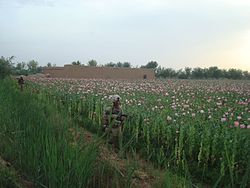
Marjah is geographically situated in one of Afghanistan's major belts of poppy fields,[6] which are a source of funds for the Taliban.[7] According to one figure, 10% of global illicit opium production in the year 2000 originated from the Marjah/Nad-i-Ali area.[8] During the 1950s and 1960s the United States funded a scheme, run by the Helmand and Arghandab Valley Authority, to irrigate the fields around Marjah (Lashkar Gah/Helmand was nicknamed "Little America"), with many canals remaining to this day.[1][7]

In conjunction with this American-led development, which included building and staffing a number of local schools, the Afghan government jump-started a program in 1959 to resettle Pashtun nomads to the area, providing them each with "almost 15 acres of land, two oxen and free seeds", with a focus on growing wheat.[9]

Climate

[edit]

Data collected in the 1950s in the Marjah/Chah-i-Anjirs area showed an average rainfall of over one inch per month from December through March, peaking in January at 2.46 inches. The rest of the year experienced little or no precipitation, and besides January, there was actually a consistent net loss of water through evaporation. June, July, and August experienced average high temperatures of over 100 °F (38 °C), while the average lows in winter bottomed out at just above freezing in December and January.[10]

See also

[edit]

References

[edit]

Further reading

[edit]
Revisions and contributorsEdit on WikipediaRead on Wikipedia
from Grokipedia
Marjah is a rural district in , southern , encompassing fertile farmland irrigated by canals and historically serving as a major hub for opium poppy cultivation that supplied a significant portion of global production. For years prior to 2010, the area functioned as the last major stronghold in the central Valley, enabling insurgent financing through narcotics and imposing oppressive control over local residents. In February 2010, Marjah became the focal point of , the largest joint coalition offensive of the (ISAF) war to date, involving approximately 15,000 Afghan, U.S., British, Danish, and other allied troops aimed at expelling fighters, dismantling their networks, and enabling Afghan government extension into the vacuum. U.S. Marines from units such as , partnered with Afghan National Army soldiers, conducted the ground assault into densely booby-trapped terrain, achieving initial tactical clearance of insurgent forces within weeks despite heavy threats and pockets of resistance. Post-operation, efforts emphasized "hold and build" phases with reforms, projects, and agricultural alternatives to farming, yielding temporary stability gains like expanded Afghan presence and local elections by late 2010. However, persistent shadow , renewed violence, and incomplete eradication of economies highlighted challenges in sustaining control, with insurgent activity resurging by mid-2010 and complicating long-term pacification in the district. These outcomes underscored broader causal factors in , including local economic dependencies on illicit crops and the 's adaptive resilience against foreign interventions.

Geography and Environment

Location and Terrain


Marjah is an unincorporated agricultural district within Nad Ali District, Helmand Province, in southern Afghanistan. It lies in the central Helmand River Valley, approximately 35 kilometers southwest of the provincial capital Lashkar Gah, at coordinates roughly 31°30′N 64°10′E. The region forms part of the irrigated lowlands developed through mid-20th-century projects like the Helmand Valley Authority, which reclaimed arid land for farming via extensive canal networks fed by the Boghra Canal and other branches of the Helmand River system.
The terrain of Marjah consists primarily of flat, fertile alluvial plains suitable for intensive , characterized by lush fields, sandy soils, and a dense grid of canals, ditches, and wadis. These features create a of cultivated plots interspersed with mud-walled compounds, providing natural concealment amid uneven fields, high , and jagged rocky outcrops. Elevations in the area hover around 500-800 meters above , transitioning from the river valley's verdant zones to surrounding semi-arid fringes, which support opium poppy cultivation as a dominant due to the soil's moisture-retentive properties and the infrastructure.

Climate and Hydrology

Marjah lies in the arid subtropical zone of southern , marked by hot, dry summers and mild winters with significant diurnal temperature swings. Average annual temperatures reach approximately 25.3°C, with highs often surpassing 42°C and January lows dipping to around 6°C. is minimal, totaling about 100 mm annually, primarily as winter or spring showers, rendering the area highly susceptible to . Frequent dust storms, especially in summer, contribute to and reduced visibility. Hydrologically, Marjah depends on the basin for its water supply, as natural runoff is negligible due to low rainfall and high rates. Irrigation sustains the fertile alluvial plains through a network of canals, including the Bughra Canal, which distributes river water across fields supporting , opium poppies, and other crops. This system, developed under historical engineering efforts and managed by the Helmand and Arghandab Valley Authority, enables multiple harvests per year but faces challenges from , overuse, and periodic drying during droughts, as observed in field surveys of the region.

Historical Background

Pre-Modern and Early 20th Century Development

The region encompassing present-day Marjah consisted primarily of uninhabited desert terrain within Helmand Province during the pre-modern era, supporting only sporadic nomadic pastoralism by local tribes rather than fixed agricultural communities. Archaeological evidence from the broader Helmand River valley indicates ancient Bronze Age activity, such as the Helmand civilization flourishing circa 3300–2350 BCE, but no such settlements are documented in the specific arid expanse of Marjah, which lay beyond the fertile riparian zones. Helmand as a whole experienced conquests by empires including Alexander the Great's forces around 330 BCE and the Ghurid dynasty in 1149 CE, which constructed fortifications like Qala-e-Bost, yet these developments centered on strategic riverine and urban sites distant from Marjah's peripheral sands. By the , the area fell under the established in 1747, integrating Helmand into Afghanistan's emerging centralized state, though governance remained tribal and decentralized in desert peripheries like Marjah, with economy reliant on transhumant herding rather than cultivation. British incursions during the Anglo-Afghan Wars of the influenced delineations but spurred no infrastructural changes in the undeveloped Marjah locale. In the early , under rulers such as (r. 1901–1919) and (r. 1919–1929), Helmand saw nascent modernization efforts, including boundary commissions addressing water rights with British India, but these focused on established centers like Lashkar Gah, leaving Marjah's desert unchanged and unpopulated by permanent residents. Tribal feuds and subsistence nomadism dominated local life, with no recorded or settlement projects until the post-World War II period. remained negligible, estimated at under one person per square kilometer in such arid zones, precluding any substantive economic development.

Soviet Era and Rise of Insurgency (1979–2001)

The Soviet invasion of Afghanistan commenced on December 24, 1979, with troops rapidly advancing into , including operations around Lashkar Gah, the provincial capital. In Helmand's rural districts such as Marjah, mujahedeen factions mounted sustained guerrilla resistance against Soviet forces and the Soviet-backed government, leveraging the province's irrigated farmlands for ambushes and supply routes. Prominent local commanders, including Nasim Akhundzada, coordinated attacks that inflicted significant casualties on Soviet convoys and outposts, contributing to the broader attrition strategy that characterized the conflict. Opium poppy cultivation expanded markedly in Helmand during the , driven by economic dislocation, displacement of farmers from traditional crops, and the need for portable, high-value commodities to fund resistance efforts; by the mid-1980s, the accounted for a substantial share of Afghanistan's output, with Marjah's canal systems—originally developed for and —repurposed for fields that yielded revenues for mujahedeen arms purchases. Soviet scorched-earth tactics, including aerial bombing and chemical defoliation, further eroded legitimate , entrenching opium as a survival economy in areas like Marjah, where insurgents evaded control of urban centers. The Soviet withdrawal in February 1989 left a fragmented landscape, with mujahedeen factions turning on the Najibullah regime, which collapsed in 1992 amid internal defections and supply shortages. The ensuing from 1992 to 1996 pitted mujahedeen alliances against one another, devastating Helmand through inter-commander rivalries over taxes and routes; in Marjah and surrounding Nad Ali areas, local warlords imposed extortionate tolls, fostering resentment among that had borne the brunt of Soviet-era fighting. The emerged in 1994 from religious students and ex-mujahedeen in neighboring , promising to restore order by disarming warlords and curbing corruption, rapidly gaining traction in Helmand by 1995 through military victories and appeals to tribal elders weary of factional violence. Helmand's economy provided critical funding and recruits for the , enabling their consolidation of control over Marjah by the late 1990s, where they imposed governance while taxing harvests despite periodic bans. By 1996, the had seized and most of , solidifying dominance in Helmand—including Marjah—as a hub for cross-border trade and sustainment, with local networks laying the groundwork for resilient command structures that persisted into the post-2001 era. production in Helmand peaked in the late , comprising over half of 's total and underwriting operations despite their 2000 cultivation ban, which was unevenly enforced and aimed more at international leverage than eradication. This period entrenched insurgent reliance on narco-economics and tribal alliances in Marjah, transforming mujahedeen-era resistance into a proto-state apparatus resistant to central authority.

Taliban Control and Opium Economy (2001–2009)

Following the U.S.-led invasion of Afghanistan in October 2001, Taliban forces were initially ousted from Marjah and surrounding areas in Helmand Province, but the group began regrouping amid weak central governance and began exerting de facto control over rural districts like Marjah by around 2004–2006. By 2009, Marjah had evolved into a primary command-and-control center for Taliban operations in central Helmand, integrating insurgent activities with narcotics networks. Opium poppy cultivation in Helmand Province expanded dramatically after the 2001 collapse of the Taliban's nationwide ban, which had reduced Afghanistan's planted area to just 8,000 hectares in 2001. By 2007, Helmand accounted for 53% of national cultivation at 103,000 hectares, rising to 66% or 103,500 hectares in 2008, as insecurity deterred eradication and alternative crops. In Marjah, farmers like Haji Ramtullah typically sold raw at low farm-gate prices to local smugglers, who then exported it—often via —for processing, reflecting the district's integration into broader trafficking routes under Taliban protection. The Taliban shifted from their 2000 prohibition to actively facilitating and taxing the opium trade to fund the insurgency, imposing a 10% ushr levy on harvests and up to 20% zakat on truck transports in Helmand. These taxes, combined with protection fees for refineries and shipments, generated an estimated $50 million annually for the Taliban from opium by 2008, based on 7,700 metric tons produced at around $70 per kilogram. Insurgents defended poppy fields against government eradication teams, operated heroin laboratories—such as the 50 documented in Taliban-held Musa Qala in 2007—and enforced informal governance to sustain cultivation amid economic desperation, where 95% of locals expressed preference for legal alternatives if viable. This opium economy not only bolstered Taliban logistics and recruitment but also entrenched their authority in Marjah, intertwining narcotics revenue with military operations until major coalition offensives in 2010.

Military Operations

Operation Moshtarak: Planning and Execution (February 2010)

, launched to dislodge control from Marjah—a key insurgent stronghold and production center in —was planned as part of ISAF commander General Stanley McChrystal's population-centric strategy, emphasizing Afghan government partnership and civilian protection. Planning commenced in summer 2009 under Regional Command Southwest, integrating U.S. Marine Corps, Afghan National Army (ANA), and coalition elements to surround and isolate Marjah while conducting shaping operations to disrupt logistics. Objectives focused on clearing insurgents, securing population centers, and enabling rapid governance rollout, with an estimated 1,000 fighters targeted, though initial assessments suggested around 400 actively defending the area. Shaping phases from February 4 to 12 involved British and Afghan forces establishing blocking positions, clearing mines along the main access road, and conducting limited kinetic strikes like Operation Tor Shpah to degrade insurgent command networks. forces totaled approximately 15,000 personnel across Helmand, with Marjah-specific commitments including over 3,000 U.S. from units such as (1/6) and (3/6), 4,400 ANA troops, nearly 1,000 British soldiers, and elements of the U.S. Army's 5th Brigade. Prior to the main assault, tribal elders from Marjah met with Helmand Governor Gulab Mangal in Lashkar Gah, requesting a one-day delay to allow civilians to evacuate, which was granted to minimize under restrictive . Execution began on February 13, 2010, with a large-scale night-time helicopter assault involving over 60 aircraft inserting approximately 1,200 into insurgent strongholds across Marjah between 0400 and 0600 hours, bypassing defenses along canals rigged with improvised explosive devices (IEDs). Ground forces, supported by ANA partners, advanced to seize key intersections, the central bazaar, and patrol bases, constructing metal bridges over waterways to counter IED threats and enable mechanized support. Resistance proved lighter than anticipated, with employing hit-and-run ambushes, snipers, and IEDs rather than sustained defense; by day's end, coalition troops controlled major population nodes, though pockets of fighting persisted. Clearing operations intensified February 14–15, uncovering bomb-making facilities and caches amid slowed advances due to IEDs, with an estimated 100 killed or fled by February 15. By February 20–21, teams targeted remaining northern and western strongholds, linking with U.S. Army units by February 27 to consolidate control over 80% of the district. Afghan National Police elements deployed to central Marjah on February 16–17 to initiate hold phases, though insurgents shifted to infiltration tactics, exploiting local distrust and porous borders. The operation's tactical execution prioritized precision fires and civilian warnings via leaflets and radio to adhere to principles, setting conditions for transition despite ongoing low-level threats.

Immediate Outcomes and Tactical Achievements

Coalition forces launched the main assault on Marjah on , 2010, employing over 60 helicopters for airborne insertions alongside ground advances by more than 3,000 U.S. Marines, 4,400 Afghan National Army troops, and nearly 1,000 British soldiers. These units quickly overran initial positions, securing the town center, key intersections, and one major bazaar within hours, despite encountering booby-trapped structures and improvised explosive devices (IEDs). fighters, numbering around 400 in the area, largely avoided decisive engagements, opting instead for hit-and-run ambushes, sniper fire, and IED deployments; many withdrew northward to or across the border to . By February 18, coalition and Afghan forces had gained control of two-thirds of Marjah town, including government buildings, the Koru Chareh and Loy Chareh bazaars, and adjacent districts such as northern Nad Ali and the Chah-e Anjir triangle. Tactical successes encompassed the neutralization of approximately 100 Taliban fighters—about 25% of the estimated insurgent force—in the opening days, alongside the destruction of weapons caches and command nodes. Engineers and route clearance teams defused over 400 IEDs by February 27, mitigating a primary Taliban defensive mechanism and enabling freedom of movement across canal networks via improvised bridges. These outcomes reflected the insurgents' strategy of preserving forces for prolonged rather than risking annihilation, resulting in lighter-than-anticipated kinetic resistance and minimal initial fatalities, though IEDs and sporadic attacks inflicted ongoing attrition. The rapid seizure of terrain facilitated the immediate deployment of Afghan governance elements, marking a tactical shift from dominance to provisional allied oversight in the district.

Long-Term Security Challenges and Taliban Resurgence

Despite initial tactical successes in clearing fighters from Marjah during in February 2010, long-term security deteriorated due to persistent insurgent infiltration, ineffective (ANSF), and governance failures. By mid-2011, elements had re-established shadow governance structures, imposing taxes and meting out punishments to locals who cooperated with coalition or Afghan authorities, undermining efforts to build legitimate institutions. Improvised devices (IEDs) remained a primary threat, with insurgents exploiting the district's canal-irrigated terrain and fields for ambushes and bombings, resulting in hundreds of ANSF and civilian casualties annually in , including Marjah. Key challenges included the fragility of local governance, heavily reliant on individual Afghan officials prone to or assassination, which eroded public trust and allowed intimidation campaigns to regain influence. The "government in a box" strategy—pre-positioning officials and services post-clearing—faltered as appointed leaders, often from outside the area, lacked tribal legitimacy and were perceived as predatory, driving passive support toward insurgents. Afghan police and army units in Marjah suffered from high desertion rates, inadequate training, and infiltration by sympathizers, with reports indicating that by 2012, insurgents controlled up to 40% of Helmand's territory through and economic coercion via the trade. Taliban resurgence accelerated from 2013 onward, fueled by reduced international troop presence after the 2014 transition to ANSF lead, enabling insurgents to launch sustained offensives. In , heavy fighting erupted in Marjah as forces besieged Afghan positions, capturing key sub-districts and prompting emergency reinforcements; provincial officials admitted control over significant rural areas, with gains attributed to ANSF morale collapse and supply shortages. By 2016, U.S. Marines redeployed a to Helmand to stem advances threatening Lashkar Gah, the provincial capital, after insurgents overran parts of Marjah and imposed blockades that exacerbated and shortages. These dynamics culminated in the Taliban's rapid consolidation during the 2021 U.S. withdrawal, when ANSF in Helmand collapsed without external support, allowing insurgents to seize Marjah and the province with minimal resistance by August 2021. Assessments highlighted systemic ANSF weaknesses—such as siphoning equipment and funds—as causal factors, rather than isolated tactical errors, in the to achieve enduring stability despite billions invested in training and equipping. Taliban control restored their pre-2010 opium economy dominance, with Marjah's fields yielding record harvests under insurgent protection, perpetuating the cycle of funding for further entrenchment.

Governance and Reconstruction Efforts

Afghan Government Initiatives (2010–2021)

Following in February 2010, the Afghan government established a district administration in Marjah, increasing the number of local officials from 2–3 to approximately 20 by early 2011 to oversee governance and coordination with provincial authorities. A District Community Council was elected on September 18, 2010, with 1,200 registered voters participating across 12 polling sites, yielding 935 votes to facilitate citizen liaison with district and provincial government on local needs. In security, the Afghan government deployed over 270 Afghan Uniformed Police officers by March 2011, operating from four police stations with a fifth planned, to maintain checkpoints and local order. Marjah received approval to participate in the Afghan Local Police program, enabling community mobilization for auxiliary policing support against insurgents. Initial plans called for recruiting approximately 1,000 local constables to bolster formal policing. By late 2010, Afghan police assumed primary responsibility for the population center's daily security, with multiple stations operational. Development initiatives included expanding , with eight schools operational by 2011, student enrollment rising from 200 to over 1,000, including more than 100 girls where none had attended previously. Healthcare access improved through one comprehensive clinic, two sub-centers, and 25 health posts. The Food Zone Program supported 5,500 farmers with subsidized seeds and fertilizer, benefiting 93% of participants and reducing illicit crop cultivation. Infrastructure efforts enhanced connectivity, cutting travel time to Lashkar Gah to 30 minutes, while five main , including Izmat Bazaar, became active hubs. Government-funded projects continued into the , adding schools and clinics in southern Helmand districts like Marjah. These efforts persisted amid pressures through 2021, though advances in Helmand intensified by the late .

Corruption, Local Resistance, and "Government in a Box" Strategy

The "Government in a Box" strategy, articulated by U.S. General Stanley McChrystal ahead of , aimed to rapidly deploy Afghan civil servants, security forces, and basic services into cleared areas like Marjah to establish legitimate governance and prevent resurgence. This pre-packaged approach involved coordinating , Afghan National Army, and units to transition from combat to administration, with promises of quick infrastructure repairs, agricultural alternatives to , and local hiring to build trust. However, implementation faltered due to the selection of unqualified and corrupt Afghan officials; for instance, the designated district chief for Marjah, Abdul Zahir, was a convicted felon in who had stabbed his own son, leading to his eventual removal after exposure by U.S. forces. Corruption permeated Afghan governance efforts in Marjah and broader , undermining the strategy's viability. Pre-operation assessments highlighted Marjah's prior Afghan Uniformed Police as notoriously abusive and corrupt, extorting locals and collaborating with insurgents, which fueled resident warnings to incoming about predatory officials. Post-2010, systemic issues persisted, including fuel theft, ghost , and opium taxation by officials, with Helmand's provincial leadership repeatedly cited for intelligence failures and embezzlement that weakened defenses against counterattacks. U.S. Defense Secretary acknowledged in March 2010 that such corruption acted as a direct impediment to success, eroding credibility among who viewed the Karzai government as equally predatory as the . Local resistance in Marjah stemmed from deep-seated distrust of both rule and the incoming Afghan government's track record, exacerbated by economic dependencies and cultural factors. During the February 2010 operation, over 900 families fled Marjah for Lashkar Gah, straining local resources and signaling widespread fear of prolonged fighting or reprisals, while insurgents intensified IED placements and ambushes to maintain control. Tribal elders, consulted pre-assault in Lashkar Gah, expressed conditional support but emphasized the need for accountable local power brokers over imposed outsiders, as "government-in-a-box" risked alienating communities reliant on networks that officials also exploited. By mid-2010, slow development progress amid ongoing insurgent resistance reflected this resistance, with residents prioritizing security and economic alternatives over abstract governance promises, often reverting to accommodation when official mirrored pre-operation abuses.

Taliban Takeover and Post-2021 Administration

In August , during the 's rapid offensive across , fighters seized control of , including Marjah district, following the fall of the provincial capital Lashkar Gah on August 13. This takeover ended two decades of intermittent conflict in the area, marked by clashes among forces, Afghan government troops, and ISIS-Khorasan militants. Many local residents expressed relief at the cessation of hostilities, viewing the Taliban's return as a restoration of order after prolonged instability under the prior U.S.-backed regime. Under Taliban administration, governance in Marjah shifted to direct control by local commanders operating from repurposed originally constructed by U.S. forces, such as the district headquarters. guards oversee district offices, enforcing the group's interpretation of Islamic law, though specific local judicial or policing mechanisms in Marjah remain sparsely documented beyond general provincial patterns of taxation and . Security improved relative to the pre-2021 era, with reduced factional violence, but the regime's consolidation has coincided with humanitarian challenges, including aid disruptions and , prompting local complaints of neglect. A pivotal shift occurred in April 2022 when the decreed a nationwide ban on cultivation, citing the substance's harmful effects, with rigorous in Helmand—Marjah's and a historic of production. This led to widespread crop eradication, slashing national output by over 95% in subsequent years and compelling Marjah farmers, long reliant on the crop for income, to pivot to lower-yield alternatives like . Compliance was high in strongholds like Helmand, though the ban exacerbated , displacing laborers and sharecroppers without viable substitutes, as limited economic alternatives. By 2024-2025, cultivation remained suppressed, but uneven and persistent stockpiles sustained some illicit trade, underscoring the 's mixed outcomes in curbing narcotics while straining local livelihoods.

Demographics and Society

Population and Ethnic Composition

The of Marjah and its surrounding villages was estimated at approximately 80,000 prior to in 2010, though some assessments suggested figures as high as 125,000, potentially inflated by including transient farmers or overlapping rural areas. More conservative projections for Marjah as a temporary administrative placed the 2020 at around 30,000, reflecting challenges in enumeration amid ongoing insecurity and displacement. Reliable post-2021 data remains scarce due to control and lack of independent surveys, with broader Nad Ali District (encompassing Marjah) estimates ranging from 95,000 to 180,000 as of 2019. Ethnically, Marjah's residents are overwhelmingly Pashtun, aligning with Helmand Province's where Pashtuns constitute the vast majority. In Nad Ali District, account for about 95% of the population, drawn from subtribes such as Alizai, Ishaqzai, and Noorzai, with historical settlement patterns tied to Soviet-era irrigation projects that encouraged Pashtun migration for . Minorities, including Baloch in southern Helmand fringes, are negligible in Marjah itself, and no significant non-Pashtun communities like or have been documented in the area. Tribal affiliations within the Pashtun majority often influence local loyalties, exacerbating insurgent influence during conflicts.

Social Structure and Tribal Dynamics

Marjah's is predominantly organized around tribal affiliations, with the Alizai subtribe of the confederation forming the core population in the district. This hierarchical system, known as rutbawi among , emphasizes ranked lineages, clans, and hereditary leadership, where authority flows from elders (maliks or khans) within networks governed by the code of honor, hospitality, and revenge. Social relations are regulated through segmentary opposition, where alliances shift based on proximity and external threats, often prioritizing tribal loyalty over centralized authority. Tribal dynamics in Marjah have been marked by internal feuds and competition over land and in the fertile canal-irrigated plains, exacerbated by the influx of settlers from other Pashtun groups like the . Historical rivalries, such as those between Alizai factions or with neighboring Ishaqzai in broader Helmand, influenced local power balances, with traditional elites historically mediating disputes via jirgas (tribal councils). However, decades of conflict, including Soviet-era disruptions and subsequent economy shifts, eroded these structures, displacing landed khans and empowering figures or religious leaders outside hereditary lines. The further altered dynamics by systematically targeting tribal elders to dismantle opposition networks, fostering a generational shift toward youth radicalization and weakening hierarchies in favor of ideological . This created opportunities for non-traditional actors, such as returned expatriates from Alizai clans, to assume roles like district governance, though often amid accusations of criminal ties that highlighted fractured trust within tribes. efforts post-2010 attempted to leverage tribal leaders for stability, but persistent feuds and shadow governance perpetuated fluid alliances, underscoring the challenges of imposing external authority on segmentary systems.

Economy

Agriculture and Opium Production

Agriculture in Marjah, located in 's canal-irrigated districts, relies on crops such as and , supported by the Helmand River's extensive systems developed in the mid-20th century. However, cultivation has historically dominated as the primary due to its high profitability in arid conditions with limited alternatives. , encompassing Marjah, accounted for 66% of Afghanistan's total cultivation in , producing nearly all of the country's opium gum. Prior to the 2010 military operation, Marjah's economy was deeply intertwined with the opium trade, funding local Taliban networks through cultivation, processing, and trafficking; family members of insurgents often grew the crop, generating significant revenue estimated in millions annually for provincial actors. Helmand contributed 54% of Afghanistan's opium supply around that period, with Marjah's fields exemplifying the scale. Post-operation eradication efforts in Helmand destroyed thousands of hectares, including in Marjah, as part of broader counter-narcotics strategies backed by over $600 million in development aid to the province between 2009 and 2011 aimed at crop substitution. Despite these initiatives, poppy cultivation rebounded, with Helmand reporting approximately 70,000 hectares under poppy in 2010 alone, reflecting persistent economic incentives and weak enforcement. Following the Taliban's 2021 takeover of Marjah and Helmand, opium production initially increased, with national output rising in the 2022 harvest before a strict ban was imposed in April 2022 prohibiting all cultivation. Enforcement led to a 99% reduction in Helmand, dropping from 129,000 hectares in 2022 to under 1,000 hectares by 2023, rendering the province virtually -free; confirmed near-total eradication in key areas like Marjah. Cultivation further declined in 2024, replaced primarily by low-value , exacerbating as opium had provided up to 60% of some farmers' income without viable substitutes. By 2025, opium prices in Helmand had plunged, signaling sustained compliance with the ban amid Taliban penalties including arrests and property destruction, though underground processing of prior stockpiles persists.

Post-Conflict Economic Recovery Attempts

Following the clearance of forces from Marjah during in February 2010, coalition and Afghan government efforts focused on transitioning the area's opium-dependent toward licit . Over 2,000 farmers received seeds and to cultivate alternative crops, aiming to provide immediate substitutes while security stabilized. Infrastructure projects, including road construction and a new district government center, were initiated to facilitate and administrative support for economic activities. USAID-supported quick-impact projects sought to employ locals in reconstruction, but by May 2010, only about 20 Marjah residents had been hired, hampered by ongoing violence and limited project scale relative to the population's needs. services and repairs drew on the legacy of earlier Helmand projects, yet persistent insurgent threats disrupted implementation and farmer adoption. Despite these inputs, economic recovery faltered as farmers reverted to opium poppy cultivation due to its superior profitability—up to 60 times higher than alternatives like wheat—and crop failures in non-opium fields exacerbated by drought and poor market linkages. SIGAR assessments highlighted systemic issues, including corruption in aid distribution and insufficient enforcement of poppy eradication, which undermined long-term diversification efforts through 2021. By 2011, Helmand's opium output remained dominant, with Marjah's fields contributing significantly, as alternative livelihoods failed to compete without sustained security and viable processing infrastructure.

Controversies and Strategic Lessons

Civilian Casualties and Media Narratives

During , launched on February 13, 2010, coalition forces reported taking extensive measures to reduce civilian harm, including pre-operation psychological operations via leaflets, radio broadcasts, and mosque announcements urging non-combatants to evacuate Marjah, as well as a deliberate avoidance of in the initial phases to prioritize ground maneuvers and precision artillery. Despite these efforts, civilian casualties occurred primarily from errant munitions and crossfire in Taliban-held urban areas where insurgents embedded fighters among the population, using homes and compounds for defensive positions. forces confirmed at least 15 civilian deaths attributable to their operations by mid-February, including three accidental killings in hours and a notable incident on February 14 when two rockets intended for Taliban targets missed and struck a civilian home, killing 12 individuals. Independent estimates varied, with Afghan groups claiming at least 19 deaths and analyses from think tanks placing the total between 16 and 28 by the operation's early stages, reflecting discrepancies in verification amid chaotic reporting from local sources often influenced by information operations. These figures represented a relatively low rate for an urban clearance of strongholds—comparable in scale to clearing in 2004 but with fewer non-combatant losses due to restricted tactics—yet claims exaggerated the toll into the hundreds to undermine legitimacy, a pattern consistent with their broader of portraying international forces as indiscriminate aggressors. UNAMA's broader 2010 reporting on noted a 78% rise in casualties from ground clashes overall, but attributed the majority nationwide to anti-government elements like improvised explosive devices and assassinations, with pro-government forces responsible for a declining share through measures like those in Marjah. Media coverage amplified isolated incidents of coalition-inflicted while often contextualizing them within narratives skeptical of the operation's feasibility and emphasizing potential for higher tolls, as seen in early Guardian reports framing rocket misfires as symptomatic of broader risks in populated areas. Such portrayals, drawing heavily from Afghan official and local accounts without equivalent scrutiny of tactics like human shielding, contributed to public perceptions of disproportionate coalition accountability, even as analyses later highlighted how insurgent integration into spaces causally drove most incidental deaths. Critical reviews of war reporting, including those examining 2001–2010 body counts, have noted systemic underreporting of -caused harm in mainstream outlets, potentially reflecting institutional biases favoring narratives that question Western military efficacy over balanced causal attribution. In Marjah's case, this dynamic persisted post-operation, with initial headlines on risks overshadowing verified low totals and the strategic trade-offs of ground-heavy assaults that preserved centers for governance efforts.

Counterinsurgency Failures and Policy Critiques

The initial clearance of Marjah during in February 2010 achieved tactical gains, with U.S. Marines and Afghan forces raising the Afghan flag over the district center by mid-February, but these proved ephemeral as elements regrouped and infiltrated returning populations. By July 2010, violence resurged, with insurgents launching attacks that undermined early stability efforts and highlighted the inadequacy of follow-on "hold" phases. Analysts attributed this to the 's adaptive tactics, including blending into civilian areas and exploiting local grievances, which outpaced kinetic operations. A core policy critique centered on the "government in a box" strategy, intended to rapidly install Afghan post-clearance, which collapsed due to the Government of the Islamic Republic of Afghanistan's (GIRoA) entrenched and disconnection from rural Helmand dynamics. Deployed officials often lacked legitimacy, alienating tribal networks reliant on customary , while shadow courts continued providing swift, albeit harsh, justice that filled the vacuum. This failure to synchronize with enabled insurgent resurgence, as locals perceived little improvement in daily or economic conditions despite promises of development. Broader (COIN) doctrines faltered in Marjah owing to overreliance on (ANSF), which suffered from high rates—exacerbated by poor pay, ethnic imbalances, and inadequate —and proved unable to sustain control independently. U.S. policy emphasized "Afghan-led" transitions prematurely, with Marines bearing disproportionate combat burdens, fostering dependency rather than capacity-building and setting conditions for reconquest by 2015. Cultural misalignments compounded these issues, as Western-centric population protection models ignored codes and opium-driven loyalties that sustained insurgent financing, leading to ineffective "clear-hold-build" sequencing. Strategic assessments post-2010 underscored how unrealistic timelines and metrics—such as short-term insurgent activity reductions—masked enduring failures, with Marjah's infrastructure remaining intact and funding operations despite eradication pledges. By 2015, the district fell fully under control, only briefly recaptured in 2019 amid escalating collapses elsewhere, illustrating COIN's causal shortcomings in prioritizing partner reform over verifiable local buy-in. Critics like those in military journals argued that without addressing root enablers like in and GIRoA predation, such operations devolved into resource-intensive attrition without decisive leverage.

References

Add your contribution
Related Hubs
User Avatar
No comments yet.