


Community hub
Recent from talks
Contribute something
Nothing was collected or created yet.
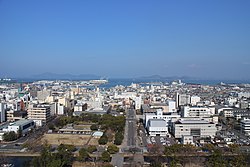
Marugame, Kagawa
View on Wikipedia.jpg)
Key Information


Marugame (丸亀市, Marugame-shi) is a city located in Kagawa Prefecture, Japan. As of 1 October 2022[update], the city had an estimated population of 108,541 in 46101 households and a population density of 970 persons per km2.[1] The total area of the city is 111.79 square kilometres (43.16 sq mi).
Geography
[edit]Marugame is located in north-center Kagawa Prefecture, on the island of Shikoku, facing the Seto Inland Sea to the north. The city covers the northeastern part of the Marugame Plain and part of the Shiwaku Islands. As with many other cities and towns in Kagawa Prefecture, there are many reservoirs. The Doki River flows from north to south through the center of the city, and to the south is Mount Tsutsumi, also known as Hatoko Fuji, one of the "Sanuki Seven Fujis". Mount Iino, nicknamed Sanuki Fuji and located on the border between Marugame and Sakaide, is another of the "Sanuki Seven Fujis".[2]
Neighbouring municipalities
[edit]Kagawa Prefecture
Climate
[edit]Marugame has a humid subtropical climate (Köppen Cfa) characterized by warm summers and cool winters with light snowfall. The average annual temperature in Marugame is 15.7 °C. The average annual rainfall is 1439 mm, with September as the wettest month. The temperatures are highest on average in August, at around 26.6 °C, and lowest in January, at around 5.3 °C.[3]
Demographics
[edit]According to Japanese census data,[4] the population of Marugame has recently plateaued after several decades of growth.
| Year | Pop. | ±% |
|---|---|---|
| 1950 | 87,271 | — |
| 1960 | 81,523 | −6.6% |
| 1970 | 78,263 | −4.0% |
| 1980 | 94,849 | +21.2% |
| 1990 | 101,253 | +6.8% |
| 2000 | 108,356 | +7.0% |
| 2010 | 110,473 | +2.0% |
| 2020 | 109,513 | −0.9% |
History
[edit]The area of Marugame was part of ancient Sanuki Province and has been inhabited since ancient times, with many kofun burial mounds found within the city limits. From the Heian period onwards, it was noted as an entry point for pilgrims to the Kotohira-gū shrine. During the Edo Period, the area developed as the castle town for Marugame Domain, which was ruled for 210 years by the Kyōgoku clan. Following the Meiji restoration, the town of Marugame was established with the creation of the modern municipality system on February 15, 1890. It was elevated to city status on April 1, 1890, becoming the 53rd city in Japan. During the 1950s the southeast area of the city and some islands were amalgamated to form new parts of the city.
On March 22, 2005, the towns of Ayauta and Hanzan (both from Ayauta District) were merged into Marugame to create the current expanded city of Marugame.
Government
[edit]Marugame has a mayor-council form of government with a directly elected mayor and a unicameral city council of 24 members. Marugame, together with Naoshima, contributes four members to the Kagawa Prefectural Assembly. In terms of national politics, the city is divided between the Kagawa 2nd district and the Kagawa 3rd district of the lower house of the Diet of Japan.
List of mayors of Marugame (from 1899 to present)
[edit]| Name | Office Entered | Office Left |
|---|---|---|
| Motoyoshi Toyoda (豊田元良) |
3 August 1899 | 8 January 1904 |
| Aina Hasegawa (長谷川和愛) |
18 June 1904 | 17 June 1910 |
| Kenkichi Fujiyoshi (藤好乾吉) |
8 June 1910 | 12 January 1915 |
| Kenichi Saito (斎藤研一) |
2 November 1915 | 1 June 1917 |
| Tokutaro Higuchi (樋口德太郎) |
15 September 1917 | 7 October 1920 |
| Kiyoshi Hisano (久野廉) |
3 June 1921 | 7 March 1923 |
| Iwao Osuka (大須賀巖) |
5 July 1923 | 4 July 1931 |
| Kikuma Takaki (高木季熊) |
17 November 1931 | 10 April 1934 |
| Seizaburo Ogaza (大柏淸三郎) |
25 July 1934 | 24 July 1942 |
| Toshisuke Irie (入江俊輔) |
25 July 1942 | 24 July 1946 |
| Katsuhide Mihara (三原勝英) |
26 April 1947 | 29 April 1963 |
| Shigetoshi Horiie (堀家重俊) |
30 April 1963 | 29 April 1991 |
| Keisuke Katayama (片山圭之) |
30 April 1991 | 29 April 2003 |
| Tetsuji Arai (新井哲二) |
30 April 2003 | 23 April 2013 |
| Masaharu Kaji (梶正治) |
24 April 2013 | present |
Economy
[edit]Marugame has a mixed economy centered on agriculture (rice, vegetables, chicken, peaches) and manufacturing along a coastal belt of reclaimed land which contains a number of industrial parks, textile plants and shipyards. Traditionally, the city was noted for its production of uchiwa fans, claiming a 90% market share; however, due to mechanization and changes in fashion, only two workshops are left in the city. Due to its well-developed transportation network, industry is expanding, and the city is increasingly becoming a commuter town for neighboring Takamatsu.
In 2015, Imabari Shipbuilding announced the construction of a large dry dock capable of building world-class containerships in Marugame.[5]
Education
[edit]Marugame has 18 public elementary schools and eight public middle schools operated by the city government, and four public high schools operated by the Kagawa Prefectural Board of Education. In addition, there are one private middle school, two private high schools and two correspondence high schools. The prefecture also operates one middle school and one high school.
Transportation
[edit].svg)


Sister cities
[edit] Donostia / San Sebastián, Spain, since November 6, 1990[6]
 Pasig, Philippines[7]
 Willich, Germany, since July 6, 2023[8]
 Zhangjiagang, Jiangsu, China, friendship city since May 28, 1990[6]


Local attractions
[edit]- Kaitenyama Kofun, National Historic Site
- Marugame Castle, National Historic Site and one of only 12 Japanese castles with original wooden tenshu (keeps) remaining.
- Marugame Genichiro-Inokuma Museum of Contemporary Art (MIMOCA), situated just east of the railway station, houses the works of Genichiro Inokuma, as well as playing host to many visiting exhibitions.
- Reoma World, a recreational facility with many attractions, two restaurants, a spa and hotel in the theme park
- Shiwaku Kinbansho, National Historic Site
Events
[edit]- Marugame Half Marathon - Occurring in early February, the race attracts thousands of runners each year.[9] Held since 1947, the Asian record in the half marathon was set on the course by Kayoko Fukushi in 2006.[10]
Notable people from Marugame
[edit]- Yoshihiko Isozaki, politician
- Katsuyuki Motohiro, movie director
- Fumiko Saiga, judge on the International Criminal Court
- Toshio Yamauchi, politician
References
[edit]- ^ "Marugame city official statistics" (in Japanese). Japan.
- ^ "Mt. Iino (飯野山)". 14 May 2012.
- ^ Marugame climate data
- ^ Marugame population statistics
- ^ "Imabari to build giant dock in Japan". Nikkei Asia. Retrieved 2023-07-18.
- ^ a b "Marugame city homepage" (in Japanese). Japan.
- ^ "List of Sister City Affiliations with Japan (by country)". Clair Singapore. Archived from the original on October 23, 2016. Retrieved July 15, 2017.
- ^ "Freunde aus Japan begrüßt". www.stadt-willich.de (in German). Retrieved 2023-07-27.
- ^ Ota, Shigenobu (2009-02-02). Marugame Half Marathon. ARRS. Retrieved on 2010-02-07.
- ^ Nakamura, Ken (2006-02-05). Fukushi sets Asian Half-Marathon record in Marugame. IAAF. Retrieved on 2010-02-07.
External links
[edit]
- Marugame City official website (in Japanese)
- Marugame City official website (in English)
 Marugame travel guide from Wikivoyage
 Geographic data related to Marugame, Kagawa at OpenStreetMap


| Core city |  | |
|---|---|---|
| Cities | ||
| Districts | ||
| Others | ||

| International | |
|---|---|
| National | |
| Geographic | |
| Academics | |
| Other | |

Marugame, Kagawa
View on GrokipediaGeography
Location and Topography
Marugame is situated in the north-central part of Kagawa Prefecture on the island of Shikoku, Japan, occupying a central position along the prefecture's coastline. The city faces the Seto Inland Sea to the north, forming part of the scenic Seto Inland Sea National Park, while its southern boundary is defined by the Sanuki Mountains. Spanning a total area of 111.83 km², Marugame extends approximately 24.16 km east-west and 23.82 km north-south, with about 23 km² consisting of island territories scattered in the inland sea.[8] The topography of Marugame features a diverse landscape, primarily encompassing the flat expanses of the Marugame Plain, which is an extension of the broader Sanuki Plain characterized by fertile alluvial farmland. To the south, low mountains rise, including Mount Tsutsumi, locally known as Hatoko Fuji and reaching an elevation of around 399 m, alongside Mount Iino (also called Sanuki Fuji) at 422 m, which straddles the border with neighboring Sakaide. The Tedorigawa River flows through the city center, supplemented by tributaries such as the Ōtsuka River to the east and the Kinkura River to the west, alongside numerous reservoirs that support agriculture in this historically water-scarce region. Offshore, the Shiwaku Islands—such as Honjima, Awashima (also known as Awajima), Hiroshima, Tejima, Kotejima, and Ushijima—contribute to the city's maritime profile, with these islands integrated into Marugame's administrative boundaries.[8] Coastal reclamation has played a significant role in Marugame's urban expansion, particularly along the Seto Inland Sea shoreline. Projects such as the Higashi Shiio River reclamation area have transformed former waterways into developable land, facilitating green spaces, community facilities, and improved accessibility to enhance residential and recreational environments. These efforts have supported the city's growth while addressing flood risks and promoting integrated land use. As of 2022, Marugame's population density stands at approximately 970 persons per km², reflecting concentrated settlement on the reclaimable plains and coastal zones amid the limited flat terrain.[9][10][8]Climate
Marugame features a humid subtropical climate under the Köppen classification Cfa, marked by four distinct seasons with mild winters and hot, humid summers influenced by its position along the Seto Inland Sea.[11] Winters are relatively temperate due to the moderating effects of the inland sea, while summers bring high temperatures and elevated humidity, typical of the region.[12] The average annual temperature stands at 16.7°C, with January recording an average low of 2.1°C and August seeing an average high of 33.0°C.[12] Annual precipitation totals approximately 1,150 mm, concentrated during the rainy season (tsuyu) from June to July, when over 40% of the yearly rainfall often occurs.[12] Autumn brings risks of typhoons, which can deliver intense rainfall and strong winds to the area.[13] In comparison to broader Seto Inland Sea norms, Marugame's climate aligns closely, featuring lower precipitation than the Pacific coast of Shikoku and extended sunshine hours of about 2,046 annually, fostering clearer skies especially in winter.[12] Average relative humidity hovers around 67%, contributing to the muggy conditions prevalent from late spring through early autumn.[12] Local topography, including surrounding low mountains, provides some shelter from extreme winds but amplifies humidity from sea breezes.[14]Neighbouring Municipalities
Marugame City shares administrative borders with six municipalities within Kagawa Prefecture: Utazu to the north, Ayagawa and Mannō to the west, Zentsūji and Sakaide to the south, and Tadotsu to the east. These boundaries are primarily defined by natural features such as rivers, hills, and coastal lines along the Seto Inland Sea, with Marugame's northern edge directly interfacing with the sea.[8] The city's coastal position facilitates shared access to the Seto Inland Sea and the Shiwaku Islands, an archipelago partially administered by Marugame that includes inhabited islands like Honjima and Hiroshima, known for their historical shipbuilding heritage and scenic hiking trails.[6] Neighboring municipalities, particularly those along the coast like Sakaide and Tadotsu, collaborate on maritime activities, including joint port security exercises conducted by the Sakaide Port Security Committee involving Marugame, Tadotsu, and nearby Wakayama ports to address potential threats such as unauthorized intrusions.[15] Inter-municipal cooperation extends to environmental management of the Seto Inland Sea, where Marugame participates in Kagawa Prefecture's comprehensive plan for conservation, focusing on pollution control, habitat preservation, and sustainable fisheries in coordination with adjacent coastal areas.[16] Infrastructure efforts, such as coordinated disaster response and waste management, further strengthen these ties across borders.[17] Proximity to Takamatsu, the prefectural capital approximately 30 kilometers north, positions Marugame as a key commuter hub, with efficient rail and road links enabling daily travel for work and leisure, contributing to regional urban integration despite the lack of a direct land border.[18] This connection influences local development patterns, including residential growth oriented toward Takamatsu's economic opportunities.[19]Demographics
Population Statistics
As of October 1, 2025, Marugame has a total population of 107,492 residents across 47,729 households.[20] The city's population density stands at approximately 961 persons per square kilometer, calculated over its total land area of 111.83 km². Population distribution is urban-rural in nature, with the majority concentrated in coastal urban zones along the Seto Inland Sea.[8] In terms of age structure (based on January 1, 2024 data), approximately 12.8% of the population is under 15 years old, 58.3% is of working age (15–64 years), and 28.9% is aged 65 and over.[21] The gender ratio is nearly balanced at 1:1, with a slight female majority (48.7% male and 51.3% female).[20]Demographic Trends
Marugame's population grew steadily from 87,339 in 1950 to a peak of 110,473 in 2010, driven by post-war economic expansion and urbanization, before stabilizing around 109,513 by the 2020 census.[22][3] This growth reflects broader national patterns of rural-to-urban migration in the mid-20th century, with the city's population increasing by over 25% between 1950 and 2000. Since 2010, the population has plateaued and begun a slight decline, reaching an estimated 107,492 as of October 2025, primarily due to Japan's nationwide aging population and low birth rates, which have reduced natural increase to near zero.[20] A significant factor in early 21st-century population dynamics was the municipal merger on March 22, 2005, when the towns of Ayauta and Hanzan (both from Ayauta District) were incorporated into Marugame, expanding the city's area from 64.59 km² to 111.8 km²—an increase of approximately 73%.[23][3] This merger added about 28,800 residents from the two towns, boosting the immediate population to 110,085 and contributing to the observed peak in the following years.[3] The expansion integrated rural peripheries, helping to offset some urban depopulation pressures in the core city area. Recent migration patterns (as of 2024) show a net outflow of 110 people for Marugame, including an outflow of 260 to the neighboring city of Takamatsu for employment and education opportunities, alongside inflows from other areas within Kagawa Prefecture.[24] This dynamic, combined with out-migration of younger residents to larger metropolitan areas, contributes to the ongoing population decline, though net migration was modestly positive in earlier years following the merger. Projections indicate a continued decline, with Marugame's population expected to fall below 100,000 to 99,528 by 2040, aligning with national trends of demographic contraction due to sustained low birth rates (around 1.3 children per woman) and aging (over 30% of residents aged 65+ by 2040).[25] These forecasts assume moderate net migration and no major policy interventions, emphasizing the need for regional strategies to address labor shortages and sustain community vitality.History
Early and Feudal Periods
The region encompassing modern Marugame formed part of ancient Sanuki Province, one of the historic provinces on Shikoku Island, dating back to the Nara period classifications in the 8th century. Evidence of early settlement appears from the Kofun period (c. 250–710 CE), marked by numerous burial mounds constructed between the 3rd and 7th centuries for elite figures, reflecting influences from continental Asia and the emergence of centralized power structures in Japan.[26] During the medieval and Sengoku periods, Sanuki Province saw shifting control among warring clans, culminating in the late 16th century when the Ikoma clan, loyal to Toyotomi Hideyoshi, consolidated authority over the area. Ikoma Chikamasa, daimyo of Sanuki from 1587, ordered the construction of Marugame Castle in 1597 on Mount Kameyama to secure western Sanuki as a strategic outpost, with work involving his son Kazumasa and completing the initial structure by 1597. This fortress, designed as a branch to Takamatsu Castle, featured extensive stone walls and moats to control key Seto Inland Sea routes.[27][28][29][30] The Ikoma clan's tenure ended in 1640 amid internal disputes and succession issues; after siding with the Tokugawa victors at Sekigahara in 1600, they had maintained control but were reassigned following the Ikoma Disturbance. The domain then passed to the Yamazaki clan from 1641 to 1657, under whom major reconstruction of the castle began in 1641. In 1658, Kyōgoku Takakazu, from the Kyōgoku clan of Ōmi Province origins, was transferred from Tatsuno Domain in Harima Province to lead Marugame, initially with an assessed revenue of 60,067 koku of rice. Under the Kyōgoku, the current three-story keep was completed in 1658, solidifying Marugame as the castle town of the Marugame Domain during the Edo period (1603–1868). The domain's economy centered on agriculture and maritime trade, sustaining the clan's governance until the feudal system's abolition.[30][29][28]Modern and Contemporary History
Following the Meiji Restoration, Marugame transitioned from its feudal domain status to a modern administrative entity. In 1890, the area was formally organized as Marugame Town, and on April 1, 1899, it was elevated to city status as the 53rd municipality in Japan, with an initial population of 23,634 and an area of 4.74 km²; Toyoda Motoyoshi was appointed as the first mayor.[8][31] This marked the beginning of centralized governance and infrastructure development, including early expansions through mergers with nearby villages such as Honjima, Kojima, Kawanishi, and Toki in 1954, and parts of Iino, Harada, and Kanzouji in 1955.[31] After World War II, Marugame underwent rapid industrialization as part of Japan's broader economic recovery, focusing on coastal reclamation for industrial use and the growth of manufacturing sectors. By the 1950s and 1960s, the city established fire and education boards in 1952, and initiated multi-phase coastal industrial land development projects, including the fourth phase in the late 20th century, which supported key industries like chemicals, textiles, and shipbuilding.[31][32] This period also saw the restoration of cultural landmarks, such as the Marugame Castle keep in 1950 following earlier dismantling.[31] The city's strategic location along the Seto Inland Sea facilitated these efforts, transforming it into a hub for heavy industry while preserving its historical core. In 2005, Marugame expanded significantly through municipal mergers under Japan's "Great Heisei Mergers" initiative. On March 22, the city incorporated the towns of Ayauta and Hanzan from Ayauta District, increasing its area to 111.79 km² and integrating rural and coastal communities to enhance administrative efficiency and economic vitality.[31] More recent developments highlight Marugame's ongoing modernization and cultural preservation. In January 2015, Imabari Shipbuilding announced plans to construct a massive new dry dock at its Marugame facility, measuring 600 meters in length and 80 meters in width, at a cost of approximately 40 billion yen; designed for building ultra-large container ships up to 20,000 TEU, the facility broke ground shortly after and became operational in 2017, bolstering the region's shipbuilding prowess.[33][34] Following severe damage from torrential rains and a typhoon in 2018, which caused sections of the iconic stone walls at Marugame Castle to collapse, restoration work commenced in 2019 and is ongoing as of November 2025, scheduled for completion by fiscal 2028, employing traditional techniques to rebuild the nationally designated Important Cultural Property.[35][36] In July 2023, Marugame formalized a sister city agreement with Willich, Germany, promoting international exchange through events like commemorative tree plantings and cultural programs.[37]Government
Administrative Structure
Marugame employs a mayor-council form of government, featuring a directly elected mayor who serves as the chief executive and a unicameral city council comprising 24 members elected by residents for four-year terms.[38][39] The mayor oversees the execution of policies, while the council deliberates and approves budgets, ordinances, and major administrative decisions.[40] In higher-level governance, Marugame contributes four seats to the Kagawa Prefectural Assembly, representing the city's interests in regional matters such as infrastructure and education.[41] Nationally, the city is divided between Kagawa's 2nd and 3rd districts in the House of Representatives, ensuring proportional representation based on population distribution across its areas. Administratively, Marugame is subdivided into 141 chō (neighborhoods or wards) as of October 2025, which serve as the basic units for local services, elections, and community organization; the city hall is situated in the central Honmachi area for convenient access to core functions.[20][42] The city's fiscal operations emphasize urban planning and social welfare, with key departments including the Urban Development Bureau for infrastructure projects and the Welfare Bureau for health and elderly care services. For fiscal year 2023 (Reiwa 5), the general account budget totaled approximately ¥58.4 billion as of the initial budget, supporting these priorities amid population stabilization efforts following the 2005 municipal mergers.[43][44]List of Mayors
Marugame was incorporated as a city on August 1, 1899, with Toyoda Motoyoshi serving as its first mayor from August 3, 1899, to January 8, 1904.[45] Over the subsequent decades, the city saw a succession of mayors, many appointed or elected under evolving local government systems, culminating in the post-World War II democratic elections starting in 1947. One of the most notable early modern mayors was Horike Shigeharu, who served for an extended period from April 1963 to March 1991, overseeing significant cultural and infrastructural developments, including the establishment of key public institutions.[46] The current iteration of Marugame City was formed on April 1, 2005, through the merger of the former Marugame City with Ayauta Town and Iiyama Town in Ayauta District, marking a pivotal administrative reorganization under the Japanese government's Heisei mergers. Tetsuji Arai, who had been mayor of the pre-merger city since 2003, was re-elected to lead the expanded municipality, playing a key role in integrating the merged areas. Subsequent mayors have typically served four-year terms, with elections held every four years. The following table lists the mayors since the 2005 merger, including tenures and election details:| No. | Name (Romanized) | Tenure | Notes |
|---|---|---|---|
| 1 | Arai Tetsuji (新井 哲二) | April 24, 2005 – April 23, 2013 | Elected April 24, 2005 (first post-merger election, defeating incumbent Keiji Katayama); re-elected April 26, 2009. Oversaw initial merger integration.[47][48] |
| 2 | Kaji Masaharu (梶 正治) | April 24, 2013 – April 23, 2021 | Elected April 14, 2013; re-elected April 9, 2017. Focused on industrial revitalization projects post-2015, including economic partnerships.[47][49] |
| 3 | Matsunaga Kyoji (松永 恭二) | April 24, 2021 – present | Elected April 18, 2021, with support from LDP, Komeito, and other parties. Former city councilor (four terms). Re-elected unopposed on April 13, 2025 (first uncontested election since merger); term ongoing as of November 2025.[47][50] |