Hubbry Logo
Maxime BossisMaxime BossisMain
Open search
Maxime Bossis
Community hub
Maxime Bossis
logo
8 pages, 0 posts
0 subscribers
Be the first to start a discussion here.
Maxime Bossis
Maxime Bossis
from Wikipedia

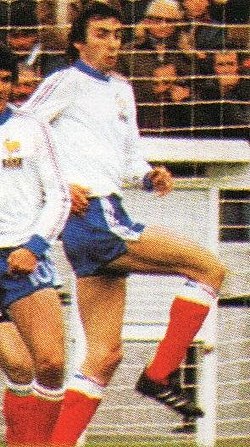
Maxime Jean Marcel Bossis (French pronunciation: [maksim ʒɑ̃ maʁsɛl bɔsis]; born 26 June 1955) is a French retired professional footballer who played as a defender.

Key Information

Bossis spent most of his career playing for Nantes, a club he helped win three Ligue 1 titles and one Coupe de France. He obtained 76 caps (one goal) for the France national team, won UEFA Euro 1984, and played in two FIFA World Cup semi-finals.

Early life and club career

[edit]

Bossis was born in Saint-André-Treize-Voies, Vendée.[2] A longtime starter for FC Nantes during the club's most successful period during the 1970s and 1980s,[4] he was noted chiefly as a full-back on the left flank, but filled in at various roles in defence. Bossis spent much of his time at right back during Nantes' championship-winning seasons in 1977 and 1980, in which Thierry Tusseau normally started on the left, but made the left back position his own beginning in 1981. Bossis helped Nantes to finish first or second in every season between 1976 and 1981. The club added a third title in 1983, finishing ten points ahead of second-place Girondins Bordeaux. In 1985, Bossis moved to the ambitious RC Paris, but the Parisian club achieved only modest success in spite of heavy spending that acquired such players as Enzo Francescoli and Pierre Littbarski. Bossis returned to Nantes for one final season in 1990, lining up next to future French international Marcel Desailly before retiring from play.[citation needed]

Bossis was named Footballer of the Year by France Football in 1979 and 1981.[5]

International career

[edit]

Bossis also represented the France national team for ten years, appearing at the 1978, 1982, and 1986 FIFA World Cups, reaching the semifinals of the latter two editions of the tournament.[6] He is mostly remembered for missing France's last penalty in the 1982 World Cup semi-final against West Germany. While the score was tied at 4–4, Bossis missed the next penalty, allowing Horst Hrubesch to score the last penalty and send the Germans to the final. Bossis was also an important member of the France team that won UEFA Euro 1984 on home soil in 1984. From 1985 to 1992, he held the French record of caps, before fellow defender Manuel Amoros established a new mark with 82 caps. He also held the French record of matches played in the World Cup with 15, which was subsequently surpassed by Fabien Barthez in 2006.[citation needed]

Personal life

[edit]

Bossis' younger brother, Joël, also played professional football and holds the all-time record for most goals scored for Chamois Niortais.[citation needed]

After retirement

[edit]

After he retired in 1991, Bossis briefly embraced a career as a football executive, heading the Coupe de France Central Commission (1993–1995) before he joined Saint-Étienne as sporting director (1996–1997).[7] He then reinvented himself as a TV commentator, working first for TPS, then for Orange Sport and since 2014 for BeIn Sport.[8]

Honours

[edit]

References

[edit]
[edit]
Revisions and contributorsEdit on WikipediaRead on Wikipedia
from Grokipedia
Maxime Bossis (born 26 June 1955) is a retired French footballer who played primarily as a centre-back, renowned for his defensive prowess and loyalty to , where he spent the majority of his club . Bossis began his with in 1973, making over 400 appearances for the club across two stints (1973–1985 and 1990–1991), during which he helped secure three titles in the 1976–77, 1979–80, and 1982–83 seasons, as well as the 1979 . In 1985, he transferred to Racing Club de Paris (also known as Matra Racing), where he played until 1989 and contributed to their 1985–86 championship win, before returning to to conclude his playing days. Internationally, Bossis earned 76 caps for the national team between 1976 and 1986, scoring one goal, and was a key member of the squad that achieved fourth place at the , victory at the 1984 UEFA European Championship, and third place at the . His defensive reliability and tactical intelligence earned him the award in 1979 and 1981. After retiring in 1991, Bossis transitioned into football administration, serving as a at clubs including . Standing at 1.86 meters and known for his physical presence and versatility (also capable of playing left-back), Bossis remains a celebrated figure in French football history, particularly as part of the nation's "golden generation" in the .

Early Life

Childhood and Family

Maxime Bossis was born on 26 June 1955 in Saint-André-Treize-Voies, a small rural commune in the department of western , into a working-class of farmers. As the fourth of eight children, he grew up in a modest household shaped by the demands of agricultural labor, where his parents, Maximin Prosper Francis Bossis and Marcelle Marie-Josèphe Marguerite Gouraud, worked the land to sustain the . The post-World War II socio-economic context of , a predominantly rural region reliant on amid ongoing recovery from wartime hardships, instilled in Bossis a grounded upbringing marked by the challenges of eking out a living from the soil. He attended the agricultural school in Les Établières near , reflecting the family's ties to farming traditions in a department where occupied nearly 78% of the by the mid-20th century. This environment, characterized by cooperative dairy production and landscapes, fostered resilience but also highlighted the economic vulnerabilities of small-scale farming in the region. Bossis's early interest in football was nurtured within his family and local community, beginning with informal games in the courtyard of the . Encouraged by his surroundings, he progressed to organized play at the village club in Saint-André-Treize-Voies before joining nearby teams in the area. His younger brother, Joël Bossis, born in 1965, similarly pursued professional football, becoming a key figure at Chamois Niortais FC, where he holds the record as the club's all-time leading scorer during its professional era with 51 goals in over 200 league matches. This familial involvement in the sport provided additional motivation and a supportive dynamic during Bossis's formative years.

Youth Development and Early Career

Born in Saint-André-Treize-Voies in the region on June 26, 1955, Maxime Bossis began his organized football journey relatively late, signing his first club license at age 14 in 1969 with the local team FC Saint-André-Treize-Voies. Growing up as the fourth of eight children in a farming family, he received encouragement from his parents to pursue the sport alongside school and farm duties. Bossis quickly progressed within Vendée's regional structure, moving to FC Yonnais in , where he initially played as a in the club's senior team competing in Division 4. His talent caught the attention of scouts during the Tournoi de la Paix in Montaigu, , leading to his recruitment into the club's youth academy at age 17 in 1972. At ' emerging centre de formation, under the influence of coach José Arribas, Bossis transitioned to defensive roles, honing his skills in across the backline to build versatility. The emphasized technical proficiency and zonal marking systems, prioritizing defensive solidity through collective organization over individual man-marking, which shaped Bossis into a composed and adaptable defender. He signed his first with the club in 1973 at age 18, marking his entry into senior football while continuing to develop in the reserves.

Club Career

FC Nantes (1973–1985)

Maxime Bossis made his professional debut for in 1973, marking the start of a prolific tenure as a central defender for the club. By the mid-1970s, he had established himself as a cornerstone of the team's defense, contributing to ' dominance in French football during their golden era. Bossis played a pivotal role in securing three titles across the 1976–77, 1979–80, and 1982–83 seasons, often anchoring a backline that emphasized tactical discipline and fluidity. His defensive contributions helped the team maintain strong records. In the 1979 , Bossis featured prominently, including in the final victory over on June 16, where won 4–1 after extra time, showcasing his reliability in high-stakes matches. Over this period, he amassed approximately 380 appearances in Division 1 for , scoring 20 goals while providing defensive stability. Renowned for his elegant, ball-playing style, Bossis was a versatile center-back celebrated as "Le Grand Max" for his clean tackling, precise positioning, and tactical awareness, which allowed him to tightly mark opponents while initiating attacks from the back. His occasional forays forward yielded around 15 goals during this stint, including contributions in European competitions such as the European Cup, Cup Winners' Cup, and , where competed and he made over 20 appearances. In total, Bossis recorded over 460 appearances across all competitions for from 1973 to 1985, with 23 goals, solidifying his legacy as a key figure in the club's success. His club form also earned him early international call-ups, overlapping with France's rising national team.

Racing Club de Paris (1985–1989)

In 1985, following a distinguished period at marked by three titles and a victory, Maxime Bossis transferred to Racing Club de Paris, an ambitious project backed by industrialist aiming to assemble a star-studded squad with international talents. Bossis, then 31 years old, viewed the move as an opportunity to extend his career at a higher profile while addressing skepticism from regarding his form after France's Euro 1984 triumph, describing it as a personal quest to demonstrate his enduring quality amid perceptions of a lucrative deal sparking envy. Over his four-year tenure from 1985 to 1989, Bossis featured in 135 appearances across all competitions, contributing 3 goals mainly during the 1985–86 campaign, during which the club won the championship for direct promotion to , though they secured no major trophies in the top flight and recorded mid-table finishes. As a starting center-back, Bossis provided essential stability to the defense amid the club's frequent managerial changes and underlying instability, including limited fan support and inadequate infrastructure that hindered consistent performance. The 1986–87 season saw Bossis integral to the side that finished 13th in Ligue 1, underscoring both the team's potential and its fragility. In 1987–88, the team achieved a seventh-place finish.

Return to FC Nantes (1990–1991)

After spending four seasons at Racing Club de Paris, Maxime Bossis took a one-year sabbatical following the 1989–90 campaign before rejoining in July 1990 at age 35, motivated by the club's sporting difficulties and a desire to support his formative team. In the 1990–91 season, Bossis appeared in 34 matches and 4 fixtures, logging over 3,400 minutes without scoring, as finished 10th in the top flight. His role was limited by age-related physical demands, but he offered veteran leadership in central defense, mentoring emerging talents and bolstering team morale during a transitional period. Bossis retired definitively in June 1991 after this final season, having returned as a to symbolically close the loop on his professional journey at the club where he began. Fans embraced his comeback as a homecoming for one of ' most iconic figures, reflecting on it as a poignant end to his playing days. Across his entire club career with and , Bossis amassed 632 appearances and 26 goals in all competitions.

International Career

National Team Debut and Build-Up

Bossis earned his first cap for the France national team on 27 March 1976, at the age of 20, during a 2–2 friendly draw against in . The match marked the beginning of his international career under newly appointed , who had taken over earlier that year and identified Bossis as a promising versatile defender from . Under Hidalgo's guidance, Bossis rapidly established himself as a key figure in the French defense, accumulating around 50 caps by the end of 1982. His only international goal came during the against , a late strike that secured a 4–1 victory and highlighted his occasional offensive contributions from the backline. Hidalgo's tactical approach emphasized defensive solidity and fluidity, allowing Bossis to develop alongside central defender , with whom he formed a reliable partnership that anchored the back four in multiple campaigns. Their combination of physicality and ball-playing ability became a cornerstone of France's emerging international identity. Bossis played a pivotal role in France's preparations for their first World Cup appearance in 20 years, featuring in all four qualifying group matches for the 1978 tournament. These included a 2–2 draw away to in October 1976, a 2–0 home win over the in November 1976, a 0–2 away loss to in March 1977, and a decisive 3–1 home win over in June 1977 to top the group. His consistent club form at , where he contributed to multiple titles, directly facilitated his integration into the national setup and Hidalgo's pre-tournament training regimen, which focused on building team cohesion through intensive defensive drills and friendlies.

Major Tournaments and Key Moments

Bossis made his World Cup debut at the 1978 tournament in , where he appeared in three group stage matches for as a versatile defender capable of playing at center-back or full-back. France exited in the first round after drawing with and losing to and , with Bossis contributing to a defense that struggled against potent attacks but showed promise in build-up play. In the 1982 World Cup in , Bossis was a mainstay in 's defense, playing all eight matches during their run to the semi-finals and fourth-place finish. He helped anchor a backline that conceded just five goals in the tournament proper, including during wins over and , and a draw with in the second group stage, as well as a 4-1 win against where he scored a late goal to restore the three-goal lead. The semi-final against remains one of the most iconic matches in history, ending 3-3 after extra time and going to penalties following a controversial collision involving German goalkeeper Harald and French substitute ; Bossis, tasked with France's eighth kick in sudden death, saw his shot saved by , allowing to advance 5-4. ultimately finished fourth after a 2-3 loss to in the third-place match. Bossis played a pivotal role in France's triumphant 1984 UEFA European Championship campaign on home soil, starting all five matches as a reliable center-back in Michel Hidalgo's 4-4-2 system. The team advanced through the group stage with a 1-1 draw against , a 5-0 rout of —featuring a clean sheet where Bossis neutralized key threats—and a 3-2 win over . In the semi-final, France edged 3-2 in extra time, with Bossis helping to contain strikes from Futre and Sousa despite conceding twice. The final against ended 2-0, another clean sheet masterminded by Bossis and the defense, securing France's first major international title and capping a dominant tournament where they conceded only five goals overall. At the 1986 World Cup in , Bossis featured in all seven matches, solidifying his status as a defensive cornerstone during France's semi-final run. After topping their group with wins over and plus a draw with the , France defeated 1-0 in the round of 16. The quarter-final against was a classic 1-1 draw resolved by penalties, where Bossis successfully converted his kick in the 4-3 shootout victory, eliminating the tournament favorites. However, the semi-final against ended in a 0–2 loss in extra time, with goals from Rummenigge and Völler; Bossis was substituted in the 88th minute but had earlier helped repel waves of attacks from the German forwards. France claimed with a 4-2 win over . Over his international career spanning 1976 to 1986, Bossis earned 76 caps for , scoring once, and was a key figure in the nation's "" alongside stars like and , helping elevate Les Bleus to consistent contention in major tournaments.

International Retirement and Caps Summary

Bossis earned his final international cap on 28 June 1986, during 's 4–2 victory over in the third-place match in , bringing his total to 76 appearances at the age of 31. He retired from international duty immediately following the tournament, concluding a decade-long tenure that had defined much of 's defensive stability during their golden era. Over his international career from 1976 to 1986, Bossis featured in 76 matches, scoring just one goal—a late goal in the 1982 World Cup group stage against —and contributed to 43 wins, 15 draws, and 18 losses, yielding a win rate of approximately 57%. These figures underscore his reliability as a central defender, often partnering with players like to anchor the backline in high-stakes competitions, including three World Cups and the triumphant 1984 European Championship. Bossis's presence was instrumental in evolving French defensive tactics throughout the , where his tactical awareness and ability to read the game allowed for a more fluid, possession-oriented approach under coach , transitioning from rigid man-marking to zonal elements that supported the team's attacking flair. His understated yet pivotal role earned lasting respect from teammates, who later highlighted his professionalism and consistency as key to France's semi-final appearances in and , as well as their continental triumph.

Post-Playing Career

Administrative Roles

Following his retirement from professional football in 1991, Maxime Bossis transitioned into administrative roles within the sport, leveraging his extensive experience as a player. From 1993 to 1995, Bossis served as president of the Central Commission of the for the (FFF), where he oversaw the event's logistics, scheduling, and operational aspects to ensure smooth execution across its rounds. In the late 1990s, Bossis was involved with , serving as interim head coach in early 1996 during the 1995–96 season and as from July 1996 to June 1997. At the time, faced significant financial challenges, including mounting debts that nearly led to , prompting administrative changes to stabilize operations and plan for a return to the top flight. Bossis's involvement helped navigate these issues by advising on squad management and strategic decisions during a turbulent period for the historic club.

Media and Broadcasting Work

Following his administrative roles in football, Maxime Bossis drew on his playing expertise to enter media and , becoming a respected known for his tactical breakdowns. Bossis began his media as a for TPS in the early 2000s, covering matches and offering insights into defensive strategies during live broadcasts. He continued this work at Orange Sport from 2008 to 2012, where he analyzed fixtures and contributed to post-match discussions, emphasizing the evolution of defensive play. In 2014, Bossis joined , where he has since served as a regular consultant, providing specialized defensive insights for coverage and studio analysis. His contributions extend to major international events, including notable commentaries on the 2018 and 2022 World Cups, as well as , where he dissected team defenses and key moments. Bossis has earned a reputation for his candid and experienced analysis of modern defending, often highlighting tactical nuances and player positioning in a straightforward manner that resonates with viewers.

Recent Activities and Legacy

In June 2025, at the age of 70, Maxime Bossis participated in a legends match organized by against the Variétés Club de France at the in , an event celebrating the club's 60 years of history and supporting charitable causes. During the match and surrounding activities, Bossis interacted with fans and young players, sharing insights from his career and signing autographs on the pitch. Bossis's enduring legacy as an icon of and a quintessential French defender of the has been highlighted in 2025 retrospectives, which reflect on the poignant closure of his after a challenging return to in 1990–1991, often described as a "sad end" amid the club's struggles. These accounts emphasize his role in three titles with , 76 international caps, and key contributions to France's national team during the and World Cups and Euro , positioning him as a symbol of defensive reliability and club loyalty. As of November 2025, Bossis remains active in nostalgic events tied to his career, with no public reports of health issues.

Personal Life

Family and Relationships

Bossis was born into a large family of eight children from a farming background in Saint-André-Treize-Voies, Vendée. His younger brother, Joël Bossis, followed in his footsteps by pursuing a professional football career, where he became the club's all-time leading league goalscorer for Chamois Niortais FC with 51 goals in over 200 appearances. Details about Bossis's marriage and children remain private, with no verified public information available on these aspects of his personal relationships. Post-retirement, he has stayed closely tied to his roots, engaging in regional activities such as book signings for his 2024 biography Le Grand Max and commemorating his career through local events in Montaigu, where the municipal stadium bears his name. Bossis is known for his discreet nature in personal matters, often retreating to the comfort of his home away from the public eye.

Honours and Individual Recognition

During his club career primarily with FC Nantes, Maxime Bossis contributed to three Ligue 1 titles in the seasons 1976–77, 1979–80, and 1982–83. He also helped secure the in 1979, defeating 4–1 in the final after extra time. On the international stage, Bossis was a key defender for the France national team during their triumphant campaign in 1984, where they defeated 2–0 in the final held in . Bossis received individual acclaim as French Footballer of the Year, awarded by magazine, in both 1979 and 1981. His international career culminated in 76 caps between 1976 and 1986, establishing him as France's most-capped player—a record he held upon retirement.

References

Add your contribution
Related Hubs
User Avatar
No comments yet.