Hubbry Logo
Medium Mark DMedium Mark DMain
Open search
Medium Mark D
Community hub
Medium Mark D
logo
8 pages, 0 posts
0 subscribers
Be the first to start a discussion here.
Medium Mark D
Medium Mark D
from Wikipedia

Medium Mark D was a British medium tank developed at the end of the First World War.

Key Information

It was envisaged as a vehicle to be used in "Plan 1919" an offensive on the Western Front which would use large numbers of heavy and medium tanks to break through the German defences, destroy lines of communication crippling the German army and thus end the war. The Armistice ended the war in 1918 and it would never be tested in combat but development continued for the post-war needs of the British Army. The unusual suspension proved problematic and the earlier tanks were replaced by a Vickers design - the Medium Mark I - in the 1920s.[1]

It should not be confused with export Vickers Medium Mark D tank, built in one unit for Ireland in 1929.

Development

[edit]

J F C Fuller's plan 1919 (circulated in mid-1918) was for the heavy tanks to engage and pin the German troops allowing faster tanks to penetrate the flanks and encircle the enemy isolating them from the chain of command precipitating a breakdown of morale and fighting capacity. Fuller calculated this fast tank, which he called Medium Mark D in the text, would have to manage 20 mph (32 km/h) - substantially faster than any tank then in service - and that it would be no more than 20 tons in weight.[2]

Major Johnson, working at the Mechanical Warfare Department's grounds at Dollis Hill, identified that a more powerful engine and a sprung suspension would be needed. He had experimentally fitted leaf springs to both a Mark IV heavy tank and a Medium Mark A "Whippet" and also fitted powerful Rolls-Royce Eagle aeroplane engines to a Whippet.[2]

Johnson's ideas were tested by conversion of a Mark V tank

To give a suspension that could flex without adding the weight of individual springs for each roller, Johnson, based on his pre-war experience with Fowler ploughing engines, used steel cable ropes wound between the rollers and terminated in springs. Wire ropes were also used to connect the track links together, allowing them to flex during turning manoeuvres and for the individual links to pivot on rough ground.[3] This was tested on a converted Mark V, which reached 20 mph (32 km/h)

With the end of the war the immediate need for the Mark D disappeared. Fuller was now at the War Office and continued to champion the tank adding on a requirement for amphibious use.[3]

The wooden mockup shows the forward tilt of the track run

Before the war a wooden mockup of the Mark D had been built and shown to members of the Tank Corps and an orders for ten prototypes placed (four from Fowler and six from Vickers).[4]

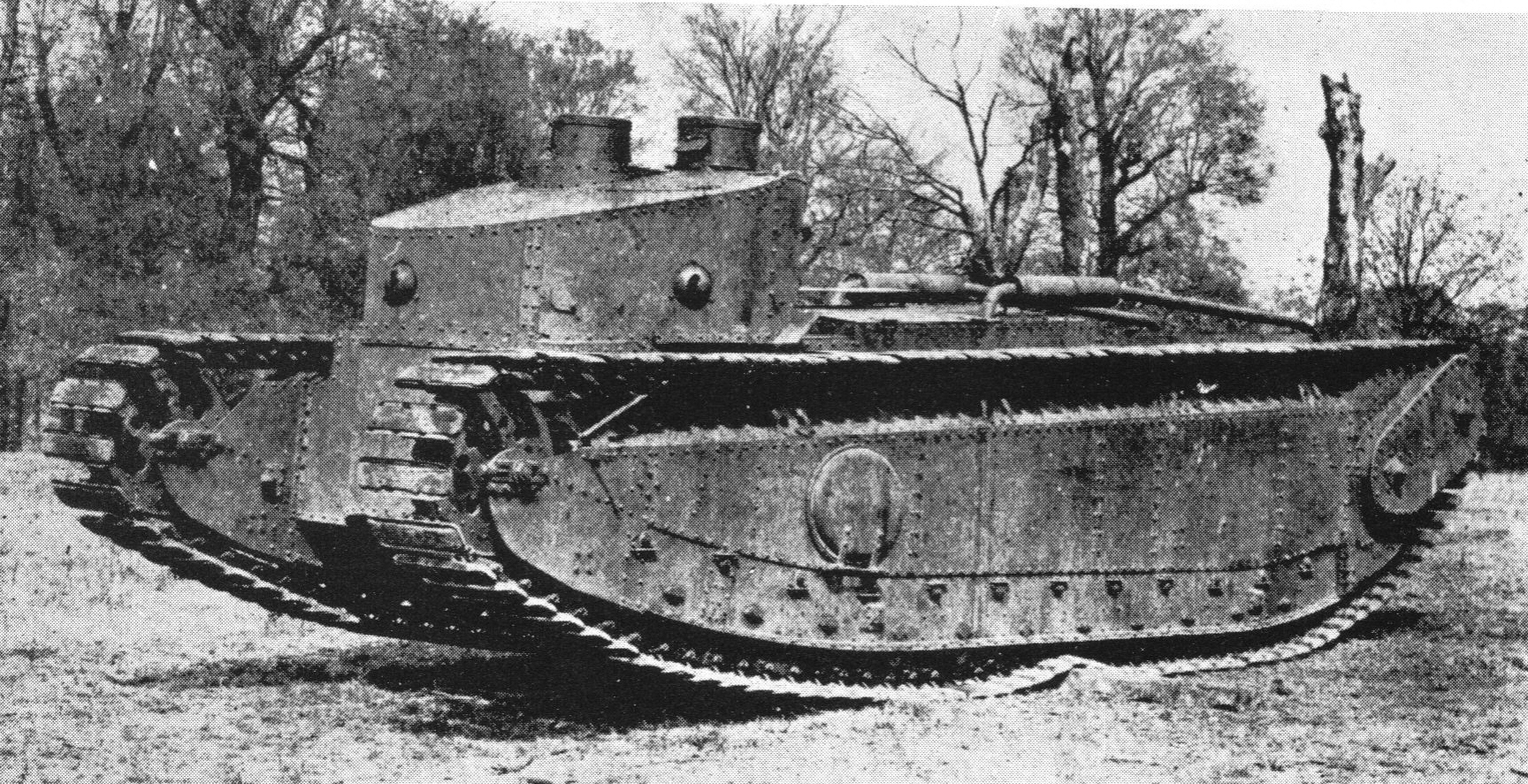
The tank as built was relatively long and narrow with a cylindrical fighting compartment at the front with machine gun ports to the front and sides. As it was so narrow the driving position was displaced to the back of the fighting compartment with the driver under a small cupola. To improve the view forward the roof of the fighting compartment sloped down from the cupola. Because the track runs sloped forward, another feature to improve driver views, in order to cross taller obstacles the driver was expected to take them by reversing.[5] Powered by a Siddeley Puma engine the speed was in excess of Fuller's specification.

Swimming trials were carried out with two modified tanks; the Mark D* which was widened to 8 ft 5 in (2.57 m) and the Mark D** at 9 ft (2.7 m); the latter swimming well in a river test.[5]

Sufficient funds were provided for production of 45 tanks complete with Rolls-Royce engines, later cut to 20 of which only three were built - by the Royal Ordnance Factory - based on the D** and known as the "D Modified" (DM).[6]

Johnson's design department, and any further work on the D was terminated in 1923.[7]

Variants and derivatives

[edit]
  • Mark D
  • Mark D*
  • Mark D**
  • Light Infantry Tank - one example[6]
  • Tropical Tank - three lighter vehicles based on the D following Johnson's visit with two Mark Ds to India[6]

See also

[edit]

Notes

[edit]

References

[edit]
[edit]
Revisions and contributorsEdit on WikipediaRead on Wikipedia
from Grokipedia
The Medium Mark D was a British developed in late 1918 at the Central Tank Corps Workshops in , designed to support Plan 1919—a proposed 1919 offensive strategy emphasizing rapid exploitation of breakthroughs using fast-moving armored vehicles. Led by Philip , the project originated amid World War I's final months but continued post-Armistice, with initial orders for up to 500 units scaled back to just 20 due to postwar budget cuts; only a handful were built, including variants like the Medium D* and Medium DM. Weighing approximately 13.5 to 20 tons depending on the variant, it was powered by a 240 horsepower Puma engine (later upgraded to a 370 horsepower in some models), achieving speeds of up to 23 mph on level ground and 28 mph downhill—making it one of the fastest tanks of its era. Armament consisted solely of machine guns, typically three ball-mounted models, housed in a fixed circular turret and sponsons, with thin 8-10 mm armor providing limited protection against small-arms fire. Key innovations included the "Snake track" system of flexible steel wire rope for improved cross-country mobility and a cable suspension to enhance ride quality over rough terrain, while the design aimed for amphibious capability to cross rivers and canals during advances. The first prototype rolled out in June 1919 and underwent trials in 1920, demonstrating promising speed but suffering from mechanical unreliability, overheating, and instability—particularly in water tests, where the added flotation gear compromised balance and amphibious performance. Further evaluations in in 1922 exposed additional flaws, such as track failures and engine issues in hot climates, leading to the project's termination in March 1923 in favor of the more reliable and lighter . Although no production vehicles entered service and none survive today, the Medium Mark D represented an early British effort to evolve beyond heavy tanks like the Mark V, influencing interwar armored doctrine toward speed and maneuverability.

Background and Context

Role in Plan 1919

Plan 1919 was a strategic offensive plan formulated by Major , Chief of Staff of the British Tank Corps, in May 1918 to guide Allied operations in a potential 1919 campaign against German forces on the Western Front. The strategy emphasized achieving a decisive breakthrough through massed armored forces, followed by deep exploitation to sever enemy communications, disrupt command structures, and target headquarters over a broad front of up to 90 miles. It proposed deploying approximately 5,000 tanks in a coordinated "decapitation stroke," integrating them with infantry, artillery, and air support to paralyze German operations and force a rapid collapse. Within Plan 1919, medium tanks were assigned a critical role as the "disorganizing force" responsible for infiltrating breaches created by heavy tanks, advancing rapidly into rear areas to sow chaos in enemy . These tanks were required to achieve speeds exceeding 15 mph for swift exploitation of breakthroughs, possess lighter weight than heavy tanks to enhance cross-country maneuverability, and operate in close coordination with and to maintain momentum. This approach contrasted sharply with the doctrinal use of slower, heavier tanks for initial assaults, prioritizing mobility to replace traditional in pursuit roles. The was specifically designed and envisioned as the primary for this exploitation mission in Plan 1919, intended to number around 2,000 units in production to support the offensive's scale. Unlike the ponderous , limited to about 4 mph and focused on breaching fortified lines, the Medium Mark D's emphasis on speed and agility positioned it as the key vehicle for operational depth and rapid strikes. This built briefly on the exploitation tactics tested with earlier medium tanks like the during the . Fuller's plan, developed in May 1918, was rendered obsolete by the on November 11, 1918, which ended hostilities before it could be executed. Despite its non-implementation, Plan 1919 represented a visionary shift toward mechanized warfare, influencing interwar doctrines on armored exploitation.

Influences from Earlier Medium Tanks

The Medium Mark D's design lineage traced back to the of 1917-1918, from which it adopted the rear-engine layout to achieve improved and greater mobility on the battlefield. This configuration in the Whippet positioned its twin engines at the rear, allowing for a lower and better balance compared to front-engined heavy tanks, a feature retained and refined in the D to enhance overall speed. While the reached a top speed of 8 mph—significantly faster than contemporary heavies—its unsprung suspension proved unreliable over rough terrain, limiting sustained cross-country performance. The offered only modest upgrades, such as minor ergonomic adjustments, but retained similar suspension vulnerabilities and failed to substantially increase speed. The Medium Mark C addressed some reliability concerns with a more robust frame but grew excessively large and heavy, compromising mobility and still capping speeds below operational ideals. In response, the Medium Mark D targeted 20 mph through innovative suspension enhancements, directly building on these predecessors' shortcomings to prioritize velocity and endurance. The Central Tank Corps Workshops in , established in early , were instrumental in bridging these earlier designs to the by conducting practical modifications on . Engineers there tested leaf-spring additions to Whippet suspensions for better shock absorption, followed by coil-spring prototypes that improved ride quality and informed the D's foundational concepts for high-speed traversal. Lieutenant Colonel , who led these workshops from , drew on his hands-on modifying Whippets and other mediums to the D's emphasis on mechanical reliability and superior cross-country capability. His experiments with suspension dynamics and power distribution in prior projects addressed the fragility seen in the B and C, ensuring the D's design focused on practical battlefield durability.

Development

Design Specifications

The design specifications for the Medium Mark D were finalized in mid-1918 under directives from the Tank Design Department, as part of broader efforts to develop fast tanks for exploitation roles in anticipated offensives. These targets emphasized mobility, , and producibility to support mass deployment, with the overall weight capped at a maximum of 20 tons to ensure the vehicle could be transported by existing rail and bridge infrastructure while maintaining reasonable armor and armament. The targeted dimensions aimed for a length of about 30 feet (9.15 m), a width of 8 feet 6 inches, and a of 8 feet, creating a profile that balanced maneuverability with internal space for crew and equipment. Performance goals included a road speed of 20 mph (32 km/h) and 12-15 mph cross-country, enabling rapid advances behind breakthroughs, alongside an operational range of 100 miles to facilitate extended maneuvers without frequent resupply. The layout accommodated a 4-man —consisting of the commander, gunner, driver, and mechanic—with the main armament mounted in a central turret for flexible and auxiliary weapons positioned in side sponsons for close defense. The general configuration utilized a riveted hull with sloped armor plating to enhance ballistic protection against small-arms fire and shrapnel, while prioritizing straightforward construction techniques for high-volume output in wartime factories. This approach drew initial inspiration from the Medium Mark A Whippet's compact, speed-oriented layout.

Prototyping Efforts

Initial plans called for up to 500 tanks, but postwar reductions scaled this to 75 and then 20 units. In 1919, an initial order was authorized for 10 prototypes of the Medium Mark D tank, with 4 assigned to John Fowler & Co. and 6 to , as part of efforts to realize the design's potential for rapid mechanized operations. Post-armistice fiscal constraints prompted a shift to a modified configuration known as the "D Modified," with production limited to just 3 vehicles built by the Royal Ordnance Factory at beginning in 1920. Construction progressed with the first completed in , followed by the full assembly of the prototypes by , reflecting the scaled-back ambitions amid economic pressures. Key challenges included drastic budget reductions after the war that prevented broader production, alongside delays in integrating the novel cable-based suspension system developed by Lieutenant Colonel . These prototypes were prepared specifically for evaluation under the revised design parameters.

Technical Design

Engine and Suspension

The Medium Mark D tank's propulsion system centered on a water-cooled Rolls-Royce Eagle VIII V-12 petrol engine, which delivered 360 horsepower at 1,800 rpm in later prototypes such as the Medium DM variant. This aircraft-derived powerplant provided a favorable power-to-weight ratio of approximately 18 hp per ton, enabling the tank's emphasis on high mobility over rough terrain compared to heavier rhomboidal designs like the Mark V. Earlier iterations, including the initial Medium Mark D, employed a Siddeley Puma engine rated at 240 hp, with upgrades to 300 hp in the Medium D** before transitioning to the Eagle for enhanced performance. The transmission used epicyclic gearing in initial models (with three speeds) or experimental hydraulic options like the Williams-Janney in advanced prototypes (four forward gears and one reverse), supporting the tank's role as a fast reconnaissance vehicle under Plan 1919 doctrines. Suspension was a key innovation, utilizing Lt. Col. Phillip Johnson's cable spring system, which threaded a sprung steel cable through pulleys on the road wheels and chassis for distributed load absorption. This arrangement incorporated 12 small road wheels per side in a flexible setup, akin to a leaf-spring configuration, to enhance ride quality and stability over uneven ground without the rigidity of earlier tanks. The design prioritized speed and cross-country capability, though it lacked redundancy—a single cable failure could halt mobility. Variant differences included adjustments for wider hulls in the D* and D**. Mobility was further aided by 14-inch-wide tracks employing the "snake" system with flexible wire rope and swinging elements, maintaining a ground pressure of around 10 psi for superior flotation relative to contemporary British heavy tanks. Track pitch varied across variants, from 7.5 inches in the Medium D** to 10 inches in the Medium D*, optimizing traction while keeping overall weight around 15 tons in powered prototypes. Fuel capacity consisted of 80-gallon tanks, supporting an operational endurance of 80 to 100 miles depending on terrain and load, which aligned with the tank's intended rapid exploitation role in offensive maneuvers.

Armament and Armor

The armament of the Medium Mark D consisted solely of three machine guns—one ball-mounted in the fixed circular turret and two in the side sponsons—providing close-range anti-infantry fire across a wide arc. The tank's armor was relatively light, ranging from 8 to 10 mm in thickness across the hull and turret, emphasizing protection against small-arms fire and shrapnel rather than heavy anti-tank rounds. The riveted plates provided basic ballistic resistance, a design choice that balanced weight savings with minimal protection to fulfill the medium tank's role in rapid exploitation under Plan 1919. This approach allowed the Medium Mark D to operate as a versatile escort vehicle, though its thin armor limited survivability against dedicated .

Testing and Evaluation

Prototype Construction

The three operational prototypes of the Medium Mark D, designated as the Medium DM variants, were constructed at the Royal Ordnance Factory in , employing mild steel riveting for the hull to facilitate durable assembly under wartime-derived production techniques. These prototypes represented the culmination of hands-on fabrication efforts following initial design contracts, with work commencing on the in 1921 and the complete vehicles finalized by late that year. Prior to full , wooden mockups were employed at to test turret configurations and overall layout, allowing engineers to refine without committing to costly use. The innovative cable spring suspension, utilizing flexible wire ropes as part of the "snake track" system, was integrated directly into the hull structure during assembly to optimize weight distribution and mobility. While the standard Medium DM prototypes emphasized land-based performance, related variants like the D* incorporated amphibious modifications, including flotation aids and a widened hull for waterborne stability, though these were primarily handled by rather than . Overall production for the three units drew from a reduced funding allocation originally intended for 20 vehicles, underscoring the project's constrained post-war resources.

Performance Trials

Performance trials for the Medium Mark D prototypes began in 1919 following the completion of the first prototype and continued through 1922, with testing at sites including in the UK. Speed tests demonstrated up to 23 mph on level ground and 28 mph downhill for early variants, with the Medium DM achieving around 20 mph. These trials evaluated the tank's operational capabilities in varied terrains, building on the prototypes' design specifications for enhanced mobility. In terms of mobility, the suspension system proved effective in handling obstacles up to 4 feet deep forward and 6 feet in reverse, allowing the tank to navigate challenging terrain with relative stability. Overall, these outcomes indicated that while the Medium Mark D met several baseline specifications for cross-country traversal, further refinements were needed for reliability in demanding conditions. The ball-mounted machine guns operated reliably during evaluations, providing effective support. Reliability emerged as a significant concern, with mechanical issues including suspension cable failures contributing to inconsistent operational uptime and underscoring the prototype's complexities. One tank burned out during trials. Amphibious trials were conducted with modified variants; however, the Medium DM sank during tests in the River Thames in 1921, highlighting balance issues with flotation gear. In 1922, two prototypes were sent to for tropical trials at , where both suffered breakdowns and were abandoned, exposing flaws such as track and engine failures in hot climates.

Variants and Derivatives

Standard and Modified Marks

The standard Medium Mark D represented the baseline configuration of this design, featuring a hull width of 7 feet 5 inches (2.26 meters) and intended for the construction of 20 prototypes as part of Britain's late armored vehicle program. Although orders were placed for 11 mild steel pre-production models—with four from John Fowler & Co., six from , and one from —only five were completed as prototypes for evaluation purposes, with the remainder canceled due to postwar shifts. The design emphasized speed and maneuverability, powered by a 240 hp Puma engine, with armament limited to machine guns in the prototypes. To address stability issues identified in early trials, particularly for potential amphibious operations, the D* variant modified the hull by widening it to 8 feet 5 inches (2.56 meters), incorporating adjusted tracks for improved balance. Only one such prototype was adapted and built by in late specifically for evaluation purposes. This change aimed to enhance the tank's performance in water without altering the core Puma engine or armament of the standard model. The D** mark further refined these adaptations by expanding the width to 9 feet (2.74 meters), allowing for the addition of buoyancy tanks to support river-crossing capabilities. A single of this version was constructed in and subjected to trials at , demonstrating enhanced flotation during water tests. Like its predecessors, it retained the fundamental chassis layout, with engine options including an uprated Puma or for higher power output. The Medium DM (D Modified) was a further with three prototypes built, featuring the 370 hp VIII engine, an extra , and side escape hatches, tested in 1920. Derived directly from the Medium Mark D chassis, the Light Infantry Tank Mark I was ordered as a single unit in 1920 to prioritize speed over protection, featuring lighter armor plating while maintaining the overall configuration. This variant, completed in 1921, utilized a 100 hp Hall-Scott engine to achieve speeds exceeding 30 mph and incorporated the Johnson Snake Track system for amphibious mobility. Across these marks, the primary distinctions centered on progressive width increases to bolster stability and amphibious potential, yet all variants preserved essential elements such as the planned engine in later iterations. These modifications reflected iterative responses to trial feedback on the original design's limitations in dynamic environments.

Post-War Adaptations

Following the , efforts to adapt the Medium Mark D for use focused on suitability for tropical environments, leading to limited trials and prototypes. In 1922, two Medium Mark D prototypes—one built by John Fowler & Co. and the other by —were dispatched to for evaluation at the testing grounds. The Fowler example was fitted with insulation to mitigate heat, along with dust filters and enhanced cooling systems, but both vehicles suffered mechanical breakdowns during trials and were ultimately abandoned on site. A related , known as the Tropical Tank, emerged as a single prototype constructed at the Royal Arsenal, , in 1922. This variant incorporated conventional tracks instead of the original snake-track design, twin machine-gun turrets for improved ventilation, and additional cooling modifications tailored for hot climates, but it underwent only brief testing at Farnborough before the project was shelved due to ongoing reliability issues and shifting priorities. Export initiatives for the Medium Mark D in the early proved unsuccessful, hampered by severe budget constraints imposed by the British government's , which assumed no major war would occur within a decade and thus curtailed military expenditures, including tank development and sales. Proposals to foreign buyers, including potential adaptations of the design, yielded no contracts, as fiscal redirected resources away from advanced prototypes like the Medium Mark D. One notable point of confusion arises with the Vickers Medium Mark D, a distinct 1929 export model built solely for the (now the ). This single vehicle, a derivative of the rather than the original 1918 Medium Mark D, weighed approximately 14 short tons (12.7 metric tons), achieved a top speed of 20 mph (32 km/h), and was armed with a 47 mm 6-pounder gun and four 0.303-inch machine guns. It incorporated some suspension refinements inspired by interwar experiments but shared no direct lineage with the earlier D project. Serving as 's first tank with the 2nd Cavalry Squadron until damaged beyond repair in a 1940 training exercise and subsequently scrapped, it remains the only production vehicle to bear the "Medium Mark D" designation.

Cancellation and Legacy

Project Termination

Following the , the British Tank Board's funding was sharply curtailed as part of widespread post-war demobilization and economic retrenchment, drastically limiting resources for ongoing tank projects including the Medium Mark D. The 1920 Geddes Axe, a government committee's recommendations for public expenditure cuts, further reduced military budgets by imposing severe measures on defense programs, resulting in orders for the Medium Mark D being scaled back from an initial 500 units in December 1918 to just 20 by December 1919. These fiscal constraints were compounded by the Ten Year Rule, formally adopted by the Cabinet in August 1919, which directed the armed forces to plan on the basis of no major war occurring for at least a decade, thereby diverting emphasis from development toward cheaper air power and lighter mechanized forces. Technical challenges also played a pivotal role in the project's demise, with trials exposing unresolved gearbox unreliability and overall mechanical shortcomings that undermined the tank's performance compared to emerging alternatives like the Vickers Medium Tank Mark I. The Medium Mark D's higher production costs, estimated at around £13,333 per unit based on the £1 million allocation for the final 75 planned tanks, exacerbated budgetary pressures when juxtaposed against more economical designs. In the evolving political landscape, increasingly favored lighter tanks suited to rapid, cost-effective operations, rendering the ambitious Medium Mark D obsolete before full-scale production could commence. The project was officially terminated in March 1923, coinciding with the closure of Lt. Col. Philip Johnson's Department of Tank Design and Experiment, after which the three completed prototypes were either scrapped or placed in storage, with none surviving to the present day. This decision marked the end of centralized government-led tank innovation in Britain for the , as resources shifted to private manufacturers like .

Impact on British Tank Design

The Medium Mark D's innovative cable spring suspension system, developed by Lieutenant Colonel , represented an early attempt to enhance mobility in medium tanks through flexible steel wire rope tracks and pulleys integrated with the chassis and roadwheels. Although the system encountered mechanical reliability issues during testing, achieving speeds up to 20 mph but suffering from track wear and complexity, it underscored the importance of advanced suspension for faster armored vehicles, influencing the transition to more practical designs in the Medium series of the 1920s. These successors incorporated and mechanisms that improved cross-country performance and stability, marking a step toward greater maneuverability in British medium tanks. The project's emphasis on speed and exploitation tactics, originally aligned with the British Army's Plan 1919 for rapid advances behind enemy lines, reinforced interwar doctrinal priorities toward fast medium tanks capable of independent operations. This conceptual shift contributed to the evolution of ideas, prioritizing velocity over heavy armor to support infantry breakthroughs, as seen in the doctrinal exercises of the Experimental Mechanised Force in 1927. Key design elements from the Medium Mark D, such as its lightweight hull and high-speed potential, informed proposals like the in the mid-1920s and later manifested in the A9 Cruiser tank of the 1930s, which emphasized wheeled or tracked mobility for armored divisions. Although production was limited to a few prototypes, the Medium Mark D supported training and technical studies for Royal Tank Corps personnel in the early , allowing engineers to analyze mobility challenges firsthand. The design also influenced foreign projects, such as the U.S. Medium Tank M1922, which adopted elements of the snake track and cable suspension systems. Furthermore, the use of engines in later prototypes highlighted the need for powerful, reliable powerplants in tracked vehicles, paving the way for Rolls-Royce's deeper involvement in tank engineering, culminating in engines like the for wartime designs such as the Cromwell.
Add your contribution
Related Hubs
User Avatar
No comments yet.