Hubbry Logo
Black butcherbirdBlack butcherbirdMain
Open search
Black butcherbird
Community hub
Black butcherbird
logo
8 pages, 0 posts
0 subscribers
Be the first to start a discussion here.
Black butcherbird
Black butcherbird
from Wikipedia

Black butcherbird
Scientific classification Edit this classification
Kingdom: Animalia
Phylum: Chordata
Class: Aves
Order: Passeriformes
Family: Artamidae
Subfamily: Cracticinae
Genus: Melloria
Mathews, 1912
Species:
M. quoyi
Binomial name
Melloria quoyi
(Lesson & Garnot, 1827)
Synonyms

Cracticus quoyi

The black butcherbird (Melloria quoyi) is a species of butcherbird in the family Artamidae. It is found in Australia, Indonesia, and Papua New Guinea. Its natural habitats are subtropical or tropical dry forest, subtropical or tropical moist lowland forest, and subtropical or tropical mangrove forest.

Taxonomy

[edit]
Cairns Centenary Lakes - Australia

Evidence was published in a 2013 molecular study which showed that it was the sister taxon to the Australian magpie (Gymnorhina tibicen). The ancestor to the two species is thought to have split from the other butcherbirds between 8.3 and 4.2 million years ago, during the late Miocene to early Pliocene, while the two species themselves diverged sometime during the Pliocene (5.8–3.0 million years ago).[2]

Description

[edit]

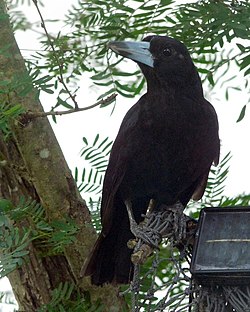
The adult is black all over except for its beak which is black-tipped grey. Most juveniles are rufous-brown. Confusingly, some juveniles are black while some brown young birds may rarely retain their brown colour into adulthood.[3] As the only butcherbirds with wholly black bodies, they are sometimes confused with crows or currawongs, from which they are distinguished by their gray and hooked bills.[4]

Behaviour

[edit]

In Papua New Guinea, Black butcherbirds have been observed parasitising the nests of Hooded monarch birds.[5]

In 1903, ornithologist E. M. Cornwall observed brown and black varieties of the bird, the black preferring deeper forest and the brown preferring coastal scrub or mangroves.[6]

References

[edit]
[edit]
Revisions and contributorsEdit on WikipediaRead on Wikipedia
from Grokipedia
The black butcherbird (Melloria quoyi) is a of in the Artamidae, characterized by its entirely glossy black , large size, and prominent grey bill with a dark hooked tip. It measures 38–44 cm in length and weighs 125–220 g, with juveniles often appearing duller brown before to adult coloration. Native to , (including West Papua), , and nearby islands, the was previously classified under the genus Cracticus but was reclassified in 2016 based on phylogenetic analysis. This occupies a range of forested habitats, including subtropical and tropical moist lowland forests, mangroves, woodlands, and edges, typically at elevations from to 2,080 m. It is an that forages in the and mid-canopy for a diet primarily consisting of such as , supplemented by small vertebrates including , snakes, frogs, and occasionally birds or small mammals. Notable for its complex vocal repertoire, the black butcherbird produces deep warbling songs, throaty ringing calls, and mimetic phrases that aid in defense and pair bonding. Breeding takes place mainly from to in , with pairs constructing deep cup-shaped nests of sticks and rootlets in trees or mangroves, laying clutches of 3–4 eggs that are incubated for about 25 days. The species exhibits in some populations, where offspring from previous broods assist in rearing subsequent young. Classified as Least Concern on the , the black butcherbird maintains a stable population across its extensive range of over 4.4 million km², facing no major threats.

Taxonomy and systematics

Classification and etymology

The black butcherbird (Melloria quoyi) belongs to the family Artamidae, a group of birds that includes the butcherbirds, woodswallows, currawongs, and their allies. This placement reflects its morphological and genetic affinities with other Australo-Papuan songbirds characterized by robust bills adapted for carnivory and arboreal lifestyles. The species was first scientifically described in 1827 by French naturalists René Primevère Lesson and Prosper Garnot as Barita quoyi, based on specimens collected from Dorey (present-day ) in northwestern during the expedition of the ship La Coquille. The binomial name Melloria quoyi was established when the monotypic genus Melloria was erected by Australian ornithologist Gregory M. Mathews in to separate it from the genus Cracticus, recognizing its distinct phylogenetic position. Although erected in , the genus Melloria was not widely adopted until molecular phylogenetic studies in the 2010s supported its distinctness from Cracticus, leading to reclassification around 2018. The specific epithet "quoyi" honors Jean René Constant Quoy (1790–1869), a French naval surgeon, naturalist, and who participated in Pacific expeditions, including earlier voyages that contributed to early descriptions of Australasian . Phylogenetically, the black butcherbird forms a sister to the Australian magpie (Gymnorhina tibicen), with the two species diverging during the epoch approximately 5.8–3.0 million years ago. This close relationship, supported by multilocus coalescent analyses of mitochondrial and nuclear DNA, underscores their shared evolutionary history within the Cracticinae subfamily, distinct from other butcherbirds.

Subspecies and evolutionary history

The black butcherbird (Melloria quoyi) is classified into five , primarily distinguished by subtle variations in gloss and tone, as well as geographic isolation. The nominate subspecies, M. q. quoyi, inhabits the mainland of and is characterized by glossy black with a brighter blue-black sheen on the upperparts. M. q. spaldingi occurs in and exhibits duller black compared to the nominate form. M. q. alecto is found in southern and the Aru Islands, showing intermediate gloss in its black feathering. M. q. jardini is restricted to the in , with similar to the nominate but slightly less vibrant. Finally, M. q. rufescens in northeast displays some tones in its , particularly in individuals. Phylogenetic analyses place the black butcherbird within the family Artamidae, where it forms a with the Australian (Gymnorhina tibicen) that is the to the genus Cracticus (butcherbirds), rather than to the woodswallows (Artamus). Multilocus estimates indicate that the lineage leading to the black butcherbird diverged from the ancestor shared with the Australian (Gymnorhina tibicen) between 8.3 and 4.2 million years ago, during the to early . Subsequent species-level divergence within the black butcherbird occurred approximately 5.8 to 3.0 million years ago, reflecting radiation amid changing Australo-Papuan landscapes.

Physical characteristics

Plumage and size

The black butcherbird is a medium to large , with adults measuring 33–44 cm in total length and weighing 125–220 g across . Males average slightly larger than females, with no pronounced in , though lengths range from 165–210 mm depending on and sex. Adult plumage is entirely black, featuring a glossy blue-black sheen that is more pronounced on the upperparts and somewhat duller on the underparts. Both sexes share this monomorphic appearance, which provides effective in forested environments. Rare brown morphs occur in adults of the subspecies M. q. rufescens, where individuals retain tones rather than transitioning fully to . Juveniles differ markedly, exhibiting mostly rufous-brown or dull blackish-brown plumage overall, with blackish wings and tail feathers. They undergo a molt to immature plumage within months of fledging, retaining some juvenile feathers and displaying a less glossy, blackish-brown version of the adult coloration; full glossy adult plumage is typically achieved by the end of the second year, during which some individuals show partial black feathering on the body.

Bill and morphology

The bill of the black butcherbird (Melloria quoyi) is a prominent feature, characterized by its stout, elongated structure measuring approximately 5–6 cm in length, with a gray coloration and a dark, hooked tip that enhances its predatory capabilities. This hooked design allows the bird to tear flesh effectively and impale prey on thorns or branches, reflecting its name-derived "butcherbird" behavior suited to handling and food items. The bill's robust build provides the leverage needed for subduing larger prey, distinguishing it functionally from more generalized beaks. Complementing the bill, the black butcherbird possesses strong legs and feet adapted for secure perching and holding prey steady, supporting its ambush-hunting strategy by allowing manipulation of food items while tearing with the bill. The overall body morphology is sturdy and compact, akin to corvids in robustness but aligned with proportions, facilitating maneuverability through dense vegetation while maintaining power for predation. In comparison to similar species, the black butcherbird's grayer bill sets it apart from the all-black bills of (Corvus spp.) or the darker bills of currawongs (Strepera spp.), aiding in field identification and underscoring its specialized adaptations within the Artamidae family.

Distribution and habitat

Geographic range

The black butcherbird (Melloria quoyi) is distributed across , eastern , and . Its range encompasses coastal and near-coastal regions of from the northwest Kimberley division eastward to northeast , the Aru Islands and West Papuan Islands (including , Salawati, and ) in , and mainland (with exceptions noted for subspecies) plus Yapen Island in . Five subspecies are recognized, each occupying distinct portions of this overall range. M. q. spaldingi occurs in northwestern Australia from Cambridge Gulf eastward along the coast, including the (Bathurst and Melville) and extending to coastal near Blue Mud Bay in the . M. q. jardini is found on the coastal , ranging south to the Mitchell River in the west and Cooktown in the east. M. q. rufescens inhabits the northeast coastal Queensland region from Cooktown southward to north Broad Sound (south of Mackay), though with a gap in distribution at the . In and associated islands, M. q. quoyi is distributed across the West Papuan Islands, Yapen Island in Geelvink Bay, and the mainland of northern , excluding the Trans-Fly region in the south-central area. M. q. alecto occupies the Trans-Fly region of south-central (from Princess Marianne Strait eastward to Island), the Aru Islands, and northern such as Boigu and Saibai. The species' range has remained stable, with no significant contractions documented, and it is considered resident without notable migratory behavior or widespread outside core areas.

Preferred habitats

The black butcherbird primarily inhabits subtropical and tropical moist lowland forests, where it is most commonly observed, along with subtropical and tropical forests above high tide levels. These core habitats provide the dense canopy and structures essential to the ' ecology. It also utilizes subtropical and tropical dry forests and edges of rainforests, particularly where vegetation remains relatively thick. Microhabitat preferences center on areas with denser , such as understories and thickets, which offer suitable cover within its broader habitat types. Subspecies exhibit subtle variations: the predominantly black forms, like the nominate M. q. quoyi, are more associated with interiors of deeper in , while the M. q. rufescens, notable for a morph in its juveniles and immatures, occurs in coastal scrub and mangroves along northeastern . Australian populations, represented by such as M. q. spaldingi and M. q. jardini, show a stronger affinity for mangroves compared to the diverse types favored in . The species occupies elevations from up to 2,080 m. It consistently avoids open woodlands and arid zones, restricting its presence to humid, vegetated tropical environments across and .

Ecology and

and diet

The black butcherbird maintains a primarily carnivorous diet dominated by , particularly such as beetles, grasshoppers, and caterpillars, supplemented by small vertebrates including lizards, snakes, frogs, small mammals, birds, nestlings, and eggs. It occasionally consumes crustaceans like small crabs, fish, and carrion, highlighting its opportunistic feeding habits. As an , the black butcherbird typically forages from perches in the lower canopy or sub-canopy of , scanning the ground or foliage before descending to capture prey. Larger items are impaled on thorns, spikes, or wedged into branch forks—a distinctive "butchering" that facilitates dismemberment and consumption—and the species also gleans from bark or catches them in flight. The black butcherbird is diurnal, exhibiting heightened activity and while making limited local movements within its to locate food. Its strong, hooked bill aids in tearing flesh from impaled prey.

Reproduction and breeding

The black butcherbird forms monogamous pairs for breeding, with both sexes sharing responsibilities in . The breeding season occurs from August to January in , peaking between September and October, while in it is primarily from September to February, peaking in October to November. Nests are built as untidy, bowl-shaped structures of sticks and twigs in tree forks 5–15 m above the ground, often lined with grass, bark, or rootlets; construction is performed by both parents over several weeks. The female lays a clutch of 3–4 eggs, which are pale cream to greyish-green or buff, sometimes blotched; eggs are incubated by both sexes for about 25 days. Chicks hatch altricial and are brooded and fed by both parents, fledging after 25–30 days in the nest. Parental care is biparental, with both adults provisioning nestlings and fledglings; occurs in some populations, where offspring from previous broods occasionally assist as helpers. The species occasionally engages in nest parasitism, with records of eggs laid in the nests of other birds such as the hooded monarch (Monarcha pileatus) in .

Vocalizations and communication

The black butcherbird produces a variety of loud vocalizations that play key roles in its social and territorial interactions. Its primary is a rich, melodious yodelling incorporating clear liquid notes, often delivered in extended bouts, particularly at dawn during the breeding season. This song exhibits regional variation, with populations in featuring deeper warbles, while those in tend toward higher-pitched renditions. These differences in vocal quality contribute to distinguishing subspecies, such as M. q. quoyi in from M. q. spaldingi in . In addition to song, the black butcherbird emits distinct calls, including a prominent loud, throaty ringing note often associated with situations. These calls serve in territorial defense, where individuals or pairs use them to assert boundaries and deter intruders within their year-round territories. The ringing quality carries effectively through dense rainforest habitats, enhancing communication over distance. Communication between mated pairs frequently involves duetting, where both birds synchronize initial loud calls before alternating phrases, such as one producing "oh-oh-aah" sequences while the other responds. This coordinated vocal exchange strengthens pair bonds and reinforces territorial claims, with recordings showing precise timing in responses during interactions. Such duets highlight the species' role in monogamous partnerships, where vocal synchronization helps maintain social cohesion.

Conservation

The global population size of the black butcherbird (Melloria quoyi) is unknown, reflecting its widespread distribution across and . The overall trend is considered stable, supported by its classification as Least Concern by the IUCN with an extremely large extent of occurrence exceeding 4 million km². Local density varies by region; in New Guinea's lowlands, densities can reach 3 birds per 10 hectares (equivalent to about 15 pairs per km² assuming territorial pairs), while populations in the peripheral fringes of exhibit lower densities due to more fragmented habitats. Population monitoring relies on contributions through platforms like eBird, which document sightings and relative abundance across its range, alongside periodic assessments. As of the 2024 assessment, these efforts indicate no significant declines, with the species maintaining its status as quite common throughout core areas. In , a 2020 sub-global assessment also confirms stable populations.

Threats and protection

Although no substantial threats have been identified, the black butcherbird may face minor pressures from due to and agricultural expansion in , and an emerging illegal pet trade in and , where surveys documented 12 individuals in physical markets across 12 cities and 43 online advertisements, often sourced from wild populations despite zero export quotas under Indonesian regulations. In Australia, the species experiences minor impacts from predation by such as feral cats, though its adaptability to modified habitats mitigates broader risks. Despite these potential pressures, the black butcherbird is classified as Least Concern on the , assessed in 2024, owing to its extremely large range exceeding 4.4 million km² and stable population with no evidence of substantial declines. Conservation measures include protection under Australia's Environment Protection and Biodiversity Conservation Act 1999 (EPBC Act), which safeguards native fauna from unauthorized harm and . Trade is further controlled through national laws in , including zero quotas for wild-caught birds, though enforcement remains challenging. The species occurs in habitat reserves such as National Park in , Australia, and various protected areas across .

References

Add your contribution
Related Hubs
User Avatar
No comments yet.