
Hubbry Logo
MethodenstreitMethodenstreitMain
Open search
Methodenstreit
Community hub
Methodenstreit
logo
7 pages, 0 posts
0 subscribers
Be the first to start a discussion here.
Methodenstreit
Methodenstreit
from Wikipedia

Methodenstreit (German for "method dispute"), in intellectual history beyond German-language discourse, was an economics controversy commenced in the 1880s and persisting for more than a decade, between that field's Austrian School and the (German) Historical School. The debate concerned the place of general theory in social science and the use of history in explaining the dynamics of human action. It also touched on policy and political issues, including the roles of the individual and state. Nevertheless, methodological concerns were uppermost and some early members of the Austrian School also defended a form of welfare state, as prominently advocated by the Historical School.

When the debate opened, Carl Menger developed the Austrian School's standpoint, and Gustav von Schmoller defended the approach of the Historical School.

(In German-speaking countries, the original of this Germanism is not specific to the one controversy, which is likely to be specified as Methodenstreit der Nationalökonomie, i.e. "Methodenstreit of national economics".)

History

[edit]

Background

[edit]

The Historical School contended that economists could develop new and better social laws from the collection and study of statistics and historical materials, and distrusted theories not derived from historical experience. Thus, the German Historical School focused on specific dynamic institutions as the largest variable in changes in political economy. The Historical School were themselves reacting against materialist determinism, the idea that human action could, and would (once science advanced enough), be explained as physical and chemical reactions.[1]

The Austrian School, beginning with the work of Carl Menger in the 1860s, argued against this (in Grundsätze der Volkswirtschaftslehre, English title: Principles of Economics), that economics was the work of philosophical logic and could only ever be about developing rules from first principles—seeing human motives and social interaction as far too complex to be amenable to statistical analysis—and purporting to deduce universally valid precepts from human actions.[citation needed]

Menger and the German Historical School

[edit]
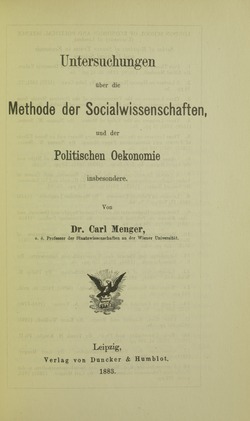
Untersuchungen über die Methode der Socialwissenschaften, und der politischen Ökonomie insbesondere, 1933

The first move was when Carl Menger attacked Schmoller and the German Historical School, in his 1883 book Investigations into the Method of the Social Sciences, with Special Reference to Political Economics (Untersuchungen über die Methode der Socialwissenschaften, und der politischen Ökonomie insbesondere). Menger thought the best method of studying economics was through reason and finding general theories which applied to broad areas. Menger, as did the other Austrians, concentrated upon the subjective, atomistic nature of economics. He argued that the foundations for economics were built upon assumption of self-interest, evaluation on the margin, and incomplete knowledge. He said aggregative, collective ideas could not have adequate foundation unless they rested upon individual components.[citation needed]

The direct attack on the German Historical School lead Schmoller to respond quickly with an unfavourable and quite hostile review of Menger's book.[2] Menger accepted the challenge and replied in a passionate pamphlet,[3] written in the form of letters to a friend, in which he (according to Hayek) "ruthlessly demolished Schmoller's position". The encounter between the masters was soon imitated by their disciples. A degree of hostility not often equaled in scientific controversy developed.[4]

Consequences

[edit]

The term "Austrian school of economics" came into existence as a result of the Methodenstreit, when Schmoller used it in an unfavourable review of one of Menger's later books, intending to convey an impression of backwardness and obscurantism of Austria compared to the more modern Prussians. A serious consequence of the hostile debate was that Schmoller went so far as to declare publicly that members of the "abstract" school were unfit to fill a teaching position in a German university, and his influence was quite sufficient to make this equivalent to a complete exclusion of all adherents to Menger's doctrines from academic positions in Germany. The result was that even thirty years after the close of the controversy Germany was still less affected by the new ideas now spreading elsewhere, than any other academically important country in the world.[5]

See also

[edit]

References

[edit]
[edit]
Revisions and contributorsEdit on WikipediaRead on Wikipedia
from Grokipedia
The Methodenstreit, or "dispute over methods," was a foundational methodological controversy in during the late nineteenth century, pitting , originator of the Austrian School, against Gustav Schmoller, prominent figure in the . The debate, which erupted in following Schmoller's unfavorable review of Menger's Principles of Economics, centered on the validity of deriving universal economic laws through deductive analysis of individual human actions versus constructing theory inductively from empirical historical observations. Menger contended that social sciences, including , could establish "exact" theoretical principles grounded in the essential nature of human purposive behavior, independent of specific historical contexts, as elaborated in his Investigations into the Method of the Social Sciences with Special Reference to . In contrast, Schmoller emphasized the uniqueness of historical processes and the necessity of comprehensive factual induction to inform policy-relevant generalizations, rejecting abstract universalism as overly simplistic. This clash extended to broader epistemological questions, such as the role of theory in isolating causal invariants amid complexity, and devolved into personal acrimony, with Menger accusing of methodological error and Schmoller decrying Austrian dogmatism. The Methodenstreit underscored enduring tensions between (law-seeking) and idiographic (context-specific) approaches in the social sciences, shaping the development of and later Austrian critiques of .

Overview

Definition and Core Dispute

![Page from Carl Menger's Untersuchungen über die Methode der Socialwissenschaften (1883)][float-right] The Methodenstreit, translating to "dispute over methods," denotes the methodological conflict in late 19th-century between the Austrian School, represented by , and the , led by Gustav Schmoller. This debate, spanning from 1883 to roughly 1904, centered on whether constitutes an exact theoretical deriving universal principles or a historically contingent discipline reliant on empirical induction. Menger initiated the public exchange with his 1883 treatise Untersuchungen über die Methode der Socialwissenschaften, und der politischen Oekonomie insbesondere, critiquing the Historical School's emphasis on descriptive over theoretical abstraction. At its core, the dispute pitted deductive theorizing against inductive empiricism. Menger advocated for economics as a discipline uncovering "strictly typical" laws of human economic action through isolation of essential causal factors, akin to exact sciences like mechanics, where a priori reasoning from self-evident axioms yields timeless, universal propositions independent of historical context. He contended that theoretical economics must abstract from accidental empirical details to grasp the necessary essence of phenomena, such as the origins of money or value, enabling predictive and explanatory power applicable across eras. In contrast, Schmoller and the Historical School prioritized comprehensive historical and statistical investigation as the foundation for any economic understanding, arguing that theoretical generalizations prematurely abstracted from the unique, evolving interplay of institutions, customs, and ethical norms shaping economic life. They viewed universal laws as illusory, insisting that economics, as a practical policy science, required inductive accumulation of concrete data to inform Kathedersozialismus reforms tailored to Germany's specific developmental stage. The disagreement extended beyond technique to epistemology and the scope of social science. Menger rejected the Historicists' relativism, which denied the possibility of objective, non-historical theories, maintaining that such an approach conflated practical historical inquiry—useful for applied economics—with the pure theory essential for any rigorous science. Schmoller, conversely, dismissed abstract deduction as sterile Prioriwitz detached from reality, advocating a gradual convergence of theory and history through exhaustive empirical work, though he acknowledged theory's role once sufficiently grounded in facts. This fundamental rift underscored divergent views on causality: Austrians emphasized individual human action as the ultimate driver, amenable to logical deduction, while Historicists stressed collective, institutionally embedded processes best revealed through contextual analysis.

Methodological Foundations at Stake

The Methodenstreit fundamentally contested the epistemological foundations of as a , pitting deductive theorizing grounded in universal principles of against inductive derived from historical particulars. Carl , in his 1883 Investigations into the Method of the Social Sciences, contended that social phenomena originate from individual purposeful behaviors, enabling the derivation of exact, theoretically necessary laws through from a priori axioms, akin to but distinct from natural sciences due to the volitional nature of human conduct. This approach posits as a theoretical discipline uncovering timeless causal relations, such as the , independent of specific historical contexts. In opposition, the , led by Gustav Schmoller, advocated an inductive emphasizing comprehensive historical to discern economic patterns shaped by evolving institutions, , and cultural contingencies, rejecting the notion of universal laws as overly abstract and detached from empirical reality. Schmoller argued that economic "laws" are probabilistic and context-dependent, requiring meticulous collection and analysis of statistical and institutional data to inform practical policy, rather than reliance on deductive models that he viewed as speculative and unhistorical. This stance aligned economics more closely with , prioritizing descriptive accuracy over predictive generality. At stake was the very possibility of a general : the Austrian position affirmed the existence of invariant principles applicable across times and places, facilitating through logical deduction, whereas the Historical School's implied as a descriptive, policy-oriented enterprise without foundational universals, potentially subordinating it to state-driven ethical reforms. Menger critiqued for conflating theoretical essentials with accidental historical details, arguing it undermines scientific rigor by eschewing essential for isolating causal mechanisms in complex social systems. The debate thus highlighted tensions between causal realism—seeking underlying invariants—and nominalist , influencing subsequent divides in , including critiques of and .

Historical Context

Precursors in Economic Thought

The roots of the methodological tensions later formalized in the Methodenstreit trace back to early 19th-century German critiques of classical political economy's abstract, universalist deductions, particularly from and . Friedrich List, in his 1841 work Das nationale System der politischen Ökonomie, argued against the cosmopolitan free-trade doctrines of and , positing instead that economic policies must account for national developmental stages, historical contexts, and productive powers specific to each country's circumstances. List's emphasis on organic national growth over timeless principles influenced subsequent German thinkers by highlighting the limitations of deductive generalizations detached from empirical national histories. Building on such romantic and nationalist critiques, including those by Adam Müller, the Older Historical School emerged in the 1840s, advocating an inductive, historically grounded approach to . Wilhelm Roscher, often credited as its founder, outlined this in his 1843 Grundriss zu Vorlesungen über die Staatswirthschaft nach geschichtlicher Methode, rejecting the construction of universal economic theories in favor of compiling historical facts to trace the evolution of economic institutions and behaviors across eras and cultures. Roscher viewed as a "historical science" akin to or , where theory emerges gradually from empirical observation rather than a priori reasoning, though he attempted a tentative by incorporating some abstract elements. Complementing Roscher were Bruno Hildebrand and Karl Knies, who in the and further developed the school's inductive framework through works emphasizing ethical, institutional, and national variations in economic phenomena. Hildebrand's 1848 Die gegenwärtige Aufgabe der Wissenschaft der politischen Ökonomie critiqued Ricardo's mathematical abstractions as ignoring real-world money functions and social structures, while Knies's 1853 Die politische Oekonomie vom geschichtlichen Standpunkte stressed the need for historical induction to uncover context-dependent economic laws. These thinkers collectively challenged the classical school's reliance on invariant principles, laying groundwork for later insistence on (interpretive understanding) of historical particulars over universal models—a divide that intensified with the advent of marginalist theory.

Emergence of Marginalism and the Austrian School

The concept of marginal utility emerged independently in the early 1870s as a foundational shift in economic theory, challenging the classical labor theory of value by positing that the value of goods derives from their ability to satisfy individual human wants at the margin. Carl Menger's Grundsätze der Volkswirthschaftslehre, published in 1871, articulated this through subjective valuation, where goods rank in importance based on their marginal contribution to satisfying needs, ordered hierarchically from most urgent to least. Menger argued that economic phenomena arise from purposeful human action, with prices forming through bilateral negotiations reflecting individuals' ordinal preferences rather than intrinsic costs. Concurrently, in Britain published The Theory of in 1871, employing mathematical functions to model diminishing , while Léon Walras's Éléments d'économie politique pure (1874) formalized general equilibrium via in a system of simultaneous equations. These works collectively constituted the "marginal revolution," redirecting toward individual choice and opportunity costs over aggregate production factors. Menger's contribution diverged by rejecting heavy mathematization, prioritizing verbal logic and the causal-genetic method to trace economic categories back to individual decisions. Menger's 1871 treatise established the Austrian School, named for its Vienna origins and centered at the where Menger held a professorship from 1873. The school's early methodological stance emphasized a priori deduction from self-evident axioms of , such as the universality of and purposeful behavior, over empirical induction or historical generalization. This approach contrasted with the dominant German Historical School's , setting the stage for later disputes by insisting on timeless economic laws derivable from logical analysis. The school's initial expansion occurred through Menger's private seminar in the 1870s, influencing key figures like , who joined academia in 1876 and later developed time-preference theory in capital analysis, and , who formalized imputation and concepts by the mid-1880s. By 1884, and Wieser co-edited a for Menger, signaling the emergence of a distinct tradition rooted in and —the science of exchanges. This development solidified marginalism's Austrian variant as a bulwark against historicist critiques, prioritizing theoretical purity over statistical or contextual data.

Institutionalization of the German Historical School

The achieved institutional prominence in the late through strategic academic appointments and dedicated organizations that embedded its inductive, historically contextual methodology in German higher education and policy discourse. Gustav Schmoller, as leader of the Younger Historical School, advanced this process significantly. Following professorships at the University of Halle from 1864 to 1872 and the from 1872 to 1882, Schmoller secured the chair in at the University of in 1882, the flagship institution of the unified . In this role, he cultivated a seminar-based model focused on empirical data collection and historical analysis, training generations of economists and Prussian civil servants who prioritized national-specific economic evolution over universal principles. A cornerstone of institutionalization was the founding of the Verein für Socialpolitik, spearheaded by Schmoller alongside figures like Adolph Wagner and Lujo Brentano. Initiated at an conference on October 6–7, 1872, the association was formally established at a subsequent meeting on –13, 1873, with Rudolf von Gneist as initial chairman. Its explicit purpose was to undertake systematic empirical studies of social issues stemming from industrialization and free markets, such as labor conditions and inequality, to inform state-led reforms—a "" between and . The Verein commissioned large-scale surveys and publications, directly shaping Bismarck's laws of the and providing the Historical School with a policy-oriented platform that reinforced its academic influence. The school's entrenchment extended across major German universities, where earlier proponents secured key positions: Wilhelm Roscher at , Karl Knies at Freiburg and , and Bruno Hildebrand briefly at . These appointments, dating to the mid-19th century, integrated historical economics into standard curricula, emphasizing archival research and statistical induction while critiquing abstract theorizing. By the 1870s, the approach dominated Prussian and imperial training for administrators, often derided by opponents as "Kathedersozialismus" for its advocacy of interventionist policies grounded in empirical-historical evidence rather than ideals. Schmoller's editorial oversight of the Jahrbücher für Nationalökonomie und Statistik further disseminated these methods, fostering a cohesive network that sustained the school's hegemony in German economics until .

The Debate Unfolds

Triggering Events and Initial Exchanges

![Title page of Carl Menger's Untersuchungen über die Methode der Socialwissenschaften (1883)][float-right] The Methodenstreit originated from tensions between the emerging and the dominant , escalating after published Grundsätze der Volkswirthschaftslehre in 1871, which emphasized subjective value theory and from individual actions. , editor of the Jahrbuch für Gesetzgebung, Verwaltung und Volkswirthschaft im Deutschen Reich, critiqued Menger's work in a 1872 review, arguing that economic theory must rely on historical induction and empirical data rather than abstract generalizations, dismissing Menger's approach as overly speculative and detached from real-world contexts. Menger directly countered these criticisms in his 1883 treatise Untersuchungen über die Methode der Socialwissenschaften und der politischen Ökonomie insbesondere, where he defended the autonomy of theoretical economics, asserting that universal laws of could be derived a priori through analysis of individual purposes, independent of historical particulars. This publication explicitly targeted the Historical School's emphasis on inductive generalization from historical facts, positioning it as insufficient for establishing exact economic laws. Schmoller responded in the same year through articles in his journal, rejecting Menger's distinction between theoretical and historical sciences as artificial and insisting on a unified ethical-historical approach to policy-oriented . Menger escalated the exchange in with the Die Irrthümer des Historismus in der deutschen Nationalökonomie, a concise accusing Schmoller of misrepresenting theoretical and promoting a relativistic that undermined scientific rigor. These initial volleys framed the core methodological divide, with Menger advocating praxeological deduction and Schmoller prioritizing empirical .

Austrian Arguments: Deductive Reasoning and Universal Laws

![Title page of Carl Menger's Untersuchungen über die Methode der Socialwissenschaften und der politischen Ökonomie insbesondere (1883)][float-right] Carl Menger initiated the Austrian defense in the Methodenstreit through his 1883 treatise Untersuchungen über die Methode der Socialwissenschaften, where he advocated for a deductive approach to economics grounded in the isolation of essential causal factors in human phenomena. Menger posited that economic theory derives universal laws by starting from general, self-evident propositions about purposeful human action—such as the pursuit of ends with limited means—and logically deducing their implications. These laws, he argued, possess exactness akin to those in physics, applicable across all societies and eras due to the unchanging nature of human needs and scarcity. Menger distinguished theoretical economics, which uncovers necessary relations through abstraction and deduction, from empirical history, which describes specific events. He critiqued the Historical School's inductive method for yielding only probabilistic generalizations from historical data, incapable of establishing the strict causality required for predictive laws, as induction conflates accidental circumstances with essential principles. Instead, deduction proceeds by progressively analyzing complex phenomena into simpler elements, revealing invariant sequences like the emergence of prices from subjective valuations. This methodology emphasized , wherein societal outcomes arise from individual actions, enabling the derivation of laws such as diminishing without reliance on empirical verification for validity. Menger maintained that while empirical observation informs the selection of axioms, the core of economic science lies in their logical elaboration into timeless theorems, providing a foundation for independent of contextual .

Historical School Arguments: Inductive Empiricism and Contextual Analysis

The German Historical School maintained that genuine economic understanding demands an inductive approach, beginning with the accumulation of empirical data from historical records, statistical compilations, and institutional observations rather than abstract deductions. Figures such as Wilhelm Roscher, who in his 1843 Grundlagen der Nationalökonomie outlined early principles, rejected the pursuit of universal theoretical systems in favor of tracing economic phenomena through their concrete historical manifestations, arguing that such specificity reveals patterns inaccessible to armchair theorizing. Gustav von Schmoller, leader of the Younger Historical School, reinforced this by insisting on exhaustive factual research—encompassing legal, social, and cultural elements—as the foundation for any economic generalization, critiquing deductive methods for their detachment from real-world variability. This empiricism aimed to induce tentative regularities from diverse evidence, viewing economics as an evolving science akin to history rather than a static axiomatic one. Central to the school's contextual analysis was the assertion that economic processes are inherently relative, shaped by unique temporal, national, and institutional conditions that render purported universal laws illusory or overly simplistic. Schmoller, in his organizational efforts through the Verein für Socialpolitik founded in , promoted monographic studies of interventions and economic institutions to illuminate how factors like state regulations and cultural norms influence outcomes, as seen in analyses of Prussian industrial development post-1870. Unlike deductive frameworks presuming human action's invariance, historicists contended that behaviors and structures—such as guilds or tariffs—must be interpreted within their formative s, with Karl Knies emphasizing in 1853 the "historical-ethical" dimension where ethical norms and power relations dynamically condition economic relations. This approach prioritized causal explanations rooted in observable sequences over timeless propositions, positing that ignoring leads to erroneous prescriptions disconnected from practical efficacy. In the Methodenstreit, these arguments framed induction and as complementary to—but ultimately superior in scope to—deduction, with Schmoller arguing in 1884 exchanges that abstract serves best as a subordinate to empirical verification, not an independent source of truth. The school's thus integrated with broader Staatswissenschaften, fostering data-driven reforms like studies in the 1880s, though critics later noted its vulnerability to subjective interpretation amid voluminous facts.

Key Participants and Contributions

Carl Menger's Role and Writings

Carl Menger (1840–1921), founder of the Austrian School of economics, played a pivotal role in the Methodenstreit by articulating a deductive, theory-driven approach to economics rooted in individual human action. His seminal work, Grundsätze der Volkswirtschaftslehre (Principles of Economics), published in 1871, established the methodological foundations of this school through subjective value theory and marginal utility analysis. In it, Menger derived economic principles deductively from the purposeful behavior of individuals, emphasizing that value originates in the marginal satisfaction of human needs rather than objective costs or labor inputs. This approach implicitly contrasted with the inductive, history-focused methods of the German Historical School, setting the stage for later confrontation. The Methodenstreit intensified in the 1880s following critical reviews of Menger's Principles by members of the Historical School, including , who questioned the universality of abstract economic laws. Menger responded decisively with Untersuchungen über die Methode der Socialwissenschaften und der politischen Ökonomie insbesondere (Investigations into the Method of the Social Sciences with Special Reference to Economics), published in 1883. In this treatise, he explicitly defended theoretical economics as an "exact" science capable of uncovering timeless, universal laws through the isolation of essential causal factors in , rather than relying solely on empirical induction and historical particulars. Menger distinguished between theoretical sciences, which abstract from the "inessential" to formulate general principles, and historical sciences, which describe unique events; he argued that the Historical School conflated these, neglecting the necessity of for understanding economic phenomena. He contended that from a priori insights into economizing—such as the pursuit of higher-ranked ends with scarce means—yields precise, predictive laws applicable across contexts, countering the inductivists' emphasis on context-specific accumulation without foundational . This publication directly ignited the debate, positioning Menger as the chief proponent of and apriorism against the collectivist, empiricist stance of his opponents. Menger's arguments influenced subsequent Austrian economists, reinforcing the school's commitment to praxeological deduction over .

Gustav von Schmoller's Leadership and Responses

(1838–1917) emerged as the foremost leader of the Younger German Historical School, directing its focus toward inductive empiricism, institutional evolution, and the integration of ethical considerations into economic analysis, in contrast to the deductive individualism of the Austrian School. Appointed professor at the University of Berlin in 1882, Schmoller commanded academic influence through his editorial control of the Jahrbuch für Gesetzgebung, Verwaltung und Volkswirtschaft im Deutschen Reich, which he co-founded in 1872 and used to promote historical-inductive methodologies and critiques of abstract theorizing. His leadership extended to founding the Verein für Sozialpolitik in 1872, an association dedicated to empirical investigations of and labor conditions, reflecting his belief that economics must serve practical state intervention informed by historical data rather than timeless axioms. Schmoller's initial engagement in the Methodenstreit intensified following Carl Menger's Untersuchungen über die Methode der Socialwissenschaften (1883), which lambasted the Historical School for neglecting theoretical essentials in favor of descriptive historiography. In a sharply critical review published that year in his Jahrbuch, Schmoller rejected Menger's emphasis on universal, deductively derived economic laws as speculative and detached from , insisting instead that valid principles emerge only from exhaustive inductive study of historical contexts, institutional development, and ethical norms. He portrayed Menger's approach as narrowly sectarian, prioritizing abstract value theory over the concrete dynamics of social and state , and argued that requires a synthesis of empirical facts and purposive policy to address real-world complexities. When Menger countered with Die Irrthümer des Historismus in der Deutschen Nationalökonomie (1884), a polemical indicting Schmoller and sixty other historicists for methodological fallacies such as overreliance on induction and denial of exact theoretical , Schmoller issued a brief rejoinder in his journal, dismissing the work as intemperate and unconstructive while reaffirming the Historical School's commitment to fact-based, ethically oriented research. Rather than prolong the exchange, Schmoller leveraged his institutional authority to marginalize Austrian perspectives, barring further in his publications and prioritizing collaborative empirical projects that underscored the relativity of economic phenomena across eras and cultures. This strategic restraint, coupled with his dominance in German academia, sustained the Historical School's influence despite , though it drew accusations of suppressing theoretical pluralism.

Secondary Figures and Broader Involvement

, a prominent second-generation Austrian , aligned with Menger's during the Methodenstreit, interpreting the debate as a defense of theoretical against excessive . In his 1889 work Capital and Interest, Böhm-Bawerk extended Menger's principles of and , arguing that economic laws derive from individual actions rather than historical aggregates, thereby reinforcing the Austrian emphasis on over Schmoller's inductive . , Böhm-Bawerk's contemporary and collaborator, further advanced this position by developing the concept of in his 1889 Natural Value, which presupposed universal principles of and imputation applicable across contexts, countering the Historical School's contextual relativism. On the Historical School side, Adolph Wagner, a key figure in the younger generation alongside Schmoller, advocated for state intervention informed by historical and ethical considerations, as outlined in his multi-volume Lehr- und Handbuch der Staatswissenschaften (1876–1897), which integrated socialist elements into empirical policy analysis. Wagner's approach emphasized the role of in addressing social inequalities through historical precedents, aligning with Schmoller's rejection of abstract theory in favor of Sozialpolitik. Lujo Brentano, another younger Historical economist, contributed through labor studies and cooperative movements, promoting inductive methods to derive policy from German , as seen in his 1870s writings on trade unions. Wilhelm Roscher, founder of the older Historical School, represented a less polemical precursor whose inductive, descriptive approach in Geschichte der National-Oekonomik in Deutschland (1874) influenced the debate indirectly; Menger critiqued Roscher's but acknowledged his contributions to factual over the younger school's . Broader involvement extended to institutional battles, such as Schmoller's founding of the Verein für Socialpolitik in 1872–1873, which mobilized over 300 members including Wagner and Brentano to advance empirical social reform against Austrian theoretical purity, shaping German academic dominance in by 1900. This network prioritized policy-oriented , sidelining deductive models in favor of data from Prussian statistics and histories.

Outcomes and Resolutions

Short-Term Consequences in Academia

The Methodenstreit ended in a , with neither nor conceding ground, but its immediate aftermath solidified the German Historical School's institutional in German universities. Schmoller, as a pivotal figure in academic networks and policy circles, wielded considerable influence over professorial appointments, enabling the Historical School to secure a majority of chairs and marginalize advocates of Menger's deductive, theoretical . This exclusionary dynamic effectively barred adherents of the Austrian approach from prominent positions in during the and 1890s, channeling their efforts toward alternative venues. In , the debate's fallout fostered a contrasting trajectory, as Menger's chair—established in —provided a for theoretical free from the Historical School's dominance. Students like , appointed to a professorship in 1880 and later Vienna's finance ministry roles, and extended Menger's praxeological framework, emphasizing universal economic laws over context-specific empiricism. This separation intensified methodological polarization, with German academia prioritizing inductive historical analysis and policy-oriented research through institutions like Schmoller's Verein für Socialpolitik, founded in but invigorated by the dispute's publicity. Short-term, the controversy heightened scrutiny of across seminars and publications but yielded no in curricula or hiring practices; empirical remained entrenched in Prussian-dominated universities, where state influence favored practical, reformist over abstract . The acrimony, peaking with Menger's 1889 Errors of Historicism, prompted some neutral observers like to later critique both sides, yet it primarily entrenched divisions rather than resolving them.

The Second Methodenstreit: Mises and Max Weber

The second Methodenstreit emerged in the interwar years as systematically critiqued 's methodological framework, framing it as a continuation of the original dispute by challenging the integration of historical empiricism into economic theory. Weber, who died on June 14, 1920, had positioned himself beyond the strict of the older Historical School by emphasizing —interpretive understanding of actors' subjective meanings—and ideal types as tools for analyzing culturally embedded phenomena, rather than deriving universal laws from abstract deduction. This approach treated economic categories as provisional constructs suited to specific historical contexts, prioritizing causal imputation through empirical probabilities over timeless axioms. Mises, in his 1933 work Epistemological Problems of Economics (originally published in German as Grundprobleme der Nationalökonomie), engaged directly, praising his recognition of subjective valuation in but faulting him for treating theoretical propositions as historically contingent and empirically verifiable, akin to natural . Mises contended that Weber, as a , misunderstood the aprioristic nature of economic , which derives from the self-evident axiom of purposeful (praxeology) and yields universally valid theorems immune to historical or statistical testing. He rejected Weber's ideal types as non-scientific abstractions lacking logical necessity, arguing they blurred the distinction between praxeological Begreifen (conceptual grasp of rational choice) and mere historical description, thus subordinating theory to inductive contingencies. A core divergence lay in their views on social science's scope: Weber advocated an idiographic orientation, where serves interpretive through value-free analysis of unique cultural configurations, while Mises insisted on a purified of empirical admixtures to explain means-ends frameworks across all societies. Mises extended this to , where Weber portrayed rational-legal administration as an inevitable, efficiency-maximizing endpoint of modernization; Mises countered that bureaucratic , devoid of profit-and-loss , inherently stifles and reflects political choices rather than technical inevitability, leading to inefficiency and power concentration. Though no direct exchanges occurred due to Weber's death, Mises' posthumous analysis reinforced Austrian commitments to deductive rigor, influencing later works like Human Action (1949) and underscoring methodological individualism without Weber's historicist qualifications. The debate yielded no formal resolution but highlighted enduring tensions between abstract theory and contextual empiricism, with Mises prioritizing causal explanation via universal principles over Weber's probabilistic imputations.

Legacy and Criticisms

Long-Term Impact on Economic Methodology

The Methodenstreit reinforced the primacy of deductive, theoretical approaches in economic methodology, establishing the Austrian School's commitment to deriving universal laws from the axioms of human action rather than historical induction. This shift marginalized the German Historical School's inductive empiricism, which prioritized contextual data over abstract principles, leading to its limited influence on core economic theory by the early 20th century. Austrian proponents argued that historical methods could not yield timeless insights into praxeological categories like scarcity and choice, a view that gained traction as marginalist revolution principles integrated into mainstream frameworks. Subsequent developments, including Ludwig von Mises's 1949 elaboration of in , extended Menger's legacy by critiquing empiricist overreliance on measurable data, which deemed incapable of capturing subjective valuations and dynamic processes. The debate's methodological divide persisted into the , manifesting in Austrian opposition to neoclassical equilibrium models and econometric , seen as synchronizing heterogeneous human actions into static, predictive equations. This critique highlighted causal realism in and market coordination, influencing heterodox analyses of business cycles and policy interventions. In modern economic thought, the Methodenstreit echoes in tensions between qualitative and quantitative , with Austrian insights informing post-1990s reevaluations of dynamic after the collapse of central planning, where predictive econometric models faltered. While adopted hybrid empirical-theoretical tools, the debate underscored the risks of data-driven induction without foundational axioms, fostering ongoing scrutiny of mathematized assumptions in fields like and institutional analysis.

Achievements of the Austrian Approach

The Austrian approach's defense of deductive, theory-driven analysis over inductive secured the enduring validity of universal economic principles, as evidenced by the widespread adoption of and subjective value theory following Menger's Grundsätze der Volkswirthschaftslehre in 1871, which derived value from individual preferences rather than historical aggregates or production costs. This methodological stance refuted the Historical School's claim that economic laws were context-specific, demonstrating instead that core concepts like and apply across cultures and eras, as later formalized in Austrian . Subsequent Austrian developments, building on this foundation, yielded explanatory successes in areas where historicist methods faltered, such as theory; Ludwig von Mises's 1912 Theory of Money and Credit integrated monetary distortions with analysis to predict boom-bust patterns, a framework that anticipated the 1929 crash more presciently than contemporaneous empirical aggregates favored by German historicists. Friedrich Hayek's extensions in , emphasizing knowledge dispersion and malinvestment, contributed to his 1974 in Economic Sciences for pioneering work on monetary dynamics and economic fluctuations, validating the Austrian emphasis on theoretical deduction over data-dependent induction. The approach's axiomatic focus on purposeful enabled trenchant critiques of interventionism, most notably in the 1920s , where Mises demonstrated in 1920 that central planning lacks price signals for rational —a logical deduction from subjective valuation that exposed empirical failures of Soviet-style economies without relying on post-hoc historical data. This methodological rigor influenced theory, explaining institutional evolution (e.g., , ) as unintended outcomes of actions, a perspective that outlasted historicist by providing causal mechanisms absent in purely descriptive approaches. Overall, these achievements underscored the Austrian method's superiority in generating falsifiable predictions and coherent frameworks, as contrasted with the Historical School's inability to formulate generalizable theories amid interwar economic upheavals.

Shortcomings of the Historical Method

![Page from Carl Menger's Untersuchungen über die Methode der Socialwissenschaften][float-right] Carl Menger critiqued the historical method of the German Historical School for its denial of theoretical economics as a distinct science capable of yielding exact, universal laws. In his 1883 work Untersuchungen über die Methode der Socialwissenschaften, Menger argued that the historical approach reduces economics to mere description of contingent empirical phenomena, neglecting the deduction of timeless principles essential for understanding causal relations in human action. This rejection of theory, he contended, stems from a misunderstanding of social sciences, where general laws arise from the essential properties of human goods and actions, not from inductive aggregation of historical facts. A core shortcoming identified by Menger is the overreliance on induction, which he viewed as incapable of penetrating the "essence" of economic processes. The historical method collects vast historical data to derive "historical laws," but Menger maintained that such generalizations remain superficial, failing to isolate invariant causal structures like the marginal utility principle that operate across contexts. Without deductive reasoning from first principles, this inductive empiricism leads to relativism, portraying economic truths as bound to specific times and places, thus undermining economics' scientific status and practical applicability. Furthermore, Menger highlighted the historical school's conflation of theoretical inquiry with historical narrative, which obscures the distinction between explaining why phenomena occur (theory) and describing what occurred (history). This methodological error, he asserted, prevents the development of a "strictly scientific" economics, as theory must precede and guide empirical work to avoid ad hoc interpretations biased by contemporary policy preferences. Critics like Menger noted that this approach often justified state interventionism by invoking "historical stages" rather than evaluating policies against universal principles of efficiency and individual action. The historical method's emphasis on holistic, organic development of institutions further compounds its flaws, according to Menger, by prioritizing over purposive behavior—the true origin of economic order. This discourages analysis of formation through decentralized decisions, favoring instead teleological views that attribute progress to state direction, lacking empirical rigor or theoretical foundation. Ultimately, these shortcomings rendered the method inadequate for advancing beyond descriptive , as evidenced by the Historical School's limited contributions to core theoretical insights compared to deductive approaches.

Modern Relevance and Ongoing Debates

The Methodenstreit continues to inform contemporary methodological divides in , particularly between deductive, theory-driven approaches emphasizing universal principles of and inductive, data-centric methods reliant on historical patterns and . Proponents of the Austrian tradition, building on Menger's legacy, argue for praxeological reasoning—deriving economic laws from self-evident axioms of purposeful behavior—while critiquing for overemphasizing empirical testing of models that often fail to capture complex, non-quantifiable entrepreneurial dynamics. This echoes the original dispute, as modern reject formal mathematical modeling and econometric predictions as inadequate for understanding catallactic processes, viewing them as akin to the historical school's overreliance on induction without theoretical foundations. Post-2008 debates have revived Methodenstreit-like discussions, with critics labeling calls for economic reform a "Methodenstreit 2013," though analyses contend these remain superficial, focusing on tweaking methodologies within existing neoclassical rather than challenging core assumptions about agent rationality or equilibrium. Austrian economists, in contrast, have sustained an "ongoing Methodenstreit" internally and externally, resisting methodological pluralism influenced by postmodern and advocating rigorous adherence to deductive against relativistic empiricism. For instance, Austrian critiques of interventions and theories have gained traction in explaining events like the 2022-2023 surge, attributing it to monetary expansion rather than supply shocks alone, thereby validating Menger's insistence on theoretical generality over historical explanations. In philosophy of economics and heterodox schools, the debate persists over the scope of economic science: whether it should prioritize timeless laws testable via logical consistency or context-specific data amenable to statistical inference. Mainstream economics, dominant in academia, integrates elements of both but leans toward falsificationist empiricism, as seen in the Lucas critique's emphasis on microfoundations; yet Austrians counter that such approaches undervalue qualitative causal mechanisms, like time preferences in capital structure, leading to policy errors in areas such as fiscal stimulus efficacy. These tensions underscore unresolved questions about economics' scientific status, with Austrian persistence outside institutional orthodoxy highlighting potential biases in peer review that favor quantifiable over qualitative rigor.

References

Add your contribution
Related Hubs
User Avatar
No comments yet.