

Mexican Navy
View on Wikipedia
| Mexican Navy | |
|---|---|
| Armada de México (Spanish) | |
 Seal of the Mexican Navy | |
| Founded | October 4, 1821 |
| Country | Mexico |
| Type | Navy |
| Role | Naval warfare |
| Size | 92,043 personnel (2025) |
| Part of | Mexican Armed Forces Secretariat of the Navy |
| Anniversaries | June 1, National Navy Day[1] |
| Engagements | |
| Commanders | |
| Current commander | Admiral Raymundo Pedro Morales Ángeles |
| Insignia | |
| Naval jack |  |
The Mexican Navy (Spanish: Armada de México) is one of the components of the Mexican Armed Forces. The Secretariat of the Navy is in charge of administration of the navy. The commander of the navy is the Secretary of the Navy, who is both a cabinet minister and a career naval officer.
The Mexican Navy's stated mission is "to use the naval force of the federation for external defense, and to help with internal order".[2] As of 2020, the Navy consisted of about 68,200 personnel plus reserves,[3] over 189 ships, and about 130 aircraft.[4][5] The Navy attempts to maintain a constant modernization program to upgrade its response capability.
Given Mexico's large area of water (3,149,920 km2 (1,216,190 sq mi)) and extensive coastline (11,122 km (6,911 mi)), the Navy's duties are of great importance. Perhaps its most important on-going missions are fighting the Mexican drug war, which includes protecting Pemex's oil wells in Campeche in the Gulf of Mexico. Another important task of the Mexican Navy is to help people in hurricane relief operations and other natural disasters.
The Mexican navy is the second largest navy in Latin America and North America, and the third largest in the Americas after the United States and Brazil.
History
[edit] | You can help expand this section with text translated from the corresponding article in Spanish. (December 2021) Click [show] for important translation instructions.
|

.png)
The Mexican Navy has its origins in the creation of the Ministry of War in 1821. From that year until 1939 it existed jointly with the Mexican Army in the organic ministry. Since its declaration of independence from Spain in September 1810, through the mid decades of the 19th century, Mexico found itself in a constant state of war, mostly against Spain which had not recognized its independence. Therefore, its priority was to purchase its first fleet from the U.S. to displace the last remaining Spanish forces from its coasts.[6]
The Mexican Navy has participated in many naval battles to protect and defend Mexico's interests. Some of the most important battles were:
- Attempts by Spain to reconquer Mexico
- Takeover of the San Juan de Ulúa fort (1821–1825)
- The invasion of Cabo Rojo (1829)
- Battle of Mariel (February, 1828)
The first French intervention in Mexico (The 'Pastry War') (November 1838 – March 1839)
- An entire Armada was captured at Veracruz
- Texan Independence (1836–1845)
- Yucatán Independence (1841–1848)
- The Mexican–American War (1846–1848)
- The Second French Intervention (1862–1867)
- The Mexican Revolution (1910–1919)
- First Battle of Topolobampo
- Second Battle of Topolobampo
- Third Battle of Topolobampo
- Tampico Affair
- Fourth Battle of Topolobampo
Second invasion by the United States (April 9, 1914 – November 23, 1914)
Historical ships
[edit]
|
|
-
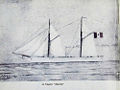 Mexican Navy gunboat Libertad in the 1870s
 -
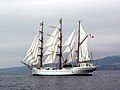 Mexican Navy training ship Cuauhtemoc in 2005

Organization
[edit]The President of Mexico is commander in chief of all military forces. Day-to-day control of the Navy lies with the Navy Secretary, José Rafael Ojeda Durán.[7] In Mexico there is no joint force command structure with the army, so the Secretary reports directly to the President. The Navy has a General Headquarters and three naval forces. There are furthermore eight regions (four on the Pacific coast, three on the Mexican Gulf coast and the Región Naval Central, grouping the naval forces, based in and around the capital Mexico City, such as the 7th Naval Infantry Brigade, the Central Special Operations Group and the Air Transport Squadron), thirteen zones, and fourteen naval sectors.
The Navy is divided into three main services designated as "forces":
Other notable services include:
Officers are trained at the Mexican Naval Academy, called the "Heroica Escuela Naval Militar" ("Heroic Military Naval School"), located in Antón Lizardo, Veracruz.


Naval Infantry
[edit]The Mexican Naval Infantry Corps was reorganized in 2007–2009 into 30 Naval Infantry Battalions (Batallones de Infantería de Marina – BIM), a paratroop battalion, a battalion attached to the Presidential Guard Brigade, two Fast Reaction Forces with six battalions each, and three Special Forces groups.[8] The Naval Infantry are responsible for port security, protection of the ten-kilometer coastal fringe, and patrolling major waterways.
The Naval Infantry also is responsible for 23 National Service Training Units under the responsibility of the Navy Secretary, enforcing the National Service obligation for Mexicans of teenage and young adult age.
Naval Aviation
[edit]Search and rescue units
[edit]In 2008, the Mexican Navy created its new search and rescue system, allocated in strategic ports at Pacific and Gulf of Mexico ports, to provide assistance to any ships which are in jeopardy or at risk due to mechanical failure, weather conditions or life risk to the crew. To provide such support, the Navy has ordered Coast Guard Defender class ships (two per station, and one 47-Foot Motor Lifeboat coast guard vessel). Other stations will be provided only with Defender-class boats.[9]
Maritime role
[edit]On April 1, 2014, SEMAR officially announced the creation of Port Protection Naval Units (Unidades Navales de Protección Portuaria: UNAPROP) which will include a marine section.[10][11] The main task of UNAPROPs is to ensure maritime surveillance and inspection.[12]
Training and education
[edit]


The Navy offers several options for graduate studies in their educational institutions:
It is the school where future officers are trained for the General Corps of the Navy. Candidates can enter upon completing high school. Upon completion of studies, graduates obtain the degree of Sub-Lieutenant and the title of Naval Science Engineer.
- Naval Medical School
This school Located in Mexico City, offers a career in medicine. Officers are trained with skills for the prevention and health care of naval personnel. By adopting a professional examination, graduates are commissioned Sub-Lieutenants.
- Naval Engineering School
In the Naval Engineering School, officers are responsible for the preventive and corrective maintenance of systems and electronic equipment installed on ships and installations of the Mexican Navy. This school offers career of Electronic Engineering and Naval Communications. It is located between the town of Mata Grape and Anton Lizardo, 32 km (20 mi) from the port of Veracruz.
- Naval Nursing School
Here the time to achieve a nursing degree lasts eight semesters. Officers are trained with the knowledge and skills necessary to enable them to assist medical personnel in caring for patients in hospitals, sanatoriums, clinics, health sections on land, aboard ships and at The Naval Medical Center.
- Naval Aviation School
The Naval Aviation School trains pilots for the Mexican Naval Aviation as well as staff from the Federal Preventive Police and Naval personnel from various countries of Central America. This school is located on La Paz, Baja California Sur.[13]
- Search, Rescue and Diving School
Located in Acapulco, members of The Navy are trained for marine search, rescue and diving. It also trains state police officers and firefighters.
Rank insignia
[edit]Commissioned officer ranks
[edit]The rank insignia of commissioned officers.
| Rank group | General / flag officers | Senior officers | Junior officers | |||||||||||||||||||||
|---|---|---|---|---|---|---|---|---|---|---|---|---|---|---|---|---|---|---|---|---|---|---|---|---|
 Mexican Navy[14] Mexican Navy[14] |

|

|

|

|

|

|

|

|

|

|

|

|

|

|

| |||||||||
| Secretario de Marina | Almirante | Vicealmirante | Contraalmirante | Capitán de navío | Capitán de fragata | Capitán de corbeta | Teniente de navio | Teniente de fragata | Teniente de corbeta | Guardiamarina | ||||||||||||||
Other ranks
[edit]The rank insignia of non-commissioned officers and enlisted personnel.
| Rank group | Senior NCOs | Junior NCOs | Enlisted | |||||||||||||||||||||||||||||||||
|---|---|---|---|---|---|---|---|---|---|---|---|---|---|---|---|---|---|---|---|---|---|---|---|---|---|---|---|---|---|---|---|---|---|---|---|---|
| Mexican Navy[14] |

|

|

|

| ||||||||||||||||||||||||||||||||
| Segundo maestre | Tercer maestre | Cabo | Marinero | |||||||||||||||||||||||||||||||||
Modernization and budget
[edit]The annual Navy's budget is in a one to three proportion of the national budget relative to the Mexican Army and Mexican Air Force. The Navy has a reputation for being well-run and well-organized. This reputation allows for a close relationship with the United States Navy (USN), as evidenced by the procurement of numerous former USN ships.
Ships
[edit]The Secretary of the Navy, Admiral Mariano Francisco Saynez Mendoza, announced on October 1, 2007, detailed plans to upgrade and modernize the country's naval capabilities. On the following day, La Jornada newspaper from Mexico City, disclosed the Mexican Navy plans, which are among others, to build six offshore patrol vessels (OPVs) with a length of 86 metres (282 ft), 1,680 tons and each housing a Eurocopter Panther helicopter as well as small high-speed interception boats. The budget for this project is above US$200 million.
Another project is to build 12 CB 90 HMN high speed (50 knots (93 km/h; 58 mph)) interception boats under license from a Swedish boat company Dockstavarvet to the Mexican Navy. Also, a number of fully equipped planes for surveillance and maritime patrol are being considered. Combinations of options and development are being defined.
Shipbuilding
[edit]The Mexican Navy depends upon their naval shipyards for construction and repairs of their ships. There are five shipyards located in the Gulf of Mexico and Pacific Ocean:
- Gulf of Mexico
- Naval shipyard 1 (ASTIMAR 1) – Tampico, Tamaulipas
- Naval shipyard 3 (ASTIMAR 3) – Coatzacoalcos, Veracruz
- Pacific Ocean
Missiles
[edit]The Mexican Navy initiated studies to develop and construct its first missile, according to a May 2005 interview with the undersecretary of the Navy, Armando Sanchez, the missile was to have an average range of 12 to 15 kilometres (7.5 to 9.3 mi) and be able to target enemy ships and aircraft. The undersecretary added that they already had the solid propellant, and the basic design of the missile. All aspects relative to their fuselage were solved as well as the launch platforms. The Mexican Navy was developing the software to direct the missile to its target. In July 2008, the project was reported to be 80% complete. Despite this effort, the missile development was canceled in 2009 due to "problems with the propulsion system".[15]
Radar modernization
[edit]In 2009, the Mexican Navy began operating a batch of new MPQ-64 Sentinel radars in the oil-rich Gulf of Mexico. The radar network was installed in 2007 for a trial phase while military personnel were trained to get familiar with the system. The new installations will work together with combat surface vessels that patrol the area.[16][17]


Present fleet
[edit]| Class | Image | Type | Ships | Origin | |
|---|---|---|---|---|---|
| Frigates (1) | |||||
| Reformador class[18] | .jpg)
|
Multipurpose Frigate | F101 Benito Juárez[19] |  Netherlands/ Netherlands/ Mexico – Ships being built in The Netherlands and Mexico. At least 8 ships planned for fleet modernisation plan. Mexico – Ships being built in The Netherlands and Mexico. At least 8 ships planned for fleet modernisation plan.
| |
| Missile boats (2) | |||||
| Huracán class |  |
Missile boat | A301 Huracán A302 Tormenta |
 Israel – ex-Israeli Navy Sa'ar 4.5-class missile boat Israel – ex-Israeli Navy Sa'ar 4.5-class missile boat
| |
| Patrol vessel and other Warships (35) | |||||
| Oaxaca class | .JPG) |
Offshore patrol vessels | P161 Oaxaca P162 Baja California P163 Independencia P164 Revolución P165 Chiapas[20] P166 Hidalgo[20] P167 Jalisco[21] P168 Tabasco |
Mexico
| |
| Durango class |  |
Offshore Patrol Vessel | P151 Durango P152 Sonora P153 Guanajuato P154 Veracruz |
Mexico
| |
| Sierra class |  |
Corvette | P141 Sierra P143 Prieto P144 Romero |
Mexico
| |
| Holzinger class |  |
Offshore patrol vessels | P131 Holzinger P132 Godínez P133 De la Vega P134 Berriozabal |
Mexico
| |
| Uribe class | Offshore patrol vessels | P122 Azueta P123 Baranda P124 Bretón P125 Blanco P126 Monasterio |
 Spain Spain
| ||
| Valle class | .jpg) |
Converted Minesweeper / Offshore patrol vessels | P102 Juan de la Barrera P103 Mariano Escobedo P104 Manuel Doblado P108 Juan N. Álvarez |
 United States – ex-Auk-class minesweeper United States – ex-Auk-class minesweeper
| |
| Coastal patrol ships (44) | |||||
| Tenochtitlan class[22][23] |  |
Coastal patrol | PC331 Tenochtitlan PC332 Teotihuacan PC333 ARM Palenque PC334 ARM Mitla PC335 ARM Uxmal PC336 ARM Tajin[24] PC337 ARM Tulum[25] PC338 ARM Monte Albán[26] PC339 ARM Bonampak[27] PC340 Chichen Iztzá |
Netherlands/ Mexico Based on Damen Stan Patrol 4207
| |
| Azteca class |  |
Coastal patrol | PC202 Cordova PC206 Rayón PC207 Rejón PC208 De la Fuente PC209 Guzmán PC210 Ramírez PC211 Mariscal PC212 Jara PC214 Colima PC215 Lizardi PC216 Mugica PC218 Velazco PC220 Macías PC223 Tamaulipas PC224 Yucatán PC225 Tabasco PC226 Cochimie PC228 Puebla PC230 Vicario PC231 Ortíz |
United Kingdom Mexico
| |
| Demócrata class | Coastal patrol | PC241 Demócrata PC242 Francisco I. Madero |
Mexico
| ||
| Cabo class | Coastal patrol | PC271 Corriente PC272 Corso PC273 Catoche |
Mexico
| ||
| Punta class | Coastal patrol | PC-281 Morro PC-282 Mastún |
Mexico
| ||
| Interceptors | |||||
| Polaris class |  |
Small Patrol vessel | 44 In service |  Sweden Sweden
| |
| Polaris II class | |
Small Patrol vessel | 6 In service + 17 under construction | Mexico
| |
| Acuario A/B class | Patrol vessel | In service | Mexico
| ||
| Isla class | Patrol boat | In service | Mexico
| ||
| Amphibious ships (2) | |||||
| Papaloapan class | _sits_off_the_coast_of_Mississippi_preparing_to_assist_with_Hurricane_Katrina_relief_efforts_along_the_Gulf_Coast.jpg) |
Tank landing ship | A411 Papaloapan A412 Usumacinta |
United States – ex-USN Newport-class tank landing ship
| |
| Logistic support vessel (2) | |||||
| Montes Azules class |  |
Landing ship | BAL01 Montes Azules BAL02 Libertador (construction completed, inaugurated on September 10, 2012)[28] |
Mexico
| |
| TBD class | Supply ship | BAL11 Isla Madre Launched July 11, 2016.[26] | Netherlands/ Mexico Based on Damen Stan 5009 Fast Crew Supplier
| ||
| Mine counter-measure (6) | |||||
| Banderas class | Minesweeper | Banderas Magdalena Kino Yavaros Chamela Tepoca |
United States
| ||
| Auxiliary vessels | |||||
| Huasteco class | Multipurpose logistics vessel | AMP01 Huasteco AMP02 Zapoteco |
Mexico
| ||
| Maya class | Multipurpose | ATR01 Maya ATR02 Tarasco |
Mexico
| ||
| B.E.Cuauhtémoc class |  |
Three-masted barque sail training ship | BE01 Cuauhtémoc | Spain
| |
The Mexican Navy includes 60 smaller patrol boats and 32 auxiliary ships. It acquired 40 fast military assault crafts, designated CB 90 HMN, between 1999 and 2001 and obtained a production license in 2002, enabling further units to be manufactured in Mexico.
Modern equipment
[edit]| Vehicle/System | Type | Versions | |||
|---|---|---|---|---|---|
| Armoured Vehicles | |||||
| BTR-60/BTR-70 | Amphibious Armored Personnel Carrier | APC-70 | |||
| Carat Security Group | Armoured car | Wolverine (Escorpion) | |||
| Renault Sherpa Light[29] | Light Armored Vehicle | MACK Sherpa Scout | |||
| Land Rover | Military light utility vehicle | Defender 4x4 | |||
| Infantry Transport Vehicles | |||||
| AM General HMMWV[30][31] | Military light utility vehicle | M1026, M1038, M1151 | |||
| Ford-150[32] | Pickup truck | 4x4 F-150 series pick up | |||
| Ford-250[32] | Pickup truck | 4x4 F-250 series pick up | |||
| Dodge Ram[33] | Pickup truck | 4x4 Pick up | |||
| Mercedes-Benz G-Wagen[34][35] | Military light utility vehicle | 4x4 G-class | |||
| Trucks | |||||
| Mercedes-Benz Zetros | Military truck | 6x6 truck | |||
| Ural-4320[36] | Military truck | Off-road 6x6 truck | |||
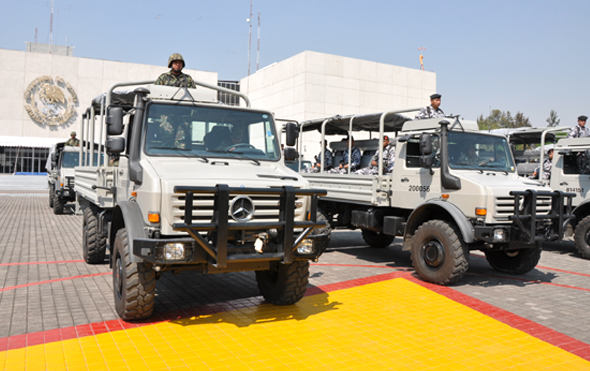
| Unimog U-4000[37][38] | Military truck | 4x4 truck | |||
| Gama Goat[citation needed] | Amphibious 6-wheeled vehicle | 6x6 truck | |||
| Freightliner M2[39] | Truck | 4x2 truck | |||
Individual weapons and equipment
[edit]| Name | Versions | Type |
|---|---|---|
| M16A2 rifle | 5.56×45mm NATO | Assault rifle |
| M4 Carbine | 5.56×45mm NATO | Carbine |
| IMI Galil | 5.56×45mm NATO | Assault rifle |
| Heckler & Koch MP5 | 9×19mm | Submachine gun |
| Heckler & Koch UMP | .45 ACP | Submachine gun |
| FN P90 | 5.7×28mm | Submachine gun |
| Colt M1911 | .45 ACP | Semi-automatic pistol |
| Beretta | 9×19mm Parabellum | Pistol |
| Glock 17 | 9×19mm Parabellum | Semi-automatic pistol |
| Five-seveN | 5.7×28mm | Semi-automatic pistol |
| Heckler & Koch MSG90 | 7.62×51mm NATO | Sniper rifle |
| Barrett M82 | .50 BMG | Anti-material rifle |
| Remington 700 | 7.62×51mm NATO | Sniper rifle |
| FN Minimi | 5.56×45mm NATO | Light machine gun |
| CETME Ameli[40] | 5.56×45mm NATO | Light machine gun |
| GAU-19 | 12.7×99mm NATO | Rotary machinegun |
| M2 Browning machine gun | 12.7×99mm NATO | Heavy machine gun |
| M134 | 7.62×51mm NATO | Rotary machinegun |
| STK 40 AGL | 40mm | Automatic grenade launcher |
| Milkor MGL | 40mm | Grenade launcher |
| M203 grenade launcher | 40mm | Grenade launcher |
| Remington 1100 | 12 | Semi-automatic shotgun |
Artillery
[edit] |
| Name | Versions | Type | ||
|---|---|---|---|---|
| Self-propelled artillery | ||||
| Bofors 40 mm Automatic Gun L/70 | 40mm | Anti-aircraft autocannon | ||
| Oerlikon | 20mm | Anti-aircraft autocannon | ||
| Shipboard anti-aircraft artillery | ||||
| Phalanx CIWS | 20mm | Close in Weapon System | ||
| Multiple rocket launchers | ||||
| FIROS | 122mm | multiple rocket launcher | ||
| Towed artillery | ||||
| OTO Melara Mod 56 | 105mm | Towed howitzer | ||
| K6 | 120mm | Heavy mortar | ||
| M29 | 81mm | Medium mortar | ||
| Brandt LR | 60mm | Light mortar | ||
| Bofors 40 mm Automatic Gun L/60 | 40mm | Towed anti-aircraft autocannon | ||
| Bofors 40 mm Automatic Gun L/70 | 40mm | Towed anti-aircraft autocannon | ||
| Oerlikon | 20mm | Towed anti-aircraft autocannon | ||
| Anti-shipping missiles | ||||
| Gabriel | Mk. II | Anti-ship missile | ||
| RGM-84L Harpoon | Block II | Anti-ship missile | ||
| Anti-aircraft missiles | ||||
| SA-18 | 72.2mm | Surface-to-air missile | ||
| RIM-116[41] | RIM-116 Rolling Airframe Missile (RAM) | Surface-to-air missile | ||
| RIM-162[42] | RIM-162 Evolved SeaSparrow Missile (ESSM) | Surface-to-air missile | ||
| Light anti-tank weapons | ||||
| RPG-75 | Anti-tank weapon | 68mm | ||
| B300 | Rocket-propelled grenade | 82mm | ||
Aircraft inventory
[edit]Future
[edit] | This section needs to be updated. (June 2018) |
For the year 2008 budget, the Mexican Congress approved a US$15 million fund to build only 17 out of the 60 combat boats requested. These ships, designated CB 90 HMN, are to increase the Mexican Navy's fast boat fleet. Additional budgets will be awarded each passing year.[43] In total, the Mexican Navy has over 189 operational ships.[4]
In January 2013, the 112th Session of US Congress authorized the transfer of the Oliver Hazard Perry-class frigates USS Curts and USS McClusky to the Mexican Navy,[44] but due to the cost of overhauling the vessels and the removal of all the weapons systems and most of the electronics and radar gear by the USN prior to transfer, this is still undecided by Mexico. The offer expired on January 1, 2016.[44]
2014
[edit]On March 25, 2014 Beechcraft Corporation received an order of 2 T-6C+ military trainers from the Mexican Navy.[45]
On June 24, 2014, the Mexican Government requested the purchase of 5 UH-60Ms in USG configuration from the U.S.; its estimated cost is $225 million.[46] Also on June 24, BAE Systems announced it was awarded a contract by the Mexican Government to supply the navy with 4 Mk 3 57mm naval guns, for the ships of the Reformador class.[47]
See also
[edit]References
[edit]- ^ "Día de la Marina". sct.gob.mx. Archived from the original on May 31, 2015. Retrieved December 24, 2014.
- ^ "Mission and objectives" Archived July 7, 2007, at the Wayback Machine (in Spanish)
- ^ "Secretaria de Marina – Armada de México". Archived from the original on September 24, 2015. Retrieved December 24, 2014.
- ^ a b [1] Archived September 11, 2008, at the Wayback Machine Rendición de cuentas SEMAR 2006 página 40
- ^ "Material Aereo" Archived February 5, 2007, at the Wayback Machine(outdated page) (in Spanish)
- ^ "History of the Mexican Navy ships". Archived from the original on January 10, 2010. Retrieved April 1, 2017.
- ^ "Secretaría de Marina | Gobierno | gob.mx". Archived from the original on June 6, 2016. Retrieved June 23, 2016.
- ^ Informe 2009 Secretaria de Marina – Armada de México[permanent dead link]
- ^ "Textron Systems Brand Change". Archived from the original on June 13, 2009. Retrieved December 24, 2014.
- ^ "Mexican Navy increasing coast guard capabilities". Jane's. Archived from the original on December 24, 2014. Retrieved December 24, 2014.
- ^ Noticieros Televisa (March 31, 2014). "Crea Marina Unidades Navales de Protección Portuaria". televisa.com. Archived from the original on December 24, 2014. Retrieved December 24, 2014.
- ^ "Unidades de Marina vigilarán 19 puertos del país a partir del martes". Excélsior. March 31, 2014. Archived from the original on December 24, 2014. Retrieved December 24, 2014.
- ^ SIAL Sistema Informativo Aeronáutico Latinoamericano Archived July 6, 2012, at the Wayback Machine
- ^ Mexican Naval missile Archived July 2, 2013, at the Wayback Machine (in Spanish)
- ^ "En marzo iniciarán operaciones radares de la Armada" (in Spanish). NOTIMEX. December 27, 2008. Archived from the original on December 29, 2008. Retrieved December 27, 2008.
- ^ "ThalesRaytheonSystems receives contract to support Mexican homeland security, protect Gulf oil infrastructure". Thales Raytheon Systems. May 11, 2006. Archived from the original on October 13, 2008. Retrieved December 27, 2008.
- ^ "En la presente Administración se impulsa el desarrollo de la Flota Naval con el Diseño, Construcción y Reparación de Buques de la SEMAR". Archived from the original on October 8, 2018. Retrieved October 7, 2018.
- ^ "Launch date scheduled for Mexico's long-range patrol vessel". Archived from the original on October 8, 2018. Retrieved October 7, 2018.
- ^ a b "3er Informe De Labores" (PDF). Archived (PDF) from the original on October 4, 2015. Retrieved October 3, 2015.
- ^ "La Secretaría de Marina pone a flote la Patrulla Oceánica ARM "HIDALGO" para la Armada de México". Archived from the original on September 20, 2016. Retrieved September 5, 2016.
- ^ "Fourth Damen Stan Patrol 4207 patrol vessel for Mexican Navy". August 23, 2013. Archived from the original on September 15, 2013. Retrieved August 23, 2013.
- ^ "Mexican Navy contracts Damen for fifth Tenochtitlan-class Patrol Vessel (Stan Patrol 4207)". December 12, 2013. Archived from the original on December 18, 2013. Retrieved December 18, 2013.
- ^ "Mexican Navy orders sixth Tenochtitlan-class Patrol Vessel (Stan Patrol 4207) from DAMEN". April 1, 2014. Archived from the original on April 7, 2014. Retrieved April 4, 2014.
- ^ "MEXICAN NAVY AND DAMEN SIGN CONTRACT FOR TWO VESSELS". Archived from the original on November 29, 2014. Retrieved April 3, 2015.
- ^ a b "LA SECRETARÍA DE MARINA-ARMADA DE MÉXICO REALIZA BOTADURA DEL BUQUE DE APOYO LOGÍSTICO ARM "LIBERTADOR" (BAL-02), EN SALINA CRUZ, OAXACA". Archived from the original on July 13, 2016. Retrieved July 14, 2016.
- ^ "4° Informe de Gobierno" (PDF). Presidencia de la República. September 1, 2016. Archived (PDF) from the original on September 16, 2016. Retrieved September 2, 2016.
- ^ "La Secretaría de Marina- Armada de México realiza la botadura de la patrulla costera Arm "Monte Albán" (PC-338)". Archived from the original on September 14, 2012. Retrieved September 12, 2012.
- ^ "Mexican military parades variety of new equipment – IHS Jane's 360". September 21, 2016. Archived from the original on September 21, 2016.
- ^ "AM General Exhibe el Humvee HMMWV M1151B1 en DITDEF 2013". Infodefensa.com. May 19, 2013. Retrieved January 18, 2020.
- ^ "México incorporó más de 6.000 vehículos en seis años". Infodefensa.com. June 9, 2018. Retrieved January 18, 2020.
- ^ a b "Secretaria de Marina – Armada de México". Archived from the original on September 24, 2015. Retrieved December 24, 2014.
- ^ "Secretaria de Marina – Armada de México". Archived from the original on September 24, 2015. Retrieved December 24, 2014.
- ^ "Recibe Semar vehículos para incrementar capacidad operativa". EL INFORMADOR. Archived from the original on December 29, 2016. Retrieved December 24, 2014.
- ^ "LA SECRETARÍA DE MARINA CONTINÚA INCREMENTANDO SU CAPACIDAD OPERATIVA CON UNIDADES TODO TERRENO". Archived from the original on July 16, 2011. Retrieved July 26, 2009.
- ^ "Another Batch of Russian Trucks to be Shipped to Latin America". Archived from the original on January 3, 2017. Retrieved January 2, 2017.
- ^ "Secretaria de Marina – Armada de México". Archived from the original on September 24, 2015. Retrieved December 24, 2014.
- ^ "Unimog Image". Archived from the original on February 13, 2010. Retrieved September 29, 2009.
- ^ "Secretaria de Marina – Armada de México". Archived from the original on September 24, 2015. Retrieved December 24, 2014.
- ^ "CETME Ameli". Archived from the original on July 28, 2009. Retrieved November 22, 2009.
- ^ "Raytheon delivers RAM launcher for Mexican Navy POLA OPV". Archived from the original on October 23, 2018. Retrieved October 23, 2018.
- ^ "Mexico buying Evolved Seasparrow missiles for new Sigma corvette". Archived from the original on August 15, 2018. Retrieved November 21, 2018.
- ^ It was published within the Chapter 13 of the SEMAR 2008 final budget, by the SHCP, the Mexican finance ministry for this period.
- ^ a b "H.R. 6649 (112th): Naval Vessels Transfer Act of 2012". USA 112th CONGRESS, 2nd. session, H. R. 6649. govtrack.us. January 1, 2013. Archived from the original on March 23, 2013. Retrieved April 13, 2013.
- ^ "Textron – Mexican Navy places initial order for Beechcraft T-6C+ trainers". Archived from the original on December 24, 2014. Retrieved December 24, 2014.
- ^ "Mexico – UH-60M Black Hawk Helicopters – The Official Home of the Defense Security Cooperation Agency". Archived from the original on December 24, 2014. Retrieved December 24, 2014.
- ^ "Newsroom – BAE Systems". Archived from the original on December 24, 2014. Retrieved December 24, 2014.

External links
[edit]- Secretary of the Navy Official site (Spanish)
- Naval Infantry official site (Spanish)
| Statutory holidays |
|
|---|---|
| Civic holidays | |
| Festivities |
|
Mexican Navy
View on GrokipediaHistory
Origins and Formation (16th-19th Centuries)
During the 16th to 18th centuries, maritime activities in the territory of New Spain were conducted under the auspices of the Spanish Crown, with no independent Mexican naval force existing. Spanish naval expeditions, including Hernán Cortés's voyages in 1519 and subsequent treasure fleets (flotas de Indias), facilitated conquest, trade, and defense against pirates and rival European powers such as England and the Netherlands. Coastal fortifications like San Juan de Ulúa in Veracruz and ports such as Acapulco served as hubs for galleon trade with the Philippines, while ad hoc Spanish squadrons patrolled against incursions, but these operations were directed from Madrid and lacked local autonomy.[3] The Mexican War of Independence (1810–1821) featured minimal organized naval engagement, as insurgents under figures like Miguel Hidalgo y Costilla focused on land campaigns, relying on captured Spanish vessels or privateers for sporadic maritime actions rather than a formal fleet. Following the consummation of independence on September 27, 1821, with Agustín de Iturbide's Trigarante Army entering Mexico City, the new government prioritized naval establishment to secure sovereignty and counter Spanish remnants. On October 4, 1821, Iturbide decreed the creation of the Secretariat of War and Navy (Secretaría de Estado de Guerra y Marina), marking the formal origins of the Armada de México, initially under Antonio de Medina Miranda, to organize coastal defense and administration.[8][9][10] Early formation involved acquiring vessels from the United States and local sources; in 1822, naval departments were established in Veracruz, Campeche, and San Blas, with the schooner Iguala—purchased by agent Eugenio Cortés y Azúa—becoming the first to hoist the Mexican tricolor flag on April 17 upon arriving in Veracruz. This initial squadron, including schooners Anáhuac, Libertad, Bravo, and Victoria, enforced a blockade against the Spanish-held fortress of San Juan de Ulúa from September 8, 1823, to November 23, 1825, culminating in its surrender and affirming Mexico's maritime independence. By 1826, under U.S. Commodore David Porter's command (hired to professionalize the force), the navy expanded to include frigates Guadalupe and Moctezuma, enabling operations like the 1828 Battle of Mariel against Spanish forces.[3][9][11] The navy's structure remained integrated with the army under the joint secretariat until the late 19th century, hampered by chronic underfunding, internal political instability, and reliance on foreign advisors, yet it laid foundational roles in sovereignty enforcement amid 19th-century threats from Spain, Texas, France, and the United States. Key early commanders like Pedro Sainz de Baranda directed the Ulúa blockade, emphasizing the shift from colonial dependence to nascent national capability despite limited resources—often fewer than a dozen vessels by the 1830s.[3][12]19th and Early 20th Century Conflicts
During the Pastry War (1838–1839), the Mexican Navy confronted a French naval squadron that imposed a blockade on key Gulf of Mexico ports, including Veracruz, to enforce debt repayments demanded by France. In November 1838, French forces under Rear Admiral Charles Baudin bombarded Veracruz and seized the Mexican naval base at Frontera, capturing much of the Mexican fleet, which consisted of outdated vessels unable to mount effective resistance. The blockade persisted until March 1839, when Mexico agreed to pay 600,000 pesos in reparations, highlighting the navy's vulnerability to European naval power due to chronic underfunding and obsolescent ships.[13][14] In the Mexican–American War (1846–1848), the Mexican Navy, comprising fewer than a dozen seaworthy ships including corvettes and brigs, focused on coastal defense and attempts to challenge the U.S. blockade of Pacific and Gulf ports. U.S. naval forces under Commodore David Conner and later Matthew C. Perry rapidly neutralized these efforts by capturing key vessels and establishing dominance, such as the seizure of Monterey and San Francisco in 1846. Mexican naval operations, constrained by shortages of crew, ammunition, and maintenance, inflicted minor delays on U.S. advances but failed to break the blockade or protect maritime trade routes, contributing to Mexico's strategic isolation. By war's end, the navy had lost most operational capability, with remaining ships scuttled or captured.[15][16] The Second French Intervention (1861–1867) saw limited Mexican naval involvement, as French warships blockaded Pacific ports like Acapulco and Manzanillo to support Emperor Maximilian's regime, while Mexican republican forces prioritized land resistance. The navy's remnants, still recovering from prior defeats, conducted sporadic guerrilla-style raids and transport missions for President Benito Juárez's supporters but lacked the strength for fleet engagements against the superior French squadron. This period underscored ongoing challenges of modernization, with Mexico relying more on privateers and Allied smuggling than organized naval combat.[17] In the early phases of the Mexican Revolution (1910–1920), the Navy aligned variably with factions but primarily supported constitutionalist leader Venustiano Carranza after 1914, enforcing coastal blockades against rebel ports and transporting troops. Notable actions included patrols during the 1914 U.S. occupation of Veracruz, where Mexican naval units avoided direct confrontation to preserve assets, and efforts to intercept arms shipments to revolutionaries like Pancho Villa. However, internal mutinies and factional splits limited effectiveness, with the navy playing a supportive rather than decisive role in the civil conflict.[3]Mid-20th Century Expansion and Cold War Era
Following Germany's sinking of two Mexican oil tankers, Potrero del Llano on May 13, 1942, and Faja de Oro on May 20, 1942, Mexico declared war on the Axis powers on May 22, 1942, marking its entry into World War II as an active belligerent. The Mexican Navy's operational role remained primarily defensive, focused on convoy protection in the Gulf of Mexico and coastal patrols to counter U-boat threats, though no major naval engagements occurred. This involvement underscored the Navy's limitations in blue-water capabilities but facilitated post-war access to U.S. military aid and surplus equipment, aligning with Mexico's strategic interest in bolstering maritime sovereignty without formal alliances.[18] In the immediate post-war period, the Navy expanded significantly through acquisitions of decommissioned U.S. vessels, beginning in 1947 with gunboats (cañoneros), frigates, and corvettes repurposed for patrol and escort duties. These included Tacoma-class patrol frigates and other escort types transferred under mutual defense agreements, enhancing fleet numbers from a pre-war handful of aging ships to over a dozen combatant vessels by the early 1950s. Concurrently, on January 1, 1940, the Secretariat of the Navy (Secretaría de Marina) achieved full cabinet-level independence from the Secretariat of War and Navy, enabling dedicated budgeting and operational autonomy that supported infrastructure development, such as expanded bases at Veracruz and Manzanillo. This administrative reform, rooted in interwar professionalization efforts, allowed the Navy to prioritize modernization over joint army-navy subordination.[19][20] During the Cold War, the Mexican Navy maintained a non-aligned posture reflective of Mexico's foreign policy, emphasizing coastal defense, fisheries protection, and search-and-rescue operations rather than expeditionary roles or ideological confrontations. Fleet upgrades in the 1950s and 1960s incorporated radar systems, improved anti-submarine warfare sensors, and limited domestic construction of patrol craft, with acquisitions like ex-U.S. destroyer escorts sustaining capabilities amid growing offshore oil exploration in the Gulf. By the 1970s, the service had shifted focus to exclusive economic zone enforcement following 1976 oil discoveries, commissioning its first purpose-built oceanographic vessels and initiating submarine programs, though personnel remained modest at around 20,000-30,000, prioritizing efficiency over mass expansion. These developments ensured maritime territorial integrity without entanglement in superpower rivalries, supported by bilateral training exchanges with the U.S. despite Mexico's aversion to formal pacts.[21][9]Contemporary Developments and Anti-Cartel Role (1980s-Present)
In the 1980s, the Mexican Navy underwent significant modernization, acquiring new vessels such as six 844-ton patrol boats and benefiting from substantial investments in equipment and infrastructure to enhance maritime patrol capabilities amid growing concerns over territorial waters and resource protection.[22][23] By the 1990s, domestic shipyards under the Secretariat of the Navy (SEMAR) began producing platforms like the Holzinger-class offshore patrol vessels, expanding the fleet to include over 80 interceptor craft and 31 ocean patrol vessels by the early 2000s, focusing on coastal defense and anti-smuggling interdiction.[23][21] The 2000s and 2010s saw further fleet expansion through indigenous construction, with the delivery of Oaxaca-class patrol vessels in 1999–2004 and Durango-class in the mid-2000s, alongside plans for advanced corvettes like the Sigma 10514 design, culminating in the commissioning of the Reformador-class frigate ARM Benito Juárez in 2023 as one of Latin America's most modern surface combatants equipped with anti-air and anti-submarine systems.[24][25] SEMAR's shipbuilding program produced 14 military vessels between 2012 and 2018, including logistical support ships, while ongoing efforts aim to add 18 new units by 2030, such as Patrullas Oceánicas de Largo Alcance (POLA) warships, to reach a total fleet exceeding 189 ships supported by approximately 130 aircraft.[24][26][27] Radar upgrades, including MPQ-64 Sentinel systems deployed in 2009, bolstered surveillance in the Gulf of Mexico, reflecting a strategic pivot toward integrated maritime domain awareness.[23] The Navy's role intensified in the 2000s as drug cartels expanded maritime trafficking routes, prompting SEMAR to deploy Infantería de Marina (Naval Infantry) units for joint operations with the army under President Felipe Calderón's 2006 initiative to dismantle cartel networks, focusing on Pacific and Gulf interdictions where semi-submersible vessels ("narco subs") evaded traditional patrols.[28] Naval forces conducted high-profile raids, including the December 2009 killing of Sinaloa Cartel leader Arturo Beltrán Leyva in Cuernavaca, which disrupted Beltrán-Leyva Organization finances, and the 2012 capture of Gulf Cartel boss Mario Cárdenas Guillén ("El Coss") in Tamaulipas, yielding weapons caches and intelligence on smuggling tunnels.[28][29] Infantería de Marina spearheaded captures of key figures, such as Zetas co-founder Eduardo "El Lucky" Solis in 2015 and Joaquín "El Chapo" Guzmán's 2016 recapture in Los Mochis, operations often supported by U.S. intelligence but executed by elite Mexican naval units trained for urban combat and rapid insertion.[30] More recently, marines arrested Gulf Cartel operative José Inés "La Kena" García Zetina in January 2024 near the U.S. border, alongside seizures like the October 2024 interdiction of 8.3 tons of cocaine from narco subs off Guerrero, the largest single maritime haul in Mexican history valued at over $200 million wholesale.[31][32] These efforts have netted thousands of cartel operatives and disrupted fentanyl precursors, though cartel adaptation—via drone surveillance and militarized convoys—has sustained violence, with naval deployments expanding under subsequent administrations to over 20,000 personnel in high-risk zones despite documented risks of corruption in broader security forces.[33][34] By 2025, SEMAR's anti-cartel mandate integrates cybersecurity and port control reforms proposed under President Claudia Sheinbaum, emphasizing autonomous naval operations amid U.S.-Mexico cooperation on fentanyl routes, while fleet investments prioritize versatile platforms for sustained interdiction in Mexico's exclusive economic zone spanning over 3 million square kilometers.[35][23]Organization
Command and Administrative Structure
The Mexican Navy, formally the Armada de México, operates under the Secretariat of the Navy (Secretaría de Marina, SEMAR), with the President of the Republic as supreme commander of the nation's armed forces. The Secretary of the Navy, holding the rank of admiral and appointed by the President, exercises high command, administering naval power, directing doctrine, policy, and strategy, and ensuring operational readiness. As of October 1, 2024, Almirante Raymundo Pedro Morales Ángeles serves in this role, having previously commanded key naval regions.[36][37][38] Administratively, SEMAR is divided into the Subsecretariat of the Navy, which oversees personnel, training, and resource allocation, and the Chief Clerk's Office (Oficialía Mayor), responsible for logistics, procurement, and financial management, supported by specialized general directorates for planning, legal affairs, and infrastructure. These components ensure the Navy's sustainment, with the Subsecretariat focusing on internal governance and the Chief Clerk's Office on efficient resource distribution to maintain fleet and personnel capabilities.[39] Operationally, the Cuartel General del Alto Mando Naval (High Naval Command Headquarters), based in Mexico City and commanded by a vice admiral subordinate to the Secretary, coordinates doctrine implementation and force deployment. It directs two primary naval forces—the Pacific Naval Force and the Gulf Naval Force—organized into seven naval regions (e.g., First Region in Veracruz, Second in Guaymas), further subdivided into 13 zones and approximately 17 sectors as of 2022 expansions to enhance coastal coverage and response efficacy. Regional commanders, typically vice admirals, manage local operations, including maritime enforcement and defense within assigned jurisdictions.[40][38][41]Naval Infantry (Marines)
The Infantería de Marina forms the marine corps component of the Mexican Navy, specializing in amphibious operations, coastal security, and rapid response missions to protect national sovereignty over maritime territories. Established following Mexico's independence in 1821, the force has grown to encompass specialized battalions focused on expeditionary warfare and internal security support. As of 2010, it comprised approximately 19,238 personnel organized across naval regions.[42] Structurally, the Naval Infantry is divided into 30 battalions (Batallones de Infantería de Marina, or BIM), with 28 grouped into eight regional brigades aligned with Mexico's naval commands, plus dedicated paratroop, artillery, and reaction force units. These brigades enable deployment from Pacific, Gulf, and Caribbean bases, facilitating quick mobilization for maritime interdiction and land-based contingencies. The organization emphasizes modular units capable of independent action or integration with naval assets for joint operations.[43] Training regimens underscore elite infantry standards, including annual offerings of over 27 specialized courses covering amphibious tactics, urban combat, and counter-insurgency, with nearly 19,000 training slots provided to maintain operational readiness. Collaborations with foreign partners, such as U.S. Marine Corps exchanges, enhance capabilities in areas like small-unit leadership and equipment handling.[44] Armed with light infantry weapons including assault rifles, machine guns, and mortars, supplemented by 105mm towed howitzers and 106mm recoilless rifles for fire support, the marines prioritize mobility and firepower in littoral environments. Since the mid-2000s escalation against drug cartels, their role has expanded to inland patrols and high-risk captures, such as the 2015 operation eliminating Joaquín "El Chapo" Guzmán, leveraging rapid insertion via helicopters and naval vessels. This shift reflects the navy's strategic emphasis on less-corruptible forces for confronting organized crime, with marines conducting permanent anti-narcotics interdictions yielding thousands of tons of seized contraband annually.[45][43][46]Naval Aviation
The Mexican Naval Aviation, or Fuerza Aeronaval, traces its origins to 1918, when a domestically constructed float biplane was successfully tested by pilot Carlos Santa Ana at the Port of Veracruz, marking the inception of organized naval air operations in Mexico.[47] Formal training for naval pilots began in 1946 with the first complete course at the Escuela de Aviación Naval, evolving from post-World War II acquisitions of amphibious aircraft to support maritime reconnaissance and rescue missions.[48] Operated under the Unidad de Aeronáutica Naval within the Secretaría de Marina, the force comprises fixed-wing and rotary-wing aircraft organized into 22 squadrons across 9 naval air bases, including La Paz in Baja California Sur and Antón Lizardo in Veracruz.[49][50] These bases facilitate operations along Mexico's Pacific, Gulf, and Caribbean coasts, with squadrons dedicated to interception, reconnaissance, and utility roles.[51] In 2024, the Fuerza Aeronaval executed over 70,500 naval operations, underscoring its integral support to surface and infantry units.[50] Fixed-wing assets include maritime patrol aircraft such as CN-235 turbo-props for surveillance and transport, alongside Beechcraft King Air 350 variants adapted for medical evacuations, with at least five units noted for rapid response during health crises like COVID-19.[49] Rotary-wing inventory features utility helicopters like the MBB BO 105 for search and rescue, alongside larger models for anti-submarine warfare and troop transport, contributing to coastal patrol and interdiction efforts.[52] Modernization efforts emphasize reliable, multi-role platforms to enhance maritime domain awareness and humanitarian support.[52] Primary roles encompass search and rescue, maritime surveillance, aerial reconnaissance, and logistical support to naval deployments, including medical evacuations and disaster response.[53] Pilots undergo rigorous training at the Escuela de Aviación Naval, focusing on theoretical instruction, flight proficiency, and operational integration with naval forces.[49] The component's effectiveness stems from its alignment with broader naval objectives, prioritizing empirical operational data over expansive fleet growth.Specialized Units and Support Forces
The Unidad de Operaciones Especiales de la Armada de México (UNOPES), established as an independent brigade-level unit under the Ley Orgánica de la Armada de México, serves as the primary command for conducting high-risk special operations, including direct action raids, unconventional warfare, and maritime counter-terrorism missions.[54] This unit integrates specialized groupings focused on rapid deployment and precision strikes, often in support of broader naval infantry operations against organized crime and threats to national sovereignty.[55] UNOPES personnel undergo advanced training in tactics such as close-quarters battle, hostage rescue, and amphibious insertions, with capabilities enhanced through international cooperation, including joint exercises with U.S. special forces.[56] Within UNOPES, the Fuerzas Especiales (FES), formed on April 1, 2001, as the elite special missions component of the Mexican Navy, specializes in counter-narcotics interdictions, high-value target captures, and disruption of transnational criminal networks.[57] FES operators, numbering in specialized teams rather than large battalions, receive rigorous selection processes involving physical endurance tests, combat simulations, and specialized skills like diving and parachuting, culminating in basic courses that produce cohorts such as the 30th generation graduating in October 2025 with 12 personnel.[58] These forces have executed operations resulting in the apprehension of cartel leaders, leveraging naval assets for coastal and riverine assaults, though their effectiveness is constrained by broader institutional challenges in intelligence sharing and resource allocation.[59] Support forces augment operational capabilities through dedicated units like the Unidad de Inteligencia Naval, which conducts maritime surveillance, signals intelligence, and threat assessment to inform tactical decisions and prevent smuggling incursions.[55] Complementing this, the Unidad de Policía Naval enforces naval law, performs investigations into onboard crimes, and secures ports, while the Unidad de Investigación y Contrainteligencia Naval counters espionage and internal threats, ensuring force integrity amid heightened anti-cartel engagements.[55] Logistical support derives from administrative directorates under the Oficialía Mayor, providing sustainment for extended deployments, though detailed inventories of auxiliary vessels and equipment remain classified or underreported in public disclosures.[39] These elements collectively enable sustained projection of naval power, prioritizing empirical operational outcomes over doctrinal expansions.Roles and Operations
Maritime Security and Sovereignty Enforcement
The Mexican Navy, operating as the National Maritime Public Authority under the Secretariat of the Navy (SEMAR), holds primary responsibility for asserting and enforcing maritime sovereignty across Mexico's territorial seas, contiguous zones, exclusive economic zone (EEZ) spanning approximately 3 million km², and continental shelf. This mandate encompasses surveillance of the nation's 11,122 km coastline, prevention of foreign incursions, regulation of navigation safety, and interdiction of activities undermining national jurisdiction, such as unauthorized resource extraction or vessel violations.[60][61] Patrol operations rely on a mix of surface vessels—including coastal patrol boats constructed domestically at SEMAR shipyards and longer-range platforms like the Oaxaca-class ocean patrol ships designed for extended EEZ surveillance—and aviation assets for aerial monitoring. These assets enable sustained presence to detect and respond to sovereignty threats, with recent incorporations of new aircraft in 2025 enhancing coverage over remote maritime domains. Legislative amendments in May 2024 expanded naval powers to pursue, board, and inspect flagged or stateless vessels suspected of infractions, directly bolstering enforcement against non-compliant actors.[62][61][63] A core focus of sovereignty enforcement involves combating illegal, unreported, and unregulated (IUU) fishing, which depletes resources in protected waters and challenges jurisdictional control. In the first half of 2025, SEMAR-led operations seized 4,266 tons of illegal fishing gear and products nationwide, reflecting intensified interdictions amid persistent threats to biodiversity hotspots like the Gulf of California. Specific actions include deploying anti-trawling devices and patrols in vaquita porpoise refuges since 2022 to curb gillnet use tied to totoaba poaching, alongside detentions of vessels in areas such as the Islas Marías Biosphere Reserve.[64][65][66] Since June 2017, Naval Infantry (marines) have administered 103 commercial ports, integrating land-based security with maritime patrols to seal sovereignty gaps at key chokepoints vulnerable to smuggling networks that erode control. In October 2025, President Claudia Sheinbaum advanced reforms to grant SEMAR expanded oversight of ports, customs enforcement, and cybersecurity domains, aiming to integrate digital surveillance with physical patrols for holistic sovereignty defense. These measures address empirical gaps in prior frameworks, where fragmented authority allowed evasion, though operational effectiveness remains constrained by resource limits and adaptive illicit tactics.[67][35]Anti-Narcotics and Anti-Smuggling Operations
The Mexican Navy, through its Secretariat of the Navy (SEMAR), conducts extensive maritime patrols and interdictions targeting drug smuggling routes originating from South America, primarily via the Pacific and Caribbean approaches to Mexico's 11,000-kilometer coastline. These operations focus on detecting and neutralizing semi-submersible vessels, speedboats, and fishing trawlers adapted for narcotics transport by cartels including the Sinaloa Cartel and Jalisco New Generation Cartel, which exploit Mexico's ports and exclusive economic zone for transshipment of cocaine destined for the United States.[6][33] Since the intensification of Mexico's federal response to organized crime in 2006, the Navy has shifted resources toward coastal enforcement, deploying fast patrol boats, helicopters, and naval infantry for boarding actions, often in coordination with aerial surveillance and intelligence from the National Intelligence Center.[7] Annual seizures underscore the scale of these efforts, with SEMAR reporting record cocaine interdictions in 2023, surpassing prior years amid heightened focus on Pacific routes where over 90% of detected loads originate.[6] In the first six months of President Claudia Sheinbaum's term beginning October 2024, naval units confiscated nearly 30 tons of cocaine at sea, equivalent to thousands of kilograms per operation in some cases.[68] Key examples include the June 2025 interception of a semisubmersible vessel off Guerrero carrying 3.5 tons of cocaine valued at approximately $43 million, and a May 2025 seizure of 1.285 tons off Michoacán, both involving coordinated naval-air assets to pursue and board suspect craft.[69][70] By mid-2025, cumulative seizures under the new administration exceeded 44.8 tons, reflecting sustained operational tempo despite cartel adaptations like low-profile "narco-subs."[71] Beyond narcotics, anti-smuggling operations target fuel theft (huachicol), arms, and contraband via port inspections and tanker monitoring, as the Navy administers major facilities like Manzanillo and Veracruz. In 2025, these efforts yielded historic fuel seizures alongside drugs, but revelations of internal corruption— including the September arrests of 14 personnel, among them officers, for facilitating a billion-dollar huachicol network—highlighted vulnerabilities in naval oversight of smuggling hubs.[68][72][73] International cooperation bolsters these missions, with joint interdictions alongside the U.S. Coast Guard yielding disruptions of smuggling ventures off Baja California and shared intelligence targeting cartel maritime logistics.[74] U.S. agencies, including CIA-supported special units embedded with Mexican naval forces, have aided in tracking high-value targets since the 2010s, though operational details remain classified.[33] Despite measurable intercepts, persistent cartel innovation and occasional institutional graft underscore the limits of unilateral enforcement in stemming flows estimated at hundreds of tons annually.[72][73]Disaster Response and Humanitarian Missions
The Mexican Navy executes disaster response operations primarily through Plan Marina, a contingency framework established to provide auxiliary support to civilian populations in emergencies or disaster zones, utilizing naval assets such as ships, aircraft, and specialized personnel in coordination with federal, state, and municipal authorities.[75] This plan emphasizes phases of prevention, preparation, assistance, recovery, and reconstruction, enabling rapid deployment of search-and-rescue teams, medical units, and logistics for damage assessment and relief distribution, particularly in coastal or maritime-affected areas.[76] The Navy's involvement stems from its maritime expertise, including helicopter evacuations and amphibious capabilities, which complement the Army's inland-focused Plan DN-III-E. In domestic responses, the Navy has mobilized for major natural disasters, including earthquakes and hurricanes. During the September 2017 earthquakes in central Mexico, which registered magnitudes of 8.2 and 7.1 and caused over 370 deaths, Navy urban search-and-rescue (USAR) teams, including canine units like the Labrador Retriever Frida—who contributed to locating 40 bodies and aiding in 12 live rescues across multiple operations—participated in rubble clearance and survivor extraction in Mexico City and other affected regions.[77] More recently, following torrential rains and flooding from October 7-11, 2025, in states including Veracruz, Hidalgo, Puebla, and Querétaro, the Navy activated Plan Marina, deploying 18 emergency response brigades comprising 4,300 personnel, who cleared 88 roads and 101 thoroughfares, distributed 600 rations, and conducted aerial surveys and supply drops using helicopters to assist over 2,900 affected individuals.[78][79] In Hurricane Otis's 2023 landfall on Acapulco, which inflicted Category 5 damage with winds exceeding 260 km/h, Navy AS565MBe Panther helicopters performed immediate victim rescues and damage assessments in the initial hours post-impact.[80] Humanitarian missions extend internationally, leveraging naval vessels for aid delivery. In response to Haiti's August 2021 magnitude 7.2 earthquake, which killed over 2,200 and displaced hundreds of thousands, the Mexican Navy transported 1,729 tons of relief supplies—including food packages, hygiene kits, clothing, tents, and medical equipment—aboard ships to Port-au-Prince, facilitating medical support and infrastructure aid.[81] Similarly, following Hurricane Katrina's 2005 devastation in the United States, Navy personnel joined cleanup and aid efforts in Harrison County, Mississippi, providing hot meals to evacuees and assisting in debris removal alongside U.S. forces, marking one of Mexico's early cross-border humanitarian deployments.[82] These operations underscore the Navy's role in both immediate life-saving interventions and sustained recovery, often integrating with multinational efforts to enhance response efficacy.[83]International Cooperation and Joint Exercises
The Mexican Navy, through the Secretariat of the Navy (SEMAR), engages in international cooperation primarily via participation in multinational maritime exercises aimed at enhancing interoperability, maritime security, and regional stability. These efforts focus on joint training in areas such as amphibious operations, anti-submarine warfare, and humanitarian assistance, often involving Latin American partners alongside the United States and other allies.[84][85] A cornerstone of this cooperation is the annual UNITAS exercise, initiated in 1959 as the world's longest-running multinational maritime drill. Mexico has consistently contributed naval assets, including patrol vessels like ARM Oaxaca (PO-161) and ARM Rio Papaloapan (A-411), to phases involving live-fire gunnery, boarding operations, and combined force integration. In UNITAS 2024, held September 2-12 across Pacific waters with 24 nations and over 4,300 personnel, Mexican forces executed combined exercises in maritime, air, and ground domains. UNITAS 2025, spanning multiple East Coast U.S. locations including Naval Station Mayport from September 2025, featured Mexican participation alongside 25 nations, emphasizing urban operations training and amphibious assaults with U.S. Marines.[86][87][88] The Mexican Navy also joins RIMPAC, the largest international maritime exercise, hosted biennially by the U.S. Pacific Fleet. During RIMPAC 2024 (June 27-August 1), involving 29 nations, 40 surface ships, and 25,000 personnel, Mexico deployed a naval task force to the Pacific Warfighting Center for integrated training, including amphibious raids with multinational forces from 10 countries. This marked sustained involvement, building on prior editions to practice complex scenarios like search-and-rescue coordination.[89][90][91] Additional engagements include TRADEWINDS, a Caribbean-focused exercise for countering illicit trafficking and disaster response. Mexico concluded participation in TRADEWINDS 2024 on May 19 in Barbados with 25 nations, conducting trilateral sea-air-ground drills after nearly a decade of escalating contributions. Bilateral exercises, such as Fuerzas Amigas in July 2024 with U.S. forces on chemical decontamination and search-and-rescue, and the approved Fénix 2025 hosting 155 U.S. Marines for maritime defense training, further bilateral ties with the U.S. In 2024 alone, SEMAR committed to at least seven such multinational drills, including Solidarex in Peru.[85][92][93]Training and Personnel
Recruitment, Training Programs, and Education
Recruitment into the Mexican Navy is conducted on a voluntary basis, regulated by the Reglamento de Reclutamiento y Reenganches de Personal Naval, which outlines processes for initial enlistment and reenlistment at naval zones and installations.[94] Enlisted personnel, such as marineros in the Infantería de Marina, must be Mexican by birth, aged 18 to 30 years, meet minimum height requirements (1.63 meters for males), and have a body mass index between 18.5 and 24.9, along with completion of secondary or preparatory education.[95] Annual convocatorias issued by the Secretaría de Marina-Armada de México (SEMAR) specify openings and application procedures, emphasizing physical fitness, absence of criminal records, and national service compliance where applicable.[96] Officer candidates enter through competitive examinations and convocatorias for the Heroica Escuela Naval Militar, requiring applicants to be Mexican by birth, aged 17 years and 11 months to 20 years and 11 months, single without dependents, with a minimum preparatory average of 7.5, and meeting physical standards including height (1.60 meters for females, 1.67 meters for males).[97][98] The process includes medical evaluations, psychological assessments, and academic aptitude tests, leading to a four-year program commissioning graduates as sub-lieutenants upon passing professional examinations.[99] Basic training for enlisted recruits focuses on physical conditioning, naval discipline, and operational skills, with routines progressing from foundational to advanced levels to build endurance and combat readiness, as detailed in SEMAR's Guía de Actividad Física.[100] Specialized units, such as the Infantería de Marina, undergo rigorous programs testing extreme physical and mental resilience, exemplified by a 2025 course from May 12 to October 24 emphasizing tactical proficiency in maritime, terrestrial, and aerial environments. The Centro de Entrenamiento Avanzado de la Armada de México, inaugurated on September 18, 2018, in Valle de Bravo, Estado de México, supports advanced professionalization for up to 2,000 personnel annually through simulated and field exercises.[101] Educational programs at the Heroica Escuela Naval Militar provide undergraduate-level instruction in naval leadership, engineering, and operations, integrating practical sail training aboard vessels like the Cuauhtémoc.[98] Postgraduate education occurs at the Centro de Estudios Superiores Navales (CESNAV), established September 21, 1970, offering master's degrees in naval administration, national security, and command-and-staff courses to develop strategic decision-making for officers and select civilians.[102] CESNAV emphasizes competitive analytical skills and national defense studies, preparing personnel for higher command roles through specialized maestrías and seasonal programs.[103]Ranks, Insignia, and Personnel Management
The rank structure of the Mexican Navy, administered by the Secretaría de Marina (SEMAR), divides personnel into commissioned officers (oficiales) and enlisted ranks (personal de tropa y marinería), with equivalences to the Mexican Army and Air Force for interoperability. Officer ranks progress from Guardiamarina or Primer Maestre (sub-lieutenant equivalent) through intermediate grades such as Teniente de Corbeta, Teniente de Fragata, and Teniente de Navío, to senior commands including Capitán de Corbeta, Capitán de Fragata, Capitán de Navío, Contralmirante, Vicealmirante, and Almirante.[104] Enlisted ranks begin at Marinero (seaman, equivalent to soldado) and advance to Cabo (corporal), Tercer Maestre, and Segundo Maestre (petty officer equivalents).[104]| Officer Rank (Spanish) | English Equivalent | Army/Air Force Equivalent |
|---|---|---|
| Almirante | Admiral | General de División |
| Vicealmirante | Vice Admiral | General de Brigada / General de Ala |
| Contralmirante | Rear Admiral | General Brigadier / General de Grupo |
| Capitán de Navío | Captain | Coronel |
| Capitán de Fragata | Commander | Teniente Coronel |
| Capitán de Corbeta | Lieutenant Commander | Mayor |
| Teniente de Navío | Lieutenant | Capitán Primero |
| Teniente de Fragata | Lieutenant (jg) | Capitán Segundo |
| Teniente de Corbeta | Ensign | Teniente |
| Guardiamarina / Primer Maestre | Midshipman / Warrant Officer | Subteniente |
| Enlisted Rank (Spanish) | English Equivalent | Army/Air Force Equivalent |
|---|---|---|
| Segundo Maestre | Petty Officer 1st Class | Sargento Primero |
| Tercer Maestre | Petty Officer 2nd Class | Sargento Segundo |
| Cabo | Corporal | Cabo |
| Marinero | Seaman | Soldado |
Equipment and Inventory
Surface Fleet Composition
The surface fleet of the Mexican Navy emphasizes patrol and multi-mission vessels suited for coastal defense, exclusive economic zone enforcement, and counter-narcotics interdiction, reflecting Mexico's geographic priorities and limited blue-water ambitions. As of 2025, it includes four aging frigates derived from U.S. Knox-class designs, one advanced long-range ocean patrol vessel (OPV), multiple classes of offshore and coastal patrol ships, missile boats, amphibious units, and auxiliaries, with smaller interceptor craft comprising the bulk of the inventory. The fleet totals over 140 surface units, prioritizing endurance, helicopter capability, and light armaments over heavy combatants.[25][2] Major surface combatants consist of the Allende-class frigates (ex-U.S. Knox FF-1052), numbering four vessels (F-211 ARM Allende, F-212 ARM Cuauhtémoc, F-213 ARM Isabel la Católica, F-214 ARM Benito Juárez) transferred and modernized between 1998 and 2002, each displacing about 3,000 tons with helicopter decks and anti-submarine warfare features, though maintenance challenges limit operational readiness.[25] The Reformador-class (POLA), represented by a single unit, ARM Benito Juárez (POLA-101, formerly ARM Reformador), commissioned in 2020, serves as the fleet's most capable vessel; this 105-meter, 2,400-ton OPV, built domestically with Dutch design input, incorporates surface-to-air missiles (e.g., RIM-116), anti-ship missiles, and a helicopter hangar for extended patrols up to 5,000 nautical miles.[25][110]| Class | Type | Number in Service | Key Features |
|---|---|---|---|
| Allende (ex-Knox) | Frigate | 4 | 3,000 tons; ASW focus; modernized 1990s-2000s.[25] |
| Reformador (POLA) | Long-range OPV | 1 | 2,400 tons; missile-armed; 2020 commission.[25][110] |
| Oaxaca | Offshore Patrol Vessel | 8 | 1,800 tons; built 2003-2019; helicopter-capable.[25][2] |
| Sierra | Corvette/OPV | 3 | Coastal patrol; commissioned 2000s.[25][2] |
| Durango | OPV | 4 | 1,300 tons; 2000-2003 builds.[25] |
| Holzinger | OPV | 4 | 1,200 tons; 1990s construction.[25] |