


Community hub
Recent from talks
Contribute something
Nothing was collected or created yet.
Mexico–United States border wall
View on Wikipedia


A border wall has been built along portions of the Mexico–United States border in an attempt to reduce illegal immigration to the United States from Mexico.[1] The barrier is not a continuous structure but a series of obstructions variously classified as "fences" or "walls".[2]
Between the physical barriers, security is provided by a "virtual fence" of sensors, cameras, and other surveillance equipment used to dispatch United States Border Patrol agents to suspected migrant crossings.[3] In May 2011, the Department of Homeland Security (DHS) said it had 649 miles (1,044 km) of barriers in place.[4] A total of 438 miles (705 km)[2] of new primary barriers were built during Donald Trump's first presidency, dubbed the "Trump wall", though Trump had repeatedly promised a "giant wall" spanning the entire border and that Mexico would "pay for the wall," neither of which were done.[5] The national border's length is 1,954 miles (3,145 km), of which 1,255 miles (2,020 km) is the Rio Grande[6] and 699 miles (1,125 km) is on land.
On July 28, 2022, the Biden administration announced it would fill four wide gaps in Arizona near Yuma, an area with some of the busiest corridors for illegal crossings.[7] In October 2023, Biden announced that he was restarting wall construction on some parts of the border due to the surge of migrant crossings, constructing an additional 20 miles of border wall.[8] On January 20, 2025, re-elected President Donald Trump pledged to finish the wall during his second term, although this time not mentioning his previous statement that Mexico would pay for it.[9][10]
Description
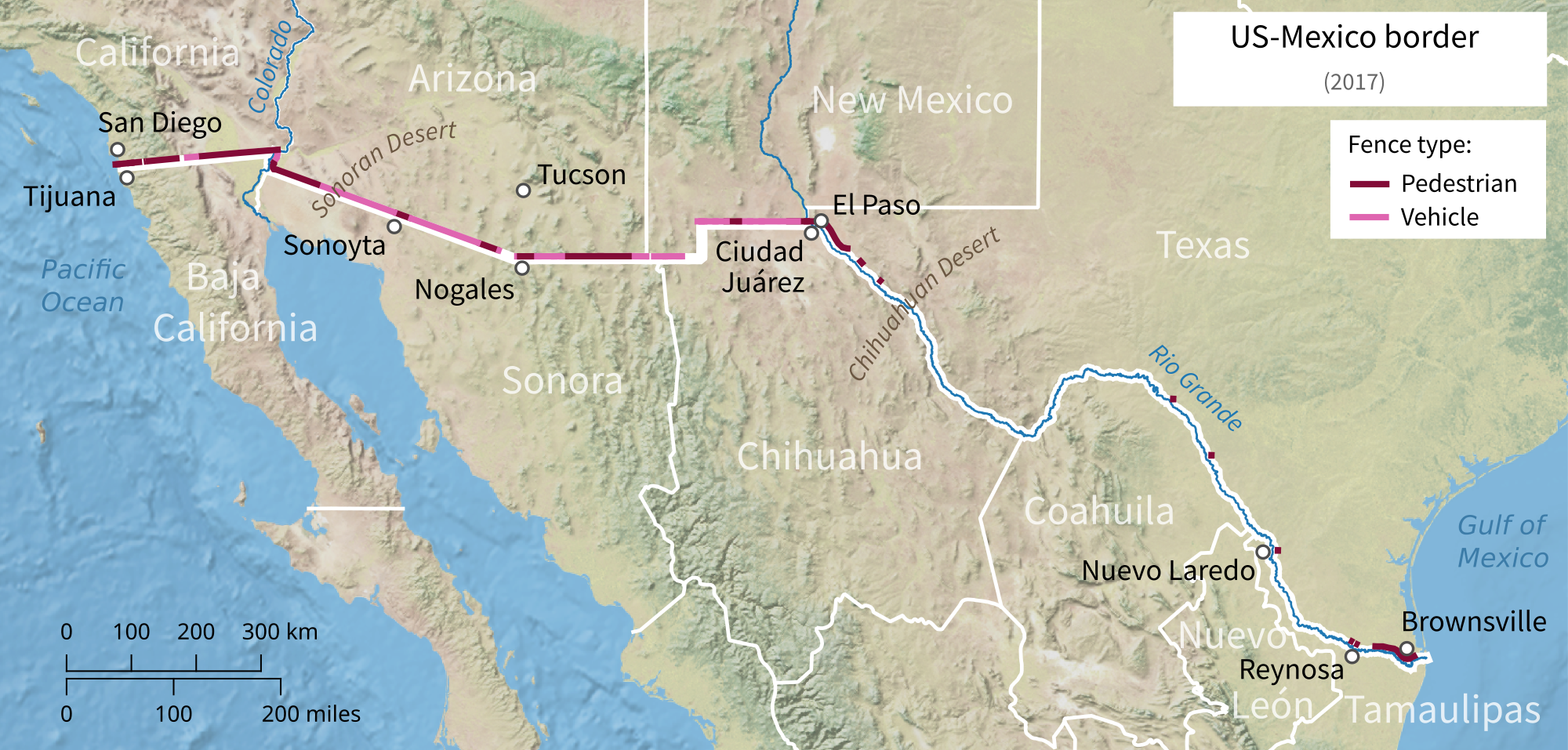
[edit]The 1,954-mile (3,145-kilometer) border between the U.S. and Mexico traverses a variety of terrain, including urban areas and deserts.[11] The border from the Gulf of Mexico to El Paso, Texas, follows the Rio Grande, a natural barrier. The barrier is on both urban and uninhabited sections of the border, where the most illegal crossings and drug trafficking have been observed in the past. These urban areas include San Diego, California, and El Paso, Texas.[12] The fencing includes a steel fence (varying in height between 18 and 27 feet (4.8 and 8.1 meters)) that divides the border towns of Nogales, Arizona, in the U.S. and Nogales, Sonora, in Mexico.[13]
97% of border apprehensions (foreign nationals caught in the U.S. illegally) by the Border Patrol in 2010 occurred at the southwest border. The number declined 61% from 1,189,000 in 2005 to 723,842 in 2008 to 463,000 in 2010. The decrease in apprehensions is the result of numerous factors, including changes in U.S. economic conditions and border enforcement efforts. Border apprehensions in 2010 were at their lowest level since 1972.[12][14] Total apprehensions for 2017, 2018, and 2019 were 415,517, 521,090, and 977,509, respectively.[15] And while the barrier is along the border with Mexico, 80% of those apprehended are not Mexican.[16]
As a result of the barrier, the number of people trying to cross in areas that have no fence, such as the Sonoran Desert and the Baboquivari Mountains in Arizona, has increased.[17] Such immigrants must cross 50 miles (80 km) of inhospitable terrain to reach the first road, which is in the Tohono Oʼodham Indian Reservation.[17][18]
Geography
[edit]The Mexico–U.S. border stretches from the Pacific Ocean in the west to the Gulf of Mexico in the east. Border states include the Mexican states of Baja California, Sonora, Chihuahua, Coahuila, Nuevo León, and Tamaulipas and the U.S. states of California, Arizona, New Mexico, and Texas.[19]
| U.S. state | Border length | Mexican states |
|---|---|---|
| California | 140.4 miles (226.0 km) | Baja California |
| Arizona | 372.5 miles (599.5 km) | Baja California, Sonora |
| New Mexico | 179.5 miles (288.9 km) | Sonora, Chihuahua |
| Texas | 1,241.0 miles (1,997.2 km) | Chihuahua, Coahuila, Nuevo León, Tamaulipas |
| Total | 1,933.4 miles (3,111.5 km) | – |
History
[edit]_133_and_NMCB-14_are_building_a_1,500_foot-long_concrete-lined_dr.jpg)
Origins
[edit]Territorial exchanges in the Mexican–American War (1846–1848) and the Gadsden Purchase (1853) largely established the current U.S.–Mexico border. Until the early 20th century, the border was open and largely unpatrolled, with only a few "mounted guards" patrolling its length.[20][21] But tensions between the U.S. and Mexico began to rise with the Mexican Revolution (1910) and World War I, which also increased concerns about weapons smuggling, refugees and cross-border espionage. The first international bridge was the Brownsville & Matamoros International Bridge, built in 1910. The first barrier built by the U.S. (a barbed-wire fence to prevent the movement of cattle across the border) was built in Ambos Nogales between 1909 and 1911,[21] and was expanded in 1929 with a "six foot–high chain-link fence".[22] The first barrier built by Mexico was likely a 6-foot (1.8 m)-tall wire fence built in 1918 explicitly for the purpose of directing the flow of people, also in Ambos Nogales. Barriers were extended in the following decades, and became a common feature in border towns by the 1920s. In the 1940s, the U.S. Immigration and Naturalization Service built chain-link barriers along the border.[23]
The U.S. Congress approved a $4.3 million request by Immigration and Naturalization Service, in 1978, to build a fence along the border to replace an existing 27-mile (43 km) fence near San Ysidro, California, and El Paso, Texas, and then build an additional 6 miles (9.7 km) of new fence.[24][25] Anchor Post Products was contracted to build the new fence in a project inherited from Richard Nixon,[26] who was the first president to propose building a border fence. The proposed construction received press coverage after the company's George Norris, described the fence as a "razor-sharp wall", leading to negative responses in Mexico.[24] The proposed wall, dubbed the "Tortilla Curtain" by critics,[27][28][29] was condemned by Mexican politicians such as then-president José López Portillo, and it was raised as an issue during President Jimmy Carter's state visit to Mexico in February 1979.[24] Fencing was ultimately constructed, but had a limited length and did not have razor wire.[25]
U.S. president George H. W. Bush approved the initial 14 miles (22.5 km) of fencing along the San Diego–Tijuana border.[30] In 1993, President Bill Clinton oversaw initial border fence construction which was completed by the end of the year. Starting in 1994, further barriers were built under Clinton's presidency as part of three larger operations to taper transportation of illegal drugs manufactured in Latin America and immigration: Operation Gatekeeper in California, Operation Hold-the-Line[31] in Texas, and Operation Safeguard[32] in Arizona. Clinton signed the Illegal Immigration Reform and Immigrant Responsibility Act of 1996, which authorized further barriers and the reinforcement of the initial border fence. The majority of the border barriers built in the 1990s were made out of leftover helicopter landing mats from the Vietnam War.[30]
Bush administration (2001–2009)
[edit]The Real ID Act, signed into law by President George W. Bush on May 11, 2005, attached a rider to a supplemental appropriations bill funding the wars in Iraq and Afghanistan, which went into effect in May 2008:
Notwithstanding any other provision of law, the Secretary of Homeland Security shall have the authority to waive all legal requirements such Secretary, in such Secretary's sole discretion, determines necessary to ensure expeditious construction of the barriers and roads.
In 2005, there were 75 miles (121 km) of fencing along the border.[33] In 2005, the border-located Laredo Community College obtained a 10-foot (3.0 m) fence built by the United States Marine Corps. The structure led to a reported decline in border crossings on to the campus.[34] U.S. Representative Duncan Hunter of California proposed a plan on November 3, 2005, calling for the construction of a reinforced fence along the entire United States–Mexico border. This would also have included a 100-yard (91 m) border zone on the U.S. side. On December 15, 2005, Congressman Hunter's amendment to the Border Protection, Anti-terrorism, and Illegal Immigration Control Act of 2005 (H.R. 4437) passed in the House, but the bill did not pass the Senate. This plan called for mandatory fencing along 698-mile (1,123 km) of the 1,954-mile (3,145 km)-long border.[35] On May 17, 2006, the U.S. Senate proposed the Comprehensive Immigration Reform Act of 2006 (S. 2611), which would include 370 miles (600 km) of triple-layered fencing and a vehicle fence, but the bill died in committee.[36]
Secure Fence Act of 2006
[edit]

_133_and_NMCB-14_construct_a_1,500_foot-long_concrete-lined_drainage_ditch_and_a_10_foot-high_wall_to_increase_security_along_the_U.S._and.jpg)


The Secure Fence Act of 2006, signed into law on October 26, 2006, by President George W. Bush[37] authorized and partially funded the potential construction of 700 miles (1,100 km) of physical fence/barriers along the Mexican border. The bill passed with supermajorities in both chambers.[38][39] Secretary of Homeland Security Michael Chertoff announced that an eight-month test of the virtual fence he favored would precede any construction of a physical barrier.
The government of Mexico and ministers of several Latin American countries condemned the plans. Governor of Texas Rick Perry expressed his opposition, saying that the border should be more open and should support safe and legal migration with the use of technology.[40] The barrier expansion was opposed by a unanimous vote by the Laredo, Texas, City Council.[41] Laredo Mayor Raul G. Salinas said that the bill would devastate Laredo. He stated "These are people that are sustaining our economy by 40%, and I am gonna close the door on them and put [up] a wall? You don't do that. It's like a slap in the face." He hoped that Congress would revise the bill to better reflect the realities of life on the border.[42]
Secretary Chertoff exercised his waiver authority on April 1, 2008, to "waive in their entirety" the Endangered Species Act, the Migratory Bird Treaty Act, the National Environmental Policy Act, the Coastal Zone Management Act, the Clean Water Act, the Clean Air Act, and the National Historic Preservation Act to extend triple fencing through the Tijuana River National Estuarine Research Reserve near San Diego.[43] By January 2009, U.S. Customs and Border Protection (CBP) and Homeland Security had spent $40 million on environmental analysis and mitigation measures aimed at blunting any possible adverse impact that the fence might have on the environment. On January 16, 2009, DHS announced it was pledging an additional $50 million for that purpose, and signed an agreement with the U.S. Department of the Interior for use of the additional funding.[44] In January 2009, U.S. Customs and Border Protection reported that it had more than 580 miles (930 km) of barriers in place.[45]
Obama administration (2009–2017)
[edit]On March 16, 2010, DHS announced that there would be a halt to expand the virtual fence beyond two pilot projects in Arizona.[46] Contractor Boeing Corporation had numerous delays and cost overruns. Boeing had initially used police-dispatching software that was unable to process all of the information coming from the border. The $50 million of remaining funding would be used for mobile surveillance devices, sensors, and radios to patrol and protect the border. At the time, DHS had spent $3.4 billion on border fences and had built 640 miles (1,030 km) of fences and barriers as part of the Secure Border Initiative.[46]
In May 2011, President Barack Obama stated that the wall was "basically complete", with 649 miles (1,044 km) of 652 planned miles of barrier constructed. Of this, vehicle barriers comprised 299 miles (481 km) and pedestrian fence 350 miles (560 km). Obama stated that:
We have gone above and beyond what was requested by the very Republicans who said they supported broader reform as long as we got serious about enforcement. All the stuff they asked for, we've done. But ... I suspect there are still going to be some who are trying to move the goal posts on us one more time. They'll want a higher fence. Maybe they'll need a moat. Maybe they want alligators in the moat.[a] They'll never be satisfied. And I understand that. That's politics.[4]
The Republican Party's 2012 platform stated that "The double-layered fencing on the border that was enacted by Congress in 2006, but never completed, must finally be built."[48] The Secure Fence Act's costs were estimated at $6 billion,[49] more than the Customs and Border Protection's entire annual discretionary budget of $5.6 billion.[50] The Washington Office on Latin America noted in 2013 that the cost of complying with the Secure Fence Act's mandate was the reason that it had not been completely fulfilled.[51]
A 2016 report by the Government Accountability Office confirmed that the government had completed the fence by 2015.[52] A 2017 report noted that "In addition to the 654 miles (1,053 km) of primary fencing, [Customs and Border Protection] has also deployed additional layers of pedestrian fencing behind the primary border fencing, including 37 miles (60 km) of secondary fencing and 14 miles (23 km) of tertiary fencing."[53]
First Trump administration (2017–2021)
[edit].jpg)
_(3x4_close_cropped).jpg)


The concept for the proposed expansion of the border wall was developed in 2014 by Donald Trump's 2015–2016 presidential campaign advisers Sam Nunberg and Roger Stone as a talking point Trump could use to tie his business experience as a builder and developer to his immigration policy proposals.[54][55] The idea for the expansion of "the Wall", as Nunberg and Stone called it, was first aired publicly in January 2015 at the Iowa Freedom Summit hosted by Citizens United and Steve King.[55]
Trump proposed the wall's expansion again, along with a claim that Mexico would pay for it, during his June 2015 candidacy announcement. Throughout the 2015–2016 presidential campaign, Trump called for the construction of a much larger and fortified border wall, claiming that if elected, he would "build the wall and make Mexico pay for it".[56] Mexican president Enrique Peña Nieto maintained that his country would not pay for the wall.[57][58][59]
On January 25, 2017, the Trump administration signed Executive Order 13767, which formally directed the U.S. government to begin attempting to construct a border wall using existing federal funding, although construction did not begin at this time because a formal budget had not been developed.[60] In March 2017, U.S. Customs and Border Protection (CBP) began accepting prototype ideas for a U.S.–Mexico border wall from companies and said it would issue a request for proposals by March 24.[61][62]
In 2013, a Bloomberg Government analysis estimated that it would cost up to $28 billion (~$37.1 billion in 2024) annually to seal the border.[63] While campaigning for the presidency in early 2016, Trump claimed it would be a one-time cost of only $8 billion,[64] while Republican House Speaker Paul Ryan and Senate Majority Leader Mitch McConnell said $15 billion,[65] and the Trump administration's own early estimates ranged up to $25 billion.[58][66][67][68] The Department of Homeland Security's internal estimate in early 2017, shortly after Trump took office, was that his proposed border wall would cost $21.6 billion and take 3.5 years to build.[69]
In September 2017, the U.S. government announced the start of construction of eight prototype barriers made from concrete and other materials.[70][71] On June 3, 2018, the San Diego section of wall construction began.[72] On October 26, a two-mile (3.2 km) stretch of 30-foot steel bollards in Calexico, California, was commemorated as the first section of Trump's wall, although media coverage heavily debated whether it should be considered a "wall" or a "fence".[73] Trump scheduled a visit to this section in April 2019.[74]
Trump's campaign promise has faced a host of legal and logistical challenges since. In March 2018, the Trump administration secured $1.6 billion from Congress for projects at the border for existing designs of approximately 100 miles (160 km) of new and replacement walls.[75] From December 22, 2018, to January 25, 2019, the federal government was partially shut down because of Trump's declared intention to veto any spending bill that did not include $5 billion in funding for a border wall.[76]
On May 24, 2019, federal Judge Haywood Gilliam in the Northern District of California granted a preliminary injunction preventing the Trump administration from redirecting funds under the national emergency declaration issued earlier in the year to fund a planned wall along the border with Mexico. The injunction applies specifically to money the administration intended to allocate from other agencies and limits wall construction projects in El Paso and Yuma.[77] On June 28, Gilliam blocked the reallocation of $2.5 billion of funding from the Department of Defense to the construction of segments of the border wall categorized as high priority by the Trump administration (spanning across Arizona, California and New Mexico).[78] The decision was upheld five days later by a majority in the Ninth Circuit Appeals Court[79] but was overturned by the U.S. Supreme Court on July 26.[80] On September 3, Secretary of Defense Mark Esper authorized the use of $3.6 billion in military construction funding for 175 miles (282 km) of the barrier.[81][82] The House and Senate have twice voted to terminate Trump's emergency declaration, but the president vetoed both resolutions.[83] In October, a lawsuit filed in El Paso County produced a ruling that the emergency declaration was unlawful, as it fails to meet the National Emergencies Act's definition of an emergency.[84] On December 10, a federal judge in the case blocked the use of the funding,[85] but on January 8, 2020, a federal appeals court granted a stay of the ruling, freeing $3.6 billion for the wall.[86]
.jpg)
As of August 2019[update], the Trump administration's barrier construction had been limited to replacing sections that were in need of repair or outdated,[87] with 60 miles (97 km) of replacement wall built in the Southwest since 2017.[88] As of September 12, 2019, the Trump administration plans for "Between 450 and 500 miles (724–806 kilometers) of fencing along the nearly 2,000-mile (3,218-kilometer) border by the end of 2020"[89][90] with an estimated total cost of $18.4 billion.[91] Privately owned land adjacent to the border would have to be acquired by the U.S. government to be built upon.[82][92]
On June 23, 2020, Trump visited Yuma, Arizona, for a campaign rally commemorating the completion of 200 miles (320 km) of the wall.[93] U.S. Customs and Border Protection confirmed that almost all of this was replacement fencing.[94] By the end of Trump's term on January 21, 2021, 452 miles (727 km) had been built at last report by CBP on January 5, much of it replacing outdated or dilapidated existing barriers.[95]
Contractors and independent efforts
[edit]As of February 2019, contractors were preparing to construct $600 million worth of replacement barriers along the south Texas Rio Grande Valley section of the border wall, approved by Congress in March 2018.[96][97] In mid-April 2019, former Kansas Secretary of State Kris Kobach visited Coolidge, Arizona, to observe a demonstration by North Dakota's Fisher Industries of how it would build a border fence. The company maintained that it could erect 218 miles (351 km) of the barrier for $3.3 billion and be able to complete it in 13 months. Spin cameras positioned atop the fence would use facial-recognition technology, and underground fiber optic cables could detect and differentiate between human activity, vehicles, tunneling, and animals as distant as 40 feet (12 m) away. The proposed barrier would be constructed with 42 miles (68 km) near Yuma and 91 miles (146 km) near Tucson, Arizona, 69 miles (111 km) near El Paso, Texas, and 15 miles (24 km) near El Centro, California—reportedly costing $12.5 million per mile ($7.8 million per kilometer).[98] In April 2019, U.S. Senator Bill Cassidy said that he traveled with the group of politicians and administration officials over the Easter recess to Coolidge (120 miles (190 km) north of the Mexico border) because he felt that insufficient barrier and border enhancements had been erected since Trump became president.[98] U.S. senator Kevin Cramer was also there, promoting Fisher Industries, which demonstrated the construction of a 56-foot (17 m) fence in Coolidge.[99]
A private organization founded by military veteran Brian Kolfage called "We Build the Wall" raised over $20 million beginning in 2018, with President Trump's encouragement and with leadership from Kobach and Steve Bannon. Over the 2019 Memorial Day weekend, the organization constructed a 0.5-mile (0.80 km) to 1-mile (1.6 km) "weathered steel" bollard fence near El Paso on private land adjoining the U.S.–Mexico border using $6–8 million of the donated funds. Kolfage's organization says it has plans to construct further barriers on private lands adjoining the border in Texas and California.[100][101][102] On December 3, 2019, a Hidalgo County judge ordered the group to temporarily halt all construction because of its plans to build adjacent to the Rio Grande, which a lawyer for the National Butterfly Center argues would create a flooding risk.[103] On January 9, 2020, a federal judge lifted an injunction, allowing a construction firm to move forward with the 3-mile (4.8 km) project along the Rio Grande.[104] This ended a month long court battle with both the Federal Government and the National Butterfly Center which both tried to block construction efforts. By August 2020, the portions constructed by the organization were already in serious danger of collapsing due to erosion, and the acting U.S. attorney for the Southern District of New York unsealed an indictment charging four people, including Bannon,[105][106][107][108] with a scheme to defraud hundreds of thousands of donors by illegally taking funds intended to finance construction for personal use.[109] An unpublished memo from the U.S. Customs and Border Protection leaked in March 2022 revealed that the wall had been breached more than 3,200 times from October 2018 to September 2021. Nonetheless, CBP officials say the bollard fencing remains a valuable border security tool when combined with surveillance technology and sufficient personnel.[110]
Outcome
[edit]As of December 2020, the total funding given for new fencing was about $15 billion (~$17.9 billion in 2024), a third of which had been given by Congress while Trump had ordered the rest taken from the military budget. This funding was intended to build new fencing over 738 miles (1,188 km), at a cost of about $20 million per mile ($12.5 million per kilometer); this would cover a little more than half the approximately 1,300 miles (2,100 km) that had no fencing when Trump took office.[111][112]
A March 2021 review of the Trump work on the wall found only 47 miles (76 km) of new barriers where none had previously existed. While Trump had described the new wall as "virtually impenetrable", it was found that smugglers had repeatedly sawed through the wall with cheap power tools. Also, new dirt roads that had been used to access the wall construction served as new access roads for smugglers.[113]
Biden administration (2021–2025)
[edit]President Joe Biden signed an executive order[114] on his first day of office, January 20, 2021, ordering a "pause" in all construction of the wall no later than January 27.[115] The government was given two months to plan how to spend the funds elsewhere and determine how much it would cost to terminate the contracts. There were no plans to tear down parts of the wall that have been built.[116] The deployment of 3,000 National Guard troops along the border continued.[117] Furthermore, the Biden administration continued to seize land for construction of the border wall.[118][119] By December 2021, many contracts had been cancelled, including one requiring the possession of the land of a family represented by the Texas Civil Rights Project.[120]
In June 2021, Texas governor Greg Abbott announced plans to build a border wall in his state, saying that the state would provide $250 million and that direct donations from the public would be solicited.[121][122] On June 29, the Republican Study Committee organized a group of two dozen Republican House members to visit a gap in the border where Central Americans were crossing into the country. Representative Mary Miller (R-IL) stated that "obviously our president has advertised this and facilitated this invasion". Rep. Jim Banks (R-IN) praised the effectiveness of Trump's wall and said that because of the halted construction, "thousands of migrants [pass] through this area on a regular basis ... because there's an open door that allows them to do that". In reference to wristbands on migrants used by Mexican cartels and smugglers to track them, Rep. Madison Cawthorn (R-NC) stated, "They're basically treating people like Amazon products. ... There is no care that that is a human being, someone who has a soul, someone who has unalienable rights that predate any government."[123]
On July 28, 2022, the Biden administration announced it would fill four wide gaps in Arizona near Yuma, an area with some of the busiest corridors for illegal crossings.[7]
In October 2023, Biden announced he would restart wall construction due to the surge of migrant crossings, while White House Press Secretary Karine Jean-Pierre stated that Biden believed that a border wall is "not effective".[124] To expedite production, the Biden administration would waive more than two dozen laws that "protect air, water and endangered species" such as the Clean Air Act, the Endangered Species Act and the National Historic Preservation Act.[125][126] The administration claimed that the money for the wall construction was "allocated during Trump's term in 2019." In 2021, the congress controlled by the Democratic Party ignored Biden's request to rescind the funds.[127][128] The decision was praised by former president Donald Trump and criticized by Mexican president Andres Manuel Lopez Obrador as "a step backwards" and Jonathan Blazer, director of border strategies for the American Civil Liberties Union as "doubling down on the failed policies of the past."[129][130]
Binational River Park
[edit]In 2021, in collaboration with the United States and Mexican ambassadors, as well as businessmen, a binational park was proposed along the Rio Grande between the border towns of Laredo, Texas, and Nuevo Laredo, Mexico. Supported by the No Border Wall Coalition, the park aims to create a shared recreational space instead of a border wall. Earthjustice estimated that the decision to not build a border wall in Laredo saved 71 miles (114 km) of river from destruction and over $1 billion in taxpayer dollars.[131][132][133]
Arizona container wall
[edit] | This section needs to be updated. (October 2025) |

In August 2022, Arizona governor Doug Ducey ordered the erection of a makeshift wall of shipping containers on the border with Mexico in Cochise County, Arizona. The construction began in the Coronado National Forest without authorization from the U.S. Forest Service, which operates the land. Ecologists at the Center for Biological Diversity argue that the construction, which imperils at-risk species including the ocelot and jaguar, violates the Endangered Species Act of 1973 and have sued to halt its construction.[134] Governor-elect Katie Hobbs stated that she would remove the containers after taking office,[135] and the U.S. Justice Department sued the state to remove the containers and "compensate the [U.S.] for any actions it needs to take to undo Arizona's actions".[136] Deconstruction of the container wall had begun by January 2023.[137]
Second Trump administration (2025–present)
[edit] | This section needs to be updated. (June 2025) |
![[icon]](https://en.wikipedia.org/wiki/File:Wiki_letter_w_cropped.svg) | This section needs expansion. You can help by adding to it. (June 2025) |
Trump has stated that during his second administration he will finish construction on the border wall.[138] In January 2025, he declared a national emergency to direct the departments of State and Defense to resume construction of the wall.[139]
On July 3, 2025, the Republican-controlled Congress passed the One Big Beautiful Bill Act which includes $46.5 billion to complete construction of the wall on the United States–Mexico border, along with:[140]
- $17.3 billion to support state and local law enforcement with border enforcement.[141]
- $10 billion to reimburse the Department of Homeland Security for costs related to border security.[142]
- $7.8 billion for hiring Border Patrol agents and vehicles, with the aim of hiring 3,000 new agents.[141]
- $6.2 billion for border detection technology such as cameras, lights, and sensors.[141][143]
Border wall is being constructed in the areas of Tucson, Arizona[144] and San Diego, California area[145]. In early June 2025, Department of Homeland Security permitted 36 miles of wall to be built across Arizona and New Mexico with additional wall barrier to be built following waivers of environmental regulations.[144]
Impacts and concerns
[edit]
.jpg)
Effectiveness
[edit]Different sources draw different conclusions about the actual or likely effectiveness of the wall. Experts on the subject have said that aside from the human crossings, drugs among other things will still be making their way to the United States illegally.[146][147] U.S. Customs and Border Protection has frequently called for more physical barriers on the Mexico–United States border, citing their efficacy.[148] However, research at Texas A&M University and Texas Tech University indicated that the wall, and border walls in general, are unlikely to be effective at reducing illegal immigration or movement of contraband.[149] By contrast, the American Economic Journal found that wall construction caused a 15–35% reduction in migration, varying with proximity to the barrier.[150]
Critics of Trump's plan note that expanding the wall would not stop the routine misuse of legal ports of entry by people smuggling contraband, overstaying travel visas, using fraudulent documents, or stowing away.[151] They also point out that in addition to the misuse of ports of entry, even a border-wide wall could be bypassed by tunneling, climbing, or by using boats or aircraft.[149][152][153][154] Additionally, along some parts of the border, the existing rough terrain may be a greater deterrent than a wall.[146] Trump reportedly suggested fortifying the wall with a water-filled trench inhabited by snakes or alligators, and electric fencing topped with spikes that can pierce human flesh.[155][b]
The U.S. Customs and Border Protection agency has frequently called for more physical barriers, citing their efficacy. "I started in the San Diego sector in 1992 and it didn't matter how many agents we lined up," said Chief Patrol Agent Rodney Scott. "We could not make a measurable impact on the flow [of undocumented immigrants] across the border. It wasn't until we installed barriers along the border that gave us the upper hand that we started to get control."[156] Carla Provost, the chief of U.S. border patrol, stated "We already have many miles, over 600 miles (970 km) of barrier along the border. I have been in locations where there was no barrier, and then I was there when we put it up. It certainly helps. It's not a be all end all. It's a part of a system. We need the technology, we need that infrastructure."[157]
Over the wall's first three years, Mexican smugglers sawed through the wall multiple times per day, usually with ordinary power tools, according to maintenance records from U.S. Customs and Border Protection. The Washington Post reported "891 breaches during fiscal 2019, 906 during fiscal 2020 and 1,475 during fiscal 2021." The government patched these holes, spending approximately $800 per incident and often leaving visible evidence of the repair.[158] One early report of this damage was in November 2019. People were sawing through steel bollards in areas where sensors to detect such breaches had not yet been installed.[159] Though Trump claimed it was "very easily fixed" by "put[ting] the chunk back in",[160] border agents argued that smugglers tend to return to previously sawed wall because the bollards are weakened.[159]
In January 2020, a few wall panels under construction in Calexico, California, were blown over by strong Santa Ana winds before the poured concrete foundations cured. There was no other property damage or injuries as a result of the incident.[161][162]
In October 2020, the DHS published data indicating that the new border barrier has been effective at reducing the number of illegal border entries. The barrier also reduced ongoing manpower costs in at least one area in which it had been built.[163]
Divided American Indian land
[edit]Tribal lands of three American Indian reservations are divided by a proposed border fence.[164][165]
On January 27, 2008, a Native American (Indian) human rights delegation in the United States, which included Margo Tamez (Lipan Apache-Jumano Apache) and Teresa Leal (Opata-Mayo) reported the removal of the official International Boundary obelisks of 1848 by the U.S. Department of Homeland Security in the Las Mariposas, Sonora-Arizona sector of the Mexico–U.S. border.[166][167] The obelisks were moved southward approximately 20 m (70 ft), onto the property of private landowners in Sonora, as part of the larger project of installing the 18-foot (5.5 m) steel barrier wall.[168]
The proposed route for the border fence would divide the campus of the University of Texas at Brownsville into two parts, according to Antonio N. Zavaleta, a vice president of the university.[169] There have been campus protests against the wall by students who feel it will harm their school.[3] In August 2008, UT-Brownsville reached an agreement with the U.S. Department of Homeland Security for the university to construct a portion of the fence across and adjacent to its property. On August 20, 2008, the university sent out a request for bids for the construction of a 10-foot (3.0 m) high barrier that incorporates technology security for its segment of the border fence project. The southern perimeter of the UT-Brownsville campus will be part of a laboratory for testing new security technology and infrastructure combinations.[170] The border fence segment on the campus was substantially completed by December 2008.[171]
The SpaceX South Texas launch site was shown on a map of the Department of Homeland Security with the barrier cutting through the 50-acre facility (20 ha) in Boca Chica, Texas.[172]
Santa Ana National Wildlife Refuge
[edit]On August 1, 2018, the chief of the Border Patrol's Rio Grande Valley sector indicated that although Starr County was his first priority for a wall, Hidalgo County's Santa Ana National Wildlife Refuge had been selected instead for initial construction, because its land was owned by the government.[173]
National Butterfly Center
[edit] | This section needs to be updated. (October 2025) |
The proposed border wall has been described as a "death sentence" for the American National Butterfly Center, a privately operated outdoor butterfly conservatory that maintains a significant amount of land north of the Rio Grande, but south of the wall's route.[174][175][173] Filmmaker Krista Schlyer, part of an all-woman team creating a documentary film about the butterflies and the border wall, Ay Mariposa,[176] estimates that construction would put 70% of the preserve habitat on the Mexican side of the border fence.[177] In addition to concerns about seizure of private property by the federal government,[178] center employees have also noted the local economic impact. The center's director has stated that "environmental tourism contributes more than $450m to Hidalgo and Starr counties."[174]
In early December 2018, a challenge to wall construction at the National Butterfly Center was rejected by the U.S. Supreme Court. According to the San Antonio Express-News, "the high court let stand an appeals ruling that lets the administration bypass 28 federal laws", including the Endangered Species Act, the Safe Drinking Water Act and the Native American Graves Protection and Repatriation Act.[175]
Mexico–U.S. relations
[edit]
In 2006, the Mexican government vigorously condemned the Secure Fence Act of 2006. Mexico has also urged the U.S. to alter its plans for expanded fences along their shared border, saying that it would damage the environment and harm wildlife.[179]
In 2012, Mexican presidential candidate Enrique Peña Nieto campaigned at the Plaza Monumental de Tijuana, less than 600 yards (550 m) from the U.S.–Mexico border adjacent to Border Field State Park. In one of his speeches he criticized the U.S. government for building the barriers and asked for them to be removed, referencing President Ronald Reagan's "Tear down this wall!" speech from Berlin in 1987.[180]
In January 2017, President Donald Trump's signing of his Executive Order 13767 soured relations between the U.S. and Mexico. Mexican president Peña Nieto addressed Mexican citizens via a recorded message, in which he condemned the executive order and again said Mexico would not pay for the wall's construction. Following a Twitter feud between the two leaders in which Trump threatened to cancel a planned meeting with Peña Nieto in Washington, Peña Nieto decided to cancel the meeting himself.[181][182] At the same time, while addressing supporters, Mexican opposition politician Andrés Manuel López Obrador condemned the wall order as an insult to Mexico and demanded the Mexican government pursue claims against the American government in the United Nations.[183]
In March 2017, Mexican congressman Braulio Guerra of Querétaro illegally climbed, and partially crossed, an existing 30-foot (9.1 m) border fence on American soil dividing San Diego and Tijuana, saying that more walls would be ineffective.[c][184][185]
The Roman Catholic Archbishop of Mexico opposed the border wall, and wrote that any Mexican company that participates in construction of the wall or supplies materials for construction would be committing "treason against the homeland".[186][187]
Other international reactions
[edit]At the annual summit of the Community of Latin American and Caribbean States in January 2017, representatives from Latin American and Caribbean countries condemned the wall proposal.[188]
Israeli Prime Minister Benjamin Netanyahu applauded the plan, calling it as a "Great idea." Netanyahu said "Trump is right" and likened the proposal to the Israeli West Bank barrier.[189][190] After Mexican protests, the Prime Minister's office issued a statement saying that "[he] was addressing Israel's unique circumstances and the important experience we have and which we are willing to share with other nations. There was no attempt to voice an opinion regarding U.S.–Mexico ties."[189][191]
Pope Francis was critical of the project, saying in a March 2019 interview: "If you raise a wall between people, you end up a prisoner of that wall that you raised."[192] During his tenure he made references in several speeches, and in a tweet, to building "bridges, not walls".[193][194][195]
International reactions include artistic and intercultural facilitation devices. Projects have included exhibitions, signs, and demonstrations as well as physical adaptations promoting socialization such as a bright pink see-saw built through the wall that is accessible to people on both sides to enjoy together.[196]
Migrant deaths
[edit]
Between 1994 and 2007, there were around 5,000 migrant deaths along the Mexico–United States border according to a document created by the Human Rights National Commission of Mexico and signed by the American Civil Liberties Union.[197] An April 2021 report by the University of Arizona's Binational Migration Institute said the remains of 3,356 migrants were found in Southern Arizona between 1990 and 2020.[198]
Between 43 and 61 people died trying to cross the Sonoran Desert from October 2003 to May 2004; three times that of the same period the previous year.[17] In October 2004, the Border Patrol announced that 325 people had died crossing the entire border during the previous 12 months.[199]
U.S. Border Patrol Tucson Sector reported on October 15, 2008, that its agents were able to save 443 illegal immigrants from certain death after being abandoned by their smugglers. The agents also reducing the number of deaths by 17%: from 202 in 2007 to 167 in 2008. Without the efforts of these agents, hundreds more could have died in the deserts of Arizona.[200] According to the same sector, border enhancements like the wall have allowed the Tucson Sector agents to reduce the number of apprehensions at the borders by 16% compared with 2007.[201]
Environmental impact
[edit]
In April 2008, the Department of Homeland Security announced plans to waive more than 30 environmental and cultural laws to speed construction of the barrier. Despite claims from then Homeland Security Chief Michael Chertoff that the department would minimize the construction's impact on the environment, critics in Arizona, New Mexico, and Texas, asserted that the fence endangered species and fragile ecosystems along the Rio Grande. Environmentalists expressed concern about butterfly migration corridors and the future of species of local wildcats, the ocelot, the jaguarundi, and the jaguar.[202][203]
By August 2008, more than 90% of the southern border in Arizona and New Mexico had been surveyed. In addition, 80% of the California–Mexico border has been surveyed.[204] About 100 species of plants and animals, many already endangered, are threatened by the wall, including the jaguar, ocelot, Sonoran pronghorn, Mexican wolf, a pygmy owl, the thick-billed parrot, and the Quino checkerspot butterfly. According to Scott Egan of Rice University, a wall can create a population bottleneck, increase inbreeding, and cut off natural migration routes and range expansion.[205][206]
In 2008 a resolution "based on sound and accurate scientific knowledge" expressing opposition to the wall and the harmful impact on several rare, threatened, and endangered species, particularly endangered mammals such as the jaguar, ocelot, jaguarondi, and Sonoran pronghorn, was published by The Southwestern Association of Naturalists, an organization of 791 scientists specializing in the zoology, botany, and ecology of southwestern United States and Mexico.[207] A decade later in 2018, well over 2500 scientists from 43 countries published a statement opposing the Border Wall, affirming it will have "significant consequences for biodiversity" and "Already-built sections of the wall are reducing the area, quality, and connectivity of plant and animal habitats and are compromising more than a century of binational investment in conservation."[208]
An initial 75-mile (121 km) wall for which U.S. funding has been requested on the nearly 2,000-mile (3,200 km) border would pass through the Tijuana Slough National Wildlife Refuge in California, the Santa Ana National Wildlife Refuge and Lower Rio Grande Valley National Wildlife Refuge[209] in Texas, and Mexico's Cabeza Prieta National Wildlife Refuge and El Pinacate y Gran Desierto de Altar Biosphere Reserve, which is a UNESCO World Heritage Site that the U.S. is bound by global treaty to protect.[210] The U.S. Customs and Border Protection plans to build the wall using the Real ID Act to avoid the process of making environmental impact statements, a strategy devised by Chertoff during the Bush administration. Reuters said, "The Real ID Act also allows the secretary of Homeland Security to exempt CBP from adhering to the Endangered Species Act", which would otherwise prohibit construction in a wildlife refuge.[211]
Legal aspects
[edit]On September 12, 2017, the United States Department of Homeland Security issued a notice that Acting Secretary of Homeland Security Elaine Duke would be waiving "certain laws, regulations and other legal requirements" to begin construction of the new wall near Calexico, California.[212] The waiver allows the Department of Homeland Security to bypass the National Environmental Policy Act, the Endangered Species Act, the Clean Water Act, the Clean Air Act, the National Historic Preservation Act, the Migratory Bird Treaty Act, the Migratory Bird Conservation Act, the Archaeological Resources Protection Act, the Safe Drinking Water Act, the Noise Control Act, the Solid Waste Disposal Act, the Antiquities Act, the Federal Land Policy and Management Act, the Administrative Procedure Act, the Native American Graves Protection and Repatriation Act, and the American Indian Religious Freedom Act.[213]
In 2020, two contractors who were employed by Sullivan Land Services Co. to provide security for wall construction filed a federal complaint alleging that the company and a subcontractor had performed illegal acts such as hiring undocumented workers, going "so far as to build a dirt road to expedite illegal border crossings to sites in San Diego, using construction vehicles to block security cameras", which was approved by an "unnamed supervisor at the Army Corps of Engineers".[214]
Appropriations challenge
[edit]Following Trump's executive order to proceed with the wall's construction in February 2019, two separate cases were filed in the United States District Court of the Northern District of California alleging that the Trump administration had overstepped its boundaries by authorizing funds to use to build the border wall without Congressional approval, citing the Congressional restrictions they had passed earlier in the month. One was filed by the state of California and 19 other states, while the other was filed by the American Civil Liberties Union for the Sierra Club and the Southern Border Communities Coalition. Both cases were heard together by Judge Haywood Gilliam.[215]
On May 17, 2019, the U.S. Department of Justice argued in court that, because Congress had not explicitly stated in an appropriations bill that "no money shall be obligated" for construction of the wall, the administration was free to spend funds that were not expressly appropriated for border security. Douglas Letter, the general counsel for the House of Representatives, responded, "That just cannot be right. No money may be spent unless Congress actually appropriates it."[216] On the following week, Gilliam granted a preliminary injunction preventing the Trump administration from redirecting funds under the national emergency declaration issued earlier in the year to fund a planned wall along the border with Mexico. Gilliam ruled that "Congress's 'absolute' control over federal expenditures – even when that control may frustrate the desires of the Executive Branch regarding initiatives it views as important – is not a bug in our constitutional system. It is a feature of that system, and an essential one."[217] The injunction applied specifically to some of the money the administration intended to allocate from other agencies, and limited wall construction projects in El Paso, Texas and Yuma, Arizona.[218] Gilliam's decision was temporarily upheld on appeal to the Ninth Circuit Court on July 3, 2019.[219]
The U.S. Department of Justice petitioned the Supreme Court, and on July 26, 2019, the Supreme Court, in a 5–4 decision, issued a stay to Gilliam's ruling, allowing wall and related construction to proceed while litigation continues. The summary ruling from the majority indicated the groups suing the government may not have standing to challenge the executive order.[215] However, the plaintiffs will return to the Ninth Circuit Appeals Court.[220][82] Rulings for both the states' and the environmental groups' cases were issued on June 26, 2020, with the Ninth Circuit affirming that the funds for constructing the wall were transferred illegally against the Appropriations Clause.[221]
The parties in the Sierra Club suit sought to have the Supreme Court lift their stay based on the Ninth's decision, but the Supreme Court refused to grant this on a 5–4 order on July 31, 2020, effectively allowing the wall construction to continue despite the decision of the Ninth; Justices Ginsburg, Breyer, Kagan, and Sotomayor dissented.[222] On August 7, 2020, the U.S. Department of Justice petitioned the Supreme Court challenging the Ninth Circuit's ruling in both the California and Sierra Club cases on the questions of standing and the legality of the appropriations transfer.[223] On October 19, 2020, the Supreme Court announced that it would hear the case.[224]
The House of Representatives also filed suit in the U.S. District Court for the District of Columbia against the administration in 2019 for misappropriation of funds. U.S. District Judge Trevor N. McFadden dismissed the lawsuit in June 2019, determining the House could not show damages and thus had no standing to sue.[225] On appeal, a unanimous panel of the U.S. Court of Appeals for the District of Columbia Circuit reversed, in September 2020, finding that expenditures made without the approval of the House of Representatives are an injury for which the House has standing to sue.[226]
The case was made moot with the ceased construction and delegated to lower courts for any necessary further processing.[227]
Environmental legal challenge
[edit]In April 2017, the Center for Biological Diversity, an environmental group, and U.S. Representative Raúl Grijalva from Arizona, the ranking Democratic member on the House Committee on Natural Resources filed a lawsuit in federal court in Tucson. In their complaint, Grijalva and the Center argue that the government's wall construction plans fail to comply with the National Environmental Policy Act, and seek to compel the government to carry out an environmental impact study and produce an environmental impact statement (EIS) before building the wall.[228][229] The lawsuit specifically seeks "to stop any work until the government agrees to analyze the impact of construction, noise, light and other changes to the landscape on rivers, plants and endangered species – including jaguars, Sonoran pronghorns and ocelots – and also on border residents".[230] Two separate cases, also arguing about the government's failure to complete an EIS, were later filed, one by the groups the Sierra Club, Defenders of Wildlife and the Animal Legal Defense Fund, and the second by California's Attorney General Xavier Becerra.[231]
The three lawsuits were consolidated into a single case within the U.S. District Court for the Southern District of California by Judge Gonzalo P. Curiel.[231] Oral arguments were heard in February 2018, and Curiel ruled by the end of the month in favor of the government, citing that the Department of Homeland Security has several waivers in its authorization to expedite construction of border walls, which includes bypassing the EIS statement. Curiel had written his opinion without consideration of the other political issues regarding the border wall, ruling only on the environment impact aspect.[232] The ruling was challenged to the U.S. Supreme Court by the Sierra Club, Defenders of Wildlife, and the Animal Legal Defense Fund, but the Court denied their petition for writ of certiorari by December 2018, allowing Curiel's decision to stand.[233]
Eminent domain
[edit]About two-thirds of the U.S.–Mexico border runs along private or state-owned lands, and the federal government would need to acquire such land through purchase or seizure (eminent domain) to build any border wall. The "process is likely to cost the government millions and could take years of complex litigation", as was the case for pre-existing border walls.[234] In his budget request to Congress, Trump requested funds for twenty U.S. Department of Justice lawyers "to pursue federal efforts to obtain the land and holdings necessary to secure the Southwest border".[235] In 2017, he also revived condemnation litigation against land owners that had been dormant for years.[234] There are 162 miles (261 km) of it in Southern Texas; 144 miles (232 km) are privately owned. By December 2019, the Trump administration had acquired three miles (4.8 km).[92]
Religious freedom
[edit]The Roman Catholic Diocese of Brownsville has challenged the government's right to build part of the wall on the grounds of a historic chapel, La Lomita Chapel in Mission, Texas. At a hearing in McAllen, Texas, on February 6, 2019, U.S. District Judge Randy Crane said the diocese must allow surveyors onto the grounds. It was said that if the government did not reconsider, then the diocese would plan to assert its rights under the Religious Freedom Restoration Act, a federal law which prohibits the government from placing a "substantial burden" on the practice of religion.[236] According to Mary McCord, a Georgetown University ICAP attorney representing the diocese, "a physical barrier that cuts off access to the chapel, and not only to Father Roy and his parish but those who seek to worship there, is clearly a substantial burden on the exercise of religious freedom."[237]
Polling
[edit] | This section needs expansion. You can help by adding to it. (April 2024) |
A Rasmussen Reports poll from August 19, 2015, found that 51% supported building a wall on the border, while 37% opposed.[238]
In a January 2017 study conducted by the Pew Research Center, 39% of Americans identified construction of a U.S.–Mexico border wall as an "important goal for U.S. immigration policy". The survey found that while Americans were divided by party on many different immigration policies, "the widest [partisan split] by far is over building a southern border wall. Two-thirds of Republicans and Republican-leaning independents (67%) say construction of a wall on the U.S.–Mexico border is an important goal for immigration policy, compared with just 16% of Democrats and Democratic leaners."[239]
A February 2017 Pew Research Center study found that "As was the case throughout the presidential campaign, more Americans continue to oppose (62%) than favor (35%) building a wall along the entire U.S. border with Mexico."[240] 43% of respondents thought a border wall would not have much impact on illegal immigration, while 54% thought it would have an impact (29% thought it would lead to a major reduction, 25% a minor reduction).[240] 70% of Americans thought the U.S. would ultimately pay for the wall; 16% believed Mexico would pay for it.[240] Public opinion was polarized by party: "About three-quarters (74%) of Republicans and Republican-leaning independents support a border wall, while an even greater share of Democrats and Democratic leaners express opposition to building a wall across the entire U.S.–Mexico border (89%)."[240] Younger Americans and Americans with college degrees were more likely to oppose a wall than older Americans and those without college degrees.[240]
A survey conducted by the National Border Patrol Council found that 89% of border patrol agents said a "wall system in strategic locations is necessary to securing the border". 7% of agents disagreed.[241]
A poll conducted by CBS on June 21 and 22, 2018, found that 51% supported the border wall, while 48% opposed.[242]
A poll conducted by the Senate Opportunity Fund in March 2021 found that 53% supported finishing construction of the border wall, while 38% opposed.[243]
See also
[edit]


References
[edit]Footnotes
- ^ Privately suggested by Obama's successor, Republican Donald Trump[47]
- ^ In May 2011, after announcing that the planned border fence was "basically complete", President Barack Obama stated,
We have gone above and beyond what was requested by the very Republicans who said they supported broader reform as long as we got serious about enforcement. All the stuff they asked for, we've done. But ... I suspect there are still going to be some who are trying to move the goal posts on us one more time. They'll want a higher fence. Maybe they'll need a moat. Maybe they want alligators in the moat. They'll never be satisfied. And I understand that. That's politics.[4]
- ^ In a video he can be heard to say: "I was able to scale it, climb it, and sit myself right here. It would be simple for me to jump into the United States, which shows that it is unnecessary and totally absurd to build a wall. It's easy, and it shows how unnecessary this project, this political rhetoric from Donald Trump, is".
Citations
- ^ Garcia, Michael John (November 18, 2016). Barriers Along the U.S. Borders: Key Authorities and Requirements (PDF). Washington, DC: Congressional Research Service. Retrieved December 9, 2016.
- ^ a b Chaichian, Mohammad. 2014. Empires and Walls: Globalization, Migration, and Colonial Domination (Brill, pp. 175–235)
- ^ a b "The Border Fence". NOW on PBS. Archived from the original on October 21, 2008.
- ^ a b c Farley, Robert (May 16, 2011). "Obama says the border fence is 'now basically complete'". Politifact. Archived from the original on July 28, 2019. Retrieved July 27, 2019.
- ^ Farley, Robert (February 16, 2021). "Trump's Border Wall: Where Does It Stand?". FactCheck.org. Archived from the original on December 22, 2020. Retrieved June 13, 2021.
- ^ "About the Rio Grande". International Boundary and Water Commission.
- ^ a b "Biden administration to fill border wall gaps near Yuma, Arizona". NBC News. July 29, 2022. Retrieved July 30, 2022.
- ^ Gillman, Todd J. (October 5, 2023). "Biden expedites 20 miles (32 km) of new border wall in South Texas but doesn't think it will work". Dallas Morning News. Archived from the original on October 6, 2023. Retrieved October 5, 2023.
- ^ Bustillo, Ximena (January 20, 2025). "Trump signs sweeping actions on immigration and border security on Day 1". NPR. Retrieved January 20, 2025.
- ^ Rosenbaum, Steven; Candido, Sergio (January 20, 2025). "President Trump pledges to expand border wall, praises Texas Gov. Greg Abbott". CBS News. Retrieved January 20, 2025.
- ^ "The Wall: How long is the U.S.–Mexico border?". USA Today. Retrieved January 13, 2019.
- ^ a b Sapp, Lesley (July 2011). Apprehensions by the U.S. Border Patrol: 2005–2010. Office of Immigration Studies, United States Department of Homeland Security (Washington, D.C.) Retrieved November 18, 2011,
- ^ Peter Holley, "Trump proposes a border wall. But there already is one, and it gets climbed over", Washington Post (April 2, 2016).
- ^ "U.S. Homeland Security secretary has 'elbow room' on building border wall". Homeland Preparedness News. April 5, 2017. Archived from the original on June 8, 2017. Retrieved April 21, 2017.
- ^ "Southwest Border Migration FY 2020". Department of Homeland Security. February 11, 2020. Archived from the original on January 6, 2021. Retrieved February 15, 2020.
- ^ "What's happening at the U.S.–Mexico border in 5 charts". Pew Research Center. Retrieved April 8, 2020.
- ^ a b c Egan, Timothy (May 23, 2004). "Border Desert Proves Deadly For Mexicans". The New York Times. Archived from the original on June 5, 2015. Retrieved February 19, 2017.
- ^ One Nation, Under Fire Archived December 3, 2020, at the Wayback Machine High Country News, February 19, 2007.
- ^ "US States That Border Mexico". August 13, 2019. Archived from the original on April 17, 2020. Retrieved March 11, 2020.
- ^ "US/Mexico Border Wall". Flint Hills Design, LLC. Archived from the original on December 18, 2022.
- ^ a b Klein, Christopher (April 17, 2018). "Everything You Need to Know About the Mexico–United States Border". History.com. Archived from the original on May 12, 2023. Retrieved May 22, 2023.
- ^ McGuire, Randall C. (2013). "Steel Walls and Picket Fences: Rematerializing the U.S.–Mexican Border in Ambos Nogales" (PDF). American Anthropologist. 115 (3): 469. doi:10.1111/aman.12029. Retrieved May 22, 2023.
- ^ John, Rachel St (July 2018). "The Raging Controversy at the Border Began With This Incident 100 Years Ago". Smithsonian Magazine. Archived from the original on April 4, 2023. Retrieved May 22, 2023.
- ^ a b c Grandin, Greg (February 10, 2019). "How the U.S. Weaponized the Border Wall". The Intercept. Archived from the original on March 24, 2023. Retrieved May 22, 2023.
- ^ a b Townley, Amy (July 6, 2016). "Tortilla Curtain Incident". Texas State Historical Association. Archived from the original on December 1, 2021. Retrieved May 22, 2023.
- ^ Brown, Aaron (November 11, 2018). "The Militarization of the US–Mexico Border is Not a New Idea". History News Network. Archived from the original on May 10, 2023. Retrieved May 22, 2023.
- ^ Martinez, Oscar J. (2008). "Border Conflict, Border Fences, and the "Tortilla Curtain" Incident of 1978–1979". Journal of the Southwest. 50 (3): 263–278. doi:10.1353/jsw.2008.0012. JSTOR 40170391. Retrieved May 22, 2023.
- ^ Hill, Kathryn J. (2018). Built to Order: Violence, Border Enforcement, and the Construction of the Tortilla Curtain, 1978–1979 (PDF) (Masters). University of California. Archived (PDF) from the original on May 22, 2023. Retrieved May 22, 2023.
- ^ "Hispanic Americans' Legislative Interests". Office of the Historian. U.S. House of Representatives. Archived from the original on February 21, 2023. Retrieved May 22, 2023.
"Building a 'tortilla curtain' certainly is not the answer," argued Manuel Luján, Jr., of New Mexico in 1980, then the sole Republican in the Hispanic Caucus.
- ^ a b Scoichet, Catherine E.; Sands, Geneva (January 19, 2019). "This is how much of the border wall has been built so far". CNN. Archived from the original on April 4, 2023. Retrieved May 22, 2023.
- ^ McPhail, Weldon, Assistant Director, Administration of Justice Issues, Dennise R. Stickley, Evaluator, David P. Alexander, Social Science Analyst: Washington, DC, Appendix I:1; Michael P. Dino, Evaluator-in-Charge, James R. Russell, Evaluator: LA Regional Office, Appendix I:2; "Border Control: Revised Strategy Is Showing Some Positive Results" Archived February 9, 2020, at the Wayback Machine. Subcommittee on Information, Justice, Transportation and Agriculture, Committee on Government Operations, House of Representatives, December 29, 1994.
- ^ Pike, John. "Operation Gatekeeper: Operation Hold-the-Line: Operation Safeguard". Globalsecurity.org. Archived from the original on April 4, 2023.
- ^ Gamboa, Suzanne (September 15, 2006). "House Approves U.S.–Mexican Border Fence". The Washington Post. ISSN 0190-8286. Archived from the original on August 7, 2019. Retrieved August 7, 2019.
- ^ "Laredo border fence offers possible comparisons". Valley Morning Star. Archived from the original on February 28, 2019. Retrieved July 29, 2019.
- ^ "Hunter proposal for strategic border fencing passes House". 2005. Archived from the original on October 6, 2006. Retrieved October 10, 2006.
- ^ "109th Congress Public Law 367". gpo.gov. Archived from the original on January 29, 2017. Retrieved January 15, 2017.
- ^ "ABC News: Bush Signs U.S.–Mexico Border Fence Bill". ABC News. Archived from the original on November 21, 2007. Retrieved October 26, 2006.
- ^ "U.S. Senate: U.S. Senate Roll Call Votes 109th Congress – 2nd Session". Archived from the original on June 30, 2020. Retrieved August 12, 2019.
- ^ "Final Vote Results for Roll Call 446 – H R 6061 Recorded Vote 14-Sep-2006 3:41 pm Question: On Passage Bill Title: Secure Fence Act of 2006". clerk.house.gov. Archived from the original on October 18, 2015. Retrieved August 12, 2019.
- ^ "Rechaza gobernador de Texas muro fronterizo" (in Spanish). Archived from the original on January 9, 2014. Retrieved March 7, 2006.
- ^ James Rowley, "U.S.–Mexico Border Fence Plan Will Be 'Revisited' By Congress," Bloomberg Archived February 22, 2021, at the Wayback Machine January 17, 2007.
- ^ Kahn, Carrie (July 8, 2006). "Immigration Debate Divides Laredo". NPR. Archived from the original on February 28, 2019. Retrieved September 28, 2007.
- ^ "Billing Code 4410-10 Department of Homeland Security" (PDF).
Thomas M. Wilson; Hastings Donnan (2012). A Companion to Border Studies. John Wiley & Sons. p. 379. ISBN 978-1-4051-9893-6. - ^ Archibold, Randal C. (January 17, 2009). "Border Plan Will Address Harm Done at Fence Site". The New York Times. Retrieved March 27, 2010.
- ^ U.S. Plans Border 'Surge' Against Any Drug Wars Archived June 11, 2019, at the Wayback Machine The New York Times, January 7, 2009.
- ^ a b Hsu, Spencer S. (March 16, 2010). "Work to cease on 'virtual fence' along U.S.–Mexico border". The Washington Post. Archived from the original on October 13, 2017. Retrieved September 4, 2017.
- ^ Shear, Michael D.; Davis, Julie Hirschfeld (October 1, 2019). "Shoot Them in the Legs, Trump Suggested: Inside His Border War". The New York Times. Archived from the original on October 1, 2019. Retrieved October 1, 2019.
- ^ "2012 Republican Party Platform" (PDF). The Republican National Convention. Archived (PDF) from the original on July 30, 2014. Retrieved September 24, 2012.
- ^ Weisman, Jonathan (September 30, 2006). "With Senate Vote, Congress Passes Border Fence Bill". The Washington Post.
- ^ "Budget-in-Brief" (PDF). United States Department of Homeland Security. 2006.
- ^ Isaacson, Adam (2013). "A budget-busting proposal in the Republican platform". Border Facts: Separating Rhetoric from Reality. Archived from the original on September 5, 2015. Retrieved October 2, 2019.
- ^ Annie Linskey, In 2006, Democrats were saying 'build that fence!' Archived January 27, 2021, at the Wayback Machine, Boston Globe (January 27, 2017).
- ^ GAO February 2017, p. 9.
- ^ Davis, Julie Hirschfeld; Baker, Peter (January 5, 2019). "The Border Wall: How a Potent Symbol Is Now Boxing Trump In". The New York Times. ISSN 0362-4331. Archived from the original on January 5, 2019. Retrieved January 6, 2019.
- ^ a b Anderson, Stuart (January 4, 2019). "Where The Idea For Donald Trump's Wall Came From". Forbes. Archived from the original on January 6, 2019. Retrieved August 17, 2020.
- ^ Bump, Philip (January 10, 2019). "Trump claims he never said Mexico would cut a check for the wall. Let's go to the tape". The Washington Post. Archived from the original on February 7, 2019.
- ^ "Donald Trump: 'We will build Mexico border wall'". BBC News. January 26, 2016. Archived from the original on January 29, 2021. Retrieved January 26, 2016.
- ^ a b "How realistic is Donald Trump's Mexico wall?". BBC News. January 26, 2016. Archived from the original on September 1, 2016. Retrieved January 26, 2016.
- ^ "Quien se mueve sí sale en la foto". Excelsior (in Spanish). March 7, 2016. Archived from the original on April 11, 2019. Retrieved January 25, 2017.
- ^ Davis, Julie Hirschfeld (January 25, 2017). "Trump Orders Mexican Border Wall to Be Built and Is Expected to Block Syrian Refugees". The New York Times. ISSN 0362-4331. Archived from the original on January 26, 2017. Retrieved January 26, 2017.
- ^ "U.S. agency seeks ideas for Trump's proposed border wall". Reuters. February 24, 2017. Archived from the original on January 25, 2019. Retrieved January 27, 2019.
- ^ Gonzales, Richard (March 6, 2017). "Rush Begins For Contractors Who Want In On Border Wall Construction". Morning Edition. NPR. Archived from the original on January 25, 2019. Retrieved January 27, 2019.
- ^ Dwoskin, Elizabeth (March 13, 2013). "Sealing the U.S. Border Would Cost an Additional $28 Billion a Year". Bloomberg Businessweek. Archived from the original on January 26, 2021. Retrieved December 17, 2020.
- ^ Kessler, Glenn (February 11, 2016). "Trump's dubious claim that his border wall would cost $8 billion". The Washington Post. Archived from the original on January 10, 2021. Retrieved December 17, 2020.
- ^ Burnett, John (January 19, 2020). "$11 Billion And Counting: Trump's Border Wall Would Be The World's Most Costly". NPR News. Archived from the original on July 29, 2020. Retrieved January 22, 2020.
- ^ Ainsley, Julia Edwards (January 26, 2017). "President Trump moves ahead with wall, puts stamp on U.S. immigration, security policy". Reuters. Archived from the original on June 18, 2020. Retrieved January 26, 2017.
- ^ Isidore, Chris; Sahadi, Jeanne (January 26, 2017). "Here's how much Trump's border wall will cost". CNN. Archived from the original on April 22, 2020. Retrieved January 31, 2017.
- ^ PBS NewsHour Weekend full episode March 18, 2017 on YouTube at 4:18 of 22:29
- ^ Ainsley, Julia Edwards (February 9, 2017). "Trump border 'wall' to cost $21.6 billion, take 3.5 years to build: internal report". Reuters. Archived from the original on July 29, 2020.
- ^ Carranza, Rafael (October 18, 2017). "A first look at 8 possible versions of President Donald Trump's border wall". The Arizona Republic. Archived from the original on December 6, 2020. Retrieved April 1, 2021.
- ^ Bowes, Peter (September 27, 2017). "US–Mexico border wall prototype construction starts". BBC News. Archived from the original on September 27, 2017. Retrieved September 28, 2017.
- ^ Zwirz, Elizabeth (June 1, 2018). "Construction on San Diego section of US border wall begins, CBP says". Fox News. Archived from the original on April 5, 2019. Retrieved April 5, 2019.
- ^ Timm, Jane C. (October 26, 2018). "DHS chief marks first section of Trump's border wall. (But it kinda looks like a fence.)". NBC News. Archived from the original on October 28, 2018. Retrieved October 28, 2018.
- ^ Rivlin-Nadler, Max (April 4, 2019). "As Trump Visits Calexico, Calif., Residents Worry About Rising Border Wall Tension". NPR. Archived from the original on April 4, 2019. Retrieved April 5, 2019.
- ^ Jack Goodman; Micah Luxen (January 5, 2019). "Trump's wall: How much has been built so far?". BBC.com. Archived from the original on February 17, 2021. Retrieved February 17, 2019.
- ^ "Government Shutdown 2018: Latest Updates & Reaction". Politico. December 27, 2018. Archived from the original on January 24, 2019. Retrieved December 28, 2018.
- ^ Del Real, Jose (May 24, 2019). "Federal Judge Blocks Part of Trump's Plan to Build Border Wall". The New York Times. Archived from the original on May 25, 2019. Retrieved May 25, 2019.
- ^ "U.S. judge expands ban on constructing sections of Trump's border wall in Calif., Ariz., while also clearing way for quick appeal". The Washington Post. Archived from the original on June 29, 2019. Retrieved June 28, 2019.
- ^ Kanno-Youngs, Zolan (July 3, 2019). "Appeals Court Upholds Ruling Blocking Trump From Using Defense Funds for Border Wall". The New York Times. Retrieved July 5, 2019.
- ^ Liptak, Adam (July 26, 2019). "Supreme Court Lets Trump Proceed on Border Wall". The New York Times. New York City. Retrieved July 28, 2019.
- ^ "Read: Letter announcing decision to divert military funds for Trump's border wall". CNN. September 3, 2019. Archived from the original on September 3, 2019. Retrieved September 3, 2019.
- ^ a b c Cohen, Zachary; Browne, Ryan (September 3, 2019). "Pentagon diverts $3.6 billion in military construction funds to build Trump's border wall". CNN. Archived from the original on September 3, 2019. Retrieved September 3, 2019.
- ^ Samuels, Brett (October 15, 2019). "Trump again vetoes resolution blocking national emergency for border wall". TheHill. Archived from the original on October 16, 2019. Retrieved October 16, 2019.
- ^ Alvarez, Priscilla (October 11, 2019). "Federal judge says Trump's use of emergency funds to build wall is unlawful". CNN. Archived from the original on October 12, 2019. Retrieved October 12, 2019.
- ^ Alvarez, Priscilla; Kelly, Caroline (December 10, 2019). "Federal judge blocks use of billions of dollars in Pentagon funds to build border wall". CNN. Archived from the original on December 14, 2019. Retrieved December 14, 2019.
- ^ Alvarez, Priscilla; LeBlanc, Paul (January 8, 2020). "Appeals court allows use of $3.6 billion in military funds for border wall". CNN. Archived from the original on January 9, 2020. Retrieved January 8, 2020.
- ^ Giaritelli, Anna (July 20, 2019). "Trump has not built a single mile of new border fence after 30 months in office". Washington Examiner. Archived from the original on July 22, 2019. Retrieved July 23, 2019.
- ^ Valverde, Miriam (August 30, 2019). "Border wall under way? It's replacement fencing". PolitiFact. Archived from the original on September 2, 2019. Retrieved September 2, 2019.
- ^ "450 miles of border wall by next year? In Arizona, it starts". AP News. September 12, 2019. Archived from the original on January 19, 2021. Retrieved December 20, 2019.
- ^ Norman, Greg (August 26, 2019). "Border Patrol releases drone footage showing miles of 'new wall system' being built". Fox News. Archived from the original on September 2, 2019. Retrieved September 2, 2019.
- ^ Miroff, Nick; Dawsey, Josh (September 19, 2019). "Trump officials considering plan to divert billions of dollars in additional funds for border barrier". The Washington Post. Archived from the original on September 21, 2019. Retrieved September 22, 2019.
- ^ a b Kanno-Youngs, Zolan (December 26, 2019). "A Barrier to Trump's Border Wall: Landowners in Texas". The New York Times. ISSN 0362-4331. Archived from the original on December 26, 2019. Retrieved December 26, 2019.
- ^ Lemire, Jonathan (June 23, 2020). "Watch: Trump visits Arizona to mark construction of 200 miles of wall along U.S.-Mexico border". PBS NewsHour. Archived from the original on November 25, 2020. Retrieved June 24, 2020.
- ^ Eltohamy, Farah (June 23, 2020). "Trump in Yuma to mark 216 miles of border wall, still a work in progress". Cronkite News – Arizona PBS. Archived from the original on February 22, 2021. Retrieved July 16, 2020.
- ^ "Border Wall System". Wayback Machine archive of U.S. Customs and Border Protection. January 21, 2021. Archived from the original on January 21, 2021. Retrieved June 11, 2021.
- ^ Spagat, Elliot; Mascaro, Lisa (March 23, 2018). "Trump gets wishes on border wall – sort of". AP News. Archived from the original on January 11, 2021. Retrieved April 10, 2019.
- ^ Merchant, Nomaan (February 4, 2019). "US prepares to start building portion of Texas border wall". AP News. Archived from the original on January 26, 2021. Retrieved February 8, 2019.
- ^ a b Kris Kobach and fellow border hawks join Army Corps in Arizona to see company's border fence proposal, Washington Examiner, Anna Giaritelli, April 16, 2019. Retrieved April 19, 2019.
- ^ ND company demonstrates building border wall Archived December 27, 2019, at the Wayback Machine, Minot Daily News, Eloise Ogden, April 19, 2019. Retrieved April 19, 2019.
- ^ Catherine E. Shoichet, Leyla Santiago, Devon M. Sayers, Jeremy Diamond and Rosa Flores, "A private group says it's started building its own border wall using millions donated in GoFundMe campaign Archived July 23, 2019, at the Wayback Machine", CNN, May 28, 2019
- ^ "Private group unveils crowd-funded border wall despite legal hurdles". abc news. Archived from the original on December 15, 2020. Retrieved May 30, 2019.
- ^ Camacho, Marian, "Construction on private border wall continues Archived August 11, 2019, at the Wayback Machine", KOB, May 30, 2019
- ^ Armus, Teo (December 4, 2019). "Right-wing group must stop building private border wall in South Texas, judge says in temporary order". The Washington Post. Archived from the original on December 4, 2019. Retrieved December 4, 2019.
- ^ Langford, Cameron (January 10, 2020). "Judge clears way for construction of private US–Mexico border fence". Tucson Sentinel. Archived from the original on August 20, 2020. Retrieved January 10, 2020.
- ^ Binion, Billy (August 21, 2020). "Wall Funding Scandal Exposes Steve Bannon's False Populism". Reason. Archived from the original on August 22, 2020. Retrieved August 24, 2020.
- ^ "Why there's a Colorado P.O. Box listed on that viral border wall GoFundMe page". KUSA.com. December 21, 2018. Archived from the original on July 2, 2024. Retrieved August 20, 2020.
- ^ "Castle Rock man charged alongside ex-Trump adviser Steve Bannon in border wall fundraising scheme". The Colorado Sun. August 20, 2020. Archived from the original on January 18, 2021. Retrieved August 20, 2020.
- ^ Hawkins, Erik (August 20, 2020). "Timothy Shea: Who Is Steve Bannon's Co-Defendant in Build the Wall Indictment?". Heavy.com. Archived from the original on January 19, 2021. Retrieved August 20, 2020.
- ^ "Leaders Of 'We Build The Wall' Online Fundraising Campaign Charged With Defrauding Hundreds Of Thousands Of Donors". United States District Court for the Southern District of New York. August 20, 2020. Archived from the original on August 20, 2020. Retrieved August 20, 2020.
- ^ Miroff, Nick (March 2, 2022). "Trump's border wall has been breached more than 3,000 times by smugglers, CBP records show". The Washington Post. Archived from the original on March 3, 2022. Retrieved July 28, 2023.
- ^ Trevizo, Perla; Schwartz, Jeremy (October 27, 2020). "Records Show Trump's Border Wall Is Costing Taxpayers Billions More Than Initial Contracts". ProPublica. Archived from the original on December 17, 2020. Retrieved December 17, 2020.
- ^ Dawsey, Josh; Miroff, Nick (December 17, 2020). "Biden order to halt border wall project would save U.S. $2.6 billion, Pentagon estimates show". The Washington Post. Archived from the original on December 17, 2020. Retrieved December 17, 2020.
- ^ Benen, Steve (March 16, 2021). "Trump's wall inadvertently makes things easier for smugglers". MSNBC. Archived from the original on March 17, 2021. Retrieved April 1, 2021.
- ^ "Proclamation on the Termination Of Emergency With Respect To The Southern Border Of The United States And Redirection Of Funds Diverted To Border Wall Construction". The White House. January 21, 2021. Retrieved March 31, 2021.
- ^ "Biden halts border wall building after Trump's final surge". AP News. January 21, 2021. Archived from the original on February 17, 2021. Retrieved January 29, 2021.
- ^ Aldridge, Bailey (January 26, 2021). "The future of Trump's border wall: What we know after Biden halts construction". The News & Observer. Retrieved January 29, 2021.
I'm going to make sure that we have border protection but it's going to be based on making sure that we use high tech capacity to deal with it at the ports of entry.
- ^ Myers, Meghann (January 26, 2021). "The border emergency is canceled, but thousands of troops there aren't scheduled to go home". Military Times. Retrieved January 29, 2021.
- ^ Kumar, Anita (April 15, 2021). "Biden promised to stop seizing border wall land. His DOJ is still doing it". Politico. Archived from the original on July 2, 2021. Retrieved April 17, 2021.
- ^ Lonas, Lexi (April 15, 2021). "Biden administration still seizing land near border despite plans to stop building wall: report". The Hill. Archived from the original on April 17, 2021. Retrieved April 17, 2021.
- ^ Alvarez, Priscilla (December 7, 2021). "Border land returned to Texas family after it was seized for wall". CNN. Retrieved December 26, 2021.
- ^ Guzman, Joseph (June 17, 2021). "Texas governor unveils $250M for 'hundreds of miles' of new border wall". The Hill. Retrieved June 26, 2021.
- ^ Choi, Joseph (June 15, 2021). "Abbott says he'll solicit public donations for border wall". The Hill. Retrieved June 26, 2021.
- ^ Wong, Scott (June 30, 2021). "'I want to cry': House Republicans take emotional trip to the border". The Hill. Archived from the original on July 2, 2021. Retrieved July 2, 2021.
- ^ Gillman, Todd J. (October 5, 2023). "Biden expedites 20 miles of new border wall in South Texas but doesn't think it will work". Dallas Morning News. Archived from the original on October 6, 2023. Retrieved October 5, 2023.
- ^ Hackman, Michelle (October 5, 2023). "Biden Administration to Resume Border Wall Construction in Policy Reversal". Wall Street Journal. Archived from the original on October 5, 2023. Retrieved October 5, 2023.
- ^ Miroff, Nick; Sacchetti, Maria (October 5, 2023). "Biden officials will resume Venezuela deportations, extend border wall". Washington Post. Archived from the original on October 6, 2023. Retrieved October 5, 2023.
- ^ Owen, Quinn (October 5, 2023). "Why Biden claims he has no choice but to build more of Trump's border wall". ABC News. Archived from the original on October 6, 2023. Retrieved October 6, 2023.
- ^ Bayoumi, Moustafa (October 6, 2023). "Why is Joe Biden campaigning for Donald Trump?". The Guardian. ISSN 0261-3077. Archived from the original on October 6, 2023. Retrieved October 6, 2023.
- ^ Rosenberg, Mica; Bose, Nandita (October 5, 2023). "Biden to build more US border wall using Trump-era funds". Reuters. Archived from the original on October 5, 2023. Retrieved October 5, 2023.
- ^ Long, Colleen (October 5, 2023). "Biden says he had to use Trump-era funds for the border wall. Asked if barriers work, he says 'No'". Associated Press. Archived from the original on October 6, 2023. Retrieved October 5, 2023.
- ^ "It's Over! The Border Wall in Laredo is Officially Dead". Earthjustice. October 8, 2021. Retrieved March 31, 2022.
- ^ "Instead of a Wall, a Binational Park To Be Built on Border of Texas & Mexico". Good Good Good. March 30, 2022. Retrieved March 31, 2022.
- ^ "Overland Partners to Design a 6.3-mile Park On the US–Mexico Border". ArchDaily. March 25, 2022. Retrieved March 31, 2022.
- ^ Main, Douglas (December 7, 2022). "A rogue barrier threatens wildlife on Arizona border". National Geographic. Archived from the original on December 7, 2022. Retrieved December 9, 2022.
- ^ del Bosque, Melissa. "Gov. Ducey's Illegal Shipping Container Wall is Worse Than You Can Imagine". www.theborderchronicle.com. Archived from the original on December 6, 2022. Retrieved December 9, 2022.
- ^ Romine, Taylor (December 14, 2022). "DOJ sues Arizona for placing shipping containers at the border". CNN. Retrieved December 15, 2022.
- ^ "Arizona's makeshift border wall is coming down". BBC News. January 4, 2023. Retrieved January 4, 2023.
- ^ Hesson, Ted (November 12, 2024). "Trump's Day One: Deportations, border wall, scrapping Biden humanitarian programs". Reuters. Archived from the original on January 24, 2025. Retrieved January 21, 2025.
- ^ "National Emergency at Southern Border Declared by President Trump". JD Supra. Retrieved February 8, 2025.
- ^ Kim, Juliana (July 3, 2025). "How Trump's big beautiful bill aims to 'supercharge' immigration enforcement". NPR. Retrieved July 4, 2025.
- ^ a b c "What's in the 2025 Reconciliation Bill So Far?". American Immigration Council. Retrieved July 4, 2025.
- ^ Pachico, Elyssa (July 1, 2025). "Congress Approves Unprecedented Funding for Mass Deportation". American Immigration Council. Retrieved July 4, 2025.
- ^ Rubin, April (July 3, 2025). "How the GOP spending bill will fund immigration enforcement". Axios. Retrieved July 4, 2025.
- ^ a b "Border wall construction surges ahead as illegal crossings plummet to historic lows". Fox News. June 18, 2025. Retrieved October 2, 2025.
- ^ "Trump administration announces plans to build new sections of southern border wall". KCRA. October 1, 2025. Retrieved October 2, 2025.
- ^ a b Loiaconi, Stephen (August 18, 2015). "Experts: Trump's border wall could be costly, ineffective". WJLA. Archived from the original on February 7, 2019. Retrieved April 1, 2021.
- ^ Felbab-Brown, Vanda (2017). The Wall: The Real Costs of a Barrier between the United States and Mexico. Brookings Institution Press. ISBN 978-0-8157-3295-2.
- ^ "Border Patrol Makes Its Case For An Expanded 'Border Barrier'". NPR. January 11, 2019. Archived from the original on April 8, 2019. Retrieved April 8, 2019.
- ^ a b Gabbatiss, Josh (February 17, 2019). "Trump's border wall will not work 'no matter how high', scientists warn". The Independent. London. Archived from the original on February 18, 2019. Retrieved February 18, 2019.
- ^ Feigenberg, Benjamin (July 3, 2020). "Fenced Out: The Impact of Border Construction on US–Mexico Migration". American Economic Journal: Applied Economics. 12 (3): 106–139. doi:10.1257/app.20170231. ISSN 1945-7782.
- ^ Da Silva, Chantal (January 18, 2019). "Visa overstays far exceed illegal border crossings in U.S. – and a wall won't change that, study says". Newsweek. Archived from the original on March 1, 2019. Retrieved February 28, 2019.
- ^ Newman, Lily Hay (January 19, 2017). "A Wall Alone Can't Secure the Border, No Matter Who Pays for It". Wired. Archived from the original on February 10, 2018. Retrieved February 9, 2018.
- ^ Thomas-Peter, Hannah (January 23, 2019). "Sky Views: Donald Trump's wall, and the myths that sustain it". Sky News. Archived from the original on February 22, 2019. Retrieved February 22, 2019.
- ^ Newman, Lily Hay (February 14, 2019). "Trump's Wall Won't Solve a National Emergency. It Is One". Wired. Archived from the original on August 9, 2020. Retrieved February 22, 2019.
- ^ Shear, Michael D.; Davis, Julie Hirschfeld (October 1, 2019). "Shoot Them in the Legs, Trump Suggested: Inside His Border War". The New York Times. Archived from the original on October 1, 2019. Retrieved October 1, 2019.
- ^ Burnett, John (January 11, 2019). "Border Patrol Makes Its Case For An Expanded 'Border Barrier'". NPR. Archived from the original on April 8, 2019. Retrieved April 8, 2019.
- ^ Manchester, Julia (August 9, 2019). "Border patrol chief: Wall will 'most certainly' help secure southern border". The Hill. Archived from the original on April 8, 2019. Retrieved April 8, 2019.
- ^ Miroff, Nick (March 2, 2022). "Trump's border wall has been breached more than 3,000 times by smugglers, CBP records show". The Washington Post. ISSN 0190-8286. Archived from the original on March 3, 2022. Retrieved March 3, 2022.
- ^ a b Stracqualursi, Veronica (November 2, 2019). "Washington Post: Smugglers in Mexico are cutting through parts of Trump's border wall". CNN. Archived from the original on November 2, 2019. Retrieved November 2, 2019.
- ^ Vasquez, Christian (November 2, 2019). "Trump defends border wall design after report smugglers are sawing through it". Politico. Archived from the original on November 25, 2020. Retrieved November 4, 2019.
- ^ "Trump's wall: Winds blow over section of US–Mexico border fence". BBC News. January 30, 2020. Archived from the original on January 30, 2020. Retrieved January 30, 2020.
- ^ Fedschun, Travis (January 30, 2020). "Border wall section under construction falls over amid high winds in California". Fox News. Archived from the original on November 28, 2020. Retrieved December 18, 2020.
- ^ "The Border Wall System is Deployed, Effective, and Disrupting Criminals and Smugglers". DHS.gov. October 29, 2020. Archived from the original on December 1, 2020. Retrieved December 1, 2020.
- ^ O'odham tell U.N. rapporteur of struggles Indian Country, October 31, 2005
- ^ As Border Crackdown Intensifies, A Tribe Is Caught in the Crossfire, Washington Post, September 15, 2006
- ^ "Nogales Residents Say US is Building Border Wall on Mexico's Land – the narcosphere". Archived from the original on May 6, 2008. Retrieved April 29, 2008.
- ^ "Monuments, Manifest Destiny, and Mexico". August 15, 2016. Archived from the original on November 28, 2020. Retrieved September 4, 2017.
- ^ "Nogales Residents Say US is Building Border Wall on Mexico's Land". Narcosphere.narconews.com. Archived from the original on May 15, 2009. Retrieved March 27, 2010.
- ^ "Some Texans Fear Border Fence Will Sever Routine of Daily Life" Archived November 7, 2017, at the Wayback Machine, New York Times, June 20, 2007
- ^ Bids Requested for Fence Upgrade Archived September 30, 2008, at the Wayback Machine The University of Texas at Brownsville and Texas Southmost College, August 20, 2008
- ^ Sieff, Kevin (December 12, 2008). "Friendly Fence". Brownsville Herald. Archived from the original on July 22, 2012. Retrieved March 27, 2010.
- ^ Wasson, Erik (February 9, 2019). "Trump border wall could split SpaceX's Texas launchpad in two". Bloomberg. Archived from the original on March 31, 2019. Retrieved March 31, 2019 – via Los Angeles Times.
- ^ a b del Bosque, Melissa (August 4, 2017). "National Butterfly Center Founder: Trump's Border Wall Prep 'Trampling on Private Property Rights'". The Texas Observer. Archived from the original on December 20, 2018. Retrieved December 18, 2018.
- ^ a b Gilbert, Samuel (December 13, 2018). "'Death sentence': butterfly sanctuary to be bulldozed for Trump's border wall". The Guardian. ISSN 0261-3077. Archived from the original on September 14, 2019. Retrieved December 18, 2018.
- ^ a b Foster-Frau, Silvia (December 6, 2018). "Bulldozers to soon plow through National Butterfly Center for Trump's border wall". San Antonio Express-News. Retrieved December 18, 2018.
- ^ "Ay Mariposa Film". Indiegogo. Retrieved December 18, 2018.
- ^ Heimbuch, Jaymi (December 11, 2018). "All-women film team takes on border wall on behalf of all at-risk wildlife". Mother Nature Network. Retrieved December 18, 2018.
- ^ Guerra, Luciano (December 17, 2018). "I voted for Trump. Now his wall may destroy my butterfly paradise". Perspective. Washington Post. Archived from the original on April 8, 2019. Retrieved April 10, 2019.
- ^ "US border fences 'an eco-danger'". BBC News. July 31, 2007. Archived from the original on July 29, 2017. Retrieved March 27, 2010.
- ^ "Borders | The Fence : The Semantics of a Border Barrier". apps.cndls.georgetown.edu. Archived from the original on January 7, 2019. Retrieved January 7, 2019.
- ^ Ahmed, Azam (January 26, 2017). "In a Corner, President Enrique Peña Nieto of Mexico Punches Back". The New York Times. Archived from the original on April 20, 2020. Retrieved May 6, 2020.
- ^ "Mexican President Peña Nieto cancels trip to Washington". Chicago Tribune. January 26, 2017. Archived from the original on November 11, 2020. Retrieved March 30, 2021.
- ^ "Calls for Trump to face UN lawsuit over Mexico border wall". Euronews. January 26, 2017. Archived from the original on April 2, 2019. Retrieved March 30, 2021.
- ^ Caplan, David (March 3, 2017). "Mexican congressman climbs U.S. border fence to illustrate that Trump's wall is 'totally absurd'". ABC News. Archived from the original on April 17, 2019. Retrieved April 2, 2019.
- ^ Johnson, Kevin (March 6, 2017). "The Arizona lawman challenging President Trump's border wall". USA Today. Archived from the original on November 5, 2020. Retrieved March 30, 2021.
- ^ Hamblin, Abby (March 28, 2017). "Mexican archdiocese: Build that wall, commit treason". San Diego Union-Tribune. Archived from the original on January 3, 2019. Retrieved March 30, 2021.
- ^ "Mexico's Catholic Church: Work on Trump wall is treason". AP News. March 26, 2017. Archived from the original on April 2, 2019. Retrieved April 2, 2019.
- ^ Newman, Lucia (January 26, 2017). "Latin America leaders condemn Trump's Mexico wall at CELAC summit". Al Jazeera. Archived from the original on April 2, 2019. Retrieved April 2, 2019.
- ^ a b Booth, William (January 29, 2017). "Israel's Netanyahu applauds Trump's plan for wall; Mexico not pleased". The Washington Post. Archived from the original on January 18, 2019. Retrieved January 27, 2019.
- ^ Jones, Rory (January 29, 2017). "Israel PM Netanyahu Praises Trump's Plan for Mexico Border Wall". The Wall Street Journal. ISSN 0099-9660. Archived from the original on January 3, 2019. Retrieved January 27, 2019.
- ^ "Facing Mexico's fury, Israel backtracks on Trump border wall praise". The Times of Israel. January 29, 2017. Archived from the original on November 19, 2019. Retrieved October 27, 2019.
- ^ San Martín, Inés (March 31, 2019). "Trump's border wall will make US a 'prisoner' of isolation, pope says". Crux (online newspaper). Archived from the original on June 4, 2019. Retrieved October 27, 2019.
- ^ Winfield, Nicole; Zamorano, Juan (January 24, 2019). "Pope in Panama blasts corruption, walls, prays for Venezuela". AP News. Archived from the original on April 16, 2019. Retrieved September 7, 2019.
- ^ "Pope repeats 'bridges not walls' after Trump travel ban". AP News. February 8, 2017. Archived from the original on February 2, 2019. Retrieved October 27, 2019.
- ^ Pope Francis [@pontifex] (March 18, 2017). "I invite you not to build walls but bridges, to conquer evil with good, offence with forgiveness, to live in peace with everyone" (Tweet) – via Twitter.
- ^ Bakare, Lanre (July 30, 2019). "Pink seesaws reach across the divide at US–Mexico border". The Guardian. Archived from the original on October 10, 2019. Retrieved October 27, 2019.
- ^ "Mueren cinco mil emigrantes en 13 años en frontera norte". El Universal. November 25, 2007. Archived from the original on January 16, 2015.
- ^ Miroff, Nick (June 3, 2021). "Huge border influx brings fears of grim summer for migrant deaths". Archived from the original on June 19, 2021. Retrieved October 17, 2025.
- ^ "Border deaths of illegal migrants cause concern". Observer-Reporter. Associated Press. November 7, 2004. Archived from the original on January 13, 2021. Retrieved October 19, 2020.
- ^ "CBP Border Patrol Announces Fiscal Year 2008 Achievements for Tucson Sector". Archived from the original on November 30, 2009.
- ^ "Tucson Sector Makes Significant Gains in 2008". Archived from the original on July 22, 2012.
- ^ Marosi, Richard; Gaouette, Nicole (April 2, 2008). "Border fence will skirt environmental laws". Los Angeles Times. Archived from the original on April 14, 2008. Retrieved March 27, 2010.
- ^ Border Wall Could Threaten Northern Jaguar Archived January 13, 2021, at the Wayback Machine July 5, 2017
- ^ "U.S. Customs and Border Protection". Cbp.gov. September 28, 2005. Archived from the original on October 19, 2015. Retrieved March 27, 2010.
- ^ Ruth, David (August 3, 2017). "Border wall would put more than 100 endangered species at risk, says expert". Phys.org. Science X Network. Archived from the original on August 6, 2017. Retrieved August 4, 2017.
- ^ Greenwald, Noah; et al. (May 2017). "A Wall In the Wild" (PDF). Center for Biological Diversity. Archived (PDF) from the original on July 21, 2017. Retrieved August 3, 2017.
- ^ Southwestern Association of Naturalists (SWAN) 2008. Resolution on the US–Mexico Border Fence
- ^ Peters, Robert et al. 2018. Nature Divided, Scientists United: US–Mexico Border Wall Threatens Biodiversity and Binational Conservation. BioScience, 68 (10): 740–743.
- ^ Barclay, Eliza; Frostenson, Sarah (July 26, 2017). "The ecological disaster that is Trump's border wall: a visual guide". Vox. Vox Media. Archived from the original on August 7, 2017. Retrieved August 6, 2017.
- ^ Uhlemann, Sarah (August 3, 2017). "Commentary: Trump's border wall endangers wildlife refuges, World Heritage sites". San Diego Union Tribune. Archived from the original on November 11, 2020. Retrieved August 6, 2017.
- ^ Flitter, Emily (July 21, 2017). "Trump administration seeks to sidestep border wall environmental study: sources". Reuters. Thomson Reuters. Archived from the original on August 1, 2017. Retrieved August 4, 2017.
- ^ 82 FR 42829
- ^ Hand, Mark (September 12, 2017). "Homeland Security waives environmental review for California border project". Think Progress. Archived from the original on September 12, 2017. Retrieved September 13, 2017.
- ^ Hannon, Elliot (December 9, 2020). "Whistleblowers Say Armed Mexicans Were Smuggled Into U.S. to Provide Security for Border Wall Construction". Slate Magazine. Archived from the original on December 10, 2020. Retrieved December 11, 2020.
- ^ a b Liptak, Adam (July 26, 2019). "Supreme Court Lets Trump Proceed on Wall Plans Amid Legal Fight". The New York Times. Archived from the original on July 26, 2019. Retrieved July 26, 2019.
- ^ Barbash, Fred (May 17, 2019). "Trump administration tells judge Congress did not deny border wall funds when it declined to appropriate money for it". The Washington Post. Archived from the original on July 18, 2019. Retrieved November 11, 2019.
- ^ Kendall, Brent; Radnofsky, Louise (May 25, 2019). "Federal Judge Blocks Trump's Border-Wall Plans". Wall Street Journal. Archived from the original on May 25, 2019. Retrieved May 25, 2019.
- ^ Del Real, Jose A. (May 24, 2019). "Federal Judge Blocks Part of Trump's Plan to Build Border Wall". The New York Times. Archived from the original on May 25, 2019. Retrieved May 25, 2019.
- ^ Re, Gregg (July 3, 2019). "9th Circuit blocks emergency funding for border wall, as White House vows appeal". Fox News. Archived from the original on July 4, 2019. Retrieved July 4, 2019.
- ^ Einbinder, Nicole (August 2, 2019). "Money from a retirement program for the US military is set to be diverted to pay for Trump's border wall". Business Insider. Archived from the original on August 1, 2019. Retrieved August 2, 2019.
- ^ Bruno, Bianco (June 26, 2020). "Trump Scheme to Fund Border Wall Illegal, 9th Circuit Rules". Courthouse News. Archived from the original on March 11, 2021. Retrieved August 7, 2020.
- ^ Solis, Nathan (July 31, 2020). "Supreme Court Allows Construction of Trump's Border Wall to Continue". Courthouse News. Archived from the original on March 11, 2021. Retrieved August 7, 2020.
- ^ "Trump Asks Justices To Hear $2.5B Wall Fund Transfer Case". Law360. August 10, 2020. Archived from the original on March 11, 2021. Retrieved August 17, 2020.
- ^ Barnes, Robert (October 19, 2020). "Supreme Court to review Trump's border wall funding and 'remain-in-Mexico' program". The Washington Post. Archived from the original on March 11, 2021. Retrieved October 19, 2020.
- ^ Liptak, Adam (June 3, 2019). "Trump Wins Ruling in House's Border Wall Suit". The New York Times. Archived from the original on March 11, 2021. Retrieved October 10, 2020.
- ^ Morero, J. Edward (September 25, 2020). "Appeals court revives House lawsuit against Trump border wall". The Hill. Archived from the original on April 14, 2021. Retrieved February 14, 2021.
- ^ Rowan, Nicholas (July 2, 2021). "Supreme Court dumps border wall funding case". Washington Examiner. Archived from the original on July 2, 2021. Retrieved July 3, 2021.
- ^ Carranza, Rafael (April 12, 2017). "Donald Trump's border wall faces first lawsuit". Arizona Republic. Archived from the original on July 2, 2024. Retrieved February 15, 2021.
- ^ "Lawsuit Targets Trump's Border Wall, Enforcement Program" (Press release). Tucson: Center for Biological Diversity. April 12, 2017. Archived from the original on May 5, 2019. Retrieved February 15, 2021.
- ^ Santos, Fernanda (April 13, 2017). "No Environmental Impact Study? No Border Wall, Lawsuit Says". The New York Times. Archived from the original on February 13, 2019. Retrieved January 27, 2019.
- ^ a b Spagat, Eliot (February 8, 2018). "Judge Delays Ruling on Environmental Lawsuit Against Border Wall Until Next Week". KNSD–NBC San Diego. Archived from the original on December 4, 2018. Retrieved December 3, 2018.
- ^ Kopan, Tal (February 28, 2018). "Judge Curiel, once attacked by Trump, rules border wall can proceed". CNN. Archived from the original on October 14, 2018. Retrieved December 3, 2018.
- ^ Chung, Andrew (December 3, 2018). "U.S. top court snubs environmental challenge to Trump's border wall". Reuters. Archived from the original on December 4, 2018. Retrieved December 3, 2018.
- ^ a b Kopan, Tal (November 13, 2017). "Trump admin taking quiet steps on seizing border land, report says". CNN. Archived from the original on January 28, 2019. Retrieved April 1, 2021.
- ^ Alvarez, Priscilla (April 6, 2017). "Trump's Border Barrier Hits a Wall". The Atlantic. Archived from the original on January 19, 2019. Retrieved January 27, 2019.
- ^ Knowles, David (February 12, 2019). "A tiny chapel – and a law beloved by evangelicals – might stand in the way of Trump's wall". Yahoo! News. Archived from the original on November 11, 2019. Retrieved November 11, 2019.
- ^ Hendricks, Dave (February 6, 2019). "Judge says Catholic Church must allow access to La Lomita Chapel property for border wall survey". Progress Times. Archived from the original on November 25, 2020. Retrieved April 27, 2019.
- ^ "Voters Want to Build A Wall, Deport Felon Illegal Immigrants". rasmussenreports.com. August 19, 2015. Archived from the original on February 18, 2022. Retrieved February 18, 2022.
- ^ Suls, Rob (January 6, 2017). "Less than half the public views border wall as an important goal for U.S. immigration policy". Pew Research Center. Archived from the original on January 28, 2019. Retrieved January 27, 2019.
- ^ a b c d e Suls, Rob (February 24, 2017). "Most Americans continue to oppose U.S. border wall, doubt Mexico would pay for it". Pew Research Center. Archived from the original on January 28, 2019. Retrieved January 27, 2019.
- ^ Dinan, Stephen (April 2, 2018). "Border Patrol agents overwhelmingly support Trump's wall in new survey". The Washington Times. Archived from the original on April 2, 2019. Retrieved April 2, 2019.
- ^ "CBS Poll: 51% Of Americans Support Border Wall, Major Support For Family Deportations". abcstlouis.com. June 25, 2018. Archived from the original on February 17, 2022. Retrieved February 17, 2022.
- ^ "Support for border wall surges as border crisis intensifies". The Washington Times. March 23, 2021. Archived from the original on February 18, 2022. Retrieved February 17, 2022.
Further reading
[edit]- Chaichian, Mohammad. 2014. Empires and Walls: Globalization, Migration, and Colonial Domination (Brill, pp. 175–235) [ISBN missing]
- "Border Security: Barriers Along the U.S. International Border". Congressional Research Service.
- Gerstein, Josh (July 26, 2019). "Supreme Court gives Trump go-ahead on border wall". Politico.
- The High Cost and Diminishing Returns of a Border Wall
External links
[edit]
Mexico–United States border wall
View on GrokipediaThe Mexico–United States border barrier is a network of physical structures, including steel bollard walls, chain-link fencing, and vehicle barriers, deployed along segments of the 1,954-mile (3,145 km) land boundary separating the United States from Mexico to obstruct unauthorized entries, combat narcotics smuggling, and mitigate associated security risks.[1]
Initial barriers emerged in the 1990s targeting urban crossing hotspots, with the Secure Fence Act of 2006 mandating up to 700 miles of fencing and vehicle impediments, substantially completed by 2011.[2] The Trump administration accelerated construction, erecting over 400 miles of new primary barriers by late 2020 as part of a layered security strategy incorporating patrol roads and surveillance technology.[3] Empirical analyses indicate that barrier placement correlates with reduced illegal crossings in proximate areas, such as a 27% drop in municipal-level Mexican emigration following nearby fence erection, though overall border encounters fluctuate with enforcement policies and economic drivers.[4]
By October 2025, primary pedestrian barriers encompass roughly 702 miles of pre-existing installations augmented by subsequent federal and state initiatives, alongside secondary walls and non-federal contributions totaling over 1,500 miles when including all barrier types; ongoing projects under renewed authorizations aim to close gaps and integrate detection systems in the "Smart Wall" framework.[5] Proponents highlight measurable declines in apprehensions and seizures within fortified sectors, attributing causal efficacy to physical deterrence amid persistent debates over fiscal outlays exceeding billions and ecological disruptions to wildlife corridors.[6][7]
Physical Characteristics
Design Specifications
The primary design for contemporary sections of the Mexico–United States border wall consists of steel bollard barriers, engineered to obstruct pedestrian crossings while enabling Border Patrol agents to maintain visual oversight of the opposite side. These barriers feature vertical steel slats, or bollards, typically 30 feet (9.1 meters) in height for new construction, though heights range from 18 to 30 feet (5.5 to 9.1 meters) across segments, with the taller variants prioritized in high-traffic zones to deter scaling.[1][8] The bollards are constructed from six-inch-diameter steel tubes, reinforced internally with concrete and rebar for structural integrity against ramming or cutting attempts, and spaced approximately four inches apart to block human passage while allowing for drainage and limited wildlife movement.[8][9] Design standards mandate anti-climb features, such as flat or angled steel plates affixed to the top of bollards, extending up to five feet in some configurations to prevent leveraging or gripping during ascent attempts.[10] Foundations typically include rebar-reinforced concrete footings extending at least six feet underground to resist tunneling, with the overall structure required to withstand penetration by standard tools for a minimum of one hour and vehicle impacts without breaching.[11][12] Additional specifications incorporate accommodations for surface drainage to mitigate flooding, integration points for patrol roads, lighting, and sensors, and modular construction for rapid deployment in varied terrains.[10] Earlier prototypes tested in 2017 included solid concrete panels and other variants, but steel bollards were selected for their balance of durability, cost, and operational utility following evaluations by U.S. Customs and Border Protection.[13] Variations exist by sector and era; for instance, Rio Grande Valley segments may employ 18-foot bollards with four-inch square profiles and jersey-barrier bases for flood-prone areas, while urban replacements often upgrade legacy chain-link fencing to the taller bollard standard.[9] These designs, informed by Department of Homeland Security requirements, emphasize physical deterrence integrated with technological surveillance rather than standalone fortification.[14]Materials and Construction Types
The primary construction types along the Mexico–United States border consist of vehicle barriers and pedestrian barriers, with the latter evolving from basic fencing to more robust wall systems. Vehicle barriers, typically 4 to 15 feet high, include Normandy-style designs made of steel beams or posts embedded in concrete foundations to halt unauthorized vehicles while allowing some wildlife passage.[7] These are spaced to prevent ramming, often supplemented by anti-climb features and integrated with patrol roads.[15] Pedestrian barriers, the dominant modern type, are steel bollard walls ranging from 18 to 30 feet in height, constructed from hollow steel tubes approximately 6 to 8 inches in diameter, spaced 4 inches apart to permit agent visibility while blocking passage.[1] [16] The bollards are filled with concrete and reinforced with rebar for structural integrity against cutting tools and impacts, topped with anti-climb plates to deter scaling.[13] [17] Legacy pedestrian fencing includes chain-link mesh with barbed wire toppings, often 10 to 15 feet high, which has been largely replaced in high-traffic areas due to easier breaching.[1] Early prototypes tested in 2017 near San Diego incorporated solid concrete panels up to 30 feet high alongside steel-concrete hybrids to evaluate resistance to breaching methods, but operational deployments favored lighter, recyclable steel bollards for faster installation and lower long-term costs.[13] In arid or flood-prone sections, foundations extend 6 to 10 feet underground with gravel backfill for drainage, and gates use cantilevered steel designs for vehicle access.[10] Temporary adaptations, such as shipping container stacking in remote Arizona sites since 2022, employ welded steel containers bolted to concrete pads, providing rapid deployment but lacking the permanence of bollard systems.[18] All types prioritize corrosion-resistant galvanized steel to withstand desert conditions, with ongoing maintenance addressing rust and damage from environmental exposure.[13]Geography and Strategic Locations
Border Terrain and Length
The Mexico–United States border extends 1,954 miles (3,145 km) from the Pacific Ocean to the Gulf of Mexico, demarcating the international boundary between the two nations.[1][19] This length excludes maritime boundaries and primarily follows land features, with approximately 1,255 miles (2,020 km) along the Rio Grande River in Texas and the remainder over terrestrial terrain.[20] The border traverses four U.S. states, with lengths distributed as follows: California (140 miles), Arizona (372 miles), New Mexico (180 miles), and Texas (1,241 miles).[21] Texas accounts for the majority due to the extensive Rio Grande segment, which forms a winding, riverine boundary prone to seasonal flooding and meanders.[22] Terrain varies significantly, influencing barrier feasibility and enforcement strategies. Western sections through California and Arizona feature arid deserts like the Sonoran, with flat expanses, sand dunes, and sparse vegetation, as seen near the Algodones Dunes where shifting sands challenge fixed structures.[23] Central portions in Arizona and New Mexico include rugged mountains such as the Santa Rita and Chiricahua ranges, steep canyons, and rocky highlands that act as natural obstacles but complicate surveillance and patrols.[18] Eastern Texas terrain shifts to river valleys, coastal plains, and semi-arid scrublands along the Rio Grande, interspersed with urban developments in binational metro areas like El Paso–Ciudad Juárez.[24] This diversity—encompassing deserts, mountains, rivers, and cities—spans biomes from hyper-arid lowlands to temperate highlands, affecting ecological connectivity and human migration patterns.[25]High-Traffic and Vulnerable Sections
High-traffic sections of the Mexico–United States border, spanning approximately 1,954 miles, are characterized by elevated rates of illegal crossings, often correlating with urban proximity, navigable terrain, and incomplete physical barriers. U.S. Customs and Border Protection (CBP) divides the southwest border into nine sectors, with the Rio Grande Valley and Tucson sectors historically recording the highest encounter numbers. These areas facilitate crossings due to factors such as shallow river sections, expansive deserts, and smuggling routes controlled by cartels.[26][27] The Rio Grande Valley Sector in Texas, covering 295 miles along the Rio Grande River, has long been a primary corridor for illegal entries, particularly family units and unaccompanied minors from Central America. In fiscal year 2021, it saw 549,077 encounters, a sharp rise from prior years, driven by river wading in low-water areas where barriers are sparse or absent. Vulnerabilities include seasonal flooding that erodes fencing and numerous vehicle barrier gaps, exploited by smugglers for narcotics and human trafficking. By early 2025, daily apprehensions dropped to 100-150 amid stricter enforcement, yet the sector's flat terrain and proximity to population centers like McAllen sustain its status as a hotspot.[28][29][27] In Arizona's Tucson Sector, encompassing 262 miles of rugged desert and mountain terrain, encounters peaked at over 250,000 in the first four months of fiscal year 2024, surpassing other sectors due to established migrant trails and cartel operations. The area's remoteness challenges surveillance, with vulnerabilities amplified by incomplete wall segments and natural funnels like canyons that concentrate crossings. Steel bollard fencing in built areas deters vehicles but is scalable by individuals, while unbarriered stretches in the Sonoran Desert enable "got-aways." Apprehensions fell over 70% by March 2025 following policy shifts, highlighting the sector's responsiveness to deterrence but underscoring persistent terrain-based risks.[30][31][32] Urban-adjacent sections, such as the San Diego Sector near Tijuana and El Paso Sector bordering Ciudad Juárez, face high pedestrian traffic volumes owing to short crossing distances and economic pull factors. These zones feature Normandy-style vehicle barriers and taller pedestrian fencing, yet gaps from halted construction and climbable designs allow breaches, particularly at night. Smugglers exploit these vulnerabilities for rapid entries before detection, with CBP data indicating sustained encounters despite barriers covering much of the 140-mile San Diego stretch. Mountainous and riverine terrains elsewhere, like Big Bend, pose fewer traffic issues but remain vulnerable to low-volume, high-risk crossings due to enforcement gaps in remote areas.[26][33][34]Historical Development
Pre-2000 Origins and Initial Barriers
The earliest physical barriers along the U.S.-Mexico border were constructed in the early 20th century primarily to control livestock movement and prevent the spread of diseases such as tick fever, rather than to address human immigration. In 1909, the U.S. Bureau of Animal Industry erected the first such fence to halt trans-border cattle migration from Mexico.[2] Similar rudimentary fencing, including barbed wire, appeared sporadically in border towns like Nogales, Arizona, by 1918, often initiated by local authorities on either side for sanitary or quarantine purposes.[35] These initial structures were limited in scope and not designed for large-scale enforcement against unauthorized human crossings. Significant immigration-related barriers emerged in the 1990s amid rising illegal entries, which had surged following the economic disruptions in Mexico and the 1986 Immigration Reform and Control Act's amnesty provisions that failed to curb future inflows. In El Paso, Texas, the U.S. Border Patrol launched Operation Hold the Line (initially dubbed Operation Blockade) on September 19, 1993, under Sector Chief Silvestre Reyes. This operation stationed approximately 400 agents visibly along a 20-mile urban stretch from Ysleta to Sunland Park, New Mexico, creating a human blockade that deterred crossings through constant surveillance rather than pursuit. Apprehensions in the El Paso sector plummeted by about 85% within months, from over 286,000 in fiscal year 1993 to under 45,000 by early 1994, demonstrating the deterrent effect of concentrated enforcement without initial permanent fencing.[36][37] The strategy's success shifted migration patterns eastward and inspired replication elsewhere, though critics later argued it merely displaced crossings to more remote, hazardous areas.[38] Building on this model, Operation Gatekeeper commenced on October 1, 1994, in the San Diego sector under the Clinton administration's broader Southwest Border Strategy. It deployed 200 additional agents, installed lighting, cameras, and initial segments of metal fencing along the 14-mile urban border near Tijuana, transforming porous areas into fortified zones. Illegal entries in San Diego dropped by over 75% in the subsequent years, with apprehensions falling from 500,000 annually to around 100,000 by the late 1990s, as migrants were funneled toward less populated deserts.[39][40] These operations marked the origins of systematic physical barriers for immigration control, evolving from ad hoc vehicle barriers and nylon mesh to more durable steel panels by the decade's end, though coverage remained patchy—totaling under 10 miles nationwide—and focused on high-traffic urban corridors.[41] Empirical data from Border Patrol records underscored their efficacy in localized deterrence, countering narratives that downplayed enforcement's role in favor of socioeconomic explanations for migration.[42]Bush Administration Expansion (2001–2009)
The Bush administration significantly expanded border barriers along the U.S.-Mexico border, building on limited pre-existing fencing through increased funding and personnel. Upon taking office in 2001, President George W. Bush more than doubled annual border security funding from $4.6 billion to $10.4 billion by fiscal year 2006, while expanding the U.S. Border Patrol from approximately 9,000 agents to over 12,000.[43] These resources supported initial barrier enhancements in high-traffic sectors, such as San Diego and El Paso, where about 90 miles of rudimentary pedestrian and vehicle fencing already existed from 1990s initiatives like Operation Gatekeeper. In August 2006, Bush launched Operation Jump Start, deploying 6,000 National Guard troops to assist Customs and Border Protection with surveillance, logistics, and preliminary construction support until December 2008, aiming to deter illegal crossings amid rising apprehensions exceeding 1 million annually.[44] The pivotal expansion occurred with the Secure Fence Act of 2006, enacted on October 26, 2006, which authorized and partially funded up to 700 miles of reinforced physical barriers, including double-layered fencing with anti-climb features, vehicle barriers, and access roads, primarily along the 1,954-mile southwestern border. Notably, the Secure Fence Act was voted in favor of by Senators Joe Biden, Hillary Clinton, and Barack Obama.[45] [43] [46] The legislation targeted urban and smuggling-vulnerable areas in California, Arizona, New Mexico, and Texas, such as the Yuma and Tucson sectors, where barriers were designed to channel traffic to controlled points.[47] Building on the 2004 Intelligence Reform and Terrorism Prevention Act's mandate for a barrier plan, the act provided Department of Homeland Security (DHS) Secretary Michael Chertoff with waiver authority over environmental and other laws to expedite projects, invoking it multiple times starting in 2007 to override delays from lawsuits and regulations.[43] Construction under the Secure Border Initiative (launched in 2005) accelerated post-2006, with DHS completing over 100 miles by late 2006 and reaching approximately 302 miles by March 2008, primarily using steel bollards, mesh panels, and concrete foundations suited to varied terrain.[48] [49] By the end of Bush's term in January 2009, nearly 465 miles of new barriers had been erected, including 354 miles of pedestrian fencing and 300 miles of vehicle barriers, though full 700-mile authorization extended into subsequent administrations.[50] These efforts correlated with apprehensions dropping from 1.2 million in fiscal year 2005 to under 800,000 by 2009, though causation involved multiple factors like economic conditions in Mexico. Challenges included cost overruns—exceeding $2.8 billion—and environmental impacts, but the barriers demonstrably redirected crossings to remote areas, reducing urban sector apprehensions by up to 90% in places like San Diego.[43]Obama Administration Modifications (2009–2017)
The Obama administration continued implementation of the Secure Fence Act of 2006, which had authorized approximately 700 miles of physical barriers along the U.S.-Mexico border, focusing primarily on pedestrian fencing and vehicle barriers rather than new expansive wall systems.[43] In fiscal year 2009, the Department of Homeland Security (DHS) under Secretary Janet Napolitano prioritized completing fencing in high-traffic areas, constructing over 100 miles of new barriers early in the term, including mesh-style pedestrian fences up to 15-18 feet high and Normandy vehicle barriers designed to deter crossings by automobiles.[50] This built upon prior efforts, with the administration emphasizing tactical infrastructure such as access roads, lighting, and cameras integrated with the barriers to enhance Border Patrol effectiveness.[51] In January 2011, DHS terminated the Secure Border Initiative Network (SBInet), a $1 billion virtual fence program initiated under the Bush administration that relied on cameras, sensors, and radar towers but proved unreliable due to technical failures and high maintenance costs, with limited operational deployment along just 15 miles of the Arizona border.[52][53] Napolitano cited the program's inefficiency, redirecting remaining funds—approximately $120 million—to proven physical fencing and non-virtual technologies like mobile surveillance units, which allowed for faster deployment and better adaptability to terrain challenges.[54] This shift resulted in the completion of 651 miles of total fencing by August 2014, comprising 352 miles of pedestrian barriers and 299 miles of vehicle barriers, fulfilling much of the Secure Fence Act's mandate without further major expansions.[55] Subsequent years under Obama emphasized maintenance, repairs, and selective reinforcements amid rising apprehensions in some sectors, with DHS issuing environmental waivers in 2010-2012 to bypass delays from litigation and ecological reviews, enabling construction in sensitive areas like the Rio Grande Valley.[56] By 2017, cumulative barriers reached approximately 700 miles, though critics noted displacement of crossings to unsecured riverine and mountainous regions rather than overall reduction in illegal entries, as empirical data from U.S. Customs and Border Protection showed apprehensions fluctuating from 723,830 in fiscal year 2009 to 408,870 in 2016, influenced by multiple factors including economic conditions in Mexico.[57] The administration's approach prioritized integrated enforcement over monolithic wall construction, incorporating biometric tracking and increased agent staffing to 21,000 by 2016.[51]First Trump Administration Build-Out (2017–2021)
Following his inauguration, President Donald Trump issued Executive Order 13767 on January 25, 2017, directing the Secretary of Homeland Security to construct, install, or deploy physical barriers, including a wall, along the southern border to achieve complete operational control.[58] The order emphasized immediate planning and use of existing authorities, such as waivers under Section 102 of the Illegal Immigration Reform and Immigrant Responsibility Act of 1996, to expedite construction in high-traffic areas previously designated for barriers.[59] Initial efforts focused on repairing and extending existing pedestrian and vehicle fencing, with the Department of Homeland Security (DHS) and U.S. Customs and Border Protection (CBP) identifying priority sectors including San Diego, El Paso, Tucson, and Yuma. Congress provided $1.375 billion annually in fiscal years 2018 and 2019 for border barrier construction through appropriations bills, enabling contracts for primarily steel bollard-style fencing, typically 18 to 30 feet high with anti-climb features and integrated technology like sensors and cameras. Construction ramped up in early 2018, with prototypes tested near San Diego and initial segments built in Calexico, California, replacing outdated Normandy-style barriers.[60] A partial government shutdown from December 22, 2018, to January 25, 2019, stemmed from disputes over $5.7 billion in requested wall funding, halting progress temporarily but not derailing contracts already in place. To overcome congressional limitations, Trump declared a national emergency on February 15, 2019, invoking powers under the National Emergencies Act to redirect approximately $8 billion from Department of Defense funds, Treasury forfeiture assets, and other sources for barrier projects. This enabled accelerated construction in the Rio Grande Valley and Yuma sectors, where new primary barriers were erected in previously unbarriered areas, and secondary barriers added behind existing fencing.[15] By January 2021, the administration had constructed 458 miles of border barriers, comprising about 80 miles of new primary wall where none previously existed and 378 miles of replacement or reinforcement of prior structures, according to CBP data.[61] Legal challenges, including lawsuits from environmental groups and states like California, contested the emergency declaration and eminent domain seizures for private land acquisition, but courts largely upheld the administration's actions, allowing most projects to proceed. Total expenditures exceeded $15 billion, with costs averaging around $20 million per mile due to terrain challenges, labor, and materials.[60] In sectors like Yuma, completion of 60 miles of new bollard wall correlated with a 90% drop in apprehensions compared to pre-construction levels, per DHS assessments, though overall border crossings fluctuated due to policy changes and external factors.[15] Construction ceased upon the transition to the Biden administration in January 2021, with ongoing contracts redirected or terminated.[62]Biden Administration Pauses and Partial Resumptions (2021–2025)
Upon taking office on January 20, 2021, President Joe Biden issued a proclamation terminating the national emergency declaration previously used to divert funds for border barrier construction and directing that no further taxpayer dollars be allocated to new wall projects.[63] This action implemented a 60-day pause on funding transfers initiated under prior administrations, followed by efforts to permanently halt new construction.[64] On April 30, 2021, the Department of Defense announced the termination of all remaining border wall construction contracts, affecting approximately 464 miles of planned projects, though some work persisted briefly due to contractual obligations requiring completion of active segments.[65][66] The administration's redirection of over $1 billion in congressionally appropriated funds to other border security uses, such as environmental remediation, faced legal scrutiny for violating the Impoundment Control Act of 1974, as determined by the Government Accountability Office in rulings that affirmed the funds were designated specifically for barriers.[67] Multiple lawsuits from states including Texas and Missouri resulted in court orders blocking fund diversions; for instance, a March 2024 federal ruling temporarily barred the reallocation of $1.4 billion in fiscal year 2021 barrier funds, compelling their use for intended purposes.[68][69] These judicial interventions ensured partial continuation or completion of barrier segments totaling around 20 miles in areas like Arizona's Yuma sector by mid-2022, despite the administration's policy against expansion.[70] By late 2022, amid rising migrant encounters exceeding 2.3 million annually, the Department of Homeland Security announced plans to address gaps in existing barriers and repair environmental damage from prior construction, framing these as maintenance rather than new builds.[71] In October 2023, DHS invoked waivers of 26 federal laws, including the Endangered Species Act and National Environmental Policy Act, to expedite replacement of riverine barriers in Texas's Starr County, involving approximately 8 miles of new steel bollard fencing integrated with anti-climb features and technology.[72][73] Officials justified this as necessary to counter smuggling routes exploited by cartels, with President Biden stating the work was unavoidable due to prior congressional appropriations that could not be legally impounded.[70] Additional waivers and contracts followed for limited expansions in the Rio Grande Valley sector, adding roughly 14 miles of barriers by 2024, though these represented a fraction of the 450 miles constructed under previous administrations.[74][75] Into 2024 and early 2025, ongoing litigation prevented the disposal of surplus materials from halted projects, with federal courts issuing injunctions in December 2024 and January 2025 to halt auctions of steel panels and gates, preserving assets valued at hundreds of millions for potential future use.[76][77] The Congressional Research Service noted that while the Biden administration prioritized non-physical enforcement tools like technology and personnel, fiscal year 2021-2024 appropriations still obligated over $1.3 billion for barrier-related activities, including repairs and limited replacements amid record-high illegal crossings.[74] Overall, federal barrier mileage increased minimally—by an estimated 20-30 miles—during this period, constrained by policy pauses but compelled by legal mandates and operational needs in high-traffic zones.[70][78]Second Trump Administration Accelerations (2025–Present)
Upon inauguration on January 20, 2025, President Trump issued executive orders "Securing Our Borders" and "Declaring a National Emergency at the Southern Border of the United States," directing the Departments of Homeland Security (DHS) and Defense to accelerate construction of physical barriers along the U.S.-Mexico border, including resuming and expanding wall segments halted under prior administrations.[79][80] These orders invoked national emergency powers to reallocate funds and prioritize barrier erection, integrating traditional steel bollard walls with "smart wall" technologies such as sensors, cameras, and surveillance systems for enhanced detection.[1] U.S. Customs and Border Protection (CBP), under DHS, awarded the first federal border wall contract of the second Trump term on March 15, 2025, targeting high-traffic areas in Texas and Arizona to close gaps in existing barriers.[81] Subsequent contracts followed, including one for 27 miles of new wall in Arizona's Santa Cruz County, where construction waivers were issued to bypass environmental and other regulatory reviews.[82] By October 2025, DHS had committed $4.5 billion in contracts for approximately 200-230 miles of new or replacement barriers across Arizona, New Mexico, and California sectors, focusing on vulnerable riverine and urban crossings.[83][84] On October 15, 2025, DHS issued unprecedented waivers exempting wall projects along the entire 1,954-mile border from over two dozen federal laws, including the Endangered Species Act and National Environmental Policy Act, to expedite construction timelines amid ongoing illegal crossing pressures.[85] This followed announcements of specific builds, such as nearly 10 miles extending barriers near San Diego and expedited segments in New Mexico's Bootheel region.[86][87] Legislative support included the introduction of S.42, the Build the Wall Act of 2025, establishing a dedicated Southern Border Wall Construction Fund for DHS to maintain and expand barriers independently of annual appropriations.[88] Construction accelerations emphasized strategic locations, with initial segments completed in Arizona by July 2025 to seal "critical gaps" and integrate with operational enhancements, contributing to reported declines in southwest border encounters to historic lows.[89] As of October 2025, federal efforts contrasted with Texas's decision to defund its state-led wall program after completing only 8% of planned segments, shifting reliance to national initiatives.[90] These actions built on first-term prototypes, prioritizing 30-foot-high steel panels with anti-climb features and vehicle barriers in terrain-challenged areas like the Rio Grande Valley.[91]Legal and Policy Foundations
Key Legislation and Executive Actions
The Illegal Immigration Reform and Immigrant Responsibility Act of 1996 (IIRIRA) established initial authority for physical barriers by directing the Attorney General to construct fencing in high-traffic areas, such as San Diego, California, leading to the erection of triple-layered fencing prototypes and increased Border Patrol presence. This legislation marked the federal government's first systematic commitment to barrier infrastructure amid rising unauthorized crossings, though implementation focused on urban sectors rather than comprehensive coverage. The REAL ID Act of 2005, enacted as Division B of the Emergency Supplemental Appropriations Act for Defense, the Global War on Terror, and Tsunami Relief, granted the Secretary of Homeland Security unprecedented waiver authority to bypass any federal, state, or local law deemed to impede expeditious construction of border barriers, roads, and technology.[92] This provision, Section 102(c), enabled circumvention of environmental statutes like the National Environmental Policy Act and Endangered Species Act, facilitating rapid deployment of fencing without judicial review beyond narrow constitutional challenges. The Act's waiver mechanism has been invoked repeatedly, including over 30 times by subsequent administrations, to accelerate projects despite legal obstacles. The Secure Fence Act of 2006, signed into law on October 26, 2006, by President George W. Bush, explicitly authorized the Department of Homeland Security to construct at least 700 miles of reinforced fencing, including double-layer barriers with anti-climb features, illumination, and detection technology, along the U.S.-Mexico border's high-priority sectors.[93] The legislation aimed to achieve "operational control" by integrating physical barriers with patrols and surveillance, resulting in over 650 miles of fencing built or upgraded by 2010, primarily vehicle and pedestrian barriers.[43] Funding came via subsequent appropriations, such as the Consolidated Appropriations Act of 2008, which allocated billions for barrier completion. Executive actions have supplemented legislative mandates. On January 25, 2017, President Donald Trump issued Executive Order 13767, directing the Department of Homeland Security to immediately plan, design, and construct a contiguous physical wall along the southern border, prioritizing impermeable materials and leveraging existing waiver authorities for swift implementation.[94] This order initiated new segments beyond prior fencing, with construction contracts awarded for over 450 miles by 2021, funded partly through congressional appropriations and military reallocations following a February 2019 national emergency declaration under the National Emergencies Act. President Joe Biden, on January 20, 2021, issued a proclamation terminating the 2019 emergency, halting further diversions of funds, and pausing wall construction contracts to review environmental and fiscal impacts, redirecting unobligated funds toward border technology instead.[63] In the second Trump administration, Executive Order on Securing Our Borders, issued January 20, 2025, recommenced wall construction using remaining appropriated funds, invoked REAL ID waivers for procurement and environmental laws, and directed interagency coordination to complete barriers in vulnerable sectors.[79] This action facilitated contracts for approximately 230 additional miles by October 2025, supported by congressional measures like the proposed Build the Wall Act of 2025, which would establish a dedicated fund for ongoing maintenance and expansion.[88] These steps reversed prior pauses, emphasizing physical deterrence amid record encounter levels prior to 2025.[95]Waivers, Court Challenges, and Eminent Domain
The authority to waive federal laws for border barrier construction stems from Section 102(c) of the Illegal Immigration Reform and Immigrant Responsibility Act of 1996 (IIRIRA), as amended by the REAL ID Act of 2005, which empowers the Secretary of Homeland Security to exempt any legal requirements deemed to impede timely construction, including the National Environmental Policy Act (NEPA), Endangered Species Act, Clean Water Act, and National Historic Preservation Act.[96] This waiver power has been invoked by successive administrations, but most extensively during the first Trump administration (2017–2021), with over 20 waivers issued to bypass environmental reviews for hundreds of miles of barriers, and resumed in the second Trump administration (2025–present), including nine waivers on October 15, 2025, for projects in Arizona, California, New Mexico, and Texas, three waivers in June 2025 for 36 miles of new wall and roads in Arizona and New Mexico, and additional waivers in April and October 2025 waiving 29 laws to expedite construction.[97][98][99][100] Court challenges to these waivers have primarily targeted their constitutionality and scope, often filed by environmental organizations alleging violations of separation of powers or inadequate justification, yet federal courts have consistently upheld the waiver authority as congressionally granted and largely unreviewable, with a 2018 district court ruling affirming the Secretary's expansive discretion under IIRIRA Section 102.[101] Separate litigation focused on funding diversion via the 2019 national emergency declaration, as in Sierra Club v. Trump, where lower courts issued injunctions against reallocating military funds—ruling $2.5 billion in Pentagon appropriations illegal for barrier use—but the Supreme Court in July 2020 stayed these blocks, permitting construction to proceed on approximately 200 miles, and in October 2021 dismissed related claims after the Biden administration redirected funds.[102][103][104] Recent 2025 suits by conservation groups against Arizona waivers echo prior arguments but face similar judicial deference to DHS authority.[105] Eminent domain proceedings, authorized under the Declaration of Taking Act and bolstered by IIRIRA's mandate for barriers on federal, state, or private land, have been essential for acquiring the roughly 95% of the U.S.-Mexico border in Texas held privately, with the first Trump administration filing over 100 condemnation lawsuits by 2020 to seize more than 135 tracts totaling thousands of acres, including 63 suits in South Texas that year alone and 29 nationwide in 2019.[106][107][108] These cases often involve protracted negotiations and litigation over compensation, with landowners challenging valuations—such as a 2025 Starr County, Texas, seizure offering $3,000 for parcels—and dozens more filings in 2025 to support resumed construction, though processes can extend years due to appeals, even as barriers advance on acquired land. In early 2026, the second Trump administration issued notices to dozens of property owners near Laredo, Texas, including homeowners along the Rio Grande, offering negotiations for land acquisition to build "smart wall" segments, with eminent domain proceedings planned if agreements are not reached, as part of efforts to secure remaining unfenced sections.[109][110][111][112]Security Effectiveness
Empirical Data on Reduced Crossings
In the San Diego Sector, implementation of Operation Gatekeeper in 1994, which included the construction of primary fencing along urban areas of the border, resulted in a more than 75% reduction in illegal entries over the subsequent years, according to U.S. Customs and Border Protection (CBP) historical records.[39] Apprehensions in the sector fell from approximately 500,000 in fiscal year (FY) 1992 to around 100,000 by FY 1996, with further declines to about 5,000 annually by the mid-2000s, representing a 95% drop from pre-fencing levels, as reported by Border Patrol officials.[113] This localized deterrence was attributed to the physical barriers combined with increased agent presence, which made urban crossings more difficult and shifted attempts to remote desert areas.[114] Similar patterns emerged in the Yuma Sector following barrier expansions. After the installation of new border wall systems in FY 2019, illegal entries in those specific areas plummeted by over 87% in FY 2020 compared to FY 2019, per Department of Homeland Security (DHS) data.[15] CBP records indicate that apprehensions in Yuma dropped from nearly 300,000 annually prior to enhanced fencing to under 80,000 within one year of its completion, correlating with the barriers' role in facilitating agent response and reducing successful crossings.[7] In the El Paso Sector, post-fencing apprehensions declined by 60% between FY 2007 and FY 2008, from 75,169 to 30,126, amid ongoing barrier construction along the Rio Grande, though some pre-construction declines were also noted due to broader enforcement.[115] Academic analyses support these sector-specific reductions. A study using Mexican municipal survey data found that border fence construction reduced out-migration from affected areas by 27% locally and up to 35% from nearby non-border municipalities, as migrants faced higher crossing costs and risks.[4] Another econometric analysis in the American Economic Journal: Applied Economics confirmed that barriers decreased unauthorized migration by approximately 35%, based on variation in fencing placement and apprehension proxies.[116] These findings indicate that physical barriers causally deter crossings by increasing detection probabilities and physical obstacles, though effects are most pronounced in high-traffic urban zones where walls replace open terrain.[117]| Sector | Pre-Barrier Apprehensions (Approx. Annual) | Post-Barrier Apprehensions (Approx. Annual) | Reduction |
|---|---|---|---|
| San Diego (post-1994) | 500,000 (FY 1992) | 5,000 (mid-2000s) | 95%[113][39] |
| Yuma (post-2019 expansions) | 300,000 (pre-fencing peak) | <80,000 (one year post) | ~73% (initial); 87% in walled areas[7][15] |
| El Paso (post-2006 fencing) | 75,169 (FY 2007) | 30,126 (FY 2008) | 60%[115] |
Impacts on Smuggling and Crime
The construction of physical barriers along the U.S.-Mexico border has correlated with significant reductions in illegal pedestrian crossings and associated human smuggling attempts in targeted sectors. In the Yuma Sector, completion of border wall systems led to a 79% decrease in U.S. Customs and Border Protection (CBP) apprehensions following installation, as barriers channeled migrants toward more surveilled areas or deterred attempts altogether. Similarly, in the El Paso Sector, apprehensions dropped by 89% in zones with newly erected barriers compared to pre-construction levels, disrupting smuggling networks that rely on undetected foot traffic between ports of entry (BPOE). These outcomes reflect empirical patterns where fencing increases detection times and costs for smugglers, reducing successful entries by an estimated 39% among nearby Mexican populations, according to econometric analysis of fencing expansions.[15][15][117] Drug smuggling, however, shows more limited direct impacts from barriers, as the majority of hard narcotics like fentanyl, heroin, methamphetamine, and cocaine enter primarily through official ports of entry (POEs) via concealed vehicles or passengers, rather than open BPOE routes. Congressional Research Service analysis indicates that intelligence assessments attribute over 90% of such seizures to POE interdictions, with BPOE efforts capturing mostly bulk marijuana carried by pedestrians—commodities less affected by wall height or continuity. While barriers have facilitated increased CBP seizures in BPOE areas by concentrating smuggling into detectable patterns, adaptations by cartels, including over 224 documented tunnels since 1990 and emerging drone usage, have sustained flows, underscoring that walls alone do not address vehicular or concealed trafficking at checkpoints.[118][118][119] Regarding border-related crime, enforcement data from the 1990s onward, including post-fencing expansions under the Secure Fence Act of 2006, show accelerated declines in property crimes along the border compared to national averages, with violent crime rates falling twice as fast in the U.S. overall amid heightened enforcement. CBP reports attribute localized reductions in assaults on agents and smuggling-linked violence to fewer crossings in walled sectors, where illegal activity dropped alongside apprehensions from nearly 300,000 to under 80,000 annually in high-traffic zones. However, rigorous studies find no statistically significant effect of fencing on broader property or violent crime rates in adjacent U.S. counties, suggesting that while barriers curb immediate border incursions, they do not systematically alter interior criminality tied to unauthorized entries. Displacement to unsecured sectors or alternative routes remains a noted limitation, as smugglers exploit gaps, though integrated with technology and patrols, barriers contribute to overall deterrence.[120][7][121]Displacement Effects and Broader Border Control
The construction of border barriers along high-traffic urban sectors, such as San Diego and El Paso, has demonstrably reduced illegal crossings in those specific areas by channeling potential entrants toward more remote or controlled locations, a phenomenon often termed displacement or the "balloon effect." For instance, following the erection of fencing in the San Diego sector under Operation Gatekeeper in the mid-1990s, apprehensions there plummeted from over 500,000 in fiscal year 1996 to fewer than 10,000 by fiscal year 2001, but this correlated with a surge in crossings in the less fortified Arizona desert sectors, where apprehensions rose from about 30,000 to over 600,000 annually by the early 2000s. Similar patterns emerged after barrier expansions in the Yuma sector post-2005, where local apprehensions dropped 87% between 2005 and 2008, yet overall Southwest border apprehensions initially shifted eastward before broader enforcement mitigated the effect.[7][122] Empirical analyses indicate that while barriers locally deter or redirect crossings—reducing migration by 27% in directly affected municipalities and up to 35% from non-adjacent areas—they do not eliminate undocumented flows entirely, often increasing reliance on professional smugglers who charge higher fees and expose migrants to greater risks in ungated terrains. A 2019 study of Mexican migration data found that wall segments displaced routes without reducing overall return migration likelihood, heightening demand for coyotes and correlating with elevated migrant fatalities in remote zones, where deaths rose from an average of 300 annually pre-1990s to over 400 by the 2000s amid funneling to perilous deserts. However, U.S. Customs and Border Protection (CBP) data from barrier-intensive zones post-2017 show net disruptions to smuggling networks, with 79% fewer apprehensions in newly fortified El Paso areas and 87% in Yuma after integrating walls with patrols and sensors, suggesting displacement is not indefinite when paired with adaptive enforcement.[4][123][15] In broader border control strategies, barriers function as a foundational layer in a multi-tiered system, funneling irregular migration toward official ports of entry where asylum claims can be processed under legal frameworks, thereby facilitating apprehensions and expedited removals over uncontrolled entries. Department of Homeland Security assessments from 2020 highlight how wall systems in high-smuggling corridors reduced drug seizures disruptions by channeling activity into surveilled zones, with CBP reporting 26-87% apprehension declines in targeted sectors when barriers complemented aerial surveillance, vehicle patrols, and technology like radars. This approach has proven more effective against repeat crossers and cartel operations than barriers alone, as evidenced by a 96% drop in Yuma sector apprehensions from 2006 peaks to under 3,000 by 2010 amid comprehensive deployments, though critics note persistent overflows at ports strain resources without interior enforcement or visa reforms. Overall, displacement underscores the need for holistic measures—beyond physical structures—to achieve sustained reductions, with CBP sector data indicating that unfortified gaps remain vulnerabilities exploited by organized smuggling until systematically addressed.[15][7][122]Environmental and Ecological Effects
Impacts on Wildlife and Habitats
The construction of barriers along the Mexico–United States border has fragmented habitats and impeded wildlife movement, particularly for species reliant on cross-border migration for foraging, breeding, and genetic exchange. Empirical studies indicate that these structures, including steel bollard walls and fencing, create physical barriers that reduce permeability for large mammals, with one 2024 analysis of camera trap data showing an 86% reduction in successful wildlife crossings where walls are present. Habitat loss from construction activities, such as clearing vegetation and grading land, has affected thousands of acres in sensitive ecosystems like the Sonoran Desert, exacerbating fragmentation already influenced by roads and urban development.[124][125] For endangered species like the Sonoran pronghorn (Antilocapra americana sonoriensis), the barriers block traditional migratory corridors spanning the U.S.-Mexico boundary, confining populations to smaller areas and limiting access to seasonal water sources and forage. A 2024 assessment linked wall segments in Arizona to interrupted connectivity in the Gran Desierto de Altar region, contributing to population vulnerabilities that predate full wall completion but are worsened by reduced dispersal. Similarly, ocelots (Leopardus pardalis) in South Texas face genetic isolation, with existing fencing correlating to declining diversity as individuals cannot replenish U.S. populations from larger Mexican groups; camera surveys post-2000s barrier expansions documented fewer cross-border detections. Jaguars (Panthera onca) and mountain lions (Puma concolor) exhibit altered behaviors, avoiding wall areas and showing reduced gene flow, as evidenced by genomic studies comparing pre- and post-barrier samples.[126][127][128] Broader ecological effects include disrupted access to riparian habitats and watering holes, affecting amphibians, reptiles, and pollinators, with a 2024 review synthesizing data from multiple border regions finding consistent negative impacts on gene flow and population viability across taxa. While some mitigation features, such as 18-foot ladder-like gaps in bollard designs, allow passage for smaller species like javelina or coatis, larger mammals like American black bears demonstrate low success rates, with trail camera evidence from 2024 indicating near-impermeability for bears attempting dispersal. These barriers intersect critical binational habitats for over 80 listed species, though long-term data gaps persist due to monitoring challenges in remote areas. Ongoing expansions since 2025 have intensified pressures in previously less-affected zones, such as eastern Arizona, without comprehensive post-construction assessments to quantify cumulative effects.[129][125][130]Specific Affected Areas and Mitigation
In the Lower Rio Grande Valley of Texas, border wall segments fragment the Tamaulipan thorn-scrub ecosystem, isolating small populations of the endangered ocelot (Leopardus pardalis) and reducing genetic diversity through restricted movement and gene flow.[131] [132] Construction has cleared vegetation across approximately 200 acres in this region, exacerbating habitat loss for ocelots and associated species like the jaguarundi (Herpailurus yagouaroundi), which rely on cross-border corridors for foraging and dispersal.[133] A 2024 peer-reviewed analysis confirmed that wall barriers impede terrestrial mammal movements, with ocelots among federally listed species facing heightened isolation risks.[125] In Arizona's Organ Pipe Cactus National Monument, wall extensions through the Sonoran Desert have disturbed over 100 acres of native habitat, including removal of saguaro cacti (Carnegiea gigantea) and disruption toQuitobaquito Springs, affecting species such as the Sonoran pronghorn (Antilocapra americana sonoriensis) and transient jaguars (Panthera onca).[134] [135] Construction activities consumed up to 710,000 gallons of groundwater per mile, straining local aquifers and introducing invasive species via soil disturbance.[135] Pre-existing vehicle barriers in the monument reduced illegal cross-border vehicle traffic by over 90% without equivalent ecological fragmentation, but bollard wall additions have further severed wildlife pathways.[136] [137] Mitigation efforts by U.S. Customs and Border Protection (CBP), in coordination with the U.S. Fish and Wildlife Service (USFWS), include installing small passages (approximately 21.5 cm by 27.8 cm) in bollard fencing for reptiles and small mammals, as well as larger flood gates designed for periodic opening to facilitate big game movement and hydrological flow.[125] [9] A $50 million mitigation fund supports habitat restoration projects, such as revegetation in the Rio Grande Valley, though waivers under the Illegal Immigration Reform and Immigrant Responsibility Act of 1996 have expedited construction at the expense of comprehensive environmental reviews.[138] Empirical camera trap data from 2024 indicate these features achieve only 14% successful crossings for large mammals compared to vehicle barriers, underscoring persistent impermeability for species requiring broader corridors.[125] [139]Social and Humanitarian Dimensions
Effects on Native American Communities
The construction of barriers along the U.S.-Mexico border has significantly affected Native American tribes whose ancestral lands straddle the international boundary, particularly the Tohono O'odham Nation in Arizona, whose 2.8-million-acre reservation includes 62 miles of the border and members residing on both sides.[140] These barriers, including steel bollards and fencing erected under waivers of federal environmental and cultural protection laws, have physically divided tribal communities, restricting traditional cross-border movement for ceremonies, family visits, and access to sacred sites that predate the 1848 Treaty of Guadalupe Hidalgo establishing the boundary.[141] Tribal leaders, such as Tohono O'odham Chairman Edward Manuel, have opposed wall segments traversing reservation lands, arguing they infringe on sovereignty and cultural continuity without tribal consent, though federal eminent domain authority has been invoked in some cases despite tribes' semi-sovereign status complicating land takings.[142][143] A 2023 Government Accountability Office (GAO) audit documented direct harm to cultural resources from barrier construction between fiscal years 2017 and 2021, including blasting activities that damaged a tribal burial site on the Tohono O'odham Nation and altered hydrological flows in sensitive habitats used for traditional practices like foraging and hunting.[144] The audit, covering 470 miles of new or replacement barriers, found that while mitigation efforts like archaeological surveys were attempted, waivers under the Illegal Immigration Reform and Immigrant Responsibility Act of 1996 expedited projects and limited comprehensive protections, resulting in unremedied destruction of Indigenous artifacts and ceremonial grounds.[145] Environmental disruptions from wall-related activities, such as habitat fragmentation and impeded wildlife corridors, have compounded these issues by affecting species integral to tribal subsistence and spirituality, though tribes acknowledge broader border security needs amid rising smuggling and migrant traffic on their lands.[144][146] Increased Border Patrol presence and infrastructure, including vehicle barriers and surveillance towers on tribal territories, have eroded traditional autonomy, with Tohono O'odham reports of heightened external policing straining relations and complicating interactions with Mexican-side kin, who face deportation risks for crossing.[147] Other affected tribes, such as the Kickapoo Traditional Tribe of Texas and the Cocopah Tribe in Arizona, have raised similar concerns over divided homelands and lost access to shared resources, though construction has focused primarily on high-traffic areas like the Tohono O'odham region.[148] Despite these impacts, some tribal voices, including from the Tohono O'odham, have noted that barriers may indirectly reduce illicit crossings that exacerbate local crime and environmental degradation from migrant trash and cartel activity, though empirical data on net security benefits for tribes remains limited and contested.[149][150]Migrant Routes, Deaths, and Safety
Migrant routes across the Mexico–United States border primarily traverse sectors such as the Sonoran Desert in Arizona, the Rio Grande river in Texas, and urban areas near San Diego, California, and El Paso, Texas. These paths often involve crossing remote terrain, rivers, or climbing physical barriers, with recent surges concentrating encounters in the Rio Grande Valley near Brownsville, Texas, where approximately 8,000 immigrants cross monthly as of spring 2024 via bridges or nearby land routes from Matamoros, Mexico.[151] Barriers constructed since the 1990s, including under the Secure Fence Act of 2006, have displaced crossings from populated urban zones to more isolated desert and mountainous regions, increasing exposure to environmental hazards like extreme heat and rugged landscapes.[152][123] Border-related migrant deaths, predominantly from dehydration, drowning, and exposure, totaled over 8,000 between 1998 and 2020 according to U.S. Customs and Border Protection (CBP) records, with fiscal year 2022 marking a peak of 895 fatalities amid record-high crossing attempts.[153][154] The U.S.–Mexico land border remains the world's deadliest migration route, surpassing even the Darién Gap jungle crossing between Colombia and Panama, where 141 deaths were documented in 2022 compared to higher annual tolls at the U.S. border.[155] Causes include vehicular accidents, falls while scaling barriers, and hypothermia, with men comprising about 80% of fatalities and undercounts likely due to unreported bodies in remote areas.[156][157] Physical barriers contribute to migrant safety risks both directly and indirectly; climbing 18- to 30-foot walls has led to traumatic falls and increased injury severity in apprehensions, with one study noting a rise from zero to 16 deaths and higher injury scores post-construction in specific sectors.[158] Indirectly, walls funnel migrants into perilous alternative routes, correlating with clustered "hot spots" of deaths in Arizona deserts following expanded fencing, though aggregate mortality rates showed no statistically discernible change after the 2006 Secure Fence Act across broader border segments.[152][159] Deterrence policies, including barriers, have been linked by some analyses to sustained or heightened fatalities through route displacement rather than overall reduction in attempts, as pull factors like economic opportunities persist despite enforcement.[123] CBP conducts rescues, with data indicating thousands of interventions annually to mitigate immediate dangers, though critics argue such measures underscore the humanitarian costs of rigid border control strategies.[160]Private Landowner and Local Community Issues
The federal government has invoked eminent domain to acquire private land for border wall construction, particularly in Texas where much of the Rio Grande Valley border consists of private holdings. By November 2020, the Trump administration had secured at least 135 tracts of private land totaling thousands of acres, with plans to seize additional properties through condemnation proceedings when negotiations failed.[106] This process has often involved lengthy legal battles, as landowners challenge valuations and assert property rights, contributing to delays in wall segments.[161] In Texas, state-led wall efforts under Governor Greg Abbott have faced significant landowner resistance, as legislation passed in 2021 prohibits eminent domain for such projects, forcing reliance on voluntary sales or state purchases. At least one-third of approached landowners have refused access, resulting in fragmented construction concentrated in remote, state-owned or willing private areas rather than high-traffic zones. For instance, in October 2024, the Texas General Land Office purchased a 1,100-acre ranch in Starr County outright to enable wall building, bypassing individual holdouts but raising concerns over taxpayer-funded land aggregation.[162][163][164] Ranchers and farmers report disruptions to operations, including restricted access to grazing lands, water sources along the Rio Grande, and hunting areas divided by barriers. Owners like Joseph Hein, whose family has held the 580-acre Rancho Santo Niño near Laredo for nearly a century, have opposed state encroachments, fearing permanent severance of property continuity and inadequate compensation for devalued parcels. A 2020 Government Accountability Office report highlighted systemic challenges in land acquisition, such as incomplete property records and difficulties identifying all interested parties, exacerbating delays and costs for both federal and state initiatives.[165][166] Local communities in border counties like Zapata and Starr experience divided properties that complicate maintenance and emergency access, with some residents noting increased administrative burdens for gates or easements. While some landowners support barriers for reducing trespassing by migrants and smugglers—issues that predate wall construction—opposition centers on perceived overreach, as eminent domain historically compensates at below-market rates, leaving families with fragmented inheritances. Ongoing federal seizures as of 2025 continue to fuel lawsuits, underscoring tensions between national security aims and individual property autonomy.[167][165]Economic Considerations
Construction Costs and Funding Sources
The construction of physical barriers along the Mexico–United States border has been financed almost entirely by U.S. taxpayers through congressional appropriations to the Department of Homeland Security (DHS) and U.S. Customs and Border Protection (CBP), supplemented by reprogrammed funds from the Department of Defense (DoD) and other federal sources such as asset forfeitures. No direct funding has been provided by the Mexican government, despite campaign pledges to that effect during the 2016 presidential election.[1] From fiscal years 2017 to 2021, DHS received $5.84 billion in appropriations specifically for border barrier projects, enabling the installation of 458 miles of primarily steel bollard-style pedestrian fencing—87 miles of new construction and 371 miles replacing prior vehicle or pedestrian barriers. An additional 342 miles were funded through DoD reprogrammings authorized under a 2019 national emergency declaration, including $3.6 billion from military construction accounts (covering 87 miles) and funds from counter-narcotics activities (covering 255 miles). Total expenditures for this period reached approximately $15 billion, with per-mile costs averaging $20–25 million in challenging terrains like the Rio Grande Valley, though simpler replacements cost less.[18][168] The Biden administration (2021–2025) largely halted new obligations in January 2021, redirecting unobligated funds toward project remediation, gap closures, and technology additions like lighting and cameras, with no new appropriations for barriers in FY2022–FY2024. However, approximately 20 miles of new barrier were constructed in Texas's Starr County using $190 million in FY2019 carryover funds, expedited via waivers under the Illegal Immigration Reform and Immigrant Responsibility Act. Following the 2024 election, the Trump administration's second term saw renewed emphasis on expansion. The One Big Beautiful Bill Act, signed into law on July 4, 2025, appropriated $46.5 billion for "Smart Wall" construction integrating physical barriers with surveillance technology, marking the largest single funding commitment to date. By October 2025, CBP had awarded $4.5 billion in contracts for 230 miles of new barriers and nearly 400 miles of related infrastructure, with initial projects like a $70 million contract for 7 miles in Hidalgo County, Texas, reflecting per-mile costs around $10–20 million depending on design and site preparation. As of mid-2025, over 700 miles of primary barriers existed from prior efforts, with dozens of additional miles completed or underway since January 2025.[1][6][81]| Funding Period | Primary Sources | Approximate Amount | Miles Supported |
|---|---|---|---|
| FY2017–2021 (Trump I) | DHS appropriations; DoD military/counterdrug reprogrammings | 6–10B (DoD) | 458 |
| FY2021–2024 (Biden) | Carryover FY2019 funds | $190M | 20 new |
| FY2025+ (Trump II) | One Big Beautiful Bill Act | $46.5B | 230+ contracted |
Job Creation, Local Economies, and Long-Term Savings
The construction of the Mexico–United States border wall generated direct and indirect employment opportunities through federal contracts awarded to private firms for design, engineering, and building activities. Between fiscal years 2018 and 2020, the U.S. Army Corps of Engineers obligated $10.7 billion across 39 contracts, facilitating the completion of approximately 450 miles of barriers by January 2021.[169] In October 2025, the Department of Homeland Security awarded 10 additional contracts totaling $4.5 billion to construct 230 miles of new barriers, further stimulating hiring in the construction sector.[170] These projects employed workers in roles such as laborers, welders, and heavy equipment operators, with ancillary jobs in logistics, surveying, and environmental compliance. Local economies along the border experienced temporary boosts from wall construction, particularly in rural areas with limited industry. In Douglas, Arizona, a border city with high unemployment, the influx of construction workers during 2019–2020 increased demand for housing, food services, and retail, providing an economic stimulus welcomed by some residents and businesses.[171] Similar effects occurred in Hidalgo County, Texas, where a $70 million contract awarded in March 2025 for seven miles of barriers supported regional contractors and suppliers.[172] However, these gains were short-term and concentrated in construction phases, with potential disruptions to cross-border commerce in some municipalities due to restricted access during building.[4] Long-term savings from the wall stem primarily from enhanced operational efficiency in border enforcement, reducing personnel requirements for patrolling. In the San Diego sector, a 12-mile barrier segment decreased U.S. Customs and Border Protection manpower needs by 150 agents per 24-hour shift, yielding annual savings of approximately $28 million in salaries and overtime.[173] Empirical analysis indicates the barriers reduced unauthorized migration flows by about 300,000 individuals, exerting modest upward pressure on wages for low-skilled U.S. workers through decreased labor supply competition.[174] These effects contribute to fiscal efficiencies by lowering apprehension and processing costs, though comprehensive cost-benefit assessments vary, with some estimating that even partial reductions in illegal entries could offset billions in net public expenditures associated with unauthorized immigration.[175]International and Bilateral Relations
Mexico's Official Stance and Actions
The Mexican government has maintained a position of firm opposition to the construction of a physical border wall along the U.S.-Mexico frontier, viewing it as a unilateral U.S. initiative that undermines bilateral cooperation and sovereignty. In January 2017, President Enrique Peña Nieto explicitly stated that Mexico would not contribute financially to the proposed wall, emphasizing in a national address that such funding was non-negotiable amid escalating tensions with the incoming Trump administration.[176] This stance was reinforced following a contentious February 2018 phone call between Peña Nieto and President Trump, after which Mexico shelved a planned bilateral meeting to avoid endorsing wall-related demands.[177] Under President Andrés Manuel López Obrador (2018–2024), Mexico continued to reject wall expansion, prioritizing alternative migration management strategies such as deploying the National Guard to its southern border to interdict Central American migrants, though officials framed this as domestic policy rather than acquiescence to U.S. pressure.[178] López Obrador publicly advised against wall-building in July 2024, warning that it would disrupt economic remittances from Mexican nationals in the U.S., totaling approximately $325 billion annually at the time.[179] Mexican diplomats have consistently argued that barriers exacerbate humanitarian issues without addressing root causes like violence and poverty driving migration. President Claudia Sheinbaum, assuming office in October 2024, has upheld this opposition, rejecting U.S. proposals for new wall segments in October 2023—prior to her presidency but reflective of continuity—and voicing strong disapproval of a July 2025 construction project in New Mexico, stating Mexico opposes walls, militarized borders, and mistreatment of its citizens.[180][181][182] In actions, Mexico has pursued diplomatic channels, including high-level talks to avert tariff threats tied to wall demands, while refusing any direct funding or joint construction involvement; no bilateral agreement has ever materialized to support wall-building costs, which remain U.S.-funded.[183] This policy reflects a broader emphasis on shared security through trade, intelligence-sharing, and addressing migration drivers, rather than physical barriers.Cooperation, Condemnations, and Cross-Border Dynamics
Mexican officials have consistently condemned U.S. efforts to construct a border wall, particularly during Donald Trump's first presidency. In January 2017, President Enrique Peña Nieto publicly rejected the wall's construction, stating that Mexico would not contribute funding and expressing regret over the decision, which he viewed as contrary to bilateral cooperation.[176] [184] Similar opposition arose in response to proposals for import taxes to finance the project, which Mexico labeled as punitive and damaging to trade relations.[185] In 2023, Mexico again dismissed U.S. plans for new wall segments during bilateral talks, prioritizing alternative security measures over physical barriers.[180] Despite these condemnations, U.S.-Mexico cooperation on border security has persisted, focusing on joint operations against trafficking and migration rather than wall construction itself. A September 2025 joint statement outlined immediate actions to enhance border security, including halting fentanyl trafficking and improving intelligence sharing, without reference to wall funding from Mexico. The U.S.-Mexico Security Implementation Group, launched in September 2025, initiated efforts like the "Mission Firewall" to combat arms trafficking, involving multiple U.S. and Mexican agencies.[186] Earlier meetings, such as in Ciudad Juárez in 2023, addressed railway security and irregular migration through coordinated enforcement.[187] By 2025, Mexico agreed to bolster migration controls and security measures amid U.S. tariff threats, averting economic penalties while maintaining opposition to direct wall payments.[188] Cross-border dynamics reveal tensions between barrier construction and interdependent economic ties. Studies indicate that border walls correlate with reduced cross-border trade flows, as physical and symbolic barriers disrupt commerce integrated under agreements like USMCA.[189] [190] In twin cities like El Paso and Ciudad Juárez, the illuminated barrier delineates urban continuity yet facilitates legal crossings via ports of entry that support regional economies through daily commuter flows and supply chains.[191] Illicit activities, including drug smuggling, adapt to barriers by shifting routes, underscoring that walls alone do not eliminate crossings but necessitate complementary bilateral enforcement.[119] Overall, while the wall strains symbolic relations, pragmatic cooperation on security and migration endures to mitigate shared threats like cartel violence and uncontrolled inflows.[192]Public Opinion and Political Debate
Polling Data and Trends
A June 2025 Pew Research Center survey found that 56% of Americans favored substantially expanding the wall along the U.S.-Mexico border, marking an increase from 42% in 2019, with support among Democrats rising to 27% from lower levels previously.[193] This uptick coincided with heightened migrant encounters at the border in prior years, suggesting public opinion responds to empirical border pressures rather than static ideological commitments.[194] Support for wall expansion reached 53% in a July 2024 Gallup poll amid record-high illegal crossings, reflecting a 13-point rise from earlier measurements.[195] A February 2024 Monmouth University poll indicated with 60% viewing illegal immigration as a very serious problem, underscoring causal links between perceived security threats and policy preferences.[196]| Pollster | Date | Support for Expanding/Building Wall | Key Notes |
|---|---|---|---|
| Pew Research | June 2025 | 56% favor expansion | Partisan gap: 88% Republicans, 27% Democrats; up from 2019 baseline.[193] |
| Gallup | July 2024 | 53% favor expansion | Tied to surge in concern over immigration levels.[195] |
| NPR/Ipsos | February 2025 | Growing approval (majority implied) | Reflects divisions but rising restrictions support post-2024 election dynamics.[197] |