Respect all members: no insults, harassment, or hate speech.
Be tolerant of different viewpoints, cultures, and beliefs. If you do not agree with others, just create separate note, article or collection.
Clearly distinguish between personal opinion and fact.
Verify facts before posting, especially when writing about history, science, or statistics.
Promotional content must be published on the “Related Services and Products” page—no more than one paragraph per service. You can also create subpages under the “Related Services and Products” page and publish longer promotional text there.
Do not post materials that infringe on copyright without permission.
Always credit sources when sharing information, quotes, or media.
Be respectful of the work of others when making changes.
Discuss major edits instead of removing others' contributions without reason.
If you notice rule-breaking, notify community about it in talks.
Do not share personal data of others without their consent.
The Microhylidae, commonly known as narrow-mouthed frogs, are a geographically widespread family of frogs. The 683 species are in 57 genera and 11 subfamilies.[2]
A molecular phylogenetic study by van der Meijden, et al. (2007) has estimated the initial internal divergence of the family Microhylidae to have taken place about 66 million years ago, or immediately after the Cretaceous extinction event.[1] The most recent common ancestor of the Microhylidae and their closest ranoid relatives is estimated to have lived 116 million years ago in Gondwana.[1]
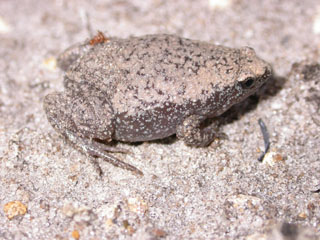
As suggested by their name, microhylids are mostly small frogs. Many species are below 1.5 cm (0.59 in) in length, although some species are as large as 9 cm (3.5 in).[3] They can be arboreal or terrestrial, and some even live close to water. The ground-dwellers are often found under leaf litter within forests, occasionally venturing out at night to hunt. The two main shapes for the microhylids are wide bodies and narrow mouths and normal frog proportions. Those with narrow mouths generally eat termites and ants, and the others have diets typical of most frogs. Egg-laying habits are highly varied.
The microhylids of New Guinea and Australia completely bypass the tadpole stage, with direct development from egg to frog. The arboreal species can therefore lay the eggs within the trees, and never need venture to the ground. Where species do have tadpoles, these almost always lack the teeth or horny beaks typical of the tadpoles of other families.[3]
The skull has paired palatines and frontoparietals. The facial nerve passes through the anterior acoustic foramen in the auditory capsule; the trigeminal and facial nerve ganglia are fused to form a prootic ganglion. The eight (or seven) presacral holochordal vertebrae are all procoelous except for a biconcave surface on last presacral. The pectoral girdle is firmisternal and some show reduced clavicle and procoracoids. The terminal phalanges are blunt, pointed, or T-shaped. The tadpole lacks keratinized mouth parts and has a large spiracular chamber emptied by a caudomedial spiracle.[4]
Frogs from the Microhylidae occur throughout the tropical and warm temperate regions of North America, South America, Africa, eastern India, Sri Lanka, Southeast Asia, New Guinea, and Australia. Although most are found in tropical or subtropical regions, a few species can be found in arid or nontropical areas. They are the majority of frog species in New Guinea and Madagascar.
^ abcvan der Meijden, A., M. Vences, S. Hoegg, R. Boistel, A. Channing, and A. Meyer. 2007. Nuclear gene phylogeny of narrow-mouthed toads (family: Microhylidae) and a discussion of competing hypotheses concerning their biogeographical origins. Molecular Phylogenetics and Evolution44(3):1017–1030. doi:10.1016/j.ympev.2007.02.008
^Amphibiaweb. "Microhylidae". Amphibiaweb. Retrieved 2 April 2020.
^ abZweifel, Robert G. (1998). Cogger, H.G.; Zweifel, R.G. (eds.). Encyclopedia of Reptiles and Amphibians. San Diego: Academic Press. pp. 102–103. ISBN0-12-178560-2.
^Caldwell, George R. Zug; Laurie J. Vitt; Janalee P. (2001). Herpetology : an introductory biology of amphibians and reptiles (2. ed.). San Diego [u.a.]: Academic Press. ISBN0-12-782622-X.{{cite book}}: CS1 maint: multiple names: authors list (link)
^De Sá, R. O., Streicher, J. W., Sekonyela, R., Forlani, M. C., Loader, S. P., Greenbaum, E., Richards, S., Haddad, C. F. B. (2012). Molecular phylogeny of microhylid frogs (Anura: Microhylidae) with emphasis on relationships among New World genera. BMC Evolutionary Biology, 12, 241. doi:10.1186/1471-2148-12-241
Microhylidae is a diverse family of anuran amphibians, commonly known as narrow-mouthed frogs, characterized by their small to medium size (typically 10–100 mm in snout-vent length), stout bodies, short snouts, and notably narrow mouths adapted for a fossorial or terrestrial lifestyle.[1][2] This family encompasses 764 species (as of November 2025) across 59 genera, making it one of the largest frog families worldwide, with a pantropical distribution spanning the Americas, sub-Saharan Africa, Madagascar, Southeast Asia, New Guinea, and northern Australia, though absent from the Palaearctic region, most of Australia, the West Indies, and oceanic islands.[1][3] Microhylids exhibit remarkable ecological diversity, inhabiting environments from arid deserts to wet tropical rainforests, and include both fossorial burrowers and some arboreal forms, with high species richness in biodiversity hotspots like Madagascar and New Guinea.[1][2]Taxonomically, Microhylidae belongs to the suborder Neobatrachia within Anura and is divided into 12 subfamilies, including Asterophryinae (with 368 species), Cophylinae (119 species), Gastrophryninae, Kalophryninae, Microhylinae, and others such as Adelastinae, Dyscophinae, Hoplophryninae, Melanobatrachinae, Otophryninae, Phrynomerinae, and Scaphiophryninae (as of November 2025).[1] The family's monophyly is well-supported, though some subfamilies like Scaphiophryninae have been debated in relation to other ranoid families; it originated from a diploid ancestor with 26 chromosomes, and species counts have grown rapidly due to ongoing discoveries in tropical regions.[2][4] Named Microhylidae by Günther in 1858 (with priority from Fitzinger's 1843 works on Hylaedactyli and Gastrophrynae), the family reflects its morphological distinctiveness, including the absence of teeth, reduced clavicles, horizontal or round pupils, and 2–3 palatal folds.[3][2]Morphologically, microhylids often feature pointy heads, rounded bodies, and robust hind limbs suited for burrowing, with some species displaying vivid aposematic coloration, such as the bright red Dyscophus antongilii (tomato frog) in Madagascar.[1] Reproduction varies widely, from aquatic larvae with specialized type II morphology (lacking beaks and denticles) to direct development without free-living tadpoles in subfamilies like Asterophryinae; many employ axillary amplexus, foam nests, or even male brooding, while some New World species exhibit facultative commensalism with spiders.[1][2] Ecologically, they play key roles in tropical ecosystems as insectivores, with some miniaturized species like those in Paedophryne representing the world's smallest vertebrates, and their fossorial habits often lead to secretive behaviors and brief breeding seasons.[5][2] Conservation concerns are notable, particularly in Madagascar where genera like Stumpffia include multiple endangered and critically endangered species threatened by habitat loss.[1]
Description
Morphology and anatomy
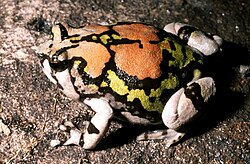
Microhylidae frogs are characterized by their distinctive narrow mouths and pointed heads, which facilitate a fossorial or terrestrial lifestyle. These features contribute to their compact, often globose body shape with a generalized teardrop outline, supported by stout hind legs adapted for burrowing or short-distance movement.[1][2] The family exhibits two primary body types: wide-bodied forms, such as those in genera like Breviceps, which are robust and orb-like, enabling efficient myrmecophagy by allowing storage of ants and termites in expanded stomachs; and slender-bodied forms with more typical frog proportions, seen in genera like Microhyla, suited for generalist predation.[2][6]Key anatomical features include a firmisternal pectoral girdle with reduced or absent clavicles and procoracoids, providing structural rigidity for underground locomotion. The skull features paired palatines and frontoparietals, along with two or three palatal folds in adults, while the vertebral column consists of eight presacral vertebrae that are procoelous, except for a biconcave anterior surface on the last, with the terminal phalanges of digits being blunt, pointed, or T-shaped to aid in digging or climbing. The trigeminal and facial nerve ganglia are fused to form a prootic ganglion, a trait consistent with neobatrachian anurans but prominent in this family. Typically toothless jaws (though some species possess vomerine or maxillary teeth) and an eleutherognathine condition, where the maxillae do not meet anteriorly with the premaxillae, further define their cranial morphology.[7][8][2]Skin texture varies from smooth to warty, often thick and glandular for protection in soil environments, with dorsal coloration ranging from reddish-brown to grey-brown and venters in white, yellow, or orange tones. Limb structures emphasize burrowing adaptations, particularly in fossorialspecies, where hind legs are short and robust, lacking extensive webbing or discs.[7][1] Sensory adaptations include reduced eyes in subterranean species, limiting visual reliance in favor of tactile and auditory cues, while vocal sac morphology is diverse, often featuring subgular sacs with abundant elastic fibers integrated with muscle for efficient sound amplification during calls.[9][10]
Size and variation
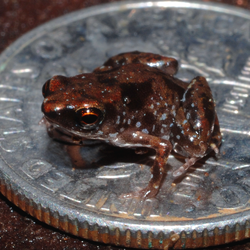
Microhylidae exhibit a remarkable range in body size, spanning from some of the smallest known vertebrates to moderately large anurans. The family includes highly miniaturized species such as Paedophryne amauensis, where adult males reach a snout-vent length (SVL) of only 7.0–8.0 mm, representing one extreme of vertebrate miniaturization.[11] At the other end, larger forms like those in the genus Kaloula can attain SVLs up to approximately 70 mm, with females of Kaloula picta averaging 35.0–56.5 mm.[12] Overall, the family displays adult SVLs from 7 mm in diminutive genera to 100 mm in robust species, reflecting adaptations to diverse ecological niches.[2]Coloration in Microhylidae varies widely, often serving antipredator functions through camouflage or warning signals. Many ground-dwelling species feature cryptic earth tones, such as browns and mottled patterns that blend with leaf litter for concealment, as seen in Oreophryne ezra juveniles whose colors match the surrounding substrate.[13] In contrast, toxic species like those in the genus Dyscophus display bright aposematic coloration, with females exhibiting vivid orange-red hues and males paler yellow-orange, signaling unpalatability to predators.[14] Sexual dichromatism occurs in some taxa, including Dyscophus, where differences in hue between sexes may relate to reproductive signaling or defense.[14]Body shape among Microhylidae shows intraspecific and intergeneric diversity tied to lifestyle. Ground-dwellers typically have plump, globular bodies with stout hind legs and short snouts, facilitating burrowing or terrestrial foraging, as exemplified by the teardrop-shaped form common in the subfamily Microhylinae.[1] Arboreal species, such as certain Cophyla, tend toward more elongated bodies with expanded digital pads for climbing, contrasting the compact build of litter inhabitants.[15]Extreme miniaturization is prevalent in Southeast Asian and New Guinean genera like Paedophryne and Microhyla, where adults under 10 mm SVL enable exploitation of microhabitats such as leaf litter crevices.[11] This reduction in body size often correlates with elevated mass-specific metabolic rates, as smaller amphibians require higher relative energy expenditure to maintain physiological functions, influencing foraging efficiency and predator avoidance.[16]
Reproduction
Breeding behaviors
Microhylid frogs primarily rely on acoustic signals for mate attraction, with males producing advertisement calls that vary significantly across species and body sizes. In smaller species such as those in the genus Microhyla, calls consist of high-pitched peeps or whistles with dominant frequencies ranging from 2.5 to 6 kHz, serving to advertise male presence and quality to females.[17] Larger species, including some Neotropical forms like Chiasmocleis mantiqueira, emit lower-frequency calls, such as pulsatile notes or trills around 1.2–1.8 kHz, which may function similarly but adapt to different acoustic environments.[18] These calls are typically broadcast at night from calling sites, often elevated perches or pond edges, to minimize predation risk and maximize transmission in humid tropical conditions.[19]Courtship in Microhylidae involves physical and chemical cues that facilitate pairing. The predominant amplexus type is axillary, where the male clasps the female around the upper body, though inguinal amplexus (clasping at the waist) occurs in some taxa; this positioning ensures external fertilization during egg deposition.[20] Males often defend territories through aggressive displays, including wrestling or call interruptions toward intruders, to secure access to receptive females.[21] In fossorial species like Dermatonotus muelleri, courtship incorporates pheromonal elements via skin secretions, including adhesives that bind the pair during amplexus and potentially chemical signals that stimulate female receptivity.[22]Breeding sites for Microhylidae are diverse and tied to ephemeral water sources, reflecting opportunistic reproduction in variable environments. Many species, such as Glyphoglossus molossus, select temporary pools formed after heavy rains for explosive breeding aggregations, where pairs quickly mate and deposit eggs before sites dry.[23] Arboreal or semi-arboreal forms like Ramanella montana utilize tree holes or phytotelms, which accumulate rainwater and provide sheltered oviposition.[24] Burrowing species, including Kalophrynus taxa, oviposit in underground chambers or flooded burrows, emerging en masse during wet seasons.[25] In tropical regions, breeding is seasonally synchronized with monsoons, peaking from May to July when rainfall creates suitable habitats and cues chorusing.[26]Parental care in Microhylidae shows considerable variation, ranging from complete neglect to active male involvement. In many aquatic-breeding species, such as Microhyla fissipes, adults provide no post-oviposition care, relying on high fecundity to offset predation losses.[27] Conversely, terrestrial genera like Cophixalus exhibit paternal guarding, where males attend egg clutches in hidden sites, such as leaf litter or under rocks, for weeks to protect against desiccation and invertebrates; this behavior has been observed in C. ornatus for up to five months per clutch.[28] Such care enhances offspring survival in direct-developing species but is absent in explosive breeders focused on rapid colonization of temporary habitats.[29]
Developmental modes
Microhylidae exhibit a remarkable diversity of developmental modes, ranging from direct development to biphasic life cycles with specialized larval stages. In many Old World species, particularly within the subfamily Asterophryinae, direct development predominates, whereby embryos develop entirely within gelatinous egg capsules into fully formed froglets, bypassing a free-living tadpole phase. These eggs are typically deposited in terrestrial foam nests or on moist substrates such as leaf litter or soil depressions, providing protection from desiccation and predators while allowing internal nourishment from large yolk reserves.[30][1]In contrast, other microhylids, such as those in the subfamily Gastrophryninae, display biphasic development characterized by endotrophic tadpoles that hatch from terrestrial or semi-terrestrial eggs and rely solely on endogenous yolk for nutrition. These larvae lack functional mouthparts, including teeth and keratinous beaks, rendering them non-feeding and adapted for brief aquatic or moist terrestrial existence before metamorphosis. For instance, in genera like Gastrophryne, the tadpoles possess reduced oral structures that prevent external feeding, emphasizing yolk-dependent growth over a short larval period. Some species in Microhylinae, such as Microhyla nepenticola, also exhibit endotrophic tadpoles in specialized phytotelm habitats like pitcher plants.[1][31][32]Variations in larval feeding strategies further highlight the family's adaptability, with exotrophic tadpoles appearing in aquatic genera such as Kaloula, where larvae actively filter-feed on algae and detritus in ponds or temporary waters. Additionally, some species employ arboreal oviposition, laying eggs on vegetation overhanging water bodies; upon hatching, the tadpoles drop directly into the aquatic environment to commence their free-living phase. These exotrophic forms feature well-developed mouthparts suited for suspension feeding, contrasting sharply with their endotrophic relatives.[33][34]Metamorphosis in biphasic microhylids involves rapid physiological remodeling, including tail resorption over 10–20 days depending on temperature and species, culminating in the shift from aquatic larval habitats to terrestrial adult lifestyles. In Microhyla fissipes, for example, tail absorption completes within approximately 18 days at 28°C, accompanied by gill regression and lung development to facilitate the transition to air-breathing. This process underscores the family's evolutionary innovations in ontogeny, enabling exploitation of diverse microhabitats while minimizing exposure to aquatic risks.[8][1]
Taxonomy
Subfamilies and genera
The family Microhylidae is classified into 12 subfamilies, encompassing 59 genera and 769 species worldwide.[1][3] These subfamilies are: Adelastinae, Asterophryinae, Cophylinae, Dyscophinae, Gastrophryninae, Hoplophryninae, Kalophryninae, Melanobatrachinae, Microhylinae, Otophryninae, Phrynomerinae, and Scaphiophryninae.[1] The classification reflects molecular phylogenetic analyses that have refined relationships within the family, including the resurrection of Otophryninae in 2012 based on distinct osteological features such as the presence of an omosternum, straight clavicles, and a well-developed tympanum.Asterophryinae is the largest subfamily, containing 376 species across 18 genera, primarily distributed in New Guinea and Australia, with many species exhibiting direct development and terrestrial breeding habits.[1][35] Cophylinae, with 118 species in eight genera, is endemic to Madagascar and features diverse reproductive modes, including endotrophic larvae in several genera.[1] Gastrophryninae focuses on the New World, comprising 80 species in 16 genera across the Americas, often characterized by burrowing lifestyles and exotrophic aquatic larvae.[1][36] Microhylinae includes 87 species in five genera, mainly in Asia and Africa, with diagnostic traits such as endotrophic or non-feeding larval stages adapted to temporary pools.[1]Adelastinae is restricted to South America, with a single genus featuring specialized adhesive toe discs and direct-developing embryos.[1] Dyscophinae, also with one genus, is endemic to Madagascar and known for aposematic coloration in species like the tomato frogs.[1] Other subfamilies, such as Hoplophryninae (four species in Africa) and Phrynomerinae (six species in sub-Saharan Africa), show geographic biases and unique larval morphologies, including reduced mouthparts in many taxa.[1] Kalophryninae and Melanobatrachinae are Asian endemics with fossorial adaptations and endotrophic development.[1]Representative genera illustrate subfamily diversity: Paedophryne (Asterophryinae) includes the world's smallest vertebrates, with direct-developing, non-aquatic embryos and leaf-litter habits in New Guinea.[1]Dyscophus (Dyscophinae) comprises brightly colored, toxic Madagascan species with aquatic larvae.[1]Kaloula (Microhylinae), known as balloon frogs for their vocal sac inflation, occurs in Southeast Asia and features burrowing behavior and endotrophic tadpoles.[1]Cophixalus (Asterophryinae) consists of New Guinean leaf-litter specialists with direct development and adhesive eggs laid on vegetation.[1] These examples highlight the family's morphological and ecological variation within the taxonomic framework.[1]
Diversity and recent discoveries
The Microhylidae family encompasses 769 species across 59 genera as of November 2025, representing a substantial rise from prior assessments of 683 species in 57 genera reported in earlier taxonomic compilations.[1][3] This expansion reflects ongoing taxonomic revisions driven by integrative approaches in herpetology. Centers of diversity include New Guinea, dominated by the subfamily Asterophryinae with over 200 species; Madagascar, home to the Cophylinae including diverse genera like Stumpffia; and Southeast Asia, where the Microhylinae thrives with genera such as Microhyla.[1][37][38]Recent discoveries have further enriched this tally. In 2018, the new genusVietnamophryne (subfamily Asterophryinae) was established in northern and eastern Indochina, encompassing six miniaturized species differentiated by molecular and morphological traits.[39] A novelMicrohylaspecies, M. roedderi, was described from Deo Ca Mountain in Vietnam in 2025, distinguished by genetic divergences in 12S rRNA and 16S rRNA genes alongside unique morphological features like copper-colored eyes.[40] Similarly, in 2025, two new asterophryine species were identified from the Purari River Basin in Papua New Guinea: Cophixalus flavopunctatus and Oreophryne purari, based on acoustic, molecular, and osteological evidence.[41] In October 2025, two additional microhylid species, Callulops gobakula and Choerophryne koeypad, were described from boulder-field habitats on Dauan Island in the Torres Strait.[42] Earlier, in November 2025, Platypelis efatra was added from Madagascar.[43] In 2017, an integrative study unveiled 26 new Stumpffiaspecies in Madagascar's rainforests, elevating the genus from 16 to 42 species through multilocus phylogenetics and bioacoustics.[1]These advancements stem primarily from molecular analyses, such as DNA barcoding and phylogenomics, coupled with bioacoustic comparisons of advertisement calls, which have unmasked numerous cryptic species previously overlooked due to morphological conservatism.[44] Such methods underscore the underestimated biodiversity in Microhylidae hotspots, informing conservation priorities amid habitat threats like deforestation.[44]
Evolutionary history
Origins and phylogeny
The family Microhylidae traces its origins to the aftermath of the Cretaceous-Paleogene (K-Pg) extinction event, with the crown group diversifying approximately 66 million years ago in Africa, as part of a broader radiation of neobatrachian frogs that exploited newly available ecological niches following the mass extinction.[45] This timing aligns with molecular clock estimates placing the common ancestor of Microhylidae and other ranoid frogs (Ranoidea) around 116 million years ago within Gondwana, during the Early Cretaceous, prior to the fragmentation of the supercontinent that influenced subsequent biogeographic patterns.[46] The Gondwanan roots are evident in the family's pantropical distribution, which reflects both vicariance and long-distance dispersal events as continents separated.Molecular phylogenetic analyses have elucidated the family's evolutionary relationships, revealing a deep split between Old World and New World lineages. A comprehensive study using mitochondrial and nuclear DNA sequences from over 200 taxa established that New World subfamilies, such as Gastrophryninae, form a monophyletic clade distinct from Old World groups like Microhylinae and Kalophryninae, with divergences dating back to the Late Cretaceous around 82 million years ago.[47] Subsequent phylogenomic work incorporating anchored hybrid enrichment data across 66 loci confirmed these separations, while resolving unstable backbone relationships and identifying new subfamilies (e.g., Adelastinae in South America), underscoring independent radiations in the Old World (Asia-Australasia) versus the Americas.Key divergences highlight adaptive innovations tied to biogeographic shifts. In the Australasian region, the subfamily Asterophryinae evolved direct development, bypassing aquatic larval stages, which facilitated terrestrial breeding in diverse habitats from Southeast Asia to New Guinea and Australia.[48] The colonization of the Americas involved multiple independent events via trans-Atlantic dispersal from African ancestors, leading to the establishment of Gastrophryninae and Otophryninae, with lineage splits occurring during the Paleogene.[45] These radiations were driven by shifts to insectivory and varied microhabitats, including fossorial and arboreal lifestyles, with miniaturization—adult body sizes under 15 mm—evolving convergently in several lineages, such as Microhylinae and certain Gastrophryninae genera, to exploit small prey and leaf-litter niches.
Fossil record
The fossil record of Microhylidae is notably sparse, consisting primarily of isolated skeletal elements such as ilia, humeri, and vertebrae from Cenozoic deposits, reflecting the challenges of preserving small, fossorial amphibians. The oldest attributed fossils date to the Eocene-Miocene interval in Peruvian Amazonia, where bone fragments indicate the early presence of the family in South America, with morphologies suggestive of basal microhylids similar to modern Gastrophrynespecies. These specimens, recovered from multiple sites during recent field expeditions, represent the first direct paleontological evidence of Microhylidae in the Neotropics and underscore their Cenozoic diversification alongside lineages like Hyloidea and Pipidae.Subsequent records include Miocene fossils of Gastrophryne from Florida, United States, comprising partial skeletons that exhibit the characteristic narrow mouth and robust build of the subfamily Gastrophryninae, confirming the family's establishment in North America by the Neogene. In the Indo-Pacific, Oligocene or late Miocene fossils from Australia and Pleistocene disarticulated ilia from cave deposits in Papua New Guinea's central highlands document at least four microhylid taxa, highlighting post-Gondwanan breakup dispersal and adaptation in Australasia. Overall, only a handful of fossilspecies have been formally described—primarily within Gastrophryne and indeterminate forms—often from karstic or sedimentary contexts that favor bone preservation.[2][49][50]Paleontological evidence supports a Gondwanan origin for Microhylidae through vicariance patterns and shared morphological traits, such as reduced pedal webbing and specialized tongue structures, with hyloid frogs, though no pre-Cretaceous fossils of the family have been confirmed. The limited temporal and geographic coverage stems from taphonomic biases, including rapid decomposition in humid tropical soils and the burrowing habits of most microhylids, which reduce exposure to depositional environments. While fossils indicate initial diversification around 50 million years ago in the Paleogene, molecular divergence estimates suggest the clade's roots lie in the Late Cretaceous, revealing a substantial ghost lineage unsupported by direct skeletal evidence.[51]
Distribution and ecology
Geographic range
The family Microhylidae exhibits a pantropical distribution, with species occurring across the Americas, Africa, Asia, and Australasia, but absent from temperate zones. In the Americas, representatives of the subfamily Gastrophryninae range from the southern United States (e.g., Gastrophryne carolinensis in the southeastern U.S.) through Central America to northern South America, primarily in tropical regions. Scattered populations in sub-Saharan Africa include members of Hoplophryninae and Phrynomerinae, mainly in East African highlands and savannas. In Asia, the family is widespread from India through Southeast Asia, encompassing subfamilies like Kalophryninae and Microhylinae. Australasian distribution centers on New Guinea and northern Australia, dominated by Asterophryinae.[1]Endemism is pronounced in several hotspots, reflecting biogeographic isolation. New Guinea hosts over 368 species, primarily in the subfamily Asterophryinae, representing a significant portion of the region's amphibian diversity. Madagascar is another key center, with high diversity in the endemic subfamily Cophylinae (over 100 species) and Scaphiophryninae, confined entirely to the island. Island endemism extends to Pacific archipelagos around New Guinea, where numerous genera show restricted distributions.[1][52]The family's evolutionary history indicates an Old World core, with diversification originating in Asia-Australasia before colonization of the New World approximately 30-40 million years ago during the Oligocene. This dispersal led to the establishment of Gastrophryninae and Otophryninae in the Americas. Introductions are rare, but species like Kaloula pulchra have been recorded as non-native in Pacific islands such as Guam and the Philippines, likely via human transport.[47][53]
Habitats and adaptations
Microhylidae, commonly known as narrow-mouthed frogs, primarily inhabit humid tropical forests, savannas, and wetlands across tropical and subtropical regions, with many species exhibiting fossorial lifestyles in leaf litter or soil. Fossorial species, such as those in the genusGlyphoglossus, have evolved pointed snouts and robust hindlimbs with spade-like tubercles to facilitate burrowing into soft substrates, allowing them to evade desiccation and predators during dry periods. In contrast, arboreal members, including genera like Cophyla and Platypelis, occupy tree canopies and phytotelms, featuring expanded digital pads on their toes for adhesion to bark and foliage, enabling navigation through vertical vegetation in rainforest understories. These habitat preferences reflect recurrent evolutionary shifts, as seen in the cophyline clade of Madagascar, where terrestrial, semi-arboreal, and fully arboreal forms have independently arisen multiple times.[54][55][56][54]Dietary adaptations in Microhylidae vary by habitat and morphology, with many species being generalist insectivores that forage on small arthropods in leaf litter or on vegetation. Specialized myrmecophagy is prominent in wide-mouthed genera like Elachistocleis, where diets consist predominantly of ants and termites, supported by robust jaws and a pointed tongue for extracting colonial insects from soil or nests; for instance, E. ovalis in Araucaria forests relies on these prey for over 90% of its diet. This specialization likely aids in exploiting abundant but chemically defended food sources, with some species tolerating alkaloids through physiological adaptations in the gut microbiome.[2][57][58]Behavioral ecology in Microhylidae emphasizes nocturnal activity to reduce predation and desiccation risks, with many species emerging at dusk to forage or breed. Explosive breeding is a common response to seasonal rains, particularly in fossorial taxa like Scaphiophryne and Elachistocleis, where adults rapidly aggregate in temporary pools following precipitation events, minimizing exposure time in open habitats. Predator avoidance strategies include aposematic coloration and toxicity in genera such as Dyscophus, where species like D. guineti secrete bioactive peptides from granular glands, serving as a chemical defense and potentially facilitating Batesian mimicry with more toxic anurans. These behaviors are finely tuned to ephemeral water availability and humidity.[59][60]Microhylidae show sensitivities to climatic changes, particularly drying trends and habitat alteration, as many species are restricted to moist microhabitats and absent from arid zones. For example, cophyline frogs in Madagascar are confined to eastern rainforests with consistently wet substrates, failing to colonize drier western regions due to physiological limits on water balance. Some species, however, demonstrate resilience by adapting to modified edges of urban or deforested areas, where increased sunlight may support prey abundance despite reduced humidity.[54][61]






.png)

_Figure_3_(cropped).png)
_Figure_4_(cropped).png)

.jpg)


_Ranomafana.jpg)