


Community hub
Recent from talks
Contribute something
Nothing was collected or created yet.
Migrant Mother
View on Wikipedia | This article is written like a personal reflection, personal essay, or argumentative essay that states a Wikipedia editor's personal feelings or presents an original argument about a topic. (April 2025) |
| Migrant Mother | |
|---|---|
 | |
| Artist | Dorothea Lange |
| Year | 1936 |
| Catalogue | 50989 |
| Medium | gelatin silver print photograph |
| Subject | Florence Owens Thompson |
| Dimensions | 28.3 cm × 21.8 cm (11.1 in × 8.6 in) |
| Location | Museum of Modern Art, New York |
| Accession | 331.1995 |
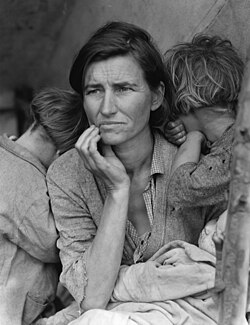
Migrant Mother is a photograph taken in 1936 in Nipomo, California, by American photographer Dorothea Lange[1] during her time with the Resettlement Administration (later the Farm Security Administration).[2] The 28.3 by 21.8 cm (11 1/8 by 8 9/16 in) gelatin silver print depicts a mother anxiously gazing into the distance, with an infant in her lap and two older children huddling close by. The photo captures the plight of migrant farm workers who arrived in California en masse looking for employment during the Great Depression. Initially anonymous, the woman in the photo was identified as Florence Owens Thompson in 1978, following the work of a journalist for the California-based newspaper The Modesto Bee.[3]
Since its publication, Lange's work has been considered symbolic of the Great Depression. It is in the public domain and has been widely reproduced in educational material, advertisements, and other media. Today, Migrant Mother is considered to be a part of the classic canon of American art and international photography. A print is housed at the Museum of Modern Art in New York City.[4]
Description
[edit]Migrant Mother depicts a mother looking off into the distance with two of her children at her sides and an infant in her lap. Her children's faces are not shown as the children both bury their faces in their mother's shoulders.[5] The black and white photograph print held in the Museum of Modern Art is approximately the same size as a sheet of North American printer paper (11 1/8 by 8 9/16 in).[2]
Execution
[edit]Migrant Mother was achieved through a process of deliberate and careful intervention by Lange. Although she considered herself a documentary photographer and stuck to the belief that she should not intervene in the subject of her photography, Lange manipulated the framing and the subjects to arrive at her final shot.[6][1] Furthermore the photo has been retouched after capture: the mother's left thumb was removed from the foreground on the right side of the image as Lange "considered the thumb to be such a glaring defect that she apparently didn't have a second thought about removing it'.[6]
Lange found the mother and her children by chance while driving home on a cold, rainy afternoon in March 1936, when she passed a sign reading “Pea-Pickers Camp” in Nipomo, California. She continued to drive but could not shake the image of the sign from her memory and turned around heading for the camp. In a memoir written by Lange about the photoshoot, she writes, "I was on my way and barely saw a crude sign with pointing arrow which flashed by me at the side of the road saying Pea-Pickers Camp. But out of the corner of my eye I did see it...Having well convinced myself for twenty miles that I could continue on, I did the opposite. Almost without realizing what I was doing, I made a U-turn on the empty highway".[2] When Lange first arrived to the camp of migrant pea pickers, she took two snapshots of the mother's tent and her children. In the tent was the mother, her teenage daughter, and three young children. Realizing that these photographs lacked a central focus, Lange honed in on the mother and her children.[5]
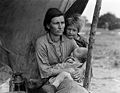
Lange moved closer to the tent and took a third snapshot of just the mother and her baby, asking the two young children at her side to move out of the frame. In this photograph, the mother is breastfeeding her baby as she looks down. The mother looks tired and worn in her makeshift tent home. Despite capturing an intimate moment where a mother is nursing her child, Lange sensed a flaw in the photograph – the mother's gaze. The mother was looking downward, "... as if wishing to shield herself from the scrutiny of the camera". For Lange, this expression spoiled the image. She and her colleagues tried as best they could to present their subjects as dignified human beings in order to elicit sympathy rather than ridicule. Lange sensed that she was invading her subject's privacy and was causing discomfort so she moved on to her fourth shot to regain composure.[7]
In Lange's fourth photograph, she asks one of the children to enter the frame and to stand with her chin resting on her mother's shoulder. In this photograph, the mother is looking up into the distance with her daughter's head resting on her shoulder and her baby on her lap. The mother's expression in this photograph was now acceptable for Lange. She decided to take another but made some critical changes looking at what was captured in the background of the photograph.
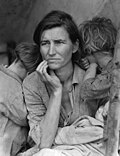
Lange moved herself to the left and switched from her previously horizontal orientation to a vertical orientation of the frame. This allowed her to center the mother, the child, and the baby and left ample headroom for them. Additionally, moving left cut out the details in the background which she preferred not to show because of the possible implications that might sour viewers' image of her subjects. Lange took one last picture of the mother and her children, but this time she asked a second child to step in the frame. There were now a total of three children in the frame. The mother held her baby in her lap and her two children stood at her sides. In order to remove any possibility of competing gazes and any exchanges that might create unwanted effects, Lange asked both children to turn their backs towards the camera and place their hands on their mother's shoulders. Lange then moved closer to the mother, focusing her at the center of the frame and excluding any other background such that the mother and her children were the only objects in the frame. This last photograph is now known as Migrant Mother. According to Lange, she was only at the camp for ten minutes. After her last shot, she finally closed her camera and went home.[6][8]
-
 1
1 -
 2
2 -
 2b (not included by Lange in original sequence)
 -
 3
3 -
 4
4 -
 5
5 -
 6
6


.jpg)

Identity of family
[edit]The subjects of Lange's photography were always nameless. Roy Stryker, a manager of the FSA's photographic project, had his photographers practice contemporary social science techniques in captioning their images. This allowed the subjects to be viewed as common men and women under unfortunate circumstances that the Roosevelt administration was trying to improve. Several decades after the photograph's publication, a journalist found the identity of the iconic photograph's mother – Florence Owens Thompson – discovering that she was born in 1903 on a Cherokee reservation in Oklahoma. She married at the age of seventeen and had six children until her husband died in 1931. In 1933, she became pregnant again. Fearing that welfare authorities would take her child away, she moved back to Oklahoma. In 1934, her whole family moved out to Shafter, California where she worked in fields and began a relationship with James Hill. She had four more children with him. When Lange met Thompson, Hill and Thompson's sons were out looking to get their car fixed. In 1958, 22 years after the photograph had been published, Thompson saw Migrant Mother in a magazine and wrote to the magazine asking them to recall all unsold magazines to protect her and her family's rights. As the photograph was the creation of an employee of the federal government working in her official capacity, it belonged to the public domain and its publication was far beyond the reach of Lange's control. Once Thompson and her family came to know this, they withdrew their complaint and now speak positively about Lange.[9][7]
Interpretation and legacy
[edit]Migrant Mother's furrowed brow and hand placement suggests anxiety and worry about her duties as a mother to nurture and protect her children. Her expression and juxtaposition with her children and clothing indicates that the family is overcome by circumstances they cannot control, thus removing any blame from the mother. The children leaning on their mother depicts the mother as the children's pillar of strength. The absence of any space between the mother and children implies that the family have become one flesh in their suffering. In fact, photography scholar Sally Stein writes that if the photograph depicted the mother without her children, the photograph would have much less power. She argues that because the children are so close to their mother that through this visual compression, the merged mother with her children represents a sort of bondage. As a mother herself and a photographer of the working-class people, Lange was aware of this imprisonment and shared the complex anxiety felt by the mother. In addition to the presence of children, Stein argued that due to these implications and lack of resolution, Migrant Mother held a sort of inner tension that added to its power.[6]
The process in which Lange obtained Migrant Mother revealed key insights into the prevailing social norms at the time and reflects key aspects in Lange's life. By 1936, Lange was married to a new man and was much happier in this marriage than her previous one. She felt like she was starting a new chapter in her life and felt more in control. Lange's process reflects this new chapter in her life. James Curtis, a scholar of FSA photography, writes, "The Migrant Mother series reflects Lange's new mood... Lange moved confidently in arranging her compositions. She knew the image she wanted, knew what to feature and what to leave out". Lange and her colleagues worked very hard to convey their subjects with dignity such that their plight would receive sympathy rather than ridicule. Her transition from photograph to photograph in the Migrant Mother series reveals this as she chooses to remove and alter key aspects of the frame in order to achieve a certain aesthetic. For example, she chooses to remove the teenager altogether from the final photographs to remove the questions such as, "Was she [the mother] a teenager herself when she gave birth to her first child?". Curtis writes, "While middle-class viewers were sympathetically disposed to the needs of impoverished children, teenagers posed thorny questions of personal responsibility".[9]
Since its publication, Migrant Mother has become an icon of the Great Depression.[5] The photograph has always been in the public domain and since its creation it has been reproduced many times including as postage stamps, as advertisements, for charity fundraising, and as magazine covers. The Black Panthers even put an afro on the mother. However, the legacy of Migrant Mother extended further than just to media. In the summer of 1983, the photograph was published in the national press. Florence Thompson was ill with cancer, but had no insurance to help pay the costs. Her children pleaded for money to help with the costs and within weeks, they were able to raise $30,000 for their dying mother. Thompson eventually succumbed to her illness and passed in mid-September. Although most people will likely not know who Dorothea Lange is nor will they know the identity of the Migrant Mother, many recognize the mother's face as an emblem of the Great Depression.[9]

Location research and locally planned commemoration
[edit]In the 2010s, pinpointing the precise location of the photograph became the subject of much research and scholarship in Nipomo, as nearly 40 historians, photographers, authors, and local residents attempted to find the exact area.[10]
According to Paul Martin Lester, a professor at UT Dallas who led a campaign to fundraise for a commemorative historical marker, and author Doug Jenzen, the series of photos is believed to have taken place next to what is today known as North Oakglen Avenue in Nipomo.[11][12][13] As of the mid-2020s, the site was still a crop field, bordered by the same eucalyptus trees, between the northbound side of U.S. Highway 101 to the south and the outskirts of Nipomo High's football stadium to the north.[14]
See also
[edit]References
[edit]- ^ a b Gottschalk, Molly (2018-01-12). "The Fateful Roadside Stop That Led to Dorothea Lange's "Migrant Mother"". Artsy. Archived from the original on 2021-01-17. Retrieved 2020-05-26.
- ^ a b c "Dorothea Lange. Migrant Mother, Nipomo, California. 1936". www.moma.org. Archived from the original on 2021-10-08. Retrieved 2020-05-26.
- ^ King, Peter H. (October 18, 1998). "One defiant family escapes poignant portrait of poverty". The Fresno Bee. Section: Vision; Page F1.
- ^ Soltys, Hanna. "Research Guides: Dorothea Lange's "Migrant Mother" Photographs in the Farm Security Administration Collection: Introduction". guides.loc.gov. Archived from the original on 2021-12-08. Retrieved 2020-05-26.
- ^ a b c "See the Story Behind The 'Migrant Mother' Photo". 100 Photographs. Archived from the original on 2020-05-17. Retrieved 2020-05-26.
- ^ a b c d Pruitt, Sarah (8 May 2020). "The Real Story Behind the 'Migrant Mother' in the Great Depression-Era Photo". HISTORY. Archived from the original on 2020-05-24. Retrieved 2020-05-26.
- ^ a b Estrin, James (2018-11-28). "Unraveling the Mysteries of Dorothea Lange's 'Migrant Mother'". The New York Times. ISSN 0362-4331. Archived from the original on 2019-11-15. Retrieved 2020-05-26.
- ^ "Migrant Mother: Photograph Analysis & Facts". Study.com. Archived from the original on 2020-10-31. Retrieved 2020-05-26.
- ^ a b c Phelan, Ben (April 14, 2014). "Antiques Roadshow". Antiques Roadshow. Archived from the original on 2020-05-16. Retrieved 2020-05-26.
- ^ Hodgson, Mike (July 7, 2012). "Detective story: Nipomo historian says he's pinpointed site of 'Migrant Mother' photo". Santa Maria Times. (Subscription required.)
- ^ "Website set up for donations to create 'Migrant Mother' marker in Nipomo". Santa Maria Times. April 8, 2016. (Subscription required.)
- ^ Hodgson, Mike (January 29, 2016). "'Migrant Mother' marker to get its own site in new Nipomo park". Arroyo Grande Times Press Recorder.
- ^ Hodgson, Mike (March 19, 2016). "Crowd pays tribute to woman immortalized in 'Migrant Mother'". Nipomo Adobe Press.
- ^ Hodgson, Mike (October 8, 2012). "Nipomo 'Migrant Mother' camp pinpointed". Santa Maria Times. Archived from the original on February 19, 2015.
Migrant Mother
View on GrokipediaHistorical Context
The Great Depression and Agricultural Crises
The Great Depression began with the stock market crash on October 29, 1929, which precipitated a severe economic contraction marked by widespread business failures, unemployment reaching 25% by 1933, and a 29% decline in real GDP.[9] [10] This downturn was exacerbated by the Federal Reserve's monetary contraction, which limited credit availability and intensified deflationary pressures, alongside a series of banking panics from 1930 to 1933 that resulted in over 7,000 bank failures and further eroded public confidence and liquidity.[11] [12] The Smoot-Hawley Tariff Act, enacted in June 1930, raised U.S. import duties by approximately 20% on average, prompting retaliatory tariffs from trading partners and contributing to a collapse in global trade volumes by over 60%, which deepened the domestic agricultural and manufacturing slumps.[13] [14] Agricultural crises compounded these macroeconomic failures, particularly in the Great Plains, where the Dust Bowl emerged as a confluence of environmental and human-induced factors. Severe droughts from 1930 to 1936, following a post-World War I wheat boom that encouraged overfarming, led to widespread soil erosion as deep plowing and insufficient crop rotation had stripped protective sod layers, allowing winds to displace millions of tons of topsoil and render vast areas infertile.[15] [16] Overgrazing by livestock and monoculture practices further degraded the land, displacing an estimated 2.5 million people from farming-dependent livelihoods in states like Oklahoma, Texas, and Kansas, with tenant farmers—often sharecroppers with no ownership stake—hit hardest due to their vulnerability to mechanization and debt burdens amid falling crop prices.[16] This displacement fueled large-scale migration westward, with 300,000 to 400,000 individuals from Oklahoma, Arkansas, Texas, and Missouri—derisively termed "Okies"—relocating to California between 1930 and 1940 in search of agricultural employment.[17] Upon arrival, these migrants encountered a saturated labor market, where an oversupply of workers drove daily wages down to 10–25 cents for backbreaking field labor, coupled with exploitation by growers who offered sporadic contracts and substandard housing in makeshift camps plagued by sanitation issues and evictions.[18] The influx strained California's resources, as local resentment grew over competition for jobs, yet the migrants' desperation perpetuated a cycle of poverty amid the state's own Depression-era agricultural volatility.[19]Role of the Farm Security Administration
The Resettlement Administration (RA) was created by President Franklin D. Roosevelt through Executive Order 7027 on April 30, 1935, as an independent New Deal agency tasked with resettling destitute rural families, providing rehabilitation loans, and promoting soil conservation to mitigate farm foreclosures and dust bowl devastation during the Great Depression.[20] Reorganized in 1937 under the U.S. Department of Agriculture and renamed the Farm Security Administration (FSA), it absorbed the RA's functions while emphasizing tenant purchase loans at 3 percent interest over 40 years, construction of approximately 200 migrant labor camps, and limited cooperative farming to foster self-sufficiency among sharecroppers and migratory workers displaced by agricultural mechanization and drought.[21][22] The FSA's Historical Section, led by economist Roy Emerson Stryker, launched a documentary photography project in 1935—initially under the RA—to systematically record rural poverty and advocate for policy reforms, hiring professional photographers to generate images for government reports, press releases, and public exhibits that illustrated the urgency of federal aid.[23] This effort produced around 175,000 negatives by 1943, focusing on unvarnished depictions of economic distress to build empathy and justify expanded appropriations for relief, though instructions to photographers emphasized factual documentation over staged scenes.[24] Despite aiding over 400,000 families through loans that raised participant incomes by an estimated 69 percent from 1937 to 1941, the FSA's resettlement initiatives achieved limited success, relocating fewer than 10,000 families into planned communities amid high failure rates from client defaults, administrative overload, and insufficient oversight.[25][26] The program drew sharp criticism for bureaucratic inefficiency and politicized use of photography as soft propaganda to dramatize suffering and secure congressional funding, with opponents like the American Farm Bureau Federation decrying it as an experiment in agricultural collectivization that undermined private property and market-driven recovery.[27][21] These assessments aligned with empirical shortfalls, as wartime labor demands eclipsed the FSA's rural focus, prompting its merger into other agencies by 1946.[28]Creation and Execution
Dorothea Lange's Assignment
Dorothea Lange established a successful portrait photography studio in San Francisco in 1919, but the economic fallout from the 1929 stock market crash severely reduced her clientele, prompting a shift toward documentary work amid widespread unemployment and poverty.[29] This transition began in earnest in 1933 with street photographs like White Angel Breadline, capturing breadlines during the deepening Great Depression.[29] In early 1935, Lange joined the Resettlement Administration (RA), a New Deal program aimed at alleviating rural distress, which tasked her with documenting the living conditions of migrant workers and farmers; the RA evolved into the Farm Security Administration (FSA) later that year.[30] In February 1936, Lange received an RA assignment to photograph migratory laborers across California, focusing on their hardships during the agricultural season.[1] By March, while driving north from the southern fields toward Berkeley after completing much of the fieldwork, she passed a roadside sign for a pea pickers' camp near Nipomo, where approximately 2,500 workers had gathered for the harvest only to be stranded after a late February frost destroyed the crops, halting all picking and leaving families destitute without tires or fuel to relocate.[31][1] Lange recounted driving about 20 miles past the camp before an intuitive urge compelled her to reverse course, later describing it as following "instinct, not reason" and being drawn "as if by a magnet" to the desperate scene despite her exhaustion and undeveloped film backlog.[6][1] Nonetheless, her approach prioritized objective evidentiary recording for RA reports and policy advocacy over personal artistic expression, aligning with the agency's mandate to expose systemic rural failures without embellishment.[1]Encounter and Photographic Process
On March 6, 1936, Dorothea Lange, returning from a Farm Security Administration assignment, passed a sign for a pea pickers' camp near Nipomo, California, and, despite fatigue, decided to stop and document the conditions of frost-struck workers living on frozen peas and wild birds.[1][6] She approached a lean-to tent where Florence Owens Thompson, aged 32 and mother of seven, sat with several of her children, appearing hungry and preoccupied; Thompson reported having no food, her youngest child ill with the flu, and plans to sell car tires for gas to return home.[32][3] Lange later recalled a brief, intuitive interaction without asking Thompson's name or full history, sensing mutual awareness that the images might aid her situation.[1] Lange set up her 4x5-inch Graflex camera on a tripod and made five exposures from the same direction, gradually moving closer to frame Thompson more intimately.[3][1] The sequence began with wider shots capturing the family group, including visible children, before evolving to tighter compositions where Lange directed the older children to turn away and hide their faces, enhancing focus on Thompson's anxious expression; the final exposure featured Thompson resting her chin on her hand in a gesture of weary contemplation.[6] This progression reflected Lange's opportunistic yet deliberate approach, prioritizing emotional resonance over candid spontaneity.[33] The negatives were promptly developed and sent to the Farm Security Administration in Washington, D.C., accompanied by Lange's descriptive caption emphasizing destitution: "Destitute pea pickers in California. Mother of seven children. Age thirty-two. Nipomo, California," along with narrative details of starvation and desperation.[3][34] Published in the San Francisco News on March 10, 1936, the images and story spurred federal response, with approximately 20,000 pounds of food dispatched to the camp within days.[6][35] Thompson later contested some elements of Lange's recounted dialogue and circumstances, suggesting possible embellishment for advocacy effect.[1][36]Technical Details and Post-Processing
Dorothea Lange captured the Migrant Mother image using a 4x5-inch Graflex Series D camera loaded with sheet film, relying on available natural light within the subject's makeshift tent at the Nipomo pea pickers' camp.[8][37] The setup produced a shallow depth of field, sharply focusing on Florence Owens Thompson's face and upper body while softly rendering the background and her children's forms, enhancing the portrait's intimate, emotive quality.[33] Lange exposed a sequence of at least five to seven negatives during the encounter, with the selected frame originating from this series.[37][38] She directed Thompson and her children into positions to emphasize anxiety—asking the older children to turn away and hide their faces—before selecting and submitting the image for publication in the San Francisco News on March 10, 1936.[33] These interventions, later acknowledged by Lange, have prompted debates over the photograph's documentary authenticity, as they blended candid observation with staged elements to amplify narrative impact.[8] In post-processing, Lange cropped the negative to eliminate Thompson's left thumb visible in the bottom-right corner, a alteration performed to streamline composition and direct viewer attention toward the subject's expression; this modified version was printed and distributed.[39][40] Further darkroom retouching refined tones and contrasts for aesthetic clarity, standard practices in 1930s documentary photography that prioritized interpretive strength over unaltered fidelity.[41][40] The Library of Congress holds the original negative, which retains a diagnostic crack on Thompson's forearm, confirming the cropped print's divergence from the raw capture.[42]Visual Description
Composition and Key Elements
The central figure in the photograph is Florence Owens Thompson, aged 32, seated with her chin propped on one hand and her gaze directed diagonally away from the camera, her brow furrowed.[33][31] Two older children, identified as approximately four and five years old, lean closely against her shoulders with their faces turned inward and obscured from the viewer's sight, while an infant rests in her lap.[33] The overall composition forms a triangle, with Thompson's head at the apex and the leaning figures of the children delineating the base, centering the subjects tightly within the frame.[43][44] This image derives from a series of progressively closer exposures, with the final version cropped and retouched to eliminate a visible thumb at the edge, enhancing focus on the primary subjects.[33][3] The background reveals a blurred expanse of tent fabric, indicative of a lean-to shelter, with no distinct objects sharply defined to distract from the foreground figures.[3][33] Natural lighting produces chiaroscuro effects, casting shadows that accentuate the contours of faces, hands, and worn clothing textures.[33]Iconographic Features
The central figure in Migrant Mother adopts a pose with her chin resting on her hand, her gaze directed thoughtfully away from the camera, which conveys a sense of quiet determination amid hardship. This stance, captured in March 1936 at a Nipomo pea pickers' camp, reflects Thompson's documented physical and emotional fatigue from the family's destitution following a frost that ruined the early pea crop, leaving workers without income or sufficient food.[1][3] While later interpretations have likened the composition to classical maternal icons of endurance, such as Renaissance depictions of the Madonna cradling the Christ child, the image's evocation stems directly from the subject's real circumstances rather than deliberate artistic emulation.[1] The two older children flank Thompson with their faces turned inward and away from the viewer, their bodies huddled close to her shoulders, while an infant rests in her lap. This arrangement of averted gazes among the children heightens the photograph's anonymity, initially presenting Thompson not as an individual but as a representative of broader migrant struggles, a universality reinforced by the lack of identifying captions in early publications.[33][6] Visual details such as Thompson's threadbare dress, marked by frayed edges and patches, alongside the coarse fabric of the tent visible in the background, serve as tangible indicators of the camp's squalid conditions. These elements document the makeshift living arrangements endured by families stranded after the March frost halted pea harvesting, with residents subsisting on scavenged frozen vegetables and small game.[1]The Subject and Her Family
Florence Owens Thompson's Background
Florence Owens Thompson was born Florence Leona Christie on September 1, 1903, in Indian Territory, Oklahoma (now part of the Cherokee Nation), to parents of Cherokee descent; her mother was Mary Jane Cobb, and her father, Jackson Christie, abandoned the family before her birth.[33] Her mother's remarriage to a man of Choctaw heritage further underscored the family's Indigenous roots, which were often overlooked in later depictions framing Thompson as a stereotypical white "Okie" migrant from the Dust Bowl.[45] This ethnic background complicated narratives of homogeneous Anglo-American displacement, as Thompson's origins tied her to earlier forced relocations of Native peoples rather than solely the 1930s agricultural collapses in the Great Plains.[46] At age 17, in 1921, Thompson married Cleo Leroy Owens, a 23-year-old farmer's son, with whom she began building a family amid economic instability in Oklahoma and Mississippi. The couple had five children by the late 1920s, but Cleo died of tuberculosis in 1931, leaving Thompson pregnant with their sixth child and widowed at 28. She subsequently gave birth to that child and, by 1936, had seven children in total, reflecting the rapid family growth common among rural working-class households of the era. Thompson's migration westward began in the late 1920s with her husband, driven by farm failures in Oklahoma, but accelerated after his death as she sought work to support her growing family; routes took her through Texas and Arizona before settling in California, where her family had resided for several years by the mid-1930s, countering portrayals of abrupt Dust Bowl exodus.[46] By March 1936, she was living with partner George Kelley—a logger and truck driver—and their children in transient agricultural labor circuits, including pea picking camps, rather than as recent arrivals from the Plains. This pattern of seasonal mobility, rooted in pre-Depression economic pressures and her Indigenous familial ties to land dispossession, highlighted broader causal factors in migrant labor beyond singular environmental disasters.[33]Family Dynamics and Immediate Circumstances
In March 1936, Florence Owens Thompson and her family were among thousands of pea pickers stranded at a makeshift camp near Nipomo, California, following a severe freeze that destroyed the local crop and eliminated available wage labor.[1] [6] The sudden weather event left workers, including Thompson's group, without income after arriving for seasonal employment, exacerbating the challenges of itinerant farm labor during the Great Depression's agricultural oversupply.[36] Thompson, then 32 years old and mother to seven children from multiple relationships, resided in the camp with her youngest daughters and partner Jim Hill, the father of her three most recent children; Hill had departed days earlier to procure food but had not yet returned, leaving Thompson to manage immediate needs.[36] The iconic photograph captured Thompson flanked by two of her daughters—Katherine Owens, aged 4, positioned to her left with her face turned away, and Mary Ruth Owens, approximately 1 year old, to her right in a similar pose—while her other children, including older siblings, were absent from the frame, underscoring the selective focus on the most vulnerable members amid a larger household.[33] Facing acute scarcity, the family sustained itself through rudimentary foraging, consuming frozen vegetables salvaged from surrounding fields and wild birds trapped by the children, a collective effort reflecting Thompson's adaptive resourcefulness in the absence of formal relief or steady work.[1] This approach highlighted individual initiative within the constraints of migratory patterns driven by regional crop failures and labor competition, as Thompson had repeatedly relocated her family across states in pursuit of harvest opportunities.[36]Post-Photograph Life and Identity Revelation
Following the 1936 photograph, Florence Owens Thompson and her family persisted as itinerant farm laborers, migrating seasonally across California and occasionally into Arizona to harvest crops such as cotton and peas.[36] By 1945, the family relocated to Modesto, California, where Thompson secured employment at a local hospital, transitioning from precarious fieldwork to more consistent wage labor that afforded modest financial security.[47] She later married George Thompson, an administrator at the same hospital, further stabilizing her circumstances in the postwar years.[36] Thompson's identity as the "Migrant Mother" remained anonymous for over four decades until 1978, when Modesto Bee reporter Emmett Corrigan, acting on a tip, interviewed her at her home in Modesto and obtained her confirmation.[48] In the interview, Thompson voiced resentment toward the image, describing it as exploitative for perpetuating a depiction of her family's destitution without delivering any personal gain, and she expressed shame over its association with her impoverished past.[6] She emphasized that the photograph provided no financial assistance, stating it "didn't help Mrs. Thompson financially."[48] Among Thompson's children, opinions on the photograph diverged: Thompson herself regarded it as a curse emblematic of endured suffering, whereas some daughters, including Katherine McIntosh, later viewed it more favorably as a testament to maternal resilience and a catalyst for public awareness of Depression-era migrant hardships.[6] The family derived no royalties or compensation from the image's extensive commercial and institutional reproductions.[48] Thompson died on September 16, 1983, at age 80, shortly after her birthday.[36]Interpretations and Controversies
Symbolic and Artistic Readings
The photograph has been interpreted as a secular counterpart to religious icons like the Madonna and Child, portraying maternal endurance amid hardship. Art historian Sarah Klein notes parallels in the composition, where Thompson's central figure cradles her children in a gesture of protective vigilance reminiscent of depictions of the Virgin Mary bearing suffering for redemption.[44] This reading emphasizes universal themes of feminine resilience, transforming a specific moment of desperation into a timeless emblem of sacrificial motherhood.[35] As an icon of the Great Depression, the image encapsulates the era's pervasive anxiety and resolve among displaced workers. The Museum of Modern Art describes it as symbolizing the plight of migrant farm laborers, with Thompson's tense expression—furrowed brow and averted eyes—conveying acute worry over sustenance and survival.[1] This portrayal shaped public understanding of the economic crisis, highlighting not mere victimhood but a steely determination to persevere, as evidenced by its rapid dissemination in media that spurred federal relief efforts.[42] Certain critics, however, question the dominance of empathetic symbolism, arguing that the image's deliberate framing prioritizes emotive storytelling over unfiltered realism. Literary critic George Elliott characterized it as an "anti-Madonna and Child," where maternal instinct clashes with destitution, potentially romanticizing hardship into a narrative of innate fortitude rather than documenting raw contingency.[49] Art scholars like David Campany highlight the "mixed blessing" of its iconic status, suggesting that such constructed pathos can obscure the photograph's basis in directed posing, favoring aesthetic uplift over the Depression's unvarnished causal severities.[40]Allegations of Staging and Manipulation
The photographic sequence from the March 1936 session at the Nipomo pea pickers' camp consists of seven exposures preserved in the Farm Security Administration (FSA) archives, demonstrating a progression from initial candid frames—where the children faced the camera—to later composed shots in which they turned away and rested their heads, actions consistent with Lange directing the subjects to enhance emotional expressiveness.[4][23] In preparing the image for publication, Lange cropped the frame to eliminate extraneous elements such as a tent pole and tightened the composition for visual impact; additionally, in 1939, she instructed her assistant to retouch the print by dodging out Florence Owens Thompson's thumb from the lower right foreground, viewing it as a distracting imperfection that detracted from the intended focus.[50][5] Lange's field notes accompanying the photographs to the FSA described Thompson's family as living on frozen vegetables scavenged from fields and birds killed by the children, claims that Thompson disputed decades later, asserting they had food on hand and tires sold only for gas rather than necessities, indicating potential embellishment in captions to amplify the scene's urgency for advocacy purposes.[8][7] While Lange verbally requested and received permission from Thompson to take the photographs, Thompson remained unaware of the shutter releases and the images' subsequent iconic dissemination, later expressing bitterness over the lack of consent for their perpetual association with destitution and her uncompensated role in shaping public perceptions of Depression-era hardship.[6][7]Political Instrumentalization and Propaganda Critiques
The Farm Security Administration (FSA), established in 1937 as part of New Deal efforts to address rural poverty, employed Dorothea Lange's photographs, including Migrant Mother taken in March 1936, to document conditions and build congressional and public support for resettlement and relief programs.[1] The image was rapidly disseminated through government channels, with Lange's accompanying report on the Nipomo pea pickers' camp—describing frozen crops and starving families—prompting federal agencies to dispatch food supplies to the site within days, demonstrating its direct influence on immediate aid allocation.[33] This strategic use positioned the photograph as visual advocacy for federal intervention, amplifying calls for expanded programs amid ongoing Dust Bowl migrations and agricultural collapse. Critics have characterized the photo's promotion as propagandistic, arguing it cultivated a narrative of inevitable victimhood under laissez-faire economics, thereby justifying unprecedented government expansion while sidelining causal factors like the Smoot-Hawley Tariff Act of June 1930, which imposed duties on over 20,000 imports, contracted international trade by approximately 66% from 1929 to 1933, and intensified deflationary pressures.[14] [51] Economic commentators contend this framing minimized personal responsibility—such as migrants' adaptive labor mobility—and obscured policy-induced distortions, portraying suffering as a market failure rather than a confluence of monetary contraction, trade barriers, and agricultural overproduction.[52] The image's staging, acknowledged by Lange herself as involving directed poses and cropped negatives to heighten emotional impact, further fueled accusations of manipulative advocacy over neutral documentation. The photograph's mythic elevation, with reproductions in stamps, textbooks, and media exceeding one million by the mid-20th century, is critiqued for homogenizing migrant realities into a uniform tale of destitution, neglecting that many families, including Thompson's, secured seasonal work shortly after the Nipomo episode amid improving conditions.[52] By the late 1930s, U.S. real GNP had rebounded with annual growth rates of about 8% from 1933 to 1937 and 10% from 1938 to 1941, surpassing 1929 output levels by 1939 through monetary easing and private sector adjustments, rather than solely sustained fiscal outlays.[53] Proponents credit the image with humanizing policy needs and spurring relief, yet detractors assert its selective pathos entrenched dependency tropes, distorting causal attributions and underemphasizing spontaneous economic resilience evident in declining unemployment from 25% in 1933 to under 15% by 1937.[54][55] This duality reflects tensions between evidentiary documentation and instrumentalized symbolism in Depression-era visual rhetoric.Legacy and Impact
Cultural and Historical Symbolism
The photograph Migrant Mother, taken by Dorothea Lange in March 1936, has become an enduring icon of American visual culture, symbolizing the human toll of the Great Depression. Widely reproduced in history textbooks and educational materials, it exemplifies the era's widespread poverty and displacement. The image appeared on a U.S. postage stamp in the Celebrate the Century series on September 10, 1998, as part of the "1930s: America Survives the Depression" issuance, further cementing its status as a national emblem.[56] It is frequently invoked alongside John Steinbeck's The Grapes of Wrath (1939) to represent Dust Bowl migration and economic despair, shaping public perceptions of the period's agricultural crises.[57] The photo's influence extends to documentary photography practices, sparking ongoing debates about ethical responsibilities toward subjects, including consent, compensation, and the risk of reducing personal stories to archetypes of suffering.[58] These discussions highlight tensions between artistic impact and fidelity to lived realities, influencing standards for photojournalism in social realism traditions that persisted into the post-World War II era. While not directly tied to wartime propaganda, the image contributed to narratives of resilience and federal intervention that informed morale-boosting depictions of American recovery.[33] Despite its symbolic power, Migrant Mother captures a transient episode of acute hardship rather than the comprehensive migrant experience. The Farm Security Administration (FSA) produced over 250,000 images documenting not only destitution but also New Deal programs fostering resettlement, employment, and community self-sufficiency among migrants. This broader archive reveals instances of entrepreneurial adaptation, such as migrants establishing small farms or labor cooperatives, underscoring that while the photo evokes universal desperation, empirical evidence from FSA records indicates varied outcomes, with many migrants achieving stability through wartime labor demands and government aid by the early 1940s. Its dominance has occasionally eclipsed these recovery narratives, limiting appreciation of the era's economic dynamism.[59]Family Perspectives and Commemorations
Florence Owens Thompson's family expressed ambivalence toward the Migrant Mother photograph, with Thompson herself regarding it as an unwelcome reminder of past poverty that brought unwanted attention later in life.[6] Her daughters, however, emphasized her personal resilience and maternal strength over images of victimhood. In a 1992 interview, daughters Katherine Owens McIntosh and Norma Rydlewski recounted Thompson's tireless work ethic and insistence on keeping the family clean amid hardship, portraying her as a determined provider rather than an object of pity.[60] Katherine McIntosh reiterated this pride in a 2009 statement, viewing the image as a testament to endurance.[61] Following Thompson's death on September 16, 1983, at age 79 from cancer, her family selected a gravestone inscription at Lakewood Memorial Park in Hughson, California—near Modesto—reading "Migrant Mother – A Legend of the Strength of American Motherhood," underscoring their focus on her fortitude.[62] This modest marker aligned with her preference for simplicity, avoiding elaborate monuments. Local grassroots efforts in the late 1970s and 1980s centered on verifying the photograph's Nipomo origins after a Modesto Bee reporter, tipped off in 1978, confirmed Thompson's identity through family contacts. These investigations by regional historians and journalists pinpointed the pea pickers' camp site on the outskirts of Nipomo, fostering community awareness without formal family orchestration. Partial commemorations emerged, including a 2016 public tribute at the site marking the photograph's 80th anniversary, attended by locals honoring Thompson's story.[63] No evidence exists of family-donated prints to museums, and post-1983, surviving daughters pursued no major initiatives, with interviews remaining the primary outlet for their viewpoints.[64]Modern Reassessments and Debates
In 2018, analysis of Dorothea Lange's contact sheets from the Migrant Mother series revealed the sequential nature of her photographic approach, including directives to Thompson to assume specific poses, prompting renewed scrutiny of the image's authenticity as a spontaneous documentary capture.[65] This examination, featured in exhibitions and scholarly discussions, underscored Lange's deliberate compositional choices, such as cropping out a thumb visible in the original negative to enhance the image's focus and emotional impact.[64] High-resolution digital scans of the unretouched nitrate negative, made available by the Library of Congress, exposed these alterations, fueling debates on the ethics of photographic manipulation that parallel contemporary concerns over digital editing and AI-generated imagery in visual storytelling.[66] Recent scholarship has reevaluated Florence Owens Thompson's background, emphasizing her Cherokee ancestry—born Florence Leona Christie in the Cherokee Nation's Indian Territory on September 1, 1903—which connects her plight to historical Indigenous displacements like the Trail of Tears, aspects often overlooked in early narratives of the photograph.[67] This reassessment highlights potential erasure of Native identity in Depression-era depictions, arguing that Thompson's heritage adds layers of systemic marginalization beyond Dust Bowl migration alone.[46] Critics contend that initial captions and FSA promotions prioritized a generic migrant worker archetype, sidelining ethnic specifics that could complicate the image's universal appeal.[68] Debates persist over the photograph's influence on public policy perceptions, with some analyses critiquing its role in bolstering narratives of federal relief necessity, despite evidence that private charities, family networks, and market-driven recoveries—such as wartime industrial booms—played significant roles in alleviating Depression hardships.[8] These critiques, drawn from economic histories, challenge the image's perpetuation of a welfare state mythology by questioning whether FSA imagery overstated government dependency while underrepresenting adaptive private sector responses.[35] Such reevaluations stress causal factors like monetary policy shifts and entrepreneurial resurgence over relief programs in fostering long-term recovery, urging a balanced view of the era's multifaceted causation.[69]References
- https://commons.wikimedia.org/wiki/File:Lange-MigrantMother02.jpg