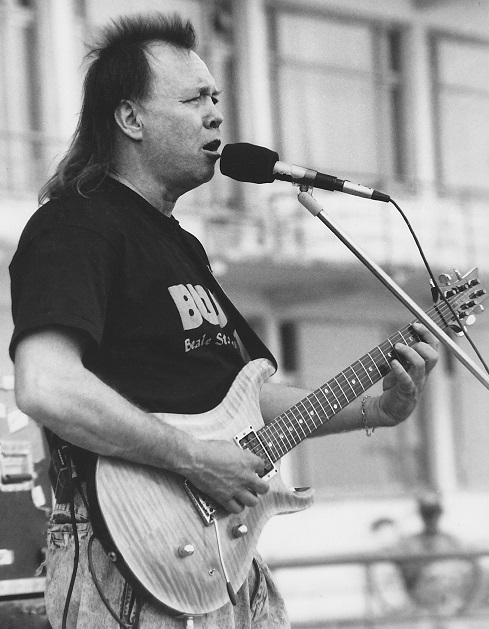

Mike Deasy
View on Wikipedia
Key Information


Michael William Deasy (born February 4, 1941) is an American rock and jazz guitarist. As a session musician, he played on numerous hit singles and albums recorded in Los Angeles in the 1960s, 1970s and 1980s. He is sometimes credited as Mike Deasy Sr.
Biography
[edit]He was born and raised in Los Angeles, California, where he learned to play guitar as a child.[1] While still in high school, he played in bands backing visiting musicians such as Ricky Nelson and The Everly Brothers, and also played in Ritchie Valens' touring band with Bruce Johnston, Larry Knechtel, Sandy Nelson, and Jim Horn. After graduating in 1959, he joined Eddie Cochran's band, the Kelly Four, where he played both guitar and baritone sax and made his first recordings.[2][3][4] He also played with The Coasters and Duane Eddy.[1]
Following Cochran's death in 1960, he became an active session musician in Los Angeles[5] after winning a Down Beat magazine collegiate jazz music scholarship in 1961.[6] Deasy married Jim Horn's sister Kathie in 1961, and the couple later set up their own recording studio and production company, Saltmine Recording. He worked as a member of "The Wrecking Crew", with Hal Blaine, Joe Osborn, Larry Knechtel and others, on sessions for Phil Spector, and contributed guitar parts to The Beach Boys' album Pet Sounds.[1][5] In the 1960s and later years he also worked on records by the Monkees, the Association, Scott McKenzie, Johnny Rivers, the Fifth Dimension, Rick Nelson, Randy Newman, Spanky & Our Gang, Tommy Roe, Fats Domino, The Byrds, Michael Jackson, Helen Reddy, Frank Zappa, and others.[1][2]
In 1967, he contributed to albums coordinated by record producer Curt Boettcher, including Friar Tuck and His Psychedelic Guitar, effectively a Deasy solo album with wordless vocals by Boettcher.[7] Under the pseudonym Lybuk Hyd, Deasy also played guitar and sitar on the psychedelic concept album Tanyet, credited to The Ceyleib People, which also featured Ry Cooder.[5]
Deasy played guitar (with Tommy Tedesco and Al Casey) on Elvis Presley's 1968 TV special, Elvis. He also performed live with musicians including Cannonball Adderley and Little Richard. In 1969, he was invited by record producer Terry Melcher to work with a newly discovered singer-songwriter, Charles Manson.[8] Deasy left Manson's home after three days, "in a state of drug-fueled paranoia".[5]
Deasy continued to record with leading musicians, including Frank Sinatra, Ella Fitzgerald, Barbra Streisand, Chet Baker, and Mel Tormé.[1] His guitar playing has appeared on the soundtrack of many films including The Graduate, Guess Who's Coming to Dinner, Duel, Bullitt, and Dirty Harry, as well as on many commercials.[1][9]
From the early 1970s onwards after becoming a born again Christian at the 1969 Billy Graham crusade in Anaheim, California, Deasy became increasingly involved with Contemporary Christian music, producing and writing songs for several successful albums, often in conjunction with his wife. In later years, he has had a parallel career as a motivational speaker, and since 1988 has run a "Yes To Life" educational and inspirational program in schools and colleges in the US, Canada and Europe.[3] The Deasys also co-pastored Rock Church Southeast in Port Arthur, Texas, until it eventually shut its doors when Hurricane Harvey flooded the building.
Discography
[edit]- Your Gang (Mercury, 1966)
- Tanyet (Vault, 1967)
- Friar Tuck and His Psychedelic Guitar (Mercury, 1967)
- Gator Creek (Mercury, 1970)
- Letters to My Head (Capitol, 1973)
- Wings of an Eagle (Sparrow, 1976)
- Wings of Praise (Saltmine, 1987)
- God Hates Queer (Saltmine, 1988)
- Holy Smoke (Saltmine, 1991)
- Tru Love (Saltmine, 1994)
- Guitar Gold (Saltmine, 1995)
- Signs and Wonders (Saltmine, 1999)
- Paper Airplane (Saltmine, 2000)
- Path of Peace Vol. 1 (Saltmine, 2003)
- Path of Peace Vol. 2 (Saltmine, 2003)
- Endtimes Weather Band (Saltmine, 2011)
- Driftin' (Saltmine, 2013)
- The Road Home Vol. 1 (Saltmine)
- The Road Home Vol. 2 (Saltmine)
Partial credits as a sideman
[edit]


Film and television
[edit]References
[edit]- ^ a b c d e f Biography by Bruce Eder at Allmusic.com. Retrieved August 22, 2013
- ^ a b Mike Deasy at Musicians Hall of Fame Archived September 3, 2014, at the Wayback Machine. Retrieved August 22, 2013
- ^ a b Rob Whitehurst, Mike Deasy – Rock and Roll, at MikeDeasy.com Archived May 22, 2018, at the Wayback Machine. Retrieved August 22, 2013
- ^ Cochran, Bobby (October 24, 2003). Three Steps to Heaven: The Eddie Cochran Story. Hal Leonard Corporation. ISBN 9780634032523. Retrieved October 24, 2023 – via Google Books.
- ^ a b c d Dawn Eden, The Mike Deasy Story: 2001 interview, 29 June 2006, Dawneden.blogspot.co.uk, Retrieved August 22, 2013
- ^ "p.14" (PDF). Archive.org. Retrieved October 24, 2023.
- ^ Sean Westergaard, Friar Tuck and His Psychedelic Guitar, Allmusic.com. Retrieved August 22, 2013
- ^ Guinn, Jeff (August 6, 2013). Manson: The Life and Times of Charles Manson. Simon and Schuster. ISBN 9781451645163. Retrieved October 24, 2023 – via Google Books.
- ^ Michael Deasy at IMDb. Retrieved August 22, 2013
- ^ "AllMusic | Record Reviews, Streaming Songs, Genres & Bands". AllMusic. Retrieved October 24, 2023.
- ^ "Mike Deasy Discography". Mikedeasydiscography.blogspot.com. Retrieved October 24, 2023.
- ^ "Mike Deasy". Discogs.com. Retrieved October 24, 2023.
- ^ "Mike Deasy Sr. Songs, Albums, Reviews, Bio & More". AllMusic. Retrieved October 24, 2023.
- ^ "Mike Deasy | Music Department, Soundtrack". IMDb.com. Retrieved October 24, 2023.
External links
[edit]
| International | |
|---|---|
| National | |
| Artists | |
| Other | |

Mike Deasy
View on GrokipediaEarly Life and Influences
Childhood and Musical Beginnings
Michael William Deasy was born on February 4, 1941, in Los Angeles, California, and raised in Southern California during the region's post-World War II cultural expansion.[2][8] He displayed an early aptitude for music, beginning to play guitar and sing at a young age amid the burgeoning rock 'n' roll scene of the 1950s.[8] By the mid-1950s, during his high school years, Deasy had immersed himself in local performances, assembling and fronting his own rock 'n' roll band known as His Big Guitar.[3] This group secured opportunities to back touring national acts passing through Los Angeles venues, including Ricky Nelson and the Everly Brothers, as well as contributing to Ritchie Valens' band during that period.[3] These experiences highlighted his emerging proficiency on guitar and established his initial connections within California's vibrant amateur and semi-professional music circuits.[5]Formative Experiences in Los Angeles Music Scene
In the late 1950s, Deasy immersed himself in Southern California's burgeoning rock and roll ecosystem through live performances and regional tours, collaborating with emerging players who would later define the Los Angeles studio landscape. During 1958, he toured Southern California with Ritchie Valens alongside future session musicians such as Bruce Johnston, Larry Knechtel, Jim Horn, and Sandy Nelson, honing ensemble interplay amid the shift from regional live circuits to more structured recording environments.[3] This period exposed him to the demands of rapid adaptation across genres, as live bands increasingly incorporated rock influences from jazz and rhythm-and-blues, fostering technical versatility essential for studio transitions.[3] By 1959, Deasy's experiences expanded through summer engagements with The Coasters in the Kansas City Bell Blues Band and tours with Dick Clark's Caravan of Stars, where he played bass for Chubby Checker and joined Duane Eddy's Rebels with Knechtel and Horn, emphasizing the growing emphasis on portable, adaptable instrumentation over fixed live setups.[3] These gigs, alongside earlier work backing Eddie Cochran in The Kelly Four on guitar and baritone saxophone, built foundational speed and precision amid the competitive SoCal scene, where musicians navigated diverse acts to secure steadier opportunities.[8] Cochran's death on April 17, 1960, marked a pivotal inflection for Deasy, accelerating the industry's pivot toward Los Angeles studios as live touring risks mounted and recording technology enabled scalable production.[9] Entering the early 1960s, Deasy engaged in initial demo work at facilities like Gary Paxton's Garage, participating in studio sessions with groups such as The Flips under Kip Tyler, which underscored the era's evolution from ad-hoc live ensembles to precision-oriented recording demands.[8][3] His early recognition as a jazz guitarist, including a first-place win at the Lighthouse Jazz Festival, facilitated experiments blending jazz improvisation with rock rhythms, enhancing adaptability for quick-read charts and multi-take efficiency in emerging facilities.[3] This immersion in LA's rock-jazz nexus, amid the late-1950s boom into the 1960s studio explosion, positioned Deasy to meet the causal prerequisites for session mastery: relentless exposure to varied players and the discipline of transitioning from performative flair to reproducible technical execution.[10][3]Professional Career in Secular Music
Session Work with Wrecking Crew and Producers
Deasy became a member of the informal Wrecking Crew collective of Los Angeles session musicians in the early 1960s, engaging in the intensive studio grind from approximately 1962 to 1972. He routinely worked 12-14 hours daily, escalating to 15 sessions per week by late 1965, collaborating closely with core members including drummer Hal Blaine, bassist Joe Osborn, and keyboardist Larry Knechtel.[5] This schedule demanded high efficiency, with musicians sight-reading complex charts, improvising riffs on the spot, and operating without prior rehearsals, relying on established group chemistry for seamless execution.[5][11] His contributions extended to producer Phil Spector's sessions, where Deasy provided guitar layers essential to the Wall of Sound production method, which used repeated overdubs to build thick, reverberant textures unattainable in single-take live band recordings.[5] With Brian Wilson, Deasy adapted to experimental directives around 1965, such as translating hummed ideas into guitar parts without standard notation, facilitating rapid iteration through playback reviews.[5] These techniques prioritized observable sonic outcomes over preconceived arrangements, allowing empirical refinements via isolated track adjustments.[11] Deasy also supported Elvis Presley's 1968 studio recordings, including elements for the television comeback special, in environments emphasizing precision and mimed performance elements to optimize final mixes.[5] Across these engagements, his role exemplified the studio system's methodological edge: overdubbing decoupled instruments from real-time synchronization, enabling data-driven enhancements through iterative playback analysis that exposed and corrected live-band inefficiencies like timing variances or balance issues.[5][11]Key Collaborations and Hit Recordings
Deasy contributed rhythm guitar to Tommy Roe's "Dizzy," recorded in sessions featuring Wrecking Crew members like Hal Blaine on drums and Joe Osborn on bass, which topped the US Billboard Hot 100 and UK Singles Chart upon its November 1968 release, selling over a million copies and exemplifying bubblegum pop's commercial peak.[12] On Helen Reddy's title track "I Am Woman," Deasy supplied guitar and 12-string guitar parts during 1971-1972 sessions at Capitol Studios, aiding its ascent to number one on the Billboard Hot 100 in December 1972 and earning a Grammy for Best Female Pop Vocal Performance, with the single certified gold by the RIAA for over 1 million units sold.[13] Deasy's 12-string acoustic rhythm guitar featured on multiple tracks of The Beach Boys' Pet Sounds, including "Wouldn't It Be Nice," released as a single on July 11, 1966, which peaked at number eight on the Billboard Hot 100 and showcased Brian Wilson's experimental harmonies and orchestration, with Deasy's parts recorded amid 15 weekly sessions blending jazz-inflected rock elements into the album's baroque pop sound.[5][14]Personal Struggles and Transition to Christian Music
Drug Addiction and Recovery
Deasy's drug addiction emerged in the late 1960s amid the high-pressure demands of session musicianship in Los Angeles, where access to substances was rampant in the rock scene, contributing to excesses fueled by sudden fame and financial success.[10] The lifestyle's causal pressures—long hours, late nights, and cultural normalization of drug use—intensified his dependency, leading to multiple near-death experiences from overdoses and related crises.[15] [10] A pivotal incident occurred on June 4, 1969, when producer Terry Melcher invited Deasy to Spahn Ranch to record with Charles Manson's group; during the three-day stay, Deasy overdosed on LSD, overwhelmed by a perceived "great fear of the evil" in the environment, consuming excessive amounts that prevented him from regaining mental clarity.[5] He departed in a state of drug-fueled paranoia that persisted upon returning home, marking a crisis point in his escalating substance issues tied to the era's psychedelic experimentation within music circles.[5] Conventional recovery efforts followed, including Jungian analysis and transcendental meditation, but these secular approaches proved ineffective, yielding relapses as Deasy's underlying dependencies remained unaddressed by materialist methods focused on psychological reframing rather than root causal factors.[5] Documented failures in these interventions underscored the limitations of therapy and detox absent deeper structural change, prompting Deasy to reject them in favor of faith-based sobriety as empirical evidence mounted against their sufficiency.[5]Conversion and Family Musical Ventures
In 1969, Deasy experienced a religious conversion at a Billy Graham crusade, becoming a born-again Christian after years of personal turmoil involving drug use and explorations of eastern philosophies.[10][8] This event marked a pivotal shift, leading him to study the Bible intensively and redirect his musical talents toward promoting Christian themes, viewing his prior secular career as part of a broader spiritual journey culminating in faith-based expression.[8] The conversion facilitated his sustained sobriety and reframed his worldview around salvation and spiritual warfare, contrasting sharply with the hedonistic elements of the Los Angeles music scene he had navigated.[8] Following his conversion, Deasy formed a musical duo with his wife, Kathie Deasy, transitioning from anonymous session work to collaborative Christian recordings that emphasized purposeful messaging over commercial anonymity.[16] As one of the earliest acts signed to Sparrow Records, a pioneering label in contemporary Christian music during the Jesus Movement era, the duo released albums such as Wings of an Eagle in 1976, featuring songs that critiqued materialism and cultural excesses through biblical lenses.[16][17] Their output included tracks like "Mark of the Maker," which addressed themes of divine purpose amid worldly temptations, reflecting a deliberate pivot to evangelistic content that sustained productivity into subsequent decades of touring and production.[18] This family-centered venture not only produced multiple releases but also positioned them alongside Jesus Movement pioneers, fostering a genre shift toward accessible, rock-influenced worship music.[16]Discography and Credits
Solo Albums and Singles
Deasy's earliest solo releases came under the pseudonym The Flower Pot, a side project allowing him to explore psychedelic and folk rock styles separate from his session obligations. In July 1967, Vault Records issued two singles: "Wantin' Ain't Gettin'" backed with "Gentle People" (catalog V-937), and "Mr. Zig Zag Man" backed with "Black Moto" (catalog V-935).[19][20] These 45 rpm records featured Deasy's guitar work and songwriting, produced in collaboration with associates from producer Curt Boettcher's circle, but achieved no documented chart positions or widespread airplay.[21][22] Deasy's sole full-length solo album under his own name, Letters to My Head, appeared in 1973 on Capitol Records (ST-11170). This LP comprised 11 original tracks, including "Flutterby," "Humpty Dumpty," the title song, and "The Peace Song," blending rock, blues, and jazz influences with Deasy handling lead guitar, vocals, and composition.[23][4] Backed by prominent Los Angeles session players, the album represented a rare platform for Deasy's personal artistic voice amid his extensive sideman career, though it garnered no notable commercial metrics such as sales figures or radio rotation data.[24] Production emphasized electric guitar-driven arrangements, distinguishing it from Deasy's typical anonymous contributions to others' hits.[25] These outputs highlight the scarcity of Deasy's lead efforts, with just the 1967 singles and 1973 album marking his primary ventures into fronting material, underscoring the industry dynamics that prioritized his guitar-for-hire role over solo prominence.[26] No further solo singles or albums under his name preceded or immediately followed these until later instrumental works outside the secular peak period.[27]Extensive Sideman Contributions
Deasy's extensive sideman work as a guitarist, primarily through the Wrecking Crew collective, encompassed over 150 sessions in the 1960s and 1970s, contributing to multiple number-one hits and demonstrating his adaptability across rock, pop, and brief jazz excursions.[1] His roles often involved rhythm and lead guitar parts that enhanced arrangements without overt soloing, underscoring his influence through ubiquity rather than spotlight prominence.[11]Beach Boys (1960s)
- 1966: Provided 12-string acoustic rhythm guitar and electric guitar on Pet Sounds, including tracks like "God Only Knows" and "I Just Wasn't Made for These Times," supporting Brian Wilson's orchestral pop innovations.[28][29]
Elvis Presley Sessions (1960s)
- 1966 (for 1967 release): Guitar overdubs on soundtrack tracks for the film Double Trouble, such as "Double Trouble" and "Old MacDonald," adding texture to Presley overdubs at MGM Studios.[30]
- June 1968: Rhythm and lead guitar alongside Tommy Tedesco and Al Casey on rehearsals and recordings for Presley's NBC-TV '68 Comeback Special, including hits like "Heartbreak Hotel" and "Hound Dog," helping revive Presley's rock edge.[31][32]
Other Pop and Rock Hits (1960s–1970s)
- 1969: Electric guitar on Tommy Roe's "Dizzy," a bubblegum pop track that topped the US Billboard Hot 100 and UK Singles Chart, featuring riff-driven hooks.[11]
- 1971: Guitar contributions to Barbra Streisand's single "Mother" from the album Streisand Forever, peaking at #79 on the Billboard Hot 100.[11]
- 1972: Rhythm guitar on Helen Reddy's "I Am Woman," an empowerment anthem that reached #1 on the Billboard Hot 100, bolstering its anthemic drive.[11]
Jazz Detours
Deasy occasionally ventured into jazz, showcasing technical versatility through fluid phrasing and improvisation.- Mid-1960s onward: Live performances with Cannonball Adderley, applying rock-honed precision to bebop and hard bop contexts. (Note: While Wikipedia is not cited directly, corroborated by session musician accounts in AllMusic biography.)[1]
- 1960s sessions: Guitar on exploratory tracks with artists like Ben Benay (The Big Blues Harmonica, 1966), blending blues-jazz elements in studio experiments.[33]