


Community hub
0 subscribers8 pages, 0 posts
Recent from talks
All channels
Be the first to start a discussion here.
Be the first to start a discussion here.
Be the first to start a discussion here.
Be the first to start a discussion here.
Contribute something
Welcome to the community hub built to collect knowledge and have discussions related to Military Emergencies Unit.
Nothing was collected or created yet.
Military Emergencies Unit
View on Wikipediafrom Wikipedia
| Emergency Military Unit | |
|---|---|
| Unidad Militar de Emergencias | |
 | |
| Founded | October 7, 2005 |
| Country |  Spain Spain |
| Role | Emergency management |
| Size | 3,987 (2008) |
| Part of |  Spanish Armed Forces Spanish Armed Forces |
| Headquarters | Torrejón Air Base |
| Motto | Perseverando para servir (Persevering to serve) |
| Colors | Yellow |
| March | "Himno UME" |
| Anniversaries | October 7 |
| Website | www.mde.es/ume |
| Commanders | |
| Commander in Chief |  King Felipe VI King Felipe VI |
| Unit Commander |  Lt General Francisco Javier Marcos Izquierdo Lt General Francisco Javier Marcos Izquierdo |
| Insignia | |
| Guidon |  |
| Aircraft flown | |
| Bomber | Canadair CL-215 |
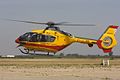
| Utility helicopter | Eurocopter EC135 |
| Transport | Eurocopter AS532 Cougar |
The Emergency Military Unit (Spanish: Unidad Militar de Emergencias, UME; IPA: [uniˈðað miliˈtaɾ ðe emeɾˈxenθjas]) is a branch of the Spanish Armed Forces responsible for providing disaster relief throughout Spain mainly, and abroad if required. It is the newest branch of the Spanish Armed Forces.
History
[edit]The decision to create the Military Emergencies Unit was agreed upon at a cabinet meeting of the Zapatero administration on October 7, 2005.[1] This was enacted in law by the Real Decreto 416/2006 (Royal Decree 416/2006) on April 11, 2006.[2]
Missions
[edit]- Intervention during emergencies that have their origin in natural hazards; among these are floods, spill-overs, earthquakes, land slides, large snow storms and other adverse weather conditions.
- Intervention fighting forest fires.
- Intervention during emergencies derived from technological hazards; among which are chemical, nuclear, radiological and biological hazards.
- Intervention during emergencies as a consequence of terrorist attacks or illicit or violent acts, including those acts against critical infrastructures, dangerous installations or with nuclear, biological, radiological or chemical agents.
- Intervention during situations of environmental contamination.
- Intervention during any other emergency deemed appropriate by the Prime Minister of Spain.
Chiefs
[edit]| Rank | Name | Start | End |
|---|---|---|---|
| Lieutenant general | Fulgencio Coll Bucher | 21 January 2006[3] | 19 July 2008 |
| José Emilio Roldán Pascual | 25 July 2008[4] | 26 September 2012 | |
| Cesar Muro Benayas | 28 September 2012[5] | 15 May 2015 | |
| Miguel Alcañíz Comas | 23 May 2015[6] | 16 October 2019[7] | |
| Luis Manuel Martínez Meijide | 23 October 2019[8] | 16 August 2023 | |
| Francisco Javier Marcos Izquierdo | 16 August 2023[9] |
Organisation
[edit]The UME consists of Headquarters (Unidad de Cuartel General, UCG),
- five emergency intervention battalions (Batallon de Intervención en Emergencias, BIEM),
- a support regiment (Regimiento de Apoyo a Emergencias, RAEM),
- a communications battalion (Batallón de Transmisiones, BTUME) and
- an aviation group (Agrupación de Medios Aéreos, AGRUMEDA)
| Name | Headquarters | Areas Served |
|---|---|---|
| BIEM I | Torrejón de Ardoz Air Base | Ávila, Segovia, Madrid, Cáceres, Guadalajara, Cuenca, Ciudad Real, Toledo |
| BIEM II | Morón Air Base | Badajoz, Huelva, Sevilla, Cádiz, Málaga, Córdoba, Jaén, Granada, Ceuta, Melilla, Fuerteventura, Gran Canaria, La Gomera, El Hierro, Lanzarote, La Palma, Tenerife |
| BIEM III | Bétera | Albacete, Murcia, Alicante, Valencia, Castellón, Balearic Islands |
| BIEM IV | Zaragoza Air Base | Biscay, Guipúzcoa, Álava, La Rioja, Soria, Navarre, Zaragoza, Huesca, Teruel, Lleida, Tarragona, Barcelona, Girona |
| BIEM V | San Andrés del Rabanedo | Pontevedra, La Corunna, Lugo, Orense, Asturias, Cantabria, León, Zamora, Salamanca, Valladolid, Palencia, Burgos |
| Name | Headquarters |
|---|---|
| UCG | Torrejón de Ardoz Air Base |
| RAEM | |
| BTUME | |
| AGRUMEDA |
Ranks
[edit]- Officers
| NATO code | OF-10 | OF-9 | OF-8 | OF-7 | OF-6 | OF-5 | OF-4 | OF-3 | OF-2 | OF-1 | ||||||||||||||||||||||||||
|---|---|---|---|---|---|---|---|---|---|---|---|---|---|---|---|---|---|---|---|---|---|---|---|---|---|---|---|---|---|---|---|---|---|---|---|---|
| Military Emergencies Unit |

|

|

|

|

|

|

|

|
||||||||||||||||||||||||||||
| General de división | General de brigada | Coronel | Teniente coronel | Comandante | Capitán | Teniente | Alférez | |||||||||||||||||||||||||||||
- Enlisted
| NATO code | OR-9 | OR-8 | OR-7 | OR-6 | OR-5 | OR-4 | OR-3 | OR-2 | OR-1 | |||||||||||||||||||||||||||
|---|---|---|---|---|---|---|---|---|---|---|---|---|---|---|---|---|---|---|---|---|---|---|---|---|---|---|---|---|---|---|---|---|---|---|---|---|
| Military Emergencies Unit |

|

|

|

|

|

|

|

|

|

| ||||||||||||||||||||||||||
| Suboficial mayor | Subteniente | Brigada | Sargento primero | Sargento | Cabo mayor | Cabo primero | Cabo | Soldado de primera | Soldado | |||||||||||||||||||||||||||
Gallery
[edit]-
 Suzuki DRZ 400 S
 -

-
-
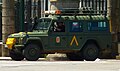
 Military police vehicle
 -
 Communications vehicle Mérida
 -

-
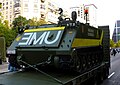
 URO M3-24.14. based BFP 40-106 J-1884 firetruck
 -
-
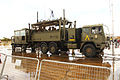 Mobile command center
 -

-
-
 Zodiac IV


_(15352038639).jpg)


See also
[edit]References
[edit]- ^ "RESOLUCIÓN de 19 de enero de 2006, de la Subsecretaría, por la que se da publicidad al Acuerdo de Consejo de Ministros por el que se crea la Unidad Militar de Emergencias (UME)". Boletín Oficial del Estado.
- ^ "Real Decreto 416/2006, de 11 de abril, por el que se establece la organización y el despliegue de la Fuerza del Ejército de Tierra, de la Armada y del Ejército del Aire, así como de la Unidad Militar de Emergencias". Boletín Oficial del Estado.
- ^ "Royal Decree 39/2006, of January 20, appointing Mr. Fulgencio Coll Bucher as Chief of the Military Emergency Unit". boe.es. Retrieved 2019-10-23.
- ^ "Royal Decree 1335/2008, of July 24, appointing Lieutenant General Mr. José Emilio Roldán Pascual, as Chief of the Military Emergency Unit". boe.es. Retrieved 2019-10-23.
- ^ "Royal Decree 1368/2012, of September 27, appointing Lieutenant General César Muro Benayas as Chief of the Military Emergency Unit". boe.es. Retrieved 2019-10-23.
- ^ "Royal Decree 392/2015, of May 22, appointing as Chief of the Military Emergency Unit to Miguel Alcañíz Comas". boe.es. Retrieved 2019-10-23.
- ^ "Unidad Militar de Emergencias- El general Miguel Alcañiz pasa a la Reserva y cesa como jefe de la Unidad Militar de Emergencias". www.ume.mde.es. Retrieved 2019-10-23.
- ^ "El teniente general Luis Martínez Meijide, nuevo jefe de la UME - Por Tierra, Mar y Aire". ABC Blogs (in Spanish). 2019-10-23. Retrieved 2019-10-23.
- ^ "El general Francisco Javier Marcos asume como nuevo jefe de la UME, "un ejemplo en Europa y el mundo", según Robles". www.europapress.es (in Spanish). 2023-08-16. Retrieved 2025-08-16.
External links
[edit]Military Emergencies Unit
View on Grokipediafrom Grokipedia
Overview
Establishment and Purpose
The Military Emergencies Unit (UME), a branch of the Spanish Armed Forces, was established on October 7, 2005, by a Council of Ministers decree under Prime Minister José Luis Rodríguez Zapatero's administration.[8] This creation was prompted by the need to bolster national emergency response capabilities, particularly following the severe 2005 Guadalajara forest fires, which claimed 11 firefighters' lives and devastated over 12,000 hectares.[8] The unit was designed to integrate military resources into the National Civil Protection System, addressing gaps in regional responses to large-scale crises.[9] The primary purpose of the UME is to deliver immediate military support in emergencies, encompassing natural disasters like floods and wildfires, technological accidents, and humanitarian crises, both within Spain and internationally when required.[1] As the first-responder entity of the Armed Forces, it operates under the direction of the Prime Minister through the Ministry of Defense, complementing civilian protection agencies by providing specialized capabilities such as rapid deployment, search and rescue, and logistical aid to enhance overall crisis management.[10] This role ensures a unified, efficient intervention that leverages military discipline and assets to mitigate risks and save lives.[11] Headquartered at Torrejón Air Base in Madrid, the UME embodies its motto, "Perseverando para servir" (Persevering to serve), reflecting its commitment to sustained service in high-stakes environments.[12] As of October 2025, the unit comprises approximately 3,500 personnel, enabling scalable responses to diverse threats while maintaining operational readiness across its specialized battalions.[13]Legal Basis and Mandate
The Military Emergencies Unit (UME) was established as a joint branch of the Spanish Armed Forces through Royal Decree 416/2006, of April 11, which defined its organization and deployment within the broader structure of the Army, Navy, and Air Force.[10] This decree positioned the UME under the direct mandate of the Ministry of Defense, emphasizing its role in enhancing national resilience to emergencies while integrating with existing military frameworks.[10] The unit's foundational legal framework builds on Organic Law 5/2005, of November 17, on National Defense, which provides the overarching authority for military involvement in civil protection activities.[14] Activation of the UME follows specific protocols outlined in Royal Decree 1097/2011, of July 22, which approves the intervention protocol for the unit in emergency scenarios.[15] These protocols are triggered through the National Plan for Civil Protection and Emergencies, managed by the Directorate-General for Civil Protection and Emergencies under the Ministry of the Interior, ensuring coordinated response efforts between military and civilian entities. For national deployments, authority rests with orders from the President of the Government, typically in response to declarations of states of alarm or emergency, as per the constitutional provisions on government powers in crisis situations. Internationally, deployments occur via United Nations mandates or bilateral agreements, with the UME classified as a heavy Urban Search and Rescue (USAR) team under the International Search and Rescue Advisory Group (INSARAG) since 2011, enabling rapid integration into global response operations.[16] The UME's mandate is strictly limited to a non-combat support role, focusing on humanitarian assistance and disaster relief without supplanting civilian first responders or assuming command over civil operations.[17] This is reinforced by Royal Decree 407/1992, of April 24, on basic civil protection standards, and Law 17/2015, of July 9, on the National Civil Protection and Emergency System, which mandate collaboration where military assets augment rather than replace local and regional authorities.[18] Such limitations ensure the UME operates in a subsidiary capacity, prioritizing the preservation of life, property, and environmental protection in alignment with Spain's civil protection doctrine.[19]History
Formation and Early Development
The creation of the Military Emergencies Unit (UME) was spurred by the need to bolster Spain's emergency response capabilities following major crises, including the 11 March 2004 Madrid train bombings that killed 193 people and the severe forest fires in Galicia during the summer of 2005, which devastated thousands of hectares.[20][21] These events highlighted deficiencies in coordinated rapid intervention, prompting the Council of Ministers under Prime Minister José Luis Rodríguez Zapatero to approve the unit's establishment on 7 October 2005 as a permanent joint formation within the Spanish Armed Forces.[2] The decision aimed to centralize military resources for civil protection, with initial funding allocated for infrastructure and personnel buildup.[22] Initial organization focused on integrating personnel from all branches of the Armed Forces—Army, Navy, and Air Force—to form a versatile force capable of nationwide deployment.[1] Headquarters were set up at Torrejón de Ardoz Air Base near Madrid, with the establishment of core elements including the Support and Emergency Intervention Regiment (RAIEM), a Communications Battalion (BTUME), the Military Emergencies School (EMES), and the first Intervention in Emergencies Battalions (BIEM) strategically located across Spain, such as in León, Valencia, Seville, and Zaragoza.[1] Lieutenant General Fulgencio Coll Bucher was appointed as the first commander on 20 January 2006, overseeing the unit's formative phase until 19 July 2008.[23] Recruitment emphasized volunteers with diverse military expertise, building specialized teams for search and rescue, firefighting, and humanitarian aid from the ground up.[22] Early challenges centered on developing operational capabilities without prior dedicated infrastructure, including training protocols and equipment acquisition amid tight timelines.[24] The unit's debut came in July 2007 during forest fires in Tejeda, Gran Canaria, marking its first activation under the protocol outlined in Real Decreto 399/2007, where it deployed to support local firefighters in containing the blaze.[25] This intervention tested initial logistics and inter-agency coordination, revealing areas for refinement in rapid mobilization. By 2008, the UME had grown from zero to over 3,000 personnel, approaching its target strength of 4,310, while early planning incorporated international standards, such as INSARAG certification for urban search and rescue, positioning it for potential overseas roles.[26][4]Key Milestones and Expansions
Between 2008 and 2015, the Unidad Militar de Emergencias (UME) underwent significant structural expansion to enhance its national coverage and operational capacity. Initially established with one battalion in 2006, the unit grew by adding battalions progressively, reaching five Emergency Intervention Battalions (BIEMs) by the mid-2010s to distribute resources across Spain's regions.[7] This development allowed for more rapid response times in diverse terrains. A pivotal milestone was the unit's first major international deployment in 2010, when 37 UME personnel were sent to Haiti following a 7.0-magnitude earthquake, supporting search-and-rescue efforts under Operation Hispaniola.[4] From 2016 to 2023, the UME adapted to emerging challenges, including support for public health crises and leadership transitions. During the COVID-19 pandemic, the unit participated in Operations Balmis and Baluarte, conducting widespread disinfection operations, including the approved use of agricultural drones like the DJI AGRAS MG-1 to sanitize large outdoor areas efficiently.[27] In August 2023, Lieutenant General Francisco Javier Marcos Izquierdo assumed command, bringing prior experience from roles such as director of Army Infrastructure and chief of the Army's Airmobile Forces, to oversee ongoing enhancements in readiness.[28] In 2024 and into 2025, the UME demonstrated its expanded scale during the response to the DANA floods in Valencia, where it formed part of the largest military deployment on Spanish soil, with over 7,800 Armed Forces personnel active in the region by November 2024, including UME specialists in search-and-rescue using certified canine units.[29] Personnel numbers had grown to approximately 3,300 by 2022, reflecting steady institutional buildup to handle complex emergencies.[30] The unit continued integrating advanced technologies, building on prior drone applications for disinfection and reconnaissance to improve situational awareness in disaster zones. In 2025, the UME marked its 20th anniversary and intervened in 57 forest fires, deploying thousands of personnel to support firefighting efforts nationwide.[13] Institutionally, the UME achieved United Nations certification as a Medium Urban Search and Rescue (USAR) team in 2023, becoming the first military unit worldwide to attain this INSARAG accreditation, enabling standardized international coordination.[31] Additionally, the UME has served as a model for Latin American nations seeking to develop similar civil defense structures, fostering bilateral cooperation through shared expertise in emergency response frameworks.[32]Missions and Operations
Core Responsibilities
The Military Emergencies Unit (UME) of the Spanish Armed Forces is tasked with providing rapid, specialized support in emergency situations to preserve citizen security and welfare, acting as the primary military response force in coordination with civil authorities.[33] Its core responsibilities encompass intervention in a wide array of crises, emphasizing non-combat roles such as search and rescue, evacuation, and logistical support, all under the framework of the National Emergency Plan and in collaboration with regional and local governments.[13] In natural disasters, the UME focuses on mitigating impacts from events like floods, earthquakes, and wildfires, conducting operations including victim location and extraction, mass evacuations, and the distribution of essential supplies to affected populations. For instance, during flood responses, personnel deploy to secure infrastructure, pump water from inundated areas, and establish temporary shelters, while in wildfire scenarios, they integrate with firefighting teams to contain blazes and protect communities. These efforts prioritize swift action to reduce loss of life and property, drawing on the unit's multi-branch composition from the Army, Navy, and Air Force for comprehensive coverage.[11] For technological and environmental emergencies, the UME handles incidents involving chemical, nuclear, radiological, or biological (NRBC) hazards, as well as environmental contamination, through specialized decontamination procedures, hazard assessment, and cleanup initiatives. Teams equipped for NRBC response isolate contaminated zones, neutralize threats, and support medical triage, ensuring minimal secondary risks to responders and civilians. This includes coordination with agencies like the Nuclear Safety Council for nuclear events or environmental ministries for pollution spills.[11] Human-induced crises fall within the UME's purview, encompassing responses to terrorist attacks, major accidents, and humanitarian needs, where the unit provides security perimeter establishment, victim assistance, and aid delivery in urban or collapsed structures. In such scenarios, the UME collaborates closely with law enforcement and emergency services to facilitate rescue from rubble or wreckage and deliver psychological support, always adhering to its supportive role without supplanting civilian leads.[13] On an international level, the UME extends its capabilities through frameworks like the European Union Civil Protection Mechanism, NATO, and United Nations operations, offering deployable teams for cross-border assistance in disasters. Since its inception in 2005, the unit has been activated nearly 800 times domestically, with the majority—over 550—involving fires and 77 related to floods, underscoring its emphasis on climate-related emergencies.[13][34] Operational principles include rapid deployment, with initial response teams mobilizing within one hour and full units within four hours of activation, ensuring seamless integration across military branches for efficient, 24/7 readiness.[11]Notable National and International Deployments
The Military Emergencies Unit (UME) has conducted over 780 interventions since its inception, primarily addressing forest fires, floods, and other natural disasters within Spain, while also providing support in international crises through specialized teams.[34] Domestically, the UME's first major deployment occurred in July 2007 during severe forest fires in Gran Canaria, marking its inaugural activation under the national emergency protocol, where units collaborated in extinguishing operations across multiple fronts.[25] In 2012, the unit responded to devastating floods in Andalusia, deploying approximately 350 personnel to Málaga and 100 to nearby Murcia for evacuation, rescue, and infrastructure assessment in areas inundated by up to 245 liters per square meter of rainfall, representing its initial large-scale flood operation.[35] The 2024 DANA floods in Valencia prompted one of the unit's most extensive national responses, with over 1,100 UME troops and around 400 vehicles mobilized initially for search-and-rescue, debris clearance, and humanitarian aid, ultimately contributing to the rescue of more than 570 individuals and supporting recovery in over 77 municipalities.[36][13] Internationally, the UME has deployed Urban Search and Rescue (USAR) teams to seismic events, beginning with the 2010 Haiti earthquake, where 37 specialists operated in Port-au-Prince, recovering over 30 bodies and aiding in initial stabilization efforts.[37] In April 2015, following Nepal's earthquake, 47 UME members assisted in Kathmandu and surrounding areas, conducting rescues, stabilizing 14 structures, and safeguarding cultural sites as part of a UN-certified team.[37] The unit repeated such support in Ecuador's 2016 earthquake, sending 45 personnel plus 12 explosive ordnance experts to western regions for search operations, infrastructure repair, and heritage protection.[37] More recently, in response to wildfires, 56 UME troops were dispatched to Chile's Biobío region in late 2023 (extending into early 2024 operations), collaborating on fire suppression alongside local forces amid over 150 simultaneous blazes.[38] The UME has conducted 26 international operations as of 2025.[34] During the COVID-19 pandemic from 2020 to 2022, the UME executed over 100 deployments as part of Operation Balmis, focusing on sanitization of public spaces, medical facility support, and logistics, with units disinfecting critical infrastructure to curb virus spread and contributing to broader military efforts involving 90,000 personnel nationwide.[39][40] These operations underscored the unit's versatility, saving lives through rapid interventions—such as the rescues in Valencia—and enhancing infrastructure resilience, while post-event analyses have refined coordination protocols for future multi-agency responses.[13]Organization
Command and Administrative Structure
The Military Emergencies Unit (UME) operates under a dual command structure, with organic dependence on the Minister of Defense and operational dependence on the Chief of the Defense Staff (JEMAD).[41] The unit commander, holding the rank of Lieutenant General and titled General Jefe de la Unidad Militar de Emergencias (GEJUME), exercises overall command and reports directly to the Minister of Defense. This framework ensures alignment with national defense priorities while enabling rapid deployment in emergencies. The headquarters, known as Cuartel General (CG UME), is located at Torrejón de Ardoz Air Base near Madrid and serves as the central hub for high-level decision-making.[12] It comprises the Estado Mayor (EM) for planning, logistics, and intelligence functions; the Órgano de Apoyo al Mando (OAM) for command support; and specialized sections such as the Sección de Asuntos Económicos (SAE) for budget management and the Asesoría Jurídica (ASEJU) for legal oversight.[12] The Regimiento de Apoyo e Intervención en Emergencias (RAIEM), also based at Torrejón de Ardoz, provides essential logistical support, including engineering, transport, and supply services to sustain operations. UME integrates closely with Spain's national emergency systems, coordinating responses with local, regional (Autonomous Communities), and national authorities during crises to optimize resource allocation and avoid duplication of efforts.[17] An international liaison function within the headquarters facilitates cooperation with foreign militaries and organizations, supporting joint training and deployments abroad.[5] Administratively, UME follows Ministry of Defense policies for recruitment, drawing personnel from all branches of the Spanish Armed Forces through standard military enlistment and commissioning processes.[13] Budgetary matters are handled via the SAE and the Intervención Delegada, which reports to the General Audit Office of the Defense for financial accountability.[12] The unit maintains a total authorized strength of approximately 3,500 personnel (efectivos), including about 3,200 active military members comprising officers, non-commissioned officers (NCOs), enlisted troops, and specialists from the Army, Navy, and Air Force, as of 2025.[42]Operational Units and Personnel
The Military Emergencies Unit (UME) is structured around five Emergency Intervention Battalions (BIEM I through BIEM V), which form the core of its field-deployable operational components for rapid response to disasters across Spain. BIEM I is based at Torrejón de Ardoz Air Base in Madrid, BIEM II at Morón Air Base in Seville with detachments in the Canary Islands (Las Palmas de Gran Canaria and Santa Cruz de Tenerife), BIEM III at Jaime I Army Base in Bétera near Valencia, BIEM IV at Zaragoza Air Base, and BIEM V at Conde de Gazola Military Base in San Andrés de Rabanedo near León.[43] Each battalion is designed for self-sufficiency in emergency interventions, comprising command and staff elements, a staff and services company, two natural emergency intervention companies, and an engineering company, enabling versatile responses to floods, fires, earthquakes, and other crises.[43] The BIEMs collectively account for the majority of deployable personnel. Complementing the BIEMs are specialized support units, including the Transmissions Battalion (BTUME), located at Torrejón de Ardoz Air Base, which ensures secure communications and command-and-control during operations with a personnel strength of 156 members organized into command headquarters, a staff and services company, a fixed command post company, and a deployable command post company.[44][43] The Aerial Means Grouping (AGRUMEDA), also headquartered at Torrejón de Ardoz Air Base, provides air support capabilities such as firefighting, helicopter transport, search and rescue, flood assistance, radiological reconnaissance, and medical evacuations, integrating with UME's broader aerial operations under a dedicated command and headquarters.[45] The Military School of Emergencies (EMES), based at Torrejón de Ardoz, is responsible for the training and formation of UME personnel in emergency response skills.[42] UME personnel total approximately 3,500 efectivos including civilians, with about 3,200 active military members distributed nationwide as of 2025, the BIEMs accounting for the majority in deployable roles.[42][13] The force draws from a joint composition primarily from the Army (89%), Air Force (7%), Navy (2%), and Common Corps (1%), incorporating specialists in urban search and rescue (USAR), medical response, engineering, and environmental management to address diverse threats.[43] Additionally, volunteer reservists, including civilian experts in fields like medicine and engineering, augment the active ranks during large-scale activations, enhancing scalability without compromising core readiness.[46] Deployments operate on a modular basis, allowing UME to scale responses from small teams of about 50 personnel for localized incidents to full battalions for major national or international emergencies, ensuring rapid deployment within four hours anywhere in Spain through strategic basing and inter-branch coordination.[13][43]Leadership and Ranks
Commanders and Chiefs
The General Jefe de la Unidad Militar de Emergencias (GEJUME) is designated by the Council of Ministers and appointed by the King of Spain on the proposal of the Minister of Defense via royal decree. Appointees are typically lieutenant generals from the Army or Air and Space Force with extensive command experience in operational units.[47] The following table lists the GEJUMEs chronologically, including their terms and key contributions:| No. | Name | Term | Key Contributions |
|---|---|---|---|
| 1 | Lt. Gen. Fulgencio Coll Bucher | January 21, 2006 – July 29, 2008 | Established the unit's initial organizational nucleus and foundational capabilities shortly after UME's creation.[48] |
| 2 | Lt. Gen. José Emilio Roldán Pascual | July 29, 2008 – October 4, 2012 | Oversaw the UME's first United Nations USAR (Urban Search and Rescue) certification in 2011, enabling international deployments.[49][50] |
| 3 | Lt. Gen. César Muro Benayas | October 4, 2012 – May 28, 2015 | Directed responses to major domestic incidents, building on prior operational frameworks during a period of expanding unit readiness.[51][52] |
| 4 | Lt. Gen. Miguel Alcañiz Comas | May 28, 2015 – October 16, 2019 | Led over 243 interventions, emphasizing personnel management and academic integration in emergency response strategies.[53][54] |
| 5 | Lt. Gen. Luis Manuel Martínez Meijide | October 23, 2019 – August 16, 2023 | Advanced international certifications, including the completion of the Domino 22 USAR exercise validation in 2022, enhancing global interoperability.[55][56] |
| 6 | Lt. Gen. Francisco Javier Marcos Izquierdo (current) | August 16, 2023 – present | Coordinated the unit's response to the 2024 DANA floods in Valencia, deploying thousands of personnel amid one of Spain's worst natural disasters.[57] |
Ranks and Hierarchy
The Military Emergencies Unit (UME) utilizes the standardized rank structure of the Spanish Armed Forces, which aligns with NATO standardization agreements for interoperability in joint operations. As a joint unit drawing personnel from the Army, Navy, and Air and Space Force, the UME applies these ranks uniformly across services via NATO codes, with specific adaptations to reflect its emergency response mission, such as integrated training and command roles that prioritize multidisciplinary expertise. Spanish titles vary by branch; the following primarily uses Army and Air and Space Force designations (Navy equivalents noted where distinct).[58][59] Officer ranks in the UME follow the NATO officer scale from OF-10 to OF-1, equivalent to standard Spanish military designations. These roles encompass strategic command at the highest levels down to tactical leadership in field interventions. The table below outlines the key officer ranks, their NATO codes, and Spanish titles used within the UME:| NATO Code | Spanish Title (Army/Air; Navy) | Role in UME Context |
|---|---|---|
| OF-10 | Capitán General (Capitán General de la Armada) | Honorary or supreme command (rarely assigned operationally) |
| OF-9 | General de Ejército/Aire (Almirante) | High-level strategic oversight |
| OF-8 | Teniente General (Almirante General) | Divisional command in large-scale deployments |
| OF-7 | General de División (Vicealmirante) | Corps-level coordination, e.g., overall emergency response direction |
| OF-6 | General de Brigada (Contraalmirante) | Brigade command, such as battalion oversight |
| OF-5 | Coronel (Capitán de Navío) | Battalion command in intervention units |
| OF-4 | Teniente Coronel (Capitán de Fragata) | Company or specialized team leadership |
| OF-3 | Comandante (Capitán de Corbeta) | Platoon or operational section command |
| OF-2 | Capitán (Teniente de Navío) | Team leadership in emergencies |
| OF-1 | Teniente / Alférez (Alférez de Navío / Alférez de Fragata) | Junior officer roles in tactical execution |
| NATO Code | Spanish Title | Role in UME Context |
|---|---|---|
| OR-9 | Suboficial Mayor | Senior advisory role to command in operations |
| OR-8 | Subteniente | Supervisory leadership in specialized units |
| OR-7 | Brigada | Squad or technical team supervision, e.g., USAR coordination |
| OR-6 | Sargento Primero | Section leadership in emergency interventions |
| OR-5 | Sargento | Direct team command in field activities |
| OR-4 | Cabo Primero | Assistant leadership in tactical roles |
| OR-3 | Cabo | Operational execution, including specialist tasks |
| OR-2 | Soldado de Primera | Support in basic response duties |
| OR-1 | Soldado / Marinero | Entry-level personnel in support and rescue |