Hubbry Logo
Step-through frameStep-through frameMain
Open search
Step-through frame
Community hub
Step-through frame
logo
8 pages, 0 posts
0 subscribers
Be the first to start a discussion here.
Step-through frame
Step-through frame
from Wikipedia
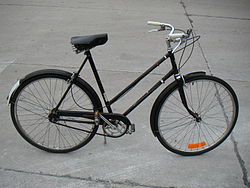
A Triumph with a step-through frame
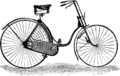
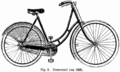
Woman with a step-through frame bicycle in the 1890s

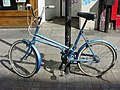
A step-through frame (also known as open frame, drop frame, or low-step frame) is a type of bicycle frame, often used for utility bicycles, with a low or absent top tube or cross-bar.[1]

Since mounting or dismounting a step-through does not require swinging one leg to hip-height, they are widely used as delivery bicycles, and for other purposes where the rider has to mount and dismount frequently.

Traditionally, bicycles with a step-through frame were known as "ladies'", "women's" or "girls' bicycles", as they allow skirts or dresses to hang fairly normally. Bicycles with a high top tube (cross-bar), were known as "men's", "gents", or "boys' bicycles". Even in the 1800s, women often rode "men's" bicycles and vice-versa; from the 1890s onwards, women commonly wore bloomers to cycle. Since the late 20th century, descriptions that describe the frame style, rather than the presumed gender of the rider, are becoming increasingly common.

Advantages

[edit]
  • less risk of stretching or ripping clothes when mounting the saddle
  • the rider can wear a skirt (also requires a skirt guard and possibly a chain guard)
  • very quick to mount and dismount, so is suitable for delivery bicycles, or any journey with many stops
  • suitable for elderly and others with restricted agility
  • potentially safer than a high top tube; a rider who loses balance can step through the bicycle without becoming entangled
  • compactness provides a popular starting point for folding bicycles.

Disadvantages

[edit]
  • Heavier. Compared to a traditional diamond frame consisting of two near-triangles, open or step-through frame designs must be designed with thicker gauge tubing, the use of additional gusseting members, and/or monocoque frame construction. These structural elements may add weight or cost over a traditional diamond design.[2][3][4]
  • Inattention to structural design can lead to excessive flexing, resulting in lower pedaling efficiency and reduced frame life.[2][3]
  • Fewer places to mount accessories, e.g. an air pump or water-bottle.
  • More difficult to carry around off the ground due to the sloping tube near the bicycle's center of gravity, e.g. carrying it up stairs, or lifting to hang it for maintenance.

Variations

[edit]

Mixte

[edit]
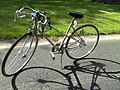
A Peugeot mixte frame bicycle

One particular type of step-through frame is called a mixte. In a mixte frame, the top tube of the traditional diamond frame is replaced with a pair of smaller tubes (lateral tubes, or lats) running from the top of the head tube all the way back to the rear axle, connecting at the seat tube on the way. The normal seat stays and chain stays are retained. This provides the lower standover height of a step-through frame bicycle with a strong diamond-frame geometry.

Mixte (pronounced [mikst]) is a direct appropriation of the French word meaning "mixed" or "unisex". The usual North American bicycle industry pronunciation of this loan word is /ˈmɪkst/.[5]

A variant on the mixte uses a single, full sized top tube running from the upper head tube to the seat tube, but retains the middle set of stays.[5] The FNCRM (Fédération Nationale du Commerce et de la Réparation du Cycle et du Motocycle) calls this style a sport.[6]

Other named French styles of step-through frames, in addition to mixte and sport, include berceau, Anglais, jumele, col de cygne and double col de cygne.

Cross

[edit]
A Dahon folding bicycle with a cross frame

Another type of step-through frame is called a cross. The cross frame consists mainly of two tubes that form a cross: a seat tube from the bottom bracket to the saddle, and a backbone from the head tube to the rear hub.[7] [8]

[edit]

See also

[edit]

References

[edit]
[edit]
Revisions and contributorsEdit on WikipediaRead on Wikipedia
from Grokipedia
A is a configuration in which the top tube connecting the and seat tube is either significantly lowered or entirely omitted, permitting the rider to mount and dismount by stepping through the frame's open structure rather than swinging a over a high crossbar. This design enhances accessibility for individuals wearing restrictive clothing such as skirts or for those with limited mobility, as it reduces the physical barrier posed by traditional frames. Developed in the 1880s amid the transition to , the step-through frame addressed practical mounting challenges for female cyclists constrained by period attire, marking a key adaptation in for broader . Beyond its origins, the frame type offers structural trade-offs, providing sufficient rigidity for everyday utility while prioritizing convenience over the superior stiffness of step-over designs suited for or rugged terrain. Today, step-through frames predominate in urban, folding, and electric bicycles, reflecting their enduring value in promoting efficient, low-effort entry for commuters and delivery personnel alike.

Definition and Design Principles

Core Geometry and Distinguishing Features

The core geometry of a step-through frame features a significantly lowered or entirely absent top tube between the and seat tube, enabling riders to mount and dismount by stepping through the open space rather than swinging a over a high bar. This configuration typically includes a primary down tube that extends from the to the bottom bracket, often curved or angled to maintain a low profile at the rider's height, which is generally kept below 30-40 cm from the ground depending on frame size. Additional structural elements, such as chainstays, seatstays, and sometimes secondary tubes, form the lower for pedaling support, but the absence of a full-height top tube reduces the primary triangulated rigidity found in conventional designs. Distinguishing features include enhanced accessibility for riders wearing skirts, carrying loads, or facing mobility limitations, as the open frame eliminates the need for high leg lift, reducing fall risk during mounting. Variants like the mixte frame incorporate twin sloping top tubes from the head tube to the seat tube, providing partial triangulation while preserving step-through capability, whereas open step-through designs rely more on reinforced down tubes or gussets for lateral stability. Compared to the diamond frame's closed triangular structure—which optimizes force distribution through equal-length tubes forming a rigid diamond—the step-through geometry inherently trades some torsional stiffness for ease of use, often necessitating thicker tubes or additional bracing to achieve comparable structural integrity under pedaling loads up to 100-150 kg rider weight plus cargo. This design promotes an upright riding posture due to the frame's proportions, with handlebars positioned higher relative to the saddle, facilitating better visibility and control in urban environments but potentially increasing wind resistance at speeds above 20 km/h. Empirical testing of frame stress via finite element analysis indicates that well-engineered step-through frames can match diamond frames in resistance when using high-strength materials like chromoly or aluminum alloys, though early 20th-century wooden or basic iterations showed higher flex under off-road conditions.

Comparison to Diamond Frames

The diamond frame, characterized by its continuous top tube forming a primary triangular structure with the down tube and seat tube, provides superior torsional stiffness and load distribution compared to the step-through frame, which omits or lowers the top tube to facilitate mounting. This triangular geometry in diamond frames acts as a truss, efficiently resisting twisting forces and pedaling inputs, as demonstrated in finite element analyses where diamond designs exhibited the highest overall rigidity among frame types under simulated loads. In contrast, step-through frames, often reinforced with additional stays or thicker tubing to compensate for the absent top tube, experience greater flex, particularly in torsional modes, leading to potential energy loss during aggressive riding. Empirical testing confirms that diamond frames maintain structural integrity with less material, resulting in lighter weights for equivalent strength levels; for instance, structural optimizations show diamond configurations achieving lower stress concentrations at junctions under vertical and lateral loads. Step-through frames, while adequate for casual or utility use, require design compromises such as smaller tube diameters or auxiliary bracing (e.g., in mixte variants with twin lateral tubes), which can increase weight by 10-20% to match , though modern aluminum or carbon implementations narrow this gap. These differences stem from first-principles of frame , where the closed-triangle layout in diamond frames minimizes deflection, enhancing power transfer and handling , whereas open step-through geometries prioritize over peak performance. In practical applications, diamond frames dominate in and high-performance bicycles due to their biomechanical efficiency, allowing riders to apply force with minimal frame twist, whereas step-through frames excel in urban or setups where frequent stops demand easy dismounting, accepting reduced as a for . Durability testing under repeated stress cycles reveals diamond frames sustain higher limits before cracking, attributed to even stress distribution, though well-engineered step-throughs with hydroformed tubes perform comparably in low-intensity scenarios.

Historical Development

Origins in the 19th Century

The step-through frame first appeared in rudimentary form during the early bicycle era with Denis Johnson's 1818-1819 Ladies' Walking Machine, a pedal-less variant designed in with a lowered frame to accommodate women's skirts and ease mounting without leg-over straddling. This early adaptation addressed practical barriers for female riders on the primitive draisine-style machines prevalent before powered propulsion. However, such designs remained marginal until the 's emergence in the shifted bicycle geometry toward stability and accessibility. The modern step-through frame crystallized with women's s in the late , coinciding with the replacement of hazardous high-wheel ordinary bicycles by chain-driven models with equal-sized wheels. In 1887, British cycle maker Dan Albone developed the Anfield Ivel, the earliest documented women's featuring a dropped top tube for skirt compatibility and simplified mounting. American production followed swiftly; by 1889, the Overman Wheel Company's Victoria model incorporated a drop-frame design, enabling women to ride without raising voluminous Victorian attire over a crossbar. These innovations prioritized ergonomic access over the rigid diamond frames suited to men's , marking a causal shift driven by gender-specific mobility needs amid rising female participation in . By the , step-through frames dominated women's bicycles, fueling a mass boom with over a million U.S. annually by 1897 and catalyzing social changes like bloomer for freer movement. Manufacturers emphasized the design's practicality, as evidenced in period advertisements promoting ease for riders in traditional , though structural compromises in rigidity were noted compared to men's frames. This era's proliferation reflected empirical demand from women seeking independent transport, unencumbered by prior designs' hazards.

Evolution Through the 20th Century

In the early decades of the , step-through frames continued as the standard for women's bicycles, evolving from 19th-century safety designs with refinements in and materials for improved stability and comfort; a notable example is the 1910 ladies' designed by Australian Arthur Sutherland, featuring a low step-through for skirt compatibility. By the 1930s, French designer Albert Six introduced the mixte variant, incorporating twin curved lateral tubes connecting the top tube to the seat stays, which enhanced structural rigidity compared to open step-through frames while preserving mounting ease. Mixte frames, with design precedents in European sketches dating to 1901, proliferated across , , and other countries for urban and touring applications, often built by brands like and René Herse as lightweight city bicycles with road geometry. Post-World War II, step-through designs, including mixtes and traditional open frames, became integral to in , supporting daily commutes and delivery roles where quick mounting was essential, as evidenced by widespread adoption in postal and fleets. During the 1970s bicycle boom, mixte frames gained traction in the United States through imports of French models like the PX series, marketed for both recreational and fitness use, though their sportier limited versatility for heavy loads compared to heavier step-throughs. By the late , while diamond frames dominated competitive and , step-through variants persisted in practical contexts, with mixtes offering a between and performance for shorter riders or those prioritizing convenience over maximum stiffness.

Post-2000 Adaptations in E-Bikes

In the early , the resurgence of electric bicycles, driven by advancements in technology, prompted adaptations of step-through frames to handle the increased weight and power demands of e-bike components. Manufacturers reinforced these frames with stronger aluminum alloys and optimized tubing geometries to compensate for the lack of a top tube, ensuring sufficient torsional rigidity for loads up to 120-150 kg including rider and battery. This was particularly evident in European markets, where e-bike sales grew rapidly from the mid- onward, with step-through designs comprising a significant portion of urban commuter models due to their low standover heights of 40-50 cm, facilitating easy access amid the added 15-25 kg from motors and batteries. Key innovations included integrated battery mounts within the down tube or frame triangle, lowering the center of gravity for improved stability during acceleration from hub or mid-drive motors rated at 250-750 W. Pedal-assist systems, standardized in under EN 15194 regulations by 2009, paired well with step-through , promoting upright postures that reduced strain for longer commutes. Dutch and German brands, responding to subsidies and investments, prioritized these frames for use, where e-bike reached millions by 2010, emphasizing over high-performance diamond-frame alternatives. By the , further adaptations emerged, such as full-suspension step-through e-bikes with rear shocks and reinforced chainstays to mitigate flex under from 500 W+ motors, catering to recreational and light off-road applications. These designs maintained frame weights around 20-25 kg while incorporating disc brakes and wider tires for safety, addressing criticisms of traditional step-through rigidity in powered contexts. from the period shows step-through e-bikes gaining over 40% share in urban segments, attributed to their suitability for diverse demographics including seniors and variants with rear racks supporting 25-50 kg payloads.

Technical Specifications

Materials and Structural Integrity

Step-through frames utilize the same core materials as conventional diamond frames, including steel, aluminum alloys, carbon fiber composites, and titanium, selected for their balance of strength, weight, and cost in bicycle construction. Steel, particularly chromoly or high-tensile variants, remains prevalent in entry-level and utility step-through models due to its high tensile strength (up to 1,000 MPa for chromoly) and ability to absorb vibrations, though it contributes greater weight (frames often 2-3 kg). Aluminum alloys, such as 6061 or 7005 series, dominate modern urban and e-bike step-through designs for their lighter weight (1-2 kg per frame) and corrosion resistance, enabling easier production of low-step geometries without excessive material thickness. Carbon fiber and appear in premium step-through frames for superior strength-to-weight ratios, with carbon composites achieving stiffness moduli exceeding 200 GPa while keeping frames below 1 kg, and offering fatigue resistance over 10^6 cycles under load. However, the defining lowered or absent top tube in step-through designs—often forming open rectangles or trapezoids rather than closed triangles—compromises inherent compared to frames, which leverage triangular for maximal against torsion and pedaling forces. Manufacturers mitigate this through reinforcements like oversized down tubes (e.g., 50-70 mm diameters), gusseted junctions, or twin lateral in mixte subtypes, ensuring compliance with standards such as ISO 4210 for frame (withstanding 100,000+ cycles at 300-500 kg loads). Despite adaptations, step-through frames exhibit 10-20% lower lateral under high in finite element analyses of similar geometries, predisposing them to flex in demanding scenarios but proving adequate for loads under 100 kg rider weight in casual applications. Frame failure remains rare, typically from manufacturing defects or rather than design alone, with steel's providing warning via deformation before catastrophic break, unlike brittle carbon which may fail abruptly if delaminated. Overall, prioritizes accessibility over peak performance, aligning with the frame type's emphasis on ease of use.

Biomechanical and Ergonomic Considerations

The step-through frame design facilitates easier mounting and dismounting by eliminating or lowering the top tube, requiring riders to lift their leg only to approximately the height of the pedal stroke rather than over a full frame height, which reduces biomechanical stress on the hips, knees, and balance during ingress and egress. This is particularly advantageous for riders with limited mobility, such as seniors or those with conditions, as it minimizes the of falls or strains associated with swinging a leg over a traditional frame. Empirical observations in bicycle fitting studies indicate that such accessibility adjustments correlate with lower overall riding discomfort over time, though direct comparative data on step-through versus frames remains limited. Ergonomically, step-through frames often incorporate geometry that supports a more upright torso position, with higher handlebars relative to the , promoting neutral spinal alignment and reducing forward flexion that can strain the lower back and cervical spine in aggressive riding postures. This configuration enhances comfort for casual or urban cycling by distributing weight more evenly across the and hands, potentially decreasing in prolonged seated positions compared to the leaned-forward stance typical of diamond frames optimized for speed. However, the absence of a continuous top tube can introduce slight frame flex under pedaling loads, which may subtly diminish power transfer efficiency and increase perceived effort for high-intensity efforts, though modern reinforcements like gussets or thicker tubing mitigate this in well-engineered designs. In terms of causal impacts, the upright of step-through frames may elevate aerodynamic drag due to increased frontal area, trading for accessibility, but this is negligible for low-speed where rider comfort and preservation predominate over velocity gains. Biomechanical analyses of posture emphasize that individualized fitting—adjusting height and stem length—remains critical regardless of frame type to optimize muscle activation and minimize overuse injuries like or numbness.

Performance and Practical Characteristics

Mounting and Accessibility Benefits

The step-through frame enables riders to mount and dismount by stepping directly through the open frame , eliminating the need to swing a leg over a high top tube as required in diamond frames. This design lowers the physical barrier to entry, reducing the required hip flexion and balance demands during the process. Manufacturers note that this facilitates quicker and safer transitions, particularly in stop-start urban environments where frequent mounting is common. Accessibility is enhanced for demographics with mobility constraints, including seniors and individuals with disabilities, as the low step-through height—often under 40 cm—accommodates reduced leg strength or joint flexibility without risking falls from overreaching. The resulting lower center of gravity further aids stability upon mounting, minimizing tip-over risks for unsteady users. Studies on adaptive cycling confirm that such frames promote prolonged use among older adults by easing biomechanical stresses on knees and hips. This configuration also supports riders in traditional attire, such as skirts, by preventing fabric entanglement on frame components during mounting, a practical advantage rooted in the frame's 19th-century origins for women's bicycles. In applications, the integration amplifies these benefits, enabling participation across broader age and fitness spectra without compromising usability.

Rigidity, Durability, and Limitations

Step-through frames typically exhibit lower torsional rigidity than traditional diamond frames due to the absence or reconfiguration of the top tube, which compromises the full triangular structure essential for distributing pedaling forces efficiently. This results in greater frame flex during high-torque efforts, such as sprinting or , as the prioritizes over maximal . Engineering analyses confirm that the open reduces resistance to twisting forces, though contemporary reinforcements like twin lateral tubes in mixte variants partially compensate by approximating diamond-frame bracing. Durability in step-through frames remains robust for intended low-to-moderate stress applications, with constructions proving particularly resilient; vintage mixtes from the and often endure decades of urban use without structural failure when maintained properly. However, achieving comparable to diamond frames may require added material thickness or weight to offset rigidity deficits, increasing susceptibility to fatigue in the seat tube junctions under repeated loading. Modern aluminum or composite step-through designs enhance resistance to and vibration-induced wear but demand precise or to prevent stress concentrations at frame openings. Key limitations include reduced power transfer efficiency and stability at speeds exceeding 25 km/h or on uneven surfaces, where frame whip can lead to imprecise handling and rider fatigue. These also constrain capacity and battery integration in e-bikes due to limited mounting points in the altered geometry, potentially accelerating wear on alternative attachment solutions. While safe for casual —evidenced by no inherent compromise in load-bearing capacity up to 120 kg when certified—they underperform in high-performance scenarios, where frames maintain superior integrity under dynamic stresses.

Variations and Frame Types

Mixte Frames

The mixte frame is a variation of the step-through characterized by two lateral top tubes that slope downward from the and converge at or near the seat cluster, connecting to the seatstays before the rear dropouts. This design allows for a low step-over height while incorporating structural elements akin to a diamond frame's top tube for enhanced rigidity. Originating in during the as a option, the mixte frame was initially intended to balance with frame strength, though it was later often marketed toward women. Peugeot introduced mixte frames to its lineup in the 1940s, building on earlier European designs and producing them as city or light touring s with lugged steel construction. French brands like and utilized this for decades, emphasizing its suitability for upright riding positions and load-carrying capabilities due to the added lateral stability from the twin tubes. In the United States, mixte frames gained visibility during the boom, often imported on models with road-like that prioritized speed over comfort. Structurally, the mixte frame restores much of the torsional rigidity compromised in open-top step-through designs by anchoring the narrower top tubes directly to the seatstays, providing better resistance to twisting forces than a single . Compared to the traditional diamond frame, mixtes exhibit slightly reduced stiffness and responsiveness, potentially requiring heavier tubing for equivalent durability, but empirical differences are minimal for non-competitive urban or touring applications. This makes them advantageous for practicality, such as easier mounting with skirts or loads, without sacrificing everyday performance.

Cross Frames

A cross frame, also known as a kruisframe in Dutch or X-frame in some historical contexts, features two primary tubes that intersect to form a cross or X-shaped structure: typically a diagonal backbone from the to the rear dropout and a seat tube from the bottom bracket upward, often reinforced at the crossing point for rigidity. This design eliminates a continuous top tube, enabling a low step-over height of approximately 20-30 cm above the ground, facilitating easy mounting without lifting the leg over a high bar. Unlike diamond frames, the crossed configuration distributes torsional forces effectively, providing comparable stiffness to traditional designs while prioritizing accessibility. The cross frame emerged in the late as part of early evolution, with the 1886 Premier by Hillman, Herbert & Cooper marking one of the first commercially successful examples, featuring pedals driving the rear wheel via chain. Patents like F. Bowden's 1894 design for Raleigh refined the X configuration for enhanced durability, influencing production through the early 20th century by manufacturers such as (e.g., 1887 Crossframe Safety) and (via G.L. Morris's 1899 patent). In Britain and the , these frames gained popularity for both men's and women's utility bicycles, including ladies' models that leveraged the open structure for skirt-wearing riders, persisting in variants until the 1930s-1950s before diamond frames dominated sportier applications. In modern usage, cross frames persist in utility and city bicycles, particularly Dutch-style models like the WorkCycles Pastoorfiets (priest's bike), built with large-diameter tubing and lugs for superior compared to lighter welded frames, supporting loads up to 150 kg including . These frames offer biomechanical advantages for urban commuting, such as reduced risk of during dismounts and compatibility with bulky , though they may exhibit slightly higher flex under high-speed cornering than mixte frames with parallel tubes. Folding variants, such as the Mu SL introduced around 2009, adapt the cross design for portability, using aluminum for weight savings while maintaining the low-entry profile. Empirical tests indicate cross frames achieve lateral ratings of 80-100 Nm/deg in mid-sized models, sufficient for casual and loaded riding but less optimal for aggressive racing.

Other Hybrid Designs

The trapeze frame constitutes a hybrid step-through design that bridges traditional diamond-frame rigidity with enhanced mounting , characterized by a lowered horizontal top tube positioned midway between the seat tube and , forming a trapezoidal . This allows riders to step either over the reduced-height bar or through the frame opening, accommodating diverse user needs such as those with limited mobility or preferences for varied attire. Manufacturers like incorporate trapeze geometry in trekking and hybrid models to optimize , handling, and integration of components such as motors and batteries in electric variants; for example, the Kathmandu Hybrid features a Superlite aluminum trapeze frame with a tapered for improved steering precision and battery enclosure. Similar applications appear in brands like Pedal Bikes' Cavalier 2, which uses an trapeze for flat-bar road suitability, emphasizing lightweight construction for urban and light touring use. Compared to mixte or frames, trapeze designs prioritize a semi-enclosed structure that approximates diamond-frame , potentially aiding in load-bearing for panniers or accessories, though specific metrics depend on tube diameters, techniques, and materials like aluminum alloys rated for 500Wh battery integration in e-bikes. Full-suspension trapeze variants, as explored in e-bike communities, further adapt this hybrid for off-road comfort while retaining step-through ease, though availability remains limited to specialized models as of 2024.

Modern Applications and Usage

Urban Commuting and Casual Riding

Step-through frames are particularly suited to urban commuting due to their design facilitating rapid mounting and dismounting, which is advantageous in environments with frequent traffic stops and starts. This feature allows riders to quickly step off at intersections or signals without maneuvering over a top tube, reducing time exposure to vehicles and enhancing safety in dense city traffic. In practice, utility-oriented step-through bicycles, common in European cities like those in , support efficient delivery and short-haul tasks by enabling seamless transitions between pedaling and pedestrian-like activities. The upright riding posture promoted by step-through geometry minimizes strain on the back, neck, and wrists, making it preferable for casual riders who prioritize comfort over speed during daily errands or leisure paths. This ergonomic advantage stems from the frame's lower center of gravity and relaxed handlebar reach, which suit varied rider physiques and reduce fatigue on potholed urban streets. Casual applications often involve riders in everyday attire, where the open frame prevents clothing snags, further enhancing practicality for non-sportive use. In market trends observed among e-bike commuters, step-through models have gained traction for their versatility in carrying loads like bags or child seats, with the frame's structure accommodating rear racks without compromising accessibility. This aligns with urban cycling's emphasis on multifunctionality, where riders value the frame's stability at low speeds over high-performance . While empirical data on adoption rates remains limited, industry reports indicate step-through designs comprise a significant portion of city-oriented sales, reflecting their alignment with practical, low-intensity riding demands.

Integration with Electric Bicycles

Step-through frames integrate seamlessly with electric bicycles by accommodating the increased weight—typically 20-30 kg from batteries, motors, and controllers—which elevates the center of gravity and demands greater stability during mounting. This design lowers the frame height to under 40 cm in many models, enabling users to step through without lifting a leg high, thereby minimizing strain and fall risks compared to step-over frames on heavier e-bikes. The geometry supports upright , positioning riders for better visibility and reduced forward lean, which suits the powered-assist nature of e-bikes for urban commuting and errands where frequent stops occur. Integration often includes reinforced lower tubes to handle from hub or mid-drive motors without compromising the open frame, as seen in models from manufacturers like Aventon and QuietKat released since 2020. Adoption has grown with e-bike market expansion, where step-through variants appeal to older riders and those prioritizing ; user surveys from 2020 indicate 30-40% demand in some custom builders, reflecting preferences for practicality over aggressive riding postures. This aligns with broader trends, as the global e-bike sector valued at $43.59 billion in 2023 emphasizes versatile, user-friendly designs amid rising urban adoption. Step-through frames appeal primarily to cyclists, older adults, and individuals with mobility limitations, as the facilitates easier mounting and dismounting without requiring a swing over the top tube. A 2018 survey of North American electric bicycle owners found that 28.5% were and 67.2% were aged 45 or older, with 28.7% reporting difficulties riding standard bicycles due to physical constraints, correlating with higher of step-through frames among these groups. Urban commuters, particularly in dense city environments requiring frequent stops, also favor step-through designs for practicality, as evidenced by their prevalence in European postal and delivery fleets and rising preference in North American city riding. Men increasingly adopt step-through frames for utility and comfort in casual or scenarios, shedding historical associations, though surveys indicate males still comprise about 70% of e-bike owners overall. Riders with joint issues, such as seniors or those recovering from injuries, benefit from the lower standover height, which reduces strain on hips and knees during access. Market trends show step-through frames gaining traction within the booming e-bike sector, where drives ; the 2018 survey reported 12.1% of e-bikes featured step-through designs, but manufacturer inquiries have since risen to 30-40% for such frames, reflecting broader appeal amid and aging populations. The global e-bike market, incorporating many step-through models for (34% of surveyed owners' primary use), expanded from USD 61.89 billion in 2024 to a projected USD 113.64 billion by 2030 at a 10.3% CAGR, fueled by urban adoption and electric integration. This growth outpaces traditional bicycles, with step-through variants positioned as a top choice for 2025 due to enhanced comfort and pedal-assist compatibility in stop-start traffic.

Debates and Criticisms

Gender Associations and Marketing Practices

Step-through frames emerged in the early primarily to facilitate women's while wearing long skirts, with the first dropped-frame design attributed to in 1819 specifically for female riders. By the , s with downward-sloping top tubes became standard for women, marketed as "ladies'" models to emphasize ease of mounting without straddling the frame, contrasting with diamond-frame bicycles promoted to men for their sporty, upright posture. This gendered marketing persisted into the , associating step-through designs with due to societal norms rather than inherent biomechanical differences, though empirical data on rider shows frame choice should prioritize individual fit over sex-based assumptions. In contemporary , step-through frames remain frequently labeled as women's or low-step options, with retailers like Raleigh noting their prevalence in "women's bikes" for , yet sales data indicate growing adoption by men for urban and e-bike integration, where quick dismounts enhance practicality. branding has increased since the , driven by trends toward inclusive designs that reject rigid categories, as evidenced by REI's promotion of step-through models for all users emphasizing over . However, some manufacturers perpetuate associations by color-coding or styling step-through bikes with softer aesthetics targeted at consumers, potentially overlooking preferences for neutral , though rider surveys reveal no significant performance disparity tied to frame type or . This shift reflects causal factors like aging populations and inclusive urban mobility, where step-through trumps historical biases.

Claims of Inferiority Versus Empirical Evidence

Critics assert that step-through frames, such as mixte and cross designs, exhibit inferior rigidity and durability due to the interrupted or modified top tube, which compromises the structural triangle and leads to greater torsional flex, reduced power transfer, and potential vulnerability under stress compared to diamond frames. Finite element analysis (FEA) provides partial empirical support for these claims, revealing that frames demonstrate the highest rigidity and minimum deformation under simulated loads, while mixte and staggered (triangular step-through variants) frames show moderate deformation—typically 0.27–0.90 mm depending on material, with unreinforced magnesium alloys performing worst. In these models, diamond configurations consistently outperform step-through types in stress distribution (von Mises criteria) and overall , though optimizations like metal matrix composites can reduce weight by up to 36% while approximating aluminum . However, international standards such as ISO 4210 mandate uniform frame and testing across all types, including cycles (e.g., 100,000+ repetitions under cyclic loads) and impact tests (e.g., 39.5 J energy absorption), which step-through frames routinely satisfy through design adaptations like reinforced or thicker tubing. No peer-reviewed data documents elevated failure rates for step-through frames in service; user reports from long-term indicate negligible differences in practical durability for or casual applications, with frame failures attributed more to or misuse than alone. For intended uses—urban transport, shorter rides, and riders prioritizing accessibility over high-speed performance—these frames prove adequate, as manufacturers employ bracing (e.g., dual lateral tubes in mixtes) to offset geometric trade-offs without compromising safety margins. Claims of outright inferiority thus appear overstated, rooted in performance-oriented benchmarks rather than evidence of real-world inadequacy.

References

Add your contribution
Related Hubs
User Avatar
No comments yet.