Hubbry Logo
Mondeuse noireMondeuse noireMain
Open search
Mondeuse noire
Community hub
Mondeuse noire
logo
8 pages, 0 posts
0 subscribers
Be the first to start a discussion here.
Mondeuse noire
Mondeuse noire
from Wikipedia
Mondeuse noire
Grape (Vitis)
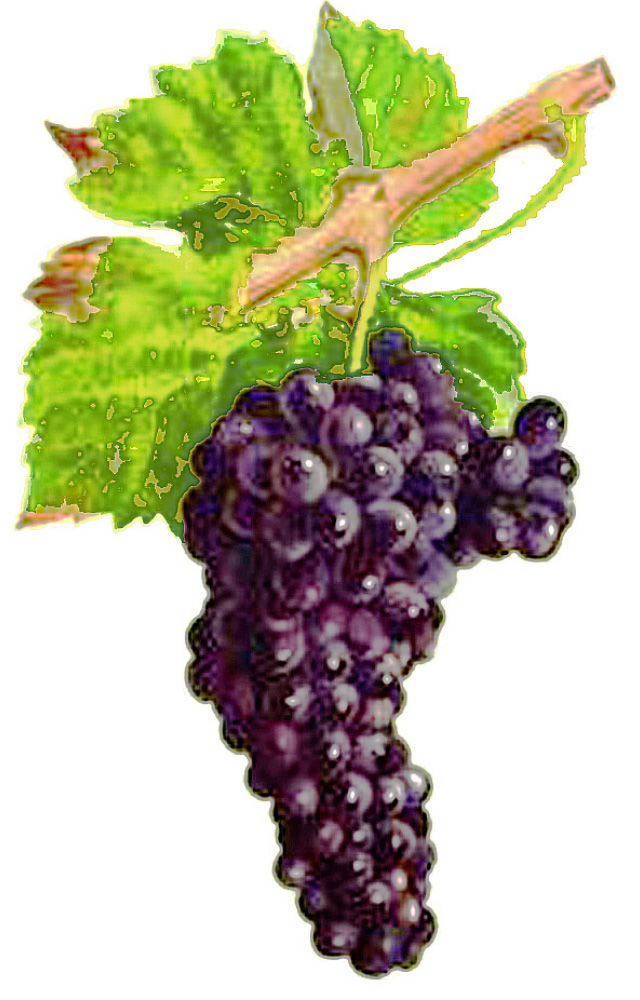
Mondeuse in Viala & Vermorel
Color of berry skinNoir
SpeciesVitis vinifera
Also calledsee list of synonyms
OriginFrance
Notable regionsSavoy
VIVC number7921

Mondeuse noire (French: [mɔ̃.døz nwaʁ]) is a red French wine grape variety that is grown primarily in the Savoy region of eastern France. The grape can also be found in Argentina, Australia, California, Switzerland and Sicily. Plantings of Mondeuse noire was hit hard during the phylloxera epidemic of the mid to late 19th century which nearly wiped out the vine from eastern France. While the grape recovered slightly in the 20th century, French plantations of Mondeuse noire fell sharply in the 1970s, with just over 200 hectares (490 acres) left in France in 2000. In the early 21st century, it seems the variety has increased somewhat in popularity, as it can give good wines if the planting site is chosen carefully.[1]

It was previously suggested that Mondeuse noire was identical to the northern Italian wine grape variety Refosco dal Peduncolo Rosso due to the similarity of the wines. In California, many plantings of Mondeuse noire were called Refosco, further adding to the confusion. DNA analysis has shown that this is not the case, and that the two varieties are unrelated.[1] Mondeuse noire is very similar to Muscardin which is found in Southern Rhône where it is one of the thirteen grape varieties permitted in the wine Châteauneuf-du-Pape. One difference is that Muscardin has less sensitivity to downy mildew.[2]

Ampelographers also thought that Mondeuse noire was a color mutation of Mondeuse blanche but DNA evidence has shown that not to be the case with the two varieties having a parent-offspring relationship though it is not yet clear which variety is the parent and which is the offspring. References to Mondeuse usually are to Mondeuse noire rather than to Mondeuse blanche. Mondeuse noire does have a pink-berried color mutant, Mondeuse grise, which was on the verge of extinction until ampelographer Pierre Galet was able to identify vines and have cuttings planted at the Domaine de Vassal conservation vineyard in Montpellier run by the Institut National de la Recherche Agronomique (INRA).[3]

In Savoie, Mondeuse noire is used in blending with Gamay, Pinot noir and Poulsard where it contributes its dark color and high acid levels to the wine that allow the wines to age well.[4] The grape is a permitted variety in the Appellation d'origine contrôlée (AOC) wines of Bugey in the Ain department and Vin de Savoie.[3]

History

[edit]
Mondeuse noire is one of the grape varieties speculated to have been the Allobrogica grape described by Pliny the Elder (pictured) and other ancient Roman writers.

There are several theories on the origin of the name Mondeuse. It could be derived from:

  1. the Franco-Provençal terms for pruning, émonder and monder, which could be a reference to the fact that Mondeuse noire vines begin shedding their leaves before the grapes are harvested; or
  2. the words moduse and moda, which have been historically applied to grape varieties that yield a high proportion of must; or
  3. the French term mal doux, which means "badly sweet" and may be a reference to the bitter flavors of Mondeuse noire berries when sampled off the vine. To this day, the synonym Maldoux is still associated with Mondeuse noire in wine regions such as Jura in eastern France.[3]

Most ampelographers believe that Mondeuse noire is indigenous to the Dauphiné region of southeastern France in an area that is now part of the Drôme, Hautes-Alpes and Isère departments. An early theory, popularized in 1887 by French ampelographer Pierre Tochon, is that Mondeuse noire could be the Ancient Roman grape Allobrogica described by Pliny the Elder and Columella as well as the 2nd century Greek writer Celsus. Ampelographers disagree about the identity of this grape, which grew widely in the land of the Allobroges after whom it is named for, with other theories speculating that the grape was instead the ancestor of Pinot noir or Syrah.[3][5][6][7]

The first mention of Mondeuse noire, under the synonym Maldoux, dates to a February 3, 1731 decree from the parliament of Besançon in the Doubs department of the Franche-Comté. This decree mandated that all plantings of several grape varieties, including Maldoux, Enfariné, Foirard noir, Foirard blanc, Valet noir and Barclan blanc, that were planted after 1702 had to be uprooted and replaced with cereal crops. Under the name Mondeuse noire, the grape was noted in records from 1845 growing in the valley of the Isère.[3]

Relationship to other grapes

[edit]

Mondeuse noire was once thought to be dark-berried color mutation of Mondeuse blanche, a variety that is best known for being the mother vine to the Rhône wine grape Syrah. However, in the early 21st century, DNA profiling showed that the two grapes actually had parent-offspring relationship though it is not yet known which grape is the parent and which is the offspring. This relationship makes Mondeuse noire, which is also known under the synonym Grosse Syrah, either a grandparent or half-sibling to Syrah.[3]

When Mondeuse noire was first introduced to California in the 19th century, some plantings of the vine were misidentified as the Italian wine grape Refosco dal Peduncolo Rosso. This confusion was exacerbated in the 1960s when cuttings of Mondeuse noire labeled as "Refosco" were taken by the University of California, Davis from a vineyard in Amador County that was established in 1880s and propagated. In 1990s ampelographers began suspecting that these cuttings were not Refosco but rather Mondeuse noire, a fact later confirmed by DNA profiling.[3]

Though the exact relationship has not yet been determined, DNA analysis has shown that Mondeuse noire has some connection to Douce noir (pictured) that is grown in Argentina (as Bonarda) and California (as Charbono).

In addition to the confusion with Refosco, some plantings of Mondeuse noire in the Russian River Valley were discovered to actually be an offspring of Mondeuse noire, Calzin. This crossing of Mondeuse noire and Zinfandel was created by UC-Davis viticulturist Harold Olmo in 1937 and later developed a white-berried color mutation known as Helena.[3] Also in the late 20th and early 21st century, it was discovered that some of the plantings of Petite Sirah were actually field blends of true Petite Sirah (Durif) as well as several other varieties including Mondeuse noire.[8]

Though the exact relationship is not yet known, DNA analysis has also shown that Mondeuse noire has some relationship to the Savoie wine grape Douce noir which is known as Charbono in California and Bonarda in Argentina.[3]

Mondeuse grise

[edit]

While Mondeuse noire and Mondeuse blanche are not color mutations of one or the other, DNA evidence has confirmed that, like Pinot gris and Pinot noir, Mondeuse grise was a pink-berried mutation of Mondeuse noire. First described by ampelographer Victor Pulliat in the late 19th century, the vine was thought to be extinct until plantings were identified by Pierre Galet in the 1950s. From these plantings, cuttings were taken and the vine was planted at the Domaine de Vassal conservation vineyard in Montpellier ran by the Institut National de la Recherche Agronomique (INRA).[3]

Today, outside of the plantings at the INRA's conservation vineyards, the only significant plantings of Mondeuse grise are being propagated as Persagne grise by Michel Grisard in Savoie.[3]

Viticulture

[edit]
Mondeuse growing in Arbin, Savoie.

Mondeuse noire is a mid-ripening grape variety that tends to thrive on stony vineyard soils that have a high limestone and clay content. The vine can be very vigorous and high yielding which requires the cordons to be pruned short during the winter to keep the vine in check. Among the viticultural hazards that Mondeuse noire is susceptible to include chlorosis, mites, downy and powdery mildew. The vine is also very sensitive to drought conditions which may require irrigation in the vineyard.[3]

In Savoie, Mondeuse noire plantings are most often trained in spur pruned systems.[9]

Wine regions

[edit]
A Mondeuse noire wine from 2007 when Bugey was a Vin Délimité de Qualité Supérieure (VDQS) classified wine.

In 2009, there were 300 hectares (741 acres) of Mondeuse noire planted in France the vast majority of it in the Savoie wine region and the departments of eastern France.[3] Here it is a permitted grape variety in the Appellation d'origine contrôlée (AOC) wines of Bugey in the Ain department and Vin de Savoie as well as the vin de pays wines of the region labeled under zonal designation of Vin de Pays d'Allobrogie. In Bugey, Mondeuse noire is permitted to be blended with Gamay and Pinot noir in the red and rosé wines of the AOC provided that the grapes are harvested to a yield no greater than 45 hectoliters/hectare (approximately 2.4 tonnes/acre) and the finished reaches at least 9% alcohol by volume. Bugey wines can also allow one of the villages in the region along the Rhone and Ain to hyphenate their names along to the AOC designation provided the harvest is restricted to no more than 40 hl/ha and the wine is made above the minimum alcohol level of 9.5%.[9][10]

The Vin de Savoie AOC covers 1,500 hectares (3,705 acres) northeast of Lyon towards to the Swiss border. Here Mondeuse noire is grown and permitted to be blended with Gamay and Pinot noir in the red and rosé wines of the AOC. Here yields are restricted to 60 hl/ha (approximately 3.2 tonnes/acre) for the basic AOC and 55 hl/ha for cru classified wine and minimum alcohol levels are 9.5% for basic AOC and 10% for cru classified. While rarely used, Mondeuse noire is also permitted in the sparkling Vin de Savoie Mousseux or semi-sparkling Vin de Savoie Pétillant wines of the region. Like Pinot noir, which is a red wine grape used in Champagne, Mondeuse noire destined for sparkling wine production would be pressed soon after harvest in order to avoid having the white grape juice tinted by the color phenolics in the skins that are usually leached out by the maceration process.[10][11]

In Switzerland, the grape is known as Gros Rouge and in the 19th century was the most widely planted red grape variety planted along the shores of Lake Geneva in what is now the Vaud, Valais and Geneva cantons. However, plantings of Mondeuse noire sharply declined throughout the 20th century and by 2009 there were only 4 hectares (10 acres) of the grape scattered throughout the Geneva and Vaud cantons.[3]

In the New World

[edit]
In some New World wine regions, such as Australia, Mondeuse noire is co-fermented/blended with Syrah/Shiraz (pictured).

Outside of Europe, Mondeuse noire can be found in New World wine region of Australia where producers such as Brown Brothers Milawa Vineyard grow the grape in Victoria. Among Brown Brothers 1.2 hectares (3 acres) of Mondeuse noire are 100 year plus old vines that date back to 1907. Here the variety is often co-fermented with Syrah and Cabernet Sauvignon.[3]

Mondeuse noire has been planted in California since at least the 1880s when it was described by Charles Krug as one of the varieties that "ambitious winemen" were planting along with Cabernet Sauvignon, Petite Sirah, Miller Burgundy (likely Pinot Meunier), Crabb Burgundy and Malbec.[5] Today, however, it is difficult to get an accurate count of Mondeuse noire plantings due to the longstanding confusion and mis-identification of plantings as being Refosco (and later confusion with Calzin). While the University of California, Davis officially corrected the error in 2005, the state of California was still counting Mondeuse noire and Refosco plantings as one and the same in their 2008 acreage reports. Some producers, such as Lagier-Meredith in Napa Valley, which is owned by UC-Davis geneticist Carole Meredith, have been able to independently confirm that their plantings of Mondeuse noire as authentic.[3]

In the United States, Mondeuse noire is used to produce wines in several American Viticultural Areas including the Van Duzer Corridor AVA of Oregon's Willamette Valley at Pamar Vineyard and Johann Vineyard. Central Coast, El Dorado, Santa Cruz Mountains and Santa Maria Valley AVAs in California as well as the Southern Oregon AVAs of the Rogue Valley and Umpqua Valley AVA.[8]

Styles

[edit]
Master of Wine Clive Coates notes that in the cool alpine vineyards of Savoie (pictured) that Mondeuse noire can sometimes have difficulties ripening which will influence the character of the resulting wine.

According to Master of Wine Jancis Robinson, Mondeuse noire tends to produce deeply colored and very aromatic wines that can be very tannic but often have good aging potential. Some examples will have "bitter cherry bite" that can be reminiscent of some Italian styles of wine. In California, the grape is often blended with other varieties such as Syrah and tends to produce dark and spicy wines.[3]

Wine expert Oz Clarke notes that one of the reasons why Mondeuse noire was often associated with the Friuli-Venezia Giulia wine grape Refosco dal Peduncolo Rosso was likely due to "Italianate intensity" of the wines produced from the grape with their bitter cherry notes and dark plum fruit.[12]

Master of Wine Clive Coates notes that Mondeuse noire sometimes has difficulties fully ripening in the cool alpine climates of Savoie and eastern France which can lead to some examples of the wine being very acidic, tart and lacking fruit.[9] However, wine expert Hugh Johnson believes that Mondeuse noire is often "underrated" and in Savoie has the potential to produce "forthright, fruity reds".[5]

Synonyms

[edit]

Over the years Mondeuse noire has been known under a variety of synonyms including: Angelique, Argillet, Argilliere, Begeain, Begean, Bon Savoyan, Chetouan, Cintuan, Cotillon Des Dames, Gascon, Grand Chetuan, Grand Picot, Grand Picou, Gros Chetuan, Gros Picot, Gros Piquot, Gros Plant, Gros Rouge (in the Vaud and Geneva cantons of Switzerland), Gros Rouge Du Pays, Grosse Sirah, Gueyne, Guyenne, La Dame, Languedoc, Largillet, Maldoux (in Jura), Mandouse, Mandoux, Mandouze, Mantouse, Margilien, Margillin, Marlanche noire, Marsanne noire, Marsanne Ronde, Marve, Maudos, Maudoux, Meximieux, Molette, Molette noire, Mondeuse Rouge, Morlanche Mouteuse, Parcense, Persagne (in the Ain department), Persaigne, Persance, Persanne, Petite Persaigne (in the Rhône department), Pinot Vache, Plant Maldoux (in Jura), Plant Maudos, Plant Medoc, Plant Modo, Plant Modol, Plant noir, Prossaigne, Refosco, Rodo (in Portugal), Rouget, Salanaise, Savoe, Savoete, Savouai, Savouette, Savoyan (in the Isère department), Savoyanche, Savoyange, Savoyanne, Savoyant, Savoyard, Savoyen, Savoyet, Syrah Grosse, Terran, Terrano, Tornarin, Tournarin, Tournerin and Vache.[3][13]

See also

[edit]

References

[edit]
Revisions and contributorsEdit on WikipediaRead on Wikipedia
from Grokipedia
Mondeuse noire is a red wine grape variety native to the region in eastern , where it has been cultivated for centuries to produce structured, aromatic red wines. Known for its vigorous growth and mid-ripening habit, the variety yields deep purple berries that create wines with high acidity, firm , and flavors evoking sour cherries, plums, , and pencil lead. DNA profiling has revealed it as a natural cross between Mondeuse blanche and Tressot noir, with a parent-offspring relationship to Mondeuse blanche and a genetic link to , explaining occasional historical references to it as "Grosse Syrah" in nearby regions. Primarily grown on the steep, stony, clay-rich slopes of appellations like Arbin, where it thrives despite susceptibility to , , mites, and , Mondeuse noire accounts for a small but significant portion of the region's plantings, often requiring robust for optimal yields. Beyond , it has been planted in Switzerland's canton, Argentina's high-altitude vineyards, California's Sonoma County and Central Coast, , , and even Sicily's Mount Etna, though global plantings remain limited at approximately 300 hectares (about 740 acres) as of 2023. In , Mondeuse noire is typically vinified as a , producing age-worthy reds that pair well with hearty alpine cuisine, though it occasionally blends with , [Pinot noir](/page/Pinot noir), or Poulsard for lighter styles. Historically, the grape faced confusion with Italy's Refosco dal Peduncolo Rosso, particularly in where it was misidentified until DNA analysis in 2005 by the Foundation Plant Services confirmed its distinct identity and corrected vine registries. This resolution has spurred renewed interest in its preservation and promotion as a unique expression of Savoie's terroir-driven .

Origins and History

Early Origins

Mondeuse noire is believed to have ancient roots in the region of southeastern , where it may trace its lineage to the viticultural practices of the Gallic tribe, who inhabited the area around the Rhône Valley and during the Roman era. This connection stems from historical speculation that the grape could be a descendant of the ancient Allobrogica variety, described by in his Naturalis Historia as a cold-hardy, late-ripening black grape adapted to the alpine foothills, though this link remains unverified by modern . The , known for their innovative winemaking that resisted harsher climates, likely contributed to the early of such varieties in the region, fostering Mondeuse noire's foundational presence before widespread Roman influence. The earliest documented reference to the appears in a decree issued on February 3, 1731, by the Parliament of in the region, where it was listed under the synonym "Maldoux" among regulated varieties to ensure quality in local . This mention, derived from ampelographic records, highlights Maldoux—possibly derived from "mal doux," alluding to the grape's astringent, less sweet berries—as an established dark-skinned in eastern by the early . By this period, the variety had gained recognition for its robustness in the mountainous terrains of and adjacent areas, though it was often conflated with other regional black grapes like Persan or even imported varieties due to limited morphological distinctions in early classifications. By the mid-18th century, evidence from viticultural surveys indicates Mondeuse noire's widespread cultivation across eastern , particularly in the Savoyard and Dauphinéan vineyards, where it formed a core part of blended assemblages for robust red wines. Its proliferation was aided by regional trade networks, facilitating initial spread to neighboring zones such as the and the Bugey foothills, where it adapted well to and soils. These early expansions underscore the grape's role in pre-industrial French , predating more systematic ampelographic studies. Recent genetic analyses have further illuminated its heritage, confirming Mondeuse noire as either a half-sibling or grandparent to , reinforcing its deep ties to southeastern French .

Historical Cultivation and Decline

Mondeuse noire was once a dominant red grape variety in the region of eastern , particularly in areas like Chignin, Arbin, and the department, where it covered significant portions of vineyards by the 18th and early 19th centuries. Historical records indicate that by 1793, plantings exceeded 1,700 hectares in alone, making it the most widespread red cépage and often commanding prices double those of white varieties like Jacquère due to its robust structure and suitability for the alpine terroirs. Cultivation thrived in the pre-industrial era, supported by the region's trade routes and the grape's adaptability to steep, schistous slopes, though it began facing challenges from emerging diseases in the mid-19th century. The late 19th-century phylloxera epidemic, arriving in between 1876 and 1893, devastated Mondeuse noire plantings, destroying approximately 80% of the region's vineyards and bringing the variety to the brink of extinction. Replanting efforts in the early involved onto American rootstocks to combat the pest, but Mondeuse noire's relatively low and susceptibility to phylloxera favored the introduction of higher-yielding alternatives like and Pinot Noir. By the mid-, surviving plots were limited to isolated, resistant sites such as Arbin's soils, and overall French acreage plummeted; peak plantings in and prior to the decline had been substantially reduced, with just over 200 hectares remaining by 2000 due to economic pressures and competition from more commercial varieties. The establishment of the Vin de Savoie AOC in 1973, followed by the Arbin cru designation in 1976, played a pivotal role in protecting and promoting local varieties like Mondeuse noire, encouraging focused plantings in traditional appellations. This institutional support, combined with growing interest in indigenous and alpine grapes during the , spurred a revival through boutique producers emphasizing terroir-driven wines; French plantings rebounded to around 300 hectares by 2009, stabilizing at approximately 250 hectares as of 2023, supported by trends toward sustainable, low-intervention in . As of 2023, plantings stand at around 250 hectares in , with growing adoption of sustainable practices contributing to its growth. Pioneers in regions like Arbin have highlighted the variety's potential for structured, peppery reds, contributing to its resurgence without overshadowing more productive hybrids.

Genetic Relationships

Parentage and Offspring

DNA profiling has established a parent-offspring relationship between Mondeuse noire and Mondeuse blanche, with Mondeuse blanche confirmed as a of Mondeuse noire rather than a simple color . Recent genetic analyses indicate that Mondeuse noire is a natural cross between Mondeuse blanche and Tressot noir. This positions Mondeuse noire as a half-sibling to , since Syrah results from the cross of Dureza (paternal ) and Mondeuse blanche (maternal ), sharing the same maternal lineage. Among its direct mutants, a pink-berried known as Mondeuse grise has been identified as a of Mondeuse noire, primarily used in the production of white wines through gentle pressing to separate the lightly colored juice from the skins. Despite historical synonymy with Refosco dal Peduncolo Rosso, DNA analysis has confirmed no genetic relation between the two varieties.

Distinctions from Similar Varieties

Mondeuse noire has often been confused with the Italian grape variety Refosco dal Peduncolo Rosso, particularly in historical plantings outside , but genetic analysis has confirmed they are distinct and unrelated varieties. In , early 20th-century vines of Mondeuse noire were mislabeled as Refosco dal Peduncolo Rosso, leading to widespread synonymy in American viticulture until in the early 2000s debunked the connection. This misidentification stemmed from superficial similarities in wine style and appearance, but Refosco dal Peduncolo Rosso originates from northeastern Italy's region and produces wines with higher acidity and more pronounced herbal notes, unlike the structured, peppery profile of Mondeuse noire. Although Mondeuse noire shares some ampelographic traits, such as compact clusters and medium-sized berries, with the southern variety Muscardin, the two are genetically unrelated, as established by DNA studies. Ampelographers once speculated a clonal relationship due to visual resemblances in leaf shape and bunch morphology, but analyses by experts like José Vouillamoz revealed no parent-offspring or sibling ties. Muscardin, permitted in blends, yields lighter, more floral wines with lower compared to the robust, age-worthy reds from Mondeuse noire. In the Jura region of eastern , Mondeuse noire was historically known as "Grosse Syrah" owing to its genetic proximity to —as a half-sibling sharing the maternal parent Mondeuse blanche—but the epithet "grosse" (large) highlights its distinction through larger berry size relative to Syrah's small, thick-skinned grapes. This naming arose from observed morphological differences, with Mondeuse noire producing small to medium berries that contribute to its higher yields and less concentrated , contrasting Syrah's intense, small-berried structure suited to warmer climates. The synonym persists in some Jura contexts but underscores the varieties' separate identities despite shared ancestry. Mondeuse noire is also distinct from Douce noire, another red grape from the region, despite the superficial similarity in naming that might suggest a close link; genetic studies indicate no direct parent-offspring relationship, though a broader within regional varietals exists. Douce noire, known as Charbono in , tends to produce softer, lower-acid wines with red fruit dominance, differing from Mondeuse noire's firmer structure and black fruit character. This separation ensures accurate varietal identification in Savoie blends, where confusion could alter wine profiles.

Viticulture

Growth Habits and Requirements

Mondeuse noire is a mid-ripening variety that produces medium-sized berries with thick skins, contributing to its deep color and tannic structure in wines. The vine displays good vigor, requiring short during winter to manage its naturally high-yielding tendency and maintain low production levels, typically around 30-40 hl/ha in quality-focused vineyards. This variety thrives in cool alpine climates, where it retains high acidity even as it ripens, and it performs best on well-drained limestone-clay soils, including screes and stony hillsides that prevent waterlogging. It is adapted to elevations up to 500 meters in regions like , where the combination of diurnal temperature variations and these soil types supports balanced maturation. Harvest typically occurs from late September to early October in its native area, allowing for optimal sugar accumulation and phenolic development while preserving the grape's characteristic acidity and color extraction potential. However, it shows some susceptibility to on iron-deficient s.

Pests, Diseases, and Challenges

Mondeuse noire exhibits high susceptibility to , particularly on iron-deficient s, which can lead to yellowing leaves and reduced vigor if not managed through soil amendments or selection. The variety is also sensitive to stress, requiring adequate in drier conditions to prevent yield losses and maintain quality. Additionally, it faces threats from pests like mites and fungal diseases including powdery mildew and , necessitating vigilant monitoring and targeted fungicide applications during humid periods. The historical phylloxera epidemic in the late 19th century devastated Mondeuse noire plantings in eastern , nearly eradicating the variety and necessitating onto resistant rootstocks for survival and replanting. In humid environments, the vine shows sensitivity to (grey rot), which can compromise bunch integrity and wine quality if airflow is poor. Productivity is often low to medium and variable across clones, with uneven ripening posing challenges that demand careful canopy management to improve sunlight exposure and green harvesting to balance crop load and promote uniform maturity. Climate change exacerbates these issues in alpine zones, where increasing heat and heatwaves potentially reduce acidity levels during ripening, altering the grape's characteristic freshness; studies highlight the need for adaptation strategies such as at higher elevations to sustain quality in regions like .

Wine Regions

France

Mondeuse noire finds its primary home in 's Savoie region, particularly within the Savoie AOC, where it dominates production alongside the neighboring Bugey AOC. Key growing areas include the crus of Arbin and in , which feature steep, south-facing slopes that capture sunlight and promote optimal ripening for this mid-ripening variety. In the , total plantings across are estimated at approximately 280 hectares as of 2025, similar to the around 300 hectares recorded in 2009, reflecting stable plantings amid growing interest in the grape's resurgence in its native . Under the Vin de Savoie appellation, Mondeuse noire is frequently vinified as a single varietal to showcase its alpine structure and spice, though it commonly blends with and to enhance color, acidity, and fruit balance in the region's lighter reds. Prominent producers like Domaine Louis Magnin in Arbin highlight the variety's potential, cultivating over 4 hectares of Mondeuse noire on high-altitude sites up to 400 meters, where cool evenings preserve the wine's vibrant freshness and minerality. Plantings have seen gradual increases in recent years, fueled by growing demand for terroir-expressive reds from Savoie's diverse soils and microclimates, as part of an alpine wine revival emphasizing sustainable, low-intervention practices. While Mondeuse noire adapts well to Savoie's limestone-dominated soils, it can face viticultural challenges such as in iron-deficient conditions, necessitating vigilant .

Switzerland and Europe

In , Mondeuse noire is primarily known as Gros Rouge and is cultivated on a small scale, with a few hectares planted mainly in the cantons of and . These plantings represent a modest revival of a variety that was once more widespread in the region before the crisis. Outside the alpine zones, cultivation remains limited in other parts of due to the grape's adaptation to cool, continental climates and its susceptibility to drought and in warmer or drier conditions. Experimental plantings exist in , including approximately 2 hectares on Sicily's Mount Etna at the Cottanera estate, where it was introduced serendipitously in the late 1990s and is vinified as a single-variety IGT Sicilia wine rather than in blends. There is growing interest in sustainable farming practices to support such peripheral adaptations amid broader European viticultural challenges. The variety's recognition under French (PDO) schemes, such as Vin de Savoie, has supported its cross-border propagation to neighboring non-EU countries like by standardizing propagation material and encouraging heritage variety preservation.

New World

Mondeuse noire has seen limited but growing adoption in the , primarily through experimental plantings that highlight its potential as a heritage variety suited to diverse climates outside its European origins. Introduced as part of early 20th-century viticultural efforts, the grape remains rare, with total plantings across regions amounting to just a few dozen hectares, often in blends or small-scale varietal productions rather than large commercial operations. In , Mondeuse noire was brought to north-eastern Victoria in the early 1900s by viticulturist Francois de Castella, with significant plantings established by Brown Brothers in the 1920s following recovery. Brown Brothers maintains some of the oldest vines, dating back nearly a century, and uses the grape in notable blends like Shiraz-Mondeuse-Cabernet, first produced in 1954, as well as occasional expressions. Plantings remain tiny, concentrated in central and north-eastern Victoria, supporting at least five producers who value its adaptability in the region's variable conditions. Experimental sites in cooler areas, such as , have emerged to test its performance in maritime climates akin to parts of . The features some of the earliest plantings of Mondeuse noire, with selections in collections dating to the 1880s, including at UC Davis, where the variety was long misidentified as until confirmed its distinct identity. In , it appears in historic field blends alongside and other varieties in old-vine sites like those from the early . Oregon's [Willamette Valley](/page/Willamette Valley) has seen renewed interest, with small commercial plantings at vineyards such as Björnson in the Van Duzer Corridor AVA and , producing varietal wines and blends that emphasize the grape's structure in cooler, windy sites. Overall U.S. acreage is minimal, totaling around 10 hectares in the , focused on blends and research rather than monoculture. In , Mondeuse noire maintains minor presence in high-altitude zones of Mendoza, where elevations and diurnal shifts mirror Savoie's alpine terroirs, supporting experimental cultivation. Recent developments in the have spurred increased trials of Mondeuse noire as part of broader heritage variety initiatives in the , particularly in drought-prone areas where its tolerance and vigor offer potential resilience amid climate shifts. Producers and institutions, including UC Davis extensions, are evaluating it for sustainable , with small expansions in and underscoring its role in diversifying portfolios against environmental pressures.

Wine Styles

Traditional Production

Traditional winemaking for Mondeuse noire in its native region emphasizes minimal intervention to highlight the grape's inherent structure and acidity. Grapes are typically harvested by hand and undergo whole-cluster for lighter, more aromatic styles, allowing for gentle extraction of color and , while destemming is employed for fuller-bodied wines to intensify fruit and structure. Maceration periods generally last 10 to 21 days in or vats, promoting balanced development without excessive influence. Some producers in incorporate , particularly for fresher expressions reminiscent of , where whole clusters ferment intracellularly before pressing. Following alcoholic and , wines are aged for 6 to 12 months in neutral oak barrels or vessels to preserve primary fruit character while allowing subtle integration of the grape's spicy notes. Blending is common in AOC regulations, where Mondeuse noire is often combined with or to enhance color, acidity, and complexity in red and wines, with permitted additions up to 10% of other varieties like Persan or . production from Mondeuse noire is rare and typically achieved via the saignée method, bleeding off juice early in the red process for a structured, pale pink wine. To ensure quality, AOC Vin de limits yields to 69 hl/ha in key crus like Arbin and Saint-Jean-de-La-Porte, though general appellation maximums reach 72 hl/ha, encouraging concentrated flavors from the grape's small, thick-skinned berries.

Sensory Profile and Modern Styles

Mondeuse noire wines typically exhibit a color, reflecting the grape's ability to produce intensely pigmented reds. The aroma profile is complex and aromatic, often featuring notes of sour cherry, , violet, , and , with additional hints of dark berries and spice in well-balanced examples. On the , these wines deliver vibrant flavors of , black cherry, , , and , underpinned by a distinctive peppery spice and earthy minerality. They are characterized by high acidity and firm, grippy that contribute to a structured, full-bodied , though underripe versions can appear rustic and tart with a bitter cherry edge. Traditional styles from emphasize the grape's alpine heritage, yielding balanced reds that showcase spice, floral lift, and mineral depth when harvested at optimal ripeness, often with an alcohol content of 12-13% ABV. These wines possess strong aging potential of 5-10 years or more, during which the tannins soften and secondary notes of and emerge, enhancing complexity. In contrast, modern interpretations, particularly in and emerging plantings, favor lighter, more fruit-forward expressions achieved through earlier harvesting, resulting in brighter acidity, reduced tannin grip, and prominent red fruit aromas. New World examples, such as those from , further adapt the variety into approachable styles that highlight black fruit, plum, and flavors with softer and juicy vibrancy, often blending the grape's inherent spice with a savory, food-friendly profile at around 13.5% ABV. These contemporary wines maintain the grape's racy acidity for aging but emphasize immediate drinkability. Mondeuse noire pairs well with game meats, , roasted dishes, and earthy fare like mushrooms or root vegetables, where its acidity and cut through richness.

Nomenclature

Primary Names

Mondeuse noire is the primary name for this variety in , where it is prominently cultivated in the Savoie region. The term "noire" denotes "black," referring to the pigmentation of the . This name is officially recognized in the Vitis International Variety Catalogue (VIVC) with variety number 7921. Historically, the grape was known under older regional names such as Maldoux in the Jura, reflecting its widespread use before the epidemic devastated French vineyards in the late . Post-phylloxera replanting efforts led to greater standardization of , establishing Mondeuse noire as the accepted prime name to distinguish it from related varieties. On the international level, Mondeuse noire is approved for use in (PDO) wines within the , as listed in the EU variety catalogue since 2010. The variety has accumulated over 80 synonyms across regions, though these are detailed separately.

Synonyms and Regional Variants

Mondeuse noire has accumulated a vast array of synonyms over centuries, reflecting its ancient origins and widespread dissemination across French and neighboring regions, with the Vitis International Variety Catalogue (VIVC) documenting more than 100 such names. These aliases, including Angelique, Argillet, Begeain, Bon Savoyan, and Chetouan, underscore the grape's historical prevalence in eastern before phylloxera devastation reduced plantings. The sheer volume of synonyms—estimated at around 80 by some ampelographic surveys—highlights its adaptability and the linguistic diversity of viticultural traditions in the . Among the most notable regional synonyms is Grosse Syrah, used in the Jura region, which arose from perceived similarities to and later confirmed genetic ties, positioning Mondeuse noire as either a grandparent or half-sibling to the renowned variety. In Switzerland, particularly along , it is commonly called Gros Rouge, where it was once the dominant red grape in the before declining due to competition from other varieties. Historically in , Gamay de Savoie served as a for certain plantings, leading to confusion with the true until ampelographic distinctions were made. An ancient name, Maldoux, dates back to at least 1731 in early viticultural records from the and areas, evoking its "mal doux" (poorly sweet) ripening characteristics in cooler climates. In , late 19th-century introductions (at least since the 1880s) were erroneously labeled as , a Friuli native, resulting in misidentified vines that persisted until DNA profiling by the Foundation Plant Services clarified the true identity as Mondeuse noire in 2005. Regional variants further complicate nomenclature; "Mondeuse" is often used standalone in Savoie contexts to denote the black-berried form, while color mutations like Mondeuse grise—a pink-skinned derivative—receive separate but genetically linked designations, with the latter now rare and preserved in conservation collections. These synonyms facilitated the grape's propagation across borders, enabling its survival through trade and blending practices, but they also engendered significant identity crises, such as the Refosco mix-up, which DNA-based ampelography has progressively resolved since the late 20th century. This clarification has been crucial for accurate propagation material and varietal authentication in modern viticulture.

References

Add your contribution
Related Hubs
User Avatar
No comments yet.